STUTTGART HIGH SCHOOL - 2018-19 COURSE CATALOG - DODEA
←
→
Page content transcription
If your browser does not render page correctly, please read the page content below
Stuttgart High School
2018-19 Course Catalog
Special thanks to Ms. Shana Blakenship
and the entire Zeitgeist Yearbook Staff for
the generous contribution of photographs
in the publication.

COVER PHOTO CREDIT: Hyla Malloy Photography.

                                              1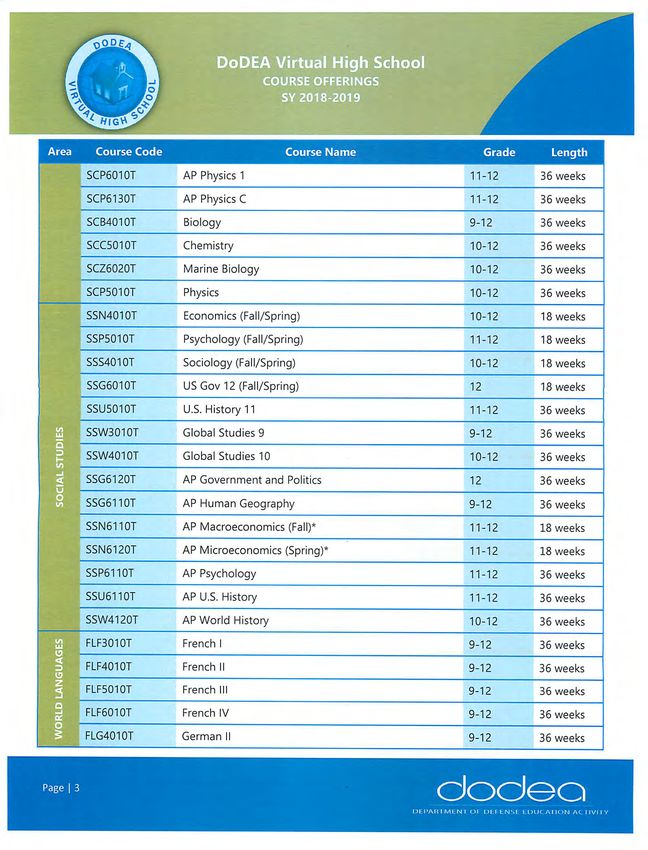
Stuttgart
                       High School
                       Unit 30401

                                                                           Table of
                       APO AE 09107-0401
                   DSN 431-4000
            Civilian 07031-15-4000                                         Contents
calling from the   USA 011-49-7031-15-4000
                                                                      Program of
                                                               page 3 Study

                         Administration                               Preparing for
          Principal Rick Renninger                             page 4 ACT and SAT

         Assistant
                                                             page 5-6 Language Arts
         Principal Tessa Moss-Beaman
         Assistant                                           page 7-8 Mathematics
         Principal Dr. Heather Ramaglia

                                                            page 9-11 Science

                          Guidance                         page 12-13 Social Studies
                          Counselors
         Freshman Monika Juergens                          page 14-16 Fine Arts
                          ext. 431-5591
                          Monika.Juergens@eu.dodea.edu
                                                                      World
     Sophomores                                            page 17-19 Language
Juniors and Seniors
             last name                                                Physical
                    A-G MeSharn Joseph                        page 20 Education
                          ext. 431-5594
                          MeSharn.Joseph@eu.dodea.edu
                                                           page 21-22 Electives
              last name
                    H-O Amy Matney
                          ext. 431-5590                               Career and
                          Amy.Matney@eu.dodea.edu          page 23-31 Technical (CTE)

              last name                                    page 23-28 Pathways
                    P-Z Lisa Gingles                           page   24   Business Management
                          ext. 431-5593                        page   25   Culinary Arts
                          Lisa.Gingles@eu.dodea.edu
                                                               page   26   Digital Design & Communications
                                                               page   27   National Security
                                                               page   28   Video Communications
          Secretary Melissa Wertz                              page 29     Programming Courses
                          ext. 431-5592                        page 29     Career Practicum
                          Melissa.Wertz@eu.dodea.edu        page 30-31     Engineering & Tech
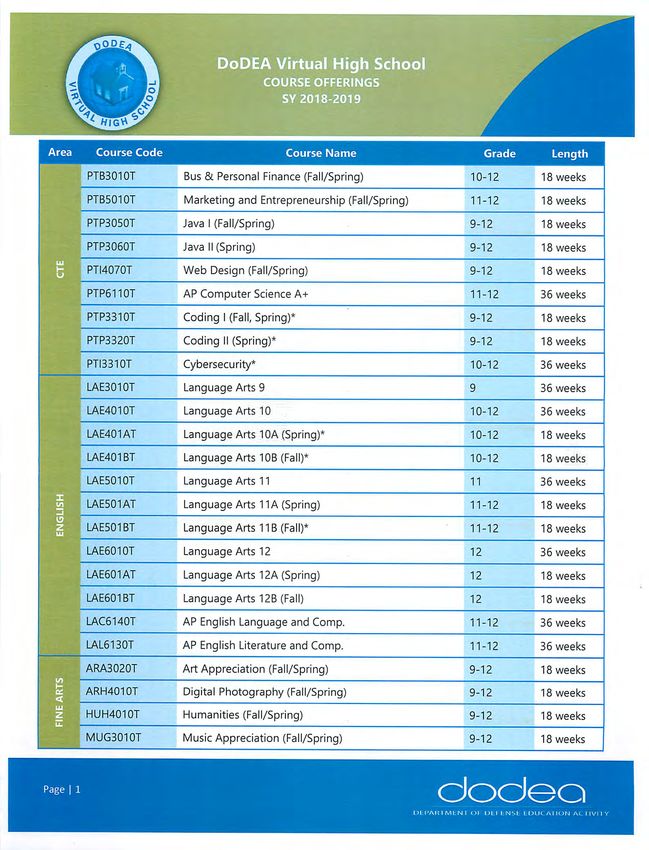
                                                               page 31     Virtual School CTE
           Registrar Ilka Matzke                           page 32-35 DoDEA Virtual Courses
                          ext. 431-5583
                          Ilka.Matzke@eu.dodea.edu            page 36 Clubs and Sports

                                                       2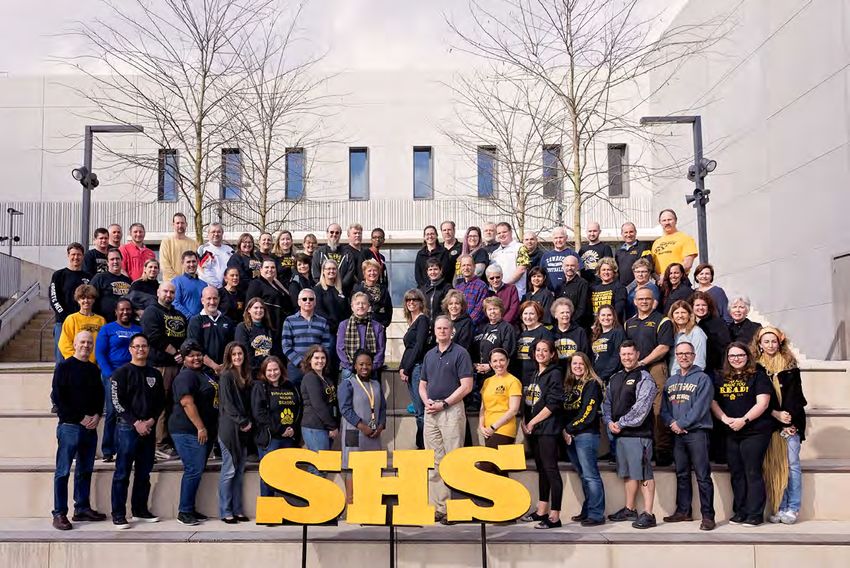
PROGRAM OF STUDY
Our school’s program of studies has been prepared for students, parents, teachers, and guid-
ance counselors. Students will receive individual advisement from guidance counselors to help
them make appropriate course selections. Each student’s teachers should also serve as resources
for advice and help in making course selections. Students should take seriously the selection of
courses for the next school year and choose a course of study based on their individual goals and
abilities.
Many universities are highly selective in their admissions. Students are encouraged to select a
rigorous course of study and enroll in higher level courses as much as possible. A rigorous senior
year of study is an expectation of many colleges as well as employers. Seniors are encouraged to
select challenging courses and consider Advanced Placement, AP, options.
AP courses are weighted in the calculation of the cumulative Grade Point Average (GPA) carry-
ing one extra point. Cumulative GPA refers to the overall GPA, which includes dividing the number
of quality points earned in all courses attempted by the total credit hours in all attempted courses.
The DoDEA Honors Diploma is available to seniors who have a cumulative GPA at or above 3.8 and
have taken four or more AP courses. Class of 2019 and beyond: 0.5 credit Economic Literacy in
CTE, Social Studies, Science, or Math. The Class of 2019 and beyond must complete four math
credits including Algebra II.
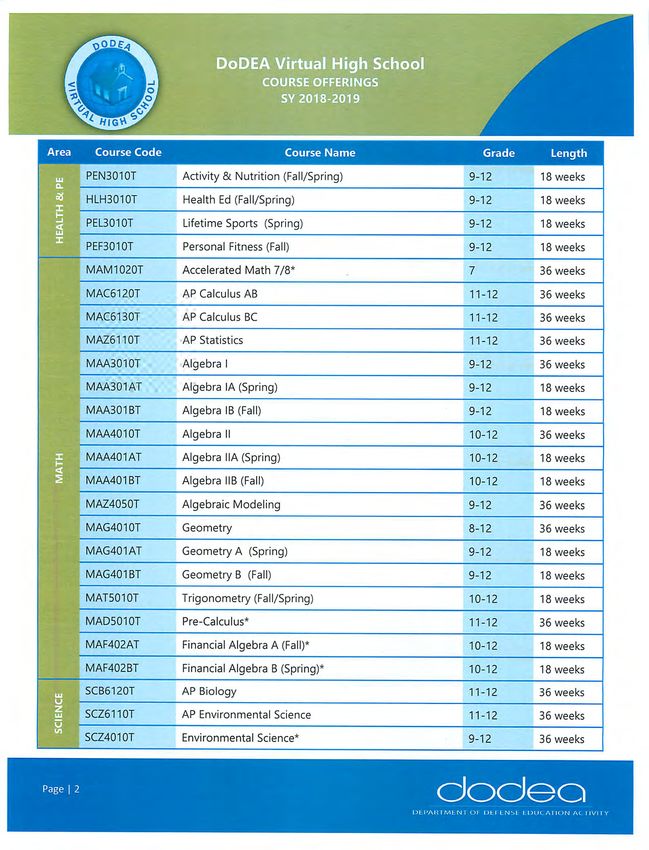
DoDEA offers online Summer School as a means for students to recover credit from failed
courses in order to meet graduation requirements, as well as a few courses for original credit.
Additionally, several courses are available during the school year through DoDEA Virtual School for
transfer students who need to complete a course not offered locally. Some well-disciplined students
may want to enroll in Virtual School as a means of taking courses not available on campus. Please
speak with your guidance counselor to learn more.
For detailed curriculum visit https://www.dodea.edu/curriculum/
DoDEA Graduation Requirements
Class of 2019
Subject Area Required Subject Area Required
Career and Technical Education
Language Arts 9, 10, 11, 12 4 2
0.5 must be Computer Technology
Social Studies—U.S. History 1 Mathematics
World History 1 Algebra I 1
U.S. Government .5 Geometry 1
Social Studies Elective .5 Algebra II 1
Elective with course code 400 or 1
higher
Science—Biology 1
World Language
2 Physics or Chemistry 1
2 credits in the same world language
Science Elective 1
Physical Education 1 Fine Arts
PE & Nutrition .5 Visual Arts, Music, Theater, Drama, 1
Health Education .5 Humanities
Elective Courses 5 Total Minimum Credits 26
2.0 Cumlative Grade Point Average (GPA) Requirement—Seniors must have earned a cumulative
grade point average of 2.0 or higher to receive a high school diploma from a DoDEA high school.
Honors Diploma Requirements—4 AP Courses, 3.8 cumulative GPA, as well as the requirements for
the regular DoDEA diploma. Class of 2019 and beyond: 0.5 credit Economic Literacy in CTE, Social Stud-
ies, Science, or Math.
3
Preparing for the ACT/SAT

  ACT   The ACT (American College Test) is an entrance test that measures what has been learned in
        high school. The test consists of four sections composed of English, mathematics, reading, and
        science. Like the SAT, the ACT also includes an essay section. Both SAT and ACT have an essay
        option. Students should check with their prospective colleges to see if they need to complete
        the essay. Rather than a total score, the ACT gives a composite or average score for the test.
        Register at www.actstudent.org . Students will create a personal account and then use these
        codes:

            Stuttgart High School Code: 576325
            ACT Test Center Code: 866390

  SAT   The SAT tests skills that you are learning in high school—skills you’re likely to need in college and
        beyond. The evidence-based reading and writing section of the SAT will ask you to analyze, syn-
        thesize, and interpret data from a wide range of sources. You will be tested on words that appear
        frequently in high-school-level and college-level texts. The Math Test focuses in depth on three
        essential areas of math: Problem Solving and Data Analysis, Heart of Algebra, and Passport to
        Advanced Math. Throughout the SAT you will be asked questions grounded in the real world, di-
        rectly related to work performed in college and career. The optional essay will ask you to analyze
        how an author uses evidence, reasoning, and other stylistic evidence to craft a persuasive argu-
        ment. The SAT is three hours long and the optional Essay is an additional 50 minutes. The SAT
        is scored on a 400 to 1600 scale. You will also receive sub-score reporting for every test (math,
        reading, and writing and language) plus additional sub-scores to provide added insight into your
        test performance. If the student waits until the senior year, it is strongly recommended that the
        test be taken when it is first given in October. Register at www.collegeboard.com Students
        will create a personal account with College Board and will need the following codes to register:
             Stuttgart High School Code: 576325
             SAT Test Center Code: 57633

 PSAT   The PSAT (Preliminary Scholastic Aptitude Test/National Merit Scholarship Qualifying Test) has
        two primary purposes. It introduces a student to the organization and types of questions found
        on the SAT and helps students to predict their scores on the SAT. The junior year PSAT scores are
        used in awarding the National Merit Scholarship awards. The PSAT is given on a Wednesday in
        October.

NCAA
        The National Collegiate Athletic Association (NCAA) serves as the athletics governing body for
        more than 1200 colleges, universities, conferences, and organizations. The NCAA Eligibility
        Center certifies the academic and amateur credentials for all college-bound student-athletes
        who wish to compete in Division I or Division II athletics. Questions regarding NCAA eligibility
        should be directed to the Athletic Director or a school counselor. For information pertaining to the
        NCAA, click here http://eligibilitycenter.org. Students are responsible for ensuring NCAA eligibili-
        ty and should go to the above website to obtain a copy of the NCAA Guide for the College-Bound
        Athlete. Transcripts must be requested through the Guidance Department. Use of Parchment, a
        secure digital transcript delivery service, with tranking system, is highly recommended.

                                                  4
Language Arts
      Language Arts 9
      LAE301      Language Arts 9 focuses on comprehension skills that students need to com-
      Year-long      prehend texts at a College and Career Ready level for 9th grade (1080-1335
      9th            Lexile level). This course provides a study of complex texts including fiction,
                     nonfiction, drama, and poetry, as well as writing tasks to include essays, and
                     critical and creative responses to text. Students will develop their grammar,
                     mechanics and usage skills in writing as they engage in research, creative
                     projects, and presentations. Students will also be required to do some reading
                     and writing outside of class, as well as in the classroom.

      Honors World Literature 9
      LAE371     Honors World Literature 9 is designed for the student who is capable of com-
      Year-long      prehending texts of significant depth and breadth of content at or above the
      9th            College and Career Ready level for 9th grade (1080-1335 Lexile level), and
                     is recommended for students who independently read above a 1200 Lexile
                     level. This course provides an in-depth study of complex texts including fic-
                     tion, nonfiction, drama, and poetry, but also requires advanced performance
                     on consistently challenging writing tasks. Writing will include reports, essays,
                     and critical and creative responses to text. Students will engage in research,
                     creative projects and group presentations. Students will also be required to do
                     extensive reading and writing outside of class as well as in the classroom.
      Language Arts 10
      LAE401     During the high school years, reading, writing, and speaking overlap as stu-
      Year-long      dents deepen their study of language and literature and gain skills that help
      10th           them in other subjects, such as science and history.

      Honors World Literature 10
      LAE471     This class integrates readings and writings that focus on exploring, inter-
      Year-long      preting, and analyzing literature that extend and support the world history
      10th           discussions and research. The course is a demanding chronological study of
                     world literature from 1500 to the present and covers the themes of culture,
                     science and technology, economics, and government.

      Language Arts 11
      LAE501     Students will experience, interpret, and evaluate fiction, non-fiction, and po-
      Year-long      etry relating to the American experience from colonization to modern times.
      11th           Readings will be challenging, complex, and rich; collegial discussions among
                     the students will deepen their understanding of the use, structure, and im-
                     pact of language embodied in a work. Wide reading will provide students the
                     opportunity to explore and appreciate trends in linguistic styles across time.
                     Students will write in informal and formal contexts to become proficient in
                     their writing. A major focus will be placed on the skills required to write a
                     research paper in MLA format.

      AP English Language
      LAC614       The AP English Language and Composition course is designed to help stu-
      Year-long      dents become skilled readers of prose written in a variety of rhetorical
      11th -12th     contexts and to become skilled writers who compose a variety of purpos-
                     es. Both their writing and their reading should make students aware of the
                     interactions among a writer’s purposes, audience expectations, and sub-
                     jects as well as the way generic conventions and the resources of language
                     contribute to effectiveness in writing. Selected reading material is designed
                     to enable students to read complex texts with understanding and to write
                     prose of sufficient richness and complexity to communicate effectively with
                     mature readers. Writing and reading assignments will help students move
                     beyond such programmatic responses.

                                         5
Language Arts 12
LAE601     The Language Arts 12 curriculum is primarily centered on British literature.
Year-long      This course explores various pieces of literature from Great Britain’s canon
12th           of masterpieces. Among the masterpieces and masters studied are: Beow-
               ulf, Chaucer, Shakespeare, and the Titans of British poetry, such as Word-
               sworth and Tennyson. Students will experience, interpret, and relate the
               selected literary works in a variety of oral, written, and project-based activ-
               ities based on student needs. The exploration of these areas will enlighten
               students as well as foster understanding and empathy for the human con-
               dition. Students will find enjoyment in expressing their feelings and relating
               their own life experiences to the literature.

AP English Literature and Composition
LAC613       Students will engage in the careful reading of literary works. Through such
Year-long      study, you will sharpen your awareness of language and your understanding
11th -12th     of the writer’s craft. You will develop critical standards for the independent
               appreciation of any literary work, and increase your sensitivity to litera-
               ture as shared experience. To achieve these goals, you study the individual
               work, its language, characters, action, and theme. You consider its struc-
               ture, meaning, and value, and its relationship to contemporary experience
               as well as to the context in which it was written. AP students in English Lit
               and Comp are involved in the study and practice of writing as well as in the
               study of literature.

                                 6
Mathematics

     Algebra I
     MAA301           The purpose of this course is to allow the student to gain mastery in working
     Year-long        with and evaluating mathematical expressions, equations, graphs, and other
     9-12             topics in a year-long algebra course. Topics included are real numbers, simplify-
                      ing real number expressions with and without variables, solving linear equations
                      and inequalities, graphing linear equations, monomial operations, linear pat-
                      terns, sequences, and radicals. Assessments within the course include multi-
                      ple-choice, short-answer, or extended response questions.
     Geometry
     MAG401           This course appeals to a number of students because of the emphasis on visu-
     Year-long        al mathematical figures and relationships. Triangles, circles, and many other
     9-12             geometric figures are explored in this course. Fundamental algebraic skills are
                      important as students work with various mathematical relationships within these
                      figures such as area, volume, lengths of segments and measurement of angles.
                      Geometric proofs are foundational to this course as students verify theorems and
                      other geometric relationships through a logical reasoning process.

      Algebraic Modeling
      MAZ405       Algebraic Modeling is a course designed to help students understand the connec-
      Year-long    tion and need of mathematics in everyday life. It is basically a course in applied
      9-12         Algebra as it relates to real world situations. Students will expand on Algebra I
                      skills in the application of equations and linear, quadratic, and exponential func-
                      tions. Concepts and solutions are presented in easy to understand language with
                      numerous ways to illustrate ideas. Students will become proficient in the use of
                      graphing calculators for displaying historical data that is used to predict future
                      trends and predictions.

     Algebra II
     MAA401           In this course students will use their prior knowledge from previous courses to
     Year-long        learn and apply Algebra II skills. This course will include topics such as func-
     9-12             tions, radical functions, rational functions, exponential and logarithmic functions,
                      trigonometry, geometry, conic sections, systems of equations, probability, and
                      statistics. Students will apply the skills that they learn in this course to real
                      world situations.

     Advanced Quantitative Reasoning
     MAZ507      This course is beyond the Algebra II level which prepares the student for col-
     Year-long   lege mathematics. Advanced Functions provides students an in-depth study of
     10-12       modeling and applying functions. Home, work, recreation, consumer issues,
                      public policy, and scientific investigations are just a few of the areas from which
                      applications should originate. Appropriate technology, from manipulatives to
                      calculators and application software, should be used regularly for instruction and
                      assessment.

     Discrete Math A and Discrete Math B
     MAZ501A      Discrete math is designed to make real world math more meaningful. By em-
     semester         phasizing reasoning, problem-solving, and connections among various topics
     11-12            such as voting, population distribution, fairness, probability, and code breaking,
     MAZ501B          the course invites students to learn about their own lives and how they interact
                      with the world around them. Discrete Math A looks at voting, fair division, and
     semester
                      graph theory. Discrete Math B looks at Graph Theory, Scheduling, and Cryptol-
     11-12
                      ogy. Both courses are non-sequential with each chapter a stand-alone topic and
                      ideally designed for post Algebra II students. The topics show how simple math-
                      ematical concepts intertwine constantly in the real world and that solutions are
                      not always based on complex equations but more often simple formulas based
                      on the correct details.

                                           7
AP Calculus AB Honor’s Diploma
MAC612       AP Calculus AB provides an understanding of the fundamental concepts and
Prerequisites:   methods of differential and integral calculus with an emphasis on their appli-
Alg I & 2        cation, and the use of multiple representations incorporating graphic, numeric,
Geometry         analytic, algebraic, and verbal and written responses. Topics of study include:
Pre-Calculus     functions, limits, derivatives, and the interpretation and application of integrals.
                 An in-depth study of functions occurs in the course. Technology is an integral
Year-long        part of the course and includes the use of graphing calculators, computers, and
10-12th          data analysis software. On a regular basis, graphing calculators are used to ex-
                 plore, discover, and reinforce concepts of calculus.

Pre-Calculus
MAD501       This course has been designed to introduce ever more difficult and complex
Year-long        math to students. Upon completion, students will have the necessary skills
11-12th          to tackle Calculus-level courses. During this course, students will be tasked
                 to know basic linear functions to complex rational and logarithmic functions
                 inside-out, create and compute functions given function characteristics, develop
                 a solid understanding of basic and advanced trigonometric concepts, and dive
                 into real-world word problem applications. This course is designed to prepare
                 students for college level math. Pre-Calculus can be a significant jump for the
                 average student who teetered between a B and C average in Algebra II. A solid
                 fundamental grasp of Algebra and Algebra II are required to understand the
                 greater complexities of (Pre)-Calculus based math. Parents, you may find you
                 are no longer able to help your children with their homework.

AP Calculus BC Virtual School
MAC613OT AP Calculus AB provides an understanding of the fundamental concepts and
Prerequisites:   methods of differential and integral calculus with an emphasis on their appli-
Alg I & 2        cation, and the use of multiple representations incorporating graphic, nu-
Geometry         meric, analytic, algebraic, and verbal and written responses. Topics of study
Pre-Calculus     include: functions, limits, derivatives, and the interpretation and application
Year-long        of integrals. An in-depth study of functions occurs in the course. Technology
11-12th          is an integral part of the course and includes the use of graphing calculators,
                 computers, and data analysis software. On a regular basis, graphing calcu-
                 lators are used to explore, discover, and reinforce concepts of calculus. This
                 class may be offered online (MAC613OT).

AP Statistics Honor’s Diploma
MAZ611        AP Statistics is the science of data. And, the data are numbers with a vast
Year-long        context. The context of the data becomes the intense focus of study and
11-12th          understanding. Major themes in the course: 1) Collecting Data—Surveys,
                 Studies, and Experiments, 2) Describing Data—Graphical and Numerical Anal-
                 ysis, 3) Probability—The Study of Chance Behavior, and 4) Inference—making
                 conclusions about data. The course is augmented by the use of data labs &
                 statistical computer based analytics.

Trigonometry Virtual School
MAT501OT AP Statistics is the science of data. And, the data are numbers with a vast
Year-long        context. The context of the data becomes the intense focus of study and
10-12th          understanding. Major themes in the course: 1) Collecting Data—Surveys,
                 Studies, and Experiments, 2) Describing Data—Graphical and Numerical Anal-
                 ysis, 3) Probability—The Study of Chance Behavior, and 4) Inference—making
                 conclusions about data. The course is augmented by the use of data labs &
                 statistical computer based analytics.

Financial Algebra A or B
MAZ502OT Use this space for class description, however I don’t see this listed online for
Year-long        the 2017-18 course list
10-12th

                                    8
Science

      Physics Applications
      SCP302      This is a semester intro to physics and chemistry. In physics, topics are the laws
      Year-long       of motion, levers and light. For chemistry, students investigate the periodic ta-
      9-12            ble, mixtures, solutions, and fusion vs. fission. Labs are conducted at opportune
                      times to emphasize the physical and chemical relationships in our world. Tech-
                      nology is heavily employed to teach students the power of computers in science
                      investigations.

      Earth and Space Science
      SCZ302      Do you have a special interest and high motivation for an in-depth study of
      Year-long       earth or space science? This course will help students understand the world
      9-12            around them and increase their ability to eval-uate that world. Topics include
                      geology, astronomy, meteorology, oceanography, and ecology.

      Biology
      SCB401          Biology teaches students the basic elements that constitute life, science and
      Year-long       biological principles, lab techniques, and the scientific process. Topics will be the
      9-12            nature of science, ecology, biochemistry, cells, reproduction, DNA, genetics, evo-
                      lution/natural selection, diversity and classification. The concepts and topics are
                      presented through labs, hands-on activities, projects, lecture, and reading. This
                      course serves as the foundation for higher-level science courses and should give
                      students the science skills necessary for Life Science-related technical careers.

      AP Biology
      SCB612          AP Biology provides an understanding of the unifying themes and fundamental
      Prerequisites   concepts and principles of biology with an emphasis on inquiry and critical think-
      Biology and     ing skills including: problem solving, mathematical reasoning, and experimental
      Chemistry       investigations. Topics include: molecules and cells, heredity and evolution, and
      Year-long       organisms and populations. The key concepts and related content that define
      11-12           the revised AP Biology course and exam are organized around a few underlying
                      principles called the big ideas, which encompass the core scientific principles,
                      theories, and processes governing living organisms and biological systems.

      Biotechnology Engineering
      CTE503      This course is an introductory course providing an overview of the following bio-
      Year-long       technology domains: Safety and Skills, History of Biotechnology, DNA Technology,
      9-12            Forensic and Medical Biotechnology, Agricultural Biotechnology, Industrial Biotech-
                      nology, and Bioinformatics. The course uses differentiated problem based learn-
                      ing in combination with a hands-on laboratory approach and/or virtual learning
                      resources. Its foundation is built upon learning the tools of scientific investigation
                      and their application to design and problem solving in all scientific and engineering
                      genres, as well as identifying the pervasive role that Biotechnology Engineering
                      has in society. Whenever possible, students will gain exposure to professionals
                      currently in the field through study trips and guest speaking. Activities involving
                      collection, organization and analysis of data supported by mathematical applica-
                      tions and computer technology will be threaded throughout the course.

      Green Technology Engineering
      CTE504     This course presents the engineering and design processes in alternative and
      Year-long       renewable energy systems. Workplace readiness skills, understanding energy
      9-12            consumptions, investigating renewable energy systems and career exploration will
                      be studied. Students will study, through project-based learning, the concepts of
                      transportation fuels and energy systems which will substantially reduce life-cycle
                      greenhouse gas emissions. Students will integrate science, technology, engi-
                      neering and mathematics (STEM), and be innovative thinkers within the realm of
                      green technology engineering. Students will distinguish between renewable and
                      non-renewable energy systems.

                                           9
Science
Chemistry
SCC501 Chemistry is a laboratory based science in which the student will investigate
Year-long the composition of matter, chemical elements and compounds. The students
10-12th will learn basic chemical calculations involving mole problems, stoichiome-
try, and solution concentrations. We will study the gas laws, thermochemis-
try, quantum theory and electronic structure of atoms as well as the periodic
properties of the elements, nuclear chemistry and chemical bonding.
AP Chemistry
SCC612 AP Chemistry provides an understanding of the unifying themes and fun-
Prerequisites: damental concepts and principles of chemistry with an emphasis on inquiry
Chemistry and and critical thinking skills including: problem solving, mathematical reason-
Biology ing, and experimental investigations. Topics of study include: Atomic Struc-
Year-long ture, Chemical Reactions, Chemical Bonding, Kinetics, Thermodynamics, and
11-12th Equilibrium. The key concepts and related content that define the revised AP
Chemistry course and exam, are organized around a few underlying prin-
ciples called the big ideas, which encompass the core scientific principles,
theories, and chemical processes.
Human Anatomy- Physiology
SCX401 Human Anatomy is designed to be an elective course for students with ca-
Prerequisites reer or special interest and high motivation for an in-depth study of human
Chemistry and structures and functions. The course integrates biology and chemistry using
Biology unifying concepts and processes of systems, order & organization, models
Year-long & explanations, change, consistency & equilibrium, and form & function.
10-12th Scientific inquiry and understanding about inquiry are emphasized through
practical and meaningful applications. Topics include muscular, nervous,
digestive, respiratory, circulatory, excretory, endocrine, and reproductive
systems, and genetics.
Physics
SCP501 Physics is a laboratory-based science were student investigate the physics
Year-long of the world around them. Through experimentation, design and construc-
11-12th tion of special projects students will develop an understanding of the basic
concepts of physics. Students will explore kinematics, linear and circular
motion, forces, energy transformations, the properties of mechanical waves
and sound, and electricity and magnetism. The students will develop scien-
tific investigation skills as they test laws of physics.
AP Physics Part 1
SCP601 AP Physics 1 is the equivalent to a first-semester college course in alge-
Prerequisites bra-based physics. The course covers Newtonian mechanics (including ro-
Algebra II tational dynamics and angular momentum); work, energy, and power; and
Year-long mechanical waves and sound. It will also introduce electric circuits.
10-12th
Environmental Science
SCZ401 This course is for students with a career or special interest and high motiva-
Year-long tion for an in-depth study of environmental science. Topics students study
10-12th include, but are not limited to, the laws of matter and energy, ecosystem
analysis, population dynamics, renewable and non-renewable resources,
human impact on the environment, and the relationships among economics,
politics, ethics, and the environment.
10Science
AP Environmental Science
SCZ611 This course is designed to be the equivalent of an introductory college course in
Prerequisites: environmental science. Environmental science is an interdisciplinary course that
Biology, embraces a wide variety of topics structured around unifying themes in science
Chemistry or and the implications for society at large. These themes are Earth Systems and
Physics, Resources; The Living World; Population; Land and Water Use; Energy Resourc-
and Algebra I es and Consumption; Pollution; Global Change. The course requires a working
Year-long knowledge of biology, chemistry and/or physics, and one year of algebra. The
breadth, pace and depth of material covered exceeds the standard high school
11-12th
Environmental Science course.
Marine Biology, Virtual School
SCZ602OT This is an introductory course for students interested in pursuing this area of
Prerequisites: study, or just to gain an understanding of the Marine environment. The class
Biology explores a variety of concepts including marine environment, ocean composition,
Year-long plants, algae, and unicellular and multicellular organisms. The concepts and
10-12th topics of the course are presented to students through a mixture of labs, hands-
on activities, projects, lecture, and reading. Students will also create their own
website that they will maintain throughout the school year.
AP Physics C+, Virtual School
SCP613OT The online AP Physics C: Electricity and Magnetism+ (year-long) course is a
Prerequisites: calculus-based, college-level physics course, especially appropriate for students
Biology planning to specialize or major in physical science or engineering. The course
Year-long explores topics such as electrostatics; conductors, capacitors, and dielectrics;
11-12th electric circuits; magnetic fields; and electromagnetism. Introductory differential
and integral calculus is used throughout the course. The Advanced Placement
Program enables willing and academically prepared students to pursue col-
lege-level studies - with the opportunity to earn college credit, advanced place-
ment, or both - while still in high school. AP Exams are given each year in May.
This course should include a hands-on laboratory component. Students should
spend a minimum of 20 percent of instructional time engaged in hands-on labo-
ratory work. Students ask questions, make observations and predictions, design
experiments, analyze data, and construct arguments in a collaborative setting,
where they direct and monitor their progress. Each student should complete a
lab notebook or portfolio of lab reports.
11Social Studies
Global History and Geography
SSW305 This course focuses on stages of human development from the prehistoric era
Year-long to 1500 CE. Examining the ancient civilizations and empires of Mesopotamia,
9-12th Egypt, China, India, Africa, the Americas, and Europe enables students to see
how the ancient world has influenced the cultural heritage we experience today.
Honors Global History & Geography I
SSW371 The focus of this course is world history from ancient times to the renaissance.
Year-long The reading and writing is at an advanced level, and teamwork is emphasized.
9th
Global History/Geography II
SSW401 After an overview of the Early Ages, emphasis will be the Renaissance to the
Year-long contemporary world. Using the multidisciplinary approach, world history is a
10-12th balanced program, not just a history of Western Europe. Attention is given to
Europe, Asia, Africa, North and South America.
Honors Global History & Geography II
SSW471 The focus of this course is world history from 1500 to the present and covers the
Year-long themes of culture, science and technology, economics, and government.
10th
AP World History
SSW612 Our time frame starts with the ancient hunting and gathering civilizations and
Year-long then hits all the global historical high points right up to the 21st century. The
10-12th course is designed to provide students with the skills necessary for college
success. Coursework is entirely focused on effective reading comprehension for
multiple-choice quizzes and analytical essay writing.
US History
SSU501 This class reviews the nation’s beginnings and the impact of the Enlightenment
Year-long on U.S. democratic ideas. The focus of the course is on major events of the
11-12th 20th and early 21st centuries.
AP US History+
SSU611 This course is the equivalent of two college classes in American history, encom-
Year-long passing the pre-colonization time period (prior to 1607) to present day. Critical
11-12th analysis of historical events will be utilized in addition to interpretation of contro-
versial issues and chronological thinking in class.
U.S. Government
SSG601 This course studies the structure of the US government and the nature of poli-
Semester tics in the United States.
12th
AP Human Geography
SSG611 NOTE: AP Human Geography does not meet the graduation requirement for
Year-long World History Human Geography is one of the two major sub-fields of the dis-
9-12th cipline of geography. Students will study the world, its people, communities and
cultures, with an emphasis on relations of and across space and place. Human
geography differs from physical geography mainly in that it has a greater focus
on studying human activities and is more receptive to qualitative research meth-
odologies. This is a college level course.
12Social Studies
AP US Government
SSG612 This is a 12th grade introductory college course. Challenge yourself to learn
Year-long in-depth about the structure of US government and the nature of politics in the
12th United States.
Sociology
SSS401 An introductory study of cultures and societies around the world to include race,
Semester ethnicity, gender and age, the family unit, religion, education, and institutions.
10-12th
Model United Nations
SSZ403 This course is course designed to introduce the student to the workings of the
1st Semester United Nations, and to prepare a selected team for participation at the Prague
10-12th Model UN Conference.
Psychology
SSP501 An introductory study of the workings of the mind to include the areas of intelli-
Semester gence and intelligence testing, personality development issues of mental health
11-12th and the treatment of such maladies, creativity, and the baby human and its
development.
Economics
SSN401 This course covers fundamental economic concepts building on real-world eco-
Semester nomic applications to create a basic understanding of economic concepts and
10-12th our economic system. It includes both macro- and microeconomic concepts with
an emphasis on the U.S. Free Enterprise System.
AP Seminar
INS612 This is a foundational course engaging students in cross-curricular conversations
Year-long that explore the complexities of academic and real-world topics and issues by
10-12th analyzing divergent perspectives.
AP Psychology, Virtual School
SSP611OT Introduces students to the systematic and scientific study of the behavior and
Year-long mental processes of human beings and other animals. Students are exposed to
11-12th the psychological facts, principles, and phenomena associated with each of the
major subfields within psychology. They also learn about the methods psychol-
ogists use in their science and practice. This course is targeted to students who
wish to complete studies in secondary school equivalent to an introductory col-
lege course in psychology.
AP Macroeconomics, Virtual School
SSP611OT Provides students with a thorough understanding of the principles of economics
Year-lonh and how economists use those principles to examine aggregate economic behav-
11-12th ior. Students learn how the measures of economic performance, such as gross
domestic product (GDP), inflation, and unemployment are constructed and how
to apply them to evaluate the macroeconomic conditions of an economy. The
course recognizes the global nature of economics and provides ample opportuni-
ties to examine the impact of international trade and finance on national econo-
mies. Various economic schools of thought are introduced as students consider
solutions to economic problems.
13Fine Arts
Fundamentals of Art
ARA301S The Fundamentals of Art course is the first art class students should take at
First Semester Stuttgart HS. Students are introduced to all the visual arts disciplines includ-
9-12th ing drawing, painting, sculpting, ceramics, computer art, and graphic design.
Students will also learn to critique artwork and be introduced to art history. It is
recommended that students take Studio Art after Fundamentals.
Ceramics
ARE401 Students will have the opportunity to explore ceramics concepts at a deeper
Prerequisite: level, and create works that demonstrate an understanding of advanced ceramic
Fund of Art techniques. Emphasis is placed on hand building techniques including pinch, coil,
Year-long and slab construction, as well as sculpture and glazing methods.
9-12th
Painting
ARP401S The Painting course is an advanced art class geared towards students planning
Prerequisite: to take AP Drawing or AP 2D. During this class, students will begin a concen-
Fund of Art tration and will focus on painting from observation as well as illustration and
2nd Sem design. Students will be exposed to a variety of painting media and will begin
9-12th critiquing using the AP rubric.
Drawing
ARW401S The Drawing course is an advanced art class geared towards students planning
Prerequisite: to take AP Drawing or AP 2D. During this class, students will begin a concen-
Fund of Art tration and will focus on drawing from observation as well as illustration and
2nd Sem design. Students will be exposed to a variety of drawing media and will begin
9-12th critiquing using the AP rubric.
Digital Photography
ARH401 This is a great class for students wanting to learn how to use a camera and cre-
Prerequisite: ate great images using digital media. During the first semester, students learn
Fund of Art to use a camera and some basic editing in Photoshop. Students also learn to
Year-long critique. In the second semester students venture into studio and street pho-
9-12th tography as well as other photography genres. Most students assemble a great
European scrapbook via the photography course while others begin preparing for
the AP Studio 2D course.
Studio Art
ARS401 Studio Art is an advanced art class where students begin to focus on a particular
Prerequisite: discipline. Students may opt to focus on drawing, painting, sculpting, ceramics,
Fund of Art computer art, graphic design or a combination of disciplines. Students will begin
Year-long using the AP rubric to evaluate their own artwork and the work of their peers.
10-12th The idea here is to get students ready for the AP Studio Courses.
AP Studio Art+ (Drawing)
ARA613 The AP Drawing course is designed for students that have strong backgrounds in
Prerequisites drawing from observation and are strong drawers in a variety of media. The AP
Fund of Art, program is fast paced. Students have to produce a minimum of 24 quality pieces
Stuido Art or in 27 weeks. Students will learn to look at and talk about artwork via critiques
Drawing and using the AP rubric. Students will assemble a portfolio of actual works and also
Painting a digital portfolio. Both will be submitted to College Board and can be used to
Year-long help gain acceptance to art school. Over 90% of AP Drawing portfolios from
10-12th Stuttgart High School earn 3’s or higher!
14AP Studio Art+ (2D Design)
ARA614 AP Studio is the most advanced class offered. The AP 2D course is designed for
Prerequisites: students that are strong in the areas of illustration, graphic design, and/or pho-
Fund of Art, tography. The AP program is fast paced–students have to produce a minimum
Stuido Art or of 24 quality pieces in 27 weeks. Students will learn to look at and talk about
Drawing and artwork via critiques using the AP rubric. Students will assemble a portfolio of
Painting actual works and prints as well as a digital portfolio. Both will be submitted to
Year-long College Board and can be used to help gain acceptance to art school. Over 90%
10-12th of AP 2D portfolios from Stuttgart High School earn 4’s or 5’s on the AP Exam!
Introduction to Drama
DRA301 The educational power of drama lies not only in its power to affect an audience,
Year-long but in its ability to have a profound and transformative influence on those who
9-12th practice it. The SHS Drama Course is designed to provide students opportunities
to communicate with, and understand others in new ways and to provide students
meaningful experience and breadth of knowledge related to creating, performing,
producing and participating in theatre as a means of artistic expression.
Advanced Drama
DRA401 The Advanced Drama course is designed to give students the opportunity to
Year-long develop advanced drama and theater arts skills through creating, performing,
10-12th responding and connecting to artistic work and ideas.
Humanities
HUH401 Students will broaden their understanding of themselves and their interaction
Year-long with the world, providing an understanding of their cultural and intellectual
9-12th heritage while giving them the tools to use that knowledge as lifelong learners.
Students explore how individuals and groups understand their existence, their
place within their cultures, and their responsibility to others and the physical
world. They learn how to express this understanding—by studies in literature,
language, history and through creative and expressive art—and define their own
meaning of humanness within an increasingly technological and diverse world.
The curriculum draws on art, art history, cultural history, literature, language,
music, philosophy and religious studies, and theater.
Computer Music
MUC301 The Computer Music (semester) course is designed to introduce students to
Semester basic synthesizer techniques, musical instrument digital interface (MIDI) con-
9-12th cepts, recording techniques, programmable rhythm techniques, music composi-
tion, notation, and software applications involving: multi-track digital recording,
frequency modulation (FM) programming, pulse code modulation.
Beginning Band and Intermediate Band
MUC301/2 Students participate in pep band, concerts, and have the opportunity to perform
Year-long for the community. This band performs a variety of musical styles. Required
9-12th (graded) events may include concerts, athletic events and fundraisers outside
the school day.
Advanced Band
MUI303 Prerequisite of more than one year of High School Band. Students participate
Year-long in pep band, concerts, and have the opportunity to perform for the community.
9-12th This band performs a variety of musical styles. Required (graded) events may
include concerts, athletic events and fundraisers outside the school day.
Jazz Band
MUI304 This course is designed to acquaint students with jazz music skills. The content
Year-long includes, but is not limited to, the following concepts: interpretation and analysis
9-12th of musical scores; application of jazz musical nuances in playing from a musical
part; improvisation; advance rhythm patterns; perfor-mance as a soloist and in
small and large group ensembles; a variety of music repertoire such as style,
periods, and forms; and sight-reading exercises.
15String Ensemble
MUI305 String ensemble is a one-year elective for students with previous training in
Year-long stringed instruments. The string ensemble is designed for students to acquire,
9-12th refine, and expand their fundamental skills and apply them to a wide variety of
string literature. The string ensemble performs a variety of musical styles. Re-
quired (graded) events may include concerts and fundraisers outside the school
day.
Advanced Chorus
MUV302 This choir learns and performs a wide variety of music literature including folk,
Year-long popular, sacred, classical, and spirituals for participation in concerts and festival
9-12th workshops. Required (graded) events may include concerts, and fundraisers
taking place outside the school day.
Show Choir
MUV303 This course is designed to provide students, but is not limited to, the follow-
Year-long ing advanced vocal musical learning experiences: continuing development of
9-12th sight-reading ability; analyzing, rehearsing, and performing unison, two-, three-
and four-part music; singing with small and large ensembles in addition to solo
opportunities; singing a cappella; experiencing a wide variety of choral literature
including secular and no secular music; singing with individual and ensemble
instrumental accompaniment; and participating in choral performances. Re-
quired (graded) events may include concerts and community events taking place
outside the school day.
Art Appreciation Virtual School
ARA302OT The Art Appreciation (semester) course provides students with opportunities to
Semester gain an understanding of the fundamental concepts of art and become familiar
9-12th with prominent artists, their stylistic characteristics and the significance of their
works of art in the context of the times in which they lived and worked. Students
will be introduced to visual art forms such as drawing, painting, printing, sculp-
ture, architecture, and film and the use of varied media, techniques and process-
es by which the artworks were created. The course focuses on student’s ability to
identify and analyze a work of art in terms of formal elements and principles of
design, placing it in historical, social, and cultural context. Other developmental
skills include the ability to discuss art, understand the process by which an art-
work was made, and evaluate the impact of societal conditions on the production
of artwork will be developed through hands-on activities, discussion, research,
and writing assignments.
Music Appreciation Virtual School
ARA301OT The Music Appreciation (one-semester) course introduces students to the el-
Semester ements, instrumentation, and historical periods of music. Students will listen
9-12th to and evaluate several types of music, and identify basic musical elements.
They will also analyze elements of music and compare and contrast elements in
different musical genres. Students will identify key musical time periods and the
characteristics of music from those periods, identify significant composers and
musicians from different time periods. Students will learn to describe different
instrumentations in music and develop critiques of musical pieces based on infor-
mation in the course.
16World Language
French I
FLF301 This introductory course presents the four basic language skills of understand-
Year-long ing, speaking, reading, and writing. Speaking proficiency is encouraged and
9-12th developed from the beginning of language study. It is stressed in the use of
practical vocabulary, including conversational expressions, time, weather, num-
bers, clothes, food, and leisure activities. The fundamentals of basic grammar
begin with conjugation of verbs and continue with the use of present tense,
agreement of nouns and adjectives, negation and interrogatives and the reading
of simple narratives and dialogues. Topics include family life, sports, school and
leisure activities, and short poems. Students are introduced to French culture
by learning the customs, geography, music, celebrated persons, and cuisine of
those cultures in the French speaking world. This course is recommended for
any student interested in learning the French language and culture.
French II
FLF401 French II continues to build upon and further develop the four basic language
Year-long acquisition skills for communication in French at a low novice level. The under-
9-12th standing, speaking, reading and writing experiences are designed to promote
application and understanding of the French language and culture in context.
The course emphasizes the study of vocabulary, verb tenses, pronoun usage
and syntax. Topics include future plans, professions, daily routines, fitness and
health and traveling. Students expand their cultural understandings by learning
about France and its history as well as other locations where French is spoken.
This course is recommended for most students who have successfully completed
French 1 and are interested in developing an ability to communicate in French at
a basic level on topics previously studied.
French III, Virtual school
FLF501OT French III is the third year of French studies in high school. The suggested
Year-long prerequisite for this course is French I and II. Students will focus on the de-
9-12th velopment of the French language and an appreciation for the French culture.
Students will review and reinforce their grammatical principles learned in French
I and II. Listening, speaking, reading, and writing will become more sponta-
neous, and fluency in all skills is emphasized. The art of translating, interpreting,
and analyzing information and concepts is stressed. Students are encouraged to
think in French.
French IV, Virtual school
FLF601OT French IV focuses on the cultural aspects of the language, as well as on re-
Year-long finement of major grammar points and acquisition of vocabulary through the
9-12th reading of authentic texts. Students are introduced to key events and figures in
French history and important literary works including prose, poetry, and drama
from each time period. Students also become familiar with art masterpieces.
Much emphasis is placed on authentic use of the language in various contexts.
Students will be assessed formally through projects, presentations and tests
and informally throughout the year to assess the four skills of reading, writing,
listening and speaking.
17German I
FLG301 In this course, students will learn to speak, write, read, and understand basic
Year-long everyday German. This is the perfect course for students new to Germany.
9-12th German I students will learn a great deal about the language and culture. Var-
ious short stories, essays, simple readers, magazines, newspapers, filmstrips,
films, slides, videos and computer programs that are representative of the Ger-
man culture and language are used. In addition, students will be encouraged
to visit museums, theaters, and attend other activities where they can hear and
speak German and appreciate cultural events of the country.
German II
FLG401 In the German II course students build on skills presented in level I, increas-
Year-long ing their speaking, understanding, reading comprehension and writing skills, in
9-12th addition to studying the German culture. Students learn to speak using basic
sentence patterns, commands, communicating in the present, future and past,
use of prepositions and comparisons among other grammatical concepts. They
learn how to ask and give directions and demonstrate writing skills. Students
are encouraged to participate in their German communities in order to practice
speaking, understanding, and culture.
German III
FLG501 German III offers extension and refinement of the grammar points and commu-
Prerequisites: nications skills gained in the first two levels. Strong emphasis is placed on the
German I & II meaningful use of language in authentic contexts. Understanding of the target
Year-long culture continues to be a focus. Students will be assessed formally through proj-
9-12th ects, presentations and tests, and informally throughout the year to assess the
four skills of reading, writing, listening, and speaking.
German IV
FLG601 German IV focuses on the cultural aspects of the language, as well as on re-
Prerequisites: finement of major grammar points and acquisition of vocabulary through the
German III reading of authentic texts. Students are introduced to key events and figures in
Year-long German history and important literary works including prose, poetry, and drama
9-12th from each time period. Students also become familiar with art masterpieces.
Much emphasis is placed on authentic use of the language in various contexts.
Students will be assessed formally through projects, presentations and tests
and informally throughout the year to assess the four skills of reading, writing,
listening and speaking.
AP German Language+
FLG614 The primary objective of the course is to guide students to a high–intermediate/
Prerequisites: advanced level of reading, writing, speaking and understanding in preparation
German I, II for the AP German Language and Culture Examination. The selected course
and III materials are authentic and have been incorporated into the curriculum with the
Year-long intent of addressing the six main themes found on the AP exam: Globalization,
9-12th Beauty/Aesthetics, Family and Society, Personal and Public Identity, Everyday
Life, and Natural Sciences/Technology. The acquisition of vocabulary continues
during this year. A holistic evaluation is applied to speaking, reading and writing
assignments. The course is taught almost exclusively in German and students
are encouraged to speak German as well.
18Spanish I
FLS301 Students develop the ability to communicate about themselves and their imme-
Year-long diate environment using simple sentences combining basic language structures.
9-12th Students are expected to actively participate in classroom activities to reinforce
speaking, listening, reading, and writing skills. By the end of the year, students
will be able to talk and write about themselves and their immediate environments.
Spanish II
FLS401 This course is designed to provide activities, projects, and experiences that en-
Year-long able students to appreciate and value the Spanish language and culture. Career
9-12th opportunities are analyzed and stu-dents learn that the knowledge of a second
language can be a useful tool in international, econom-ical, and social situations.
The content of the level II course includes teaching students to follow specific di-
rections given in Spanish, and to understand main ideas after listening to presen-
tations on familiar topics. Students learn to speak using basic sentence patterns
correctly, read a variety of materials, and demonstrate writing skills in Spanish.
Spanish III
FLS501 The Spanish III course is designed to continue the teaching of interest, sensi-
Year-long tivity, and appreciation for the language and culture. Students continue learning
9-12th to value the broadened career opportunities open to those who have knowledge
of a second language and culture. In Spanish III, students review and reinforce
grammatical principles learned in Spanish II. Listening, speaking, reading, writ-
ing, and critical thinking skills become more spontaneous, and fluency in all skills
is emphasized. The art of translating, interpreting, and analyzing information and
concepts is stressed. Students are encouraged to think in Spanish.
Spanish IV
FLS501 Spanish IV is designed to continue reviewing and reinforcing all previously pre-
Year-long sented concepts and grammar. Students demonstrate self-reliance and proficien-
9-12th cy in using proper grammar and syntax. Emphasis will be placed on reading and
writing skills. Students read literature, magazines, newspapers, and a variety of
other materials. They use Spanish for creative writing. Plays, films, and videos
are viewed in Spanish. Critical writings of materials viewed are required. Fluency
in speaking the language and in the art of translating is continually stressed.
AP Spanish Language and Culture
FLS615 This course is designed for students that want to develop, perfect and be profi-
Year-long cient in the four language skills necessary to pass the AP exam: oral, compre-
9-12th hensive, writing and auditory. They also demonstrate these abilities using the
three modes of communication: interactive, receptive and productive, as well as
the five goals stressed in the Standards for Foreign Language in the 21st Cen-
tury: communication, culture, connections, comparisons and communities. This
course is conducted completely in Spanish and students are expected to express
themselves in the target language at all times in the classroom.
Japanese I, Virtual School
FLJ301OT Please visit https://www.dodea.edu/Curriculum/allDoDEACourses.cfm?course-
Year-long View=High
9-12th
Japanese II, Virtual School
FLJ303OT
Year-long
9-12th
Japanese III, Virtual School
FLJ301OT
Year-long
9-12th
19Physical Education and Health
Recommended Sequence
9th grade, Personal Fitness
10th grade, Lifetime Sports
11th grade, PAN
12th grade, Health
Health Education
HLH301 The focus of this course is to prepare students to deal with the world today
Semester and adult living based on skills for health and wellness. Students conceptualize
9-12th health knowledge related to issues of young people and practice applying health
literacy skills. The course will encompass the application of specific skills to con-
cepts related to personal and community health; American Red Cross Adult First
Aid, CPR and AED; mental health; alcohol, tobacco and other drugs; and family
life and human sexuality.
PE-Personal Fitness
PEF301 Personal Fitness is an activity based course designed to provide students with
Semester the concepts to develop and maintain a lifetime of physical fitness. The course
9-12th incorporates various activities and technology to teach principles of fitness and
exercise. Cardiovascular exercises, strength training, and team building exercis-
es are taught in this course.
PE-Lifetime Sports
PEL301 The focus of this course is to prepare students to deal with the world today
Semester and adult living based on skills for health and wellness. Students conceptualize
9-12th health knowledge related to issues of young people and practice applying health
literacy skills. The course will encompass the application of specific skills to con-
cepts related to personal and community health; American Red Cross Adult First
Aid, CPR and AED; mental health; alcohol, tobacco and other drugs; and family
life and human sexuality.
PE-Activity Nutrition
PEN301 This course provides a variety of opportunities for students to experience alterna-
Semester tive, non-competitive physical activities and nutrition concepts. It is designed to
10-12th enable students in grades ten through twelve to develop the movement skill and
fitness readiness and conceptual knowledge necessary to implement a doable per-
sonal physical activity and nutrition plan. Classroom Activities: archery, bicycling,
orienteering, dance, tai chi, yoga, family meal planning, juicing and smoothie day,
pedometer use, food journaling, and community speakers.
20You can also read


