Tennis Sport Rules All rights reserved - Special Olympics Australia
←
→
Page content transcription
If your browser does not render page correctly, please read the page content below
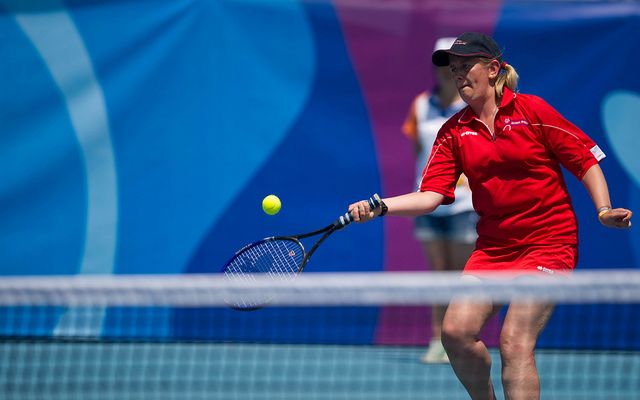
TENNIS
 SPORT RULES

Tennis
Sport Rules

                     VERSION: June 2016
               © Special Olympics, Inc., 2016.
                          All rights reserved.
TENNIS
        SPORT RULES

TABLE OF CONTENTS
1.   GOVERNING RULES .................................................................................................................................. 3
2.   OFFICIAL EVENTS ..................................................................................................................................... 3
         Individual Skills Competition ........................................................................................................ 3
         Singles ................................................................................................................................................ 3
         Doubles .............................................................................................................................................. 3
         Mixed Doubles.................................................................................................................................. 3
         Unified Sports® Doubles ............................................................................................................... 3
         Unified Sports Mixed Doubles...................................................................................................... 3
         Unified Team Tennis (See Competition Guide Book for format)......................................... 3
3.   RULES OF COMPETITION ........................................................................................................................ 3
         Divisioning ......................................................................................................................................... 3
         Match play ......................................................................................................................................... 3
         Singles Matches ............................................................................................................................... 4
         Doubles Matches ............................................................................................................................. 4
         Mixed Doubles Matches................................................................................................................. 4
         Unified Doubles Matches .............................................................................................................. 4
         Score Calling ..................................................................................................................................... 4
         Coaching ............................................................................................................................................ 4
         Tie-Breakers ...................................................................................................................................... 4
         Unified Sports Doubles .................................................................................................................. 5
         Unified Team Tennis Event ........................................................................................................... 5
         Individual Skills Competition ........................................................................................................ 6
4.   LEVELS ......................................................................................................................................................... 7
5.   SPECIAL OLYMPICS TENNIS RATING SHEET ...................................................................................... 9

                                                                                                                                                VERSION: June 2016
                                                                                                                                          © Special Olympics, Inc., 2016.
                                                                                                                                                     All rights reserved.
TENNIS
      SPORT RULES

1. GOVERNING RULES
   The Official Special Olympics Sports Rules for Tennis shall govern all Special Olympics
   competitions. As an international sports program, Special Olympics has created these rules
   based upon International Tennis Federation (ITF) Rules for tennis found
   at http://www.itftennis.com/. ITF or National Governing Body (NGB) rules shall be
   employed except when they are in conflict with the Official Special Olympics Sports Rules
   for Tennis or Article I. In such cases, the Official Special Olympics Sports Rules for Tennis
   shall apply.

    Refer to Article 1, http://media.specialolympics.org/resources/sports-
    essentials/general/Sports-Rules-Article-1.pdf, for more information pertaining to Codes of
    Conduct, Training Standards, Medical and Safety Requirements, Divisioning, Awards,
    Criteria for Advancement to Higher Levels of Competition, and Unified Sports.

2. OFFICIAL EVENTS
   The range of events is intended to offer competition opportunities for athletes of all
   abilities. Programs may determine the events offered and, if required, guidelines for the
   management of those events. Coaches are responsible for providing training and event
   selection appropriate to each athlete’s skill and interest.
   The following is a list of official events available in Special Olympics.
          Individual Skills Competition
          Singles
          Doubles
          Mixed Doubles
          Unified Sports® Doubles
          Unified Sports Mixed Doubles
          Unified Team Tennis

3. RULES OF COMPETITION
       Divisioning
               An athlete shall be divisioned on the basis of their rating in accordance with
               Tennis Rating Form.
               A Tennis Rating Form must be submitted for each athlete with the
               registration package for the event.
               The Tennis Rating Form is provided in Section D of the Official Special
               Olympics Sports Rules for Tennis.
       Match play
               A match will consist of one of the following.
                        One Tie Break 6 game set using no-ad scoring with a margin of two
                         games with a 7-point tie-break played at six all.
                        Two Tie Break short sets using no-ad scoring with a 10 point match
                        tie break to decide the match. In a short set, the first player/team
                         who wins four games wins that set, provided there is a margin of
                         two games over the opponent(s). If the score reaches four games all,

                                                                                      VERSION: June 2016
                                                                                © Special Olympics, Inc., 2016.
                                                                                           All rights reserved.
TENNIS
SPORT RULES
a 7-point tie-break game shall be played. When the score in a match
is one set all, one 10-point tie-break game shall be played to decide
the match. This tie-break game replaces the deciding final set. Not
recommended for athletes with a rating below 3.0.
Two tie break 6 game sets using no- ad scoring with a 10 point match
tie break to decide the match. In a 6 game set the first player/team who
wins 6 games with a margin of two games wins the set. A 7-point tie-
break shall be played at six games all. When the score in a match is
one set all, one 10-point tie-break game shall be played to decide
the match. This tie-break game replaces the deciding final set. Not
recommended for athletes with a rating below 6.0.
In the two tie break 4 game or 6 game sets, there will be a three-
minute rest period prior to the deciding 10-point tie-break.
The No-Ad scoring system will be used for all match play. The No-Ad
procedure is simply what the name implies: The first player to win
four points wins the game, with the seventh point of a game
becoming a game point for each player.
Singles Matches
The receiver has the choice of advantage court or deuce court, the service on
the seventh point, is to be delivered to the nominated court.
Doubles Matches
The receiving pair has the choice of advantage court or deuce court, the
service on the seventh point, is to be delivered to player playing in the
nominated court.
Mixed Doubles Matches
The player of the same gender as the server shall receive the deciding point.
i.e. male to male or female to female.
Unified Doubles Matches
The service on the seventh point is to be delivered athlete to athlete or
partner to partner.
Score Calling
The score calling may be either in the conventional terms or simple numbers,
i.e., “zero, one, two, three, game.”
Coaching
One designated Special Olympics coach may sit on court, (off the playing
surface, in a chair located at the net post next to the umpire’s chair) and may
coach a player when the players change ends at the end of every odd game
and during the three-minute rest period prior to the deciding tie-break, and
not during a tie-break game. Changes of ends must be completed within 90
seconds.
Tie-Breakers
When two or more athletes or teams have the same final point score, the tie
shall be broken as follows:
First: the fewest number of sets lost in all matches
Second: the most games won in all matches
Third: the fewest number of games lost in all matches
VERSION: June 2016
© Special Olympics, Inc., 2016.
All rights reserved.TENNIS
SPORT RULES
Fourth: (other than for teams) head to head results
Unified Sports Doubles
Each Unified Sports doubles team shall consist of one player with an
intellectual disability and one player without an intellectual disability, who
have similar skills as defined by their SO rating (or ITN).
Each team shall determine their own order of service and selection of courts
(ad or deuce).
Unified Team Tennis Event
Special Olympics Unified Team Tennis program rules are governed by ruling
body ITF (International Tennis Federation) and Special Olympics Tennis Rules.
Unified Team Composition: Unified Tennis teams are composed of Unified
doubles teams. Unified doubles team are comprised of one athlete with
intellectual disabilities and one athlete without intellectual disabilitis and
who have similar skills, as defined by their rating score, and similar age.
Individual Rating - All tennis players will be rated on the eight-point Special
Olympics Tennis Rating system. When assembling a Unified doubles team,
the athlete and Unified partner need to be as closely aligned in ability as
possible. Players either should have the same rating (Player A and Player B
have a 4 rating) or vary by no more than 1 – 1.5 points (Player A has a 4 rating
and Player B has a 5 rating).
Roster Sizes: Unified Team rosters consist of a minimum of 3 Unified doubles
and a maximum of 6 Unified doubles teams. (Ex. A Unified Team’s 3 doubles
pairings should consist of: 1 Level 2, 1 Level 4 and 1 Level 5 if possible).
Competition: Competition may be head to head or an Invitational with many
teams. During head-to-head competition, both schools, agencies or clubs,
field the same number of doubles teams of the same Level and similar rating.
Formation of Team Divisions: During competition, Unified Tennis teams are
divisioned based on Level and doubles team rating (combined individual
rating scores). Tournament Directors pair like level and rating for
competition.
Scheduling Doubles Matches: When scheduling matches for a competition,
doubles teams of similar ability levels and with similar rating scores need to
play each other.
Use of Designated Tennis Balls and Court Sizes for Competition: The ratings
of doubles teams determine what type of tennis ball must be used in
competition as well as the size of the court. A doubles team rating score is
the combined score of the two players (i.e. Player A is a 4 and Player B is a 5
giving their doubles team a rating score of 9). Following are the
requirements:
Unified Team Level 5: Doubles teams with a combined rating of 10
or higher must use a regulation yellow tennis ball on 78’ court.
Unified Team Level 4: Doubles teams with a combined rating of 6.0 -
9.9 must use a 25% lower compression ball (yellow ball with green
dot) and play on a 78’ court.
Unified Team Level 2: Doubles teams with a combined rating of
between 3.0 – 5.9 will play their matches on a 42’ court (service
boxes only) and use a red ball.
VERSION: June 2016
© Special Olympics, Inc., 2016.
All rights reserved.TENNIS
SPORT RULES
Substitutions: None are allowed for a doubles team during a match. If either
player of a doubles team is unable to complete the match, his/her doubles
team will forfeit.
Competition Formats: Following are the competition formats to be used
which are based on the number of players on both teams. When one team
has more players than the opposing team, those additional players compete
in an exhibition singles match. Example: Team A has 6 players and Team B has
8 players. Team B’s two additional players play a singles exhibition match.
Each team has:
6 players: 3 Doubles scoring matches
8 players: 4 Doubles scoring matches
10 players: 5 Doubles scoring matches
12 players 6 Doubles scoring matches
Match Play Format: A match consists of the best 2 out of 3 short sets. The
No-Ad scoring system will be used.
When a rain or time delay occurs, one 6 game may be used
instead:
In a 1 set match, the team that wins 6 games by a margin
of 2 games wins the set.
At 6 games all, a 10 point tie break is played.
No-Ad scoring will be used.
Individual Skills Competition
Competition Managers must specify the type of ball to be used at each ISC
competition.
Level 1 ball is the red foam ball.
Forehand Volley
The athlete stands approximately one meter from the net with the
feeder on the other side of the net, positioned halfway between the
service line and the net. Each athlete is given five attempts to hit a
ball safely over the net. The feeder underhand tosses each ball to
the athlete’s forehand side.
The athlete scores 5 points for hitting into the service box into
either service box.
Backhand Volley
Same as forehand volley except feeder sends the balls to athlete’s
backhand side.
Each athlete is given five attempts.
Forehand Groundstroke
The athlete stands one meter behind the center (T) of the service
line. The feeder is on the other side of the net, positioned half way
between the service line and the net, underhand tosses the ball so it
bounces once before reaching the athlete’s forehand side. Each
athlete is given five attempts.
The athlete scores five points for hitting into either service box
VERSION: June 2016
© Special Olympics, Inc., 2016.
All rights reserved.TENNIS
SPORT RULES
Backhand Groundstroke
Same as forehand groundstroke except the feeder sends the ball to
the athlete’s backhand side. Each athlete is given five attempts.
Serve — Deuce Court
Each athlete is given five attempts to hit a legal serve from the right
court to the deuce service box. A ball landing in the correct service
box will count 10 points. A zero (0) score is recorded if the athlete
commits a foot fault or fails to get the ball in the service box. A foot
fault occurs when the athlete steps on or over the service line.
Serve — Advantage Court
Same as serve to deuce court but from the left court to the
advantage service box.
Each athlete is given five attempts.
Alternating Groundstrokes with Movement
The athlete begins one meter behind the center (T) of the service
line. The feeder is on the other side of the net positioned halfway
between the service line and the net. It alternates underhand tosses
to the athlete’s forehand and backhand sides. Each toss should land
at a point which is both halfway between the service line and the net
and halfway between the center service line and singles sideline.
The athlete must be allowed to return to the center mark before
feeding the next ball. Each athlete is given ten attempts.
The athlete scores five points for hitting into either service box.
Final Score
A player’s final score is determined by adding together the scores
achieved in each of the seven events which comprise the
Individual Skills Competition.
4. LEVELS
The following is a guide to levels designed to provide competition opportunities to
athletes of all abilities. Competition events for Levels 2-Level 5 are; Singles, Doubles, Mixed
Doubles and Unified Doubles.
Level 1 Individual Skills Competition
Tennis Rating of 1.0 – 1.9 ITN 10.3-10.2 42’ Court – Red foam ball
Level 2 Matchplay:
Tennis Rating of 2.0 – 2.9 ITN 10.1 42’ Court – Red ball
Level 3 Matchplay:
Tennis Rating of 3.0 – 3.9 ITN 10 60’ Court – Orange ball
Level 4 Matchplay:
Tennis Rating of 3.0 – 4.9 ITN 9 78’ Court – Green ball
(Yellow ball with green dot)
Level 5 Matchplay:
Tennis Rating of 5.0 –8.0 ITN 8,7,6 78’ Court – Yellow ball
VERSION: June 2016
© Special Olympics, Inc., 2016.
All rights reserved.TENNIS
SPORT RULES
Notes: Level 3 is intended as a transitional level for training purposes. It can be used
for competition if sufficient entrants at this level are expected.
The SO Tennis Rating above are for singles, the range of rating should be doubled
when athletes are playing doubles matches, i.e. Level 4 would become 6.0 – 9.9.
References:
Tennis Rating Sheet
- http://media.specialolympics.org/soi/files/resources/Sports-Rules-
Competitions/Tennis/Tennis_Rating_Sheet_2012.docx
Levels Court Diagram
- http://media.specialolympics.org/soi/files/resources/Sports-Rules-
Competitions/Tennis/Levels_court_diagrams.docx
VERSION: June 2016
© Special Olympics, Inc., 2016.
All rights reserved.TENNIS SPORT RULES
5. SPECIAL OLYMPICS TENNIS RATING SHEET
Athlete’s Name: ____________________ Delegation: ____________________ Gender: __________ Age: _____
Level 1 (athlete’s at this level should complete the ISC Skills Testing) Level E. Second Serve Level
Player just starting to play tennis Double faults are common 2
Section A through G do not need to be completed Pushes 2nd serves 4
A. Forehand Level Hits 2nd serves with control 6
Hits inconsistent weak FH shots 2 Hits 2nd serves with control and depth 7
Hits FH shots with little directional control 3 Hits 2nd serves with spin, control and depth 8
FH has directional control of shots, but shots lack depth 4 F. Return of Serve Level
FH has sufficient control to sustain a short rally and is developing depth 5 Has difficulty returning serve 2
Rallies with control and depth, but has difficulty when shots are high or hard 6 Returns serve occasionally 3
Rallies consistently with depth, becomes inconsistent when adding pace 7 Returns 2nd serve consistently 4
Sustains an extended rally with direction, pace and depth 8 Returns some 1st serves, returns 2nd serves consistently 5
B. Backhand Level Returns 1st and 2nd serves consistently 6
Hits inconsistent weak BH shots 2 Aggressive return of 2nd serve and consistent return of 1st serve 7
Hits BH shots with little directional control 3 Aggressive return of 1st and 2nd serves 8
BH has directional control of shots, but shots lack depth 4 G. Volleys Level
BH has sufficient control to sustain a short rally and is developing depth 5 Hits inconsistent volleys; avoids net 3
Rallies with control and depth, but has difficulty when shots are high or hard 6 Hits consistent FH volleys; BH volley is inconsistent 4
Rallies consistently with depth, becomes inconsistent when adding pace 7 Hits consistent volleys; has problems approaching the net 5
Sustains an extended rally with direction, pace and depth 8 Has ability to approach the net and hits consistent volleys 6
C. Movement Level Comfortable moving to net, moves laterally well for both FH and BH volleys 7
Stationary position; does not move to ball to hit shots 2 Hits aggressive FH and BH volleys 8
Moves only 1-2 steps toward ball to hit shots 3 Section Category Level Comments
Moves toward ball; but court coverage is poor 4 A Forehand
Movement allows sufficient court coverage of most shots 5 B Backhand
Has good court coverage, reacts well enough to sustain a short rally 6 C Movement
Reacts quickly to the ball and has very good court coverage 7 D First Serve
Exceptional court coverage, reacts quickly to the ball and recovers after each 8 E Second Serve
shot
D. First Serve Level F Return of Serve
1st serve is weak 2 G Volleys
Hits 1st serves in at a slower pace 4 Total of Sections A through G
Hits 1st serves with pace 6 divided by 7
Hits 1st serves with pace and control 8 FINAL RATING
Rater’s Name: ____________________
Suggested Competition level for athletes Tennis Rating of 1.0 – 1.9 Athlete should compete in: Level 1 – Individual Skills Competition
Tennis Rating of 2.0 – 2.9 Athlete should compete in: Level 2 – 42’ Court – Red ball
Tennis Rating of 3.0 – 3.9 Athlete should compete in: Level 3 – 60’ Court – Orange ball
Tennis Rating of 3.0 – 4.9 Athlete should compete in: Level 4 – 78’ Court – Green ball
Tennis Rating of 5.0 – 8.0 Athlete should compete in: Level 5 – 78’ Court – Yellow ball
9 VERSION: June 2016
© Special Olympics, Inc., 2016
All rights reservedYou can also read


