BBS: Broadband Services Orchestration with ONAP - David Pérez Caparrós (Swisscom), Chaker Al-Hakim (Huawei), Tim Carey (Nokia)
←
→
Page content transcription
If your browser does not render page correctly, please read the page content below

BBS: Broadband Services
Orchestration with ONAP
     David Pérez Caparrós (Swisscom),
        Chaker Al-Hakim (Huawei),
            Tim Carey (Nokia)
Outline
• BBS use case. Motivation (David)
• BBS in ONAP Dublin release (Chaker)
• BBS: Using standards to help create an interoperable
  ecosystem (Tim)

Broadband Service (BBS) orchestration with ONAP

Why ONAP?

                                     (Switzerland’s leading telecoms company)

                Best customer experience                                        Operational excellence                 New growth
                We want to inspire our customers by                             We want to be better prepared for      We want to develop our core business
                providing them with the best service                            new business activities and optimise   and open up new areas of business.
                at all times, regardless of their                               our infrastructure.
                location.

https://www.swisscom.ch/en/about/company/portrait/vision-values-strategy.html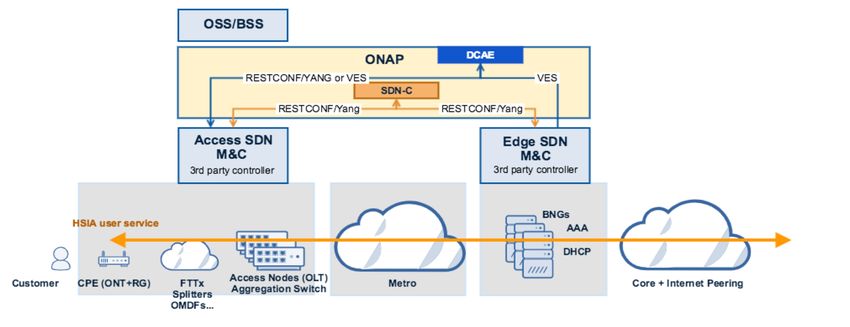
Where to start?

     Fixed networks
     4.2 million
     homes and businesses connected
     with ultra-fast broadband

     Ambitious expansion targets                     Window of opportunity
     Fibre-optic technologies in every district in
     Switzerland by end-2021

     Digital pioneer in Europe
     Compliance with the EU's digital agenda for 2020 –
     99% of all households covered with at least 30 Mbps

     2 million customers on All IP
     Call filter, HD sound quality, fixed network to go,
     simplified business communication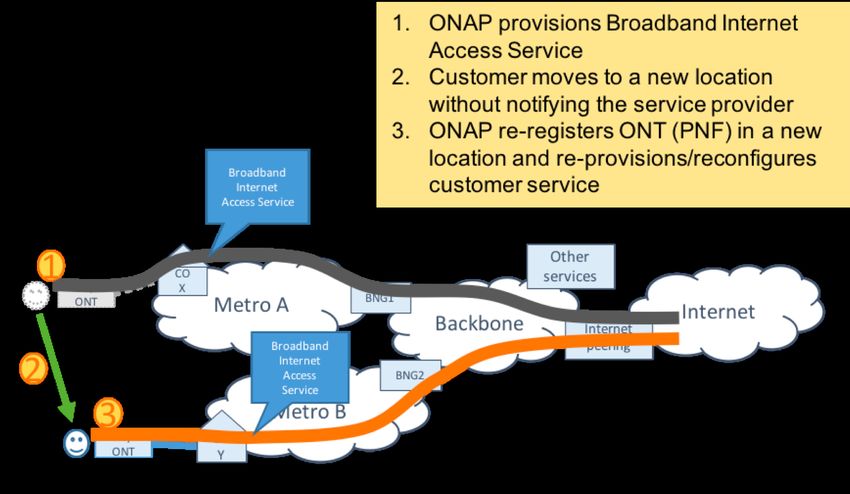
ONAP & Fixed Broadband Services: BBS

• ONAP as global service orchestration and automation platform
    Model-based, meta-data & policy-driven automation, service agnostic…

• New use case in ONAP Dublin release:
    BBS (Broadband Service)
    ONAP for the design, provisioning, life-cycle management
    and assurance of multi-gigabit internet access customer
    facing services
    Open standards: BBF CloudCO, TMF OpenAPIs
    Automation & orchestration challenge: Nomadic ONT
         Best customer experience
         Operational excellence
BBS overview

                             Customer
                              Portal
                                                         BSS

                             Access               Edge Domain
                           Domain M&C                M&C

                                                                                     HSIA
                                                                                     10Gbps
       Customer Premises                                                  Internet
                                                       Backbone office
       (CPE/ONT)                                       (BNG, AAA, DHCP)
                                         Metro

                                 Central Office
                                 (OLT, Agg)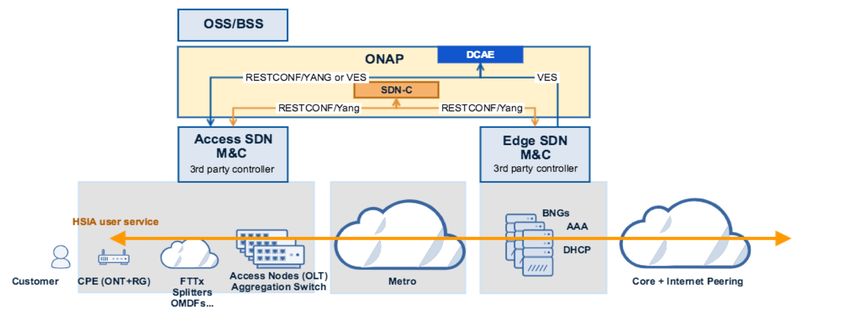
BBS in ONAP Dublin release
…this was our Goal

Domain Expertise - Service

• Some team members
  had :
   In-depth Service
   expertise
   A clear understanding of
   the new service
   capabilities to be added
   Are involved in other
   standards org that could
   also benefit from our
   Usecase
.. Domain Expertise - Service Provisioning

• Other team members
  were knowledgeable in:
    3rd-party controller layer
    Provisioning flows
    Networking
Domain Expertise - ONAP Platform
• The rest of the team
brought on:
ONAP knowledge and
expertise
Good understanding of
many ONAP components
Good understanding of
new features being
introduced in the next
ONAP releaseBBS Usecase Development timeline
• The work began in the November, 2018 timeframe (M0) Dublin Release Milestones:
o M0: 11/15/2018
Started out as 3 Different Teams § 11/30/2018 Project
Submitted
• A weekly meetings were set up starting on November 18, 2018 (T0) § 12/13/2018 Project
Proposals Approved
• Some pairwise technical discussions had taken place prior to the November o M1: 01/17/2019 Project
start date between Swisscom and Nokia. Planning
o M2: 02/24/2019
• The core Usecase team was formed with resources from Swisscom, Nokia and Functionality Freeze
o M3: 03/14/2019 API
Huawei Freeze
o M4: 04/11/2019 Code
• Project timeline created, weekly meetings started Freeze
o RC0: 05/02/2019
• Many follow-up meetings were needed/required where the team would meet o RC1: 05/16/2019
every day until open issues were closed
• Initial focus was on understanding the business problem that we were
attempting to solve
• Requirements discussions started in earnest early December (M1 - t0+8w)
Created a usecase project wiki
Prepared materials for usecase discussions and sub-committee/TCS approval
Modeling discussion
Nomadic ONT Service provisioning flow DiscussionBBS Usecase Development timeline
• Developed Modeling proposal for BBS Usecase team review Dublin Release Milestones:
o M0: 11/15/2018
• Began the Requirements discussion and the ONAP Dependencies. (i. e. § 11/30/2018 Project
Submitted
5G PnP – PNF support) § 12/13/2018 Project
Proposals Approved
• Identified functionality gaps o M1: 01/17/2019 Project
Planning
• Planned Test lab build-out o M2: 02/24/2019
Functionality Freeze
• Presented the usecase at DDF, Paris o M3:
Freeze
03/14/2019 API
• Finalized the BBS Data Model o M4:
Freeze
04/11/2019 Code
o RC0: 05/02/2019
• Monitored the status of the 5G PnP usecase (dependency) o RC1: 05/16/2019
• Setup daily calls to resolve showstoppers/Critical requirement issues
• Passed M2 Milestone
• Additional A&AI/Modeling discussions, DCAE uS, APIs, Topology
discussion
• Decided on doing a demo at ONS2019
• Passed M3 (Mar 14 – t0+12w) – API FreezeBBS Usecase Timeline – ONS-2019 Demo
18 Weeks into this effort, we have enhanced or added new functionalities Dublin Release Milestones:
o M0: 11/15/2018
to the following ONAP components: § 11/30/2018 Project
Submitted
ExtAPI § 12/13/2018 Project
Proposals Approved
DCAE: BBS uS / PRH o M1: 01/17/2019 Project
Planning
Policy o M2: 02/24/2019
Functionality Freeze
SO o M3: 03/14/2019 API
SDN-C Freeze
o M4: 04/11/2019 Code
AAI Freeze
o RC0: 05/02/2019
SDC / Model o RC1: 05/16/2019
Test Lab
• We’re able to support a BBS Demo with the code we’ve already
developed
• Still more development to be doneKey Takeaways and observations • You always start out as many different teams • Try to become one Large Cohesive team asap • Gain a common understanding of the use case as early as possible • Document gaps and develop workarounds as you go • Create a list of additional functional requirements and try to develop it as part of the use case effort • Share status and share often • Track your dependencies • Have fun doing it and make new friends, we did
Contribute back to the ONAP Community

• Document gaps and develop workarounds
    Minimize or eliminate throwaway code altogether
    To the extent possible, Code a new workaround as a new uService so it can be reused
• Develop a list of functional requirements
    When possible:
      • Code the new requirement as a uService and contribute it back to the proper ONAP component
          • As an example: SO Service Instance update function or
      • Provide the additional resource to fully implement and test the new capabilities
• Now that you’ve gained more experience in the ONAP platform, try to contribute back to the
  community
BBS: Using standards to help create an interoperable ecosystem
The “Open” path toward Cloud native solutions

                                                                                                                                       Cloud native
                                                                                                                      5

                                                                                                                                   •   Webscale ready
                                                                   2                                                               •   Lifecycle-mgmt automation
                                                                                3                                                  •   Modular, scalable and
                                                                                             4
                                                                                                                                       reusable components
               Carrier grade                    1                                                       Open development           •   Multi-vendor, multi-domain,
                                                       Open data model                                  working together to            network slicing
                                                       Self-detect device                               introduce new features,    •   Agile operations with DevOps
          Carrier-grade                                capabilities and gain                            products and services          & continuous software
                                                       analytic flexibility                                                            delivery
                                                                                    Open data
                                                                                    shared data to improve
         • 99.9999% reliability        Open standards                               network health and customer               Carrier-grade products,
         • Product lifecycle           created and controlled to                    experience                            or making open source (HW/SW)
           management                  achieve programmability                                                                     carrier-grade
         • Based on strong standards   and interchangeability
           and interoperability                                        Open ecosystem
         • Converged multi-service                                     Software modularity and multi-                              • Based on strong standards
           platform                                                    layer innovation in micro-                                    and interoperability
                                                                       services architecture                                       • Converged multi-service
                                                                                                                                     platform

                               Enabling the transformation to a digital service provider
Using Open Source and Standardization in BBS
Open Source Standardization
Implementation and validation Specification (architecture and solutions)
SA5
Provide uniform, comprehensive Definition of service Architecture and solutions for
APIs for OSS/BSS
platform for orchestration and the management of 3GPP
external interfaces
automation based networks and services
Provide integrated and NFV
compatible NFV-I reference
Architecture and Architecture and solutions for the
platform. Integrate together solutions for the management of broadband
with ONAP Provide a policy engine automated management networks and services
used to configure and and orchestration of
monitor services VNFs
Open source standardizes implementations, standards define interfaces and ensure
compatibility between implementationsBBS: Standardization Objectives
• Use the Broadband Forum’s TR-384 CloudCO Framework based on Application Note:
CloudCO-APPN-446 : ONAP Integration for Residential Broadband HSIA Service
• Use the design pattern of the Application Note as basis (i.e., use of Domain Specific Management
and Control elements)
• Vary the use case based on an operator’s actual deployment scenarios that highlight advantages
of an automation platform like ONAP (Zero touch service activation, ONT Relocation)
• Feedback the APIs for the relevant interfaces for standardization
• Use TMForum’s APIs for External APIs:
• Focus initially for service creation, activation and monitoring between ONAP and BSS
• Feedback through ONAP external APIs gaps (e.g., service operation status) and feature requests
• Use 5G Use Case work based on 3GPP specifications:
• Focus on PNF PnP and RelocationBBS: Standardization Objectives
• Use ONAP’s Service Design and Creation environment using the ETSI NFV
artifacts:
Creation of Broadband services using ONAP’s SDC and expressed through
ETSI NFV TOSCA resource and service definitions.
• Resources: TOSCA model based on ETSI SOL001
• Services: NFV TOSCA Model
Feedback through ONAP modelling gaps (e.g., service substitution) and feature
requests (e.g., attribution of virtual links)Thank you!
You can also read


