Testosterone and Male Pubertal Maturation Presentation to the Pediatric Advisory Committee 8 April 2019 - by Alan D. Rogol, M.D., Ph.D. Professor ...
←
→
Page content transcription
If your browser does not render page correctly, please read the page content below

Testosterone and Male Pubertal Maturation
  Presentation to the Pediatric Advisory
               Committee
                    8 April 2019
                              by
                   Alan D. Rogol, M.D., Ph.D.
        Professor Emeritus Pediatrics and Pharmacology
                     University of Virginia
                      Charlottesville, VA
Disclosures
• Presentation prepared for consortium of 5 companies which
  have INDs for testosterone products
     • Acerus Pharmaceuticals Corp.
     • Clarus Therapeutics, Inc.
     • Ferring Pharmaceuticals, Inc.
     • Lipocine Inc.
     • Viramal Limited

                                                              2
Agenda
• Background
• Physiology of the HPG axis in boys at puberty
• Estimate of number of adolescents who may require
  testosterone
• Challenges in designing and operationalizing studies of
  testosterone therapy in adolescents
• Conclusions

                                                            3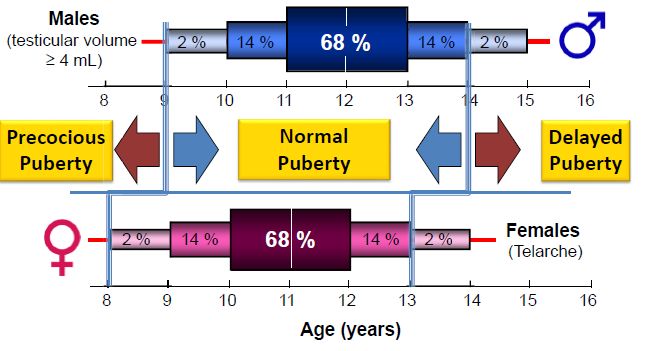
Indication on Package Insert of TRTs
[Product] is an androgen indicated for testosterone replacement therapy in adult males for
conditions associated with a deficiency or absence of endogenous testosterone:
• Primary hypogonadism (congenital or acquired): testicular failure due to cryptorchidism,
  bilateral torsion, orchitis, vanishing testis syndrome, orchiectomy, Klinefelter syndrome,
  chemotherapy, or toxic damage from alcohol or heavy metals. These men usually have
  low serum testosterone concentrations and gonadotropins (follicle-stimulating hormone
  [FSH], luteinizing hormone [LH]) above the normal range.
• Hypogonadotropic hypogonadism (congenital or acquired): gonadotropin or luteinizing
  hormone-releasing hormone (LHRH) deficiency or pituitary-hypothalamic injury from
  tumors, trauma, or radiation. These men have low testosterone serum concentrations
  but have gonadotropins in the normal or low range.

Limitations of use:
• Safety and efficacy of [Product] in males less than 18 years old have not been
  established.

                                                                                               4
5
Hypothalamic-Pituitary-Gonadal Axis

                                      6
Effects of Testosterone and its Active Metabolites
Andrology 2014;
3:124-135
7Serum Testosterone Level has Circadian Rhythm
Total T displays
both circadian
and ultradian
rhythms in young
and older me.
Andrology 1991; 12:185-190
8All Cause Delayed Puberty in 2.3% of Males
2.3% 2.3%
2.3% 2.3%
9
Best Pract Res Clin Endocrinol Metab 2019;Population of boys with delayed puberty
• The US census from the year 2017 notes the following population statistics
for boys—[total census at that age divided by 2]:
• Age 14 = 2.06 X 10⁶
• Age 15 = 2.06 X 10⁶
• Age 16 = 2.11 X 10⁶ Total = 8.38 X 10 6
• Age 17 = 2.15 X 10⁶
• The 97th percentile [>2 SD, and thus “abnormal”] for starting puberty in
boys is 13.7 years from a well-designed population study of Belgian boys1.
1 Roelants M, Hauspie R, Hoppenbrouwers K. References for growth and pubertal development from birth to 21 years in
Flanders, Belgium. Ann Hum Biol, 2009; 36(6): 680–694. 10Population size: CDGP (1)
• Thus, for the 14 year old boys, 2.3 % have delayed puberty,
of which 65% have CDGP
• 2.06 X106 X 0.023 X 0.65 = 3.08 X 10⁴
• Clearly those with delayed puberty diminish as the age nears 18
years, especially those with CDGP. Conservatively, diminish that by
50 % each year, yielding 1.54, 0.77 and 0.39 for the ensuing years
for a total of ≈57,800
11Population size: CDGP (2)
• For this calculation will use the least parsimonious
number, 2.3 %
• That number relates to the 14 year olds and is clearly less
for the older age bands for CDGP.
• I have arbitrarily halved the percentage each additional
year, although clinical experience over more than 4
decades would note that number to be high
• Two large single center studies from academic centers
noting differing referral patterns show approximately 65%
of the boys with delayed puberty have CDGP
12Population size: Klinefelter syndrome
(primary hypogonadism)
• Klinefelter syndrome estimated to be ~1:500-600 males and that is
the most prevalent form.
• However only about 10% present before age 18.
• Boys 14 to 18 y = 8.38 X 10⁶ /6 X 102 = 1.4 X 10⁴ but only ≈10%
present before age 18 y, so ≈1,400 adolescents diagnosed with
Klinefelter syndrome
13Population size: Kallmann syndrome and
IHH
• Kallmann syndrome estimated to be ~1:10,000 males and
that is the most prevalent form of IHH
• Boys 14 to 18 y = 8.38 X 10⁶ / 1 X 104 = 838.
• Once again, not all will have a diagnosis, but these
adolescents will likely not have started any pubertal
development and more will be captured earlier than
those with the Klinefelter syndrome, where most do start
pubertal maturation.
14Hypothalamic-Pituitary-Gonadal Axis
World J Men’s Health 2019; 37:45
15CDGP versus IHH
• Differential diagnosis can be difficult, especially in the early
adolescent (by age).
• Both may be familial
• Growth curves may help to distinguish
• Very early signs of pubertal maturation may help to distinguish
16Growth curve for boy with CDGP treated with T
17Growth curve for boy with CDGP
18Height SDS in Boys with CDGP
Reinehr T, et al Clin
Endocrinol 2019 in press
19Growth curve for a boy with IHH
20General Principles of Androgen Therapy
• To lead to or to restore serum T levels within the normal
range for age and stage of pubertal maturation
• To administer only to those who are transiently or
permanently hypogonadal, whether primary or secondary
21Goals of Testosterone Therapy (Adolescent)
• Linear growth (physiological growth spurt)
• Normal progression of secondary sexual characteristics
• Growth of testes during androgen therapy, even to supraphysiologic
levels, indicates gonadotropin secretion is robust and not inhibited by
negative feedback at the attained levels
• Acquisition of pubertal and then adult body composition (muscle
mass and regional distribution of body fat)
• Accrual of adequate bone mineral content
• Physiologic psychosocial development
22Forms and dose ranges from previous studies
• Mixed testosterone esters
• 50 to 125 mg monthly for 12 months
• Testosterone enanthate (TE)
• 200 mg im for four months
• 50-100 mg monthly for 12 months
After one year virtually all had a growth spurt without unduly
rapid bone maturation and in the few studies carried out to
(near) adult height there was no loss compared to predicted
adult height at initiation of therapy nor deviation from familial
target height.
23Physiologic and Pharmacologic T Concentrations (1)
• Physiology notes pulsatile GnRH and gonadotropin patterns at all ages
• Testosterone concentrations are very low except at “mini-puberty”
and at puberty
• Gonadotropin levels show increased pulse amplitude early morning as
pubertal maturation unfolds
• Testosterone levels follow with an early morning rise and then lower levels
during the day
• Mid-to-late puberty notes increasing gonadotropin levels during a greater
part of the day with night greater than day
• T levels are easily measurable for greater parts of the day and become like the
adult in late puberty
24Physiologic and Pharmacologic T Concentrations (2)
• T levels following multiple different TRT drugs and doses do not
mimic physiology
• Yet multiple forms administered by any of multiple routes are able
to mimic pubertal maturation in those with CDGP, IHH, or primary
hypogonadism
• Mechanisms for tracking adverse effects of testosterone therapy
• Height velocity excessive
• Bone age maturation excessive
• Adverse behavioral effects
• Acne
• T levels (when and what to measure)
• AUC versus peak (Cmax)
25Clinical Trials
• Conditions associated with a deficiency or absence of
endogenous testosterone
• Primary hypogonadism
• Isolated or combined gonadotropin deficiency—usually GnRH
deficiency
26PMR on NDA approval letter of recent TRTs
• A trial of testosterone replacement therapy in pediatric males ages 14
years and older for conditions associated with a deficiency or absence
of endogenous testosterone due to primary hypogonadism or
hypogonadotropic hypogonadism.
27Identifying the correct patient: CDGP vs IHH
• Can have nearly identical clinical presentation
• Both will respond to T treatment
• CDGP is not on label while IHH is
• May need to assign final diagnosis after a course of T
28Challenges for Clinical Trials: Recruitment (1)
• Small percent of the adolescents get to the specialist early
• They are the ones that want something done RIGHT NOW
• Many 14 y.o. patients have already started T treatment
• Physicians prescribing off label
• Sure to get drug
• Study design
• In placebo controlled trial there can be perception of patient/
family that there is an inferior arm (e.g., delayed T therapy)
• However, new formulations, especially without needles, makes the
recruitment a bit easier, as well as highly educated families
29Challenges for Clinical Trials: Recruitment (2)
• Subset for PK studies
• Lack of direct benefit to patients
• Limited capacity for the younger subjects to understand study
• Inability to properly compensate patients and parents,
especially the latter for loss of work
• Travel/invasive procedures for proper trials
• Difficulty scheduling because of school (time commitment)
30Challenges for Clinical Trials: Patient population
• Study design (cont)
• Klinefelter syndrome, although easily confirmed, is a problem
because only ~10 % are diagnosed by pubertal age. The
adolescents have variable T levels, often within normal limits
for age, but high gonadotropin levels, especially FSH
• When to start, what level is appropriate based on T or
gonadotropin levels?
31Challenges for Clinical Trials: Study design (details)
• Multiple etiologies, even for isolated hypogonadotropic
hypogonadism (IHH), inclusion criteria
• Are all the same?
• Development versus maturation
• Behavioral aspects are important
• Controls-required for CDGP (transient) what about others?
• Precisely who are the controls?
• Exclusion criteria
• certain genetic conditions
• Concomitant medications?
• Endocrine active including nasal and inhaled glucocorticoids
• CNS active, e.g., mood stabilizers, anti-psychotics, ADHD
32Outcomes (1)
• Height velocity or change in height SDS (easy)
• Body composition (not so easy depending on methods)
• Adult body composition reached mid-third decade
• Metabolic parameters—insulin sensitivity
• Is issue to initiate puberty or to go through the entire
sequence
• First not sure that that is valid and what does initiate mean other
than in adolescents with CDGP or IHH
33Outcomes (2)
• Psychosocial aspects—to ameliorate
• Low self esteem
• Distorted body image
• Impaired psychosocial development
• Increased anxiety
• Depression
34Conclusions
• Testosterone trials are difficult in adolescent boys
• Distinguish CDGP from IHH at young ages
• Many boys seek therapy below the age of 14 and they can get it
off label
• Mechanics of trial participation can be difficult for families
especially with pharmacokinetic studies
• Few patients with IHH
• Few patients with Klinefelter syndrome diagnosed before
emerging adulthood
35Unequal battle between early and late maturing athletes
36The only sure foundations of medicine are,
an intimate knowledge of the human body,
and observations on the effects of medicinal
substances on that.
Thomas Jefferson, letter to
Dr. Caspar Wistar, 1807
37THANK YOU
38You can also read


