The 19th ITS Biennial Conference 2012 "Moving Forward with Future Technologies: Opening a Platform for All" - EconStor
←
→
Page content transcription
If your browser does not render page correctly, please read the page content below
The 19th ITS Biennial Conference 2012
“Moving Forward with Future Technologies:
       Opening a Platform for All”
           18 - 21 November 2012, Thailand

    Open access networks and national broadband plans:
                  Tales from Down Under
                       Fernando Beltrán
              University of Auckland Business School
                 E-mail: f.beltran@auckland.ac.nz
Open access networks and national broadband plans:
Tales from Down Under1
Fernando Beltrán
f.beltran@auckland.ac.nz
University of Auckland Business School
Auckland, New Zealand
September 2012
Abstract
Recently, governments in many countries have acknowledged the higher complexity involved in
finding the more efficient path towards a so-called broadband ecosystem. The governments of
Australia and New Zealand are leading the deployment of national fibre-based broadband
infrastructures through Public-Private-Partnerships (PPP). The paper is on the approach followed by
New Zealand and Australia to developing Next-Generation broadband infrastructure, their
broadband policies and strategies for network deployment. It also contributes an economic analysis
that allows understanding the economics of those country-wide broadband platforms.The paper
critically analyses the short history of each experience, including the political process, the reasons
exhibited that justify the governments’ involvement in infrastructure deployment, and the
institutional arrangements introduced to manage the PPP. The paper’s main goal is to contribute
analytical tools to the understanding of the economic effects of a purpose-made infrastructure on
the markets that, according to every government´s declared expectation, will be propelled by the
combined effect of policy decisions, regulations and technology deployment. The paper analyses the
effect of network design principles such as open access and regulated wholesale tariffs on the
efficiency of service markets to be deployed on the fibre-based next-generation platform.
1
This work has been partially supported by University of Auckland Business School FRDF grant 3627071.
11. Introduction
The governments of Australia and New Zealand are driving, each in its own way, the
deployment of national fibre-optics broadband infrastructures through
Public-Private-Partnerships(PPP). The two cases presented analyse regulatory decisions such as the
split of New Zealand’s incumbent operator Telecom NZ and the Australian government deal with
Telstra.
The government of Australia is investing close to A $40.9 billion2, of which $27.5 billion are
Government equity and the remaining $13.4 are debt funding, into the deployment of a nationwide
broadband network, the National Broadband Network (NBN), pledging that “by 2020, Australia will
be among the world’s leading digital economies”3. The NBN will provide high-speed broadband
access to 100 per cent of Australian households and businesses, with 93 per cent of Australian
homes, schools and businesses connected via a high-speed fibre optics network, and the remaining
population connected through a combination of next-generation fixed-wireless and satellite
technologies. Likewise, the New Zealand national broadband initiative, whereby the government
currently builds a nation-wide fibre-optics network, is known as the Ultra-Fast Broadband (UFB)
network. Crown Holdings Fibre (CFH), the government agency in charge of UFB deployment, has
invested NZD $1.5 billion with a similar amount expected from private partners. Upon conclusion it
is expected that 75% of New Zealanders will enjoy fibre access to the high-speed digital
communications network. The remaining population will benefit from the Rural Broadband Initiative
(RBI), a government program to deploy broadband access either wireless or satellite-based
connections to rural areas.
The paper is structured as follows. First, main technical aspects and policy decisions regarding
market wholesale structure and wholesale prices are described for Australia´s NBN. Next, similar
considerations are done for the case of UFB in New Zealand. In each of both cases a short historical
account is provided in order to highlight the importance of the political process. Then the concept of
broadband ecosystem is introduced followed by a discussion of three main features of any
broadband ecosystem: understanding the incentives governments need to provide for infrastructure
2
NBN Co, “Corporate Plan 2011- 2013”, 2010, accessed Sep. 29, 2012,
http://www.nbnco.com.au/assets/documents/nbn-co-3-year-gbe-corporate-plan-final-17-dec-10.pdf
3
Australian Government, “National Digital Economy Strategy”, 2011, accessed Sep. 29, 2012,
http://www.nbn.gov.au/files/2011/05/National_Digital_Economy_Strategy.pdf
2growth and uptake of broadband-based services; the need for broadband policies on service
creation and application development; and, finally, the importance of the open access design
principle followed by both UFB and NBN and its implications for network neutrality. The last section
concludes.
2. The National Broadband Network of Australia
In Australia the low rankings in the OECD tables on broadband uptake and pricing throughout
the 2000s alerted the government to take political action aimed to deter Telstra, the incumbent
telecommunications operator,to use its continuing control of the last-mile infrastructure to
dominate the emerging market of fixed broadband.In November 2008, all Australian governments
endorsed a six-volume National PPP Policy and Guidelines to replace separate arrangements across
the nation 4 ; shortly thereafter the newly elected Labour government proposed a National
Broadband Network (NBN) as one of their ‘nation-building’ initiatives5. After two years of debates
and revisions to the budget process in 2011the cost to construct the NBN was raised to A$36 billion
plus A$11 billion to be paid to Telstra for their existing network structure to be incorporated into the
NBN6.
Earlier, in 2009 the government established NBN Co to manage the building and running of the
NBN. NBN Co was immediately commissioned with the building of the network with a business plan
that would make it the sole provider of wholesale services to retail service providers. Such providers,
operating on a competitive environment, would be the operators of end-user services.
To enable high-speed connections between the population centers across the continent, the
government had launched a $250 million Regional Backbone Blackspots Program (RBBP) to build
some supplementary broadband ‘highways’ to complete the network already in place, mostly
owned by Telstra.
Early January 2012 marked the achievement of several crucial milestones for the broadband
project. NBN Co announced ithad signed agreements with network construction contractors in every
4
Given, J. “Take your partners: public private interpaly in Australian and New Zealand plans for next generation
broadband”, 2010,Telecommunications Policy, 34, 540-549.
5
Kevin Rudd,“The global financial crisis”,The Monthly. 42 (February), accesed Apr. 28, 2012,
http://www.themonthly.com.au/node/1421 .
6
Lucy Battersby,“Tower ban regions face slower broadband”, The Sydney Morning Herald, Jan. 18,
2012,accesed Mar. 19, 2012,
http://www.smh.com.au/it-pro/government-it/tower-ban-regions-face-slower-broadband-20120118-1q59y.html .
3state and territory; the opening of the nerve centre of the network – the National Operations and
Test Facility in Melbourne; the signing of the first commercial contracts, the Wholesale Broadband
Agreement; the lodging with the ACCC of the Special Access Undertaking framework for how the
NBN will be regulated over the long term; and an ground-breaking deal with Telstra.
The deal with Telstra will have a large percentage of Australians migrating to fibre-optic
connections for broadband and telephone services. As Telstra gradually shuts down its copper
infrastructure over the next decade and moves its almost 10 million customers to the NBN, it will be
compensated by NBN Co withA$11 billion7. The deal secures Telstra a cash flow for the next 30
years8by which Telstra has effectively sold its copper network to NBN Co. Telstra will receive
payments “every time copper phone lines are disconnected and replaced by fibre-optics in
premises”9.
NBN Co plans to offer on the FTTP network to its Retail Service Provider wholesale speeds of up
to 100 Mbps generally for towns with populations bigger than 1000 , comprising 93% of Australian
premises by 202110. The NBN will be rolled out in a series Fibre Serving Areas (FSA) of up to 40,000
premises that are made up of up to 12 geographic modules, each covering about 3,000 premises. It
is envisaged that for each FSA module it will take about 12 months from the start of site works to
activation of the first service11.The remaining 7% of premises are composed of 4% being those on
the outer fringes of regional towns to be serviced with fixed wireless networks at 12 Mbps
download and 1 Mbps upload speed, and 3% remote premises to be serviced with satellite services
at 6 Mbps download and 1 Mbps upload speed12.
Figure 1 shows a schematic view of the NFAS product components. The wholesale speeds apply
to the capacity delivered between the user´s port (or User-Network Interface, UNI) and the network
port (or Network-Network Interface, NNI). NBN defines theFibre Access Service (NFAS) as its primary
functional unit. It is a “wholesale, layer 2 based Ethernet access product” that uses FFTP
7
Yates.
8
Lucy Battersby, “Telstra in 30-year NBN deal”, The Age, Mar. 7, 2012, accessed Apr. 17, 2012,
http://www.theage.com.au/business/telstra-in-30year-nbn-deal-20120307-1ukij.html
9
Idem.
10
Given.
11
NBN Co, “About the rollout”, 2011, accessed Apr. 29, 2012,
http://nbnco.com.au/rollout/about-the-rollout.html?icid=pub%3Arollout%3A1yr%3Abod%3Aabt-roll-maps
12
Lucy Battersby, “Tower ban regions face slower broadband”.
4technology13 that supports several classes of services, among those are the bit-stream services,
traffic classes, telephony capability, multicast, service operation, administration and maintenance,
and physical interconnection agreements14. The UNI is available on the NFAS in two forms: the
UNI-Data and the UNI-Voice. NFAS traffic performance guarantees apply to the Access Virtual Circuit
(AVC) component. The portion of the virtual circuit within the point of interconnection site –which
belongs to the NBN - is known as the Connectivity Virtual Circuit (CVC).
UNI NNI
NBN Co
Point of Interconnection
UNI-D
UNI-V
AVC CVC
End-user premises
ConnectivityServiceArea
Figure 1.Product components of the NFAS15.
The NFAS will provide wholesale access service to service providers; those services, also known
as Layer-2 services, will be purchased by NBN’s customers, that is, the service providers that will use
them to deliver end-user, IP-based telecommunications services.
In order to guarantee a flexible range of options to service providers that support their different
traffic profile needs, the NFAS offers four service classes (known as Layer-2 Class of Service, CoS)16.
Table 1 displays the four service classes and illustrates their potential utilization by wholesale
services that are used as inputs to provide end-user services.Any provider can use the NFAS to
provide the following service types: unicast data services, IP-based telephony services, and multicast
data services17. All service types can operate simultaneously over the same port on the end- user’s
13
NBN Co, “Wholesale NBN Co Fibre Access Service. Product Overview Fibre Access Services”, 2010,
accessed Sep. 29, 2012, http://www.nbnco.com.au/assets/documents/product-overview-fibre_1_03_final.pdf
14
NBN Co,“NFAS Traffic Class Performance” Discussion Paper, accessed Apr. 26, 2012,
http://www.nbnco.com.au/assets/documents/traffic-performance-whitepaper-dec-2011.pdf
15
Adapted from NBN Co,“NFAS Traffic Class Performance”
16
NBN Co,“NFAS Traffic Class Performance”
17
NBN Co, “NBNCo Technical Dicussion Paper (multicast)”, accessed Apr. 28, 2012,
http://www.nbnco.com.au/assets/documents/nfas-technical-discussion-paper-multicast.pdf
5equipment. Unicast services may be used for a range of data applications, among them Internet
access, while multicast services allow multi-media content distribution.
NFAS Traffic Class Characteristic Bit stream features End-user services
Traffic Class 1 Deterministic Low bit-rates Voice
throughput with Small packets
committed capacity
Traffic Class 2, Deterministic High bit-rates Streaming
Traffic Class Multicast throughput with Large packets High Definition Video
committed capacity
Traffic Class 3 Committed capacity Ability to burst at Premium data
peak rate Gaming
Business VPN access
Traffic Class 4 Best-effort Ability to burst at Internet access
peak rate
Table 1. NBN Co’s Traffic Classes and examples of end-user services
3. New Zealand UltraFast Broadband network
With the country’s 22nd position in Internet speed amongst 45 countries and its 35th place out
of 66 countries in terms of broadband Quality of Service (QoS), in 2009 the New Zealand
government announced an initiative to provide high-speed broadband to New Zealanders through
the deployment of a countrywide optical fibre infrastructure into New Zealand cities18 in what is
today known as the Ultra-Fast Broadband (UFB) network.Evidence of the effects of broadband
uptake on GDP per capita from a World Bank report19, which shows that a 10% increase in
broadband achieves up to 1.21% increase in GDP in developed countries and up to 1.38% increase in
developing countries, was used as a main source and justification. The announcement was followed
by the creation of Crown Fibre Holdings (CFH), the state-owned company that will manage and
monitor the Crown’s investment in the UFB and will operate the UFB private-public partnership with
selected partners. The initiative is a main component of a larger body of policy aimed to reform the
18
Murray Milner, “Playing the Telecommunications Game in New Zealand”.Telecommunications Journal of
Australia, 59, 17, 2012.
19
World Bank (2009). Information and Communications for Development 2009: Extending Reach and
Increasing Impact, accessed April 28,
2012,http://web.worldbank.org/WBSITE/EXTERNAL/TOPICS/EXTINFORMATIONANDCOMMUNICATIO
NANDTECHNOLOGIES/EXTIC4D/0,,contentMDK:22229759~menuPK:5870649~pagePK:64168445~piPK:
64168309~theSitePK:5870636,00.html
6telecommunications sector to make it a propeller for economic growth. In November 2011, after
negotiations that involved the government, CFH and the incumbent Telecom NZ, the latter was
finally split into a wholesale branch, now known as Chorus, and a retailer that retained the Telecom
brand.
The purpose of the UFB project is to accelerate the roll-out of an access network deploying
optical fibre infrastructure to 75 percent of New Zealanders by the end of 2019. The priority of this
project is broadband users such as businesses, schools and health services, in addition to greenfield
developments in particular residential areas20. UFB aims to guarantee residential broadband services
at a speed of 100 Mbps downstream (from the internet to the user) and 50 Mbps upstream (from
the user to the internet). CFH oversees a government investment of NZD $1.5 billion in the UFB with
a similar share expectedfrom private investors.
The private-public partnerships are known as Local Fibre Companies (LFCs). Close to 70% of the
country’s urban premises will be served by Chorus. The remaining urban residential and business
areas will be connected to with Northpower Fibre Limited (in the north), Ultrafast Fibre Limited (in
western and central areas of the North Island) and Enable Networks Limited (in Christchurch and
east-central South Island). In May 2011, CFH finished agreements with all four LFCs which state that
CFH funds the cost of fibre ‘passing’, that is, the connection running down the street, while the
partner must fund each ‘drop’, that is, the connection from the street to the premise21.
Figure 2 is a schematic representation of the main architectural features regarding the
connectivity from the UFB to the end-user’s premises; the diagram shows the general architecture
of an LFC service area and potential interface points for access seekers.
20
CFH, “Ultra Fast Broadband in Business - Seizing the Opportunity”, accessed May 22, 2010,
http://www.crownfibre.govt.nz/media/9669/ultra%20fast%20broadband%20in%20business%20-%20seizing%2
0the%20opportunity.pdf
21
CFH, “Fact Sheet: Agreement with Enable Networks”,accessed Mar 19, 2012,
http://www.crownfibre.govt.nz/media/13092/fact%20sheet%20-%20agreement%20with%20enable%20network
s.pdf.
7UNI E-NN1 E-NN2 E-NN3
OVC
NID AN EAS EAS
End-user premises Access UFB
Figure 2: Access Provider Network Architecture (TCF, 2011)
The Network Interface Device (NID) is provided by the LFC and is located in the end-user’s
premises. The NID implements the User Network Interface (UNI) which is the physical and logical
demarcation point for the service and terminates the physical access fibre. At the opposite extreme
the fibre terminates on the Access Node (AN) of the LFC network. Traffic from a number of ANs is
delivered to the network’s point of service or External-Network Network Interface (E-NNI). A service
will be operated using an Operator Virtual Circuit (OVC), which is an association between a UNI and
E-NNI. Bandwidth management should assure that between the UNI and each Retail Service
Provider’s E-NNI the bandwidth commitments on each OVC are honoured at all times.
Since the UFB will operate as an open access network, a provider service, known as Retail
Service Provider (RSP)wishing to provide end-user telecommunications services only has to register
with a LFC. An RSP will purchase wholesale services from the LFC using the technical and economic
conditions spelled for OVCs (see next section).
Consumers in any region will have access to the UFB network at no charge from their LFC; in
fact CFH has stated in its agreements with the LFC that “except in exceptional circumstances there
will be no one-off wholesale connection charge for residential consumers to connect to UFB at a
wholesale level”22. LFCs will sell Layer-2 (wholesale) services to RSPs, charging them at regulated
wholesale prices, to be used in the delivery of end-user (retail) services. Once a RSP purchases
Layer-2 access, it can release its own products to end-users which would be most likely based on a
triple play (Internet access, VoIP, IPTV) offer. LFCs are not allowed to trade with end-users directly
22
CFH, “Fact Sheet: Agreement with Enable Networks”, accessed Mar 19, 2012,
http://www.crownfibre.govt.nz/media/13092/fact%20sheet%20-%20agreement%20with%20enable%20network
s.pdf.
8but only provide wholesale access for RSPs who in turn will serve end-users23.
4. Comparing the wholesale offers of NBN and UFB
Both NBN and UFB follow a similar pathway to selling wholesale services. Wholesale services
are the key to the provision of new end-user services on the broadband platforms. Given the
economic structure imposed on the Australian and New Zealand broadband platforms, service
providers should find in the price levels of wholesale service price scheme the right incentives for
deploying their business plans. Bothcountries have already advertised price charts which prescribe
the price levels and allowed increases for the first 8 to 10 years – depending on the country- of
operation. Next we review the two country wholesale price structures.
4.1. NBN wholesale prices
Wholesale customers will be charged the same price across all NBN three technologies: fibre,
wireless, and satellite24. Prices for NFAS product components are shown in Table 2. As can be seen
access to facilities is at no charge. AVC products vary across a range of upstream/downstream
combinations.
Product component Monthly Non-recurring
charge charge
(AUD) (AUD)
Facilities access
Optical distribution frame termination point Zero charge Zero charge
Network-Network Interface
1 Gbps 1000Base LX $200 $1,000
10 Gigabit per second 10GBaseLR $400 $5,000
*
Access Virtual Circuit (downstream/upstream)
#
12/1 Mbps $24 N/A
25/5 Mbps $27 N/A
25/10 Mbps $30 N/A
50/20 Mbps $34 N/A
100/40 Mbps $38 N/A
Table 2. NFAS product component prices
#
(*) Includes UNI-Data( ) A freeze has been imposed on the price of 12/1 AVC until mid-2017; the other prices
25
are also frozen but only until the end of 2013 .
23
In its 2009 Invitation to Participate, MED says that a LFC can indeed offer end-user services in competition
with RSPs. LFC would have to use a separate subsidiary. The latter contributes to further justify the
introduction of non-discriminatory and equivalence principles.
24
Lucy Battersby, “Tower ban regions face slower broadband”
25
Lucy Battersby,“NBN reveals 5-year fixed price plan”, TheSydney Morning Herald, Dec. 6, 2011,accessed
9NBN Co envisages that once, with completion of the RBBP, the fiber ‘highway’ infrastructure is
improved and owned by a larger variety of providers (no longer predominately Telstra) the
consumers will benefit from increased competition and packages with larger download quotas and
faster speeds will become available. This however would not prevent retailers increasing end-user
prices.
4.2. New Zealand
As a result of negotiations between CFH and the LFCs, the latter have posted price lists for
wholesale service prices; the prices are on a “per customer per month” basis. By regulation a LFC
will not be allowed to charge more than the specified monthly price when its client RSP signs up a
new customer.
An example of LFC prices for the home/retail customer sector in New Zealand is displayed in
Table 3 with a similar structure, although higher-speed connection for businesses.The table shows
the price caps that CHF and its partners have agreed on for entry level broadband connection,
high-definition video, and entry-level business service prices. LFCs will charge wholesale prices that
will rise steadily during the first 8 years as is the case of Residential Entry and Residential Triple-Play
while others will be kept constant or will slightly decrease as in Triple-Play 100/5026.
* *
Product Downstream/Upstream data 2011 CCPM 2019 CCPM
rates (NZD) (NZD)
Basic Voice Channel Greenfields or LFC-discretional 25.00 25.00
#
GPON Residential Entry 30Mbps/10 Mbps 37.50 42.50
GPON Residential Triple-Play 30Mbps/10 Mbps 41.25 46.25
GPON Business Entry 30Mbps/10 Mbps 49.95 49.95
GPON Triple-Play 100Mbps/50 Mbps 55.00 49.90
GPON 100/100 100Mbps/100 Mbps 175.00 175.00
HD Video Channel 10 Mbps for multicast video 5.00 5.00
Table 3.Products and prices for home/retail customers in the CFH-Chorus agreement.
(*) CCPM: Customer charges per month.
#
( ) Gigabit Passive Optical Network, a network architecture that brings fiber to the premises using a
point-to-multipoint scheme that enables a single optical fiber to serve multiple premises.
Mar. 19, 2012, http://www.smh.com.au/business/nbn-reveals-5year-fixed-price-plan-20111206-1og1j.html
26
The notation adopted by CFH for wholesale services such as Triple Play 100/50 means that the service
guarantees 100 Mbps for downstream traffic (from the provider to the end-user) and 50 Mbps for upstream
traffic (from the end-user to the provider).
105. The broadband ecosystem
The idea that broadband access creates conditions for providers, users and investors to increase
the volume of transaction and the potential for spilling effects into several sectors of society was
first formalized through the introduction of the broadband ecosystem concept by Kelly et al. (2009).
The concept of broadband ecosystem enables us to have a broader view of broadband infrastructure
as a platform that enables the enhancement of relationships among its users and suppliers.
According to Kelly et al. a broadband ecosystem is “a multilayered system of interconnected
high-capacity communications networks, bandwidth-intensive services, applications, and users”.
Figure 3 shows the elements of the broadband ecosystem construct.
High-speed Availability
Investments
networks
and demand
Users Services
Affordability
relevance Applications Access
Fig. 3.The broadband ecosystem. Source: Kim et. al. (2010)
The broadband ecosystem model suggests that investment in high-speed networks creates the
conditions for serviceand application availability; next, assuming that users can afford them they will
create the demand that will be able to sustain investment. This idea of a virtuous circle in the
broadband ecosystem raises the question of where and how a government can propel the flow of
actions on the ecosystem by intervention, if necessary. Australia and New Zealand have decided to
spur the expected benefits by proposing private partners to co-invest in the deployment of, mainly,
fibre access complemented with wireless and satellite broadband access, solving the supply
question at least concerning the conditions for better and more reliable access infrastructure. The
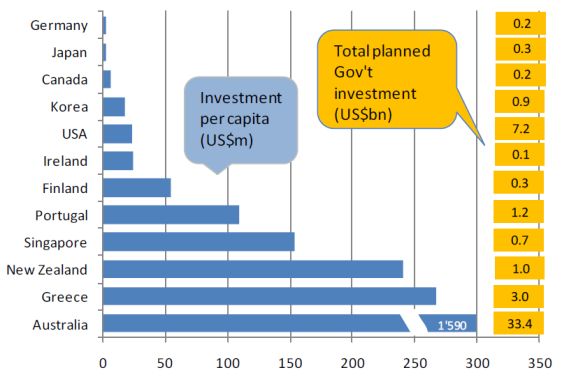
two countries are among the highest per-capita investors in the OECD in terms of use of public funds
for broadband deployment as can be seen in Figure 4.
11Figure 4. Government investment on broadband (Taken from Kelly et al. 2009)
5.1. Incentives for infrastructure growth and uptake
Several governments have stated their visions for the deployment of broadband infrastructure.
But besides stating a clear vision government initiatives need to strongly support themselves on the
design of investment incentives and the promotion of broadband use27. New Zealand has put
forward two initiatives to develop broadband infrastructure in the country: the UltraFast Broadband
network (UFB) and the Rural Broadband Initiative (RBI)28. The LFCs that build the UFB were created
after the government provided the incentives that would attract private investors that see in
government’s role a vehicle for risk and uncertainty attenuation. This is a key aspect that aims to
diminish some of the obstacles NZ entrepreneurs objected to when seeking to become
partners. PPPs have played a key factor for the deployment of broadband networks by exploiting a
relationship of mutual benefit to each party. An incentive scheme has been designed into the fibre
network plan by which the public partner will fund the cost incurred by the private partner to
connect end users; then, during the ten-year concession period the government expects that this
mechanism will see the private partner progressively buy out a significant portion of the public
partner’s shares in the joint venture. During the concession period, the private partner will receive
all of the dividends paid by the joint venture from its operating profits.
Policy aimed for broadband uptake and use needs also be developed. In an open access
broadband network policy-makers enable an environment for participation and demand in terms of
the access to the network29 when access to the network is priced below cost or at no charge at all.
27
Gómez-Torres, L. M., & Beltrán, F. “Analysis of an integrated plan for expanding broadband access in
Colombia”Telecommunications Policy, 2011,35(9-10), 871-882.
28
MED Ministry of Economic Development.Invitation to Participate. October 2009.
29
Kim, Y., Kelly, T., and Raja, S. “Building broadband: Strategies and policies for the developing world, Global
Information and Communication Technologies (GICT) Department” 2010, World Bank.
12As both country-cases studied in this chapter attest it, access to the platform by end-users is at no
cost in Australia (see Table 1) and at no one-off wholesale connection charge for residential
consumers in New Zealand.30
5.2. Broadband policies on service creation and application development
Three stages of service development are regularly identified, namely, promotion, oversight, and
universalization31. In New Zealand’s UFB incentives for the promotion of services are found in
preferred prices or pricing scheme for provision of broadband networks to schools and other priority
users. Government practices a hands-off approach by which intervention is only justified when
market is not able to deliver. New Zealand’s Digital Strategy 2.0 proposes a widening of digital access
to government services and an improved, new stage of development and improvement of local
digital content; additionally the plan also foresees actions to assure creators and investors an
adequate intellectual property legal framework.
5.3. Open access, network neutrality and discrimination
The Internet was designed as an open network with “no gatekeepers over new content or
services”32, its layered end-to-end architecture placing network intelligence at the edges rather than
at the core. Such technical features are the sources of the wide range of services and innovative
offers only possible by avoiding central control and by incentivizing innovation at the edges. Same
principle applies to the UFB and NBN. While incumbent telephone companies have not traditionally
interested in providing an open access platform, the fibre-based broadband networks have been
conceived as a level playfield in which service providers cannot be refused access.
One of the questions raised by open access to a third-party infrastructure is the extent of the
operator’s involvement in the provision of services in a way that service providers end up competing
with the network’s owner. Both Australia and New Zealand have mandated that for a period of
several years (in Australia until 2020, in New Zealand until 2019) the network operators cannot
30
CFH“Fact Sheet: Agreement with Enable Networks”, 2011, Retrieved from
http://www.crownfibre.govt.nz/media/13092/fact%20sheet%20-%20agreement%20with%20enable%20netw
orks.pdf.
31
Kim et al.
32
Cerf, V. G. “U.S. Senate Committee on Commerce, Science, and Transportation hearing on network
neutrality”, 2006.
13provide retail services directly. Therefore in those countries open access is complemented with an
explicit mandate that forbid end-user service provision by network operators.
Concerned with open access, innovators, end-user application developers, and the public in
general understand the virtues of open access to Internet. Since the platform allows the provision of
Internet-based services the network neutrality debate will start to occupy a particular place in the
efficient functioning of both UFB and NBN. The network neutrality principle proposes that no
operator can discriminate against content or traffic that travels on its network or against particular
websites and devices used to access the Internet. Forbiddance on network operators alleviates
network neutrality concerns, at least for the period over which no network owner is allowed to be a
retailer.
Under network neutrality, all traffic is treated equally, and discrimination and prioritisation are
prohibited. Network neutrality opponents warn of the possible efficiency losses incurred by
imposing a uniform regime on traffic management on all providers under any circumstance. In other
words, the critics inquire about the role of traffic discrimination as a possible welfare enhancer; they
claim that allowing providers to offer a menu of options by which users are price-discriminated may
have the ability to increase network operation efficiency.
The latter raises the question: in a broadband environment, which forms of network
33
discrimination are appropriate? . Any form of traffic discrimination is subject to debate. As
providers respond to different consumers’ tastes by offering different sets of service attributes,
consumers may benefit from having a wide variety of services that closely match their preferences.
Given the multiproduct nature of telecommunication service provision, retailers will find it to
their advantage to perform a sort of network management deemed as “non-neutral”. Two
non-neutral network policies are usually mentioned: 34 application-based and source-based
discrimination. Application-based discrimination is the prioritisation or discrimination of traffic
based on the type of content or application. Under source-based discrimination, traffic is prioritised
or discriminated based on its source, that is, the identity of a network user serves as the
prioritisation, or discrimination, criterion. Network providers are able to assign priority levels to
individual network users. They may find it appealing to execute price discrimination, and charge
33
Commerce Commission New Zealand “High speed broadband services demand side study”, 2011, Issues
paper 1: technical issues. December.
34
Federal Trade Commission, 2007, Broadband connectivity competition policy.
14differently for prioritised and non-prioritised network services 35 . Many scholars argue that
source-based discrimination may lead to a superior allocation of network capacity and network
cost36. Others argue that it may result in a strong redistribution of market power in favour of
network providers, which these would then use to exploit network users37. Regulators generally
perceive it as anticompetitive.
6. Conclusion
By design the new broadband platforms are open access, high-speed networks with no
obviously apparent competition in the wholesale access market. Agreements have been reached by
which wholesale prices have been effectively locked-up for a number of years, providing a degree of
regulatory certainty to the investors on the wholesale market as well as on the retail side. In both,
Australia and New Zealand, such regulatory certainty is an outcome of public debate and pressure
exerted by diverse actors via the competition watchdogs. In fact the concerned bodies, ACCC in
Australia and the Commerce Commission in New Zealand, have advised and challenged NBN Co and
CFH, respectively, on modifications or changes to proposed undertakings.
The dominant incumbents, Telecom in New Zealand and Telstra in Australia will focus their
efforts on continuing their current market dominance in the copper-based broadband market as
long as the full turnover to fibre access is still not completed. Meanwhile they start to cooperate for
mutual benefit with the main players in the current traditional media and TV sector.
The main questions raised by the new landscape provided by NBN and UFB refer to the
structure of markets once RSPs start to aggressively target consumers and compete for providing
bundles of services. Stakes are high in both countries as their respective fibre-based
telecommunications platforms are expected to deliver conditions that will propel the markets for
telecommunications services into greater contributors to economic growth.
35
Peha, J. “The benefits and risks of mandating network neutrality, and the quest for a balanced policy”, 2007,
International J. of Communication 1, 644–668.
36
Becker, G., Carlton, D., Sider, H. “Net neutrality and consumer welfare”, 2010, J. of Competition Law and
Econ. 6(3), 497–519.
37
Peha.
15References
Australian Government, “National Digital Economy Strategy”, 2011, accessed Sep. 29, 2012,
http://www.nbn.gov.au/files/2011/05/National_Digital_Economy_Strategy.pdf
Battersby, L. “Tower ban regions face slower broadband”, The Sydney Morning Herald, Jan. 18, 2012,
accesed Mar. 19, 2012
http://www.smh.com.au/it-pro/government-it/tower-ban-regions-face-slower-broadband-20120118-1q59y.ht
ml .
Battersby, L.“Telstra in 30-year NBN deal”, The Age, Mar. 7, 2012, accessed Apr. 17, 2012,
http://www.theage.com.au/business/telstra-in-30year-nbn-deal-20120307-1ukij.html
Becker, G., Carlton, D., Sider, H. “Net neutrality and consumer welfare”, 2010, J. of Competition Law and
Econ. 6(3), 497–519.
Cerf, V. G. “U.S. Senate Committee on Commerce, Science, and Transportation hearing on network
neutrality”, 2006.
CFH. Fact Sheet: Agreement with Enable Networks, 2011, accessed Sept. 29, 2012,
http://www.crownfibre.govt.nz/media/13092/fact%20sheet%20-%20agreement%20with%20enable%20netw
orks.pdf.
CFH, “Ultra Fast Broadband in Business - Seizing the Opportunity”, 2010, accessed May 22, 2011,
http://www.crownfibre.govt.nz/media/9669/ultra%20fast%20broadband%20in%20business%20-%20seizing%
20the%20opportunity.pdf
Given, J. “Take your partners: public private interpaly in Australian and New Zealand plans for next
generation broadband”, 2010,Telecommunications Policy, 34, 540-549.
Kim, Y., Kelly, T., and Raja, S. “Building broadband: Strategies and policies for the developing world, Global
Information and Communication Technologies (GICT) Department”, 2010, World Bank.
Kelly, T., Mulas, V., Raja, S., Zhen-Wei, Q., & Williams M. “What role should governments play in
broadband deployment?, 2009, “infoDev/OECED Workshop on Policy Coherence in ICT for Development, Paris,
September 2009.
Gomez-Torres, L. M., & Beltrán, F. (2011). “Analysis of an integrated plan for expanding broadband access
in Colombia”, 2009, Telecommunications Policy, 35(9-10), 871-882.
MED Ministry of Economic Development.Invitation to Participate. October 2009.
Milner, M.“Playing the Telecommunications Game in New Zealand”, 2012, Telecommunications Journal of
Australia, 59, 17.
NBN Co, “Corporate Plan 2011- 2013”, 2010, accessed Sep. 29, 2012,
http://www.nbnco.com.au/assets/documents/nbn-co-3-year-gbe-corporate-plan-final-17-dec-10.pdf
NBN Co, “NBNCo Technical Dicussion Paper (multicast)”, accessed Apr. 28, 2012,
http://www.nbnco.com.au/assets/documents/nfas-technical-discussion-paper-multicast.pdf
NBN Co, “NFAS Traffic Class Performance” Discussion Paper, accessed Apr. 26, 2012,
http://www.nbnco.com.au/assets/documents/traffic-performance-whitepaper-dec-2011.pdf
NBN Co, “Wholesale NBN Co Fibre Access Service. Product Overview Fibre Access Services”, 2010,
16accessed Sep. 29, 2012, http://www.nbnco.com.au/assets/documents/product-overview-fibre_1_03_final.pdf
Peha, J. “The benefits and risks of mandating network neutrality, and the quest for a balanced policy”,
2007, International J. of Communication 1, 644–668.
Rudd, K., “The global financial crisis”, The Monthly. 42 (February), accesed Apr. 28, 2012,
http://www.themonthly.com.au/node/1421 .
World Bank (2009). “Information and Communications for Development 2009: Extending Reach and
Increasing Impact”, accessed April 28, 2012,
http://web.worldbank.org/WBSITE/EXTERNAL/TOPICS/EXTINFORMATIONANDCOMMUNICATIONANDTECHNOL
OGIES/EXTIC4D/0,,contentMDK:22229759~menuPK:5870649~pagePK:64168445~piPK:64168309~theSitePK:5
870636,00.html
17You can also read


