The Effects of Face Coverings and Remote Microphone Technology on Speech Perception in the Classroom
←
→
Page content transcription
If your browser does not render page correctly, please read the page content below
The Moog Center for Deaf Education

The Effects of
Face Coverings and Remote
Microphone Technology on
Speech Perception
in the Classroom

Amanda M. Rudge, Ph.D.
Valerie Sonneveldt, Au.D., CCC-A, FAAA
Betsy Moog Brooks, Ed.D., CED, LSLS Cert. AVEd

arudge@moogcenter.org || www.moogcenter.org ||   ||314-692-7172
The Effects of Face Coverings
                                                  and Remote Microphone
                                                    Technology on Speech
                                              Perception in the Classroom
                                                                                                Amanda M. Rudge, Ph.D.
                                                                                  Valerie Sonneveldt, Au.D., CCC-A, FAAA
                                                                         Betsy Moog Brooks, Ed.D., CED, LSLS Cert. AVEd

Introduction
Many schools across the nation, including those which      sound qualities when paired with face coverings (Dyre,
serve individuals who are deaf or hard of hearing, are     2020; Gordey, 2020). These systems, such as Phonak’s
planning to open in various capacities for face-to-face    digital Roger technology, are designed to improve the
lessons in the fall of 2020 or sooner. For all children,   listener’s access to a quality signal regardless of the
especially those who utilize cochlear implants and/or      distance from the talker or the environment’s acoustics
hearing aids to communicate, access to quality             by having the talker wear a microphone that wirelessly
auditory information is critical for speech perception     transmits his/her voice to a receiver coupled to and/or
and learning.                                              integrated into the listener’s hearing device. While the
                                                           data available in this area are sparse, studies have
At present, there is a dearth of information about the     been limited to clinical settings with testing occurring
impact of personal protective equipment on a listener’s    in close quarters of 3 feet or in sound-treated booths
ability to perceive speech. There exist several options    with recorded speech stimuli. There exists no data from
for face coverings to help slow the spread of the novel    real-life settings, such as a classroom with social
coronavirus, COVID-19, in enclosed spaces, including       distancing measures of at least 6-feet separation in
N95 respirators, surgical masks, cloth masks, cloth        place.
masks with clear windows, and face shields. Initial
findings from leaders in hearing healthcare indicate       To begin meeting the need for functional classroom
that masks of any kind are attenuating speech sounds,      outcomes, the Moog Center for Deaf Education
with particularly diminished quality of higher frequency   investigated how variations of face coverings, used
sounds, which largely contribute to meaning in             with and without a Phonak Roger personal remote
language (Dyre, 2020; Goldin, Weinstein, & Shiman,         microphone digital modulation (DM) system, affect
2020; Gordey, 2020). Additionally, preliminary evidence    speech perception in a classroom environment using
indicates that personal remote microphone (RM)             monitored live-voice while separated with 6 feet
systems can alleviate some of these diminished             between listener and speaker.

 The Moog Center for Deaf Education                                                          Face Coverings White Paper
                                                                                                   August 2020
Participants in this study included 15 adults with
                                                                hearing thresholds in the normal range (25 dB HL or

The Study                                                       better) across octave frequencies of 250 – 8000 Hz in
                                                                each ear, as evaluated in a sound-treated booth at the
                                                                Moog Center on the day of the speech perception
                                                                testing. Speech perception assessment was
The primary objective of this project was to document           conducted in an unoccupied classroom at the Moog
the differences in speech perception abilities of adults        Center using the Consonant/Nucleus/Consonant (CNC)
with normal hearing when listening to monitored live-           Test (Peterson & Lehiste, 1962). This assessment
voice from a speaker who was 6 feet away in nine                contains 50 monosyllabic words (e.g., merge, seize,
various listening conditions, including four variations of      yearn, etc.) which exhibit phonemic distributions
face coverings with and without remote microphone               proportional to the structure of CNC words which occur
technology, as well as a baseline condition of no face          with minimal frequencies of one per million in
covering and no remote microphone.                              agreement with the Thorndike and Lorge frequency
                                                                count (Thorndike & Lorge, 1944).
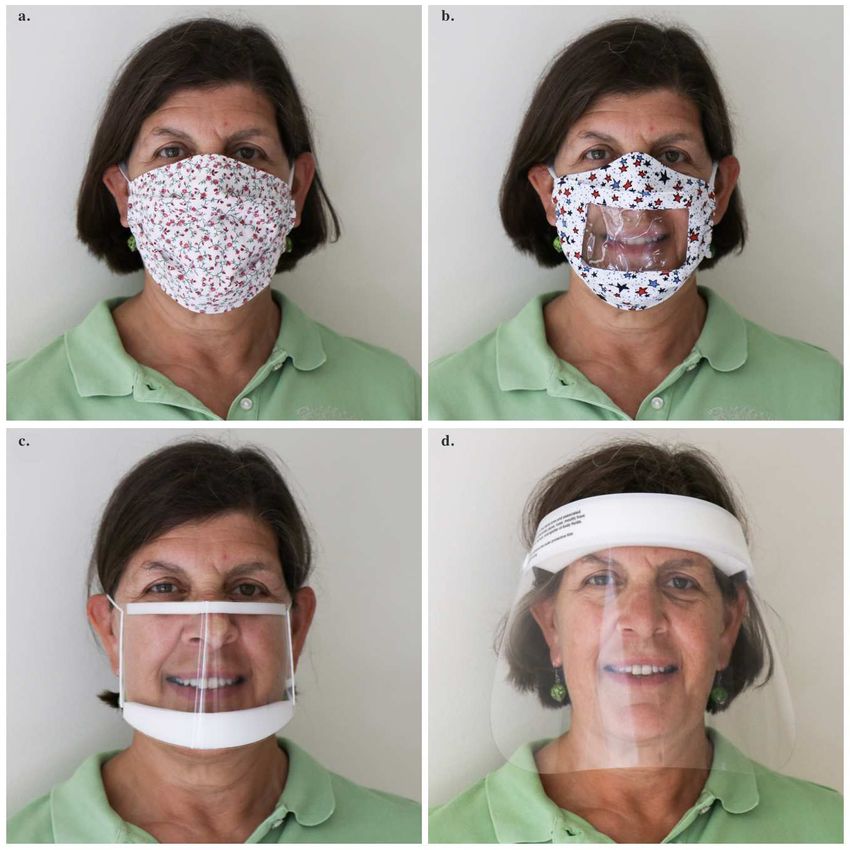
The figure below depicts the various types of face
coverings used in the test conditions for this project.         The assessment was administered by a teacher of the
                                                                deaf using monitored live-voice, seated at the CDC’s
a.   Cloth mask                                                 recommended social distancing guideline of 6 feet
b.   Windowed cloth mask                                        from the participant (CDC, 2020). The same teacher
c.   Fully transparent ClearMaskTM                              presented the words for all participants and trained to
d.   Face shield                                                maintain a vocal output of approximately 60 dB SPL, as
                                                                measured by a sound pressure level meter at the
                                                                listener’s ear in the baseline condition (no face
                                                                covering, no remote microphone). Participant
                                                                responses were recorded by the speaker and scored on
                                                                the number of words repeated correctly. A full and
                                                                randomized word list was presented in each of the
                                                                following nine listening conditions:

                                                                    1. Baseline: No face covering / No remote
                                                                       microphone
                                                                    2. Cloth mask / No remote microphone
                                                                    3. Cloth mask / With remote microphone
                                                                    4. Cloth mask with clear window / No remote
                                                                       microphone
                                                                    5. Cloth mask with clear window / With remote
                                                                       microphone
                                                                    6. Fully transparent ClearMaskTM / No remote
                                                                       microphone
                                                                    7. Fully transparent ClearMaskTM / With remote
                                                                       microphone
Figure 1. Four variations of face coverings investigated both       8. Face shield / No remote microphone
with and without remote microphone technology. These
variations were selected based on commercial availability and       9. Face shield / With remote microphone
likelihood of use in classroom settings.

The Moog Center for Deaf Education                                                           Face Coverings White Paper
                                                                                                   August 2020
The Study: Results
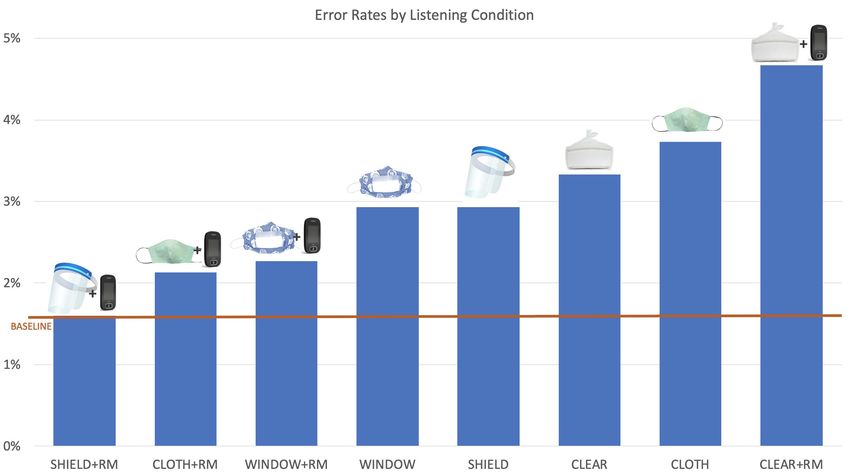
For conditions utilizing the remote microphone (RM)                        Descriptive analysis identified the mean baseline (no
system, the speaker wore a Phonak Roger Touchscreen                        face covering, no RM) speech perception error rate to
transmitter positioned 6 inches below the mouth,                           be under 2%. When comparing the baseline to other
while participants wore Phonak Roger Focus receivers                       face covering conditions, it was discovered that the
set to default gain values (EasyGain = 0) at the right                     highest error rate (M = 5%) occurred when listening to
and left ears with open dome eartips. To evaluate the                      a speaker who wore the ClearMaskTM and RM together.
effect of the face coverings and RM system use on                          The lowest error rate (M = 1.6%) occurred when
speech perception abilities alone, participants were                       listening to a speaker who wore a face shield and RM
instructed to close their eyes or divert their gaze from                   together. This error rate was nearly identical to the
the speaker’s mouth and face during all conditions,                        baseline no face covering, no RM condition. The speech
including those in which the speaker’s lips were                           perception error rates for each of the listening
visible.                                                                   conditions compared to the baseline are presented in
                                                                           Figure 2.

          Figure 2. Percentage of speech perception error as measured by the CNC test in nine variations of face covering
          conditions, including the baseline condition of no face covering and no remote microphone (RM) represented by the
          orange horizontal reference line.

The Moog Center for Deaf Education                                                                               Face Coverings White Paper
                                                                                                                       August 2020
The Study: Results
To assess whether significant differences existed in Additionally, the two listening conditions with the
speech perception error rates among listening highest speech perception error rates, Cloth alone and
conditions, a repeated-measures analysis of variance ClearMaskTM with RM, also were significantly different
(ANOVA) with one within-subjects factor was than the baseline condition (p = .37, Cohen d = 0.72;
conducted. The main effect for the within-subjects p = .15, Cohen d = 1.05, respectively). Table 2
factor was revealed to be significant across listening displays the complete pairwise comparison results.
conditions at the α = 0.10 level F(8, 134) = 1.93,
p = .062, indicating that there were significant
differences between the listening condition values of
the baseline condition of no face covering and no
remote microphone (RM), cloth mask alone, cloth
mask with RM, ClearMaskTM alone, ClearMaskTM with
RM, windowed mask alone, windowed mask with RM,
face shield alone, and face shield with RM. Table 1
presents the ANOVA results.
After confirming the presence of significant difference
in speech perception across listening conditions
through ANOVA, multiple comparison tests were
administered using pairwise t-tests with Tukey’s HSD
procedure to determine the extent of the difference
between each condition. Two of the face coverings
paired with remote microphones were revealed to
facilitate significantly better speech perception
abilities than their non-RM counterpart conditions:
shield alone compared to shield with RM (p = .05,
Cohen d = 0.48), and cloth alone condition compared
to Cloth with RM (p = .05, Cohen d = 0.58).
The Moog Center for Deaf Education Face Coverings White Paper
August 2020Discussion
When compared to baseline error rates, face coverings could supplement the acoustic signal through visual
appeared to have variable effects on speech access to the mouth and face. These findings agree
perception abilities depending on the type of covering with expected benefits of remote microphone system
utilized and the presence/absence of remote use for improving access to the primary speech signal.
microphone system use. While the introduction of a
cloth mask by itself did not yield any significant Use of the RM did not always result in improved
statistical change in performance for this particular performance, however. Specifically, RM use with the
group, study participants commented that they had to ClearMaskTM yielded significantly poorer performance
work harder to listen when the speaker was masked. than all other test conditions. As the purpose of the RM
Given the less-developed auditory systems and limited is to make the primary speech signal more audible (i.e.,
lexicons of children, it is likely that the deleterious louder) to the listener, it is hypothesized that the
impact on children’s speech perception abilities would signal (sound exiting the mask and picked up by the
be more notable, particularly for children who are deaf microphone) underwent greater distortion with the
or hard of hearing. ClearMaskTM than the cloth mask, as demonstrated by
opposing effects on error rates (see Figure 2). When
For example, participants commented throughout the the signal entering the RM is not interrupted by the
listening task that what they perceived was a non- facial covering, such as with the face shield,
sensical word, but would offer an alternate, similar- performance increases as expected with RM use.
sounding word that was more likely to be the actual
spoken word. As children typically possess less robust While it is true that clear face masks can be
lexicons, it is less likely that they would be able to advantageous for lip reading, these findings alert the
self-correct in the same way as adults when presented reader to consider the impact of the facial covering on
with an unfamiliar or non-sensical word. This would be the auditory signal for each child, the importance of
an even greater issue for young children in a typical assessing which covering might yield the best
classroom setting who not only are exposed to new listening condition for any particular child, and whether
vocabulary frequently, but also often are listening in the RM is enhancing or distorting the auditory signal.
background noise from distances greater than 6 feet. To determine the best listening condition, a functional
It is likely that the speaker’s speech signal would listening assessment can be accomplished by reading
become less robust with increased distance, which a list of 25 minimally contrasting single-syllable words
would consequently present additional listening and tracking the number of words the child is able to
challenges, particularly for children who already perceive correctly with and without the remote
experience degraded auditory input (i.e., children who microphone technology paired with the face covering.
are deaf or hard of hearing and utilize assistive One also could utilize the Functional Listening
listening technology). Evaluation (FLE) available through Phonak for a more
objective measure of listening ability in a student’s
Importantly and positively, this study found that the everyday environment (Johnson, 2013).
incorporation of a remote microphone (RM) system
yielded a significant increase in performance when For classrooms that utilize frequency modulated (FM)
paired with a cloth mask or a face shield. The face systems rather than DM remote microphone systems,
shield with RM listening condition was revealed to be a functional listening assessment would be of equal or
identical to the baseline (no face covering, no RM) greater importance given the increased susceptibility
condition. Additionally, both fabric mask conditions of FM systems to interference. When the child has the
paired with remote microphone technology (the cloth language to report on his/her listening conditions, the
mask with RM and windowed mask with RM) were child’s feedback regarding sound quality also is likely
statistically similar to the baseline. Although this to be valuable.
study investigated auditory-only conditions, it is
possible that the face shield and windowed mask
The Moog Center for Deaf Education Face Coverings White Paper
August 2020In order to eliminate the potential for decreased speech perception abilities as demonstrated
with the ClearMask , while at the same time providing increased protection from airborne
TM
particles, a modified face shield paired with an RM will be utilized by all teachers and staff at
the Moog Center when returning to school in August. The modified face shield includes an
apron made of layered fabric, which allows staff to curb transmission of viral droplets (WHO,
2020). More information related to the modified face shield with apron can be found in the
appendix.
As school personnel navigate new guidelines for protecting the health and safety of teachers
and students while needing to meet the educational needs of the children, quality access to
classroom instruction presented orally is essential, particularly for students who are deaf or
hard of hearing. When considering personal protective equipment for teachers to use in the
classroom, thought must be given not only to the amount of visual access provided by the
facial covering material, but also to the impact of that material on sound quality provided to
the listener and how it is impacted by remote microphone use.
Important Findings and Considerations
Perception of speech from a Children with underdeveloped
teacher who wore a face shield lexicons are likely to struggle
with a remote microphone was more than adults when
nearly identical to perception listening to a speaker wearing
from the baseline condition. a face covering.
Perception of speech from a Functional listening
teacher who wore a ClearMaskTM assessments can be
with a remote microphone was implemented easily in the
significantly poorer than classroom environment to
perception both from the same determine a best listening
mask without remote microphone condition for any particular
and from the baseline condition. child.
The Moog Center for Deaf Education Face Coverings White Paper
August 2020Acknowledgments
This work is a collaborative effort made possible by the teamwork, input, and participation
of many outstanding individuals at the Moog Center. The success of this study is in large
part due to the teachers, staff, and friends of the Moog Center who agreed to participate
in the investigative tasks associated with this project. We are grateful for their time and
contributions. Additionally, the authors are incredibly appreciative of the Moog Center's
dedicated team of audiologists, including Amy Birath, Megan Brockmeier, and Beth
Holstad, who were invaluable sources of inspiration, feedback, and assistance in the
development of this time-sensitive project.
Contact Us
The Moog Center for Deaf Education
www.moogcenter.org
arudge@moogcenter.org
Face Coverings White Paper
August 2020References
Centers for Disease Control and Prevention [CDC]. (2020). Social Distancing: Keep a safe
distance to slow the spread. Retrieved from https://www.cdc.gov/coronavirus/2019-
ncov/prevent-getting-sick/social-distancing.html
Dyre, L. (2020, June 10). Overview on the effects of masks on speech acoustics. Webinar
presented on behalf of Phonak via Webex. June 11, 2020.
Goldin, A., Weinstein, B., & Shiman, N. (2020). How do medical masks degrade speech
perception? The Hearing Review, 27(5), 8-9.
Gordey, D. (2020, June 17). How do face masks & shields impact audibility and remote
microphone system use? Webinar presented on behalf of Oticon via Adobe Connect.
Johnson, C. (2013). Functional listening evaluation (FLE). Sonova Phonak. Retrieved from
https://www.phonakpro.com/content/dam/phonakpro/gc_hq/en/resources/counseling_
tools/documents/child_hearing_assessment_functional_listening_evaluation_fle_2017
.pdf
Peterson, G. E., & Lehiste, I. (1962). Revised CNC lists for auditory tests. The Journal of
speech and hearing disorders, 27, 62–70. https://doi.org/10.1044/jshd.2701.62
Thorndike, E. L., & Lorge, I. (1944). The teacher's word book of 30,000 words. Bureau of
Publications, Teachers College. Columbia University, New York.
World Health Organization [WHO]. (2020). Advice on the use of masks in the context of
COVID-19. Retrieved from https://www.who.int/publications/i/item/advice-on-the-use-
of-masks-in-the-community-during-home-care-and-in-healthcare-settings-in-the-context-
of-the-novel-coronavirus-(2019-ncov)-outbreak
The Moog Center for Deaf Education Face Coverings White Paper
August 2020You can also read


