The European Baccalaureate Handbook: A Guide for European Baccalaureate Candidates - Schola Europaea Office of the Secretary General - Schola ...
←
→
Page content transcription
If your browser does not render page correctly, please read the page content below
Schola Europaea
                              Office of the Secretary General
                                              European Baccalaureate Unit

                                  The European
                                  Baccalaureate
                          Handbook: A Guide for
                         European Baccalaureate
                                    Candidates

Information and advice for pupils entering the European Baccalaureate cycle
                           Last updated: 12/09/2019

The European Baccalaureate Handbook: A Guide for European Baccalaureate Candidates

Contents

I.          Introduction and Disclaimer .............................................................................................. 4

II.         Legal notice ................................................................................................................... 4

III.        Choices for s6 and s7...................................................................................................... 5

III.        A - Choosing your Subjects for the European Baccalaureate Cycle                            ....................................... 5
III.        B - Choosing your European Baccalaureate Examinations ................................................... 9

IV.         University Applications: Dossier Management                   .................................................................. 11
V.          Weighting of Subjects and Examinations.......................................................................... 11

VI.         Registration Procedure .................................................................................................. 13

VII.        Additional Written Examinations             ..................................................................................... 13
VIII.       Helpful Notes and Tips to Prepare for your Examinations ................................................... 14

IX.         Guidelines for Written Examinations ................................................................................ 17

X.          Guidelines for Oral Examinations .................................................................................... 20

XI.         Special Arrangements ................................................................................................... 23

XII.        Plagiarism ................................................................................................................... 23

XIII.       Cheating...................................................................................................................... 26

XIV.        Receiving your European Baccalaureate Results .............................................................. 26

XV.         Reminder of Important Dates.......................................................................................... 27

XVI.      Appeals ......................................................................................................................... 28

XVII. Alumni ........................................................................................................................... 28

XVIII. Annexes ....................................................................................................................... 29

XIX.      Bibliography ................................................................................................................... 34

                                                                                                                                                   Contents
The European Baccalaureate Handbook: A Guide for European Baccalaureate Candidates

 I. Introduction and Disclaimer

 This handbook is designed to help you during the European Baccalaureate cycle,
 i.e. s6 and s7. It offers some tips and guidelines, but in no way replaces the
 European Baccalaureate regulations contained in the following two documents:

  1.   the “Regulations for the European Baccalaureate”

  2.   the “Arrangements for Implementing the Regulations for the European
       Baccalaureate”
 Make sure to read carefully the latest version of these documents available
 on the European Schools’ website http://www.eursc.eu
 This handbook is not part of the legal basis of the European Schools.

 Some information given in this handbook may not be relevant to all Accredited
 European Schools due to specific local arrangements.

 II. Legal notice

 Please, note that when you turn 18, it is your own responsibility to sign all
 the relevant documents and forms you receive. If you are under 18, this
 must be done by your legal representative(s).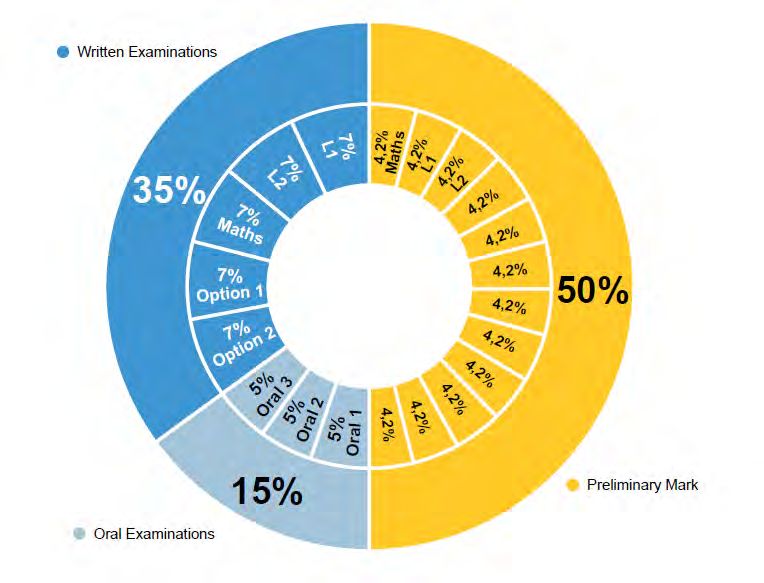
The European Baccalaureate Handbook: A Guide for European Baccalaureate Candidates
III. Choices for s6 and s7
III.A Choosing your Subjects for the European Baccalaureate Cycle
Careers advice
The European Schools organise careers guidance sessions during s5. These sessions are aimed at
helping you make the right subject choices for s6 and s7 that will allow you to continue later in the
post-secondary studies you wish to follow.
In some schools, tests to measure professional and academic aptitudes are organised in s5. Take
those tests seriously, as they may give you some new information.
Some schools organise “University fairs” where higher education institutions set up information stands
and give presentations about their education offers and application systems. It is strongly advised that
you attend those events at your school, or other similar ones organised outside your school for the
general public.
Some countries send national careers advisors to the European Schools in order to provide relevant
information about their higher education offers. Other countries also offer the possibility of contacting
national career advisors through electronic means (e.g.: email, video conference). It is strongly
recommended that you participate in these initiatives. In any case, contact your school’s careers
advisors and teachers for guidance.
The careers guidance syllabi are available on the European Schools’ website http://www.eursc.eu
Some aspects to consider
1.- The University course you would like to study 2.- Your level of competence when you sign up
or the professional field in which you would like to for a subject. Consider the level you attained and
work and therefore the subjects required or the marks obtained in the subject in previous
recommended for this field, and at which level. years and check the level you are expected to
attain at the end of s7. Consult the syllabus of the
subject and the attainment descriptors.
3.- If you are unsure for the moment about what Please, be aware that:
subjects to take, it is advisable that you choose
subjects you like and are good at. Choose You cannot take a subject in s6 if your
subjects that will give you a strong general results show that you have not been
education and the best chances to be awarded following it satisfactorily in s4 and s5.
the European Baccalaureate with the best final (Article D.3.4 Point e) from the ‘Digest of
mark. the Decisions of the Board of Governors
of the European Schools, 43rd edition’)
If you chose a subject which you have
4.- Take as much time as you need to reflect on not studied in s4 or s5, you will be
this and discuss your choices with your parents, assessed before the start of s6 to make
teachers and your school’s careers advisors. sure you have the right aptitudes to
allow you to progress successfully.
05
The European Baccalaureate Handbook: A Guide for European Baccalaureate Candidates

  Number of periods
  The minimum number of periods is 31, out of which at least 29 must be from compulsory subjects
  and the options in column 3 (see the table below).
  The maximum number of periods is 35. Exceptionally, 36 periods may be allowed by the Director of
  the school following a recommendation of the class council.
  Note that if you choose only two 4-period options, these will have to be taken as the two written
  examinations along with L1 (or Advanced L1), L2 (or Advanced L2) and Mathematics. Choosing more
  than two 4-period options will therefore give you more flexibility to choose your European
  Baccalaureate examinations later.

  Subjects and choice structure

                                                                                                     COMPLEMENTARY
         COMPULSORY SUBJECTS                                        OPTIONS
                                                                                                            SUBJECTS5
       Column 1                Column 2                  Column 3                   Column 4                Column 5

L1                 4p Biology1                2p Ancient Greek         4p Advanced L1            3p Biology Lab6           2p
L2                 3p   Geography2            2p Latin                 4p Advanced L2            3p Chemistry    Lab6      2p
                        History2              2p Biology               4p Adv.     Maths4        3p Physics   Lab6         2p
Maths 3            3p   Philosophy2           2p Chemistry             4p                            ICT                   2p
or                                               Physics               4p                            Sociology             2p
Maths 5            5p                            Geography             4p                            Intro Economics       2p

                                                 History               4p                            Art7                  2p
Religion or                                      Economics             4p                            Music7                2p
Ethics             1p                            Philosophy            4p                            L57                   2p
                                                 ONL3                  4p                            …                     2p
P.E.               2p                            L3                    4p
                                                 L4                    4p
                                                 Art                   4p
                                                 Music                 4p

                        1Biology                  3If ONL is chosen,        4Advanced                5The catalogue of
                                 2p is                                                  Maths
                        compulsory                L4 cannot be              can only be chosen       complementary
                                                                                                     courses varies
                        unless Physics            chosen.                   together with Maths      from one school to
                        or Chemistry or                                     5 periods in column 1.   another
                        Biology is chosen in
                                                                                                     6Laboratory subjects
                        column 3
                                                                                                     must only be taken if
                        2Allcourses in                                                               the corresponding 4
                        column 2 must be                                                             period subject has
                        taken if not chosen                                                          been chosen.
                                                                                                     7
                        in column 3.                                                                  Art 2p, Music
                                                                                                     2p and Intro to
                                                                                                     Economics 2p not
                                                                                                     allowed if taken in
                                                                                                     column 3.

                                                            06
Language subjects
No language can be studied at more than one level but you can take the advanced
course of the same level (e.g.: You cannot have L2 English and L3 English but you
can have L2 English and Advanced L2 English)
When entering s6, it is also possible to change your L2 (English, French or German)
to any other European Union language taught at the European Schools, provided
that a minimum number of pupils at the same school request it. The host country
languages of the European and Accredited Schools are often chosen and organised
as a new L2 for s6 and s7.
A change of L2 is only allowed if you can prove that you have the required language
competences.
When you change your L2, you must still continue studying History, Geography and
Economics in your former L2 (English, French or German) during the s6-s7 cycle.
You can also change the level of a language studied when entering s6 (for example:
L3 L4). If you are changing from a lower to a higher level, you must also prove
that you have the required language competences that will allow you to follow the
subject successfully.
Language changes need to be approved by the Director of the school on a
recommendation of the class council.
Choice procedure
In most schools, an initial survey is carried out to find out which subjects will clash in
the timetable, in order to prepare a definitive choice form.
Some clashing of subjects in the timetable is inevitable since all subjects must be
arranged in a schedule of approximately 40 periods per week. This means that not
every combination of options will be possible.
Schools produce the definitive choice form by allowing combinations of subjects that
have been most frequently requested in the initial survey and which point clearly
towards specific education/career paths.
In the definitive choice forms, options and complementary courses that have not
reached the minimum number of pupils in the initial survey may disappear. (See
“Creation of options and complementary subjects”)
07
The European Baccalaureate Handbook: A Guide for European Baccalaureate Candidates

If an option has been created in several languages, you may not choose a different
language from the one that would correspond to you. For example, in your school
Philosophy 4 periods in Spanish and Philosophy 4 periods in English are offered in
the definitive choice form because in the first survey the minimum number of pupils
was reached. If you are in the Spanish section, you must take Philosophy in
Spanish. You are not allowed to take Philosophy in English. However, if an option
has not been created in the language that would correspond to you, you may take it
in a different language provided you are competent in it. Following the same
example, if you are in the French section, you may follow Philosophy 4 periods
either in English or Spanish, normally in the language in which your proficiency is
higher. In order to determine that, your language proficiency may be assessed.
It is very important that you hand in your choice forms on time so that your preferences
can be taken into account and to avoid any delays in the choice procedure.

Creation of options and complementary subjects
For a school to create an option in s6 the minimum number of pupils required is 5.
To create a complementary subject in s6 the minimum number of pupils required
is 7. Once the option or complementary subject has been created with the minimum
number of pupils, you will not be allowed to change or drop it at the beginning of s6.
However, changes can be made at the end of s6 when entering s7 (See below
“Changes in s7”)
If an option falls below the minimum number of pupils in s7 as a result of changes, it
cannot be closed but a reduction in the number of teaching periods or a grouping
may be applied. See Article XIX of the Digest of Decisions of the Board of
Governors of the European Schools “Group/class/options creation/division and
grouping rules” containing the rules and the possible derogations or exceptions.

Changes in s7
Starting a new subject in s7 is strictly forbidden.

Changes of language level between s6 and s7 are not allowed.

However, when entering s7 you can drop an option or a complementary
subject provided you retain the minimum number of periods required: 31
(out of which at least 29 between compulsory courses and options).

Article 4.2.1.2 of the “Arrangements for Implementing the Regulations
for the European Baccalaureate” states: “Only the following changes
of level are possible:
•Mathematics 5 ↔ Mathematics 3

•4-period option ↔ Compulsory 2-period course (same subject)

A change to a more advanced course (Mathematics 5 or 4-period
option) is conditional upon the passing of an attainment test
demonstrating the pupil’s ability to keep up successfully with the
requirements of the course requested.”
Changes of level in subjects need to be approved by the Director of
the school on a recommendation of the class council.

                                                      08
The European Baccalaureate Handbook: A Guide for European Baccalaureate Candidates

 III.B Choosing your European Baccalaureate Examinations

 Choosing your European Baccalaureate examinations is also very important. You
 will sit five written examinations and three oral examinations. The examinations
 will cover the s7 syllabus, but will also assess the competences (knowledge, skills
 and attitudes) acquired in previous years, especially those from year s6.
 Some higher education institutions make admission offers based on the subjects
 you have taken as European Baccalaureate examinations, and in some cases
 also on the marks obtained. Therefore, you should enquire about the
 requirements for the higher studies you wish to follow prior to making your
 choices. So, it is advisable to start this process in s6. Contact your school’s
 careers advisors and teachers for guidance.
 Please, note that once you have made your European Baccalaureate examination
 choices, these cannot be changed.
 See the following form regarding choices for the European Baccalaureate
 examinations.

                                               09
The European Baccalaureate Handbook: A Guide for European Baccalaureate Candidates

ANNEX 1                 European School:            Language section:    Surname and first name:
                   CHOICE OF EXAMINATIONS IN THE 20.... EUROPEAN BACCALAUREATE SESSION

                                                        Extra                                                                              Extra
                                            Language of                                                                        Language of
Written: 5 examinations Examination                     language Oral: 3 examinations                          Examination                 language
                                            examination                                                                        examination
                                                            (Art. 6.4.6.8.)                                                                   (Art. 6.5.1.3.)

        L1/Adv. 1.1                                                            1.    L1 or Adv. L1
  1.                                                                                 (compulsory)
        (compulsory)
                                                                                     L2 or Adv. L2
                                                                                     or History 2 p. or 4 p. (if not chosen as written examination)
        L2/Adv. L2                                                             2.    or Geography 2 p. or 4 p.
  2.
        (compulsory)                                                                 (if not chosen as written examination)

                                                                                     Advanced mathematics
 3.     Mathematics                                                                  (compulsory)
        3 p or 5 p.
                                                                                     or Biology 2p. or 4p.*
                                                                                     or Philosophy 2p. or
 4.     Option 4 p.                                                                  4p.* or Chemistry*
                                                                               3.    or Physics*
 5.     Option 4 p.                                                                  or Language 3* or Language 4* or ONL*

                                                                                     * only if the 4-p. option has not
        Additional                                                                   been chosen for the written
 6.     examination                                                                  examination
        (Art. 13)

Restrictions:
                                                                              Restrictions:
1. Written examinations 1 & 2
                                                                              1.    Examination 1: Language 1 or Advanced Language 1.
   Candidates who have chosen to follow an advanced
   course in Language 1 and/or in Language 2 will be                                Candidates who have followed the Advanced course will
   compulsorily examined on the subject matter of                                   be compulsorily examined on that course and not on the
   those courses and not on the subject matter of the                               basic course.
   corresponding basic course.
                                                                              2.    Examination 2: Language 2 or Advanced Language 2 or
                                                                                    Geography or History.
2. Written examinations 4 & 5 concern 4-period
   options. Possible options:                                                       Candidates who have followed the Language 2 Advanced
                                                                                    course and who wish to choose L2 for their second oral
      Latin 4p                       Economics 4p                                   examination will be required to sit an examination on that
      History 4p                     Art 4p                                         advanced course, and not on the basic course.
      Chemistry 4p                   L3 4p
      Ancient Greek 4p               Physics 4p                                     Candidates who do not wish to sit an oral examination in
      Geography 4p                   Music 4p                                       L2 (basic or advanced course) will sit an examination in
      Biology 4p                     L4 4p                                          History (2 or 4 periods) or Geography (2 or 4 periods). It is
      Philosophy 4p                  ONL 4p                                         possible for candidates to sit the History or Geography oral
                                                                                    examination only provided that they have not chosen to sit
                                                                                    the subject in question as a written examination.
3. An oral examination may not be taken in any of the
   subjects taken as one of written examinations 3, 4,5.                      3.    Examination 3:
                                                                                    Candidates who have followed the advanced course in
4. Candidates choosing the ONL may not choose L4.                                   Mathematics will be compulsorily examined on that
                                                                                    course. Candidates who have not followed the advanced
5. It is not permissible to be examined at two different                            course in Mathematics will be required to sit an
   levels in any one subject.                                                       examination from amongst the options listed above, which
                                                                                    they may choose freely, provided that they have not
                                                                                    already chosen to take the subject in question as a written
                                                                                    examination. Candidates choosing the ONL may not
                                                                                    choose L4.

Date and Signature of the legal representative(s) or of the pupil if he is not a minor:

                                                                               10
The European Baccalaureate Handbook: A Guide for European Baccalaureate Candidates
IV. University Applications: Dossier Management
If you want your school to help with your University application(s), please note that
there is a management fee to be paid to your school, which does not include other
fees that Universities may claim. Most schools will have a UCAS advisor to manage
the applications to UK universities and an APB (Admission PostBac) advisor to
manage applications to French Universities. Other schools may also have advisors
specialized in applications to universities in other European countries. Contact the
careers guidance coordinator at your school to know what the possibilities are.
If you are planning to apply to universities in the United Kingdom, you need to start the
UCAS process towards the end of s6. Get in contact with the UCAS advisor at your school
as soon as possible so that s/he can guide you. The deadline for all UCAS applications is
the 15th of January in your s7 academic year and the 15th of October for all applications
for medicine, dentistry, veterinary science as well as admissions to the universities of
Oxford and Cambridge. You must respect these deadlines if you want your application to
receive equal consideration as national applications.
If you are planning to apply for French universities, you need to follow the APB
(Admission PostBac) process. Get in contact with your APB adviser at your school so
that s/he can guide you. The deadline for APB is the 20th of March in your s7
academic year for all applications.
V. Weighting of Subjects and Examinations
The number of periods of a subject does not have an influence on its weight. The
value of the different subjects depends only on whether you take them as oral or
written examinations.
Note that the value of the five written examinations (7% per examination so 35% in
total) is higher than the three oral examinations (5% per examination, so 15% in total).
Remember that the pass mark in the European Baccalaureate is 6/10.
Visual representation of the weighting of the different assessments
in the European Baccalaureate
Preliminary Mark 50%
Oral Examinations 15%
Written Examinations 35%
11The European Baccalaureate Handbook: A Guide for European Baccalaureate Candidates
Visual Representation of mark weighting for a candidate with 12 subjects
Preliminary mark
The preliminary mark is given on your final school day before the European
Baccalaureate examinations. It is the average mark of all your subjects (except Ethics/Religion) and
comes from your class marks (A1 and A2 marks) and the marks achieved in your short and long Pre-
Baccalaureate examinations (B1 and some B2 marks). Please, note that the long Pre-Baccalaureate
examinations usually take place in January, two weeks after the Christmas holidays.
The overall preliminary mark’s weight is 40% for the A mark and 60% for the B mark. The preliminary
mark accounts for 50% of the final mark of the European Baccalaureate, so it is very important to
make a constant effort throughout the year.
A good preliminary mark will allow you to start your European Baccalaureate examinations with less
stress, so aim at the highest preliminary mark possible.
12The European Baccalaureate Handbook: A Guide for European Baccalaureate Candidates VI. Registration Procedure You must register for the European Baccalaureate before the 15th of October of your final school year (s7) by filling out the choice form attached in Annex I of the “Arrangements for Implementing the Regulations for the European Baccalaureate”. You must supply either the original or a certified copy of an official document with your personal particulars (birth certificate, certified photocopy of a national ID or passport, etc.) so that the name shown on the European Baccalaureate diploma matches exactly those official documents. The registration fee must be paid at the latest by the 31st of March of the final school year (see Annex Va of the “Arrangements for Implementing the Regulations for the European Baccalaureate”). The registration fee will be converted into the currencies of those countries not using the Euro. This fee is non-refundable. VII. Additional Written Examinations In exceptional circumstances, you may register in the final school year for the European Baccalaureate in one additional option subject, regardless of whether you have attended lessons in the subject in question at the school. See Article 13 of the “Arrangements for Implementing the Regulations for the European Baccalaureate”. Additional examinations are only permitted when absolutely necessary (when it can be proven that it is part of the conditions for admission to the higher education studies you wish to follow). Please, consider that a careful choice of your subjects for s6 and s7 may spare you from requesting an additional examination, which is only allowed under exceptional circumstances. Additional examinations do not concern the language competence required to be admitted to an institution of further education. For certification of language competences, you should address official centres of language competence certification. For further information, please see the “Basic language proficiency level in the different cycles of the European Schools”, table in Annex 1 of this handbook. The result of this additional written examination will not be included in the calculation of the final mark that will appear on your Certificate of European Baccalaureate Marks, but it will be shown on an Additional Examination Certificate signed by the Secretary-General of the European Schools. Note that there is a non-refundable fee for the additional written examination (see Annex Vb of the “Arrangements for Implementing the Regulations for the European Baccalaureate”).
The European Baccalaureate Handbook: A Guide for European Baccalaureate Candidates

VIII. Helpful Notes and Tips to Prepare for your Examinations

These tips apply for both written and oral examinations. Be prepared for your European
Baccalaureate examinations!

During your revision sessions:

   a)   Understand what you are studying and clarify the objectives

   b) Prioritize examinations and identify which will require more revision time

   c)   Spot problem areas during your revision session and get clarification from your
        teachers before the examinations

     Plan ahead and be organised:

     You should organise your studying and revision well in advance of the examinations.
     Do not leave revision to the last minute as this will cause stress and anxiety.
     See Annex 2 where the European School of Bergen’s top ten study tips have been adapted.

  Schedule                                             Contact numbers
  Remember to check your examinations’                 Make sure that you have the       school’s phone
  schedule. Write it in your diary or set a reminder   number (as well as that of        the secondary
  on your phone. (Note that phones are not             secretary or the European          Baccalaureate
  allowed in the examination room.)                    responsible staff) in case of a   problem before
                                                       the examination.
  Please, note that if you are sitting a national
  examination     (i.e.   not     the    European      Remember to charge your mobile phone.
  Baccalaureate), you may be required to take it
  during the school year and that it may be
  scheduled during the European Baccalaureate
  examination period. You will need to inform your
  school as soon as possible that you are sitting
  this examination and afterwards provide
  evidence that you actually took it.
The European Baccalaureate Handbook: A Guide for European Baccalaureate Candidates
Stay healthy
It is always important to stay healthy, especially during revision and examination
periods. Doing sports will help you manage possible stress.
Avoid substances that can affect your studying patterns and concentration and,
consequently, your performance and examination results. See some selected
articles in the Bibliography section at the end of this handbook from the NHS,
American National Institute on Drug Abuse, Infor-drogue and Le Journal de la
Science.
In most European schools, drug prevention seminars or information sessions are
organised to make pupils aware of the many dangers derived from the use of
those substances. It is important that you take these activities seriously.
Should you have any problem, query or worry regarding your health, you may
consider contacting your educational advisors or any member of your school’s
counselling team.
The night before
Check the school’s website and the local news.
Do some exercise. It will help you manage your stress.
Revise your notes. If you are preparing for an oral examination,
practice in front of a mirror or practice with someone else.
Charge your calculator.
Do not overeat.
Do not go out.
Avoid unhealthy substances.
Call a classmate to check the date, time and location of the examination.
Remember to set an alarm.
Have a good night’s sleep.
Avoid staying up late. Around eight hours of sleep is recommended.
15The European Baccalaureate Handbook: A Guide for European Baccalaureate Candidates
What should I wear?
Respect your school’s dress code if there is one. Otherwise, dress
comfortably and appropriately and refer to the table in Annex 3 of
this handbook regarding footwear.
Getting to school
Plan how you will get to school. Always consult the news the evening
before to check if there are any unexpected events such as a
transport strike or a border control which could impede normal
access to your school.
Allow plenty of time to get to school, taking into consideration the
possibility of unexpected problems such as traffic jams or flat tyres.
You should be at the examination room at least 20 minutes before
the written examination starts.
Set up alternative ways of getting to and from school in case of
problems. For example, have some extra money and the number of
a taxi company, or have someone on-call to give you a lift.
What if I am ill on the day of the examination?
Please, check Article 8 “Absences” in the “Arrangements for
Implementing the Regulations of the European Baccalaureate” and
contact the school as soon as possible to help you follow the
established procedures.
16The European Baccalaureate Handbook: A Guide for European Baccalaureate Candidates
IX. Guidelines for Written Examinations
When do written examinations start?
European Baccalaureate written examinations usually take place during the
first two weeks of June.
They start at the same time in all European Schools, i.e. at 09:00 and 14:00
Central European Time (Berlin, Madrid, Paris, Rome Time). This means that
examinations in Culham start at 08:00 and 13:00, while examinations in
Heraklion, Helsinki and Tallinn start at 10:00 and 15:00 local time.
You can be required to sit a maximum of two 3-hour examinations per day.
There must be a minimum interval of one hour between two examinations.
However, any extra time granted as a special arrangement for candidates with
special needs does not count. This means that if you are a candidate with
special needs who has two examinations on the same day, the second one will
start at the official time (i.e. 14:00 CET) regardless of the extra time allocated
for the first examination.
What happens if I arrive late to an examination?
If you arrive late to a written examination, you may not be admitted.
If you are late for a justified reason, the Chairman or Vice-Chairman of the Examining Board, or, in their
absence, the Director will take a decision about whether you can be admitted to the examination or not.
What can I take into an examination?
Please, refer to the table of general items allowed and not allowed in examinations in Annex 3.
NB: Before entering the examination hall, check your pockets to make sure you have not left your
mobile phone in them, as the possession of a mobile phone in an examination hall is not allowed and
will be considered as cheating (see Article 9 of the “Arrangements for implementing the Regulations
for the European Baccalaureate”).
For subject-specific examinations please, refer to:
1. Annex VIII “PERMITTED MATERIAL” of the “Arrangements for Implementing the
European Baccalaureate”.
2. “Unbiased examination mode” for examinations that require the calculator.
Candidates must confirm they have read and understood this document.
17The European Baccalaureate Handbook: A Guide for European Baccalaureate Candidates
Questions, scripts and rough paper
You are only allowed to write on the paper provided by the school for
your work, i.e. the paper for the script and the paper for rough work.
Once you have finished, you only need to hand in your script (except
for L2, L2A and L3 when you need to hand in the examination paper
as well). You may take home the examination paper (except for L2,
L2A and L3) and the rough paper. Rough paper will not be marked.
During the examination:
a) Plan your time for each question before you start writing and
take into account the number of marks awarded for each
question.
b) Write your name, surname and candidate number at the top of
each page.
c) Follow the instructions on the cover page of the examination.
Youtube : https://bit.ly/2k6SNSO
d) Indicate the question number at the beginning of your answers.
e) Neatly cross out any mistakes with a ruler.
f) Leave some lines between different questions. This will
provide you with some space if you would like to add
something to your answer later on.
g) If you find a question difficult to understand, continue to the
next question and come back to it later.
h) Focus and concentrate. Avoid looking around and being
distracted.
i) Answer the questions you feel most confident about first.
There is no need to answer the questions in order.
j) When answering a question, avoid wandering off the question
and getting into other topics which do not concern the
question itself.
k) Do not rush into writing immediately. You may use the rough
paper to note all important bullet points to cover the topic
thoroughly.
l) Revise your work at least once before handing it in. Use all the
time that has been allocated to the examination to make sure
you have not forgotten to answer any questions.
m) Number each page (e.g.: 1/5, 2/5, 3/5, etc.).
18The European Baccalaureate Handbook: A Guide for European Baccalaureate Candidates
Can I leave an examination room before the end of the
examination?
You can leave an hour after the examination has started up until the last 10
minutes if you have finished early. For example, if an examination starts at 09:00
and finishes at 12:00, you can leave between 10:00 and 11:50. However, it is
strongly recommended to use all the time for detailed revision before handing in
the paper.
Can I go to the toilet during an examination?
It is strongly recommended to go to the toilet before the examination starts
rather than during it, so that you can use the maximum amount of time, maintain
your concentration and avoid distracting others. Please, note that:
You will not be allowed to go to the toilet during the first 30
minutes of an examination or during the last 10 minutes.
You will not be allowed to go to the toilet during the
Mathematics 3 or 5 period examination, Part A, (the one
without the technological tool), which lasts an hour.
You will not be allowed to go to the toilet more than once
during the same examination.
If you have a special medical condition, you must provide a medical certificate to
the school management so that exceptions can be made for you.
If you are allowed to go to the toilet, you will be escorted by an invigilator. This
will be noted down.
Missing an examination
If you miss an examination, a substitution examination may be arranged only if there
are duly justified reasons and if supporting documents are provided. Please,
consider that there is no guarantee that substitution examinations can be organised
during the June session. In some cases, these will be organised in September, which
could delay or hinder your admission to higher education institutions.The European Baccalaureate Handbook: A Guide for European Baccalaureate Candidates
X. Guidelines for Oral Examinations
Mock oral examinations
You should practice for your oral examinations throughout the school year. Please see article 6.5.3.1 in the
“Arrangements for Implementing the Regulations for the European Baccalaureate”.
When do oral examinations take Punctuality
place? Please, see the point “Getting to school” in the
They will take place after the written chapter “Helpful notes and tips to prepare for
examinations, but unlike the written your examinations”.
examinations, the oral examinations do not have
a common schedule across the European You should provide the school (education
Schools. Each school produces its own advisor, European Baccalaureate responsible,
schedule depending on the availability of the secondary school secretary) with your mobile
external examiners. It is very important that you phone number, should they need to contact you
check the days and times carefully when you urgently.
are listed for the oral examinations. Please, be punctual. You will pick out / make a
blind selection of your question roughly
25 minutes before the examination starts. You
should aim to get to school 1 hour before your
Notes oral examination is due to start.
After taking your question, you will be escorted There is normally a waiting room where you
to the preparation room where you will have 20
may stay before you are called to pick the
minutes to prepare your answers.
question.
During the preparation time you may produce
some notes. You may consider structuring your
presentation by using mind maps, diagrams,
bullet points, drawings and/or a list of key words What can I take into the
and main ideas. The purpose is not to write an examination room?
essay because you should not read from your
paper. Only your notes from the preparation room and
the paper with the question may be taken in.
The technological tool may be allowed for the
oral examinations, in the examination room, for
How long will the oral examination the same subject for which it is authorized in the
last for? written examinations, including Advanced
Mathematics.
The oral examination will last for 20 minutes (20
minutes for the pupil plus 5 minutes for the
examiners to discuss the final mark). During this
time you will be able to present the topic
contained in the question. Both examiners will
also ask you further questions related to the
topic. Normally, this is done in order to help you
elaborate your answer or to remind you of
aspects that you may have forgotten to mention.
20Summary:
• Wait here.
Waiting
1 hour before examination is due to start.
room
• Collect your question.
Examination
25 minutes before your examination is due to start.
room
• Prepare your answers.
Preparation
20 minutes before your examination.
room
Examination
• Present your answers
room
Who can be present during the Protocol
examination? Address the examiners politely: greet them
There will be two examiners: your teacher and the when you pick out your question and when you
external examiner. However, the Chairman, the enter the examination room. Thank them at the
Vice-Chairman of the Examining Board or the end of the examination and say goodbye.
(Deputy) Director of your school may also attend
the oral examinations. The Chairman of the Respect your school’s dress code, if there is
Examining Board may in certain circumstances one. In any case, wear appropriate clothes and
authorise other people to be present during an oral shoes.
examination with your consent. If you are asked,
and you do not feel comfortable about this, you do
not have to agree.
21The European Baccalaureate Handbook: A Guide for European Baccalaureate Candidates
During your oral examination
Consider the time allocated and try to stick to it. Consider the time you are going to give to
each aspect of your presentation relative to its importance concerning the topic.
Use a formal register of language.
Speak clearly and at a suitable volume.
Do not speak too quickly. Adjust your pace.
You may make small pauses in order to allow the examiners to understand the points you are
making and to allow you to think about what you are going to say next.
Structure your presentation. Start with a general introduction and then list the different points
or aspects you are going to deal with.
Make it clear when you are moving onto your next point.
Be clear and precise.
Rephrase your sentence if you find that a concept needs further clarification.
Use examples.
Welcome interruptions from the examiners. Show interest and listen carefully to any questions
that they ask. Answer them immediately.
Elaborate on different aspects of the question rather than answering with just a one-word
answer like “yes” or “no”.
Try to be calm, confident and relaxed. Smile. Keep a good posture and maintain eye contact
with both your teacher and the external examiner.
If you are taking a language oral examination, check the pronunciation of unusual or difficult
words beforehand.
Finish with a conclusion.
How will I be marked in an oral examination?
Please, see the “European Schools’ Criteria for the Assessment of the [year] Baccalaureate Oral
Exams” available from your teachers for marking criteria for all subjects. Make sure you are familiar
with the criteria for each subject which you are examined in.The European Baccalaureate Handbook: A Guide for European Baccalaureate Candidates
XI. Special Arrangements
See the “Provision of Educational Support in the European Schools – Procedural document”
regarding the Procedure for special arrangements in s6 and s7 which can be found on the European
Schools’ website at http://www.eursc.eu and as an annex to the “Arrangements for Implementing the
Regulations for European Baccalaureate”.
Requests for special arrangements for the European Baccalaureate must be made by the 15th of October
of the year preceding entry into the Baccalaureate cycle, i.e. at the beginning of s5, with duly justified
reasons contained in a recent medical/psychological or multidisciplinary report, stating clearly your needs.
XII. Plagiarism
Plagiarism relates to the work you submit during the year, especially in the form of
short papers or longer essays, which counts towards your A mark.
Before writing your essays it is very important to select sources with relevant
information. Nowadays, the Internet can offer you a great deal of information on
which you can base your assignments but you need to use that information
properly and reference it.
Plagiarism is when you use somebody else’s ideas without acknowledging the
source. At the end of your essays and papers you should always include a chapter
called “Bibliography and References” where you list all the sources you have
consulted (e.g. books, magazines, web pages).
Plagiarism is also taking somebody else’s words as your own without mentioning
where they come from. Copy-pasting somebody’s words to make them appear as
yours is cheating. When you borrow somebody’s words to support your arguments
you must place them in between quotation marks and acknowledge the authorship.
Remember that plagiarism is a serious act of academic dishonesty and it is
considered an offense against intellectual property rights.
23The European Baccalaureate Handbook: A Guide for European Baccalaureate Candidates
How to write a “Bibliography and References” chapter
In a “Bibliography and References” chapter, list the publications that you have consulted in
alphabetical order by the author’s surname.
Normally your language teachers will teach you how to refer to a book, a scientific journal, a web page
and other media. There are different standards. Some standards are more common than others and
they may depend on the language you use.
The following standard is quite widespread:
For books:
Surname, initial(s) of the author
Year of publication in between brackets
Title of the book in italics or underlined
Publisher
Place of publication (optional) preceded by a semicolon
Example:
Lenneberg, E. (1967) Biological Foundations of Language. Wesley Press: New York.
For articles in scientific journals, reviews, magazines:
Surname, initial(s) of the author
Year of publication in between brackets
Title of the article in between inverted comas
Title of the journal, review, magazine in italics or underlined
Volume number, issue number (if applicable)
Start and end pages in between brackets
Example:
Leardi, R. (2001) “Genetic algorithms in chemometrics and chemistry: a review”. Journal
of Chemometrics 15 (559-569)The European Baccalaureate Handbook: A Guide for European Baccalaureate Candidates
For web pages:
Surname, initial(s) of the author (if identified)
Year or full date of publication or last update (if identified)
Title of the article in italics
Name of the web page
Date it was viewed (optional)
Example:
Taylor, D. (2010). How to integrate quotations in writing essays. YouTube. Viewed
12/01/15.
Quoting and paraphrasing
Quoting and paraphrasing are two common
techniques you can use to avoid plagiarism.
Quoting consists of reproducing somebody’s exact
words. In this case you need to place those words
between quotation marks and introduce the quotation
mentioning the author and the date of publication.
Example:
According to Leardi, R. (2010) “The use of genetic
algorithms has been growing exponentially since Holland
published the first papers about them”(p.559)
Paraphrasing involves using your own words to explain
somebody’s ideas or statements. In this case you only
need to mention the authorship and date.
Example:
Leardi, R. (2010) explains that in the last decade the use
of genetic algorithms has increased tremendously.
(p.559)
You can also mention the page number from the
publication where you found the information you are
reproducing. In this case, on page 559 of the publication.
All the publications consulted and mentioned must be listed
in the chapter of “Bibliography and References” that will
appear at the end of your essay.
25XIII. Cheating
Cheating is another form of academic dishonesty, which can also have very negative
consequences. Here is a non-exhaustive list of examples of cheating:
a) Buying or selling of essays, assignments or tests/examination questions.
b) Handing in the same piece of work in more than one course or in the same course
(without the permission of the teacher).
c) The preparation and/or writing of an assignment by someone other than the name on
the work.
d) Allowing your essay, assignment or examination to be copied by someone else.
e) Copying someone else’s work in class or during an examination.
f) The presence in the examination room of materials that could be used for
cheating.
Remember that cheating is a serious lack of respect to yourself, your classmates and your teacher
and a disservice to others. In case of cheating, or attempted fraud in class or in examinations, you
risk receiving a mark of 0 and you may be subject to other disciplinary measures (see Article 9 of
the “Arrangements for Implementing the Regulations for the European Baccalaureate”).
XIV. Receiving your European Baccalaureate Results
How will I receive my results?
After your oral examinations have finished and before the European Baccalaureate Proclamation,
you will either be sent your European Baccalaureate marks (overall and subject-specific marks) by
email, or you will collect them from your school and sign a form confirming receipt of your results.
Keeping your documents safe (European Baccalaureate Diploma and
Certificates)
On the day of the European Baccalaureate proclamation, you will be given your European
Baccalaureate diploma and certificate(s). Please, look after these documents very carefully,
especially after the diploma. Keep it in a safe place as this the only one original document
that you will receive. In the case of a dinner party/ball being organised after the proclamation,
make sure that you leave your documents in a safe place to avoid damage or loss.
26The European Baccalaureate Handbook: A Guide for European Baccalaureate Candidates
XV. Reminder of Important Dates
Please, remember the deadlines below. Also note that some schools establish deadlines to
request translations or duplicata of the European Baccalaureate diploma and certificates.
Deadline for requests for special arrangements for the European
15th of October in s5
Baccalaureate
15th of September in s6 (may
Last chance to modify your s6 options
vary from school to school)
Before the s6 class councils Submission of requests for changes between s6 and s7
- Deadline for registration for the European Baccalaureate
- Deadline for the European Baccalaureate examination choices
15th of October in s7
- Submission of birth certificate, copy of ID or passport
- Deadline for registration of additional examination
31st of March in s7 Deadline for payment of registration feeThe European Baccalaureate Handbook: A Guide for European Baccalaureate Candidates
XVI. Appeals
Please, refer to Article 12 of the “Arrangements for Implementing the Regulations for the
European Baccalaureate”.
Appeals must be based on a procedural irregularity, i.e., you have the right to claim that a
procedural irregularity was prejudicial to you. A procedural irregularity occurs in the event of
non-compliance with the regulations governing the European Baccalaureate adopted by the
Board of Governors and the Board of Inspectors.
Appeals concerning the European Baccalaureate examinations must be made through the
Director of the School to the Chairman of the Examining Board. The appeals must be entered
by you, if you are over 18, or by your legal representative, if you are under 18. The appeals
should be registered no later than ten calendar days after the communication of the
examination results to the candidate. Please, refer to Article 7 of the “Arrangements for
Implementing the Regulations for the European Baccalaureate”.
The same applies for the Pre-Baccalaureate examinations (taking place in January). The date
of the communication of the results of the Pre-Baccalaureate examinations is the date which
appears in the 1st semester report.
XVII. Alumni
You may wish to stay in contact with the Euro-
pean Schools’ network after your Baccalaureate
through the former pupils association of your
school, if there is one, or through the indepen-
dent non-profit-making organization “Alumni Eu-
ropae”: http://www.alumnieuropae.org/
(email: info@alumnieuropae.org).
28The European Baccalaureate Handbook: A Guide for European Baccalaureate Candidates
XVIII. Annexes
Annex 1 : Basic language proficiency level in the different cycles
(Please, see document 2013-08-D-11)
Nursery Primary s3 s5 s7
L2 0 A2 B1 B2 C1
L3 0 0 A1+ A2+ B1+
L4 advanced 4p 0 0 0 A1 A2+
L4 basic 2p 0 0 0 A1 A2
ONL A1.1 oral A1.2 A2 B1 B2
The levels expressed above relate to the Common European Framework of Reference for
Languages (CEFR). They represent the minimum levels attained per cycle.
Annex 2: Ten tips for effective study
The European School of Bergen has given its top ten studying tips at
https://esbergen.eu/wp-content/uploads/2017/10/Ten-tips-for-effective-study.pdf
1. Find a good place to study 2. Get organised
You will need to find a space that is free from Make a study schedule including all essential
distractions such as television, loud music and activities for the week. Times for activities such as
noisy siblings. This space should have good meals, sleep, part-time work, sport, music lessons
lighting and, to avoid feeling tired, should have a and family commitments often cannot be changed.
good flow of fresh air. The surface of your desk The time remaining is up for negotiation.
should be clear and organised.
Block time for homework and study should be
Get out only the material you require for the between 30-45 minutes. Take a short break of
specific task you are about to start. Even if you 10-15 minutes after or between sessions. Using
don’t feel like studying, go through the motions. a study schedule will help you become more
The very act of writing often helps your thinking organised and visualise how much study time
processes and your interest level will soon and free time you have each week. Some
increase. students use this: http://getrevising.co.uk/
29The European Baccalaureate Handbook: A Guide for European Baccalaureate Candidates
3. Understand your homework and 4. Manage your time and progress
assignment tasks
Assignments which need to be completed over
Separate study from homework and assignment a set period of time, need to be divided into
tasks. Keep all your assignments-in-progress in a smaller, more manageable tasks. It is advisable
separate folder, so that they are all in one place. to schedule the completion of each task within
Before commencing homework or assignments the allocated set time for completion, therefore
carefully read through the instructions or task avoiding doing the assignment all at once and
sheet so that you can prepare yourself for the task. ensuring enough time for other study and
Identify what you are being asked to do. Determine personal activities prior to the date for
which resources, books and equipment you will submission. Keep track of your progress as you
need for each task. Identify what you need to complete each task and seek teacher feedback
learn, or complete, to avoid confusion and wasting as you progress, if appropriate.
time. If you are unsure of the task, write questions
in your homework and assessment organiser that
you can ask the teacher the following day. It is
advisable to start your most challenging tasks and
subjects when you are rested and feeling
refreshed, as your concentration levels will be
higher.
5. Do one thing at a time and progress
Focus on one homework or assignment task at
a time. Using a set session of 30-45 minutes for
one specific subject, task or assignment is a
more effective use of time. It prevents you
jumping from task to task and encourages you
to focus on the subject matter. It also provides
you with a time limit in which you should aim to 6. Use ‘to do’ lists
complete rather than working aimlessly and
failing to complete all homework or study Each day, or even the night before, compile a
commitments. list of things to do. Before beginning homework
or study, prioritise your list – highlight or number
the most important or immediate tasks. Cross
off completed tasks and carry over to your new
‘to do’ list, for the next day or week, any
unfinished tasks. This will help you to prioritise
and meet deadlines.
30The European Baccalaureate Handbook: A Guide for European Baccalaureate Candidates
7. Revision and summary notes
Revising what you have done in class should be part of your study timetable. Reading over your notes
and checking your understanding of new topics learned in class is an important part of study. Set
aside a period for revision of each subject for each week. This will help your understanding of the
subject and avoid cramming for tests. Create a set of summary notes for each subject or topic:
divide each subject into topics
use headings and sub-headings to identify main sections
enter information from class notes under headings to create ‘summary notes’
use a highlighter or red pen to identify key terms, concepts or formulae
identify key questions or issues and provide answers for them
regularly revise and add to your summary notes
at the end of each term or semester create a new set of summary notes, from your existing
summary notes, for examination revision
8. Follow your study schedule
As much as possible, try to stick to your study
schedule. Avoid interruptions, including
telephone calls, favourite television programmes
and visitors. You should also avoid using social
media websites such as Facebook, Twitter and
YouTube. If you want to watch a television
programme or spend time with friends, include it
in your schedule and plan around it. Let your
family and friends know what your schedule 9. Be flexible
involves. Follow your schedule, motivate
yourself, achieve your set goals, and then If a specific task is taking longer than expected,
reward yourself. re-arrange your study schedule. Change to
another subject or task and re-schedule the
times you have allocated to each subject rather
10. Reward yourself than wasting time. The change and sense of
achievement will often bolster your confidence
After each study session of 30-45 minutes, takes a to tackle the difficult task later.
10-15 minute break – have a snack, take a walk,
and have a good stretch. This will help to keep you
alert and focused. Your body can become lethargic
if it is subjected to long periods of inactivity. Eat
plenty of healthy foods and drink plenty water at
regular times. Although eating sweet or junk food
gives you a sudden boost, it is not a lasting energy
source. If you have completed your set tasks and
stuck to your study schedule, reward yourself –
catch up with friends, go outside, play sport, go
and watch a movie or see a concert. If you have
not achieved your set goals re-evaluate your study
schedule.
31The European Baccalaureate Handbook: A Guide for European Baccalaureate Candidates
Annex 3: Items permitted vs. items not permitted
Items Permitted
General stationery (ruler, eraser, pens, Please, note that there will be clocks in the
transparent pencil case) examination room.
Neatly cross out any mistakes with a ruler Bottles of water or juice
Pencil only when indicated on the exam If you do bring food into the examination
hall, please open it before the examination
starts.
Soft shoes or trainers
..................................................
Only paper provided by school lined or
squared (for mathematics or sciences)
32The European Baccalaureate Handbook: A Guide for European Baccalaureate Candidates
Items not Permitted
Watches, Smartwatches, earphones Flip-flops and high heels
or headphones
..................................................
Please, do not wear this kind of footwear
which is noisy and will disturb others.
..................................................
Coats, hats, scarves, bags, gloves
..................................................
Please, leave these items outside of
the examination room.
Mobile phones and smartphones
..................................................
Cans of drink and packets of crisps STRICTLY FORBIDDEN
.................................................. The possession of a phone in an
examination will be considered as cheating
Please, do not have noisy drinks or food.
..................................................
Your own paper, books, and revision notes
33You can also read


