THE FANTASY SKIRMISH GAME - Beta Playtest 2018-03-08 - VANGUARD - Mantic Games
←
→
Page content transcription
If your browser does not render page correctly, please read the page content below
`                                 VANGUARD

    THE FANTASY SKIRMISH GAME
       Beta Playtest 2018-03-08

                  1
VANGUARD

WHAT YOU WILL NEED
Models                                               Table and Terrain

Mantic Games supply a range of ready-made            You will need a firm, level playing surface to
Warbands for Vanguard so it’s easy to start          play your games of Vanguard. An area 3’ x 3’ is
your collection and get playing. You don’t           the standard size of playing space required
have to paint your models to play the game,          although it’s possible to play on larger surfaces
but painting is a fantastic part of the gaming       too.
hobby and we would encourage you to do so.
Playing with amazing looking miniatures you          Many players will build a collection of detailed
have painted yourself only adds to the fun!          terrain like hills, buildings, walls and trees
                                                     which all adds to the realism of the game.
Throughout this book, you will find wonderful        However, to start to play, you can simply use
examples of painted models and warbands to           what you have to hand like books and boxes if
inspire your own collection.                         you don’t already have a terrain collection.

The models for Vanguard are the same scale as        Tape Measure
the models used in Mantic’s mass-battle game,
Kings of War. Indeed, players of both games          Distances and ranges in Vanguard are
could easily use their Vanguard models as            measured in inches.
heroes and unit champions in their Kings of          Pre-measuring is allowed – you can check
War armies.                                          distances and ranges at any time during the
                                                     game.
Bases

Models should be glued to the square or
rectangular base they are supplied with which
will be the size appropriate for the model. A
model, or parts of one, may extend over the
base, but the base itself defines where the
model is for all game purposes (such as
measuring movement or range to a target).

Typically, human-sized models come on square
20mm or 25mm bases. Big brutes like ogres
and trolls can be on 40mm or 50mm bases and
cavalry models or similar will be on
rectangular 25mm x 50mm bases.

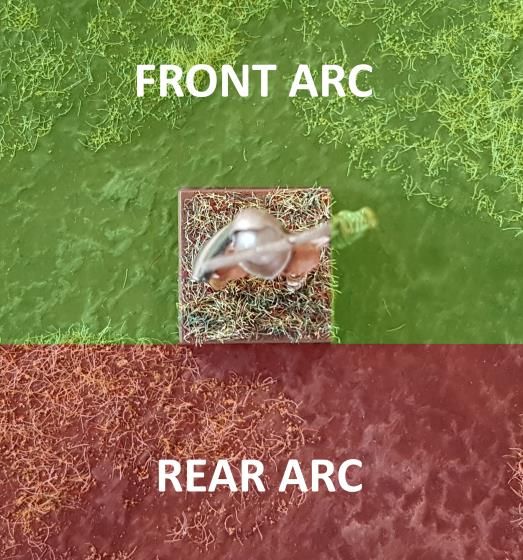
Models should be positioned on their base in a
way which clearly shows the way the model is
facing so that it is obvious where the model’s
front and rear arcs are (see page XXX).

                                                 2
` VANGUARD
Dice
Vanguard uses two types of dice. Re-rolls
D8 Sometimes you will get the opportunity to re-
roll one or more dice. You must accept the
For determining most actions and results in
second result, even if it is worse than the first.
the game, 8-sided dice are used. These are
You cannot re-roll an already re-rolled die!
rolled and read just like normal 6-sided dice.
Counters
Sometimes you may have to roll more than one
dice to see what happens. For example 2D8 Vanguard uses a number of counters to
means roll 2 8-sided dice and check each score. represent the status of models during play.
These are placed next to the models as a
Dice results may be modified. For example, a
modifier of -1 means subtract 1 from each of reminder. Some have more than one status on
them to help keep the number of counters on
your results. Unless specified otherwise, these
the table to a minimum.
are cumulative (e.g. two different +1 modifiers
results in a +2 modifier for the roll).
Sometimes rolls may benefit from bonus dice
(or even lose dice). Add or remove the number
of dice specified before making the roll.
Power Dice
Power Dice are 6-sided dice with special
symbols on them. They are rolled and used to
spend on Special Abilities and activations for
your models in the game.
If the rules specify to roll a die, a D8 is
implied. The rules will be explicit if a Power
Die is to be used.
3VANGUARD
MODEL STATS
Not all Warbands and their warriors are equal. Speed (Sp)
They will all have different abilities, strengths
and weaknesses. In the game, these are This value shows the distance the model can
represented by each model having a number of move in inches.
statistics (stats for short), skills, special rules Ranged (Ra)
and other game values. Warband stat cards are
also available as a great reference to use during This value is the target number the model
the game so the details of your warband are needs to roll to hit a target when using a
easily at hand. ranged attack, typically as part of a Shoot or
Cast action.
Each model in the Warband will have the
following stats: Melee (Me)
Faction Symbol This value is the target number the model
needs to roll to hit an opponent when making a
Which faction the model is fighting for. For Melee attack.
example, Goblins, Northern Alliance,
Basileans, Nightstalkers etc. Your Warband has Armour (Ar)
a single faction, although it is possible to draft
This value is the target number a model needs
in soldiers from other factions from time to
to roll to avoid taking damage and suffering
time.
wounds.
Race
Nerve (Ne)
What race the model is. The model’s Race is
This value is the target number for any Nerve
also a keyword that may interact with other
tests the model needs to take. This will come
rules.
into play if the Warband is broken or if
Type something unnerving happens!
Models will be one (or more) of the following Wounds (Wn)
types:
This value shows the number of wounds the
GRUNT, WARRIOR, SUPPORT, COMMAND, model can suffer before it is usually removed
SPELLCASTER, LARGE from play as a casualty. The larger the number,
the more resilient (or stupid!) the model is.
Type is important when building a Warband. A
model’s Type is also a keyword that may Wound counters are used to track how many
interact with other rules. wounds a model has taken. They are placed
next to the model as each wound is suffered.
Height (Ht) When a model reaches 0 wounds (or fewer!), it
The height of a model affects how it interacts is usually removed from the game as a casualty
with other models and terrain for line of sight (too injured to continue…or possibly dead!).
and visibility of targets. Base
Each model’s card which also indicate the
model’s base size (e.g. 20mm, 40mm etc.) A
size of Cav means a 25mm x 50mm cavalry
base.
4` VANGUARD
Equipment
Every model in the game is assumed to be
naturally equipped with the basic weapons (or
teeth, claws etc.) and armour they need to
survive. However, some models come equipped
with extra ranged weapons, specialist armour
and even rare or magical artefacts.
Cards
Some equipment may be represented using
Vanguard equipment cards. If a model has a
piece of extra equipment with a card, it should
be placed with the model’s stat card as a
reference during play.
Attack dice
Models always use the Ranged or Melee attack
dice stated on their stat cards by default.
However, some equipment comes with its own
replacement number of attack dice.
If the Type of equipment is followed by a
number of dice, use that many dice (with any
appropriate modifiers) when making an attack
with the equipment.
For example, a Bow has a Type of Ranged. The
model making a Ranged attack with a Bow uses
the number of dice stated on its model stat
card.
However, if the same model was given a Dwarf
Flame Thrower, that equipment has a Type
listed as Ranged (4D8). When the model uses
the Flame Thrower to make a Ranged Attack,
4D8 would be used instead.
A model must have a weapon or spell with a
listed range in order to make a Ranged
Attack. If not, even if a number of dice are
listed for the model, an attack cannot be made.
5VANGUARD
THE RULES
In a game of Vanguard, both you and your The following pages are intended to introduce
opponent will have a Warband of fighters that you to the rules in a prescribed way as follows:
you will be using to play an exciting skirmish
encounter using your models. In each game, The structure of the game
you will play a particular scenario that o Rounds and Turns
describes what each player needs to do to win. o Rolling for Power
Maybe one side has to defend their army’s o The End Phase
baggage train from the enemy force, or perhaps Things you can do
both are fighting over control of a vital river o Actions
crossing. o Fatigue
o Using Power
Once the battlefield has been set up with How you do them
terrain and any objectives, the scenario you are o Movement
playing will also tell you how to deploy your o Terrain
models ready to play. Details on how to set-up o Arcs and Line of Sight
the table ready for play are found on page o Ranged Attacks
XXX. o Melee Attacks
o Nerve
Friendly models
Exploding 8s!
If a rule refers to friendly models, this means
models in the same Warband (i.e. on the same For certain rolls in the game, a mechanism
side and not enemy models!). called Exploding 8s! is used.
Enemy Models This means that for each natural dice result of
8 in the roll (regardless of any modifiers), an
Conversely, the Warband’s opponents are
automatic success is achieved and another
considered the enemy models in the rules. If a
bonus die can be rolled to see if a further
scenario requires other, 3rd party models to be
success is achieved. It’s possible to keep
involved, these are considered Neutral.
rolling 8s and to keep getting bonus dice!
Conversely, all natural dice results of 1
(regardless of any modifiers) are automatic
failures.
Scoring a 1 or an 8 with the application of any
modifiers is not an automatic result.
6` VANGUARD
Rounds and Turns
A game of Vanguard is played across a number Game Sequence
of Rounds. Within each Round, players
1. Set-up
alternate taking Turns, activating their
2. Deploy your models
models, until both players have completed
3. Determine who takes the first turn
activating their whole Warband. A game might
4. Play Rounds
last a set number of Rounds, or be determined
a. Roll for Power
by a particular victory (or defeat!) condition.
b. Take alternating Turns,
The scenario being played will tell you how
activating models
long to play for. Typically, games last around 5
c. End Phase
or 6 Rounds.
5. Determine the winner!
A Round will always begin with both players
Rolling for Power. Players then take their Who goes first?
alternating Turns. During each of their Turns, The scenario being played will determine
a player gets to do something (act) with a which side will take the first Turn in the first
single model, or group of models, of their Round.
choice. Each model in a Warband only gets to
In subsequent Rounds, the player that finished
act once in each Round. During the Turn in
activating their models first in the previous
which it is acting, a model is known as the
Round, takes the first Turn in the new Round.
acting (or active) model. Once it has finished
acting, the model is marked as Activated by
placing an Activation counter next to it.
Once a player has finished activating all their
models and declares they are finished, the
player with models yet to activate continues
playing Turns until all their models are also all
Activated. Once a player has declared they are
finished for the Round (including any/all
Forced Fatigue Actions – see pages XXX and
XXX), they cannot then change their mind! All
models must be Activated, even if they then
don’t perform any actions. Players may not
choose to pass a Turn.
Once all models on both sides have Activated,
no more Turns are played and the Round
concludes with the End Phase.
7VANGUARD
Rolling for Power
Power Dice are a representation of the be available to spend during each player’s
training, co-ordination and cunning of a well Turns in the coming Round to augment the
led and experienced fighting team. They are a actions and abilities of the Warbands. The
limited resource that can be spent on accessing total on all the dice combined is the total
certain abilities or even boosting spells and amount of Power the player has to spend
attacks. Learning to manage your Power during the Round.
resource and when to spend it is a skill you
will have to master! Players can spend as much Power as they like
during a Turn and each die is discarded when
1) Roll used. Any that are not spent by the end of the
Round are discarded. See the table on page
At the start of each Round, before any Turns XXX for more detail about how and when these
are taken, each player rolls their Power Dice. can be used.
Create your pool of Power Dice by taking three
RED Power Dice and then adding any extra
dice as indicated on your Warband’s cards (for
The End Phase
models that are still in play and not removed Once both players have finished activating all
as a casualty). These extra dice will be either their models, including any Forced Fatigue (see
RED, WHITE or BLUE. Roll all your Power page XXX), the Round concludes with the End
Dice simultaneously. Phase. During the End Phase, both players now
perform the following steps in order:
2) Re-Roll
1. Resolve all effects and abilities that
After rolling, starting with the player who will state they take place in the End Phase.
go first this Round, both players may perform 2. Spend any remaining Power to clear
one single re-roll of as many of their dice as Fatigue counters from models in their
they have models in play and on the table with Warband. This is not mandatory
the COMMAND type. If a player re-rolls any of however, should a player wish to keep
their dice they must keep the new result(s). a model Fatigued.
3. Clear away all activation counters
Important: If no models with the COMMAND
from the table and any other counters
Type are left alive in a Warband, that player
(e.g. some spell effects) that are no
loses the ability to re-roll any Power Dice.
longer required, in readiness for the
3) Set next Round
4. Any Power still unused at the end of
Finally, each player sets their Power Dice this phase is discarded – it is not
results beside their edge of the table. They will carried over to the next Round.
8` VANGUARD
Activations
When a model is activated during a player’s its front arc. A model that is Engaged with one
Turn, it may perform a number of actions, or more enemy models that are not knocked-
either one long action or up to two short down, must perform a Melee action against one
actions. Any model that is in the middle of its of those models unless it intends to make a
activation is called the acting, or active, model. Break Away action. It may turn on the spot to
put the target in its front arc if there is room
Note that a model may only perform each type for the base to fit. See the Melee attack rules
of action once in a Turn unless specified on page XXX.
otherwise by a special ability, rule, or by Force
Fatiguing the model later (see page XXX).
A model that starts its activation knocked- Cast (variable) – only models that are not
down, must Stand Up as its first action, even if Engaged and with the SPELLCASTER type can
Engaged. use the Cast action. Cast can be repeated as an
action in a Turn.
The basic actions available to models in the
game are listed below. Each action also The spell name will indicate if it takes a long
indicates whether it is (short) or (long). An or short action to cast it. See Magic on page
action must be completed fully before another XXX.
can be taken.
Actions Run (long) – As a Walk action but the model
Walk (short) – Only models that are not may move up to twice its Speed in inches in
Engaged may take this action. Move the model any direction. If the model Engages an enemy
up to its Speed in inches in any direction and model at the end of its move, the Run will
leave it facing a desired direction. A Walk qualify as a Charge action instead if:
action must be performed even if the model is
being simply turned on the spot to face a new 1. The moving model had Line of Sight
direction. Models cannot move within 1” of (see page XXX) to the Engaged enemy
enemy models unless they are Engaging one of model before it moved AND
them (see page XXX). See the full rules for 2. It took the most direct route it could
Movement on page XXX. to the target, only deviating from a
straight line to avoid Impassable
Terrain or friendly models. In
Shoot (short) – only models with a ranged addition, the moving model cannot
come within 1” of enemy models it is
attack option (spell or weapon) and that are
not going to Engage unless they
not Engaged may take this action. Target a
themselves would be within 1” of the
single enemy model unless specified otherwise.
moving model’s final position once
The target must be in range, in the front arc of
Engaged.
the firing model and the firing model must
have LOS to the target. In addition, the target If the move qualifies as a Charge action, the
cannot be Engaged. See the Ranged attack charging model gets an immediate free Melee
rules on page XXX. action against the Engaged target.
Stand Up (short) – a model that is knocked-
down and is lying on the ground must Stand
Up before it can take any other actions.
Melee (short) – The model makes a Melee
attack against one model it is Engaged with in
9VANGUARD
Engaged Engaging models behind obstacles
Models in base-to-base contact with a standing Sometimes a model will position itself so that
enemy model are Engaged by it. When a model it is touching an obstacle to put a barrier
moves to Engage another model, place the between it and any enemy models. It is still
front of the moving model’s base flush against possible to Engage such a model and attack it.
the target’s base on the side contact was made, The attacking model must be able to move and
as centrally as possible. reach the obstacle itself, directly opposite the
model it wishes to attack in order to become
If a Group Charge (see page XXX) is being Engaged. In addition, the attacking model must
performed, arrange the moving models as make contact on the long edge of an obstacle
equally as possible if they are going to Engage and within 2” of the target model – there’s no
the same target. Corner-to-corner base contact charging one end and then fighting a model
is not enough to Engage a model so is not a way down the other end! If the moving model
valid charge move for that target. See the can achieve this, place it flush against the
Melee attack rules on page XXX. obstacle and facing the model it is going to
Only a qualifying Charge action to Engage an attack.
enemy model triggers a free Melee action. Models that are Engaged across an obstacle are
A model that is knocked-down cannot Engage free to move away from one another without
an enemy model (but can be Engaged by one). having to use a Break Away action.
See page XXX for more details.
Brace (long) – The model prepares and steels
A standing model that is Engaged (or itself for an attack. The model may turn to face
Engaging) an enemy model can only make any direction but otherwise doesn’t move or
Melee or Break Away actions. act in any other way. Its Armour is improved
by one (e.g. 5+ becomes 4+) from any attack
coming from its front arc until the model is
next activated (place a Brace counter next to
the model as a reminder).
Break Away (long) – a model that is Engaged
by one or more enemy models may attempt to
break away instead of taking a Melee action.
Make 1 Armour Roll (see page XXX) for each
enemy model the activating model is breaking
away from. Models that are knocked-down are
ignored, as are any models that the model
Breaking Away is wholly in the rear-arc of. The
model will suffer a wound for each failed save.
If the model is still alive and standing, it may
make a Run action in any direction, following
the normal movement rules. It may Enage
another enemy model when doing so.
10` VANGUARD
Fatigue Using Power
Sometimes, individuals in a Warband will push Each Round, players will have a limited
themselves to make an extra yard of ground, or resource of Power to spend and enhance the
fight that little bit harder. Such heroic efforts can actions and abilities of their models. A player
come at the expense of exhaustion however, or can spend as much of their Power as they wish
finding yourself exposed. to during a Turn.
During its activation, a model can be given an To help keep track of Power, it’s easiest to put
additional short action. This extra action must the Power Dice to one side as you spend it. If
be taken after the model’s “normal” actions for you have a die result which shows a higher
the Turn. It is known as a Fatigue Action, and amount of Power than you want to spend,
the model is then marked as both Activated simply turn the die to the amount remaining
and Fatigued at the end of its activation (i.e. (for example a 2 down to a 1).
once all its actions and any attacks are
resolved). A Fatigue Action cannot be a repeat
of an action the model already made this Turn
(this includes any free Melee action as a result
of a Charge).
A Fatigue Action can also be given to a model
that has already activated by spending Power
as described below. This is known as “Forced
Fatigue”. See the table on page XXX for more
details.
A Fatigue Action cannot be given to a group
(see page XXX), only to a single model. That is,
you cannot combine Fatigue Actions with
Group Actions. An activated member of a
group may still receive a Fatigue Action later
by spending Power however.
If a model is marked as Fatigued at the start of
its activation, it may only perform one short
action. In addition, it cannot have a further
Fatigue action played on it that Turn (although
it may have Force Fatigued plyed on it in a
later Turn). Once the model’s activation is
complete, the model is marked as activated and
the Fatigue counter it started the activation
with is removed.
11VANGUARD
Spending Power
Players may spend their Power to “purchase” the following:
Power
Purchase Description
Cost
What: Activate a second model that has not yet been activated. Cannot be used to trigger a Group Action.
+1 model
1 activation
When: After you have finished your first activation. You may only purchase one +1 Activation result per Turn. Unless
specified otherwise by a model ability or Warband special rule, you may only activate a maximum of two models (or 1
model and 1 group) per Turn.
What: Add 1 bonus dice to any of your Shoot, Cast, Armour Save or Melee rolls.
When: Whenever you make a Shoot, Cast, Armour Save or Melee roll, including during your opponent’s Turn (e.g.
1 +1 dice
when Retaliating). The Power must be spent and the bonus die added, before the roll is made.
You may purchase a maximum of one extra die for a single dice roll.
What: 1 Power may be spent to give any single model that has already activated this Round a “Fatigue” short action.
When: The model chosen cannot already be Fatigued. Going back to a model to give it a Fatigue Action in this way is
Forced
done instead of activating a model (or group) normally for a Turn (i.e. it replaces a normal activation). For the
1 Fatigue
purposes of any rules or abilities, it is considered an activation of the model. A Fatigue action bought like this with
Action
Power CAN be a repeat of an action the model already performed earlier in the Round. A player may continue to buy
Forced Fatigue Actions during a round even if all their models have activated normally until they declare they are
finished for the Round.
What: 1 Power may be spent to remove a Fatigue counter from a model in a player’s Warband. Each Power spent
Clear clears one Fatigue counter.
1 Fatigue
When: In the End Phase.
Group What: GROUP ACTION. The members of the group each make a Walk and then a Brace action.
Defence
2 When: Spend the Power to nominate a group and activate them together. The group members must finish their
(up to 3 movement within 3” of each other.
models)
What: GROUP ACTION. The group members all either Walk then Shoot, or Shoot then Walk. If Shooting is a long
Group action normally for any model in the group, that model may not Walk as part of the group action. All members of the
Shoot group must have a ranged weapon or spell to use.
2
(up to 3 When: Spend the Power to nominate a group and activate them together. The shooting models must all shoot the same
models) target or different targets within 3” of each other. Shoot with all models in the group before Walking (or vice-versa).
Shooting is resolved one at a time in any order you wish but all targets must be declared before dice are rolled.
What: GROUP ACTION. The group members all make a Run action and Engage an enemy model.
When: Spend the Power to nominate a group and activate them together. Models in the group may already be Engaged
(in which case they will not move, nor get any possible Charge bonuses). The group leader must to have LOS to the
Group
initial target. Models moving after the first has made contact, must Engage either the same model another member of
Assault
the group already has (or is already Engaged with), or a target within 3” of a model a group member has Engaged.
2 Declare the targets and then move all the attacking models first, before resolving any free Melee actions for qualifying
(up to 3
Charge actions in the order you wish. Models in the group that were already Engaged also make a single Melee action
models)
each.
Any follow up moves for killing enemy models are performed after all attacks are resolved. Models in the group
making follow up moves do not have to finish them within 3” of each other.
What: Use a Warband or model’s Special Ability. The effect is different for each Warband or model and explained in
the warband list or on the model’s card. Special Abilities do not count towards any other restriction on the number of
actions per Turn unless specifically mentioned otherwise (e.g. as a Group Action).
The Power cost of the Special Ability will be given in brackets after its name. For example, a Special Ability with a (2)
Warband or after it, requires 2 Power to use.
Model
various Special When: The rules for abilities will indicate when you may spend Power to use the ability.
Ability (n)
Unless specified otherwise, a model with a Special Ability may only use it once per Round. They may use multiple
abilities if they have them however.
If a model dies, any Special Ability listed on its card can no longer be used. A Warband’s Special Ability is always
available to use however.
12` VANGUARD
Group Actions Model Special Abilities
Using Power, you can activate a group of Some models have Special Abilities. These cost
models together. All models in the group must Power to use as explained on page XXX.
not have already been activated this Turn. This
is called a Group Action and all models are
considered to be performing a long action for
the Turn. Once the Group Action is complete,
Warband Specific Special
all models in the group are marked as Abilities
activated. While the makeup of Warbands can and will be
very different, every faction has a generic
To make a Group Action, nominate a model
Special Ability that is always available to
and then up to 2 more models within 3” of the
Warbands of that type.
first model. The selected models form the
group. Some models have Special Abilities that Warband Specific Special Abilities can only be
are also Group Actions. The model with the used once per Round at any time during one of
Special Ability is the nominated first model of that Warband’s Turns, unless specified
the group in this case. otherwise.
Participating in a Group Action replaces a Just like Model Special Abilities, these cost
model’s normal activation for the Turn. You Power to use as explained on page XXX.
cannot activate a single model, move it to join
a group and then attempt a Group Action
involving that model, for example.
The common Group Actions available to all
models and Warbands are listed in the table on
page XXX.
13VANGUARD
Movement
Moving your models around the battlefield is a there must be sufficient room to place the
vitally important part of the game if you want to model in position or the action cannot be
ensure you have the right models in the right performed.
places and doing the job you need!
Models of Type BEAST or with the special rule
Depending on the action they are performing, a Cavalry, cannot Climb.
model will be moving up to its Speed value in
On vertical surfaces, models can safely drop
inches. Typically this movement is simple and
down their Height in inches without taking any
along the ground in a line in any direction.
injury (instead of a controlled Climb). This
Models can turn any number of times as they movement can be voluntary (e.g. dropping to a
move. Once their activation is over, models lower level) or involuntary (e.g. pushed off a
remain facing the way they finished. cliff!). The vertical distance is counted as part
of the model’s movement. Models dropping
Use your tape measure to determine how far
further than their Height are Falling and take
your models can move. (n) hits with Crushing Strength (n), where n is
Unless a model is moving to Engage an enemy the difference between the model's Height and
the distance to the ground, rounding down.
model, it may not move within 1” of any enemy
models.
Thus a Height 2 model pushed down a 4” high
Terrain on the table can affect the way models wall will take 2 hits from Falling, each with
move. See the Terrain section on page XXX for Crushing Strength (2). A Height 1 model moving
more details. In addition, a model cannot move down the same wall would take 3 hits from
falling, each with Crushing Strength (3). A
through any other models, including friendly
model that takes any wounds from Falling ends
ones.
its action and is knocked-down. See the special
Unless specified otherwise, models cannot rules on page XXX for details on Crushing
leave the playing surface (treat the edges of the Strength.
table as Impassable terrain).
Models ending their movement with their base
touching an obstacle (e.g. a wall) must align
one side of their base flush with it.
Moving up and down stairs has no penalty.
Models can Climb up or down ladders,
counting the height in inches of the ladder as
part of their movement.
Models can Climb up or down surfaces that
require it, counting the height in inches of the
surface being scaled as Difficult Terrain and
part of their movement.
In both cases, they must reach the top (or
bottom) by the end of their activation. Models
cannot stop part-way up a wall, ladder or other
surface during a Climb. A model that would
end its movement at the top or bottom of a
surface being climbed is considered to have
successfully moved between levels and is
placed at the appropriate end, with no further
movement allowed as part of that action, but
14` VANGUARD
A model can move (jump) across gaps at the
same level up to half its Sp value in inches but
must make a test against its Sp value to do so Knocked-down
and have sufficient movement to land and be
placed on the opposite side. Roll a D8. If the Models that have been knocked-down, are
result is equal or under the model's Sp value, simply placed on their side where they stood.
the model successfully jumps the gap and may They lose any Brace counter they had. They
continue moveing the other side. Otherwise, are still Engaged if they were before by any
the model falls into the gap and may take standing enemy models. Standing models in
damage as a result (see falling above). The contact with a knocked-down model are NOT
falling model is placed in the level it lands Engaged by that model so can potentially cast
directly below the point the jump was
spells or make ranged attacks against it but
attempted from. Note that for this test, a roll
may also make a Melee attack against it if they
of 1 is always a failure and 8 is always a
success. wish.
Any attacks against a model that is knocked-
down are considered to be from its rear arc
(see arcs on page XXX).
A model that is knocked-down and is lying on
the ground must Stand Up before it can take
any other actions.
15VANGUARD
Arcs and Line of Sight
If a model is standing on (not in) terrain, then
Arcs
add the height of the terrain to the Height of
Models in Vanguard are mounted on square
the model when determining LOS.
bases with the back edge of the base defining
the rear arc of the model. Models must be Example: A model standing in an area of forest
glued on their bases clearly facing one of the would not add the height of the forest to its own
straight edges so it is obvious which edge is the Height for LOS, but a model standing on the first
back edge. floor of a building would add the height of that
floor to its Height.
A model can potentially see anything in its
front arc (subject to Line of Sight). Line of LOS is determined using a bird’s eye view. If
Sight (LOS) to anything wholly in the model’s your model can draw an uninterrupted line
rear arc is considered to be Blocked. from anywhere on its base to the whole of the
enemy model’s base then you have Clear LOS.
Obviously on a battlefield there are many
obstacles and pieces of cover that the enemy
may utilise to protect themselves. The Height
system is used to determine whether you still
have LOS when you can’t draw an
uninterrupted line.
LOS from your model to an enemy model is
considered Blocked if a line to all parts of the
enemy model’s base passes through:
A model or terrain piece of the same
height or more as your model, and the
enemy model does not have a greater
Height than the blocking item. (If the
enemy model does have a greater
height, LOS is only Partially Blocked)
Line of Sight (LOS) – see below.
Even if something is in a model’s front arc, A blocking model or blocking terrain
other models and terrain may prevent the piece of the same height as the enemy
model from having LOS to it. A lumbering troll model. However, this may be ignored if
will most certainly block the view of a lowly your model has a greater height than
goblin! the blocking item and is within 3” of
the blocking item.
In most cases, it will be obvious if a model has
LOS to something or not. In cases where it
isn’t however, all models and terrain have a
Height which can be used to check for LOS.
As a general rues for terrain, each 1” of height
is equivalent to 1 point of Height. For models,
the Height is listed on their cards.
Models that are knocked-down are considered
to be half their normal Height (rounding down)
for LOS purposes.
16` VANGUARD
LOS from your model to an enemy model is
considered Partially Blocked if:
Obstacles
Only part (not all) of the enemy
model’s base is in a position that A model in direct contact with, and tracing
would be considered Blocked. LOS over an obstacle that is of a lower Height
The enemy model is behind a blocking than it, can ignore that obstacle for
item but has a greater Height. determining LOS. For example, an archer
The enemy model is within an area of standing against a wall, firing over it, would
Difficult Terrain that is at least Height not have their LOS blocked by the wall itself.
1 (e.g. shooting at a model within a
wood).
The enemy model is less than 3”
within Difficult Terrain of equal or
greater height. If LOS to the enemy
model traces through more than 3” of
such Difficult Terrain, LOS is blocked.
An enemy model can be seen so long as LOS is
either Clear or Partially Blocked. When LOS is
Partially Blocked, the enemy model is often
said to be “in cover”.
17VANGUARD
Ranged attacks Modifiers and Bonuses
Whether your models are firing with bows, If the firing model has a Clear LOS to
throwing knives, arcane explosives or casting the target model, the firing model
deadly spells, the following rules will explain receives one bonus die to add to its
how to resolve such attacks. roll.
If the firing model is standing on
Ranged Attacks are made due to Shoot or Cast terrain that has elevated the model’s
actions. Unless specified otherwise a model Height to 3 or more Height levels
may fire one weapon (or cast one spell) at a taller than the target model, the firing
single enemy model with its action. model receives a +1 modifier to its
The target of a ranged attack must be in range roll. For example, a Height 2 model
and LOS of the firing model. Measure the standing on a Height 3 piece of terrain
distance from the base of the firing model to has a total Height of 5. It will gain a +1
the target model between the shortest points. modifier when shooting at models with a
If the distance is equal or less than the range Height of 2 or less.
value of the weapon, the target is in range. If
LOS is blocked, the attack cannot be made.
Models can only make a Shoot action if they
have a number of dice specified and are Each dice that equals or betters the Ra stat of
equipped with a Ranged weapon. If a model the firing or casting model causes 1 hit is
has a “-“ listed for its Ra stat, it may not make scored on the target. The Exploding 8s!
a Ranged attack or be given any equipment of mechanism is used with each 8 result
type Ranged. automatically scoring 1 hit.
A model may not fire at another model that is
Engaged with a friendly model in Melee. A
model that is Engaged itself may not make a
Ranged attack.
If a model has more than one type of Ranged
attack the player using the model must state
which is being used before any dice are rolled.
To make the attack, the player rolls the
number of dice shown in the model’s Ranged
section on its stat card (or equipment).
18` VANGUARD
Armour Roll casualty and plays no further
part in the game.
The owner of the target model then rolls 1 die
for each hit scored. For each die that equals or Modifiers and Bonuses
betters the target’s Armour value, 1 hit is
ignored (saved). If the firing model’s base is wholly in
the rear arc of the target model, the
The Exploding 8s! mechanism is used with each attack gains Piercing (1) or increases
8 result automatically saving 1 hit. the n value by 1 if the Ranged attack
already has the Piercing special rule.
Finally, the target model suffers one wound for
Remember, if the target is knocked-
each unsaved hit. If this takes the target to
down, the attack is considered to be
zero or less wounds, check the following
from the rear arc.
conditions:
If the model’s type is GRUNT it is
removed from the table as a casualty Example:
and plays no further part in the game.
Otherwise, a model on zero or fewer Player A’s model takes a Shoot action at Player
wounds must now make a Nerve test B’s model. The model is determined to be within
(see page XXX). If the model has taken the range of the weapon and LOS to the target is
more wounds than it had remaining, Clear. The shooting model’s Ranged section says
the difference is used to modify the to roll 2D8 and the model rolls an extra dice (3
Nerve test. For example, if a model with in total) for the Clear LOS bonus. The model has
1 wound suffers 2 wounds, the Nerve an Ra stat of 5+.
test has a -1 modifier: Player A rolls the three D8s and scores 2, 6 and
o Down But Not Out - If the 8. The Exploding 8 means another die is rolled
test is passed, the model which scores a 4.
survives with 1 wound
remaining but is knocked- In total, the target is hit twice (the 6 and the 8).
down, and is marked as both
Player B now rolls 2 dice for the Armour roll on
fatigued (if not already).
the target. The target model’s Armour is 6+. The
o Too Much Damage - If the
dice score 4 and 7 so one hit is saved but the
test is failed, the model is
other one causes a wound on the target model.
removed from the table as a
19VANGUARD
Melee attacks
A model that is in base to base contact with Modifiers and Bonuses
one or more enemy models is said to be
If the attacking model Charged (Charge
Engaged.
action) into the Melee this Turn, it
A model that takes a Melee action makes a gains 1 bonus die unless:
Melee attack against one enemy model it is o The target model is defending
engaged with and in its front arc. The owner of an obstacle
the attacking model chooses which enemy is o The charging model moved
being attacked if it is engaged with more than through Difficult Terrain or
one enemy model. over an obstacle
If the target model is knocked-down,
Before any dice are rolled, the attacking player the attacking model gains a +1
may turn their model on its centre to face any modifier to its roll.
direction, so long as it remains in base contact Outnumbering: If one or more other
with all the same enemy models and there is friendly models, that are not knocked-
room to still fit the base in the new facing. down or Fatigued, are also Engaged
with the target model, the attacking
model adds 1 bonus die).
If a model has more than one type of Melee
attack the player using the model must state
which is being used before any dice are rolled. Each dice that equals or betters the Me number
To make the attack, the player rolls the of the attacking model causes 1 hit on the
number of dice shown in the model’s Melee target. The Exploding 8s! mechanism is used
section on its card. with each 8 result automatically scoring 1 hit.
20` VANGUARD
Armour Roll Modifiers and Bonuses
The owner of the target model then rolls 1 die If the attacking model’s base is wholly
for each hit scored. For each die that equals or in the rear arc of the target when the
betters the target’s Armour value, 1 hit is move to Engage is declared (or is in
ignored (saved). the rear arc anyway while already
Engaged), the resulting attack gains
The Exploding 8s! mechanism is used with each
Crushing Strength (1) or increases the n
8 result automatically saving 1 hit.
value by 1 if the Melee attack already
Finally, the target model loses one wound for has Crushing Strength. Remember, if
each unsaved hit. If this takes the target to the target is knocked-down, the attack
zero or less wounds, check the following will be considered to be from the rear
conditions: arc.
If the defending model is the other
If the model’s type is GRUNT or it is side of an obstacle and the attack is in
already knocked-down it is removed its front arc, its Armour is improved
from the table as a casualty and plays by 1 for this Armour roll, as if it were
no further part in the game. Braced. A model already Braced will
Otherwise, a model on zero or fewer still receive this bonus.
wounds must now make a Nerve test
(see page XXX). If the model has taken
more wounds than it had remaining, Follow-up moves
the difference is used to modify the
Nerve test. For example, if a model with If a model kills its enemy and there are no
1 wound suffers 2 wounds, the Nerve other enemy models in base-to-base contact
test has a -1 modifier: with it, it may make a free follow-up move of
o Down But Not Out - If the 3” into its front arc, following the normal
test is passed, the model movement rules. When making a follow-up
survives with 1 wound move, models are allowed to move within 1" of
remaining but is knocked- enemy models but they cannot contact and
down, and is marked as Engage them (models will often be fighting in
fatigued (if not already). tight conditions and will have to remain closer
o Too Much Damage - If the than normal to their enemies out of necessity).
test is failed, the model is Models in a Group Assault action that kill their
removed from the table as a enemies and are no longer Engaged can each
casualty and plays no further make a free follow-up move.
part in the game.
If a model kills its enemy and is still Engaged
with other models, it may be turned to face any
direction as long as it can still physically fit.
21VANGUARD
Retaliate 2. If the retaliating model has not already
been marked as Activated this round
A model that has been attacked in a Melee and
mark it as such with an Activation
has survived now has a chance to Retaliate
counter.
and attack back. The intention to Retaliate is
declared after the attack is resolved. If the If a retaliating model kills its opponent and is
model is being attacked by more than one no longer engaged with any enemy models, it
enemy (for example as part of a Group Assault may make a follow-up move.
action), the intention to Retaliate is declared
after each attack in turn but before the next Models can’t retaliate against a retaliation –
one is resolved. once both models have struck blows, the Melee
action is over.
A model that is knocked-down or that is
already both Activated and Fatigued cannot
Retaliate in a Melee. Therefore, a model may
retaliate a maximum of two times during a
Round.
To Retaliate, the model is turned so that the
enemy model it is retaliating against is in its
front arc. If there is no room to turn the Group Assaults
model, it cannot Retaliate. It then makes a
When resolving a Group Assault, the player
Melee Attack against its opponent as described
whose models are attacking chooses the order
above. Resolve the attack and then check the
to resolve each Melee. Each attack (and any
following conditions and use the first which
Retaliation) is resolved fully before moving
applies:
onto the next.
1. If the retaliating model is not already
marked as Fatigued, mark it as such
with a Fatigued counter.
22` VANGUARD
If a group fails a Fallback Check, all group
Nerve members must make a Fallback! action and
A model’s Nerve value is a representation of its must finish their moves within 3” of each
morale, willpower and self-control. If things start other. Power must be spent on the Group
to go wrong, or an individual is required to do Action before any Fallback Check is made.
something they aren’t comfortable with, it might
take a test of nerve to overcome it, or the A Fatigued model that fails its Fallback Check
Warband will struggle to act as a coherent is marked as Fatigued again after the Fallback!
fighting force. action (i.e. it doesn’t lose its Fatigue marker at
the end of its activation).
Nerve Tests Fallback!
If the rules say a model must make a Nerve
test, roll a single die, applying any modifiers A model making a Fallback! action, must move
given. If the result is equal or better than the towards its own table edge (as defined by the
model’s Nerve stat, the test is passed. If it is scenario being played) along as direct a path as
under the models’ Nerve stat, the test is failed. possible and as far as possible up to twice its
Speed in inches (Run). Retreating models
cannot engage enemy models and normal
movement rules apply. Its Activation is then
Warband Morale complete (mark it as activated).
A Warband is broken if it has less than half
the number of starting models remaining (by Models that Fallback! may not have Fatigue
model count). Determine if a Warband is Actions or Special Abilities played on them
broken at the start of each Round. during their Activation. Power may be spent to
give a model a Forced Fatigue Action later
Once a Warband is broken, each unengaged however without having to make another
model in the Warband must make a Fallback Fallback Check.
Check when it activates. If performing a group
action, use the Nerve value of the model If a model that is falling back reaches the edge
nominated for the group to make the Fallback of the table (or started its Fallback there), it
Check. must make another Fallback Check
immediately. If the test is passed, the model
Fallback Checks stops and is marked as activated. If it fails, it is
To make a Fallback Check, simply make a removed from the board as a casualty.
Nerve test. If a model that is knocked-down must
If the test is passed, the Fallback Check is Fallback! it will first Stand Up and then make a
succesful and the model (or group) may be Walk action towards its own table edge.
activated as normal.
If the test is failed, the Fallback Check is not
successful and the model (or group) must make
a special Fallback! action this Turn (see
below).
23VANGUARD
TERRAIN
An empty battlefield might make moving Areas of Difficult Terrain should be clearly
models around simple but it’s not very defined with an obvious boundary. Unless the
exciting! Adding scenery to your games makes players agree, or a scenario specifies an exact
for a dynamic and tactical experience that will configuration of the elements within the area,
help immerse you in the action. While you can they are simply representations and can be
use books to represent hills or a piece of card moved to make model placement easier if
to mark the boundary of a small wood, having required (e.g. you may need to move a tree to
some great looking model terrain will really one side to make room for a model that has
bring your games to life. moved).
In Vanguard, the different types of scenery and
terrain that is used, is classified into the
following types. Impassable Terrain
Some terrain simply blocks movement. Solid
buildings, lava pools, large rock pillars are all
Open Ground good examples. Models cannot move into or on
top of Impassable Terrain and must move
Areas of flat open grass, road, or any other around it.
clear swathe of land is considered to be Open
Ground. Open Ground doesn’t impede a
model’s movement in any way.
Terrain Heights
Obstacles Terrain will have a Height, just like models do
Obstacles are linear barriers that may lay in a and so will interact with the LOS rules in the
model’s path as it moves. Examples are walls, same way.
hedges and fences. Obstacles up to the height Players should agree what Height each piece of
of the model cost 2” of movement to cross terrain they are using will be before they play a
over, regardless of how fast the model is game. Because everyone has different terrain
moving. Anything taller than the model will collections, the following table should be
need to be climbed up and over. considered a guideline to defining terrain in
Obstacles will often provide cover for targets your games, rather than hard and fast rules.
behind them as they can cause LOS (see page Name Height
XXX) to be partially blocked.
Floor 0
Models standing at windows treat them as
obstacles for all purposes. Walls, Hedges, Fences, areas of 1
low-lying ruins and boulders,
heavy scrubland etc.
Difficult Terrain
Gentle hill 2
Areas of broken ground, wooded areas, ruins,
Wood 5+
steep scree slopes and marshy ground are all
examples of Difficult Terrain. Models count Single storey building/ruin 4
every inch moved in Difficult Terrain as 2”.
Thus, a model moving 3” through Difficult 2-storey building/ruin 6
Terrain counts as having moved 6”.
24` VANGUARD
SPECIAL RULES
Some models, spells, effects and attacks Breath – extend a rectangle out the width of
possess what are known as “special rules”. the firing model’s base out to the range of the
Each of these Special Rules is an exception to attack. Roll (separately) to attack all models
the normal rules. The most common are listed whose bases are partially or wholly inside this
below. Rules unique to a model will be printed area unless LOS is Blocked to them. LOS to all
on its reference card. viable models is taken as being Clear.
Bloodlust – models with this rule add 1 bonus
dice to their Melee attack if the model they are
6th Sense – models with this rule that are not
attacking has already suffered one or more
already Engaged with an enemy model and are
wounds.
attacked in Melee in their rear arc, may turn to
face the attacking model before any Melee Cavalry – models with this rule receive a +1
attack is resolved. The attacking model loses modifier when making Melee attacks against
any bonus for attacking the model in its rear models of a lower Height (including any
arc. terrain). They cannot Climb however and will
automatically Fall if they attempt to Climb
Area Effect (range / dice / rules) – Attacks that
down a surface.
have the Area Effect rule may also hit models
near to the original target. The Area Effect rule Crushing Strength (n) – Melee attacks from
will detail the size of the affected area, how models or weapons with this rule apply a -(n)
many attack dice are rolled and any Special modifier to the target’s Armour Roll when
Rules that may apply (note that the Special attempting to save against hits. For example,
Rules from the initial attack don’t an attack made with Crushing Strength (1)
automatically apply). Once any damage and would change a roll of 5 to 4.
effects on the original target are resolved, the
extended area effect attacks are then resolved Defender – Brace is a short action for models
in any order the player using the attack wishes. with this special rule.
For example, if an attack has Area Effect (2” / Dodge – when targeted by a Ranged attack, the
2D8 / Piecing (1)), all models (not just enemy player owning the target model can force the
ones!) within 2” of the original target would be attacking player to re-roll one die that caused a
attacked with 2D8 and any hits resolved with hit. This can be used to re-roll an Exploding 8
Piercing (1). Roll for each model separately. to try and prevent it Exploding!
Area Effect attacks on a model other than the Fly – models with this special rule can move
original target are always assumed to be from over other models and terrain that would
the direction of the original target. normally block their way. They can move up or
If the original target is killed, leave it in place down any number of levels of height with no
until the any Area Effect hits have been penalty (or chance of injury). They still cannot
measured and resolved, then remove it. end their move on impassable terrain or other
models however.
Unless specified otherwise, models can only
avoid being hit by an Area Effect attack if LOS Headstrong – if a model with this special rule
to them from the original target would be is Fatigued, when it is activated, roll a die. On
blocked by impassable Terrain. Assume the a 6+, the Fatigue counter is removed and the
original target has full LOS into both front and model may act as normal.
rear arcs for working this out. No bonus die for
Clear LOS is granted however.
25VANGUARD
Inspiring – a model with this rule, and all Regenerate – Once per Round, models with
friendly models within 6” of it, may re-roll this special rule may spend 1 Power at any
failed Nerve tests. time to recover one wound previously suffered.
Remove one wound counter from the model.
Marksman – a model with this rule can re-roll This doesn’t count as an activation and the
any 1s when making Ranged attacks. model can be Fatigued or knocked-down and
Mob Assault - When involved in a Group still use this rule.
Assault action, all models with this rule Reload - Shoot is a long action for any Ranged
performing the Group action gain Crushing weapons with the Reload rule. The model may
Strength (n) where n is the number of models pivot on the spot before making an attack
in the group with this rule, attacking the same however.
target. Thus, 2 models attacking would each
have Crushing Strength (2). This is calculated Scout – After all standard model deployments
before each attack is made, so retaliating have been made, but before the game starts,
enemy models may reduce the effects by killing models with the Scout skill may set up outside
members of the assaulting mob. their deployment area but not within 12” of
the enemy deployment area or 12” of an enemy
Parry – when targeted in Melee, the player model. If both players have models with Scout,
owning the target model (including from a the player that finished deploying their other
Retaliation) can force the attacking player to models first, chooses the first Scout model to
re-roll one die that scored a hit. This can be be deployed – the players then alternate
used to re-roll an Exploding 8 to try and placing their Scouts. Models with Scout may
prevent it Exploding!
always be placed in their own deployment area
Pathfinder – models with this rule treat any if desired.
Difficult Terrain they move through as Open Smash – a model with this rule gains the Pound
Ground.
special rule in the subsequent Melee when it
Piercing (n) – Ranged attacks from models or performs a Charge action.
weapons with this rule apply a -(n) modifier to
Sneaky – when attacking the rear arc of a
the target’s Armour Roll when attempting to
model in Melee, rolls of 7 or 8 are Exploding
save against hits. For example, an attack made
and therefore score a hit and can be rerolled.
with Piercing (2) would change a roll of 7 to 5.
Steady – if a model with this rule is knocked-
Pound – if an attack with this rule scores 3 or
down, roll a die. On a 5+, the model remains
more hits and the target is not killed, it is
standing.
knocked-down. Apply this rule after any
possible Down But Not Out result. Stealthy – when making Ranged attacks at a
model with this rule, attacking models suffer a
-1 modifier when rolling for hits (including
casting spells).
Stubborn – a model with this rule may re-roll
failed Nerve tests.
Swarm – models with this rule grant 2 bonus
dice instead of one if they contribute to an
outnumbering bonus in Melee.
Vicious – a model with this rule can re-roll any
1s when making Melee attacks.
26` VANGUARD
MAGIC
In the fantasy setting of Vanguard, certain Each spell description will state the Range of
talented (or warped!) individuals can harness the spell (if applicable), how many dice to roll
and utilise arcane and mysterious magical and then any special or unique rules that
powers. apply.
Casting spells Some spells can be Boosted by Special
Abilities, by Power directly, or by taking a
In the game, models with the ability to cast longer action. This will be detailed in the spell
magical spells have the SPELLCASTER Type. description, or the Special Ability. Where a
model has a Special Ability that can boost a
All spells are Ranged Attacks using a Cast
spell (e.g. extending the range), and the spell
action. Normal LOS, ranged targeting rules and
can be boosted itself, it is possible to do both,
damage resolution apply unless specified
so long as the appropriate action is taken, and
otherwise. A spell will specify after its name if
Power spent.
it takes a short or long Cast action to use.
Spells roll to attack using the Ra of the casting If a model has a Special Ability that boosts a
model unless specified otherwise. spell’s range, it will only affect spells that
explicitly list a Range (e.g. [Range 12”]).
A model may use the Cast action more than
once in its activation. However, a model may If a model is listed as having a spell, it
not cast the same spell more than once in a automatically has access to the boosted version
Turn. too, where the spell has one.
The most common spells are listed on the Some spells have delayed or lasting effects.
following page. Spells unique to a model will Spell Effect counters are provided to help
be printed on their stat card. Typically, models track models that have these spells cast on
will only be able to use a small number of them. Unless specified otherwise in the spell
spells, as specified on their card. description, Spell Effect counters should be
removed from the board in the End Phase,
ending any effect they may have caused.
27You can also read


