The Messenger No. 145 - September 2011 - European Southern Observatory
←
→
Page content transcription
If your browser does not render page correctly, please read the page content below
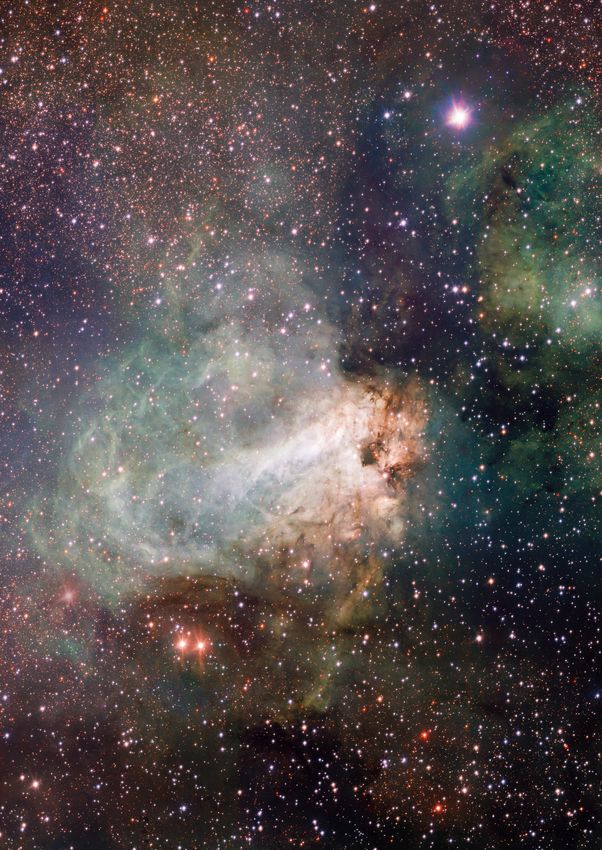
Studies for a massively-multiplexed spectrograph
Spectroscopy of Pluto and Triton
VISTA survey of Orion Belt region
VLT FLAMES Tarantula Survey
                                                                              The Messenger
                                                   No. 145 – September 2011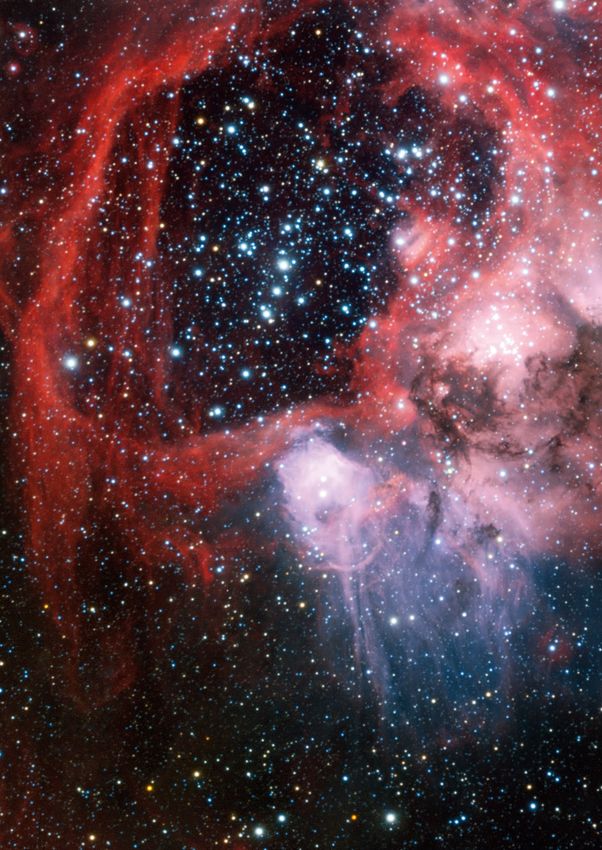
Telescopes and Instrumentation
TRAPPIST: TRAnsiting Planets and PlanetesImals Small
Telescope
Emmanuël Jehin1
E. Jehin/ESO
Michaël Gillon1
Didier Queloz 2
Pierre Magain1
Jean Manfroid1
Virginie Chantry1
Monica Lendl2
Damien Hutsemékers1
Stephane Udry2
1
Institut d’Astrophysique de l’Université
de Liège, Belgium
2
Observatoire de l’Université de Genève,
Switzerland
TRAPPIST is a 60-cm robotic telescope
that was installed in April 2010 at the
ESO La Silla Observatory. The project is
led by the Astrophysics and Image Pro-
cessing group (AIP) at the Department of Figure 1. The TRAPPIST telescope in its 5-metre time is obviously needed to monitor the
enclosure at the La Silla Observatory, Chile.
Astrophysics, Geophysics and Ocean- activity of several comets with a fre
ography (AGO) of the University of Liège, quency of a few times per week. Some
in close collaboration with the Geneva TRAPPIST is an original project using a comets are known, but others appear
Observatory, and has been funded by single telescope that has been built and serendipitously. For the latter, telescope
the Belgian Fund for Scientific Research optimised to allow the study of those two availability is crucial if we want to react
(F.R.S.-FNRS) and the Swiss National aspects of the growing field of astrobiol rapidly to observe those targets at the
Science Foundation (SNF). It is devoted ogy. It provides high quality photometric appropriate moment and for several hours
to the detection and characterisation of data of exoplanet transits and allows or nights in a row; this strategy can pro
exoplanets and to the study of comets the gaseous emissions of bright comets vide unique datasets impossible to obtain
and other small bodies in the Solar Sys- to be monitored regularly. The project otherwise.
tem. We describe here the goals of the is centred on three main goals: (1) the
project and the hardware and present detection of the transits of new exoplan
some results obtained during the first six ets; (2) the characterisation of known Telescope and instrumentation
months of operation. transiting planets, in particular the pre
cise determination of their size; and (3) For low cost operations and high flexibil
the survey of the chemical composition of ity, TRAPPIST (see Figure 1) had to be
The science case bright comets and the evolution of their a robotic observatory. The observation
activity during their orbit. programme, including the calibration
The hundreds of exoplanets known today plan, is prepared in advance and submit
allow us to place our own Solar System ted daily to a specific software installed
in the broad context of our own Galaxy. A dedicated robotic telescope on the computer controlling the obser
In particular, the subset of known exo vatory. This computer controls all the
planets that transit their parent stars are The basic project concept is a robotic tel technical aspects of the observations:
key objects for our understanding of escope fully dedicated to high precision dome control, pointing, focusing, image
the formation, evolution and properties of exoplanet and comet time-series pho acquisition, astrometry and software
planetary systems. The objects of the tometry, providing the large amount of guiding, calibrations, data storage... It is
Solar System are, and will remain, exqui observing time requested for those in sleep mode during daytime and wakes
site guides for helping us understand research projects. Exoplanet transits typi up one hour before sunset, opening the
the mechanisms of planetary formation cally last several hours, up to a full night. dome and starting to cool the CCD. This
and evolution. Comets, in particular, are There are now many known transiting process is made possible thanks to a
most probably remnants of the initial planets, and many more candidates found collection of computer programs working
population of planetesimals of the outer by transit surveys which need to be together and interacting with the tele
part of the protoplanetary disc. Therefore confirmed and characterised. Moreover scope, dome, CCD camera, filter wheels
the study of their physical and chemical these targets need to be observed at and meteorological station. Such a
properties allows the conditions that very specific times, during eclipses, put complete and rapid integration, using
prevailed during the formation of the four ting even more constraints on telescope mostly off-the-shelf solutions, would have
giant planets to be probed. availability. Similarly a lot of observing been impossible a few years ago and
2 The Messenger 145 – September 2011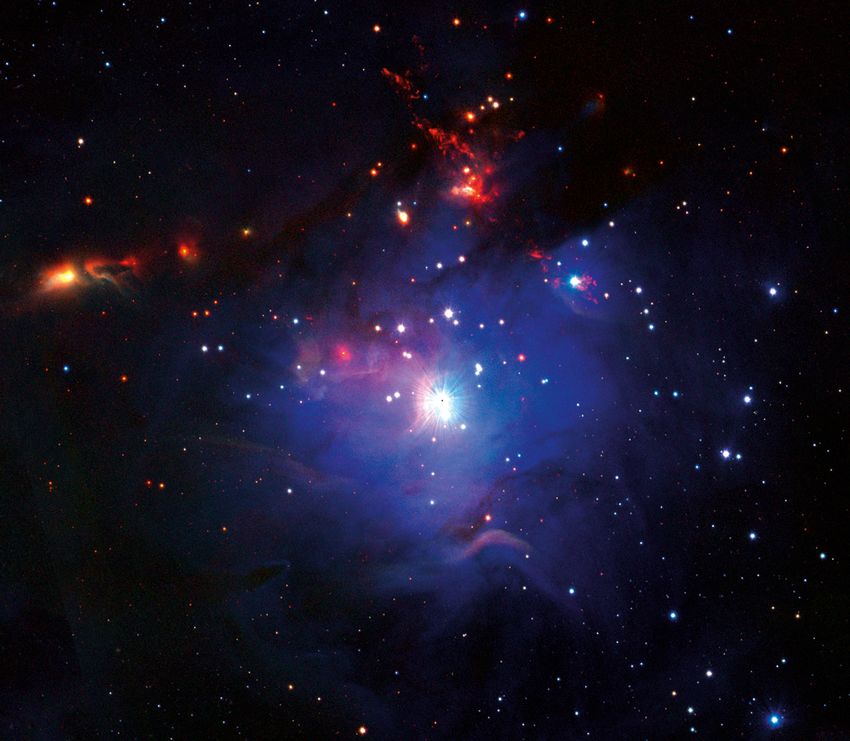
WASP—43b TRAPPIST I+z
1
0.99
Flux
0.98
0.97
σ = 0.0003
0.96
– 0.04 – 0.02 0 0.02 0.04
dT (days)
aluminium components, it weighs only Figure 3. TRAPPIST I + z transit photometry of the
planet WASP-43b, period-folded and binned per two
65 kg and was allied to a compact Ger
minute intervals, with the best-fit transit model
man equatorial mount, the New Technol superimposed. The residuals of the fit, shifted along
ogy Mount NTM-500, from the same the y-axis for the sake of clarity, are shown below
company. This robust mount uses direct and their standard deviation is 300 parts per million
(ppm). This light curve results from the global analy
drive technology to avoid the well-known
sis of 20 transits observed by TRAPPIST for this exo
periodic errors found on the usual equa planet.
Figure 2. Close-up of the 60-cm TRAPPIST torial mounts for small telescopes and
telescope.
therefore permits accurate pointing and
tracking. The accuracy of the tracking (1.3 arcseconds per pixel) and a 10 %
allowed us to set up the experiment in allows an exposure time of four minutes accuracy are B-band 16.2, V-band
less than two years. maximum, which is usually enough for 16.4, Rc-band 16.4, Ic-band 15.5 and
our bright targets. Each frame is cali I + z-band 15.6; and in 200 seconds,
The observatory is controlled through a brated in right ascension and declination B-band 19.7, V-band 19.4, Rc-band 19.2
VPN (Virtual Private Network) connection and software guiding runs continuously to and Ic-band 18.1.
between La Silla and Liège University. keep the target centred on the same few
The telescope and each individual sub pixels for the whole exposure sequence. The camera is fitted with a double filter
system can be used from anywhere in wheel specifically designed for the pro
the world, provided an internet connec The CCD camera was built by Finger ject and allowing a total of 12 different
tion is available. In case of a low-level Lakes Instrumentation, with thermo- 5 × 5 cm filters and one clear position.
mechanical failure, we can count on the electric cooling and a CCD of the latest One filter wheel is loaded with six broad
help of the Swiss technician on site or generation. This is a thinned broad- band filters (Johnson-Cousins BVRcIc,
the La Silla staff. band backside-illuminated Fairchild chip Sloan z’, and a special I + z filter for exo
with 2048 × 2048 15-µm pixels providing planet transits) and the other filter wheel
Hundreds of images, amounting to a field of view of 22 by 22 arcminutes is loaded with six narrowband filters
2–15 GB, are produced every night. and a plate scale of 0.6 arcseconds per for the comet programme. The comet
Reduction pipelines run on a dedicated pixel. The sensitivity is excellent over filters were designed by NASA for the
computer installed in the control room. all the spectral range, with a peak of 98 % international Hale–Bopp campaign
For the exoplanet programme, only tables at 750 nm, declining to around 80 % (Farnham et al., 2000). Four filters iso
and plots with the final results are trans at 550 nm and 60 % at 300 nm. It is opti lating the main molecular emission lines
ferred to Liège, while for the comet pro mised for low fringe level in the far red present in cometary spectra (OH [310 nm],
gramme, it is often necessary to transfer and achieves a sensitivity of 40 % at CN [385 nm], C3 [405 nm], C2 + NH2
dozens of frames in order to perform 950 nm. The gain is set to 1.1 e-/ADU. [515 nm]) are permanently mounted,
more interactive tasks on the images. There are three different readout modes: while the two other filters of the set
Every third month, a backup disk is sent a low noise readout mode (readout noise (CO+ [427 nm] and H2O+ [705 nm]) are
to Belgium and transferred to the archive [RON] 9.7 e- in 8s), a fast mode (RON also available. In addition two narrow
machine. 14 e- in 4s) and a very fast readout of 2s band filters, isolating “continuum win
using two quadrants. The cooling is dows” (BC [445 nm] and GC [525 nm]) for
The telescope is a 60-cm f/8 Ritchey– –55 deg below ambient, usual operation the estimation of the solar spectrum
Chrétien design built by the German being at –35 °C with a dark count of reflected by the dust of the comet, are
ASTELCO company (see Figure 2). Owing 0.11 e-/s/pixel. Typical magnitudes mounted.
to its open design with carbon fibre and reached in 20s with a 2 × 2 binning
The Messenger 145 – September 2011 3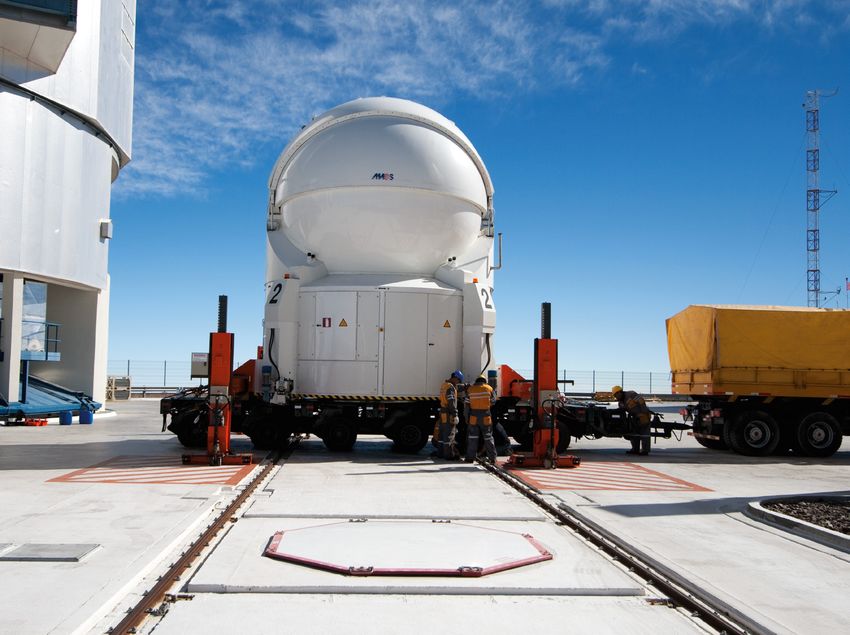
Telescopes and Instrumentation Jehin E. et al., TRAPPIST : TRAnsiting Planets and PlanetesImals Small Telescope
Installation, first light and start of allowing us to constrain its bulk compo Characterisation of known transiting
operations sition. Furthermore, the special geometry planets
of the orbit makes the study of impor- Once a transiting planet is detected, it is
The telescope was installed in April 2010 tant properties of the planet (e.g., atmos of course desirable to characterise it
in the T70 Swiss telescope building pheric composition, orbital obliquity, etc) thoroughly with high precision follow-up
belonging to Geneva University (Figure 1). possible without the challenge of having measurements. Assuming a sufficient
This facility had not been used since to spatially resolve it from its host star. precision, a transit light curve allows a
the 1990s and was completely refurbished Transiting planets are thus key objects for number of parameters to be thoroughly
in early 2010. The old 5-metre dome our understanding of the vast planetary constrained: (i) the planet-to-star radius
(AshDome) was equipped with new azi population hosted by the Galaxy. ratio; (ii) the orbital inclination; (iii) the
muth motors and computer control. A stellar limb-darkening coefficients; and
Boltwood II meteorological station with a Discovery of more transiting planets is (iv) the stellar density (assuming the
cloud sensor and an independent rain important to assess the diversity of plan orbital period is known). This last quantity
sensor was installed on the roof to record etary systems, to constrain their forma can be used with other measured stellar
the weather conditions in real time. In tion and the dependence of planetary quantities to deduce, via stellar model
case of bad conditions (clouds, strong properties on external conditions (orbit, ling, the mass of the star, which leads
wind, risk of condensation, rain or snow), host star, other planets, etc.). TRAPPIST finally to the stellar and planet radii (Gillon
the dome is automatically closed and is participating in this effort through sev et al., 2007; 2009). So far, we have
the observations interrupted to guarantee eral different projects. gathered many high precision light curves
the integrity of the telescope and equip for two dozen transiting planets. These
ment. An uninterruptable power supply Detection of new transiting planets data will not only allow us to improve our
(UPS) keeps the observatory running for On account of its extended temporal knowledge of these planets (size, struc
45 minutes during an electrical power availability and high photometric preci ture), but also to search for transit timing
cut and an emergency shutdown is trig sion, TRAPPIST has very quickly become variations that could reveal the presence
gered at the end of this period. Several an important element for the transit of other planets in the system. Since
webcams inside and outside the building surveys WASP2 and CoRoT3. It is used to TRAPPIST is dedicated to this research
help us to check what is going on in the confirm the candidate transits detected project, it can monitor dozens of tran-
observatory if needed. After two months by these surveys and to observe them sits of the same planet, leading to an
of commissioning on site, TRAPPIST with better time resolution and precision exquisite global precision, as shown in
“first light” took place remotely on 8 June to discriminate eclipsing binaries from Figure 3.
2010, together with a press conference planetary transits. TRAPPIST observa
at Liège University1. Technical tests, fine tions have so far rejected more than Transit search around ultra-cool dwarf
tuning of the software as well as the first 30 WASP candidates as being eclipsing stars (UCDs)
scientific observations were performed binaries. It has confirmed, and thus co- We have selected a sample of ten rela
in remote control mode until November discovered, ten new transiting planets tively bright late-M stars and brown
2010. The fully robotic operation then (e.g., Triaud et al., 2011; Csizmadia et al., dwarfs. For each of them, we have started
started smoothly in December with sev 2011; Gillon et al., 2011). an intense monitoring campaign (several
eral months of superb weather until the full nights) to search for the transits of
start of the winter. The search for transits of the planets the ultra-short period (less than one day)
detected by the radial velocity (RV) tech terrestrial planets that are expected by
The two scientific aspects of this dedi nique is another important science driver some planetary formation theories. The
cated telescope and the first results are for TRAPPIST. RV surveys monitor stars photometric variability of these UCDs
described below. significantly brighter than the transit sur brings a lot of information on their atmos
veys. The few RV planets that were pheric and magnetic properties, and
revealed afterwards to be transiting, have the by product of this TRAPPIST project
Survey of transiting exoplanets brought improved knowledge of exo will thus be a significant contribution
planet properties because a thorough to the understanding of these fascinating
The transit method used by TRAPPIST is characterisation is possible (e.g., Deming UCDs that dominate the Galactic stellar
an indirect technique, based on the & Seager, 2009). These planets thus population.
measurement of the apparent brightness play a major role in exoplanetology. In this
of a star. If a planet passes in front of context, TRAPPIST is used to search for
the star, there is a slight observable the possible transits of the planets Survey of the chemical composition of
decline in the apparent luminosity, as the detected by the HARPS (Mayor et al., comets
planet eclipses a small fraction of the 2003) and CORALIE (Queloz et al., 2000)
stellar disc. Recording this periodic event Doppler surveys. For the late M-dwarfs TRAPPIST is the only telescope in the
allows the radius of the planet to be observed by HARPS, TRAPPIST is even southern hemisphere equipped with
measured. Combined with the radial able to detect the transit of a massive the instrumentation to detect gaseous
velocity method, the transit method pro rocky planet. comet emissions on a daily basis. As
vides the mass and density of the planet, recently outlined during a NASA work
4 The Messenger 145 – September 2011
OH CN C3
C2 GC H 2O
Figure 4. Comet 103P/Hartley 2 imaged with calibration, image analysis can reveal follow-up of split comets and of special
T RAPPIST through the different cometary filters on
coma features (jets, fans, tails), that could outburst events is possible very shortly
5 November 2010: OH, CN, C 3, C2, green continuum
(GC) and H2O+. Note the different shapes and inten lead to the detection of active regions after an alert is given and can thus pro
sities of the cometary coma in each filter. and determination of the rotation period vide important information on the nature
of the nucleus. Such regular measure of comets. Light curves from these data
ments are rare because of the lack of tel are useful to assess the gas and dust
shop 4, the huge amount of data col escope time on larger telescopes, yet are activity of a given comet in order, for
lected by T RAPPIST will bring crucial very valuable as they show how the gas instance, to prepare more detailed obser
new information on comets and will production rate of each species evolves vations with larger telescopes, espe-
rapidly increase statistics, allowing com with respect to the distance to the Sun. cially the southern ESO telescopes. Hun
ets to be classified on the basis of their These observations will allow the compo dreds of photometric and astrometric
chemical composition. Linking those sition of the comets and the chemical measurements of all the moving targets in
chemical classes to dynamical types (for class to which they belong (rich or poor in our frames are reported each month to
instance short period comets of the carbon chain elements for instance) to the IAU Minor Planet Center. Two new
Jupiter family and new long period com be determined, possibly revealing the ori asteroids were found during a laboratory
ets from the Oort Cloud) is a funda gin of those classes. Indeed with about session with students of Liège University.
mental step in understanding the forma five to ten bright comets observed each The observatory code attributed by the
tion of comets and the Solar System. year, this programme will provide a good IAU is I40.
statistical sample after a few years.
For relatively bright comets (V ≤ 12 mag), Our first target was periodic comet 103P/
about twice a week, we measure gase Broadband photometry is also performed Hartley 2, which made a close approach
ous production rates and the spatial dis once a week for fainter comets, usually to Earth in October 2010 and was
tribution of several molecular species, far from the Sun, in order to measure the observed in great detail during the NASA
including OH, CN, C2, and C3 (see Fig dust production rate from the R-band, EPOXI spacecraft flyby on 4 November.
ure 4 for an example). In addition to pro to catch outbursts and find interesting We monitored this small (2 km) but very
viding the production rates of the differ targets for the main programme. Owing active comet roughly every other night for
ent species through a proper photometric to the way the telescope is operated, the four months and collected ~ 4000 frames
The Messenger 145 – September 2011 5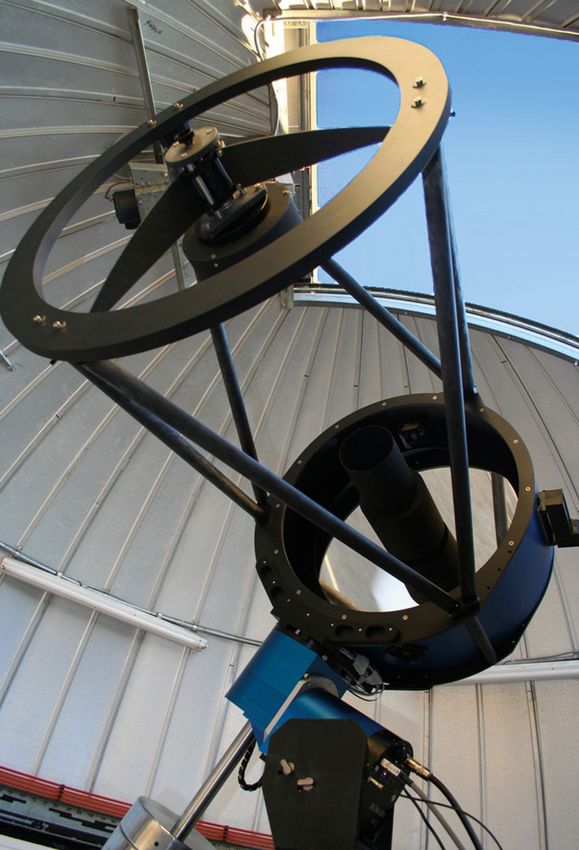
Telescopes and Instrumentation Jehin E. et al., TRAPPIST : TRAnsiting Planets and PlanetesImals Small Telescope
steroid Belt and not the result of
A key asset for confirming and characteris
cometary activity (Jehin et al., 2010). ing these planets.
Among other related projects we joined Further information and the latest news
an international collaboration whose about TRAPPIST can be found on our
goal is to catch rare stellar occultations web page 6.
by large trans-Neptunian objects (TNOs).
This technique provides the most accu
rate measurements of the diameter of Acknowledgements
these very remote and poorly constrained We would like to thank the following: Grégory
icy bodies (provided at least two chords L ambert of the Geneva Observatory for the continu
are observed). About one to two events ous technical support on site and Vincent Megevand
per month are expected for a dozen big when he was in charge; Michel Crausaz, Nigel
Evershed, Jean-Francois Veraguth, Francesco Pepe,
TNOs. On 6 November 2010, a unique Charles Maire, and Michel Fleury from Geneva
observation was performed. A faint star Observatory for the refurbishment phase of the T70
was occulted by the dwarf planet Eris building; Andrew Wright and Alexis Thomas from
for 29 seconds. Eris is the most distant ESO and Pierre Demain from Liège University for the
set-up of VPN at each site; Karina Celedon from
Figure 5. The TRAPPIST image of the the activated object known in the Solar System by ESO for the very efficient work and great help in the
asteroid (596) Scheila taken on 18 December 2010.
far (three times the distance of Pluto) and delivery of the many telescope parts to Chile and
supposedly the biggest TNO — it was the La Silla Observatory; David Schleicher from
even named the tenth planet for a few Lowell Observatory for having recovered and lent
one c omplete set of NASA cometary filters and Alain
through ten different filters. Our contribu months in 2006. This was the third posi G illiotte from ESO for the optical characterisation
tion to the worldwide campaign on this tive occultation by a TNO ever recorded of those fi lters; Sandrine Sohy and Robert Sip from
comet was recently published in Meech and it allowed a very accurate radius Liège University for setting up all the computers
et al. (2011). The quality of the data for Eris (to a few kilometres) to be derived, and backup procedures and Sandrine for being the
webmaster.
allowed us to observe periodic variations providing a huge improvement in the
in the gaseous flux of the different spe determination of its size (previously known We would finally like to pay special thanks to the
cies from which we could determine the to within about 400 km). The surprise whole staff of La Silla, and especially Gerardo Ihle and
rotation of the nucleus and show that was to discover that Eris is a twin of Pluto Bernardo Ahumada, for their constant help and sup
port, most particularly during the installation phase.
the rotation was slowing down by about and that it is not much bigger — remem
one hour in 100 days (Jehin et al., 2010). ber that Pluto was demoted as a planet in M. Gillon and E. Jehin are FNRS Research Associ
This behaviour had never been so clearly 2006 because Eris was found to be big ates, J. Manfroid is an FNRS Research Director and
observed before. The long-term monitor ger — both then received the new status D. Hutsemékers is an FRNS Senior Research
A ssociate.
ing of the production rates of the different of dwarf planets! A paper describing
species is nearly completed and will be these results has been accepted for pub
combined with high-resolution spectro lication in Nature (Sicardy et al., 2011). References
scopic data in the visible and infrared that
Csizmadia, Sz. et al. 2011, A&A, 531, 41
we obtained at the ESO Very Large Tele Deming, D. & Seager, S. 2009, Nature, 462, 301
scope (VLT) to provide a clear picture of Perspectives Farnham, T. L. et al. 2000, Icarus, 147, 180
the chemical composition of this unusu Gillon, M. et al. 2011, A&A (accepted)
ally active comet from the Jupiter family. After only six months of robotic opera Gillon, M. et al. 2007, A&A, 466, 743
Gillon, M. et al. 2009, A&A, 496, 259
tions, TRAPPIST is already recognised Hsieh, H. & Jewitt D. 2006, Science 312, 561
On account of the fast reaction time in the exoplanet and comet communities Jehin, E. et al. 2010, CBET #2589
(a few hours), TRAPPIST is an invaluable as a unique tool on account of, among Jehin, E. et al. 2010, CBET, #2632
instrument for catching rare and short- other things, the large amount of tele Mayor, M. et al. 2003, The Messenger, 114, 20
Meech, K. et al. 2011, ApJL, 734, L1
term events. As an example, the night scope time available under photometric Queloz, D. et al. 2000, A&A, 354, 99
after the announcement that asteroid conditions for performing time-consuming Sicardy, B. et al. 2011, Nature, accepted
(596) Scheila was behaving like a comet research. In particular, TRAPPIST has Triaud, A. et al. 2011, A&A, 513, A24
and could be a new Main Belt comet very quickly become a key element in the
(only five of them are known — Hsieh & follow-up effort supporting WASP. In Links
Jewitt, 2006), we began a programme future, TRAPPIST will play a similar role
to monitor the expanding coma and the for the successor of WASP, the Next 1
ESO PR on TRAPPIST: http://www.eso.org/public/
brightness of the nucleus every night Generation Transit Survey (NGTS)5, a pro 2
news/eso1023/
Superwasp: http://www.superwasp.org
during a period of three weeks (see Fig ject led by Geneva Observatory and sev 3
C oRoT: http://smsc.cnes.fr/COROT/index.htm
ure 5 for one of the images). From imag eral UK universities, that will be installed 4
C omet Taxonomy, NASA workshop held 12–16
ing with TRAPPIST and spectroscopy at ESO Paranal Observatory in 2012. March 2011, Annapolis, USA
5
with the ESO VLT we concluded that this NGTS will focus on detecting smaller N ext Generation Transit Survey: http://www.
ngtransits.org/
behaviour was the result of a collision planets than WASP, and the high photo 6
T RAPPIST web page: http://www.ati.ulg.ac.be/
with a smaller asteroid in the Main metric precision of TRAPPIST will be a TRAPPIST/Trappist_main/Home.html
6 The Messenger 145 – September 2011
Telescopes and Instrumentation
CalVin 3 — A New Release of the ESO Calibrator
Selection Tool for the VLT Interferometer
Markus Wittkowski1 NIR instrument AMBER and the MIR sions of CalVin, version 3.0 released in
Pascal Ballester1 instrument MIDI, are supported by ESO in January 2011 and version 3.1 released in
Daniel Bonneau2, 3 the same way as any of the VLT instru July 2011, now offer major improvements
Alain Chelli2, 4 ments of the Paranal observatory (c.f. in terms of the number of available calibra
Olivier Chesneau2, 3 Wittkowski et al. [2005] for further general tors, the functionality of the search tool, as
Pierre Cruzalèbes2, 3 information on observing with the VLTI). well as in performance and ease of use.
Gilles Duvert 2, 4
Christian Hummel1 In particular, ESO supports the prepara
Sylvain Lafrasse 2, 4 tion of interferometric observations using Number of available calibrators
Guillaume Mella 2, 4 the AMBER and MIDI instruments with
Jorge Melnick1 the preparation tools VisCalc and CalVin1. The underlying list of calibrators available
Antoine Mérand1 VisCalc estimates visibility values for with CalVin now incorporates the JMMC
Denis Mourard2, 3 the expected intensity distribution of the Stellar Diameter Catalog (JSDC2; Lafrasse
Isabelle Percheron1 science target and the chosen VLTI et al., 2010). This catalogue is based on
Stéphane Sacuto2, 5 configuration to assess the feasibility of a search of catalogues available at the
Klara Shabun1 an observation. CalVin may be used to Centre de Données astronomiques de
Stan Stefl1 select calibration stars for a given sci Strasbourg (CDS) using the bright mode of
Jakob Vinther1 ence target based on an underlying list of the JMMC calibrator search tool Search
calibrators and a number of user-defined Cal3 (Bonneau et al., 2006) with the faint
criteria. Both tools are also offered in an est limiting magnitudes that are offered for
1
ESO expert mode for the use of any arbitrary the VLTI. The angular diameter estimates
2
Jean-Marie Mariotti Center, France observatory location, baseline configura and their errors given in the resulting table
3
Université Nice Sophia Antipolis, CNRS, tion and spectral wavelength band (for are based on statistical estimates and
Observatoire de la Côte d’ Azur, Nice, CalVin B-, V-, R-, I-, J-, H-, or K-bands). provide information on whether a star is a
France suitable calibration source for a certain
4
Université Joseph Fourier 1/CNRS- Optical interferometers measure the instrument and baseline configuration.
INSU, Institut de Planetologie et amplitude and phase of the interference
d’Astrophysique de Grenoble, France pattern. When normalised these quan The observer may need to study selected
5
Department of Physics and Astronomy, tities are the amplitude and phase of the calibrators in more detail to obtain a
Uppsala University, Sweden complex visibility function, which is re more precise estimate of their diameters
lated to the intensity distribution by a (c.f., for example, Cruzalèbes et al., 2010).
Fourier transform. An unresolved point Each calibrator is assigned a quality
Interferometric observations require source theoretically has a visibility ampli grade depending on whether it is only
frequent measurements of calibration tude of unity. However, the measured included in the JSDC catalogue or is also
stars of known diameter to estimate visibility amplitude of an infinitely small in the catalogues by Bordé et al. (2002),
the instrumental transfer function. ESO target, also called the interferometric Mérand et al. (2005) or Verhoelst (2005),
offers the preparation tool CalVin to transfer function, will be less than unity which were used as the core underlying
select suitable calibrators from an un owing to losses introduced by the Earth’s catalogues of CalVin 2, and whose prop
derlying list of calibrators. The latest atmosphere and the instrument. These erties are studied in more detail.
version 3, first released in January 2011, losses are time variable and need to be
offers major improvements in the num- frequently monitored. For this purpose, The capacity of, for example, the NIR
ber of available calibrators, the func- the observer needs to select suitable AMBER table is now 27 814 calibrators,
tionality of the search tool, as well as in calibration stars of known diameter, which of the MIR MIDI table 27 989 calibrators,
terms of performance and ease of use. will be observed close in time to the sci and of arbitrary locations (expert version
It has been developed in a collaboration ence targets. of CalVin) 38 472 calibrators. Figure 1
between ESO and the French Jean- shows the sky coverage of the underlying
Marie Mariotti Center (JMMC). With the growing capabilities of the VLTI, list of calibrators available for AMBER,
the increasing number of instrument highlighting two typical use cases, a
modes, and the improving limiting mag bright calibrator case and a faint calibra
The ESO VLT interferometer (VLTI) is an nitudes, it has become clear that CalVin’s tor case. The bright c alibrator case high
optical interferometer that is offered as a capabilities need to be improved beyond lights calibrators of K magnitudes K < 3
general user facility. It enables the com those available when it was first offered as they are required for observations using
munity to conduct near-infrared (NIR) and in ESO Period 73. Starting with a work the 1.8-metre auxiliary telescopes (ATs)
mid-infrared (MIR) interferometric obser shop on interferometric calibrators held in and moderate c onditions of 1.2-arcsec
vations to obtain high spatial resolution Nice, France, in March 2008, ESO and the ond seeing. The faint case highlights cali
measurements of celestial sources. The French Jean-Marie Mariotti Center (JMMC) brators of K magnitudes 5 < K < 7 as
instruments of the VLTI that are offered have been collaborating on developing a they are typically required for observations
to the community, currently including the new version of CalVin. The two latest ver using the 8-metre unit telescopes (UTs).
The Messenger 145 – September 2011 7
Telescopes and Instrumentation Wittkowski M. et al., Calvin 3
New functionality of the selection tool 30
CalVin’s selection tool includes a number 15
of new functionalities corresponding to
the increasing number of instrument
0
modes available. CalVin can now be used
to search for only those calibrators that
are suited to a user-defined instrument –15
DEC
mode in terms of the offered magnitude
range of the respective mode. Observa – 30
tions are offered in service mode and
visitor mode, where, in visitor mode the – 45
day of observation is known beforehand,
but in service mode it is not. CalVin now
accepts time ranges of either Universal – 60
Time, local sidereal time, or hour angle.
CalVin outputs the observability of the – 75
science target and of the calibrators for 0 6 12 18 24
RA
the specified time interval taking into Figure 1. Sky coverage of the underlying list of cali
account the target altitude, shadowing brators available for the example of the NIR instru
constraints and the limited delay line ment AMBER. Blue circles highlight bright calibrators
as typically used with the ATs and moderate (1.2 arc
stroke. In the case of Universal Time, the second) seeing conditions for which K < 3 mag. Red
sun altitude is also taken into account. circles mark faint calibrators as typically used for
In order to assess the feasibility of a observations with the UTs (5 < K < 7 mag).
Figure 2. The use of CalVin is illustrated through
screenshots of the input and output pages, the latter
including some graphs.
8 The Messenger 145 – September 2011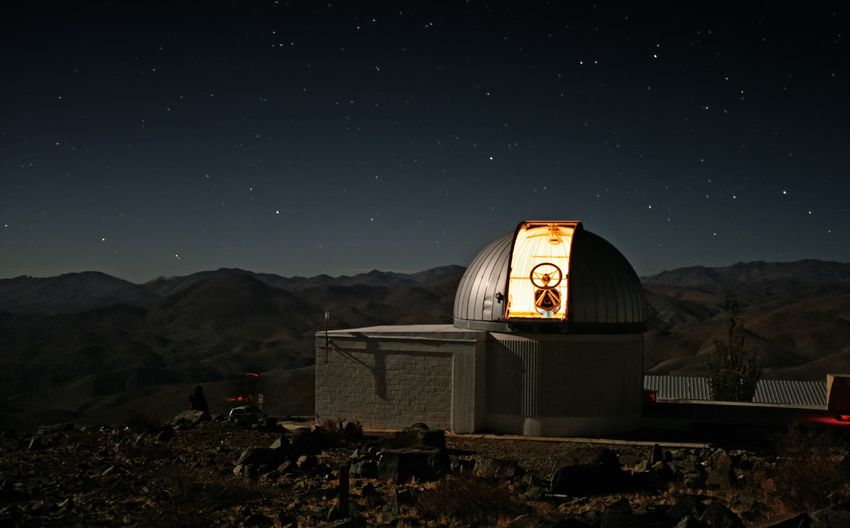
alibrator observation, visibility ampli
c tors. We plan to add these using data bases4, 5 as well as information on previ
tudes are computed for the same time from the AKARI/IRC mid-infrared all-sky ous observations may be added to the
intervals at the wavelengths of observa survey (Ishiara et al., 2010). With upcom output result of CalVin in a future release.
tion and of the VLTI fringe tracker FINITO, ing fainter limiting magnitudes for the
and magnitudes are given at the wave current VLTI instruments, and in particu
lengths of the guiding camera IRIS and lar for second generation VLTI instru References
the Coudé guiding camera. Figure 2 ments, the current underlying list may still Beust, H. et al. 2011, MNRAS, 414, 108
shows for illustration some screenshots not be sufficiently complete for the faint Bonneau, D. et al. 2006, A&A, 456, 789
of a query using CalVin. est magnitudes offered. The faint mode Bonneau, D. et al. 2011, to appear in A&A
of SearchCal (Bonneau et al., 2011) may Bordé, P. et al. 2002, A&A, 393, 183
Cruzalèbes, P. et al. 2010, A&A, 515, A6
then be used to create a significantly Ishihara, D. et al. 2010, A&A, 514, A1
Performance of CalVin larger underlying list of calibrators, which Lafrasse, S. et al. 2010, VizieR Online Data
would also impose stronger requirements Catalog, 2300
The performance of CalVin, in particular on the database technology. The addi Mérand, A. et al. 2006, A&A, 447, 783
Verhoelst, T. 2005, PhD thesis K. U. Leuven, Belgium
in terms of response time, has been tional use of the AKARI point source cat Wittkowski, M. et al. 2005, The Messenger, 119, 14
optimised using a new database technol alogue might then also allow a more
ogy and JavaScript-based visualisation robust selection of calibrator sources to
technology to display the plots. The ease be obtained. Astrometric observations Links
of use has also been improved by opti using the upcoming VLTI facilities PRIMA 1
isCalc and CalVin are available from: http://www.
V
mising the layout of the query page, now and GRAVITY may require further selec eso.org/observing/etc
including one single input page (Figure 2, tion criteria, such as a low proper motion 2
T he JSDC catalogue: http://cdsarc.u-strasbg.fr/cgi-
left), compared to two pages in version 2. of a phase reference calibrator, requir- bin/VizieR?-source=II/300
3
SearchCal is available at: http://www.jmmc.fr/
ing additional information in the database searchcal
as well as additional search criteria. An 4
T he IAU Comm. 54 bad calibrators’ registry (BCR)
Future directions example of such a search for astrometric is available at: http://www.eso.org/sci/observing/
calibrators was recently described by tools/catalogues/bcr.html
5
T he bad calibrators’ database at JMMC: http://
The current underlying list of calibrators Beust et al. (2011). Information on entries apps.jmmc.fr/badcal
lacks MIR magnitudes for many calibra in the available bad calibrators’ data
ESO/Y. Beletsky
One of the VLTI 1.8-metre Auxiliary
Telescopes (ATs) being replaced on its
tracks at Cerro Paranal after mirror re-
aluminising. Each AT has its own
transporter that lifts the telescope and
moves it from one observing position
to another on tracks. However the
transfer by road to and from the coat
ing plant at the base camp relies on a
truck, as shown.
The Messenger 145 – September 2011 9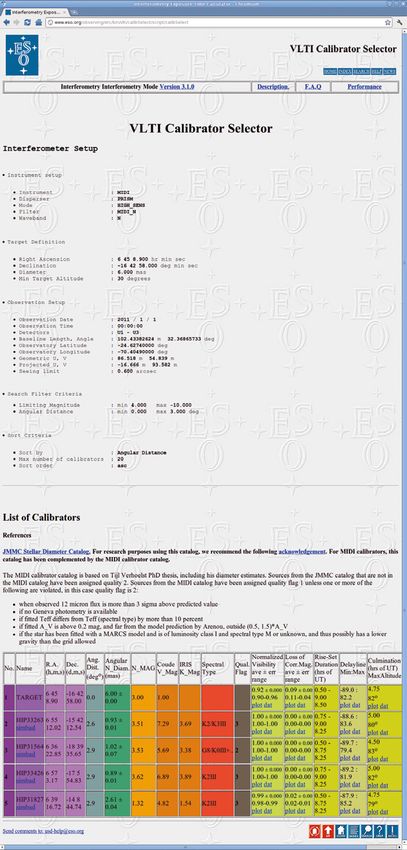
Telescopes and Instrumentation
A New Massively-multiplexed Spectrograph for ESO
Suzanne Ramsay1 In 2010, ESO launched a call for proposals Each panel was charged with commenting
Peter Hammersley1 for the conceptual design of a multi-object on the suitability of the proposals for fur
Luca Pasquini1 spectroscopic (MOS) instrument/facility ther study. The proposals were for six very
for carrying out public surveys. Up to two powerful and very different instruments.
proposals were to be selected for a com These included slit- and fibre-based spec
1
ESO petitive Phase A study. The call for pro trographs, covering the optical and near-
posals was very broad and stated that the infrared wavelength ranges and were for
instrument should provide the ESO astro the VLT, VISTA and the NTT. Although
With the advent of many large-area nomical community with the ability to some of the projects were judged to be
imaging surveys in recent years, the carry out original wide-field spectroscopic very challenging and ambitious, no techni
need for a new facility for spectroscopic science. Beyond this requirement, the cal show-stoppers were identified. The
surveys has become apparent. Follow- instrument concept and the detailed sci scientific committee strongly endorsed the
ing a recommendation from the Science entific goals were left open. Proposals 2017 delivery timescale envisaged for
and Technical Committee, ESO made a were solicited for any ESO telescope: up the instrument as being required for Gaia
call in 2010 for wide field spectroscopic grades to existing instruments or com and eROSITA follow-up. The requirement
instrument proposals among its com- pletely new instrument concepts were for high spectral resolving power (λ/δλ >
munity. Two of the ten proposals were both within the scope of the call. Even 10 000) for optimal exploitation of Gaia
selected for a competitive Phase A proposals for non-ESO telescopes were was stressed. The possible selection of
study. This article describes the selec- permissible. In total, ten letters of interest, Euclid at the end of 2011 by ESA is ex
tion process and two associated articles describing in brief the proposal concept, pected to have an important influence,
present the instrument concepts. were sent in by the community. Six teams as the science goals of its spectroscopic
were invited to submit full proposals con instrument overlap with this project.
sisting of a scientific and technical report
Large-scale observational surveys are and a management plan for the design Overall, the science panel reached excel
powerful tools for advancing many astro study. lent agreement as to the most suitable
nomical fields, often opening up new proposals for further work. Finally, ESO
directions of research, whether the goal is The final proposals were delivered on management received the input from the
a statistical understanding of a particular 1 March 2011 and included over 30 institu two committees and selected the con
class of source or the search for rare tions and 160 contributors, demonstrating cepts for study. Their recommendation
objects. In the optical and infrared many the wide interest in such an instrument. was presented to the Science and Tech
new ground-based imaging surveys are The quality of the submitted scientific and nical Committee at its April 2011 meet-
underway (e.g., WFCAM, VISTA, Pan technical ideas was warmly appreciated ing. The successful proposals are for
STARRS), are about to start (VST) or in by ESO and the panels involved in the MOONS — a fibre-fed infrared spectro
the planning stages (Large Synoptic Sur evaluation of the instrument concepts. graph designed for the VLT, led by Michele
vey Telescope, LSST). These imaging sur Cirasuolo from the UK Astronomy Tech
veys will yield catalogues of hundreds of The proposals were reviewed from a tech nology Centre, and for 4MOST — a fibre-
millions of sources and target scientific nical and scientific perspective by sepa fed optical spectrograph, led by Roelof
fields from gravitational lensing to the star rate panels. The technical panel consisted de Jong from the Leibniz-Institut für Astro
formation history of the Galaxy, such as of engineers and scientists from within physik Potsdam. Conceptual designs for
for VISTA and VST (Arnaboldi et al., 2007). ESO. The technical review addressed the 4MOST on both the VISTA and NTT tele
In space, Gaia will provide an unprece quality of the technical case for the instru scopes will be explored by the team before
dented catalogue of positional and radio- ment concept, including the level of risk the selection is made at the midterm of
velocity information for about a billion involved in the design, the quality of the the design study. In the following two arti
stars and the eRosita mission will explore management plan and the experience of cles the scientific and instrumental aspects
the nature of dark matter and dark energy the team. The important factors of the of the two proposals are summarised.
with an all-sky X-ray survey. These survey impact on the telescope and the opera
projects will deliver new results in the tional model for the instrument were also The Phase A for the two instruments will
second half of this decade which will de considered. finish in February 2013. It is expected
mand spectroscopic follow-up. The re that one of the instrument concepts will
quirement for a highly-multiplexed spec The scientific panel was made up by a then be recommended to the STC for
trograph was identified in the ASTRONET 50:50 split of astronomers from the com detailed design and construction. ESO’s
Infrastructure Roadmap (Bode, Cruz & munity and from ESO. It commented goal is to offer a new spectroscopic facil-
Molster, 2008) as a high priority for ex on the major scientific questions to be an ity on one of its telescopes around 2017.
ploiting these, and other, missions and as swered by the instrument, whether the
a standalone facility. The ESO Science science case would be interesting and
and Technology Committee (STC) has competitive on the timescales of 2016 References
recommended that steps be taken to and beyond and whether the instrument Arnaboldi, M. et al. 2007, The Messenger, 127, 28
improve the existing ESO capabilities in concept presented would address those Bode, M. F., Cruz, M. J. & Molster, F. J. 2008., The
this field. goals. ASTRONET Infrastructure Roadmap, Astronet
10 The Messenger 145 – September 2011Telescopes and Instrumentation
MOONS: The Multi-Object Optical and Near-infrared
Spectrograph
Michele Cirasuolo1, 2 Bologna; 9 CEA–Saclay, Paris; 10 Lund Observatory; Galactic archaeology
11
INAF–Osservatorio Astronomico Roma; 12 Dark
José Afonso 3
Cosmology Centre, Copenhagen; 13 IASF–INAF,
Ralf Bender4, 5 Milano; 14 ETH Zürich; 15 Universitäts-Sternwarte The study of resolved stellar populations
Piercarlo Bonifacio 6 München; 16 Max-Planck-Institut für Astrophysik; of the Milky Way and other Local Group
Chris Evans1 17
INAF–Osservatorio Astrofisico di Arcetri; 18 Max- galaxies can provide us with a fossil
Planck-Institut für extraterrestrische Physik;
Lex Kaper 7 19
record of their chemo-dynamical and star
NOVA-ASTRON; 20 INAF–Osservatorio Astronomico
Ernesto Oliva 8 Padova; 21 Durham University; 22 Leiden Observa formation histories over many-gigayear
Leonardo Vanzi 9 tory; 23 Kapteyn Astronomical Institute timescales. Scheduled for launch in 2013,
the ESA Gaia mission will deliver new
insight into the assembly history of the
1 STFC United Kingdom Astronomy MOONS (Multi-Object Optical and Milky Way, but to exploit its full potential,
Technology Centre, Edinburgh, United Near-infrared Spectrograph) is a large ground-based follow-up is required.
Kingdom field (500 square arcminutes), multi- MOONS will provide this crucial follow-up
2 Institute for Astronomy, University of object (500 object + 500 sky fibres) for Gaia and for other ground-based sur
Edinburgh, United Kingdom instrument with spectral resolution of veys such as Pan-STARRS and UKIDSS,
3 Observatorio Astronomico de Lisboa, 5000 and 20 000 proposed for the VLT and the surveys with VISTA, by measur
Portugal Nasmyth focus. The science case for ing accurate radial velocities, metallicities
4 Universitäts-Sternwarte, München, MOONS, covering Galactic structure and chemical abundances for several
Germany and galaxy evolution up to the epoch million stars. Given the spectral resolu
5 Max-Planck-Institut für extrater of re-ionisation, is briefly outlined. tions (R ~ 5000 and R ~ 20 000) and its
restrische Physik, München, Germany ability to observe in the NIR, MOONS will
6 GEPI, Observatoire de Paris, CNRS, MOONS1 is a new conceptual design for perfectly complement the ongoing and
Univ. Paris Diderot, France a Multi-Object Optical and Near-infrared planned surveys (see Figure 1) including
7 Astronomical Institute Anton Pannekoek, Spectrograph, which will provide the the new large Gaia–ESO public spectro
Amsterdam, the Netherlands ESO astronomical community with a scopic survey. The unique features of
8 INAF–Osservatorio Astrofisico di powerful and unique instrument that is MOONS will allow us in particular to clar
Arcetri, Italy able to serve a wide range of Galactic, ify the nature of the extincted regions of
9 Centre for Astro-Engineering at Univer extragalactic and cosmological studies. the Bulge, but also to assess the chemo-
sidad Catolica, Santiago, Chile The grasp of the 8.2-metre Very Large dynamical structure of the Galactic thin
Telescope (VLT) combined with the large and thick disc, understand the impor
multiplex and wavelength coverage of tance of satellites and streams in the
Team members: MOONS — extending into the near- halo, ultimately creating an accurate 3D
Miguel Abreu1, Eli Atad-Ettedgui2, Carine
infrared (NIR) — will provide the obser map of our Galaxy to provide essential
Babusiaux 3, Franz Bauer4, Philip Best5, Naidu
Bezawada 2, Ian Bryson2, Alexandre Cabral1, Karina vational power necessary to study galaxy insight into its origin and evolution.
Caputi 5, Fanny Chemla3, Andrea Cimatti 6, Maria- formation and evolution over the entire
Rosa Cioni7, Gisella Clementini 8, Emanuele Daddi 9, history of the Universe, from the Milky
James Dunlop5, Sofia Feltzing10, Annette Ferguson5,
Way, through the redshift desert and up The growth of galaxies
Andrea Fontana11, Johan Fynbo12, Bianca Garilli13,
Adrian Glauser14, Isabelle Guinouard 3, Francois to the epoch of re-ionisation at z > 8–9.
Hammer 3, Peter Hastings2, Hans-Joachim Hess15, At the same time, the high spectral reso Tracing the assembly history of galaxies
Rob Ivison2, Pascal Jagourel3, Matt Jarvis7, Guinivere lution mode will allow astronomers to over cosmic time remains a primary
Kauffmann16, Andy Lawrence 5, David Lee2, Gianluca
study chemical abundances of stars in goal for observational and theoretical
Licausi11, Simon Lilly14, Dario Lorenzetti11, Roberto
Maiolino11, Filippo Mannucci17, Ross McLure 5, Dante our Galaxy, in particular in the highly studies of the Universe. Even though, in
Minniti4, David Montgomery 2, Bernard Muschielok15, obscured regions of the Bulge, and pro recent years, large spectroscopic surveys
Kirpal Nandra18, Ramón Navarro19, Peder Norberg5, 21, vide the necessary follow-up of the Gaia at optical wavelengths (0.3–1 μm) have
Livia Origlia8, Nelson Padilla4, John Peacock5, Laura
mission. provided key information on the formation
Pentericci11, Mathieu Puech3, Sofia Randich17, Alvio
Renzini20, Nils Ryde10, Myriam Rodrigues 3, Roberto and evolution of galaxies, NIR spec
Saglia15, 5, Ariel Sanchez18, Hermine Schnetler 2, troscopy is now crucial to extend our
David Sobral 5, 22, Roberto Speziali11, Eline Tolstoy 23, Science objectives knowledge beyond z ~ 1. In fact, at these
Manuel Torres 4, Lars Venema 21, Fabrizio Vitali11,
redshifts almost all the main spectral
Michael Wegner15, Martyn Wells2, Vivienne Wild 5,
Gillian Wright 2 MOONS will be a versatile, world-leading features are shifted at λ > 1 μm. Exploit
instrument able to tackle some of the ing the large multiplex and wavelength
most compelling key questions in sci coverage of MOONS, it will be possible to
1
Centre for Astronomy & Astrophysics University of ence: How do stars and galaxies form create the equivalent of the successful
Lisboa; 2 United Kingdom Astronomy Technology and evolve? Do we understand the Sloan Digital Sky Survey, but at z > 1 (see
Centre; 3 GEPI, Observatoire de Paris; 4 Centre for
extremes of the Universe? Here we briefly Figure 2). This will provide an unparal-
Astro-Engineering, Universidad Catolica; 5 Institute
for Astronomy, Edinburgh; 6 Università di Bologna – highlight some of the main science cases leled resource to study the physical pro
Dipartimento di Astronomia; 7 University of that are driving the design of MOONS. cesses that shape galaxy evolution
H ertfordshire; 8 INAF–Osservatorio Astronomico and determine the key relations between
The Messenger 145 – September 2011 11Telescopes and Instrumentation Cirasuolo M. et al., MOONS
Figure 1. Number den Apogee R ≈ 20 000 Near-IR stellar mass, star formation, metallicity
sity of stars in the vari Bulge and the role of feedback. Filling a critical
ous components of the 5 gap in discovery space, MOONS will be
Log (Cumulatif Number of Stars/square degree)
Milky Way shown as a HERMES RVS ≈ 30 000 Optical
s
function of V-band mag te r a powerful instrument to unveil “the red
lus
rc
nitude (figure adapted Gaia RVS ≈ 7500 Optical bu
la MOONS shift desert” (1.5 < z < 3, see Figure 2)
from Recio-Blanco, Hill & Glo
4 > 1000 sq.deg. and study this crucial epoch around the
Bienaymé, 2009). Gaia
will provide astrometry
RAVE R ≈ 7500 Optical > 2 million stars peak of star formation, the assembly
for all stars with V < 20, of the most massive galaxies, the effect
however the onboard of the environment and the connection
spectrometer (RVS) will 3 with the initiation of powerful active
deliver chemical abun
dance only for stars galactic nuclei. MOONS will also provide
brighter than magnitude the essential deep spectroscopic follow-
13 and radial velocities up of imaging surveys undertaken with
for stars brighter than 17. 2
facilities in optical and near-IR (VISTA,
MOONS will perfectly
complement Gaia and UKIDSS, VST, Pan-STARRS, Dark Energy
the other spectroscopic Thin Disc Thick Disc Halo Survey, LSST) and facilities operating
surveys (e.g., Apogee, 1 at other wavelengths (ALMA, Herschel in
Hermes, RAVE) provid 10 12 14 16 18 20
V mag the infrared, eRosita in the X-ray and
ing chemical abun
dances via high resolu Chemical abundances Radial velocities and [Fe/H] LOFAR, WISE and ASKAP in the radio).
tion spectroscopy in the in NIR with R ≈ 20 000 via CaT with R ≈ 5000–10 000
NIR (e.g., observing Ca,
Si, S, Fe, Ti lines) and
radial velocities via the
calcium triplet. (O III)
Lyα (O II) Hβ
Hα
1.
05
MOONS
z = 1.5
1.
Gb
20
Mg I Bδ
CaT
Mg II H,K
0.
re
90
ds
0.5 1 1.5 2 2.5
hi
ft
(O III)
0.
60
Lyα (O II) Hβ
Hα
0.
Optical
30
Spectrographs
MOONS Gb z = 1.5
Mg I Bδ
CaT
Mg II H,K
0.5 1 1.5 2 2.5
31
3.
(O III)
e 58
)
yr
Hβ
t i m 5.
(G
(O II)
Hα
ck
ok 8
lo 7.1
ba
34
8.
SDSS at
19
Gb z = 0.1
9.
Hδ
Survey Redshift Volume #Objects Fe II Mg I
CaT
(h – 3 Mpc 3) Mg II H,K
SDSS 0 < z < 0.2 1 × 10 8 10 6
MOONS 0.8 < z < 1.8 5 × 10 7 2.5 × 10 6 0.3 0.4 0.5 0.6 0.7 0.8 0.9
λREST (µm)
Figure 2. A medium-deep survey by MOONS at z > 1 survey. As shown by the top right panels, the crucial redshifted out of the optical range) and gained the
will provide a large number of spectra of similar qual redshift range 1.5 < z < 2.5, encompassing the peak nickname “redshift desert”. As shown MOONS
ity and over the same restframe wavelength range of star formation, has proved to be the hardest to will cover this gap and properly trace the evolution
and co-moving volume as the low-redshift SDSS explore spectrally (because the major features are of galaxies throughout the redshift desert.
12 The Messenger 145 – September 2011Figure 3. Left: The redshift–
MOONS 150 sq.deg. space correlation function for
1 BOSS the 2dFGRS, ξ(σ,π), plotted as
20 VIPERS a function of transverse (σ)
HETDEX and radial (π) pair separation at
z < 0.3 from the 2dF galaxy
redshift survey (Peacock et al.,
2001). This plot clearly displays
0.8 redshift space distortions, with
Growth rate fg(z)
“fingers of God” elongations
π/h –1 Mpc
on small scales and coherent
0
Kaiser flattening at large scales,
2dFGRS
the signature of the growth rate
SDSS – LRG
0.6 of structure on galaxy cluster
VVDS
ing measurements. Right:
WiggleZ
Comparison of growth rate-
measurements, fg(z), for cur
rently available measurements
– 20 ΛCDM: Ωm = 0.325, Λ = 0.675
(solid symbols, with 2dFGRS,
0.4 ΛCDM: Ωm = 0.225, Λ = 0.775
SDSS-LRG, WiggleZ and
ΛCDM: Ωm = 0.275, Λ = 0.725
VVDS) and to projected meas
urements (open symbols) of
– 20 0 20 0 0.5 1 1.5 2 ongoing surveys (BOSS,
σ/h –1 Mpc Redshift VIPERS and HETDEX). Open
triangles show the prediction
for the growth rate measure
ment that will be obtained with
The first galaxies consists of currently unexplained dark
MOONS using ~ 1 million gal
energy and dark matter, and less than axies over 150 square degrees.
The shining of the first galaxies, just a few 4 % is in the form of baryons. Under No other ground-based survey
hundred million years after the Big Bang standing the nature of these dark compo is able to probe the redshift
range considered by MOONS.
(at redshift 7 < z < 12) is of enormous nents — which dominate the global
importance in the history of the Universe expansion and large-scale structure of
since these first galaxies hold the key the Universe — is amongst the most
to furthering our understanding of cosmic fundamental unsolved problems in sci MOONS INSTRUMENT PERFORMANCE
reionisation. Although recent advances ence. Complementary to other spectro
obtained by deep NIR imaging have been scopic surveys at z < 1 (e.g., Vipers, Telescope VLT
dramatic, very little is known about when BOSS, W iggleZ, BigBOSS), the capabili Field of view 500 sq. arcmin.
and especially how this re-ionisation ties of MOONS will allow us to con- Number of targets 500 objects + 500 sky
happened. The unique combination of strain the cosmological paradigm of the Wavelength 0.8(0.5)–1.8 μm
8-metre aperture, wide area coverage Λ Cold Dark Matter model by determin- Resolutions Medium = 5000
and NIR spectroscopy (key since at z > 7 ing the dark matter halo mass function High = 20 000
even the Lyα line is shifted to λ > 1 μm) and obtain crucial constraints on the
offered by MOONS, will p rovide accurate nature of dark energy and gravity via
distances, relative velocities and emis- detailed measurements of the growth rate both a medium resolution (R ~ 5000)
sion line diagnostics, without which the of structure at z > 1, extending previous mode and a high-resolution (R ~ 20 000)
power of these photometric surveys determinations, such as that by the 2dF mode to allow detailed dynamical and
is severely limited. The capabilities of galaxy redshift survey at z < 0.3 (Peacock chemical studies. Such characteristics
MOONS will give us the first realistic et al., 2001) and shown in Figure 3. and versatility make MOONS the long-
chance to perform a systematic, wide- awaited workhorse NIR multi-object
area spectroscopic study of the very high spectrograph for the VLT, which will per
redshift galaxies and establish the phys Instrument specifications fectly complement the optical spectros
ics of reionisation. copy performed by FLAMES and VIMOS.
To address such fundamental science
questions MOONS will exploit the full 500
Cosmology square arcminute field of view offered References
by the Nasmyth focus of the VLT and will Peacock, J. et al. 2001, Nature, 410, 169
Over the last two decades several obser cover the wavelength range 0.8 μm–1.8 μm, Recio-Blanco, A., Hill, V. & Bienaymé, O. 2009,
vational keystones have considerably with a possible extension down to 0.5 μm. Proc. French Society of Astron. & Astrophys.
changed our knowledge of the Universe. A new pick-off system will allow a fast SF2A-2009
Measurements of the cosmic microwave positioning of the fibres and the observa
background, high-redshift supernovae tion of 500 targets simultaneously, each Links
and large-scale structure have revealed with its own dedicated sky fibre for opti
1
that 96 % of the density of the Universe mal sky subtraction. MOONS will have MOONS: http://www.roe.ac.uk/~ciras/MOONS.html
The Messenger 145 – September 2011 13You can also read


