The new Checklist of the Italian Fauna: Mecoptera - eScholarship
←
→
Page content transcription
If your browser does not render page correctly, please read the page content below
Biogeographia – The Journal of Integrative Biogeography 37 (2022): ucl002
                                                                    https://doi.org/10.21426/B637156506
                                                 Special Section: The new Checklist of the Italian Fauna

                      The new Checklist of the Italian Fauna: Mecoptera

                                                                              AGOSTINO LETARDI

      National Agency for New Technologies, Energy and Sustainable Economic Development (ENEA),
                              Casaccia Research Centre, Via Anguillarese 301, I-00120 Roma (Italy)
                                                    corresponding author, email: agostino.letardi@enea.it

Keywords: Bittacidae, Boreidae, Panorpidae, scorpionflies, species list

SUMMARY
We present a data set reporting the checklist of the species of the order Mecoptera for Italy, updating the
one previously published in the series ‘Checklist delle Specie della Fauna d'Italia’ in 1995. The updated
checklist comprises 11 taxa at the species and subspecies level, currently known from national Italian
territories (7 Panorpidae, 2 Bittacidae, 2 Boreidae). The records are at the regional level and refer to
various terrestrial habitats. The previous checklist reported 10 taxa (6 Panorpidae, 2 Bittacidae, 2 Borei-
dae): no taxa were removed because currently considered not valid and one was added, after scanning 16
papers published between 1993 and 2020 and expanding the regional records. The data set is freely avail-
able from LifeWatch Italy at https://www.lifewatchitaly.eu/en/initiatives/checklist-fauna-italia-
en/checklist. The data set will be dynamically updated with new records; this paper describes the state of
the art of the data set on December 2021.

INTRODUCTION                                              Mecoptera, with the description of the state of
Thanks to the pioneering work carried out to-             the art of the updated data set as it currently
wards the end of the last century, achieved               stands in December 2021.
thanks to the project ‘Checklist delle Specie                      The project on the ‘Updated Checklist of
della Fauna d'Italia’ (Minelli et al. 1993-1995),         the Italian Fauna’ started in 2020 (Bologna et al.
the animal biodiversity of our country was one            2022) and the process is now complete for the
of the first to be exhaustively listed, photo-            data on the order Mecoptera. The database re-
graphing the situation of that period. The aim of         ported in this data paper will be continuously up-
this data paper is to provide information on the          dated in the online platform of LifeWatch Italy,
updated checklist, limited to the order                   allowing for a dynamically updated knowledge

   Letardi, 2022                         Biogeographia 37: ucl002                                         1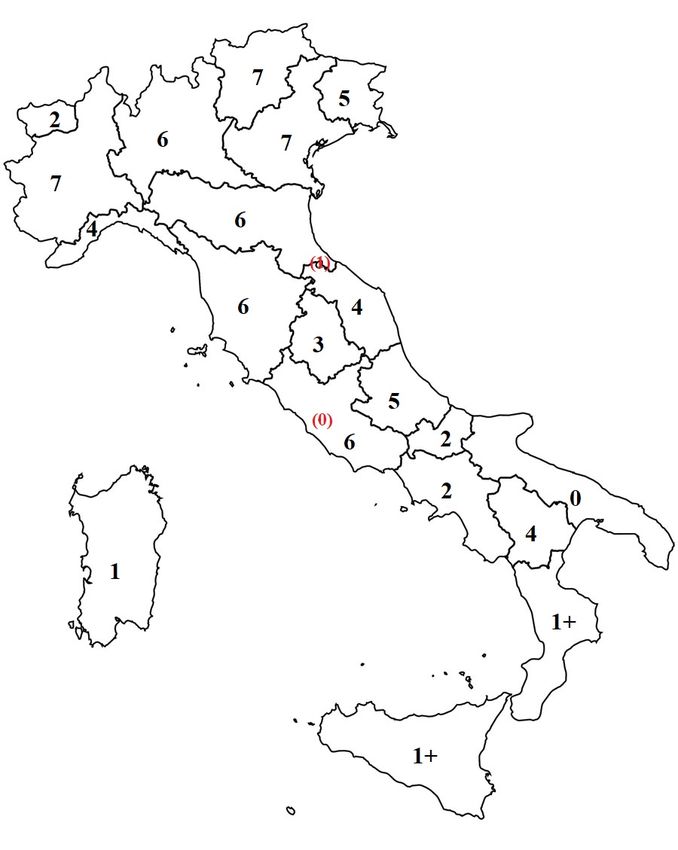
on the occurrence of the fauna in the country
(Bologna et al. 2022).
          The order Mecoptera is a small, relict
group of holometabolous insects generally
called “scorpionflies” because the males of some
families have bulbous genitalia on an upturned
abdominal tip, which resembles a scorpion’s
stinger. Today, there are only approximately 737
extant species, distributed among 39 genera and
nine families (Bicha 2018). However, during
their long evolutionary history, Mecoptera in-
habited almost all the continents during the Per-
mian and continued to be one of the most abun-
dant groups of insects until the Cretaceous, when
they declined in abundance to the recent level.
The order is peculiar for this reason, with seven
of its nine extant families having one to a score
of species, with the remaining two families –
Bittacidae, with essentially a Southern Hemi-
sphere distribution (and possible Gondwanan
origin), and Panorpidae, with mostly a Northern
Hemisphere distribution (and possible Laurasian
origin) – containing 91% of the species. Moreo-
ver, it is subject of debate whether the Mecoptera
form a single clade, or whether the Siphonaptera
(fleas) are inside that clade, so that the traditional
"Mecoptera" is paraphyletic (Meusemann et al.
2020). Concerning the present checklist, scorpi-
onflies are here considered in their traditional
meaning, without the inclusion of Siphonaptera,
considering three families observed in Italy, i.e.
Boreidae, Bittacidae, and Panorpidae (Willmann
2012) (see Fig. 1), which show different mor-
pho- and ecological characteristics. For exam-
ple, most mecopteran larvae have compound
eyes like those of hemimetabolous larvae, but
boreid larvae appear to have only stemmata.
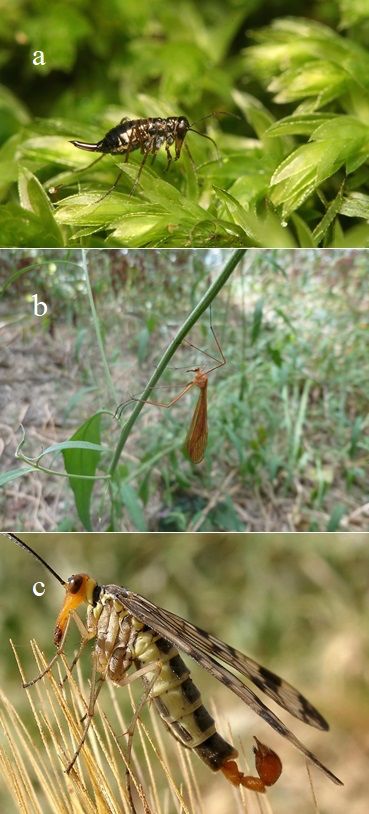
Scorpionflies diet is diverse too: adult bittacids         Figure 1. Representative scorpionflies: a) the boreid
are predaceous; panorpids are saprophagous,                Boreus hyemalis (Linnaeus, 1767), b) the bittacid
and boreids are phytophagous.                              Bittacus italicus (Müller, 1766), c) the panorpid Pan-
                                                           orpa annexa McLachlan, 1869. Photo courtesy of
       Here we report the currently biogeo-                Pierre Tillier (a, b) and Marcello Romano (c).
graphical knowledge for the known species of
Mecoptera in Italy.
       A simplified version of the checklist is
given in Supplementary File S1.

2                                           Biogeographia 37: ucl002                          Letardi, 2022
RESULTS species list and the distribution of the species
since Bernardi Iori et al. (1995).
Summary statistics
The species list accounts to 11 taxa at the species
and subspecies level, with 2 taxa of Bittacidae, 2
of Boreidae, and 7 of Panorpidae. The previous
checklist (Bernardi Iori et al. 1995) reported 10
taxa: 2 Bittacidae, 2 Boreidae, 6 Panorpidae. The
current update includes one more taxa, with
some nomenclatorial changes occurred since
1995.
Northern Italy and Southern Italy count
the same biodiversity, with 9 species (Fig. 2).
The regions with the highest number of known
species (7) are Piemonte, Veneto and Trentino-
Alto Adige, whereas for Puglia no species are
known. No species are known for Vatican City
too, but recently Bittacus hageni (Brauer, 1860)
has been reported for San Marino Republic (Fig. Figure 2. Geographical units of Italy used for the
3). checklist, with number of species of Mecoptera for
each of them. The + sign in Sicily means the doubtful
presence of a second species.
Data set description
The data set includes 40 fields (Table 1). The
first fields refer to the hierarchical taxa from
Phylum to Family, followed by Genus and Ge-
nus authorship, Species and Species authorship,
and eventually, when necessary, Subspecies and
Subspecies authorship.
Two following fields report the species
names as mentioned in the Fauna Europaea da-
tabase (de Yong 2016).
Two fields report whether the species is
currently known to be endemic to Italy or
whether it is a recent alien introduction, accord-
ing to the definition of the Secretariat of the Con-
vention on Biological Diversity (2002).
The following fields report the known
Figure 3. Regional units of Italy, San Marino Repub-
occurrence of scorpionflies in different geo-
lic and Vatican City, used for the checklist, with
graphical areas (Figg. 2 and 3). number of species of Mecoptera for each unit (San
Two final fields report nomenclatorial Marino Republic and Vatican City in red colour).
changes occurred since the publication of the The + sign in Calabria and Sicily means the doubtful
previous checklist by Bernardi Iori et al. (1995) presence of a second species.
and the literature references used to expand the
Letardi, 2022 Biogeographia 37: ucl002 3Table 1. Description of the data set with specific information relative to definitions and storage type for each of
the 40 fields of the data set.
Variable (field) Description Storage type
Phylum Phylum name, Arthropoda for all records string
Class Class name, Insecta for all records string
Order Order name, according to Willmann (2012) string
Family Family name, according to Willmann (2012) string
Valid genus name, followed the species names in the world checklist for
Genus string
Mecoptera (Penny & Byers 1979) and subsequent revisions
Genus authorship Genus descriptor, reported according to the rules of the ICZN string
Valid species name, followed the species names in the world checklist for
Species string
Mecoptera (Penny & Byers 1979) and subsequent revisions
Species authorship Species descriptor, reported according to the rules of the ICZN string
Valid subspecies name, followed the species names in the world checklist
Subspecies string
for Mecoptera (Penny & Byers 1979) and subsequent revisions
Subspecies authorship Subspecies descriptor, reported according to the rules of the ICZN string
Fauna Europaea (name) Species name as reported in FaunaEuropaea string
WoRMS (AphiaID) Species AphiaID as reported in WoRMS string
Endemic Species known as endemic binary
Alien Species known as alien binary
Occurrence of the taxon in Northern continental Italy (grouping: Friuli -
N Venezia Giulia, Veneto, Trentino - Alto Adige, Lombardia, Valle d'Aosta, binary
Piemonte, Liguria, Emilia Romagna)
Occurrence of the taxon in Southern continental Italy (grouping: Toscana,
S Marche, Umbria, Lazio, Abruzzo, Molise, Campania, Puglia, Basilicata, binary
Calabria)
Si Occurrence of the taxon in Sicily binary
Sa Occurrence of the taxon in Sardinia binary
Ao Occurrence of the taxon in Valle d'Aosta binary
Pi Occurrence of the taxon in Piemonte binary
Lo Occurrence of the taxon in Lombardia binary
VT Occurrence of the taxon in Trentino - Alto Adige binary
V Occurrence of the taxon in Veneto binary
FVG Occurrence of the taxon in Friuli - Venezia Giulia binary
Li Occurrence of the taxon in Liguria binary
ER Occurrence of the taxon in Emilia Romagna binary
To Occurrence of the taxon in Toscana binary
Ma Occurrence of the taxon in Marche binary
Um Occurrence of the taxon in Umbria binary
La Occurrence of the taxon in Lazio binary
Abr Occurrence of the taxon in Abruzzo binary
Mo Occurrence of the taxon in Molise binary
Cp Occurrence of the taxon in Campania binary
Pu Occurrence of the taxon in Puglia binary
Bas Occurrence of the taxon in Basilicata binary
Cal Occurrence of the taxon in Calabria binary
RSM Occurrence of the taxon in Repubblica di San Marino binary
CV Occurrence of the taxon in Città del Vaticano binary
Nomenclatorial changes from the previous checklist of Bernardi Iori et al.
Taxonomic notes string
(1995)
Literature reference for the records in a geographical unit not reported in
Distribution notes string
Bernardi Iori et al. (1995)
4 Biogeographia 37: ucl002 Letardi, 2022Data set information Funding grants: No funding was specifically
Object name: The new Checklist of the Italian available for the project on Mecoptera; funding
for the update of the Checklist of the Italian
Fauna: Mecoptera
fauna was obtained from LifeWatch Italy.
Characters encoding: Unicode (UTF-8)
Data set citation: Letardi A., 2021. Mecoptera.
In: Bologna M.A., Zapparoli M., Oliverio M., Geographic information
Minelli A., Bonato L., Cianferoni F., Stoch F. General description: The data set includes rec-
(eds), The new Checklist of the Italian Fauna. ords from the national territories of Italy, includ-
Version 1.0. Last update: 2021-05-31. ing the two major islands Sardinia and Sicily, to-
Format name: xml, Extensible Markup Lan- gether with archipelagos and minor islands po-
guage, for the online version at LifeWatch Italy. litically under the Italian legislation.
Geographic units: The geographical units within
Format version: 1.0
the Italian national territories for terrestrial rec-
Distribution: https://dataportal.lifewatchitaly.eu ords refer to the administrative boundaries of the
/view/urn%3Auuid%3Ac1f2ab37-61e4-48e9- 20 Italian regions, in addition to San Marino Re-
b3a9-15bdbf002f9d public and Vatican City. Continental Italy was
Date of creation: June 15th, 2020 also divided in two units, namely North (Friuli -
Venezia Giulia, Veneto, Trentino - Alto Adige,
Date of last revision: June 15th, 2020 Lombardia, Valle d'Aosta, Piemonte, Liguria,
Date of publication: July 23rd, 2021 Emilia Romagna) and South (Toscana, Marche,
Umbria, Lazio, Abruzzo, Molise, Campania, Pu-
Language: English glia, Basilicata, Calabria).
License of use: Creative Commons Attribution Bounding box: All areas falling under Italian ad-
4.0 International License ministration (in addition to San Marino Republic
Metadata language: English and Vatican City) from 35° 25' to 47° 06' N and
from 6° 35' to 19° 20' E (WGS84 reference sys-
Metadata managers: Marco A. Bologna, Lucio
tem) were included.
Bonato, Fabio Cianferoni, Alessandro Minelli,
Marco Oliverio, Fabio Stoch, Marzio Zapparoli Sampling design: We did not perform any addi-
& LifeWatch Italy tional sampling to collect records of scorpion-
flies, but we used only published data or verified
personal communications.
Management details
Habitat type: Any type of habitat where scorpi-
Project title: The new Checklist of the Italian onflies can be found was considered (Bicha
Fauna: Mecoptera 2018). These include all terrestrial habitats. The
Database manager: Letardi A.; Marco A. Bolo- terrestrial habitats refer to lush, herbaceous veg-
gna, Lucio Bonato, Fabio Cianferoni, Alessan- etation growing in the shade of forests, often
dro Minelli, Marco Oliverio, Fabio Stoch, Mar- along slow-moving streams, under or near
zio Zapparoli & LifeWatch Italy shrubs or trees that provide protection from di-
rect sun (bittacids and panorpids, although in
Temporal coverage: Anything published until 15 mountainous areas, the former generally seem to
June 2020. prefer lower elevations than do the latter); li-
Record basis: Published records in the scientific chens and mosses in snowy, mountains areas
and grey literature. (boreids).
Letardi, 2022 Biogeographia 37: ucl002 5Biogeographic region: Within the Palearctic Taxonomic information
realm, according to the definitions of the Euro- General description: Only records reporting spe-
pean Environmental Agency (2017), the data set cies or subspecies were included, disregarding
covers three European biogeographical regions:
records at higher levels like genus, family, etc.
Alpine, Continental, and Mediterranean.
Taxonomic coverage: Order Mecoptera, in-
Countries: Italy, San Marino, Vatican City. tended in its traditional inclusion of Panorpidae,
Quality control for geographic data: We Bittacidae, and Boreidae, and the exclusion of
checked that the georeferenced records and the Siphonaptera (Willmann 2012).
published localities in the papers indeed Taxonomic rank: Only species and subspecies
matched the geographical units used for the are reported; the data set reports higher taxa for
checklist at the level of administrative regions. each species, including Phylum, Class, Order,
Family, Genus.
Literature records Taxon specialist: Agostino Letardi.
General description: Only published records are Nomenclature: The adopted nomenclature fol-
included in the data set. A search through the lit- lowed the species names in the world checklist
erature was performed on 15th June 2020. for Mecoptera (Penny & Byers 1979) and subse-
Literature search methods: We searched through quent revisions. Species authorships follow the
Web of Science, Scopus, and Google Scholar for rules of art. 51.3 of the 4th edition of the Interna-
keywords (‘scorpionflies’ or ‘Mecoptera’) and tional Code of Zoological Nomenclature (Inter-
national Commission on Zoological Nomencla-
(‘Italy’ or ‘Italian’).
ture 1999) for the use of parentheses.
Literature list: The 16 papers published after the
previous checklist by Bernardi Iori et al. (1995) Taxonomic remarks: Any taxonomic change that
and that provided scopionflies records for new occurred since the publication of the previous
areas, not previously reported in Bernardi Iori et checklist (Bernardi Iori et al. 1995) is men-
al. (1995), are: Allegro (1996), Casali & Santi tioned, according to the updated nomenclature of
(2020), Letardi (1997, 1998, 2002, 2003a, the Mecoptera.
2003b, 2004, 2005, 2007, 2009), Letardi & Mal- Quality control for taxonomic data: Taxonomic
tzeff (2001), Letardi & Vigna Taglianti (2003), data were checked and updated to include revi-
Sforzi et al. (2019), Terzani & Mazza (2012), sion of names, synonyms, delimitation of genera
Willmann (2012). and higher taxa, all conducted through a compar-
Quality control for literature data: Additional ison with the world checklist for Mecoptera
references were searched through the grey liter- (Penny & Byers 1979) and subsequent revisions.
ature with online searches outside the three aca-
demic databases and no new records were found.
ACKNOWLEDGEMENTS
In addition, we scanned the cited references of
each paper and we did not find additional over- We thank the ‘Comitato Scientifico per la Fauna
looked records. We do not claim that the check- d’Italia’, who pursued the updates for the check-
list is absolutely complete, but that it is the best list of the Italian Fauna. We thank Marcello Ro-
we could do. The dynamic nature of the online mano and Pierre Tillier for providing the photos
data set at Lifewatch will allow including poten- of Fig. 1.
tially overlooked records.
6 Biogeographia 37: ucl002 Letardi, 2022REFERENCES Museo Civico di Storia Naturale, Venezia, 48,
125-126.
Allegro, G. (1996). Osservazioni sul comportamento
del Picchio rosso maggiore, Picoides major, in Letardi, A. (2002) Megaloptera, Neuroptera, Mecop-
pioppeto durante periodo di riproduzione. Rivista tera p.105 - In: Mason, F., Cerretti, P., Tagliapie-
italiana di Ornitologia, 66(1), 17-27. tra, A., Speight, M.C.D., & Zapparoli, M. (eds).
Invertebrati di una foresta della Pianura Padana,
Bernardi Iori, A., Kathirithamby, J., Letardi, A., Pan- Bosco della Fontana, Primo contributo. Conser-
taleoni, R.A., & Principi M.M. (1995). Neuropte-
vazione Habitat Invertebrati 1 - Gianluigi Arcari
roidea (Megaloptera, Raphidioptera, Planipen-
Editore, Mantova, 176 pp.
nia), Mecoptera, Siphonaptera, Strepsiptera - In:
Minelli, A., Ruffo, S. & La Posta, S. (eds) Chec- Letardi, A. (2003a). Nuovi dati sulla distribuzione
klist delle specie della fauna italiana, 62. Calde- peninsulare ed insulare italiana di Mecotteri (Me-
rini, Bologna. coptera). Frustula Entomologica n.s. 24 (37), 99-
102.
Bologna, M.A., Bonato, L., Cianferoni, F., Minelli,
A., Oliverio, M., Stoch, F. & Zapparoli, M. Letardi, A. (2003b). Neuropterida, Mecoptera p.122-
(2022) Towards the new Checklist of the Italian 123. In: Cerretti, P., Tagliapietra, A., Tisato, M.,
fauna. Biogeographia – The Journal of Integrative Vanin, S., Mason, F., & Zapparoli, M. (eds). Ar-
Biogeography, 37, ucl001. DOI: 10.21426/ tropodi dell’orizzonte del faggio nell’Appennino
B637156271 Settentrionale, Primo contributo. Conservazione
Habitat Invertebrati 2. Gianluigi Arcari Editore,
Bicha, W. J. (2018). Biodiversity of Mecoptera. pp. Mantova, 256 pp.
705-720. In: Foottit, R. G., & Adler, P. H. Insect
Biodiversity: Science and Society, Volume II. Letardi, A. (2004). L’andamento del volo di Panorpa
John Wiley & Sons Ltd, 1024 pp. cognata e Panorpa communis (Mecoptera, Panor-
pidae). In: Cerretti, P., Hardersen, S., Mason, F.,
Casali, S. & Santi, F. (2020). Segnalazioni faunisti- Nardi, G., Tisato, M., & Zapparoli, M. (eds). In-
che n. 184 - Bittacus hageni (Brauer, 1860) (In- vertebrati di una foresta della Pianura Padana, Bo-
secta: Mecoptera: Bittacidae). Quaderno di Studi
sco della Fontana. Secondo contributo. Conserva-
e Notizie di Storia Naturale della Romagna, 52: zione Habitat Invertebrati, 3. Cierre Grafica Edi-
271-272. tore, Verona: 181-184.
de Jong, Y. (2016). Fauna Europaea. Fauna Europaea Letardi, A. (2005). Insecta Mecoptera. In: Ruffo, S.,
Consortium. Checklist dataset DOI: 10.15468/
& Stoch, F. (eds). Checklist e distribuzione della
ymk1bx accessed via GBIF.org on 2021-05-23. fauna italiana. Memorie del Museo Civico di Sto-
European Environmental Agency (2017). Biogeo- ria Naturale di Verona, 2 serie, Sezione Scienze
graphical regions in Europe. European Topic della Vita 16: 237-238.
Centre on Biological Diversity (ETC/BD). Per- Letardi, A. (2007). Rafidiotteri, Neurotteri e Mecot-
malink: 3431629fe50049a7b995d125aad9c71d
teri del Parco e delle aree adiacenti (Raphidiop-
International Commission on Zoological Nomencla- tera, Neuroptera, Mecoptera), pp. 297-305. In:
ture (1999). International Code of Zoological No- Nardi, G. & Vomero, V. (eds). Artropodi del
menclature, fourth edition. The International Parco Nazionale del Vesuvio: ricerche prelimi-
Trust for Zoological Nomenclature, London. nari. Conservazione Habitat Invertebrati, 4.
Available at: https://www.iczn.org/the-code/the- Cierre edizioni, Verona.
international-code-of-zoological-nomenclature/ Letardi, A. (2009). Neurotteridi e Mecotteri delle Ri-
the- code-online/
serve Naturali "Agoraie di Sopra e Moggetto" (Li-
Letardi, A. (1997). Mecoptera - In: Zapparoli, M., (a guria, Genova) e "Guadine Pradaccio" (Emilia-
cura di). Gli Insetti di Roma. Quaderni dell’Am- Romagna, Parma) (Megaloptera, Raphidioptera,
biente, 6, 237-238. Neuroptera, Mecoptera). Bollettino dell'Associa-
zione Romana di Entomologia, 64(1-4), 281-291.
Letardi, A. (1998). Bittacus hageni Brauer, 1860 in
Veneto (Mecoptera, Bittacidae). Bollettino del Letardi, A. (2021). Insecta Mecoptera. In: Bologna,
M.A., Zapparoli, M., Oliverio, M., Minelli, A.,
Letardi, 2022 Biogeographia 37: ucl002 7Bonato, L., Cianferoni, F., Stoch, F. (eds.), Chec- Document UNEP/CBD/COP/6/23. Convention
klist of the Italian Fauna. Version 1.0. Last up- on Biological Diversity Secretariat, Montreal,
date: 2021-05-31. Available at: https://www. Canada. Available at: https://www.cbd.int/deci-
lifewatchitaly.eu/en/initiatives/checklist-fauna- sion/ cop/?id=7197
italia-en/checklist/
Sforzi, A., Bastianini, M., Benocci, A., Bonari, G.,
Letardi, A., & Maltzeff, P. (2001) Neurotteridi e Me- Bruni, G., Canovai, R., Cantini, D., Chelazzi, L.,
cotteri della Tenuta Presidenziale di Castelpor- Chiodini, E., Cianferoni, F., Colombini, I., Fan-
ziano e delle aree limitrofe (Neuroptera, Raphi- ciulli, P.P., Fastelli, P., Forbicioni, F., Lenzini, L.,
dioptera, Mecoptera). Bollettino dell’Associa- Letardi, A., Marcelli, M., Martelli, C., Montera-
zione Romana di Entomologia, 56(1-4), 49-62. stelli, E., Monti, F., Mori, E., Nappini, S., Paoli,
L., Petruzzi, E., Porciani, M., Rizzo Pinna, V.,
Letardi, A., & Vigna Taglianti, A. (2003). Il genere
Selvi, F., Spilinga, C., & Vitillo, C. (2019). Bio-
Boreus in Italia, nuovo per la fauna appenninica.
blitz 2016 Lago dell’Accesa. Atti del Museo di
Bollettino dell’Associazione Romana di Entomo-
Storia Naturale della Maremma, 24, 77-111.
logia 58, 95-100.
Terzani, F., & Mazza, G. (2012). Le Panorpa Lin-
Meusemann, K., Trautwein, M., Friedrich, F., Beu-
naeus, 1758 del Parco nazionale delle Foreste ca-
tel, R. G., Wiegmann, B. M., Donath, A., Podsi-
sentinesi, monte Falterona e Campigna (Mecop-
adlowski, L., Petersen, M., Niehuis, O., Mayer,
tera: Panorpidae). Onychium, 9, 108-110.
C., Bayless, K. M., Shin, S., Liu, S.-l., Hlinka, O.,
Quang Minh, B., Kozlov, A., Morel, B., Peters, R. Willmann, R. (2012). Fauna europaea: Mecoptera.
S., Bartel, D., Grove, S., Zhou, X., Misof, B., & Fauna europaea version 2.5, http://www.eur.org
Yeates, D. K. (2020). Are fleas highly modified
Mecoptera? Phylogenomic resolution of Antli-
ophora (Insecta: Holometabola). bioRxiv
2020.11.19.390666; DOI: 10.1101/2020.11.
19.390666 Submitted: 21 February 2022
Minelli, A., Ruffo, S., & La Posta, S. (eds) (1993- First decision: 20 April 2022
1995). Checklist delle specie della Fauna d'Italia. Accepted: 20 April 2022
Ministero dell’Ambiente, Comitato Scientifico
per la Fauna d’Italia. Calderini Editore. the Guest editors for the special section
“The new Checklist of the Italian Fauna”:
Penny, N.D., & Byers, G.W. (1979). A Check-list of
the Mecoptera of the world. Acta Amazonica, Marco A. Bologna, Lucio Bonato,
9(2), 365-388. Fabio Cianferoni, Alessandro Minelli,
Secretariat of the Convention on Biological Diversity Marco Oliverio, Fabio Stoch, Marzio Zapparoli
(2002). Decision VI/23: Alien species that
threaten ecosystems, habitats and species.
8 Biogeographia 37: ucl002 Letardi, 2022You can also read


