The New Child Care Package - Provider Information April 2018 - Department of Education and Training
←
→
Page content transcription
If your browser does not render page correctly, please read the page content below

The New Child Care Package
     Provider Information

          April 2018
Topics covered today
•   New Child Care Package
•   Key legislative changes
•   Enrolments and payments
•   New IT system
•   Child Care Safety Net
•   Compliance
•   Transition arrangements
•   Resources

                              2
New Child Care
  Package

                 3
Child Care Subsidy
• Replaces Child Care Benefit and Child Care Rebate
• All families expected to make a co-contribution

      Child Care Benefit
                           Child Care Subsidy
                               2 July 2018
      Child Care Rebate

                                                      4
Level of Child Care Subsidy
Three things will determine a family's level of Child Care
Subsidy:

 Family income –           Activity test –         Service type –
 combined family          activity level of      type of child care
    income                  the parent                service
                          undertaking the
                           least activity

                                                                      5
Combined family income 2018-19
               85%
Subsidy rate

               50%

               20%

               0%

                           Combined family income
                                                    6
Activity test
• Amount of work, training, study,
  volunteering or other recognised activity
• Paid and unpaid leave (e.g. parental leave)
• Exemptions                                      Higher
                                                 level of
• Casual/irregular hours of paid work – can     activity =
  estimate over a three-month period              more
                                                hours of
• Families can update details in myGov           subsidy

                                                         7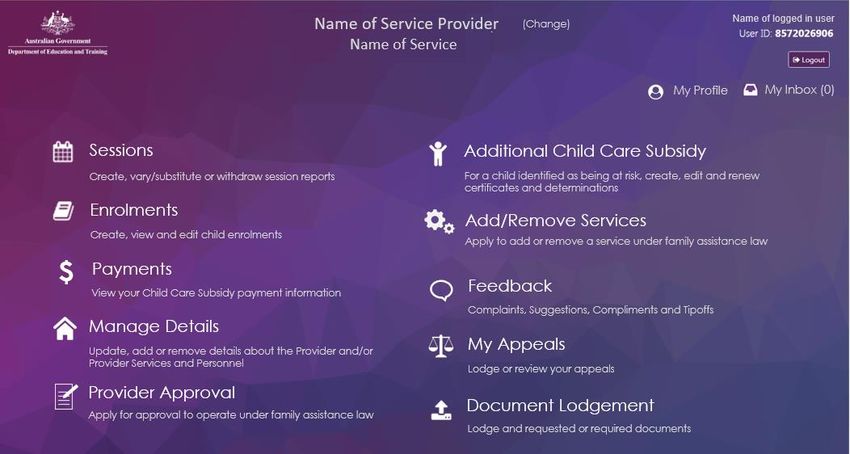
Activity step tests
                                              Maximum number of hours
Step   Hours of activity (per fortnight)
                                              of subsidy (per fortnight)
       Less than 8 hours
                                              24 hours
       (for a family earning up to $66,958)
1      8 hours to 16 hours                    36 hours
2      More than 16 hours to 48 hours         72 hours

3      More than 48 hours                     100 hours

                                                                           8
Hourly rate caps
Service type          Maximum hourly rate cap           Maximum hourly rate cap
                    (Children below school age)           (School-aged children)
Centre Based
Day Care                                  $11.77^                          $10.29^
Outside School
Hours Care                                $11.77^                          $10.29^
Family Day
Care                                      $10.90^                          $10.90^
In Home Care
                             $25.48^ (per family)             $25.48^ (per family)
         ^These amounts are correct for 2018/19 and may be subject to adjustment
         through indexation in subsequent years.
                                                                                   9
Example: Hourly rate cap
                       Centre Based Day Care
$16                                                           Family earning
      85% of            85% of             85% of
$14
                                                              $66k/year
      $9.00             $11.77             $11.77
$12                                                 $5.00     CCS % = 85
$10
                                 $2.00
                                                                Parent
$8             $1.35
                                                                contribution
$6                                                              Child Care
                                 $10.00             $10.00      Subsidy
$4             $7.65
$2
                                                                Hourly rate
                                                                cap ($11.77)
$0
          $9 per                 $12 per            $15 per
           hour                   hour               hour
                                                                               10
New In Home Care (IHC)
Care for families where other options are not available or
appropriate:
• Subsidy per family, not per child
• Capped at 3000 places
• Eligibility criteria
• Equitable distribution of places
• Networked brokerage model What’s changing?
11Key legislative changes
12Legislative framework
• Primary legislation
– Family Assistance Legislation Amendment (Jobs for
Families Child Care Package) Act 2017
• Subordinate legislation
– Minister’s Rules and Secretary’s Rules
• The legislation is available at: education.gov.au/family-
assistance-law-0
13Family Assistance Law
• The Family Assistance Law (FAL) is the basis
for Commonwealth child care fee assistance
• Under Family Assistance Law, services are
approved to administer child care fee
assistance on behalf of eligible families
• Many requirements stay the same
• Focus today is on changes
14Key legislative changes
• Hourly rate cap sets a limit on Government subsidy
contribution
• New provider/service approval requirements
• Strengthened activity test
• Strengthened compliance capability
• Changes to minimum operating hours
15Operating requirements
• Removal of minimum hours per day and
days per week a service must operate
• Sessions of care – unchanged:
– up to a maximum of 12 hours
• Services will only be required to operate
for a minimum of 48 weeks per year
– or seven weeks per year for outside
school hours care
16Provider and service approvals
• Family Assistance Law will align with provider and
service approvals issued by your state or territory
regulatory authority
17Provider approval process
• Provider’s approval must contain:
– your provider ID number
– Applicant’s name and contact details (persons with
Management or Control responsibility)
– specific details of each service
• Service Approval Number
• Type of service
• Physical and postal addresses
• Details of persons with day-to-day operational responsibility
18Fit and Proper Evidence Requirements
Checks made of all ASIC Person Bankruptcy / National Working with
persons with: Insolvency Criminal Children Card
History
Management or control of
a provider
Day-to-day Operational
responsibility of a service
Family Day Care Educators
19Enrolment process
Arrangements for the care of a child
• Four types of arrangement:
   1. Complying Written Arrangement (CWA)
   2. Additional Child Care Subsidy (child wellbeing)
      – provider eligible arrangement
   3. Relevant Arrangement
   4. Arrangement with an organisation (third party)
• Terms between provider and individual

                                                        21
Complying Written Arrangement
• Must set out the following details:
– names and contact details
– date the arrangement starts
– date of birth of the child (or children)
– provision of care – routine, casual or flexible basis
– details of fees
– Child Care Subsidy or Additional Child Care Subsidy can be paid
• Additional information can be included
22Other Arrangements
Relevant Arrangement Additional Child Care Arrangement with an
Subsidy (child wellbeing) organisation (third party)
– provider eligible
arrangement
• Child Care Subsidy or • Additional Child Care • Child Care Subsidy or
Additional Child Care Subsidy payable Additional Child Care
Subsidy not payable • You, the provider, Subsidy not payable
• Arrangement does not become eligible • When another party is
meet CWA requirements liable for fees
• Family does not wish to (e.g. an employer, Adult
claim CCS for session of Migrant English Program,
care or other organisations)
23Enrolment notice
• Submit for each child
• Types of enrolment:
– routine sessions only – casual care is not included
– casual enrolment – no routine sessions are included
– routine sessions, with casual care permitted
• Key information needed:
– Customer Reference Number (CRN) and date of birth of
the parent claiming Child Care Subsidy
– CRN and date of birth of child
24Confirm enrolment by parents
• To increase transparency of
payments, parents will:
– confirm enrolment details
– indicate if details are incorrect
– indicate if the child is not enrolled
• Families confirm enrolment:
– Centrelink online account through
myGov
25Updating enrolments
• Changes to the arrangement of care must be in writing
• Update an enrolment if:
– individual disagrees with enrolment
– arrangement for care is varied
– information in an enrolment is incorrect
– the arrangement for care ends
• Must be updated within seven days of a change
26Questions?
New IT system – Child Care Subsidy System

                                        28
New Child Care Subsidy System
• Replaces CCMS
• Family access through myGov
• Provider access
– Provider Entry Point
– Third Party Software
• User testing is underway
• Training materials for services
29Provider Digital Access (PRODA)
• Online authentication system based on a
username, password and verification code
• Personnel in certain child care roles must register
• Create an account and verify identity
• Once registered, they will receive a
Registration Authority number
• Register for a PRODA ID now
30Third Party Software
• Provides access to the new Child Care Subsidy
System
• A list of registered Child Care Management
System software is available at:
education.gov.au/new-child-care-it-system
31Provider Entry Point
• Access information
• Apply for approval
• Add or remove a service
• Change in circumstances
• Enrolment notices
Provider Entry Point
• Session reports
32Questions?
Session reports and payments

                               34
Calculation of entitlements and payment
Step 1: Session reports submitted by provider
• Session of care – period of care for which fee is charged
• Report through third party software or Provider Entry
  Point
• Session reports must be submitted within
  14 days after the end of the week when care was provided
  – unchanged
• Some exceptions
                                  Submits session reports – details of
                                  care provided, including attendance

                                                                         36
Session report details
Issue Details
Type of report Initial report
Variation (change) to a report
Withdrawal of a report
Dates Start and end dates of the week the report covers
Session details Date
Actual fee charged
Session start and finish times
Actual attendance start and finish times (from 14 January 2019)
Absences Notification of absences (if applicable)
Reasons for additional absence/s (where child has used more than 42 absence
days)
Other subsidies Where any subsidies have been received (e.g. state government funding):
Notification of other subsidies – yes/no
Name of other subsidy payer
Other subsidy amount – hourly or session amount
Family Day Care and In Educator – Child Care Personnel ID
Home Care
Preschool session Was the session part of an early educational program?
37Session reports – absences
• Initial 42 days absence – unchanged
• Additional absence days
• Reporting absences when your
service is closed
• Long absences
38Step 2: Calculation of entitlements and
payments
• Entitlements calculated by Department of Human
Services (DHS) using information provided by the:
– provider
– individual who is claiming
• Withholding
– 5% of the Child Care Subsidy is withheld by DHS
• Notification of payment Calculates Child Care Subsidy and
Additional Child Care Subsidy
entitlements
39Step 3: Statement of Entitlement
• Given to each claimant with a Complying Written
Arrangement for each fortnight
• Can only be issued for care already provided
• Parents will have access through the Centrelink Online
Account and receive periodic notifications about their
determination of entitlement
• Includes details about the service, sessions of care and
fees
• From 14 January 2019 – actual attendance
Receives Statement of Entitlement
40Step 4: Invoicing families
• Invoice for fees over and above the Child Care Subsidy
• When and how to invoice families is a business decision for
the provider
• Families can confirm fee reduction amounts through
Centrelink
Invoices family for fees, minus fee
reduction amounts
41Step 5: Reconciliation (income review)
• Actual entitlement worked out by DHS at end of the
financial year reconciliation after tax returns
• What contributes to adjusted taxable income – visit
www.ato.gov.au/individuals/lodging-your-tax-return/in-
detail/what-is-income-/
Reconciles payments during the
financial year with family income –
Submits tax return (or ATO statement additional payment made or debt
that no return is required) raised by DHS
42Questions?
Child Care Safety Net

                        44
Child Care Safety Net
Supports most vulnerable children through:
• Additional Child Care Subsidy
• Inclusion Support Programme
• Community Child Care Fund
– Connected Beginnings
45Additional Child Care Subsidy
• Extra support for: • Replaces:
– child wellbeing – Special Child Care Benefit
– grandparents – Grandparent Child Care
– temporary financial Benefit
hardship – Jobs, Education and
– transition to work Training Child Care Fee
Assistance
46Additional Child Care Subsidy (child wellbeing)
• A clear definition of ‘at risk’
• A provider initiates the payment on behalf
of the family
• Support before families reach crisis point
• Pays 100% fee charged – up to 120% of
hourly rate cap for up to 100 hours per
Activity test exempt
fortnight
47Additional Child Care Subsidy (child wellbeing)
Step 1 Step 4
Identify child Step 2 Step 3 Evaluate if an additional
at risk of Service gives Apply for a Determination is
serious abuse a certificate Determination required and reapply as
or neglect needed
Certificate Determination
• 1-6 week duration • 13 week duration
• No evidence required • Evidence required
• Notify state/territory within 6 • Reference state/territory application
weeks of start • Can apply for more than 13 weeks
• Can be backdated up to 28 days
48Certificates
• Services – initial six week ‘at risk’ certification:
– Share information with an appropriate body to connect families with help –
this is ‘providing notice’
– Start collecting evidence to support an application for further periods
– Can be backdated up to 28 days
– Where child protection is known to be involved, it is not necessary to
provide notice
– Cannot be given if a child has had one or more certificates for a total of six
weeks in a 12 month period – need to apply to DHS
• A provider can advise how long the child might be at risk
– DHS determine ongoing periods in up to 13 week blocks
49Application for Determinations
• If a child will still be at risk beyond the initial six weeks
– Evidence will be required to support an application (see page
53 of the Handbook)
• Do not need to wait for the certificate to expire
• Will be asked if the child’s circumstances have changed
– If you do not respond before expiration, payment will cease
• No limit on how long it can be provided as long as a child
remains eligible for Child Care Subsidy
50No eligible adult is identified
• Unable to identify a parent or carer who
is eligible
• You may enrol the child under a ‘provider
eligible arrangement’
• You become eligible in relation to the
child
• Provide information for the child and the
arrangement
51Special Child Care Benefit – At Risk
• Transition to Additional Child Care Subsidy
(child wellbeing) from 2 July 2018
• Need a new certificate
• Subsequent applications will be required
• Evidence required with all applications
• Evidence required will be determined by
the Department of Human Services
52Additional Child Care Subsidy (grandparent)
• Up to 100 hours of subsidised care per fortnight:
– 65% or greater carer responsibilities
– substantial autonomy for day-to-day decisions
– receives income support
• Covers 100% fee charged, up to 120% of
hourly rate cap
Activity test exempt
53Additional Child Care Subsidy
(temporary financial hardship)
• Short-term assistance – exceptional circumstances
• Ensures continuity of care
• 100% of fee, up to 120% of hourly rate cap,
up to 100 hours per fortnight
• 13 weeks of assistance per event
Activity test exempt
• Families make application to Centrelink
54Additional Child Care Subsidy (transition to work)
• From income support including:
– Parenting Payment
– Newstart Allowance
– Disability Support Pension
– Youth Allowance
• 95% of the fee charged, up to 95% of hourly NOT exempt
rate cap from activity test
• Replaces Jobs, Education and Training Child
Care Fee Assistance payment
55Questions?
Compliance

             57
Compliance strategies
• Prevent non-compliance – guidance and information
• Detect non-compliance as early as possible
• Respond to non-compliance and fraud – sanctions or
cancellation of approval
• Deter non-compliance through strong and clear controls
and publishing information about enforcement action
• Compliance analysis and monitoring
• Child Care Financial Integrity Framework
58You must notify certain changes
• Use third party software or Provider Entry Point
• Examples include:
– Operations – fees, hours, contact details, anticipated
vacancies, ceasing to operate (42 days prior)
– Staff – Serious convictions, qualifications, new person,
working with children checks
– Non-compliance – Family Assistance Law or the
National Quality Framework
59Transition arrangements
60Provider Transition arrangements
Details the five stages of transition:
1. Check and update CCMS details (completed)
2. Register child care personnel (now)
3. Complete the transition workflow (from April 2018)
4. Set up your third party software (from April 2018)
5. Migrate enrolments (from April 2018)
• education.gov.au/transitioning-new-child-care-package
• Also links to the Transition to-do-list page
61Stage 1: Check and update CCMS details
• Data has been migrated from CCMS to the new
Child Care Subsidy System
• Letter sent to all CCB approved providers to check
and update CCMS details
• Providers may experience some difficulties if their
approval details are not up-to-date
• Providers should have already completed
this step
62Stage 2: Register child care personnel now
• Personnel need to register using authentication system
called PRODA (Provider Digital Access):
– Persons with management or control of the provider
– Persons Responsible for the day-to-day operation
of the service
– Service contacts
– Family Day Care Educators
• Provide identity documents, create
an account and receive a Registration Authority
(RA) number
• RA number is used in the transition process
63Stage 3: Complete the transition workflow
from April 2018
• Authorised person for each provider
completes an online transition workflow
• Verify details about the provider and its
services
• You will receive notification of your new
Child Care Subsidy approval numbers
64Stage 4: Set up your third party software
from April 2018
• Can still be used to access new Child Care
Subsidy System
• Software vendors will work with services to
ensure software is correctly set up to interact
• A list of registered CCMS software is available
from the Department of Education and Training
website
65Stage 5: Transitioning enrolments and adding
service personnel from April 2018
1. Check that arrangements with families meet CWA requirements
2. Active formal enrolments are being migrated from CCMS
3. Review migrated enrolments and enter additional details
– Software providers will be able to provide support on how to do this
using their product
4. Parents will be provided details of existing enrolments to confirm
through their call to action workflow
• Attach service personnel to service approval
66Services and providers transition
• Check and up date their details in CCMS
• Action requests from the Department
• Visit the Department website
– check the transition pages
– download resources
• Child Care Management System Helpdesk
– ccmshelpdesk@education.gov.au
67Budget Based Funded (BBF) services
• All BBF services that deliver child care will be eligible to
administer the CCS, ACCS and receive CCCF
(non-competitive) funding from July 2018
• BBF services are following a separate transition process
68Families transition
• Awareness – communications campaign (Phase 2)
– online subsidy estimator
• Call-to-action from Centrelink in April 2018
– email or letter
• Application – provide new information
– income estimate for 2018-19 financial year
– hours of work, study, training or volunteering
• Eligibility assessment – family advised
– CCS paid directly to providers on behalf of families
69What do families need to do?
1. Look out for Centrelink letter (April 2018)
2. Log into myGov (April – May 2018)
a) Access Centrelink online account
b) Provide new information and confirm current
details
• family income estimate
• activity test
• child care/schooling details
• confirm enrolments
70Families attending BBF services
• Families attending BBF services will be able to access a child
based fee subsidy for the first time
• What do BBF families need to do?
– access the online subsidy estimator
– locate their Customer Reference Number (CRN), or if they
don’t have one, apply for one through Centrelink
– make sure they have a myGov account
– from April 2018, lodge a claim through myGov
71Resources
72Child Care Provider Handbook
• Will be published online
• DRAFT version up until 2 July but
ongoing development
• Will be printable and searchable
• Don’t rely on a hard copy
73Transition page and to-do list
• Provides details about what to do
and when
• Contains videos
• Updated regularly
education.gov.au/transitioning-new-child-care-package
74Frequently asked questions
education.gov.au/
new-child-care-package-
frequently-asked-questions
75Compliance – Complaints and tip offs
• If you have a complaint or are
concerned about fraud occurring:
– Contact the Child Care Tip Off Line
with details on 1800 664 231 or email
tipoffline@education.gov.au
• You can choose to remain anonymous
76For more information
• Visit the Department website – education.gov.au
– read about transitioning – education.gov.au/
transitioning-new-child-care-package
• Follow us on Facebook –
facebook.com/AusGovEducation/
• Child Care Management System Helpdesk
Follow us
– ccmshelpdesk@education.gov.au facebook.com/
AusGovEducation/
77Questions?
You can also read


