THE SAOLA'S BATTLE FOR SURVIVAL ON THE HO CHI MINH TRAIL 2013
←
→
Page content transcription
If your browser does not render page correctly, please read the page content below
2013

 The Saola’s Battle for Survival
 on the Ho Chi Minh Trail
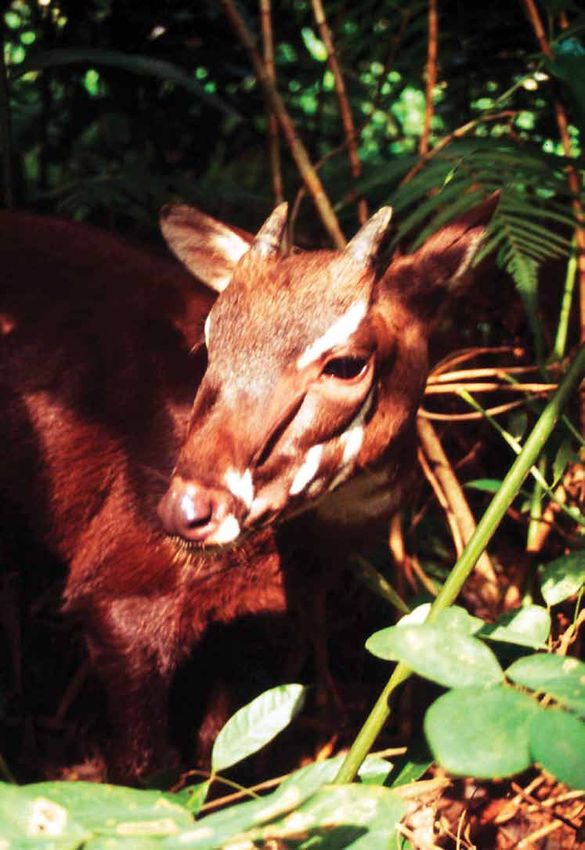
                                   © David Hulse / WWF-Canon
WWF is one of the world’s largest and most experienced
independent conservation organizations, with over
5 million supporters and a global network active in
more than 100 countries.
WWF’s mission is to stop the degradation of the planet’s
natural environment and to build a future in which humans live
in harmony with nature, by conserving the world’s biological
diversity, ensuring that the use of renewable natural resources
is sustainable, and promoting the reduction of pollution and
wasteful consumption.
Written and edited by Elizabeth Kemf, PhD.
Published in August 2013 by WWF – World Wide Fund For
Nature (Formerly World Wildlife Fund), Gland, Switzerland.
Any reproduction in full or in part must mention the title and
credit the above-mentioned publisher as the copyright owner.
© Text 2013 WWF
All rights reserved.
Contents

1. introduction 		                                                     5

2. Saola spawns decades of species discoveries 	                       7

3. The big eight of the Twentieth century 	                            9

4. Threats: Trapping, illegal wildlife trade and habitat fragmentation 11

5. Tug of War on the Ho Chi Minh Trail 	                              12

6.	Discoveries and extinctions 	                                      14

7.	WHAT IS BEING DONE TO SAVE THE SAOLA?	                             15
   Forest guard training and patrols	                                 15
   Expanding and linking protected areas	                             16
   Trans-boundary protected area project	                             16
   The Saola Working Group (SWG) 	                                     17
   Biodiversity surveys	                                               17
   Landscape scale conservation planning	                              17
   Leeches reveal rare species survival	                              18

8. The saola’s Tipping Point 	                                        19

9. Tackling the issues: what needs to be done?	                       20
   Unsustainable Hunting, Wildlife Trade And Restaurants 	            20
   Illegal Logging And Export	                                        22
   Dams And Roads	                                                    22

10.	What’s at stake? 	                                                25

References	                                                           26

                                                                             3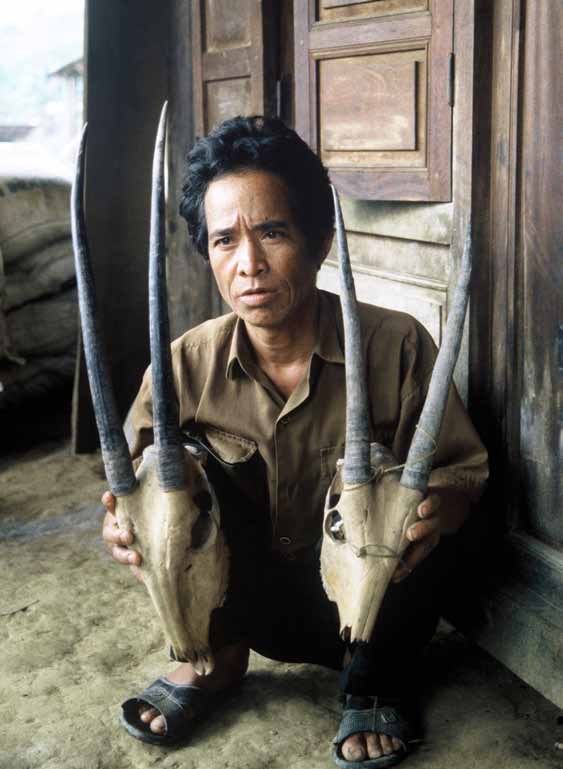
© Elizabeth Kemf / WWF-Canon

Ta Oi hunter in Vietnam’s A Luoi valley with his saola horns.
The Saola’s battle for survival on the Ho Chi Minh trail

1. introduction
With the opening of new roads in and between Vietnam and Laos, opportunistic
hunters and loggers are moving into treacherous terrain where leeches, horse flies and
deadly diseases used to keep outsiders at bay.

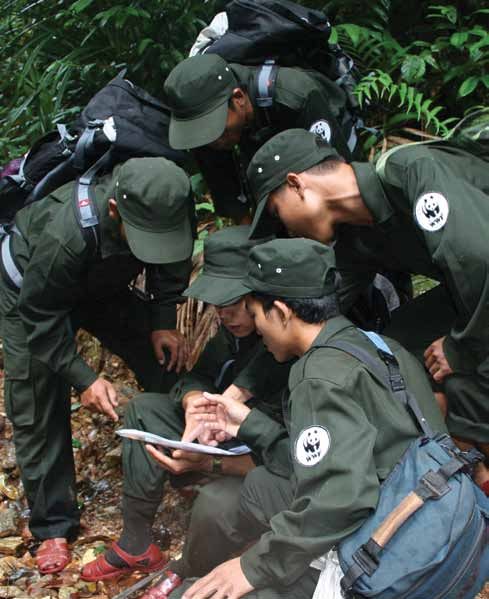
Forest guards in the rugged Annamite Mountains straddling these two countries are
battling against time, racing to remove deadly traps and rescuing endangered animals
before they are killed or tracked down by highly trained dogs.

The guards are patrolling nature reserves and protected areas along the infamous
Ho Chi Minh Trail, destroying thousands of snares and shutting down scores of
illegal hunting camps in an all-out bid to save the rare eight million year old saola
(Pseudoryx nghetinhensis) from extinction. Each time a trap is eliminated, the saola’s
chances for survival increases.

Efforts in Vietnam and Laos, the only countries where tiny saola populations struggle
for survival in the upper reaches of isolated forest patches in border areas in the
Annamite Mountain range, were stepped up dramatically in 2012, during the 20th
anniversary year of its discovery by scientists in 1992.

Between February 2012 and February 2013 – in two nature reserves alone in central
Vietnam – locally-employed WWF guards and Forest Protection Department (FPD)
rangers uprooted 336 hunting camps and removed some 13,394 snares. In neighbouring
Laos, during six months of activity between September 2011 and November 2012,
Wildlife Conservation Society (WCS) patrol teams in the Phou Sithone Endangered
Species Conservation Area wiped out 7,058 traps (Saola Working Group 2013).

Believed to be a relic species of the last Ice Age, the saola was probably squeezed into a
narrow strip of evergreen forests along the mountains and foothills of the Annamites,
referred to as Truong Son in Vietnam, and as Sai Phou Louang in Laos. So far,
the animal has been recorded in Nghe An, Ha Tinh, Quang Binh, Quang Tri, Thua
Thien Hue and Quang Nam provinces in Vietnam and Bolikhamxay, Khammouane,
Savannakhet, Xe Khong and Xieng Khouang provinces in Laos.

                                                                                                5
The Saola’s battle for survival on the Ho Chi Minh trail

                                   Despite daily law enforcement sweeps through saola reserves, trappers penetrate
                                   the steep, wet, evergreen forests and are still capturing hundreds of animals each
                                   month. In protected areas, where a thousand traps a night are sometimes set, terrified
                                   wardens and guards describe close escapes from organized criminals armed with
                                   new technology: automatic weapons, chainsaws, sophisticated satellite phones, and
                                   all-terrain vehicles that have infiltrated the once secluded hideouts of the world’s
                                   remaining saola.

                                    The Critically Endangered saola is not the main target for hunters and traders, but
                                   it has become a victim of lethal wire snares, whose numbers have skyrocketed in the
                                   past decade. The traps are mainly set to meet the burgeoning demand of Vietnam
                                   and China’s growing appetite for game meat and traditional Asian medicines. In Asia,
                                   most of the wildlife trade is underground, operates through secret networks and is
                                   not included in government statistics; countries including Cambodia, Laos, Indonesia
                                   and Vietnam are major sources of wildlife trade and consumption (Secretariat of the
                                   Convention on Biological Diversity 2011).

                                   Escalating affluence in urban areas, combined with improved transport
                                   infrastructure is leading to a spiraling demand for many wild species, according to
                                   TRAFFIC International, a joint programme of WWF and IUCN that monitors global
                                   wildlife trade.

                                   The in-migration of profiteers into the Annamites in search of precious timber and
                                   lucrative bushmeat has driven up the earnings of wildlife traders at the top of the
                                   supply chain, but most local communities that harvest the wild animals are not
                                   benefitting from the big profits. In fact, they are losing one of their main sources of
                                   nutrition and coping mechanisms: bushmeat.

                                   TRAFFIC warns that the scale of current hunting is perilous to many forest species
                                   and ecosystems not only in Vietnam and Laos, but also around the world; an
                                   unprecedented level of hunting threatens communities and the biodiversity upon
                                   which they rely. “The development of small-scale alternatives to the unsustainable
                                   bushmeat harvest and trade is of paramount importance” (Secretariat of the
                                   Convention on Biological Diversity 2011).
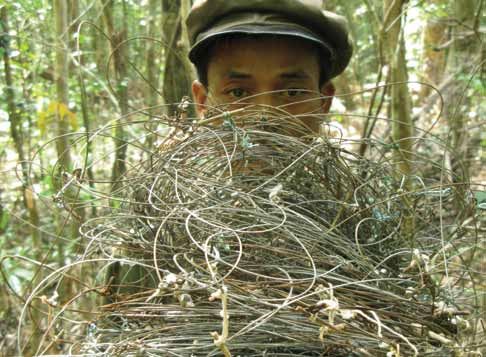
                                                                                                                             © W.Robichaud

 Patrol team member with wire
   snares collected in the Nakai
 Nam Theun National Protected
                   Area in Laos.

6
The Saola’s battle for survival on the Ho Chi Minh trail

2. Saola spawns decades of species
   discoveries
Since the saola, a member of the bovid family, was discovered in May 1992 during a
joint survey carried out by the Ministry of Forestry of Vietnam (MOF) and
WWF in the Vu Quang Nature Reserve (north-central Vietnam), over a thousand
new species have been uncovered by scientists in the Greater Mekong region
(Cambodia, Laos, Myanmar, Thailand, Vietnam and Yunnan province of the
People’s Republic of China).

On the last day of the 1992 survey, Vietnamese biologist, Dr Do Tuoc, went off on
his own with a list of the names of village hunters in hand. In the first two houses he
visited, he collected saola skulls, and in the third he spotted a pair of unusual horns
attached to a wooden pillar.

“The first time I saw them, I thought they must be from a new species”, he exclaimed.
“The hunting trophy looked like it was from an Arabian oryx, which lives in a dry
climate. But, the saola lives in humid evergreen forests where it is much cooler and
wetter than the desert”, he added. Do Tuoc rushed off to show the skulls and
horns to his research partner, Dr John Mackinnon, who recalled his reaction to
the rare find: “I knew it was so ‘wow!’ so new! That day spawned a new wave of
exploration and discoveries”.

The MOF/WWF team also found a total of 62 fish species during their first surveys,
41 more than was previously recorded. In addition, 20 species of amphibians and 37
reptiles were found. The big prize was the pair of saola horns, unlike anything the two
seasoned field biologists had ever seen in Africa or Asia. Between May 1992 and early
1993, Vietnamese scientists made four additional trips and collected 20 specimens,
including one complete skin, which was stuffed and mounted for exhibition at the
Forestry Inventory and Planning Institute (FIPI) in Hanoi. Tissue samples were
dispatched to Denmark and the US for testing.
In March 1993, WWF and the Vietnamese government announced the remarkable
results. To the astonishment of the world’s scientific community and members of the
general public, not only was the primitive animal a new species, but also an entirely
new genus in the bovid family, which includes cattle, sheep, goats and antelopes.

The following year, the saola attracted international attention again when a female
calf was captured just outside Vu Quang in May 1994. The young saola, estimated to
be about four to five months old and which weighed 18 kg, one-fifth the size (100 kg)
of a large adult saola, was transported on 9 June to a 3-hectare botanic garden at FIPI
in Hanoi. In the first two weeks of care by Do Tuoc and FIPI staff, the juvenile gained
four kilos. The conservation community, especially in Asia, was spellbound by the
striking features of the shy animal with its large facial scent glands and the dark thin
stripe down the middle of its back. Its horns were only six centimetres, unlike the
unmistakable long straight sweptback horns of a mature saola. Unfortunately, the calf
died in captivity because its diet was inappropriate.

Two years later in 1996, a pregnant female saola was held in captivity in Laos in
Bolikhamxay province. William Robichaud, Coordinator of IUCN’s Species Survival
Commission Saola Working Group (SWG), was fortunate enough to observe the
animal for three weeks before it died because of its inadequate diet. Of the experience
he recalls: “The most remarkable thing about the animal was her calm nature. The

                                                                                                7
The Saola’s battle for survival on the Ho Chi Minh trail

                                 only thing she was afraid of was dogs. Otherwise, she was tame, more so than a
                                 village cow. A Buddhist monk came to see the animal and told me, ‘we call the saola
                                 the polite animal, because it always walks quietly and slowly through the forest’.”

                                 The most recent saola to be taken into captivity was captured in 2010 by a group of
                                 Hmong villagers. It was caught in Bolikhamxay province in Laos, but the animal died
                                 only a few days later.

                                   How The Saola Got Its Name

                                   Initially dubbed the Vu Quang Ox, the animal was renamed to reflect the
                                   nomenclature used by local communities on both sides of the border: saola.
                                   Villagers throughout the Annamites say the animal, which was a part of their diet
                                   and communal ceremonies, was named after the long straight parallel posts (sao),
                                   which support the spindle (la) of the spinning wheel. The sturdy tapered supports
                                   resemble the saola’s horns. Pictured here, Bounkieng, a weaver in Thongcare
                                   village, Laos, who has seen the saola in the wild, explains to her children how the
                                   “saola” spindle is the source of the primitive animal’s name.

                                                                                                                         © Elizabeth Kemf / WWF-Canon

8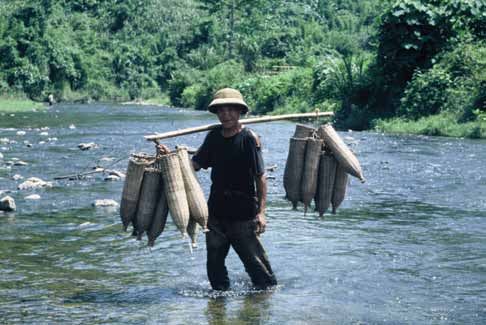
The Saola’s battle for survival on the Ho Chi Minh trail

                                   3. The big eight of the Twentieth
                                      century
                                   For over half a century, the kouprey, or wild forest ox, which existed nowhere else
                                   but in Cambodia, Laos, Thailand and Vietnam, remained the last largest terrestrial
                                   mammal to be classified as a new genus since 1940: “The discovery of the kouprey, a
                                   new genus of bovid, in Cambodia in French Indo-China in 1937 is quite as unexpected
                                   as Sir Harry Johnston’s discovery of the Okapi in 1900 in the Ituri Forest of the
                                   Belgian Congo” (Coolidge 1940).

                                   In 1993, the saola joined in the distinction of being one of only six new large mammal
                                   species discovered in the 20th century. By 1997, the number increased to eight, thanks
                                   to the discovery of two species of deer, the large-antlered or giant muntjac (Muntiacus
                                   vuquangensis), found in Vu Quang in 1994, and the Truong Son or Annamite muntjac
                                   (Muntiacus truongsonensis) discovered in Pu Mat Nature Reserve in Vietnam in 1997
                                   – and concurrently in the Annamite Mountains and adjacent hill ranges in central and
                                   southern Laos.

                                   The saola and the large-antlered muntjac are classified by IUCN’s Red List as
                                   Critically Endangered and Endangered, respectively, while the dark Annamite
                                   muntjac is classified as Data Deficient. The latter is a poorly known species, and “its
                                   coat coloration and markings remain unknown” (Schnell et al. 2012). However, local
                                   long-term indigenous residents know the small dark deer and have hunted it for food
                                   for centuries.

                                   Sadly, of the new mammal species discovered in Indochina in the past 76 years, the
                                   kouprey is believed to be extinct, and if conservation efforts and budgets on both sides
                                   of the border are not boosted significantly, the saola will continue – as the SWG warns –
                                   “sliding towards extinction”.

                                                                                                                                  © Ngan Nguyen Thi Phuong/WWF-Canon

     Nguyen Xuan Hieu (right),
 traditional healer living in Vu
    Quang in Vietnam in 2012,
 shows author Elizabeth Kemf,
the saola trophy he obtained in
              the area in 1998.

                                                                                                                                  9
The Saola’s battle for survival on the Ho Chi Minh trail

                                  Investing In The Saola, Symbol Of Survival And Recovery

                                  The saola (Pseudoryx nghetinhensis), discovered
                                  in 1992 by scientists in Vietnam’s Vu Quang Nature
                                  Reserve (expanded and now a national park), is one
                                  of the world’s rarest mammals. Although it looks
                                  somewhat like an antelope with its long tapered
                                  horns, it is actually a member of the cattle family.
                                  It is so distinctive from other bovid species (bison,
                                  buffalo, sheep and wild cattle) that it was given
                                  its own genus. Due to its highly elusive nature and remote habitat, very little
                                  information about the species has been collected since its discovery in the dense
                                  evergreen forests of the Annamite Mountains bordering Vietnam and Laos.

                                  Adult saola weigh between 80 to 100 kg, can stand about 85 cm or more at the
                                  shoulder and grow horns that can reach 50 cm in length. The sharp tapered horns
                                  rest on adults’ backs when their heads are raised. Saola have large maxillary glands,
                                  which indigenous hunters say the animals rub against the side of young plants in the
                                  forest. Since no scientist has ever seen a saola in the wild, despite years of searching
                                  and camera trapping, biologists fear that the total global population is plunging,
                                  due mainly to intensive hunting pressure. Although usually not specifically targeted
                                  by trappers, the saola has become a victim of bycatch, entangled accidentally –
                                  sometimes intentionally – in lethal snares. The animal’s numbers are estimated to be
                                  in the low hundreds, and possibly as low as in the tens, according to the SWG.

                                                                                                                                     © W.Robichaud/VangBanVillage/WCS/IUCN

                                  A rare camera trap photo of the elusive and Critically Endangered saola in its threatened forest
                                  habitat in the Annamite mountains which straddle the borderlands of Laos and Vietnam.

10
The Saola’s battle for survival on the Ho Chi Minh trail
4. Threats: Trapping, illegal wildlife
trade and habitat fragmentation
The immediate threats to the saola are hunting, logging and fragmentation of its
unique wet evergreen forest habitat. The species faces numerous dangers, mainly
from commercial hunting with wire snares, steel traps and dogs. According to the
WCS, which is supporting restaurant raids carried out by WCS Wildlife Crime Teams,
Vietnam has made a number of large wildlife seizures in recent years. Some criminals
have been prosecuted with heavy fines, but almost none has been given the maximum
sentence of seven years imprisonment. Within months of raids on restaurants, they
are back in business serving illegal wildlife to indifferent customers.
Conservationists and public officials have warned that the public is eating its
biodiversity into extinction, consuming some 3,400 tonnes of wild meat every year.
At a high-level meeting in Vietnam in 2009, an official from Vietnam’s National
Assembly said that more than 66 per cent of poached wildlife is used for food, 32
per cent is exported, and a small number of animals are used for pets and medicinal
purposes (BBC 2009).
Snares are set to satisfy the voracious and growing appetite for game meat, purchased
mainly by the prosperous. The blame for the spiraling wildlife trade has shifted away
from families with low incomes to the growing number of rich people willing to pay
for exotic game meat, some of which they obtain by choosing from live animals kept in
cages at the restaurants.
The supply of wildlife has boomed as access to once remote craggy cliffs and
dense forests has been opened up to professional trappers and loggers. Scientists
contributing to IUCN’s Red List assessment of the status of the saola concur: “All
available information indicates that the species is in a clear and protracted decline
throughout its small range due to intense hunting pressure, accelerated by continued
fragmentation of its habitat to increased human access (mainly through road
construction)…Threats from hunting are exacerbated by other factors including loss
of habitat. The new Ho Chi Minh Road through the Annamite Mountains in Vietnam
(with additional roads branching to Lao PDR) is a major and probably unmitigatable
threat. Rates of decline are likely to increase rather than decrease, and a population
reduction of 80 per cent over three generations is estimated for the past, present and
future (=A2cd+3cd+4cd)” (IUCN Red List 2008).
The ultimate threats to the saola and the other spectacular species discovered in the
mysterious Annamites in the past 20 years are large-scale development and logging.
Riverbanks covered in vegetation and steep ravines shrouded in evergreen forest –
known by local people to be the very heart of the saola’s breeding and feeding grounds
– are being bulldozed, flooded and severed by infrastructure projects.
According to IUCN, Laos’ forests “have shrunk steadily in recent decades, from
71 per cent of its land area in 1940 to 41 per cent in 2002, and an estimated 35 per
cent today. Clearing for rubber and cash crop plantations, uncontrolled logging and
spill-over effects from hydropower and mining ventures are among the main drivers
of this loss” (IUCN 2012). The Environmental Investigation Agency (EIA) asserts
Laos’ forests have shrunk that logging in Laos is feeding timber-processing industries in neighbouring China,
steadily in recent decades,
Thailand and mainly Vietnam, countries that have strict logging controls inside their
from 71 per cent of its land
area in 1940 to an estimated own borders. “On paper, Laos has a raft of laws controlling logging and timber trade,
35 per cent today. but on the ground the situation is chaotic and prone to corruption” (EIA 2011).
11The Saola’s battle for survival on the Ho Chi Minh trail
5. Tug of War on the Ho Chi Minh Trail
A tug of war between conservationists and developers has intensified on the Ho Chi
Minh Trail – the infamous network of secret transport routes that formed a north-
south supply line during the American War. Vietnamese conservationists, protected
area managers and a number of NGOs tried to put the brakes on the Ho Chi Minh
Highway as asphalt began replacing the Ho Chi Minh Trail, which bisects protected
areas and endangered forest habitat in the Annamite mountains, its foothills, and the
country’s Central Highlands.
The highway, which has provoked road rage among Vietnamese and international
conservationists since its planning stage, slices through ten national parks including
the country’s first, Cuc Phuong, and Phong Nha-Ke Bang, declared a UNESCO World
Heritage site in 2003, six years before the amazing discovery of the world’s largest
cave inside the protected area in 2009. A local farmer led scientists to the 150 metre
tall cavern, which he had found ten years earlier and dubbed: Hang Sσn Đoòng, or
Mountain River Cave.
Conservationists contend that huge swathes of concrete sever some of the region’s
critically important protected areas, the first of which was inaugurated by President
Ho Chi Minh in 1962. The highway, which already runs for lengthy stretches, mainly
in Vietnam, pierces the heart of the mysterious Annamite Mountain range. This
critical ecoregion straddles the once war-torn Vietnam-Laos border, most of which
was until recently only approachable by foot or by elephant.
“Ho Chi Minh would not like a road bisecting a national park which he approved as
president”, states Prof Vo Quy, the pioneer of Vietnam’s conservation movement: “The
road in Cuc Phuong was not part of the Ho Chi Minh Trail and we conservationists
wanted it to be outside of the park. Sensitive animals like the Delacour’s langur
(Trachypithecus delacouri) found in Cuc Phuong, or animals such as the saola
(Pseudoryx nghetinhensis), found further south, will never cross big roads, so small
populations of animals are cut off from each other”.
© Elizabeth Kemf / WWF-Canon
Road construction in Thua
Thien Hue and Quang Nam
provinces in Central Vietnam
has disrupted saola habitat and
cut populaitons of animals off
from one another.
12The Saola’s battle for survival on the Ho Chi Minh trail
Scientific studies, environmental impact assessments and objections made by
Vietnam’s leading conservationists, members of the academic community, and
protected area managers, have been largely ignored. In Laos, some officials have said
the country does not plan on upgrading the trail to highway status, but other roads
are being forged through the Annamites. In the remote reaches of the mountains in
the border areas of Khammouane and Bolikhamxay provinces, sport utility vehicles
overtake farmers hauling timber on tractors while passing construction teams
clearing away debris from landslides. In the wet evergreen forests, routes can become
navigable only after bulldozers scoop up rocks and trees torn away by torrents of mud
from steep mountainsides. The landlsides are equally, if not more, dramatic in the
parts of Vietnam where the Ho Chi Minh Highway criss-crosses saola habitat.
The highway has had an impact not only on the saola and its fragile forest habitat
in the foothills and upper reaches of the Annamites: it has also affected long-term
residents living near or displaced by roads and other development schemes. A
study, commissioned by WWF (Arnhem 2007), of the socio-cultural impact of the
highway on indigenous people in the central Annamites in Vietnam, asserts that “the
heavy emphasis on transforming local subsistence economies into market-oriented
production systems have boosted illegal, commercial hunting and logging with
obvious environmentally detrimental consequences”.
Commemorating the Souls of the Saola
The skulls of the wild animals including the saola, large-antlered muntjac, dark
Annamite muntjac and wild boar that adorn the interior roofs of indigenous peoples’
ceremonial houses are believed to be the vessels of their souls (Arnhem 2007). The
Stieng group in the lower Mekong Region used to keep rhino horns on altars for use
in rituals. The rhino horns have been sold to wildlife traders, as have many saola
trophies. Today, most saola and other animal trophies are hidden from visitors
because the hunters fear theft, fines or imprisonment. This is making it difficult
to assess the number of saola that have been killed or even observed by long-term
residents in the Annamites and their foothills in the past few years. Pictured here is a
Katu chief in 1997 in a ceremonial house with decorated skulls. © Elizabeth Kemf / WWF-Canon
13The Saola’s battle for survival on the Ho Chi Minh trail
6. Discoveries and extinctions
Among 1,700 species newly identified by science in the Greater Mekong region in
Southeast Asia between 1997 and 2011 are: the Truong Son or Annamite muntjac;
the world’s largest huntsman spider, with a leg span of 30 centimetres; the Annamite
striped rabbit (Nesolagus timminsi) in Laos and Vietnam; and the grey-shanked douc
(Pygathrix cinerea) in Vietnam.
While most species were searched for in remote jungles and wetlands, scientists
encountered others in unexpected places. The Laotian rock rat, for example, thought
to have gone extinct 11 million years ago, was first found in a local food market in
Laos in 1996, by Rob Timmins, a British biologist who also discovered the Annamite
striped rabbit in 1999, while the Siamese Peninsula pitviper was spied in the rafters of
a restaurant by researchers who were dining in Khao Yai National Park in Thailand.
An astonishing number of new bird species have also been found in the Greater
Mekong, including the golden-winged laughingthrush (Garralulax ngoclinhensis)
and the black-crowned barwing (Actinodura sodangorum), discovered in the Central
Annamites, Vietnam in 1999. At the time, they were the first new bird species to be
identified in mainland Southeast Asia for over 30 years. In 2012, the black-crowned
barwing and the chestnut-eared laughing thrush, (Garraulax konkakinhensis), first
discovered in Vietnam in 2001, were confirmed in Xe Xap NPA in Laos.
Even as species are discovered on a weekly basis in the region, biologists are also
warning of species extinctions. In October 2011, WWF and the International Rhino
Foundation announced the first extinction of a large mammal in the 21st century
in Vietnam: In April 2010, the last Javan rhino in Vietnam (Rhinoceros sondaicus
annamiticus), was found in Cat Tien National Park in the lower range of the
Annamites with a bullet in its leg and its horn removed. The sika deer (Cervus Nippon
pseudaxix), Eld’s deer (C. eldi), kouprey (Bos sauveli), wild water buffalo (Bulbalus
arnee), and the Indochinese subspecies of hog deer (Axis porcinus annamiticus) have
probably already become locally extinct in Vietnam (CRES 1997; Sterling, Hurley
and Le 2006). Some viable populations of Eld’s deer still exist in Laos and Cambodia.
Tigers and Asian elephants (Elephas maximus) could become the next high profile
large mammals to disappear from Vietnam, unless the saola vanishes first.
14The Saola’s battle for survival on the Ho Chi Minh trail
7. WHAT IS BEING DONE TO SAVE THE SAOLA?
Forest guard training and patrols
Villagers living in the saola’s range report that there used to be far more saola and
other animals than there have been in the past few years: “The forest we knew no
longer exists”. Recent interviews with communities have confirmed that sightings of
the saola have plummeted over the past two decades.
In 2011, poaching reached epidemic levels. To counter the deadly trend, teams of
forest guards in Thua Thien Hue and Quang Nam provinces in central Vietnam, were
recruited from local communities, trained and are patrolling protected areas on a
daily basis. The guards are funded primarily by the German Development Bank as
part of WWF’s Carbon and Biodiversity (CarBi) Project 1, which is aimed at the long-
term conservation of carbon sinks and biodiversity in more than 200,000 hectares of
forest in Vietnam and Laos.
© Elizabeth Kemf / WWF-Canon
Forest guards recruited from
local communities in
Quang Nam province in Vietnam
record the count of leeches
collected during their daily 1 The full title of the project is: Avoidance of deforestation and forest degradation in the border area of southern Laos and
patrol of saola territory. central Vietnam for the long-term preservation of carbon sinks and biodiversity (CarBi).
15The Saola’s battle for survival on the Ho Chi Minh trail
Expanding and linking protected areas
Vietnam and Laos have established a network of protected areas in the saola’s core
range and some reserves are pursuing innovative approaches to tackle rampant
poaching, mentioned above. WWF and other conservation agencies have also been
active in helping the governments in surveying, setting up, managing and creating
public awareness of these protected areas. WWF funded its first projects in the region
over a quarter of a century ago, starting in 1985 with Public Awareness for Vietnam’s
National Conservation Strategy (Kemf 1986) and a regional project to prepare the
groundwork for an international effort to Save the Kouprey in Indochina (Mackinnon
1986). These pioneer projects catalyzed support for conservation activities in
Cambodia, Laos and Vietnam, including funding creation and strengthening of
new and existing protected areas in the Annamites. In 1986, scientists from the
three countries drew up the region’s first international conservation agreement
Expanding and linking
protected areas is an
since the end of the American War in 1985. The agreement called for “cooperation
important strategy to between Laos, Kampuchea [Cambodia] and Vietnam in the field of environmental
help preserve saolas protection and the conservation of shared natural resources” (Kemf 1986; Mackinnon
from extinction 1986). By 1992, WWF was supporting six projects as part of its Vietnam Nature
Conservation programme, including an umbrella project supporting Conservation of
Large Mammals in nature reserves including Vu Quang and Muong Nhe in Lai Chau
province in northwest Vietnam.
More recently, as part of a plan to protect the saola, Laos created the Phou Sithone
Endangered Species Conservation area in Bolikhamxay province, and the central
Vietnamese provinces of Thua Thien Hue and Quang Nam created two nature
reserves of more than 28,000 hectares and added 14,000 hectares to Bach Ma
National Park. The Vietnamese reserves connect to cover a continuous protected
landscape of approximately 2,920km2 – stretching from the Vietnamese coast to the
Xe Sap National Biodiversity Conservation Area in Laos. “This initiative secured a
landscape corridor which is less vulnerable to the impacts of development, climate
change and human pressure,” says Dr Barney Long, WWF Manager of Asian Species
Conservation. Other species protected by the enhanced green corridor include the
Annamite muntjac and several species of primate including the red-shanked douc
(Pygathrix nemaeus), and the grey shanked douc (Pygathryx cinerea), as well as
many other new and yet to be described species.
The WCS Laos, Mining and Metals Group (MMG) and the Government of Laos
are cooperating in a joint project in Xepon-Laving Lavem-Khoun Xe Nong Ma
protected areas in the northern Annamites which aims to develop a strategic and
comprehensive plan for ongoing biodiversity conservation. The project’s main focus
is implementing landscape-scale conservation planning. This approach is intended to
guide wildlife management within large landscapes of human influence and uses, and
involves multiple stakeholders, GIS modelling, and monitoring and evaluation.
Trans-boundary protected area project
WWF’s CarBi Project, the largest trans-boundary project in WWF’s Greater Mekong
Programme, spans Annamite forests in Laos (Xe Xap NPA in Saravane and Xekong
provinces) and Vietnam (Quang Nam and Thua Thien Hue provinces). The project
focuses on four protected areas and two connecting forest corridors, including
two saola nature reserves and the Bach Ma National Park extension in Vietnam,
and Xe Sap NPA in Laos. These areas are connected with Phong Dien and Song
Thanh Nature Reserves in Vietnam, via natural forest corridors. Besides a strong
integrated biodiversity/livelihood enhancement approach, including an extensive
forest restoration project, CarBi is also focused on addressing illegal timber trade
16The Saola’s battle for survival on the Ho Chi Minh trail
in its planning domain, and also includes a strong Payment for Ecosystem Services
component in its sustainable financing model.
The Saola Working Group (SWG)
The SWG is a working group of the IUCN Species Survival Commission’s (SSC) Asian
Wild Cattle Specialist Group, which consists of more than 40 experts from a diverse
range of specialities from 14 countries (www.savethesaola.org). Founded in 2006, the
SWG comprises 18 scientists. The SWG coordinates saola conservation activities of
scientists and conservationists from Global Wildlife Conservation, the Smithsonian
Institution, IUCN Lao PDR Programme, the Wildlife Conservation Society, White
Oaks Conservation and WWF.
At the May 2013 meeting of the IUCN SWG it was unanimously decided that, in
addition to in-situ conservation activities, establishing a captive population of saola
was a necessary step to prevent the species’ global extinction. Captive saola would
remain in Laos or Vietnam and would be maintained to the highest international
standards to serve as a security population to avoid species extinction, to produce
critical knowledge applicable to conservation and augment wild populations,
including possible reintroduction release of captive-bred animals.
Biodiversity surveys
Biologists from Vietnam and Laos and international organizations intensified
surveys in the Annamites after the spectacular discovery of the saola in the
Vu Quang Nature Reserve, which at that time protected “the only example of wet
evergreen dipterocarp forest in Vietnam and the only example of Hopea millissima
formations in Indochina” (Cox 1992).
The most recent biodiversity surveys of Xe Sap NPA in southern Laos conducted
by the WWF CarBi project, the first thorough surveys undertaken in the NPA
since the late 1990s, have revealed that the site supports a characteristic suite of
Greater Annamite endemic birds and plants. A large population of the conifer,
(Pinus dalatensis), commonly known as the Vietnamese white pine, dominates
the montane evergreen forest in large sections of western Xe Sap NPA above 1,000
metres. Previously, this endemic species was known only from central and southern
Vietnam and the Phou Ak in Nakai Nam Theun NPA in Laos. A number of sightings
of the black-crowned barwing and the chestnut-eared laughingthrush suggest that
Xe Sap NPA may support the largest populations of these globally threatend species.
Previously, it was thought the birds existed only in central Vietnam.
Landscape scale conservation planning
In addition, WCS is conducting landscape field studies in Phou Chomvoy,
Bolikhamxay province in order to identify areas which support core populations
of saola. Forest guard training, capacity and awareness building, and input and
consultation with local government and villages are integral components of this
project. Outreach programs will be implemented utilizing social marketing tools to
increase knowledge and understanding of biodiversity principles.
17The Saola’s battle for survival on the Ho Chi Minh trail
Leeches reveal rare species survival
Since so few saola sightings by local people have occurred in the last 21 years, and all 20
known animals held in captivity have died, scientists and forest guards are collecting
leeches in addition to photos and droppings. They are hoping to find saola DNA, which
the leeches extract from their victims and store for up to four months.
Nicholas Wilkinson, a British wildlife ecologist who was based in Vietnam, with support
from the UK Darwin Initiative, also collaborating closely with WWF, collected leeches
on the Vietnamese side of the Annamites and sent them to a team of geneticists at the
University of Copenhagen, Denmark.
Leeches will help
find the saola DNA In April 2012, the test results showed that none of the 21 out of 25 leeches sampled
contained saola DNA. However, they did harbour DNA from other mammals, including
the Annamite muntjac and the Annamite striped rabbit discovered in 1997 and 1999,
respectively.
In 1997, after the Institute of Zoology at the University of Copenhagen analysed genetic
tissue samples from a number of skulls, the Annamite muntjac was confirmed as a new
species of muntjac. All current descriptions are based on interviews with local villagers,
examinations of skulls and camera trap photos.
So far, forest guard teams and scientists carrying out intensive saola surveys have
collected over 25,000 leeches with more than 2,000 geographically discrete samples
from saola protected areas in Hue and Quang Nam provinces in Vietnam and eastern Xe
Sap NPA in Laos.
Recent preliminary analysis carried out in 2013 by WWF and the Kunming Institute
of Zoology on a small proportion of leech samples collected from the Hue-Quang
Nam-Xe Sap landscape, reconfirm the continued presence (detected with reasonable
levels of confidence) of the Annamite muntjac and the Annamite striped rabbit. Among
other species detected are the serow (Capricornis sumatraensis) and another yet to be
identified muntjac.
“The latest leech studies have confirmed the potential of this methodology to
revolutionize the search for saola by demonstrating it can detect a suite of mammal
species. We are confident that when further leech samples are analyzed, including
those from elsewhere in the saola’s putative range, saola DNA will be found,” asserts Dr
Thomas Gray, WWF-Greater Mekong Species Manager.
© Hung Viet Luong/WWF-Greater Mekong
Forest guards in the Thua Thien
Hue Saola Reserve in Vietnam
treat an injured serow they
rescued from a snare, before
releasing it back into the forest.
18The Saola’s battle for survival on the Ho Chi Minh trail
8. The saola’s Tipping Point
In the wake of the 20th anniversary year of the discovery of the saola, there is a
revived sense of hope and realism among conservationists. Rob Timmins, member of
the SWG and a biologist who discovered two new mammal species in the Annamites
in the 1990s, has dedicated a great deal of his life to biodiversity conservation in the
region. Speaking in Vientiane in 2012, he said: “All areas where the saola exist are
being hunted on both sides of the border. Around 90 per cent of the saola probably
used to be in Vietnam, with around 10 per cent in Laos. Today, the 10 per cent in
Laos may be all that remains. We’re not at the ‘tipping point’ yet. But the best bet for
survival of the saola may now be in Laos”.
William Robichaud adds that, “A small window of opportunity remains open, but that
we must act with the greatest sense of urgency. We cannot continue to let one of the
rarest and most distinctive large animals in the world slip toward extinction through
complacency”.
Seasoned biologists Do Tuoc and Vu Van Dung, part of the first team of Vietnamese
biologists to discover the saola and champion biodiversity conservation in the
Annamites, under the auspices of FIPI, are past the age of retirement, but they both
remain active in the conservation movement. Do Tuoc, who can be truly credited as
the scientist who discovered the saola in 1992, spends more time in the leech infested
forests than he does at his home in Hanoi. He is promoting the creation of a new
protected area for the saola in Quang Binh province to complete the green corridor
spanning the Vietnam-Laos border.
“We’re not at the ‘tipping point’ yet. But
the best bet for survival of the saola may
now be in Laos.”
Rob Timmins, member of the SWG and a biologist
19The Saola’s battle for survival on the Ho Chi Minh trail
9. Tackling the issues: what needs to
be done?
The Indo-Burma hotspot for biodiversity, of which Indochina is a part, “ranks as one
of the top five most threatened biodiversity hotspots in the world, with only five per
cent of its natural habitat remaining“ (WWF 2008; Tordoff et al 2007). Shrinking
forests and biodiversity are not unique to Indochina, but a number of species are and
they exist nowhere else on earth. Once inhospitable areas, including the disappearing
wet evergreen forests, which the saola has inhabited for millions of years, are being
transformed into economic frontiers and centres of unsustainable investment. We
must be mindful of the socio-economic imperatives of the Annamites and accentuate
the critically important role that the iconic saola can play in helping raise the
importance of the need to maintain and restore essential ecosystem services.
If the saola is to escape the fate of the Javan rhino, which became extinct in Vietnam
in 2010, and the kouprey, which has not been seen in Indochina since the 1980s, Laos
and Vietnam must step up and make an all-out joint effort to save the world’s most
primitive bovine.
Both countries have developed action plans for the saola, but neither has officially
endorsed one. Both countries have laws to safeguard endangered species, but
enforcement remains weak, despite stepped up patrolling in saola protected areas,
and the massive monthly collection of snares and traps with an annual collection rate
in the thousands on both sides of the border. The following issues need to be tackled:
Unsustainable Hunting, Wildlife Trade And
Restaurants
Pressure on trapping Commercial hunters and traders who are caught should be prosecuted to the full
must be sustained and extent of the law. If members of the military are found trapping, trading or killing
increased until practically endangered species, they should be reprimanded and charged with a criminal offence
no more snares are found
in the forests
like civilians. The military should be trained like forest wardens to become guardians
not only of national security but also of natural forest heritage. Local communities
should continue to be enlisted in combating illegal hunting with new sources of
livelihood guaranteed to them as well as food security and sanitation.
Communities and stakeholders should be consulted officially before hunting laws are
put into place. This is required under Vietnamese law. Blind banning or the sudden
announcement of hunting, collection and capture bans of wild animals and plants can
drive the practice underground. Village hunters who fear fines and imprisonment are
already refusing to cooperate with researchers and enforcement officers.
Local indigenous communities have engaged in trapping and collection of wildlife for
centuries. Their wildlife products were for consumption, often as part of communal
feasts or harvest celebrations, their trophies were displayed, and many products were
used for medicinal and spiritual purposes. Decades of uninterrupted warfare against
the French, the Americans and among competing tribes and political parties have left
a legacy of weapon use and guns in the hands of former soldiers and civilians.
Consumption of bushmeat is still a staple part of the local diet in rural and remote
areas of Vietnam and Laos, but is on the rise in towns and cities in provinces that
were much less densely population before Vietnam’s Doi Moi or economic reform
began in the late 1980s. Certainly, no stigma should be attached to hunting for
subsistence needs.
20The Saola’s battle for survival on the Ho Chi Minh trail
WWF and NGOs have been campaigning for years to stop the impact that the
commercial wildlife trade is having on endangered species such the tiger and the
Asian elephant, both of which are at risk of extinction in Vietnam. The last Javan
rhino in Vietnam was found dead in Cat Tien National Park in April 2010. The animal
had a bullet in its leg and its horn was removed. Two years later, in July 2012, a
public outcry followed the posting on Facebook of three soldiers torturing and killing
two endangered grey-shanked douc (Pygathrix cinerea). One of the soldiers was
dismissed from military service, while two others were reprimanded, receiving only
warnings for their involvement in the brutal killings, broadcast internationally.
Over a thousand protests were posted online and sparked debate among lawmakers
and the public.
Despite the media uproar, a month later police and forestry protection officers in Kon
Tum province found another dead douc, tossed aside by a suspect fleeing the crime
scene. On the same day, workers at the Dak Lak Rubber Company handed over a
second live douc to the district forestry protection office, indicating that the role of
the media in reporting wildlife crimes is finally have some effect in deterring wildlife
crimes. Conservationists are pushing hard for enforcement of wildlife protection laws,
notably that Vietnamese hunters engaging in capturing or snaring animals on the Lao
side of the border be returned to Vietnam and fined or imprisoned.
Wildlife restaurants and
open markets selling In August 2012, WWF launched a global campaign calling on governments to combat
bushmeat and illicit
illegal wildlife trade and reduce demand for illicit endangered species products. That
traditional medicines
should be shut down with same month, a report into the rhino poaching crisis in South Africa documented
immediate effect how the surging demand for rhino horn in Vietnam and China has led to a dramatic
escalation in poaching in southern Africa, driven mainly by a Vietnam-South African
connection.2 A record 668 rhinos were killed in South Africa alone in 2012.
Vietnam banned the use of fireworks during its annual New Year (Tet) celebrations
in the late 1980s with success and enforced a law requiring motorcyclists to wear
helmets in the early 21st century. Surely, it can stop illegal hunting to supply
insatiable and growing consumption of bushmeat and halt the supply to local wildlife
restaurants and sophisticated criminal networks that are robbing Vietnam and
neighbouring countries of species that exist nowhere else in the world.
2 See Milliken and Shaw (2012). The South Africa—Viet Nam Rhino Horn Trade Nexus: A deadly combination of institu-
tional lapses, corrupt wildlife industry professionals and Asian crime syndicates. Available in English, Vietnamese and
Chinese at http://www.traffic.org/home/2012/8/21/loose-horns-surging-demand-and-easy-money-create-perfect-sto.
html
21The Saola’s battle for survival on the Ho Chi Minh trail
Logs being transported near
© Elizabeth Kemf
tri-border of Vietnam,
Cambodia, and Laos.
Illegal Logging And Export
The author has observed a steady flow of logs streaming from Cambodia and Laos
into Vietnam since the late 1980s, despite a ban on the export of raw logs in 1989.
However, according to recent reports released by the EIA, (2011) and (2012), hundreds
of thousands of cubic metres of logs stream out of Laos into Vietnam every year.
IUCN (2012), which maintains an office in Laos has also expressed its concern: illegal
logging is one of the most serious threats to the country’s forests, and one which is
increasingly vexing legislators, officials and citizens. There are few reliable figures on
the scale of this problem, which centres on the forests bordering Vietnam, Thailand
and China, but reports put the volume of illegal logging in recent years at between 45
per cent and 64 per cent of total production.
WWF urges countries to sign and enforce Voluntary Partnership Agreements
(VPA), which aim to guarantee legal timber supplies from producer countries
into EU markets, and to halt the illicit trade in logs. For years WWF has been
strongly engaged in the European Union Timber Regulation3 and in the Forest
Law Enforcement, Governance and Trade (FLEGT) Action Plan, especially the
VPAs. Vietnam began negotiating a VPA in 2010 and has engaged in meetings and
workshops to continue the process, most recently in early 2013.
Dams And Roads
Sustainable development In 2000, the World Commission on Dams launched a report on dams and sustainable
needs to be pushed development, which found that while dams have delivered significant benefits, in too
forward in the planning many cases the price for local people has been unacceptable and often unnecessary.
and investment stages of
infrastructure projects,
Five years on in 2005, WWF took stock of what happened since the launch of the
notably dams and roads, report, focusing on six case studies “where dam builders and countries have failed to
and environmental and clean up their act”. This included the Nam Theun 2 hydropower project in Laos, which
socio-economic impact provided much-needed income from Thailand for electricity exports. However, the
studies must be project impacted the livelihoods of translocated villagers and affected the habitat of
taken seriously
the saola and other endangered species. WWF stated: “Of particular concern are the
3 For additional information see http://www.wwf.eu/what_we_do/natural_resources/eu_forests/our_work_eu_forests /
22The Saola’s battle for survival on the Ho Chi Minh trail
On the edge of the 45,000 ha
© Elizabeth Kemf / WWF-Canon
Nam Theun 2 reservoir, created
through the construction of one
of Laos’ largest hydroelectric
schemes. There are 31 enclaves
still inside the adjacent Nakai
Nam Theun National Protected
Area, habitat of many species
endemic to the Annamites,
including the saola.
widespread social and environmental impacts, ranging from the resettlement of 5,700
villagers to the impacts on the Nakai Nam Theun Biodiversity Conservation Area and
fisheries in the Xe Bang Fai watershed” (WWF 2005), where the livelihoods of some
50,000 people were affected. The positive and negative impacts of the Nam Theun 2
are not yet fully known.
Eight years later, conservationists’ worries over flawed dam construction, particularly
on the Mekong, remain high. In 2012, WWF urged Laos ministers to halt construction
of the Xayabury dam for ten years to ensure that critical data is gathered and a
decision can be reached using sound science and analysis. Xayabury is the first of
12 major dam projects proposed for the Mekong and would affect the livelihoods
of 60 million people and hundreds of species on which their lives depend. WWF’s
appeal to defer construction follows on the heels of a ministerial level meeting of the
Mekong River Commission (MRC) in December 2011 during which representatives
from Cambodia, Laos, Thailand and Vietnam recommended that building the dam
be delayed, pending further studies on the impacts of the controversial project.
The participants also agreed to approach the Government of Japan and other
international development partners to support further studies on the sustainable
management of the Mekong River, including impacts from mainstream hydropower
development projects.
23The Saola’s battle for survival on the Ho Chi Minh trail
WWF encourages countries in the Greater Mekong region to heed the conclusions of
studies on infrastructure projects such as MRC Strategic Environmental Assessment
(SEA) of the Xayabury dam, conducted over a 14-month period. The SEA concluded
that “while the benefits of hydropower are potentially considerable for Mekong
countries, the construction of one or more of the twelve hydropower schemes
could have profound implications for the sustainable development of the basin and
irreversibly affect the lives and livelihoods of millions of people in all four Lower
Mekong Basin (LMB) Countries”.
Policies need to be backed The capacity of national and trans-border agencies need to be boosted with
by sufficient funding budget increases. Education and public awareness programmes need to be revived
and campaigns launched in order to change consumer behaviour. Sustainable
consumption of wildlife can only be achieved when species populations and habitats
recover. Vietnam and Laos can succeed in stopping the killing of endangered wildlife
such as the saola and the large-antlered muntjac. These species – whose discoveries
were lauded by the world with great fanfare – have been photographed and filmed in
hunters’ snares.
Invest in ecosystem The governments of Laos and Vietnam should promote investment in and
services conservation of ecosystem services, notably those of the Annamites. Currently,
ecosystems and their services are usually invisible in national accounts although they
are a form of natural capital representing trillions of dollars. Their services must
be brought into the decision making process because they are essential life support
systems, and local stakeholders must be involved in the process because they are
the stewards of these valuable assets. Protection of ecosystems and their services
is not a luxury. Investment in them can provide high rates of return and business
opportunities. Environmental challenges, such as the need to defer construction
of the Xayabury dam or other infrastructure projects to ensure that critical data is
gathered and decisions can be reached using sound science and analysis, represent
opportunities for innovative solutions. All business value chains are linked with
ecosystem services. Ecosystems such as those that support the saola also support the
livelihoods of millions of people. They provide – and purify – freshwater and help
regulate climate, floods, waste and disease. Once lost, they can never be replaced.
As Ho Chi Minh said: “The current destruction of our forests will lead to serious
“The current destruction effects on climate, productivity and life. Forest is gold. If we know how to conserve
of our forests will lead to and manage it well, it will be very valuable”. This adage is engraved in a woodcarving
serious effects on climate, with the image of Ho Chi Minh watering a young sapling, which is on display in the
productivity and life. entry hall of the Forest Inventory and Planning Institute (FIPI) in Hanoi. The saola
Forest is gold. If we know needs to live and breed in a wet evergreen forest with access to quiet riverbanks. It
how to conserve and cannot survive in a monoculture such as a rubber, acacia or eucalyptus plantations
manage it well, it will be or near heavily populated centres with roads. Now, more than two decades on since
very valuable.” the saola was discovered, most scientists have concluded that the iconic and elusive
Ho Chi Minh species can only continue to exist in its own undisturbed ecosystem.
24The Saola’s battle for survival on the Ho Chi Minh trail
Villager collects eels in Vietnam
© Elizabeth Kemf / WWF-Canon
in the buffer zone of Pu Mat
National Park, part of a chain of
protected areas adjacent to the
Lao border.
10. What’s at stake?
The governments of Laos and Vietnam stand together at a crossroads and must
decide if they will let the saola slip away quietly and become extinct like the Javan
rhino in Vietnam in 2010 or will they make an all-out effort to save millions of years
of regional and world heritage and invest in ecosystem services? Will they recognize
that saving the saola and its habitat are part of the protection of their natural capital,
sustaining and growing the livelihoods of its people, and putting more money into
watershed protection and water management?
WWF appeals to the governments of Laos and Vietnam to commit
more financial resources to conserve an iconic symbol of biodiversity
and the ecosystem services it maintains, that signifies – as the countries
themselves do – survival and recovery against some of the most
difficult odds.
25The Saola’s battle for survival on the Ho Chi Minh trail
References
Arhem, Nickolas. (2007). The Road to Progress: A study of the socio-cultural impact of the
Ho Chi Minh Highway on indigenous peoples in the Central Truong Son region (Vietnam).
WWF Indochina. Hanoi, Vietnam.
BBC. (2009). “Vietnam species ‘risk extinction’.” Available at http://news.bbc.co.uk/2/hi/asia-
pacific/8199997.stm
Coolidge, Harold Jefferson. (1940). The Indo-Chinese Forest Ox or Kouprey. Memoirs of the
Museum of Comparative Zoology, Vol. LIV. No. 6. Cambridge, USA.
EIA. (2011). “Crossroads: The Illicit Timber Trade Between Laos and Vietnam”. Available at
http://www.illegal-logging.info/item_single.php?it_id=1142&it=document
EIA. (2012). “Checkpoints: How Powerful Interest Groups Continue To Undermine Forest
Governance in Laos”. Available at http://www.eia-international.org/wp-content/uploads/
EIA-Checkpoints-report.pdf
“HCM Highway to run through Cuc Phuong National Park”. (2003). Vietnam News
Agency. Available at http://www.ecologyasia.com/news-archives/2003/dec-03/vietnam-
news_0301210_2.htm
IUCN Red List. (2008). Available at http://www.iucnredlist.org/details/18597/0
IUCN. (2012). “Forest law enforcement and governance in Lao PDR”. Available at http://www.
iucn.org/about/work/programmes/forest/fp_our_work/fp_our_work_thematic/fp_our_
work_flg/fp_forest_law_our_work/fp_forest_law_our_work_ongoing/fleg_lao/
Kemf, Elizabeth. (1986). “The Re-Greening of Vietnam”. WWF Monthly Report, April 1986.
WWF International. Gland, Switzerland.
Mackinnon, John. (1986). “Bid to Save the Kouprey”. WWF Monthly Report, April 1986. WWF
International. Gland, Switzerland.
Saola Working Group. (2013). Snare removals: making the forest safe for saola. Available at:
http://www.savethesaola.org/
Schnell, I.B., Thomsen, P.F., Wilkinson, N., Rasmussen, N., Jensen, L. R.D., Willerslev,
E., Bertelsen, M.F., Gilbert, T.P. (2012) Current Biology, Vol. 22, Issue 8, R262-R263,
24 April 2012. Available at http://www.cell.com/current-biology/fulltext/S0960-
9822%2812%2900209-6?large_figure=true#sec1
Secretariat of the Convention on Biological Diversity. (2011). Livelihood alternatives for the
unsustainable use of bushmeat. Report prepared for the CBD Bushmeat Liaison Group by
Nathalie van Vliet. Technical Series No. 60, Montreal, SCBD. May 2011.
Sterling, E.J., Hurley, M.M., Le Duc Minh. (2006). Vietnam: A Natural History. Yale
University Press, New Haven and London.
Tordoff, A., Baltzer, M., Davidson, P., Fellowes, J., Ha, Q.Q., and Tran, T.T. (2007). Indo-
Burma Ecosystem Profile, Indochina Region, May 2007. Critical Ecosystem Partnership
Fund. Available at http://www.cepf.net/where_we_work/regions/asia_pacific/indo_burma/
ecosystem_profile/Pages/default.aspx
TRAFFIC. (2008). “What’s Driving the Wildlife Trade? A Review of Expert Opinion on
Economic and Social Drivers of the Wildlife Trade and Trade Control Efforts in Cambodia,
Indonesia, Lao PDR and Vietnam”. East Asia and Pacific Region Sustainable Development
Discussion Papers. East Asia and Pacific Region Sustainable Development Department, World
Bank, Washington, DC.
26You can also read


