The Speed to Succeed Leaner, more responsive and quality-driven automotive operations with a manufacturing execution system - Rockwell ...
←
→
Page content transcription
If your browser does not render page correctly, please read the page content below
The Speed to Succeed
Leaner, more responsive and quality-driven automotive
operations with a manufacturing execution system.

The Automaker’s Dilemma
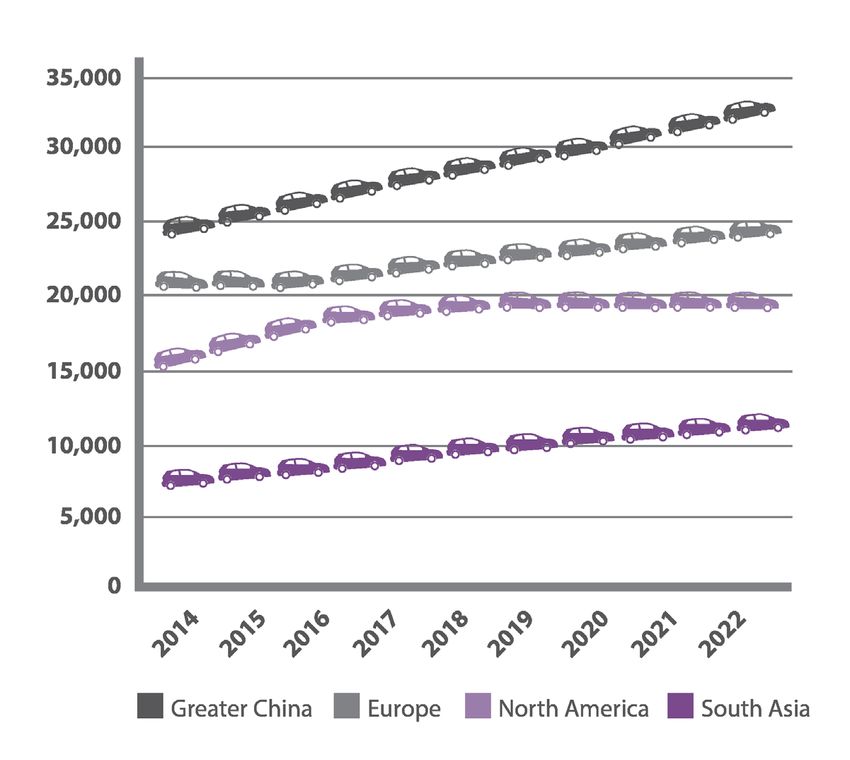
    Global automakers produced more than 80 million light vehicles for
    the first time in 2012 and are expected to exceed 100 million by 20191.
    This bright future presents new opportunities for higher sales,
    particularly in emerging markets. Automakers with their sights
    set on success also must navigate a number of unique challenges.

    • The transition from single-vehicle to                                                                              • U.S. fuel-efficiency standards will
      multi-vehicle production facilities that                                                                             increase to 54.5 mpg by 2025, and even                                                                                  LIGHT VEHICLE PRODUCTION FORECAST1
      rely on flexible manufacturing has                                                                                   higher targets are expected in Japan and
      streamlined production and cut costs                                                                                 the European Union3. Automakers must
      per car but introduced greater                                                                                       be able to deliver better-performing
      complexity into the production line.                                                                                 vehicles while continuing to reduce
                                                                                                                           production costs.
    • Global automakers are rolling hundreds
      of new cars off the production line                                                                                • China overtook the U.S. in 2009 as the
      every minute to meet the ever-growing                                                                                largest car market in the world and
      worldwide demand. This need to                                                                                       has annually produced more vehicles
      maintain high production rates has                                                                                   than the U.S. ever since4. Manufacturers
      put a premium on maximizing                                                                                          seeking to retain their foothold in
      productivity and uptime.                                                                                             existing markets and make headway
                                                                                                                           in new ones will be expected to
    • Automakers must evolve product                                                                                       provide high-quality vehicles.
      designs and production processes
      to deliver the new vehicle styles and
      technologies that will satisfy changing
      consumer demands.

“   Emerging markets’ share of global sales will rise from 50 percent in 2012 to 60 percent by 2020, while their share of global profits is
    also set to rise by 10 percentage points.” 2
    1

    3
        Global Light Vehicle Production Summary, IHS Automotive, April 2015, 2 The road to 2020 and beyond, McKinsey & Company, August 2013,
        Even with strict new rules, U.S. still lags on fuel economy, The Washington Post, Sept. 12, 2012, 4 Global Flows in a Digital Age: How trade, finance, people, and data connect the world economy, McKinsey Global Institute, April 2014
                                                                                                                                                                                                                                                                                 2
Switch to Top Gear
         Manufacturing execution system (MES) software can help you keep pace with an increasingly
         complex and fast-moving automotive industry, and better align your complex manufacturing
         operations to market needs. An MES uses three key functionalities to accomplish this:

         Operations Management: An MES can help you better                                Information Management: Automating data collection in
         coordinate the full spectrum of production operations for both                   an MES can replace costly, time-consuming and potentially             Reduce
         build-to-stock and build-to-order manufacturing. This includes                   mistake-prone manual data collection. Data can be displayed in      reject rates
                                                                                                                                                                 up to
         synchronizing production activities; improving work-instruction                  dashboards and as KPIs for better decision making and consistent
         delivery to plant personnel in increasingly complex flexible-                    performance measurement. Production data can also be used           75%
         manufacturing operations; and better managing the flow of                        for regulatory compliance and warranties, while genealogy
         materials from warehouses and suppliers.                                         and traceability can help limit the scope of recalls and shorten
                                                                                          containment response times.
Reduce                 An MES can deliver quantifiable improvements                                                     Reduce
                                                                                                                      cycle times
 scrap                 in automotive operations in many areas:                                                           up to
 up to
                                                                                                                      45%
8%                                                                          Reduce lead                                                        Reduce labor costs up to
                                                                            times up to
                                                                                                                                                     50%
         Integration Gateway: An MES also enables integration
                                                                            45%
         between plant-floor and business networks. This is the
         key to bridging historically separate information
         technology (IT) and operations technology (OT)
         systems to create what’s known as The Connected
         Enterprise – a unified network architecture that
         connects the people, processes and
         technologies across your entire organization.

   “     An analysis of 76 vehicle models shows that prices have been almost flat in real terms since 1998, while more and more features and
         improvements have been added due to competition, customer demands and regulation. The net effect has been a decline in profit per vehicle.” 1
         1
             The road to 2020 and beyond, McKinsey & Company, August 2013                                                                                         3
More Efficient Production “ By 2017, Ford will increase its
                            global flexible manufacturing
Flexible manufacturing enables you to produce a
wider range of vehicles and provide more choices for                                                                 to produce on average four
customers from a single production site. It also adds                                                                different models at each plant
greater complexities and introduces more opportunities                                                               around the world to allow for
for errors or delays. An MES can help you master this
greater complexity with more efficient control and                                                                   greater adaptability based on
automation of your operations:                                                                                       varying customer demand.” 1

                                     Order-management functionality                                   Performance measures can give operators and
                                     can help match the requirements for assembly and                 plant managers more detailed insights into site, line, machine
                                     subassembly processes, providing real-time coordination for      and cell/area performance. This information can help plant
                                     everything from an order’s initiation to its final packaging.    personnel better understand where downtime is occurring,
                                                                                                      pinpoint the root causes of efficiencies, and make better
                                                                                                      decisions to optimize assets and improve productivity.

                                     Error proofing can transform your bill of materials,             Enterprise data can also be shared across your
                                     work instructions and procedures into enforceable work           organization. The data can be contextualized into information
                                     instructions that guide operators through each production        relevant to each person’s role, allowing a broader range of
                                     process. Amid a constant influx of changing requirements,        stakeholders to support continuous-improvement efforts.
                                     parts and processes for new orders, this helps ensure products
                                     are built to their defined specifications, which in turn can
                                     improve throughput and reduce costs.

1
    New Goals for Advanced, Flexible Manufacturing, Ford, October 2013                                                                                                 4
Better Material Coordination
In fast-moving automotive production operations, you can’t afford to have vehicles sitting and waiting
for the right materials. An MES can coordinate all material-management activities and provide real-time
inventory visibility to help keep your lines moving.

An MES can also replace the need to             An MES can synchronize the flow of             Real-time visibility into inventory levels
manually manage inventory and material          materials in parallel with vehicles as they    within an MES enables operators to track
transactions. Instead, the system can           progress through the assembly line. This       materials and provide input at each decision
use Kanban and just-in-time material-           helps ensure continued material availability   point to help rein in material consumption.
replenishment triggers to detect when an        for each planned production sequence and
inventory is low. It then automatically sends   reduces the likelihood of production gaps.
a request to a supplier, while also sending a
purchase order to accounting.

                                                                                                                                       5
React Faster to Market Changes
From a desire for more fuel-efficient vehicles that can fluctuate with the price
of oil to a continued desire for new and improved technologies, consumer
demands can be difficult to predict. An MES can help ensure your operations
are agile and responsive enough to adjust to those demands.

            Responsive Operations                                                                     Agile Production                                        Speed New Deployments
            ERP system connectivity can help ensure your                                              Shops can use MES information to look ahead             Rather than developing and deploying new
            operations quickly respond to new orders.                                                 at production sequences, allowing them to               applications at each station – which can often
            Order information and build data can be                                                   retrieve the corresponding parts or tools               involve writing the same code for multiple
            immediately obtained from your business                                                   in advance of each order. The system also               applications – an MES can include automotive
            system and seamlessly converted into detailed                                             eliminates the need for each shop to handle its         library suites that save engineering time and
            build sheets for each shop. Plant managers and                                            own documentation. Instead, it can automate             costs. These configurable and scalable library
            business leaders can also track order statuses                                            the collection of millions of data points               suites are designed for common automotive
            and other information using real-time work in                                             and share that data across the enterprise as            applications and can help ensure faster
            progress (WIP) updates.                                                                   actionable information that is contextualized to        deployments.
                                                                                                      each worker’s unique role.

“ AThey
     full-line manufacturer is akin to Baskin-Robbins with its 31 flavors.
         have to be very good at things that appear to be diametrically opposed.”
                                                                                                                                            - Reilly Brennan, executive director, Revs, Stanford University

1
    Automakers race to meet sizzling demand for performance vehicles, Automotive News, May 31, 2015                                                                                                       6
Improve Quality Management
  Quality can never be compromised. Your reputation – and your business – is built on it. Yet higher
  volumes, more frequent vehicle refreshes, and the need to offer customers more options for fuel
  efficiency and vehicle technologies make quality more difficult to maintain in an increasingly complex
  manufacturing environment.

  An MES can help you manage key quality characteristics throughout                               Information Coordination
  your operations to help deliver consistently high-quality vehicles and                          Real-time connectivity to automation systems allows you to capture
  comply with industry standards.                                                                 process results, defects and attributes. Collected information can
                                                                                                  support key requirements, such as visual defect tracking, statistical
  Built-to-Spec Quality                                                                           process control and root-cause analysis. This information can be shared
  In addition to helping improve production efficiency, an MES error-                             across business and plant-floor systems as part of regular KPI reporting.
  proofing application can also use enforceable work instructions to
  help ensure workers build vehicle assemblies and subassemblies to                               Genealogy and Traceability
  specification. This can help maximize first-pass quality and reduce scrap                       An MES that offers genealogy and track-and-trace capabilities can
  resulting from nonconforming vehicles.                                                          give you new insights into the processes, production events and
                                                                                                  quality information for specific units or assemblies. These applications
  Defect Management                                                                               can provide forward and backward traceability to identify upstream
  If an error should occur on the production line, hold-and-quarantine                            or downstream quality issues, as well as provide real-time product
  capabilities available within an MES can help you manage affected                               location and as-built data to help limit the scope of recalls.
  vehicles. This supports ISO 9001 and TS16949 automotive quality
  initiatives, and can ultimately prevent defective and potentially
  dangerous vehicles from reaching your customers.

“2014,
 Vehicle recalls in the U.S. surpassed the 60 million mark for the first time in a single year in
       double the previous annual record of 30.8 million set in 2004.”                                                             1

  1
      Auto Recalls This Year May Surpass Record 2014, NHTSA Chief Says, Bloomberg, Jan. 6, 2015                                                                       7
You Have Arrived at
Your Destination
The auto industry is only going to become more competitive
as automakers compete to serve emerging markets while also                                                                                                                            In China and India
trying to maintain costs as consumer and regulatory demands                                                                                                                           alone, 680 million Gen Y
continue to evolve.                                                                                                                                                                   consumers plan to buy a
                                                                                                                                                                                      car within five years.1
At the same time, the ongoing march toward greater connectivity – within your
organization, to your suppliers and dealerships, and even out to the vehicles you to deliver                                                                                       “ Ifthea user opts to share data with Ford, we get
                                                                                                                                                                                            analytics that show how our customers
to customers – will require that you are able to collect the valuable data resulting from
                                                                                                                                                                                      are using plug-in vehicles, like how far they’re
those connections and effectively act on it within your production operations.                                                                                                        driving on a charge and how often the
                                                                                                                                                                                      vehicle is being charged. That data has been
An MES is the foundation on which this can all occur. To learn more about how an                                                                                                      tremendously powerful in shaping our
MES can make your automotive operations more efficient, responsive and quality driven,                                                                                                next-generation product.”2
contact a Rockwell Automation sales representative or visit:
                                                                                                                                                                                                                  - Michael Tinskey, Global Director,
www.rockwellsoftware.com/automotive                                                                                                                                                       Vehicle Electrification and Infrastructure, Ford Motor Co.
1
    2014 Global Automotive Consumer Study: The Changing nature of mobility, Deloitte, June 2014, 2 Green-Lighting Ford’s ‘Clean’ Technologies, Automotive Engineering, June 2015

Allen-Bradley, FactoryTalk, LISTEN. THINK. SOLVE., Rockwell Automation and ProductionCentre are trademarks of Rockwell Automation, Inc.

All other trademarks and registered trademarks are the property of their respective owners.

Publication AUTO-BR005A-EN-P – November 2015

                                                                                                                                                                                                                                                        8
You can also read


