THESSALONIKI THE CITY WATER RESILIENCE APPROACH CITY CHARACTERISATION REPORT - The Resilience Shift
←
→
Page content transcription
If your browser does not render page correctly, please read the page content below
TH E C ITY WATE R
RESILIENCE AP P ROAC H

C ITY CH ARACTE R IS AT ION R EP O RT

TH ESSALONI K I
ACK N OW L EDG EM ENTS                                        CONT E NT S

On behalf of the study team, I would like to thank The        4    EXECUTIVE SUMMARY
Rockefeller Foundation and The Resilience Shift for
                                                              6    BACKGROUND
supporting this project.
                                                              10   RESEARCH METHODOLOGY
The CWRA is a joint effort developed in collaboration
with our project partners, the Stockholm International        12   UNDERSTANDING THESSALONIKI’S WATER SYSTEM
Water Institute (SIWI), along with city partners in Amman,
Cape Town, Greater Miami and the Beaches, Mexico City,        16   ENGAGEMENT WITH KEY STAKEHOLDERS
Kingston upon Hull, Greater Manchester, Rotterdam and
Thessaloniki, and with contributions from 100 Resilient       22   CHARACTERISING RESILIENCE
Cities and the Organisation for Economic Co-operation and     24   Interdependencies of the water system
Development (OECD).                                           25   Key shocks and stresses
                                                              28   Key factors of resilience
This project would not have been possible without the
valued guidance and support of the CWRA Steering              30   ACKNOWLEDGEMENTS
Group. Our thanks to the following: Fred Boltz (Resolute
Development Solutions), Casey Brown & Sarah Freeman           32   ANNEX A: THESSALONIKI WATER SYSTEM
(University of Massachusetts, Amherst), Katrin Bruebach
& Andrew Salkin (100 Resilient Cities), Jo da Silva (Arup),   34   ANNEX B: THESSALONIKI WATER GOVERNANCE DIAGRAM
Nancy Kete & Juliet Mian (The Resilience Shift), Diego
Rodriguez & Maria Angelica Sotomayor (World Bank).            36   ANNEX C: THESSALONIKI WATER GOVERNANCE MATRIX

                                                              39   ANNEX D: THESSALONIKI WATER GOVERNANCE STAKEHOLDERS
MARK FLETCHER
Arup Global Water Leader                                      40   REFERENCES
April 2019

The CWRA project team includes Pilar Avello (SIWI),
George Beane (Arup), Kieran Birtill (Arup), James Bristow
(Arup), Alexa Bruce (Arup / The Resilience Shift), Louise
Ellis (Arup / The Resilience Shift), Sophie Fisher (Arup),
Mark Fletcher (Arup), Caroline Karmann (Arup), Richard
Gine (SIWI), Alejandro Jiménez (SIWI), James Leten
(SIWI), Kathryn Pharr (Venturi Innovation), Oriana Romano
(OECD), Iñigo Ruiz-Apilánez (Arup / The Resilience Shift),
Panchali Saikia (SIWI), Martin Shouler (Arup) and Paul
Simkins (Arup).
4   C I T Y WAT ER RESILIEN C E APP ROACH                                                                       5   E XE C U T I V E S U M M A RY

    EXECUT IVE
    S UMMARY

    The City Water Resilience Approach (CWRA)              of quality of life, the mitigation and adjustment        critical infrastructure, inadequate governance,
    helps cities plan and implement actions to build       to the implications of climate change and the            pollution, aging infrastructure, limited funding
    resilient urban water systems. A critical first step   enhancement of mechanisms and institutions for           and investment, and illegal connections all hinder
    in this process is understanding the local water       environmental governance.                                the resilience of a city.
    system, and the factors that contribute to or
    detract from resilience.
    This report details research undertaken in             KE Y STAKEHOLDER S
                                                                                                                    BUILD ING RES ILIENCE
    Thessaloniki with the goals to:                        The Ministry of Environment and Energy is
                                                           responsible for regulating water quality and             Through engagement with Thessaloniki’s
    1.   Define the city water basin including             resources at a national level. The General               stakeholders, it was identified that strong human
         natural basin(s), the urban water system                                                                   resources, effective engagement of communities,
                                                           Organisation of Land Reclamation is responsible
         and its governance structure, and the                                                                      decreases of pollution, and an upgraded sewer
                                                           for improvements to dams, irrigation canals,
         interdependencies with other systems                                                                       system would all positively contribute to the
                                                           drainage ditches and pumping stations managing
    2.   Identify the factors contributing to the          the distribution of the water needed for                 resilience of the Thessaloniki’s urban water
         resilience of the city water system and           agricultural irrigation purposes. EYATH SA is the        system.
         those increasing its vulnerability                main utility company in Thessaloniki providing
                                                           water supply and sewage services. There are
    In developing this characterisation report, the        various other stakeholders that manage risks,
    team collected desktop data on the biophysical         environment and economic and social-cultural
    characteristics of the basin and key actors in the     aspects of the water system.
    water system.
                                                           SHOCKS AND STR E SSE S
    T H E S S ALO N I KI’ S WAT E R SYSTEM                 The key interdependencies between the water
    Located along the Thermaikos Gulf in the               system and city systems in Thessaloniki is
    northwest corner of the Aegean Sea, Thessaloniki       the water-food-energy Nexus, particularly
    is Greece’s second largest city and home to            agriculture and energy where the city is
    1.12 million people. Due to austerity measures,        struggling to meet demand. Damage to housing
    tourism (2 million annually, 75% international)        and critical infrastructure caused by recent
    and the university scene (with its 150,000             flooding to houses and critical infrastructure was
    students annually) has become increasingly             also identified as a key interdependency with
    important to sustain the city’s economy. The           systems.
    port is also critical and brings in 293 million USD    Thessaloniki’s key shocks and stresses include
    annually. Greece has a national government             water scarcity due to water demand from
    with a strong central focus. At the national           increasing populations. Extensive pluvial
    level, the Ministry of Environment and Energy          flooding in 2009 and 2014 demonstrated
    works to achieve the protection of the natural         that flood mitigation infrastructure needs to
    environment and resources, the improvement             improve. These coupled with a shortfall of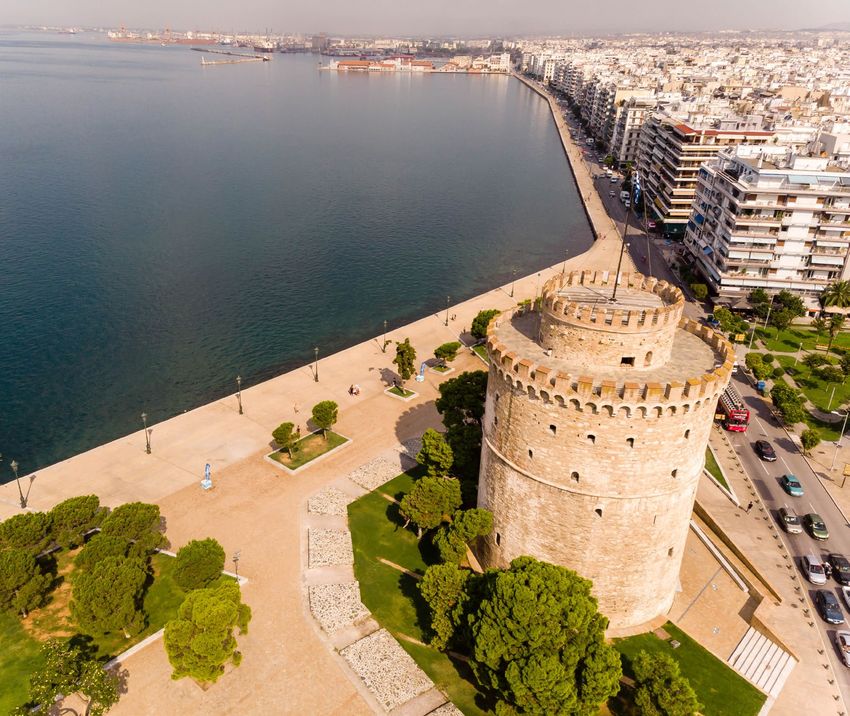
6   C I T Y WAT ER RESILIEN C E APP ROACH

    1
    BAC KG ROU N D
    Located along the Thermaikos Gulf in the northwest corner of
    the Aegean Sea, Thessaloniki is Greece’s second largest city
    with its second largest port that provides Europe easy access
    to the Balkans and the Black Sea. Part of the Hellenic, Roman,
    Byzantine and Ottoman empires, this area has been home to
    human communities since 315 BCE (Wikipedia, n.d.). Its long
    history has led to a diversity of architectural styles and historic
    sites though much of the area was destroyed and then rebuilt
    after the Great Fire of 1917. With close cultural and economic
    ties to its neighbours and a strong Jewish history, Thessaloniki is a
    multicultural city (100RC, n.d.).

                                                                            Photo by Jim Makos
8   C I T Y WAT ER RESILIEN C E APP ROACH                                                                                        9   BAC KGRO U ND

    P O P U L ATI O N                                           EC ONOM Y                                                            GOVE RNANCE
    Of the 1.9 million residents in the Central                 Due to recent austerity measures, tourism (2                         The different levels of the Greek government         The province (or periphery) of Central
    Macedonia region of Greece, 1.12 million                    million annually, 75% international) and the                         are outlined in Table 1. Greece has a national       Macedonia Region contains seven regional units,
    live within the Greater Thessaloniki area                   university scene (with its 150,000 students                          government with a strong central focus. At the       one of which is the Regional Unit of Thessaloniki.
    (Wikipedia, n.d.). The city’s largest demographic           annually) has become increasingly important                          national level, the Ministry of Environment          The Central Macedonia Region relies on the
    is its ageing population (18.4%) while Greater              (Wikipedia, n.d.). The port is also a critical                       and Energy works to achieve the protection           national government for risk management
    Thessaloniki is home to 15% of Greece’s total               component of the local economy, bringing in 293                      of the natural environment and resources,            funding. The provinces of Central Macedonia,
    refugee population (Wikipedia, n.d.) (100RC,                million USD annually (Wikipedia, n.d.). The gross                    the improvement of quality of life, the              Eastern Macedonia, and Thrace constitute the
    n.d.). In 2017, 22.1% of Thessaloniki’s 20-64               municipal product in 2011 was € 18.29 billion                        mitigation and adjustment to the implications        Decentralized Administration of Macedonia
    year old population was unemployed, gradually               (Wikipedia, n.d.).                                                   of climate change and the enhancement of             and Thrace, which supervises the peripheries,
    decreasing since 2013 when it peaked at 32.1%                                                                                    mechanisms and institutions for environmental        regional units, and municipalities. With its
    (eurostat, 2017).                                                                                                                governance (GMEE, n.d.). Within this ministry,       financial and administrative autonomy, it has
                                                                                                                                     the Special Water Secretariat develops and           devolved powers that include urban planning and
                                                                                                                                     implements all water resource management             environmental and energy policies.
                                                                                                                                     and protection programmes throughout the
                                                                                                                                     country. The General Organisation of Land            The periphery level is the lowest level of
     National (elected)                        •   Ministry of Environment and Energy (Special Water Secretariat)
                                                                                                                                     Reclamation is responsible for human-made            government to control European funds, so
                                               •   General Organisation of Land Reclamation                                          water infrastructure while the Ministry of Rural     municipalities are quite dependent on funding
                                               •   Ministry of Rural Development and Food                                            Development and Food and the Ministry of             from national and regional levels. This often
                                               •   Ministry of Finance and Development                                               Finance and Development work on agriculture          leads to difficulties regarding risk management
                                                                                                                                     and industry, respectively.                          of floods and other hindrances to resilience.
                                                                                                                                                                                          Municipalities’ limited control results in to
     Sub-National/Decentralized                •   Decentralized Administration of Macedonia and Thrace
                                                                                                                                     Within the national government, there is a sub-      low municipal taxes (
10   C I T Y WAT ER RESILIEN C E APP ROACH

     2
                                             Engagement with Thessaloniki occured over three stages:

                                             S TAG E 1   A desktop study aimed at understanding the city’s water basin, identifying
                                                         shocks and stresses that impact the city’s water system, and understanding the
                                                         system vulnerabilities.

                                             S TAG E 2   Survey and Key Informant Interviews – Wave 2 cities used a stakeholder
                                                         organogram created during the desk study to identify key stakeholders within

     RES EARC H
                                                         their cities. These stakeholders completed a survey or interview to share their
                                                         insights about the urban water system.

     MET H O D O LO GY                                   While the number of surveys completed for Thessaloniki was small (12), those
                                                         who filled it out have unique insights and perspectives into the water system
                                                         in Thessaloniki and do represent eleven of the organisations who are decision-
                                                         makers in the Thessaloniki Stakeholder Organogram. Insights from the survey
                                                         have been backed up by the desktop study with references listed here as
                                                         relevant.

                                             S TAG E 3   This characterisation report was created by combining the desktop study and
                                                         survey/interview results to prove a clear picture of the city’s basin, its key
                                                         stakeholders, its shocks and stresses, and its factors of resilience.

                                                         Engagement with ‘Wave 1’ cities included a two week field mission, where workshops,
                                                         focus groups and interviews were conducted.

                                                         Engagement with ‘Wave 2’ cities included remote support to city partners where
                                                         surveys and interviews were conducted.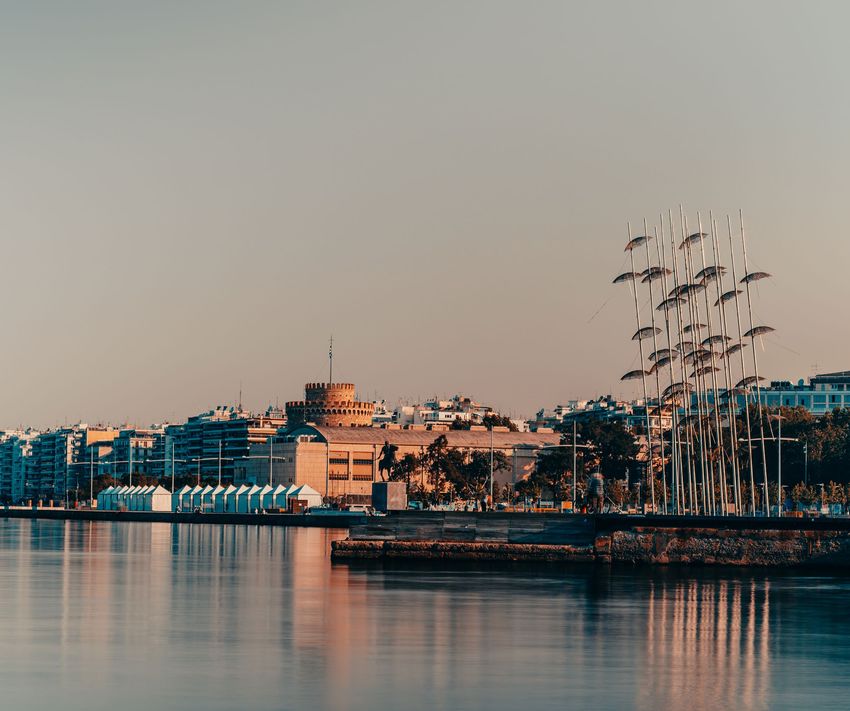
12   C I T Y WAT ER RESILIEN C E APP ROACH

     3
     UND ERS TA N D I N G
     T H ES S ALON I K I ’S
     WATER S YST E M
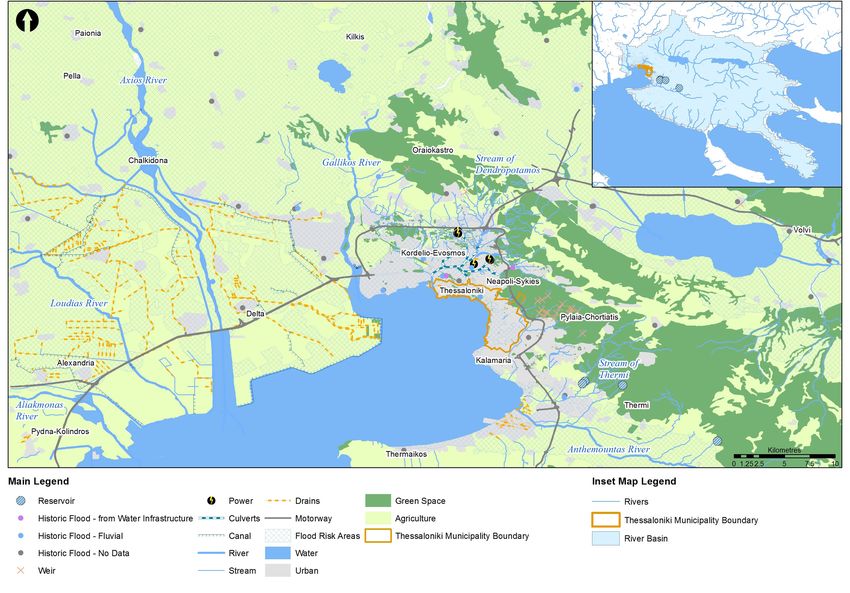
     The water supply for Greater Thessaloniki comes largely from the
     Aravissos Springs (not visible on Figure 1, west of the Axios River)
     and the Aliakmonas River where the water is diverted via a 50 km
     long free-flowing channel to beneath the Axios River and then to
     the Thessaloniki Water Treatment Plant. This does create a lot of
     infrastructure (pipes) that must be maintained for the water supply
     to Greater Thessaloniki. Smaller amounts of the water supply
     derive from underground resources via boreholes at the wider
     city’s basin area (Axios-Gallikos River Basins) (EYATH , 2017).

                                                                            For full map see Annex A: Thessaloniki’s Water System
14   C I T Y WAT ER RESILIEN C E APP ROACH                                                                    15                 U NDE RSTA NDI NG C A PE TOWN’S WAT E R S YST E M

                                                                                                                            Land Use Map from EYATH

     WATER SUPPLY                                                                                             Figure 2: Axios
                                                                                                              Delta and
                                                                                                              Thessaloniki
                                                                                                                                                                                         WESTERN CAPE RECONCILIATION STRATEGY FOOTPRINT AREA

                                                                                                              Land Use2

     The Axios River is transboundary, with 83% in       pink areas are high-risk flooding zones with
     the Former Yugoslavia Republic of Macedonia         green dots denoting historical flooding and red
     (FYROM), which has built eleven hydropower          dots denoting significant historical flooding
     dams along the river within its borders, upstream   (GMEE, 2012). Another key takeaway is how
     of Greece (Aristomenis P. , et al., 2006).          much of the Axios-Loudias-Aliakmonas Delta
                                                         is prone to flooding, a fact that was reflected
     Thessaloniki includes 40 km of coastal front from   in comments and concerns from the surveys
     Kalochori to Aggelochori that is being developed    and interviews. The industrial zone of Greater
     under the Thessaloniki Resilience Strategy to       Thessaloniki is in a high-risk flood zone (more
     encourage community to come together in work        easily denoted from the insert of the map). Many
     and play (GTP , 2018). On the other side of         areas within the City of Thessaloniki (criss-cross
     Thessaloniki are the Chortiatis mountain with       lines) have experienced historic flooding.
     the Kedrinos Lofos (Seych Sou) suburban forest.

     The Axios River Basin, the Aliakmon River Basin,
     the Loudias River Basin, the Gallikos River
     Basin, the Thessaloniki streams, and the Katerini
     Streams feed the Thermaikos Gulf. The southern
     part of the Axios-Loudias-Aliakmonas Delta is
     now protected within the Axios Delta National
     Park (Axios Delta , n.d.).

     Figure 2 from the Thessaloniki Resilience                                                                                   Flooding Map from 2012 Ministry of Environment Report
     Strategy helps identify how the land in this area
                                                                                                              Figure 3: 2012
     is used. (100RC, n.d.) The industrial zone of                                                            Regional Flood
     the area (pink) separates the agricultural zone                                                          Predictions near
     (yellow) from the City of Thessaloniki (orange).                                                         Thessaloniki
                                                                                                              (GMEE, 2012)
     What is very clear is how the wider area of
     the Axios-Loudias-Aliakmonas Delta and the
     area north of the delta is mostly an area for
     agriculture. While the Axios-Loudias-Aliakmonas
     Delta is outside the basin catchment for Greater
     Thessaloniki (and its jurisdiction), the choices
     made for agriculture in that area significantly
     affect the Thermaikos Gulf and thus Thessaloniki
     (GMEE, 2012).

     Figure 3 from the Ministry of Environment and
     Energy details historical flood locations where

                                                                                                                                        *This map is from the 2012 Implementation of Directive 2007/06/EC Preliminary Flood Risk Assessment report. (insert added)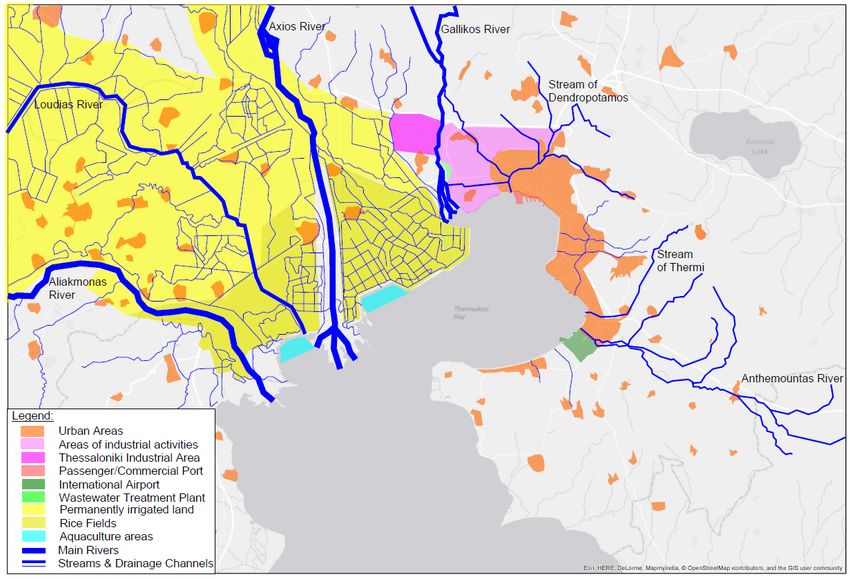
16   C I T Y WAT ER RESILIEN C E APP ROACH

                                                                                                               Clouds and Vapour

                                                                         Evapotranspiration                          Precipitation                                       OM

     4
                                                                                                                                                                     Flood Defences

                                                                                    MR                    MR
                                                                                                                                     Surface Water
                                                                        Vegetation        Ground/Soil                                                                                                              WS

                                                                                                                                                                                                                        St
                                                                                                                                                                  Aliakmon R.
                                                                        Percolation           OM                                 Axios R.
                                                                                                               Lοudias R.
                                                                                    OM
                                                                                         Aravissos                                               Gallikos R.                                       Dam - P/ V
                                                                          Aquifer        Springs                                                                                                   Reservoir

     ENG AGEM E N T
     WITH KEY
                                                                                               ΓΟΕΒ             OM
                                                                                                                                                                                                        Canal
                                                                                           Abstraction

     S TAKEHO L D E RS                                                  ΓΟΕΒ   MR
                                                                                                                 OM                                             OM
                                                                                                   ΓΟΕΒ
                                                                                                                                                                                                      Water
                                                                         Agriculture                      Irrigation                                                                                treatment
     Figure 4 is an organogram describing how the Thessaloniki
     water system interacts with the regional water cycle. The logos
                                                                                                            Canal                           Thermaikos Gulf
     of stakeholders are indicated where they have management
     responsibilities within the water cycle. A legend identifies the
     organisations associated with the logos.
                                                                                                                                                                                                   Distribution
                                                                                                                                                                                                    network

                                                                                                                                                                                    Leakage                   Illegal co

                                                                                                                                                                                                Wastewater
                                                                                                                                                                                                treatment

                                                                                                                                                          For complete Water Governance diagram see Annex B
18   C I T Y WAT ER RESILIEN C E APP ROACH                        19   E NGAGE M E NT WI T H KE Y STA KE H O L DE RS

                                                                       BASI C SE RV I CE P ROV I SI O NS                    infrastructure. The Civil Protection section of
                                                                                                                            the Decentralized Administration of Thrace and
                                                                                                                            Macedonia constructs prevention and avoidance
                                                                                                                            risk plans and manages the confronting
                                                                       The Ministry of Environment and Energy is            emergency danger and restoration actions. In the
                                                                       responsible for regulating water quality and         city, the Department of Civil Protection of the
                                                                       resources. The General Organisation of Land          Municipality of Thessaloniki coordinate actions
                                                                       Reclamation is responsible for improvements          for the prevention, treatment and remediation of
                                                                       to dams, irrigation canals, drainage ditches and     water related disasters. EYATH SA is responsible
                                                                       pumping stations managing the distribution           for the Thessaloniki sewer network and
                                                                       of the water needed for agricultural irrigation      therefore the prevention of sewer flooding in
                                                                       purposes. Furthermore, by developing quality         cases of heavy rain.
                                                                       and quantity monitoring networks of the
                                                                       water bodies, the Land Reclamation Institute
                                                                       contributes to the sustainable management            E NV I RO NME N T
                                                                       of surface and groundwater. EYATH SA is the
                                                                       main utility company in Thessaloniki providing
                                                                       water supply and sewage services. Other              The Ministry of Environment and Energy,
                                                                       Municipalities within the Greater Thessaloniki       through the Special Water Secretariat,
                                                                       area have Other Municipal Water and Sewage           is responsible for ensuring sustainable
                                                                       Companies that play a role in providing basic and    development principles, protection of aquatic
                                                                       complementary services. ETVA Industrial and          ecosystems and wetlands, and long-term
                                                                       Business Park, Co. manages common facilities         protection of available water resources.
                                                                       of the Park (such as rainwater drainage) and the     Thessaloniki follows the European Union’s
                                                                       Wastewater Treatment Plant of the Tanneries          Urban Wastewater Treatment Directive of
                                                                       located in a separate block of the Park, which       1991. The Protected Areas of Thermaikos Gulf
                                                                       serves as a pre-treatment stage of the tannery       Management Authority manages the Axios
                                                                       wastewater prior to its discharge to the general     Delta National Park, which is a third agricultural,
                                                                       sewage system of the Park. The Public Power          outside the Greater Thessaloniki area, and
                                                                       Corporation (PPC), which is the biggest (publicly    significant for the health of Thermaikos Gulf.
                                                                       traded) electricity company, generates electricity   Environmental non-governmental organisations
                                                                       in the hydroelectric factories of Aliakmonas River   include iSea, EKBY, and MedSOS.
                                                                       dams. Different departments and laboratories of
                                                                       the Aristotle University of Thessaloniki (AUTH)
                                                                       (e.g. the Centre for Integrated Water Resources      E CO NO MI C A N D S O C IO -
                                                                       Management and the Lab for Environmental             CULT UR AL
                                                                       Engineering and Planning) research integrated
                                                                       water resource management, marine water,
                                                                       surface water and wastewater quality.                The Federation of North Greece Industries
                                             Photo by Jim Makos                                                             promotes not only industrial development but
                                                                                                                            also economic and social progress in Northern
                                                                       R I SK MANAG E ME NT                                 Greece. The Ministry of Rural Development and
                                                                                                                            Food is active in the agricultural space while the
                                                                                                                            Land Reclamation Institute performs research
                                                                       The Decentralized Administration of Thrace
                                                                                                                            for it. The Ministry of Finance and Development
                                                                       and Macedonia coordinates the Central
                                                                                                                            is more connected to industry.
                                                                       Macedonia Region and municipalities of Greater
                                                                       Thessaloniki on most aspects of the urban
                                                                       water system, including human-made water
20 C I T Y WAT ER RESILIEN C E APP ROACH 21 E NGAGE M E NT WI T H KE Y STA KE H O L DE RS
KEY PROGRAMMES
There are some great programmes that Thessaloniki stakeholders are
working on that should be highlighted:
1. Thermaikos Gulf Quality Monitoring Programme
EYATH SA (Thessaloniki Water Supply and
Sewerage company) created and funded the
Thermaikos Gulf Quality Monitoring Programme
with the Aristotle University of Thessaloniki
for the study of the Thermaikos Gulf marine
environment at the specific areas where the
underwater effluent diffusion pipes of the
wastewater treatment plants are situated
(EYATH , 2017).
2. EUREAU
EYATH SA (the Thessaloniki Water Supply
and Sewerage company) is a member of the
EUREAU Committees (European Federation of
National Associations of Water and Wastewater
Services). Through these working groups EYATH
stay up-to-date with the current European
water and wastewater policy and the relevant
developments in environmental guidelines
(EYATH , 2017).
3. ICME
The European Union and the Black Sea Cross-
Border Cooperation funded the Integrated
Coastal Monitoring of Environment (ICME),
which is examining the major problems several
ports, including Thessaloniki, are facing while
developing tools to correct them (IMCE, n.d.).
4. 100 Resilient Cities Photo by Jim Makos
Thessaloniki is part the100 Resilient Cities
network and has produced the Thessaloniki
Resilience Strategy which is currently being
implemented (100RC, n.d.).5
CHAR ACTE RI SI N G
RES ILIENCE
One of the important aspects of this characterisatoin report
was reaching out to key stakeholders identified in the water
cycle governance diagram through interviews and surveys. The
participants of the surveys and interviews provided insights into
what they think the shocks and stresses for Greater Thessaloniki
and about what was happening with resilience.
Figure 6 indicates the stakeholder type of those participating in the
survey. Most represent some portion of the local, sub-national, or
national government. There is close to equal representation from
academia, civil society, and the utilities.
Photo by Jim Makos24 C I T Y WAT ER RESILIEN C E APP ROACH 25 C H A RAC T E RI S I NG RE S I L I E NC E
INTERDEPENDENCIES OF THE KEY SHOCKS AND STRESSES
WATER SYSTEM
The urban water system does not exist in a vacuum. In fact, one of the main focuses of Figure 7 examines how the different types of stakeholders identified the top shocks and
the City Water Resilience Framework is how the water system within the city engages stresses. It helps demonstrate which shocks and stresses were highlighted across each
not just with the full basin it belongs to but also the other sectors that rely on water and stakeholder type as well as listing the top ‘ten’ shocks and stresses. Notice that Ageing
that influence the use of water. Infrastructure and Lack of Investment were mentioned the same number of times as were
Loss of Ecosystem Services and Increasing Crop Water Footprint.
WAT E R - F O O D - E N E RGY N EX U S ENERGY 30
There is a strain of water scarcity when A key theme was also about how much the water 25
Count of Shock/Stress tag
considering the needs of the various sectors that system relies on electricity to function and how
depend upon it. loss of electric power would mean a loss of water 20
services.
AG R IC U LT U R E 15
HOU SI NG
There is tension around trying to meet all the 10
needs of agriculture (and the necessary economic Concern for personal property came out as
value it provides the region) and of urban a theme given the damage caused by recent 5
populations—business, industrial and domestic. flooding to houses and critical infrastructure.
0
ure
e
er
e
ent
y
of...
ture
t
od
on
ing
prin
rcit
anc
r
Oth
uctu
ti
lo
n
estm
ct
lue
ollu
truc
Plan
al F
Sca
vern
oot
stru
astr
y Va
de p
i
ng F
f Inv
fras
ter
Pluv
ban
l Go
nfra
Infr
enit
Wa
a
n
teri
ko
f Ur
an-m
oca
gy I
I
ing
ical
: Am
Lac
Wa
o
or L
ner
7%
Age
Crit
al/M
ure
s
rop
vice
Utilities/public service provides
of E
nal
Fail
ll of
stri
C
egio
Ser
ure
ing
rtfa
Indu
17%
tem
Fail
of R
eas
Sho
Academic
Incr
osy
ure
c
Fail
of E
13%
s
Civil Society
Los
Shock/Stress tag
63%
Government
Figure 6. Types of Figure 7. Types of Shocks and
Stakeholders for Thessaloniki Stresses with Stakeholder
Surveys and Interviews Type26 C I T Y WAT ER RESILIEN C E APP ROACH 27 C H A RAC T E RI S I NG RE S I L I E NC E
Shortfall of critical infrastructure Other Lack of investment / Limited funding Aliakmonas Delta). Groundwater Depletion from
Poor regulations of historic urban development Participants had several points that did not fit into The governance structure of Greece keeps irrigation has increased flood danger in that
have resulted in a combined sewer system that the current version of shock/stress tags. One major most of the funding central or at the Central area. Other concerns include the challenges of
cannot handle peak flows during flooding. This point, which links to the tag above, was concern Macedonia Region level with little reaching the subsidence, saline intrusion, and the quality of
was most recently demonstrated during the about either the level of collaboration needed to municipality level. This reality, coupled with the the remaining groundwater and how it can be
massive surface flooding earlier in 2018 that move forward on anything (too many stakeholders) recent austerity measures nationally, has meant replenished.
flooded the metro lines. Critical infrastructure or the lack of collaboration among certain groups a lack of investment in the critical infrastructure
includes operating and monitoring that of stakeholders. Others mentioned the strain on that everyone agrees needs to be updated or
infrastructure, so comments mentioning lack of leadership created by current shocks and stresses. replaced. Loss of ecosystem services
appropriate numbers of staff also fell into this Another concern that was revealed in the surveys Tied in 10th place with ‘increasing crop water
tag. was damage to private property due to flooding. footprint’ is ‘loss of ecosystem services, which is
Flooding fitting given how these two stresses are linked.
Extensive pluvial (surface) flooding in 2009 This stress was raised as a concern due to
Inadequate regional or local governance Industrial / man-made pollution and 2014 demonstrated that flood mitigation environmental degradation from government,
Survey responses pointed to several issues Concerns about pollution reaching Thermaikos infrastructure needs to improve. Seven streams academic, and civil society stakeholders.
around Governance and Strategy. Concerns Gulf were prevalent in the surveys and desktop in the metropolitan area of Thessaloniki
ranged from difficult bureaucracy, budget issues, research. Pollution comes from the industrial sector are prone to fluvial flooding. In addition to
challenges around coordinating and fostering of Thessaloniki, from agriculture in the catchments, this, development in the coastal area of the Agricultural nutrient pollution
agreement among so many stakeholders with and from the port. Thermaikos Gulf, part of the Thessaloniki Eutrophication from the use of fertilizers
overlapping authority, and the little power the Throughout January 2018 there were oil spills Resilience Strategy, could be in danger of coastal throughout the Axios-Loudias-Aliakmonas
municipality has despite perceived power by on the Aliakmon River. Fortunately, the Water flooding due to rising sea levels. Delta has caused issues for the quality of the
citizens. Some mentioned a lack of community Treatment Plant nearby was able to maintain a water in the Thermaikos Gulf, the health of the
engagement in decision-making. One point normal water supply for the city. The concern is that Lack of permeable and semi-permeable surfaces aquaculture systems places at the end of the
that came up several times was that the issues the location of the pollution source has yet to be in the dense urban environment prevents delta, and for the port. This point came up in
with the nearby agriculture are outside the identified despite initial work on pollution source significant retention and storage of stormwater. surveys and desktop research (Aristomenis P. , et
jurisdiction of the municipalities and therefore detection to prevent future repetitions. The European average for green space per al., 2006).
nothing can be done. person is between 8-10 m2 but in Thessaloniki
it is 2.6 m2 per person. These factors have
Ageing infrastructure contributed to infrastructure failures and Illegal connections
Water scarcity Ageing infrastructure was a recurring theme in the localized flooding. One issue that was discovered outside
This links back to the previous Water-Food- survey and interview responses. One example is the the surveys was illegal connections to the
Energy Nexus concern regarding water demand cracked pipeline in March 2018, which resulted in water supply system. These connections are
for all the allotted purposes, including increasing five days of diminished water supply (undisturbed Failure of urban planning unregulated and unpaid for while causing stress
populations in the area. amounts for critical users like hospitals and There was tension around how to plan for an on water availability for other uses. There are no
industry thanks to a precaution strategy) before increasing population in a way that would ensure clear numbers regarding this issue in the area.
the issue was fully resolved. This portion of the the safe and reliable provision of critical services
pipeline leading to the Aravissos Springs had been to new communities and that would use the
determined to be in a ‘high-risk zone prone to opportunity to create flood defences.
cracking.’
Increasing crop water footprint
In the Central Macedonian Region, irrigation
water-use accounts for 85% of all water uses.
Water-intensive crops, such as rice, account
for high volumes of irrigation water in the area
around Thermaikos Gulf (Axios-Loudias-28 C I T Y WAT ER RESILIEN C E APP ROACH 29 C H A RAC T E RI S I NG RE S I L I E NC E
KEY FACTORS OF RESILIENCE
25
Figure 10 shows a breakdown of where the resilience factors mentioned in the surveys
and interviews fit within the City Water Resilience Framework (CWRF) and its
dimensions and goals. One of the major takeaways is the focus on Governance & Strategy
as well as Infrastructure & Ecosystems, specifically Goal 8: Effective Provision of Critical 20
Count of Resilience Factor Per Goal
Services.
15
STRO NG H U M AN R ES OURC ES DEC REA S ES OF POLLUT I O N
While there were comments that some of the Work on major wastewater and stormwater
critical stakeholder organisations were short- infrastructure has helped clean up the water in 10
staffed, all comments about the staff also the Thermaikos Gulf. Now the major concern is
included how competent and effective they were agricultural pollution from the Axios-Loudias-
as individuals. Aliakmonas Delta and its feeding into the
Thermaikos Gulf, which is mentioned in survey 5
E U WATE R F R AM E WORK responses (EYATH, 2017).
DIR E CTIV E 2000/6 0 /EC
PLA NNED UPGRA DE FOR
Many respondents were excited about this
directive, which is focused on preserving water
S EWER S YST EM 0
quality and on protecting coastal and inland One of the major comments throughout Health & Economy & Infrastructure Governance
surface waters, estuaries, and groundwater. The the surveys and interviews was about the
directive has resulted in management plans for ineffectiveness of the combined stormwater/ Wellbeing Society & Ecosystem & Strategy
the Central Macedonia Region (Water District wastewater sewer. Once the plans to upgrade
GR10) focusing on drought, water scarcity, the combined sewer overflows occurs, this CWRF Dimension
and river basin management. Participants saw new infrastructure will be a key part of a more
this directive as a roadmap for how to adapt to resilient Thessaloniki because less combined
climate change concerns such as flooding. overflows will end up in the Gulf during rain
flooding. Minimal Human Vulnerability Effective Provision of Critical Services
E F F E CTIV E E NGAGEMENT OF Diverse Livelihoods & Employment Effective Management of Interdependencies
CO M M UN ITIE S Effective Safeguards to Human Life & Health Integrated Development Planning
Effective Community Engagement & Support Integrated and Effective
There are opportunities for effectively engaging Sustainable Economy Catchment Management
with communities to meet resilience goals. One Reduced Fragility and Exposure Transparent Governance
opportunity might be engaging with the National
Water Council, which represents the Greek
NGOs, as one participant suggested.
Figure 10. Number of
Resilience Factors Identified
Within Each CWRF Goal30 C I T Y WAT ER RESILIEN C E APP ROACH
ACKNOWLEDGEMENTS This charaterisation report was made possible
through the partnership of Arup, 100 Resilient
Cities, the Municipality of Thessaloniki, and
EYATH SA.
The following organisations for completing the
surveys for Thessaloniki:
• Mediterranean SOS Network • Civil Protections of the Decentralized
• Lab of Environmental Engineering Administration of Macedonia-Thrace
& Planning, Aristotle University of • Independent Civil Protection
Thessaloniki Directorate of Central Macedonia
• Greek Biotype Wetland Centre Region
• Thermaikos Gulf Protected Areas • General Organisation of Land
Management Authorities • Reclamation of Thessaloniki-Lagadas
• iSea, Environmental Organisation • Land Reclamation Institute (LRI) of the
for the Preservations of the Aquatic Hellenic Agricultural Organisation
Ecosystems • PPC
• Municipality of Thessaloniki • EYATH32 C I T Y WAT ER RESILIEN C E APP ROACH 33 A NNE XE S
ANNEX A : T H E SSA LO N I K I WAT E R S YS T E M34 C I T Y WAT ER RESILIEN C E APP ROACH 35 A NNE XE S
ANNEX B : T H E SSA LO N I K I WAT E R G OV E R N A N C E DI AG R A M
Clouds and Vapour
Evapotranspiration Precipitation OM
Flood Defences
MR MR
Surface Water
Vegetation Ground/Soil WS OM
Storm Drains
Aliakmon R.
Percolation OM Axios R. OM WS
Lοudias R.
Dam - P/ V Informal Sanitation
OM
Aravissos Gallikos R.
Aquifer Springs Reservoir
ΓΟΕΒ OM
Canal
Abstraction MF
Industrial
Industry
ΓΟΕΒ MR Park
OM OM
ΓΟΕΒ
Water
Agriculture Irrigation treatment
Canal Thermaikos Gulf
Industrial
Municipal &
Distribution w/w
Business
network treatment
Consumption
Leakage Illegal connections
Sewer
Network
Wastewater
treatment36 C I T Y WAT ER RESILIEN C E APP ROACH 37 A NNE XE S
ANNEX C : T H E SSA LO N I K I WAT E R G OV E R N A N C E M AT R IX
Basic Service
Provisions WS
Flood Risk 0M WS
Environment
Economic MF
Socio-
Cultural MR38 C I T Y WAT ER RESILIEN C E APP ROACH 39 A NNE XE S
ANNEX D: T H E SSA LO N I K I WAT E R G OV E R N A N C E S TA K E H OLDERS
1. Ministry of Energy & Environment 12. Industrial and Business Park, Co
2. Special Water Secretariat 13. Federation of North Greece
Industries
3. Decentralised Governance of 14. Ministry of Rural Development
MR
Macedonia & Thrace
4. Central Macedonia Region 15. Ministry of Finance & Development MF
5. Thessaloniki Municipality 16. General Organisation of Land
Reclamation
6. Other Municipalities 0M 17. Land Reclamation Insitute
7. Other Municipal Water & Sew. Co WS 18. NGO- Mediterranean SOS
Network (MedSOS)
8. Thessaloniki Water & Sewage Co 19. Protected Areas of Thermaikos Gulf
Management Authority
9. AUTH- Care for Integrated Water 20. NGO- isea
Resources Management
10. AUTH-Lab of Engineering & 21. EKBY Greek Biotape/ Wetland
Environment Planning Centre
11. National Electric Company40 C I T Y WAT ER RESILIEN C E APP ROACH
R EF ERENCES
100RC. (n.d.). Resilient Thessaloniki: A strategy for 2030.
Aristomenis P. , K., Kapsimalis, V., Kontogianni, A., Skourtos, M., Turner,
K., & Salomons, W. (2006). Impact of 100-Year Human Interventions
on the Deltaic Coastal Zone of the Inner Thermaikos Gulf (Greece): A
DPSIR Framework Analysis. Environmental Management.
Axios Delta . (n.d.). National Park Protected Areas. Retrieved from
http://axiosdelta.gr/en/national-park/protected-area/
Comision Nacional del Agua. (n.d.). CONAGUA. Retrieved
from Tunel Emisor Oriente: http://201.116.60.81/
sustentabilidadhidricadelValledeMexico/TunelEmisorOriente.aspx
eurostat. (2017). Unemployment rates by sex, age and metropolitan
regions. Retrieved from eurostat: http://appsso.eurostat.ec.europa.eu/
nui/submitViewTableAction.do
EYATH . (2017). Eyath SA 2017 Annual Report .
GMEE. (n.d.). Retrieved from Greek Ministry of Environment and
Energy : http://www.ypeka.gr/Default.aspx?tabid=37&locale=en-US
GMEE. (2012). Implementation of Directive 2007/06/EC Preliminary
Flood Risk Assessment. Greek Ministry of Environment and Energy .
GTP . (2018). Region Takes First Step Towards Development of
Thessaloniki’s Coastal Front. Retrieved from https://news.gtp.
gr/2018/06/12/region-takes-first-step-towards-development-
thessalonikis-coastal-front/
IMCE. (n.d.). Integrated Coastal Monitoring of Environment. Retrieved
from http://draxis-gis.com/icme/index.php?lang=EN
Wikipedia. (n.d.). Politics of Greece, Administrative divisions &
Regional units of Greece. Retrieved from https://en.wikipedia.org/
wiki/Politics_of_Greece#Administrative_divisions
Wikipedia. (n.d.). Port of Thessaloniki. Retrieved from https://
en.wikipedia.org/wiki/Port_of_Thessaloniki
Wikipedia. (n.d.). Thessaloniki. Retrieved from https://en.wikipedia.
org/wiki/Thessaloniki
White Tower of Thessaloniki
Photo by Marco VerchYou can also read


