TORRESOL ENERGY one year after its foundation
HERSCHEL & PLANCK, Guidance and Control Systems
  GONZALO GALIPIENSO, President of ProEspacio
←
→
Page content transcription
If your browser does not render page correctly, please read the page content below

TORRESOL ENERGY one year after its foundation HERSCHEL & PLANCK, Guidance and Control Systems GONZALO GALIPIENSO, President of ProEspacio


37
                 23

                                                   21                                                  summary
                                                                                                       04 Article
                                                                                                                    Torresol Energy, one year after its foundation

                                                                                                       08 Interview
                                                                                                                    Álvaro Lorente and Jorge Unda,
                                                                                                                    Torresol Energy’s CEO and SENER Ingeniería y
                                                                                                                    Sistemas’ Managing Director, respectively

                                                                                                       11 Tribune
                                                                                                                    Gonzalo Galipienso, President of ProEspacio

                                                                                                       12 Up-to-date:
                                                                                                                    Corporate
                                                                                                                    Space
                                                                                                                    Aeronautics and Vehicles
                                                                                                                    Actuation and Control Systems
                                                                                                                    Power and Process
                Cover picture: Artistical view of the                                                               Civil and Architecture
                concentrating solar power plant Gemasolar,                                                          Marine
                that Torresol Energy is already building in
                Seville.                                                                               31 Group
                                                                                                       32 Technology
                                                                                                                    Guidance and Control System fot the Herschel
                                                                                                                    and Planck scientific satellites

                                                                                                       34 In Brief

Contributors:

Enrique Aliaga, Verónica Alonso, Jerónimo Angulo, Fernando Artigas, Joaquín Botella, José Ignacio      Published by: SENER Communication Department.
Bueno, Ignacio Cerezo, Miguel Domingo, Ángel Fernández, Estela Fernández, Luis Gabellieri, Soledad     Edit staff: Oihana Casas, Pilar García and Rosana Madroñal.
Garrido, Daniele Gherardi, José Félix González, Eva Lázaro, Salvador Llorente, Juan Francisco Paz,     Photographic documentation: Oihana Casas, Pilar García and
Darío de la Peña, Daniel Pérez, Lorenzo Quevedo, Enrique Rodríguez, José Rodríguez Angelina, Roberto   Lourdes Olabarria.
Felipe Rodríguez, Luis Fernando Sánchez, Fernando Suárez, Dorleta Uraga, Eduardo Urgoiti, Cristina     Design and layout: KAIXO Taller de diseño gráfico.
Vidal, Rafael Vicente, Javier Viñals.                                                                  Legal deposit number: BI-1804-00 Imprenta Berekintza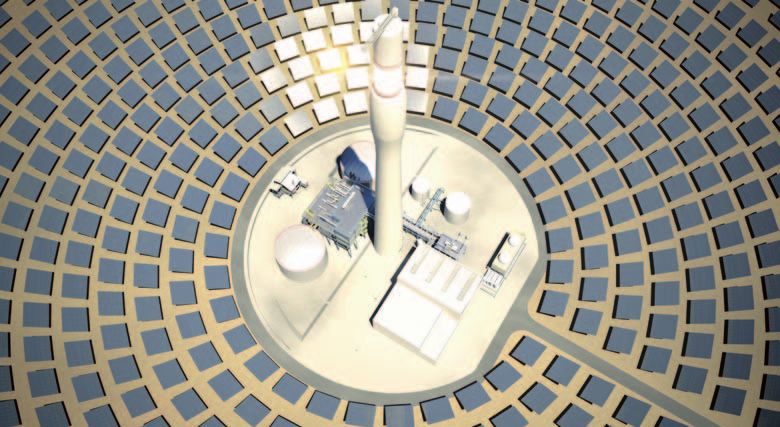
Torresol Energy:
    the strategic alliance between
    SENER and MASDAR,
    one year after its foundation
    The concentration solar power firm which is a collaboration
    between SENER and MASDAR celebrates its first year in operation with
    three projects under construction and two further projects
    at the planning stage. This brings it close to the 320 MW of power
    mentioned in the first Strategic Plan (2008 – 2014), with the expectation
    of reaching this target by 2013.
4   In March 2008, SENER and MASDAR, a company set up as part of            global financial crisis. The company currently has plans for another
    the Abu Dhabi sovereign wealth fund for investment in renewables        50 MW project, also in Spain, and is in the process of finalizing
    energies, officially presented the Torresol Energy company, a firm        plans for others in the MENA zone and the USA. Torresol Energy is
    owned by both enterprises, in the Provincial Council building in        working at full capacity in order to attain its objectives.
    Bilbao. The objective of this new business is to become world
    leader in the concentration solar power sector and its mission is to    An excellent political field for renewables energies
    promote the development and operation of an average of two major        In this regard, Torresol Energy is operating in an excellent
    solar power plants each year throughout the world, particularly in      field in social and political terms. In the social sphere,
    what is known as the global ‘sun belt’: the south of Europe, the        environmental awareness has ceased to be simply an ethical
    Middle East and North Africa (MENA) and the southwest USA. If           stance and has become an increasingly urgent necessity in
    the aims laid down in the Strategic Plan 2008-2014 are achieved,        everyday life: fluctuating energy prices and urban pollution
    Torresol Energy will be producing some 320 MW by the end of             are problems affecting all the world’s inhabitants. In response
    2013 and should reach 1,000 MW in 10 years. The firm currently           to this, the political sphere favors legislation that encourages
    has three plants under construction in Spain, that will provide total   the construction of renewable energy plants. In 2007 the
    power of 117 MW: Gemasolar, Valle 1 and Valle 2. Financing for          European Union implemented a plan to ensure that by 2020,
    these was approved by banks and credit institutions at a time of        20% of Member States’ energy requirements would come
                                                                            from renewable sources. One year later Barack Obama spoke
                                                                            in his electoral campaign of a plan to reach a figure of 10%
                                                                            renewables for US energy supplies by 2012 and 25% by 2025,
                                                                            and the new administration seems to be committed to move
                                                                            in this direction. In addition to this, transnational initiatives
                                                                            are beginning to gain ground in order to create a new global
                                                                            energy map, such as MEDREG (Mediterranean Working
                                                                            Group on Electricity and Natural Gas), a political initiative
                                                                            involving 20 countries in the Mediterranean basin: Albania,
                                                                            Algeria, Bosnia-Herzegovina, Croatia, Cyprus, Egypt, France,
                                                                            Greece, Israel, Italy, Jordan, Malta, Montenegro, Morocco, the
                                                                            Palestinian Authority, Portugal, Slovenia, Spain, Tunisia and
                                                                            Turkey, in order to create a harmonized regulatory framework
                                                                            in the zone and to facilitate investment in infrastructure
                                                                            and the integration of energy markets, and to foster the
The picture on page 4 and the picture above show different artistical views of the Gemasolar plant, the fisrt commercial plant in the world with the
central tower and heliostats technology using a molten salt heat storage system.
                                                                                                                                                       5
increased use of renewable energies. Other programs include                   independence from fossil fuels that have limited availability
DESERTEC, an initiative set put by the Trans-Mediterranean                    and that are concentrated in a small number of producing and
Renewable Energy Cooperation organization (TREC) that                         exporting countries.
consists of reaching agreements between Europe and the                        However, renewable energies, like any other development,
MENA zone for electricity production using thermosolar                        requires immediate extensive financial investment. This is firstly
plants and concentration systems, alongside wind parks, in                    because, like any new technology, they require innovation
the deserts of the north of Africa and the Middle East. These                 and improvements that could not be verified in commercial
plants can meet the growing energy demand for domestic                        plants until very recently, when the first large-scale electricity
and industrial consumption as well as for water desalination in               generating plants came into use. Secondly, this is because,
the MENA region and can additionally produce clean energy                     up to now, there has been no market for manufacturers and
that could be transported to Europe. The number of initiatives                suppliers of materials and components for this type of plant.
are growing that require the joint involvement of the political               In comparison, conventional energy plants, where the ‘know-
sphere, the industrial sector and the financial world in order to              how’ and the market have had a head-start of many years, are
develop new forms of energy supply that will gradually enable                 much more competitive in cost terms. However, for technology
                                                                              experts and investors, it is simply a question of time. In the
                                                                              words of Jorge Unda, Managing Director of SENER, “it has
                                                                              been shown that when the period of development and technical
                                                                              maturity of renewable energies reaches a very advanced stage
                                                                              and therefore large-scale use can be made of wind, photovoltaic
                                                                              and thermoelectrical energy, etc., generation costs fall. Solar
                                                                              thermoelectric power is at a very early stage, the costs are
                                                                              high, but all of the studies suggest that as this energy becomes
                                                                              more widespread, these costs will decrease.”

                                                                              Technology for Concentrating Solar Power plants
                                                                              The sun is a non-polluting, abundant, endless source of energy that
                                                                              is also more predictable than wind power, and can therefore be
                                                                              considered one of the energies of the future, with both high economic
                                                                              and environmental performance. A number of technologies now exist
Current works at Gemasolar plant.                                             that enable us to make the most of this source of energy: photovoltaic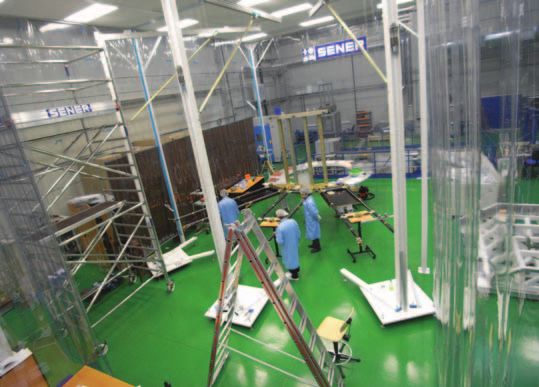
6

     Gemasolar plant.

    panels, the direct heating of water and concentrating solar power in       hot oil is used to convert water into steam, which is drawn into a
    thermal fluids, also known as thermosolar energy. The aim of these          steam turbine and drives a generator that injects electrical energy
    technologies is to meet energy demand in different ways: high-power        into the grid. The other technology is central tower receiver plants,
    generation, distributed low-power generation, energy consumption           surrounded by a solar field of heliostats (flat mirrors) that direct solar
    on an industrial and domestic level, etc. Since its beginnings, Torresol   radiation onto a central receiver, positioned above the tower. A liquid
    Energy has been committed to developing large-scale thermosolar            (in the case of Torresol plants, molten salts) circulates in the receiver.
    power plants. This means the company’s focus is on Concentrating           This is heated and is used to vaporize water into steam which is drawn
    Solar Power (CSP), which requires extremely high levels of                 into the steam turbine and drives the generator. Tower technology
    technological investment but which allows high-power energy
    generation; these are power plants of tens of megawatts, intended
    in the medium term to become an important feature on the global
    energy map. With a capacity of 17 MW, the Gemasolar plant can
    supply the energy of a city of 30,000 people, saving 30,000 metric
    tons of CO2 emissions each year. At 50 MW, the Valle 1 and Valle 2
    plants will be capable of supplying the electricity for a city of 45,000
    people, with a saving of 45,000 metric tons of CO2 each year.

    Parabolic trough plants and tower plants
    Torresol Energy focuses on the promotion and operation of the two
    types of CSP plants: firstly, parabolic trough collectors, which are the
    more conventional CSP technology. These plants consist of rows or
    loops of parabolic mirrors which concentrate solar radiation onto a
    central tube in which a liquid, usually thermal oil, is circulating. The

                                                                                 SENERtrough collector loop.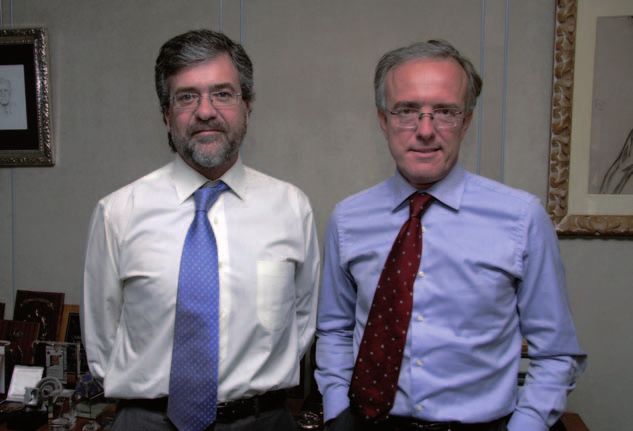
The three plants that
                                                                           Torresol Energy is already
                                                                           building, Gemasolar,
                                                                           Valle 1 and Valle 2, use
                                                                           technological innovations
                                                                           such as a system of molten
                                                                           salt storage, developed by
                                                                           SENER, which allows the
                                                                           plants to operate for periods
                                                                           of between 7 and 15 hours
                                                                           without solar radiation.
                                                                           international institutions show that tower technology is the type
                                                                           of technology that will be capable of generating energy with
                                                                           the lowest costs.”
                                                                           Gemasolar is the first project Torresol Energy has developed with
                                                                           a central tower and heliostats using a molten salt heat storage            7
                                                                           system and it is also the first commercial plant to use this type of
                                                                           technology on an industrial scale in the world. It is therefore a highly
                                                                           significant project in the field of renewable energies, as it opens
                                                                           the way for a new thermosolar energy generation technology that
                                                                           may be a better alternative to the cylindrical-parabolic commercial
                                                                           thermosolar electricity plants that are the most commonly used
                                                                           today. “The construction of Gemasolar was a huge step forward in
is much more recent and at present there is little experience in this      Torresol’s technological development and sets us up as the world
field. Gemasolar, Torresol Energy’s tower plant, differs substantially to   leader in central tower thermosolar projects,” declared the President
other plants thanks to the design innovations used. These include a        of Torresol Energy, Enrique Sendagorta. In terms of performance and
system of molten salt storage, a technology developed by SENER             operation, the technology used for the Gemasolar plant will allow
which significantly increases the plant’s yield. This storage system is     the plant to triple electricity production of other thermoelectric solar
also used in Torresol Energy’s parabolic trough plants, allowing the       plants of the same power that use conventional technology.
plants to operate for periods of between 7 and 15 hours without solar      One year from its launch, Torresol Energy is confident that it will
radiation, which increases significantly its availability.                  attain the objectives set out in its strategic plan and that it will
                                                                           reach 320 MW by 2013. In striving towards its goal, the company
The CSP technology, SENER responsability                                   has the full support of MASDAR, which is without doubt one of the
In Torresol Energy plants, SENER is responsible for providing              main global actors in the renewable energy sector, and can rely on
technological innovation. Focusing on the medium/long term,                the experience amassed by SENER, a company that has made
SENER has worked in the field of solar technology since the                 innovation one of the main pillars of its business. In all SENER’s
1980s and has built up its experience through the construction             solar projects, constant investment is made in technological
of nine solar power plants, eight of which are currently under             development with the ultimate aim of reducing generation costs. In
construction and one of which is in operation. These plants                this way, the young CSP company will be able to fulfill the mission
have been developed since the year 2000 for a variety of                   it laid out in March 2008 during its presentation: “To develop solar
clients. During the design of each plant, the company has                  energy globally through investments in profitable and efficient
tested and improved its technology and today, in addition to               concentrating solar power plants and to pioneer new thermosolar
the continuous improvement of parabolic trough plants, the                 power technologies to drive down the cost of future units.” All
company is focusing its efforts on developing central tower                of this aims to make concentration solar power an economically
technology as, in the words of Jorge Unda, “today, all of the              competitive option, making it a real, viable, environmentally sound,
analyses that have been carried out either by us or by major               sustainable alternative to traditional energy.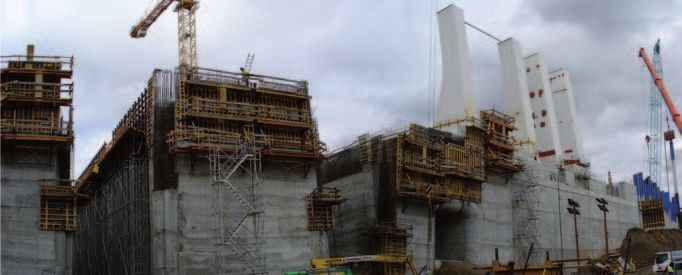
Álvaro Lorente and
    Jorge Unda
    CEO of Torresol Energy and Managing
    Director of SENER, respectively
    Last March, Torresol Energy marked its first year in existence.        the pipeline is the ACS group. If we consider power installed,
    Did the company reach the goals set for this first year?               Abengoa Solar would be in second place, Acciona in third and
    Alvaro Lorente: Yes. Our first Strategic Plan, which was drawn         we would be in fourth place. That’s if we only look at power. If
    up in February 2008 and that was passed at the first Torresol          we look at technology, the team consisting of Torresol Energy
    Energy board meeting on March 12th 2008, focused on launching         and SENER is currently at the forefront. As Jorge said, the
    the first three plants: Gemasolar, a central tower receiver plant,     Gemasolar plant is the first of its kind. It is technologically far
    and two other plants using parabolic trough collectors. We have       more advanced than our competitors’ plants and, in addition, it
    reached this goal: Torresol’s star project, based on SENER’s          opens the way for working for improved efficiency and ultimately
    central receiver tower technology, is now a reality and its           improved production costs for electrical energy. In other
    construction is in full swing, while the parabolic trough collector   words, the promoters that are installing plants with the highest
8   projects, which were finally named Valle 1 and Valle 2, are also       megawattage throughout the world have gone for tried-and-
    under construction.                                                   tested technology so that they can attain rapid increases in
                                                                          megawatts. At Torresol Energy we could have done the same;
    Is it still your aim at Torresol Energy to reach 320 MW of            we could have forgotten about the tower and funneled all of our
    power by 2013?                                                        financial resources into parabolic trough collector plants and
    A.L.: Yes, our Strategic Plan extends from 2008/2009 to               we would have experienced a faster
    2013/2014 and we are still working towards the same objective.        and more aggressive development of           We are in
    We think it is attainable and could even be extended if the Abu       megawatts than we laid down in the
    Dhabi renewables development plan which was announced                 Strategic Plan. But we feel that this is  the race for
    in January by Sultan Ahmed Al Jaber evolves. This plan aims           not the way to go. We think that what
    to ensure that 7% of the country’s energy is obtained from            is required is perhaps to move more       medium- to
    renewable sources by 2020.                                            slowly, taking on certain controlled
                                                                          risks, and invest in technologies         long-term
    To what extent has SENER been able to contribute to the               that within five, six or seven years
    fulfillment of these objectives?                                       are sure to prove that it is this route   technological
    Jorge Unda: SENER has made a major contribution to this               that will enable us to achieve what
    success, because it has been developing the solar thermoelectric      people are talking about today, ‘grid     success
    technology that is being used in the Torresol Energy plants for       parity’, which is the equalization of
    some years. For SENER, Gemasolar is the ‘first of a kind’, the         net production costs of thermosolar       Álvaro Lorente
    first commercial plant with tower and molten salt technology,          energy with those of energy from fossil
    and it has components that SENER has developed and patented           origin fuels. We are not interested in a short-term megawatt
    since it began working in the solar energy sector back in the         race, we are in the race for medium- to long-term technological
    1980s. And Valle 1 and Valle 2 are the eighth and ninth solar         success, which we are sure will put us in a privileged position
    power plants respectively of 50 MW that we are constructing           against the competition, who are moving forward as fast as
    at SENER and they include all of the know-how that we have            they can, but using technology that will be almost obsolete
    amassed during the seven previous projects.                           within six or seven years.

    What is Torresol Energy’s position in the international               J.U.: And in fact the name Torresol already stands for this
    concentrating thermosolar power market today? Could we                commitment to tower receiver technology. Here at SENER we
    say that it is one of the main players?                               do not just ‘place bets’ on new technology; we take business
    A.L.: Yes, at the moment the company that has most plants in          decisions that involve controlled risk. We decide to move in a
On the left, Álvaro Lorente, Torresol Energy’s CEO, and, on the right, Jorge Unda, Managing Director of SENER.

specific direction, having properly evaluated the associated            From a political perspective, what do you think may
risks. We like technological risks and we know how to handle           happen in the medium term and the long term in the energy            9
them. However, in terms of financial and economic risks, we             market? Will policies emerge throughout the world that are
are extremely conservative. This gives us a solid reputation that      increasingly positive for the renewable energy sector?
gives the banks a great deal of confidence in us, so that when          A.L.: We are experiencing
major crises emerge, financial institutions continue to trust us        a significant energy crisis in
and we can still finance our projects: we obtained the financing         addition to the economic crisis.       We have
for Gemasolar at the end of 2008, just when the current crisis         There are countries that are
broke, and for a pioneer technology.                                   facing real problems in terms       opened offices
                                                                       of energy, because however
In an interview with the press, the President of SENER                 you look at it, the days of         in Abu Dhabi and
revealed that agreements had been signed for the                       fossil fuel are numbered. We’re
construction of a major CSP plant in the US and another                not talking about five or ten        in San Francisco
in Abu Dhabi. Can you tell us about these projects?                    years, but if you look to the
A.L.: Both projects are still at the conceptual stage. Our             longer term, maybe 20, 30 or        with the aim
Strategic Plan, which extends to the year 2013/2014, sets              40 years, fossil fuels are really
out three phases: the first is the Spanish phase, the second           going to start to be scarce.        of being Emiratis
is the MENA phase, specifically Abu Dhabi, and the third is            There is a strong movement
the US phase. This first phase is now at the construction              on the part of many countries       and North
stage, while the second phase, the Abu Dhabi phase, is at              to support renewable energies
the conceptual stage. SENER is developing the conceptual               and foster their technological      Americans
engineering of a central tower plant in Abu Dhabi that will            development, so that in a
make the most of all of the experience we have gathered in             period of five to eight years,       Jorge Unda
recent years when developing the engineering and the start             these renewable energies will
of construction of Gemasolar, so that any improvements that            be able to fend for themselves on the market without having
have been identified can be implemented in the Abu Dhabi               to survive on subsidies. There is also social pressure calling for
tower. And in the case of the USA, as the third phase of our           these subsidies not to be infinite, but it is clear that to develop
Strategic Plan, we are at an advanced stage of identifying             a technology, you do need a hand in the early years. I think this
opportunities that will enable us to start construction of the         is a necessary commitment so that within five or eight years,
first plant. It will however take a long time to bring the US          or 10 or 15 for other, newer technologies, renewables can be
projects to fruition, because the regulatory framework there           a clear alternative to energy from fossil fuels, with no need for
is very complex.                                                       continual subsidies from the different governments.
SENER is involved in very varied activities in the Power
     and Process sector, where it builds regasification,
     combined cycle and cogeneration plants, etc. and is also
     experienced in nuclear plants. Do you at SENER believe in
     the coexistence of conventional energies, including nuclear
     energy, alongside renewables?
     J.U.: Yes, it is clear that in the long term there will have to be a mix
     of energies, within which nuclear power will play an important role. In
     itself, nuclear power will not be the solution, but it will be part of the
     solution and very broad sectors of society are beginning to understand
     this. There will be a mix of solar power, wind power, nuclear power,
     power from fossil fuels, which will still last for some time, hydraulic
     energy, etc. Because what does not fit in with our social models is the
     idea that domestic electricity should be switched on or off depending
     on whether it is sunny or the wind is blowing. Energy security is
     therefore a key factor and to guarantee it, renewable energies will
     have to be combined with other types of energy.

     A.L.: In addition, we shouldn’t forget that SENER is where it is in          electricity based on highly pollutant fossil fuels. Then nuclear power
     terms of solar power, among other things, because its long years             plants, combined cycle plants, biomass plants, thermosolar plants,
     of experience in the energy sector have allowed it to incorporate            wind farms, etc. began to emerge. As new companies like Torresol
     a great deal of the knowledge that it has acquired over this                 Energy emerge that are based to a great extent on technology, I think
     time into new projects. Today there are many engineering and                 that electricity companies will start jumping on the bandwagon, but
     construction companies that market themselves as companies                   I don’t think that thermosolar power will radically alter the map of
     that can build solar power plants, but they are new to the                   electricity companies.
     game. And this isn’t something you learn overnight – a solar
     power plant involves a collection of new and conventional                    Is continuing investment in R&D required, or do we have
     technologies in which SENER has a great deal of experience.                  enough new technology now?
10   Thanks to this experience, the company has been able to make                 J.U.: We need ever more technology, which is why at SENER we
     the right decisions at specific moments and to commit to new                  are carrying out development plans. There are various factors
     technologies, based on the background it has built up in the                 that influence cost reduction in thermosolar power plants: one
     sector in recent years. And this formula can’t fail.                         is technological development, another is the standardization
                                                                                  of designs for mass production, which allows the market to
     J.U.: There is a great deal of technology and a great deal of engineering    develop, and the third is the gathering of experience. But we still
     behind solar thermoelectric power and investment is very high.               need a lot more technological development.

     What countries will lead the CSP market in the future?                       How many people make up the company today? How many
     A.L.: There are three very clear geographical areas: the whole               new employees is the company set to hire in the coming
     Mediterranean basin, connected to the Middle East, which                     year?
     includes the Sahara Desert. In this area, important projects are             A.L.: Torresol Energy has two different types of personnel. On a
     underway on an international level to obtain a mixed network of              corporate level, in terms of Torresol Energy itself, we do not have
     electrical energy generation that includes the whole geographical            major expansion plans. There are currently 20 people working in
     area and that combines different sources of energy, with the                 Torresol Energy, which by the end of the year may be 25 and by
     significant development of thermosolar plants in the desert. A                2010 may reach 35. Then there is a second group of personnel,
     second zone is the southwest USA. And the third zone is without              who work on the operation and maintenance of the plants. For
     doubt Australia, which has very high levels of solar radiation,              each plant there will be an average of between 25 and 30 people.
     vast expanses of wasteland and is also a country of high energy
     consumption, with a very important carbon mining industry and                J.U.: The tasks that are really intensive in terms of employee time
     a major gold mining industry. Australia could supply a large                 are technological development, engineering and construction,
     proportion of its own energy needs using thermosolar power.                  all of which are dealt with by SENER, where we are still hiring
                                                                                  new engineers. This is going to be a global market; it may have
     Will there be room for large numbers of companies, or will                   started in Spain but it is going to extend to the MENA zone and
     we see a limited number of international actors?                             to the USA and we are going to try not only to follow this market,
     A.L.: I don’t think that thermosolar energy will create new trends in this   but to contribute to its development. We have therefore opened
     respect. Since electrical energy began to be a more or less commonly         offices in Abu Dhabi and in San Francisco, with the aim of being
     used utility, some 120 or 130 years ago, electricity companies involved      Emiratis and North Americans as well as Spanish and of carrying
     in the generation, transportation and distribution of energy have been       out engineering, construction and technological development
     created and these have to a certain extent followed the technology: in       projects in these areas. This will of course require the addition of
     the beginning there were just a few strange machines that generated          extra staff to our existing team at SENER.
GONZALO GALIPIENSO, President of ProEspacio, Spanish Association of Space Companies
The perception
of change
In the universe we live in, everything changes, nothing is static. low orbits. The probability of an impact is becoming greater every
Astrophysicists say that it all began with a big bang, and that our day and is growing at a disproportionate pace.
planet will eventually be devoured by a Red Giant. Paradoxically, our Due to the above, another change is now emerging: the regulation
mind would rather see things calmly, it does not like chaos. What is of space traffic. This entails many difficulties, since too many
more, in order to understand things, it builds a static image of reality, countries are involved, orbital mechanics are very rigid and the
it gives ideas an order and a structure. A structure that will no longer reorientation of bodies in space is difficult.
be valid shortly afterwards, when everything changes again… The world’s space agencies are spearheading change, although
Not only do material things change, so too do our ideas and our they have not yet reached an agreement. There are several reasons
way of seeing the world, and human relationships and social behind this attitude, for example: certain countries are reluctant for
structures also change. what they have launched into orbit to become common knowledge;
However, changes are not always perceptible. It all depends on the space monitoring, from the earth or from space, requires very
speed at which they take place, which may be very slow or very fast, advanced technologies which some countries have begun to
preventing our senses from capturing their evolution. One example develop, and none of them are willing to forego the possible
of a slow process is the movement of the stars in the firmament. economic profits; in many cases, these technologies are of military
The process is so slow that for many years man believed that the origin, and confidentiality is almost inevitable.
firmament was a static dome. At the other extreme, one example of Every day, new ideas on how to collect or deflect space scrap are 11
rapid evolution is the propagation of light, which for a long time was generated, and with every passing day new businesses are thought
assumed to be instant: man took a long time to understand that the up which remind us of how air or road traffic control was and is.
sun that rises on the horizon has been there for eight minutes. Our Recently, the European Space Agency launched a study
sensorial perception is capable of capturing movement when speed programme that seeks to address the above problems. This
is focused on a very restricted scale. Outside this scale, changes can programme is called SSA (Space Situational Awareness), and was
only be detected through an intelligent and systematic process. approved at the Council Meeting of the ESA in November 2008.
If it is difficult to capture a slow phenomenon, then its beginning The Spanish Delegation showed enviable foresight by supporting
is even more difficult to perceive. Almost a century ago, the roads the program more than any other country. Our Administration is
began to fill up with motor vehicles. Nobody at that time could have convinced of the project’s interest and of its promising future, and
imagined the ensuing chaos of traffic jams, and how terrible road has chosen to take on the risk.
accidents could be. Who could ever have imagined a network of So the challenge has been taken up, and we all trust that it will be a
roads, motorways, bridges and tunnels like the one we have today? great opportunity for the Spanish Space Industry.
Who first devised the idea of a highway code? Who could have
imagined the economic revolution that this would entail? Who was
the first person to relate road traffic to atmospheric pollution?
Our intelligence drives us on to adapt to changes. Experience
shows that it is the road to a better life. On this basis, the ‘business
visionaries’ seek to detect the principles of changes and imagine
how they will evolve. Thus, they seek to anticipate this by creating
infrastructures, services and products which they think will be useful
in the future that they imagine in order to offer them to those that
wish to adapt. Such an attitude entails major risks, since the future is
difficult to predict. The best course of action, to make sure that risks
do not lead to failure, is to develop several scenarios so that at least
one of them will be a commercial success.
Halfway through the last century, a change began in the world,
whose consequences, even today, are difficult to foresee: man,
guided by the desire to conquer space, began to launch satellites,
and one of the outcomes is that our near space is filling up with
‘space scrap’. It is now becoming difficult and dangerous to fly in
Gonzalo Galipienso, President of ProEspacio.SENER’s Robot Assistant for
Laparoscopic Surgery.
Collaboration with Spanish
Universities
The 3rd Meeting of Civil Engineering Companies, held by the
Polytechnic University of Madrid (UPM), the 2009 Forum at the
Barcelona School of Industrial Engineering, the 2009 Meeting on
Engineering and Employment (ESIEM´09) at the Seville School
of Engineering, and the talk entitled ‘Vehicle Manufacturing:
Engineering and Its Tools’ at the Terrassa School of Industrial
Engineering and Aeronautics are just a few of the activities
carried out by SENER in collaboration with Spanish universities
and technical schools.
Mention must also be made of SENER’s participation in
the engineering competition held by the Board of European
Students of Technology at the Polytechnic University of
Catalonia and the SENER Award for exceptional progress in the
class ‘Programming Languages’. SENER awarded the latter in
recognition of outstanding results in the aforementioned subject
during the 2007/2008 school year. This year, the award, which
has been given for the last three years by the Marine Department
and the SENER Foundation, with the prize purse provided by
SENER, was given by the General Manager of the Marine
Strategic Business Unit, Luis García Bernáldez, along with a
diploma, to Luis Arjonilla García and Sergio Iglesias Chapero,
sophomores at the School of Marine Engineers of Madrid.
SENER has been awarded Last year, SENER’s Barcelona Division also signed a partnership
agreement with the Polytechnic University of Catalonia (UPC)
12
the medical device to sponsor two awards for industrial and aeronautical projects
manufacturer licence at the Terrassa School of Industrial Engineers and Aeronautics,
which will be awarded for the first time in the current school year
2008/2009.
The Agencia Española de Medicamentos y Productos Sanitarios
Finally, it is to mention the collaboration with universities of
(Spanish Agency for Drug and Health Product) has awarded
many of SENER’s professionals, that give classes in subjects of
SENER the medical device manufacturer licence for the
different engineering titulations.
industrialisation of the Robot Assistant for Laparoscopic Surgery.
The company is the first to manufacture this type of robots in
Spain and it has already applied for the international extension of
the patent in Europe, North America, and Asia.
The robot, that got the Inventium Award to the best patent
2007, is a system that positions the laparoscope inside the
patient’s abdominal cavity, following the orders given by the
surgeon.
The Robot Assistant frees the surgeon from having to hold and
guide the laparoscopic camera, and its five degrees of freedom
allow it to imitate this activity’s movements. As it is an automatic
precision system, the camera is completely stable, and therefore
provides the surgeon carrying out the operation with a high
quality image. The robot is portable, and does not require any
type of installation in the operating theatre or anchorages to the
operating table and is highly autonomous, allowing for carrying
out long operations.
The technology company has applied its experience in preci-
sion actuation and control systems to develop this product in
its Medical Systems line. This is the first health licence awar-
ded by the Agencia Española de Medicamentos y Productos
Sanitarios for this type of robots. With it, the company can The Manager of SENER’s Barcelona Division, Gabriel Alarcón,
manufacture and market the Robot for Assistance in Laparos- signs the partnership agreement with the Director of the Terrassa
copic Surgery. School of Industrial Engineers and Aeronautics, Eulàlia Griful.Interior of the San Roque
Equipment center.
2009 Spanish Architecture Experience Award, given to SENER for its excellent use of the
Revit Architecture solution for BIM in the Krakow soccer stadium
and Urban Planning project; the 2007 Work of the Year award given by Alicante’s
Public Works Federation for the Port of Alicante project;
Biennial Selects San Roque the Region of Madrid’s Urban Planning Award for SENER’s
involvement in the Juan Carlos I University project; and selection
Equipment Center as a finalist for the FAD award and the 2008 Sao Paulo Biennial
for the Bilbao Exhibition Center (BEC) in Bilbao.
The San Roque Equipment Center in Portugalete (Vizcaya) was The SENER-Architecture team responsible for this project is as
selected by the 10th Spanish Architecture and Urban Planning follows:
Biennial (BEAU in Spanish) as one of the most representative Architect: Juan Francisco Paz.
architectural and urban planning projects of the past two years. Collaborating Architect: Gloria Para.
SENER planned and oversaw the works for the complex, which Supervising Technical Architect: Elizabeth Jiménez.
consists of a senior center, a youth center and an underground Collaborating Technical Architect: Patricio Mendinueta. 13
parking garage. This integrating project was based on the concept Engineering: Lorenzo Quevedo Negrete, Jaime Balart, Ramón
of a large rock, which eventually took the form of a series of terraces González Márquez, Natalia Artigas and Josu Arana.
seeking meeting points with the adjacent streets. The rock serves as Building Contractor: UTE SAN ROQUE (Ferrovial-Agroman,
the backbone for all the facilities except the youth center, which was Viuda de Sainz, Cimentaciones Abando).
ultimately left as a light, free-standing element that floats on top.
With regard to design, attention should be called to the play
between the transparent portions and colors of the youth New facilities at SENER
center’s enclosure, as well as to the integration of the parking
lot, commercial premises and senior center in a large plaza that
Bilbao offices
has been seamlessly adapted to the topographical features of
Since January, SENER Bilbao has a new building at Las
its surroundings.
Arenas. The General Office for Purchases, Construction
The BEAU is a prestigious event organized by the Spanish
and Commissioning, the Bilbao Division’s Quality Guarantee
Ministry of Housing and the Spanish High Council of Architect
Section and the Torresol Energy team have all relocated to
Associations that seeks to promote Spanish architecture both
the new site.
nationally and internationally. According to Juan Francisco Paz,
The Casa Cisco building is a stately home in the Nordic style, with
the project’s lead architect, “to be among the selected projects
four stories and an L-shaped floor plan. Designed by the architect
is recognition in itself of the quality of the SENER Architecture
Manuel María Smith, a
and Urban Planning team’s work, which has won numerous
favorite of the Basque
prizes in recent years.”
bourgeoisie, it was built
These prizes include: the International Association of Public
in 1909 for Luis Arana.
Transport (UITP) Light Rail Award 2008 - Best New System
Two cylindrical towers
for the Porto (Portugal) Subway project; Autodesk’s Revit BIM
with conical roofs were
added to the original
Outside view of the
San Roque center. building in 1929. It
became known as
Casa Cisco because
small bits of charcoal,
or “cisco,” usually used
for braziers, used to be
sold in the house.SENER Space Director Diego
Rodríguez Named Vice
President of ProEspacio
The Spanish Association of Space Companies, ProEspacio,
has recently appointed a new President and Vice Presidents
to its board of directors. The board has three Vice
Presidents in an effort to ensure representation for small and
medium-sized companies, major corporations and satellite
operators.
SENER Space Director, Diego
Rodríguez, was chosen as one
of the three Vice Presidents.
Mr. Rodríguez will share the
SENER launches a position with Antonio Abad
and María de la Malla. Gonzalo
new website Galipienso was named the
new President of ProEspacio.
SENER has launched the new SENER website, www.sener.es. All are renowned professionals
The new portal has been designed by the Adysa Consulting and within Spanish industry, and
with it the company wants to reinforce its presence at such a one of their main tasks now
global market as is the Internet. Information has been updated is to keep up the good work
for all business areas, fully capturing SENER’s wide-ranging performed over the past six
capabilities in its various spheres of activity. Particular focus years by former President
has been placed on strategic aspects such as Innovation, with Juan Nebrera and Vice
its own section, and it has also been added more information Presidents Pau Planas and
14 regarding employment opportunities at SENER, with the aim of Víctor Rodrigo. Diego Rodríguez, SENER Space
turning the portal into an effective recruitment tool to capture In its first official act, the Director..
people with profiles that meet the needs of the company. ProEspacio board met with
the Spanish Minister of Science and Innovation, Cristina
New Thermal Garmendia, to discuss the current situation of the Spanish
space sector and the role played by the Center for the
Chamber for the Integration Development of Industrial Technology (CDTI).
Over the fourteen years since it was founded, ProEspacio has
and Test Division emerged as the sole representative of Spanish space sector
companies. Today it encompasses almost all space activity
SENER Madrid’s Integration and Test Division has had a new in Spain. The association continuously strives to boost and
thermal chamber installed in Building 8. This machine, which can strengthen space-related activity in Spain by promoting
work in connection with one of the existing vibration units, enables R&D investment, helping to draft plans for Spanish space
SENER to perform vibration tests on units not only at ambient policy, facilitating cooperation between different agents in
temperature, but also anywhere within the range of -40°C the sector and raising public awareness of the benefits of
to +70°C, thereby reflecting the equipment’s actual operating space applications.
conditions.
This new acquisition
places SENER’s APPOINTMENTS
Aerospace Strategic
Business Unit on ESTELA FERNÁNDEZ, NEW HEAD OF THE QUALITY SECTION
the cutting edge of After spending more than a year as assistant to the Head of the
environmental tests for Aerospace Division’s Quality Section, Estela Fernández has been
aerospace equipment, named Head of the Division’s Quality Section herself. Ms. Fernández,
while at the same time graduated with a degree in Physical Sciences from the University of
substantially cutting Salamanca, joined SENER in 1999. Since then, she has developed
testing times for both her career as Head of Software (SW) Quality and a project director
current and future within the Aerospace Division. Previously, she worked for the
operating and control company CRISA for more than nine years, carrying out various
Thermal chamber connected
system production activities in the engineering and SW quality departments.
to a vibration unit.
programs.Spanish
Earth
Observation
SENER, main contractor of Satellite
SEOSAT /
the optical instrument of the Ingenio.
SEOSAT/Ingenio satellite
SENER has been placed in charge of the optical instrument of the
SEOSAT/INGENIO satellite, the future Spanish Earth Observation
Satellite, framed within the National Earth Observation Programme.
It is the satellite’s main instrument, with a system that delivers high-
resolution images of any part of the planet in two different spectral
channels, one panchromatic (black and white) with a resolution
of 2.5 m, and another multispectral one, with four bands (blue, established budget, and consists basically of a system of two
green, red and close infrared) and a resolution of 10 m. identical cameras that can take 60 km wide images of the Earth.
This agreement entails a major workload for SENER, and The system on which the instrument will be mounted will orbit
consolidates the new Optical Systems Integration Area of the 15 times a day; in each orbit, the instrument will be able to
company’s Space Department. SENER will be totally in charge take images continuously for more than 15 minutes, which is
of the instrument, and will be leading systems engineering work equivalent to plotting images more than 6,000 km long.
and optical and thermostructural design. In this new stage, as the main contractor, SENER leads the full
To date, SENER has been part of the group of companies development of the optical instrument, and is not only in charge of
working on the definition of INGENIO, and participated in the opto-mechanical and thermal side, but also of extracting signals
the Consolidation Study to define the satellite’s definitive from the instrument’s sensors, analogue processing and digitization.
configuration, as company in charge of the optical instrument. In SENER’s activity ranges from the preliminary design, analyses
this consortium, SENER has made an in-depth analysis of what (optical, structural, thermal, etc.) and detailed design through to the
needs have to be covered by the instrument, in order to select the qualification tests, validation and final delivery of the flight model, via
most suitable configuration to achieve maximum coverage of the the manufacturing, installation and integration processes.
Spanish territory with a minimum revisit time. The configuration The term of execution of the contract is 45 months, whereby the
chosen complies with the technical characteristics required, and SEOSAT/INGENIO optical instrument could be ready by mid-
takes into account control of the risk of development, fulfillment 2012. As of its launch, the envisaged service life of the system 15
of the terms of execution and keeping the total cost within the is seven years.
SENER in the Marco Polo planet exploration mission
Marco Polo is an asteroid sample return mission which critical technologies required for this ambitious mission: the
has been proposed as an M-class programme within the engineering company is a major player in the design of the
European Space Agency (ESA) Cosmic Vision 2015-2025 overall descending, sampling, Earth re-entry capsule sealing
programme as a joint mission with the Japanese Space and ejection technology, as well as proximity propulsion
Exploration Agency (JAXA). The collaboration scheme is technologies.
currently under discussion. For the moment, the work has had several stages, included
Marco Polo has the primary scientific goal of returning in the A Phase of the project: First, numerous trade-offs
back a sample collected from an asteroid near the Earth. were performed during the initial study stage, This stage
Global and local characterisation of the target asteroid is an was successfully completed on January 2009 and known
additional scientific requirement of the mission, with focus as the Mission Architecture Review. SENER has had a
on the context determination of the sampling site. principal role in the first trade-off iteration of critical mission
The Marco Polo study, performed under ESA contract by on landing and sampling technologies, as well as in the
an industrial team together with OHB-System (Germany) optimisation of the subsystem configuration in terms of
as prime contractor, GMV (Spain) and Aero-Sekur (Italy), definition of spacecraft modules, associated functions and
covers the whole mission scenario. In this context, SENER different propulsion technologies. The baseline spacecraft
is responsible for the descending module design for the design resulting from an extensive trade-off process is
Marco Polo spacecraft as well as detailed analysis of given, clearly driven by critical mission technologies,
being asteroid landing, sampling and high speed Earth re-
Preliminary entry technologies. The second stage of this study phase
design of is related to the detailed design for the selected baseline
Marco Polo, mission architecture, including analysis of the technological
as result of the challenges and discussion of the programmatic aspects of
initial study
stage.
the mission. Detailed analyses leading to the final selection
for those technology areas will be presented in the Mission
Design Review next September 2009.SENER has successfully
completed several phases of
the GAIA sunshield
The future GAIA mission, scheduled for December 2011, is
a project by the European Space Agency (ESA) to make the
best-known map of our galaxy. With two telescopes and their
corresponding instruments, GAIA will observe and catalogue
a million stars, 1% of those which populate the Milky Way.
Moreover, GAIA is expected to discover hundreds of thousands
of celestial objects and provide new evidence on relativity and
cosmology in general. SENER participates in this project as
the company in charge of the foldable GAIA sunshield, whose
mission will be to keep the instruments at a low temperature and
guarantee the thermal stability of the optical elements. Moreover,
SENER is also in charge of the positioning mechanism of the
telescopes’ secondary mirror, which links the reflector to the
optical bank, called M2M Subsystem.
The GAIA sunshield is a structure with a diameter of approximately
11 m, with 12 identical simultaneous deployment frames that of the qualification model was successfully passed. Besides, over
support two thermal covers arranged in parallel. The cover facing the last year SENER has completed the subset qualification tests:
the sun is reflective and allows only part of the solar energy to mechanisms, structures and thermal covers. The mechanisms,
enter the shaded area where the satellite and instruments are also developed by SENER, successfully passed the qualification
housed. The deployment mechanisms, also by SENER, include tests and have been proved to work properly after the vibration
a mechanism for frame synchronization, flexible attachment and thermal vacuum tests. The structures, manufactured by RUAG
supports of the shields to the frames for the absorption of tensions Switzerland, were accepted by SENER after lengthy verification
16 caused by temperature differences and a deployment system tests in which the engineering company checked the dimensional
based on springs with a regulator. stability characteristics and their load capacity. The structures, each
In the foldable sunshield, SENER has already overcome several major one weighing four kilos, and measuring three metres high by one
landmarks: In March 2007, it completed the PDR (Preliminary Design metre wide, are built of extra-slim carbon fibre pipes to reduce
Review) phase which authorizes the manufacture of the qualification weight. Finally, SENER completed the dynamic testing of the thermal
model, which consists of one quarter of the full sunshield, i.e., covers manufactured by RUAG Austria under SENER subcontract,
three of the twelve sectors that make up the sunshield. In October which have also passed the qualification tests. These tests were
2008, it delivered the subsystems for the qualification model and, performed on scaled-down samples to verify the capacity of the
in December of that same year, the TRR (Test Readiness Review) material to withstand the atmosphere envisaged throughout its life
on the satellite (mainly launch
dynamic loads).
At this moment, SENER is
completing the installation
of the qualification model in
the Aeronautical Technology
Center (CTA) of Miñano
(Vitoria), in a clean room
specially adapted to the
GAIA sunshield, integrating
all these components. To
date, the first operating tests
have been conducted on the
sunshield, with and without
the thermal covers in order
to fine-tune the mechanisms.
With this qualification model,
SENER intends to carry
out a test to demonstrate
compliance with the technical
requirements needed for the
mission to be successful.
Pictures above and below:
SENER personnel in the
installation of the qualification
model at the CTA in Miñano.A350 XWB Stringer The production line is to be initially installed for an output of
three aircrafts a month (rate 3), which will later be stepped
Production and Positioning Cell up to seven and thirteen aircrafts a month over a term of
one and three years, respectively. This requires the utmost
Since mid-2008, SENER has been successfully participating optimisation in the automation of the system overall. The cell
in the industrial consortium that is developing the automated must be designed and built with sufficient flexibility to permit
stringer production and positioning cell for Airbus for the the construction of the 800, 900 and 1000 versions of the
upper and lower covers of the wings of the A350 XWB (eXtra A350 XWB planned by Airbus.
Wide Body) aircraft, within the generalised trend in aircraft The scope of SENER’s work comprises the design,
manufacturing of lightening aircraft by means of a greater construction, installation, transport and commissioning
use of parts made with composite materials. of work system A (WSA) of the two production lines: one
The production cell is comprised of three different work for the lower cover of the wings that is to be installed in
systems: work system A, in which the carbon fibre laminates Illescas (Spain), and another for the upper cover that is to be
are generated, are cut to the size required for each stringer and installed in Stade (Germany).
are then stored for subsequent use and forming; work system Work system A is the area for the rolling, cutting and storage of
B, where the carbon fibre sections are hot-formed to generate the carbon fibre laminates that will later be used in the stringers.
bent sections, with the stringer formed by means of press It is comprised of three automatic tape laying (ATL) tables, one
forming technology; work system C, involving the final forming warehouse at ambient temperature and another refrigerated
operations (cold-forming), as well as preparation and handling one (to minimize loss of the service life of the cool laminates
for subsequent positioning on the skin and bagging. when they are at ambient temperature), as well as a system
for the transport of the laminates between the tables and the
warehouse, plus a set of six storage trays and some auxiliary
tools for support work during tape laying, cutting and storage.
These subsystems are coordinated from a central point that
automatically regulates the whole work system.
One of the project’s conditioning factors is the length of the
stringers which, in some cases, can be as great as 31 m,
which means that each fibre laminate that has to be generated
and handled will be 32 x 5.5 m in size, while the dimensions of 17
the WSA have to be approximately 70 x 35 m.
The project kicked off in April 2008, and work was quickly
relocated to the SENER offices in Barcelona. This is where
most of the work is done, albeit with major support from the
Aerospace Division in Madrid and the Industrial Division in
Bilbao. After passing the Preliminary Design Review (PDR)
in July, the detailed engineering work commenced, leading
to the Critical Design Review (CDR), which was completed
recently, and which, once approved, will herald the beginning
Work system WSA developed by SENER.
of actual manufacturing activities.
Health Monitoring for ‘Status warning of actuator 5d–spoiler: 70% service life’. This
system will be applied in the existing MICROEMA actuator,
electromechanical actuators with a view to reducing maintenance work on both the aircraft
and the actual actuators,
SENER continues to develop electromechanical actuators for reduce spares, deliver
aeronautics. In this sector, where SENER has already completed real-time system status
the HIGH LIFT and MICROEMA models, the company is now monitoring and provide
implementing the Health Monitoring project. Its objective predictable maintenance.
is to define a real-time monitoring system that permits the In a nutshell, to obtain a
detection of operating faults and the degree of functionality of ‘SMART EMA’.
the electromechanical actuators in order to provide high added This development is being
value in the finished product. subsidized by the Industrial
In view of this project’s complexity, SENER will address it Technology Development
in three phases: fault detection, called ‘Fault warning in Center of Spain, CDTI,
actuator 5d–spoiler’; the determination of the source of the within the SAE Aerospace
fault (spindle, bearings…), called ‘Spindle fault warning in Subprogramme, and by the
actuator 5d–spoiler’; and the determination of the actuator’s Basque Government, as part of
condition, namely, its percentage of service life, called its INTEK BERRI programme.
Health
Monitoring
system
diagram.Studies on the structural behavior
of railway vehicles in case of collision for CAF
The increase and revitalization of the railway transport of deformation and energy dissipation capacity, particularly
people and goods is one of the objectives established by if we remember that, traditionally, the structural design of
the European Union for 2010 through the White Paper. One railway vehicles has always focused on designing resistant
of the consequences of this objective regards to passenger trains, while it is now known that safety depends on body
safety. Although the railway is one of the safest modes deformability.
of transport, there are still accidents. Thus, in 2008 the In order to design vehicles that fulfill the new requirements,
European Commission implemented a safety standard to complex numerical simulations are required to anticipate
harmonize the structural behavior of railway vehicles in the the behavior of the designs proposed, and thus readapt
event of a collision. them accordingly. The approach used is the same as in
The standard in question is the ‘UNE-EN 15227:2008 automobile design. However, until the EN15227:2008
Railway Applications. Crashworthiness requirements for
railway vehicle bodies’. In accordance with the new design
requirements specified in the legislation, railway vehicles
must comply with safety criteria in three crash scenarios:
impact at 36 km/h against an identical unit, impact at 36
km/h against an 80-ton freight car, and finally impact at 110
km/h against a deformable obstacle of 15 tons. This last
scenario is the most critical, since it truly tests the train’s
Preparation of the
crash setting in
accordance with the
EN 15227:2008
standard.
18
CAF and SENER technical team at the CNTK facilities in Poland.
From left to right: Pedro Ribes, Jorge Piqueras and Sergio Lafuente,
from CAF, next to Lluís Candini and Enrique Aliaga, from SENER.
Standard came into force, there was a major difference
between train and car design: automobile manufacturers do
not merely simulate crashes, but rather conduct costly tests
in order to verify that their designs actually comply with the
requirements. Thus, the new standard also obliges railway
builders to carry out crash tests to validate the calculation
models they use.
SENER, through its calculation team from the mechanics
department in Barcelona, has been conducting railway
vehicle collision studies for years now for the company CAF
(Construcciones y Auxiliar de Ferrocarriles). This relationship
led the CAF to hire SENER to participate in the interesting
and novel project that has taken a CAF structure to the
CNTK crash laboratory in Poland to submit it to the impact
defined by the aforementioned standard. Using the data
obtained in the crash test and data from other material
tests and from welded aluminium joints, SENER adjusted
the crash calculation models and was able to validate the
design of the CAF structure in accordance with the new EN
15227:2008 standard.You can also read


