Understanding the Internet of Things - Deloitte
←
→
Page content transcription
If your browser does not render page correctly, please read the page content below
Understanding the Internet of Things
July 2020
Understanding the Internet of Things
What is it?

The Internet of Things (IoT) is the concept of
connecting any device with an on/off switch to the
Internet and to other connected devices.

It is a giant network of connected things and
people – all of which collect and share data about
the way they are used and about the environment
around them.

This includes an extraordinary number of objects,
including smartphones, smart home appliances
such as smart fridge, self-driving cars, wearable
fitness devices, and more.

                                                                Source: Northern Valley News

https://www.ibm.com/blogs/internet-of-things/what-is-the-iot/

© 2020 Deloitte & Touche Enterprise Risk Services Pte Ltd                                      Cyber 101   2
Understanding the Internet of Things
Benefits of the IoT
 This interconnectedness has brought about immense benefits to consumers in terms of productivity, convenience, time and
 cost savings, and a greater quality of life.

 These benefits are a result of 3 key factors enabled by IoT:

                                                 Remote Monitoring                        Automation and          Predictive Analysis
                                                                                          Control
                                                 Users can access data                                            With IoT, users can
                                                 and information                          With Machine-to-        know things in advance.
                                                 easily, remotely, and                    Machine (M2M)           E.g. In healthcare, smart
                                                 in real time, reducing                   communication,          sensors analyse health
                                                 the need to make                         devices can stay        conditions and lifestyle
                                                 physical trips.                          connected and           choices and recommend
                                                                                          manage everyday tasks   preventative measures
                                                                                          without the need for    to reduce disease
                                                                                          human intervention.     occurrences.

https://www.linkedin.com/pulse/advantages-disadvantages-internet-things-iot-tommy-quek/
https://www.iotforall.com/iot-healthcare-advantages-disadvantages/

© 2020 Deloitte & Touche Enterprise Risk Services Pte Ltd                                                                                     Cyber 101   3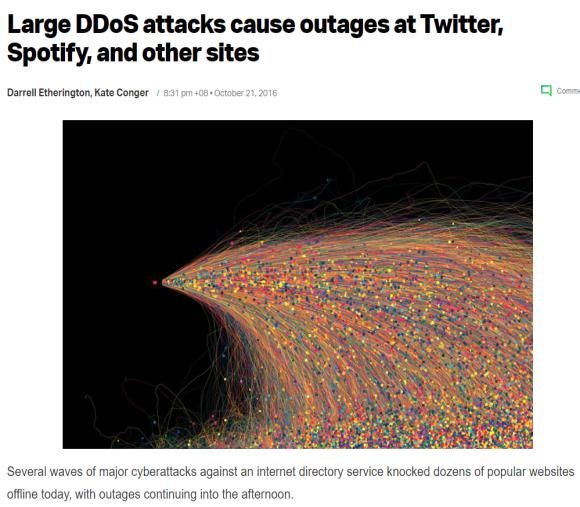
Understanding the Internet of Things
Security challenges in the IoT

 According to a forecast by Business Insider, there will be over 64 billion IoT devices by 2025. Despite these trends, there are still
 a few key IoT security challenges to be addressed in order for us to fully harness the potential of IoT.

 Challenges for the future of IoT:
                                                                                                            Outdated hardware and software
                                                                                                            A majority of IoT devices either do not get the appropriate updates, or
                                                                                                            never get a single one. This means the products become vulnerable to
                                                                                                            attacks when hackers find bugs or security issues.

                                                                                                            Use of weak and default credentials
                                                                                                            Many IoT companies sell devices and provide default credentials with them
                                                                                                            which are easy to find and often used by hackers to carry out brute-force
                                                                                                            attacks to compromise these devices and use them for nefarious purposes.

                                                                                                            Malware and ransomware
                                                                                                            The rapid rise of IoT products makes cyberattack permutations
                                                                                                            unpredictable. Cybercriminals have been able to lock consumers out of
                                                                                                            their own IoT devices.

                                                                                                            Data security and privacy
                                                                                                            With increased interconnectedness, data protection has become more
                                                                                                            difficult as it gets transferred between multiple devices within a few
                                                                                                            seconds, which can lead to a data leak.

https://readwrite.com/2019/09/05/9-main-security-challenges-for-the-future-of-the-internet-of-things-iot/
https://www.peerbits.com/blog/biggest-iot-security-challenges.html

© 2020 Deloitte & Touche Enterprise Risk Services Pte Ltd                                                                                                                               Cyber 101   4
Understanding the Internet of Things
Case Study: Mirai malware

 One of the most well-known IoT attacks is the Mirai malware, which targets online                                   Devices infected by Mirai continuously
 consumer devices such as IP cameras and home routers.                                                               scan the internet for vulnerable IoT
                                                                                                                     devices and logs into them using a table
 First discovered in August 2016, the Mirai malware has been used in some of the                                     of more than 60 common factory
                                                                                                                     default usernames and passwords to
 largest and most disruptive distributed denial of service (DDoS) attacks, including:                                infect them.

 •     Krebs on Security – A blog specialising in cyber-crime                                                        These attacks exceeded 1 Tbps – one of
 •     OVH – One of the largest European hosting providers                                                           the largest on public record – and
 •     DYN – A popular DNS provider in US                                                                            infected over 600,000 vulnerable IoT
                                                                                                                     devices.

 Read more: ZDNet                                           Read more: Ars Technica          Read more: TechCrunch

https://blog.cloudflare.com/inside-mirai-the-infamous-iot-botnet-a-retrospective-analysis/

© 2020 Deloitte & Touche Enterprise Risk Services Pte Ltd                                                                                                       Cyber 101   5
Understanding the Internet of Things
Case Study: VTech smart toys

  VTech, the maker of “smart” toys such as watches and cameras, was fined
  US$650,000 for exposing data from millions of parents and children due to poor
  security practices.

  A security researcher found that profiles of parents and children set up on VTech,
  which included pictures and personal details, could be accessed via one of the
  company’s websites.

  Furthermore, not only was the website not secure, the data were not encrypted
  in transit or at rest, contradicting security claims made in VTech’s privacy policy.

  As a result of VTech’s poor security practices, at least 5 million parent records and
  227,000 child records were shown to be accessible.

                                                                                          Read more: Tech Crunch

© 2020 Deloitte & Touche Enterprise Risk Services Pte Ltd                                                          Cyber 101   6
Understanding the Internet of Things
Case Study: Ring smart doorbell

  Ring smart doorbell is a popular home security device acquired by
  Amazon.

  In February 2019, researchers found that Ring contains a serious flaw
  that could allow an attacker on a shared WiFi network to spy on
  families’ video and audio footage.

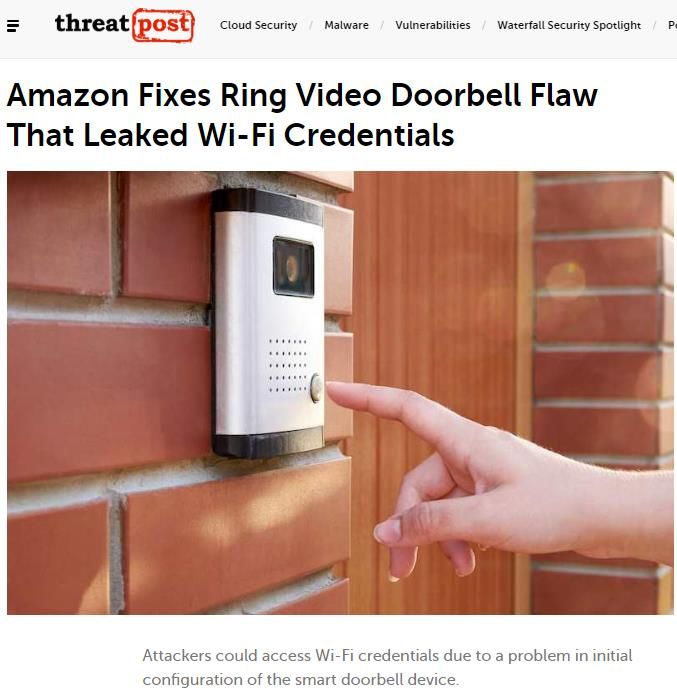
  In November 2019, researchers discovered yet another vulnerability in
  Ring that could allow attackers to access the owner’s Wi-Fi network
  credentials and potentially reconfigure the device to launch an attack
  on the home network.

                                                                           Read more: Threat Post

© 2020 Deloitte & Touche Enterprise Risk Services Pte Ltd                                           Cyber 101   7
Understanding the Internet of Things
Case Study: iLnkP2P
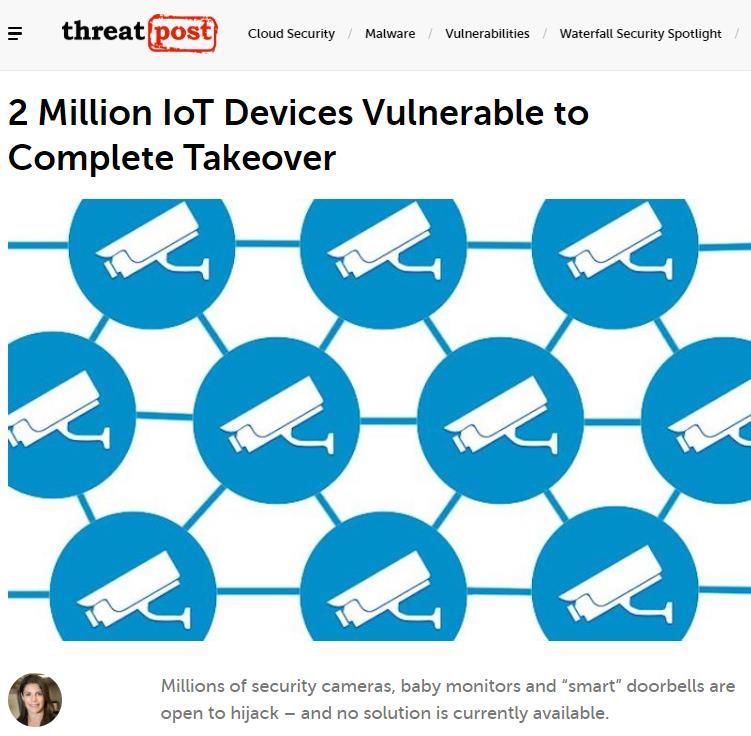
Over 2 million devices using an iLnkP2P component – including IP
security cameras, baby monitors and smart doorbells – have serious
vulnerabilities.
In April 2019, security engineer Paul Marrapese discovered two
vulnerabilities in a P2P solution, iLnkP2P, that could allow remote
hackers to find and take over vulnerable cameras used in the devices.
In other words, an attacker can hijack the devices and spy on their
owners. There is still no known patch for these security flaws.
Read more: Threat Post
© 2020 Deloitte & Touche Enterprise Risk Services Pte Ltd Cyber 101 8Understanding the Internet of Things
Ways to protect your IoT devices
IoT can bring a lot of convenience to our lives and to guard against potential threats, it is very important to secure your the IoT
devices in your smart home to prevent cyber attacks.
Here are some ways to help secure your smart home:
01 Change default usernames and passwords.
Cybercriminals probably already know the default
passwords that come with many IoT products.
Choose devices that allow you to change the default
05 Use two-factor authentication.
Two-factor authentication (2FA) — such as a one-
time code sent to your mobile phone — can keep
hackers out of your accounts. If your smart-device
password. apps offers 2FA, use it.
Use strong, unique passwords for Wi-Fi Set up a guest network.
02 networks and device accounts.
Use unique, complex passwords made up of letters,
numbers, and symbols. Use a strong encryption
06 Keep your Wi-Fi account private. Visitors, friends
and relatives can log into a separate network that
does not tie into your IoT devices.
method (such as WPA2) when you set up Wi-Fi
network access to keep your network secure.
Ensure physical security.
03 Disable features you may not need.
IoT devices come with a variety of services such as
remote access, often enabled by default. If you do
not need it, be sure to disable it.
07 Ensure that IoT devices are kept in a secure location
where attackers cannot simply walk up and tamper
with them. If the device supports tampering alarms
such as CCTV cameras, enable this feature.
04 Keep your software up to date.
Do not put off installing software updates, as it
might be a patch for a security flaw.
https://us.norton.com/internetsecurity-iot-smart-home-security-core.html
© 2020 Deloitte & Touche Enterprise Risk Services Pte Ltd Cyber 101 9Deloitte refers to one or more of Deloitte Touche Tohmatsu Limited (“DTTL”), its global network of member firms, and their related entities. DTTL (also referred to as “Deloitte Global”) and each of its member firms and their affiliated entities are legally separate and independent entities. DTTL does not provide services to clients. Please see www.deloitte.com/about to learn more. Deloitte is a leading global provider of audit and assurance, consulting, financial advisory, risk advisory, tax & legal and related services. Our global network of member firms and related entities in more than 150 countries and territories (collectively, the “Deloitte organisation”) serves four out of five Fortune Global 500® companies. Learn how Deloitte’s approximately 312,000 people make an impact that matters at www.deloitte.com. Deloitte Asia Pacific Limited is a company limited by guarantee and a member firm of DTTL. Members of Deloitte Asia Pacific Limited and their related entities, each of which are separate and independent legal entities, provide services from more than 100 cities across the region, including Auckland, Bangkok, Beijing, Hanoi, Hong Kong, Jakarta, Kuala Lumpur, Manila, Melbourne, Osaka, Seoul, Shanghai, Singapore, Sydney, Taipei and Tokyo. About Deloitte Singapore In Singapore, services are provided by Deloitte & Touche LLP and its subsidiaries and affiliates. This communication contains general information only, and none of Deloitte Touche Tohmatsu Limited, its member firms, or their related entities (collectively, the “Deloitte Network”) is, by means of this communication, rendering professional advice or services. Before making any decision or taking any action that may affect your finances or your business, you should consult a qualified professional adviser. No entity in the Deloitte Network shall be responsible for any loss whatsoever sustained by any person who relies on this communication. © 2020 Deloitte & Touche Enterprise Risk Services Pte Ltd
You can also read


