Using Depth Cameras for Recognition and Segmentation of Hand Gestures
←
→
Page content transcription
If your browser does not render page correctly, please read the page content below
Hindawi
Advances in Materials Science and Engineering
Volume 2021, Article ID 7100727, 6 pages
https://doi.org/10.1155/2021/7100727

Research Article
Using Depth Cameras for Recognition and Segmentation of
Hand Gestures

          Khalid Twarish Alhamazani ,1 Jalawi Alshudukhi ,1 Talal Saad Alharbi ,1
          Saud Aljaloud ,1 and Zelalem Meraf 2
          1
              University of Ha’il College of Computer Science and Engineering, Department of Computer Science, Hail, Saudi Arabia
          2
              Department of Statistics, Injibara University, Injibara, Ethiopia

          Correspondence should be addressed to Zelalem Meraf; zelalemmeraf@inu.edu.et

          Received 21 November 2021; Accepted 8 December 2021; Published 18 December 2021

          Academic Editor: Palanivel Velmurugan

          Copyright © 2021 Khalid Twarish Alhamazani et al. This is an open access article distributed under the Creative Commons
          Attribution License, which permits unrestricted use, distribution, and reproduction in any medium, provided the original work is
          properly cited.

          In recent years, in combination with technological advances, new paradigms of interaction with the user have emerged. This has
          motivated the industry to create increasingly powerful and accessible natural user interface devices. In particular, depth cameras
          have achieved high levels of user adoption. These devices include the Microsoft Kinect, the Intel RealSense, and the Leap Motion
          Controller. This type of device facilitates the acquisition of data in human activity recognition. Hand gestures can be static or
          dynamic, depending on whether they present movement in the image sequences. Hand gesture recognition enables human-
          computer interaction (HCI) system developers to create more immersive, natural, and intuitive experiences and interactions.
          However, this task is not easy. That is why, in the academy, this problem has been addressed using machine learning techniques.
          The experiments carried out have shown very encouraging results indicating that the choice of this type of architecture allows
          obtaining an excellent efficiency of parameters and prediction times. It should be noted that the tests are carried out on a set of
          relevant data from the area. Based on this, the performance of this proposal is analysed about different scenarios such as lighting
          variation or camera movement, different types of gestures, and sensitivity or bias by people, among others. In this article, we will
          look at how infrared camera images can be used to segment, classify, and recognise one-handed gestures in a variety of lighting
          conditions. A standard webcam was modified, and an infrared filter was added to the lens to create the infrared camera. The scene
          was illuminated by additional infrared LED structures, allowing it to be used in various lighting conditions.

1. Introduction                                                         out through body gestures; Microsoft is one of the companies
                                                                        that made this possible with one of its projects called Kinect;
The effectiveness of the human-computer interaction is                   another case is that of Nintendo with the Wii console. That is
directly influenced by the way the interface is designed. With           why, contributing to the improvement of HCI and the new
the rise of personal computers in the 1980s, HCI arose.                 trends of creating interaction with body gestures, the search for
Computers were no longer being created just for profes-                 interaction with the user is proposed where it is required to
sionals, and HCI’s purpose was to make all computer in-                 identify a hand using infrared light as a critical tool [1].
teractions simple and efficient for a wide range of users with                Infrared light provides information that cannot be obtained
varying skill levels.                                                   from visible light. All bodies tend to emit infrared radiation,
    Human-computer interaction (HCI for its acronym in                  which depends directly on the temperature in which the body is
English) is a prevalent concept among large companies. A more           located, and this is one of the advantages that are taken ad-
intuitive relationship between man and computer is sought to            vantage of within the developments of computer vision since
apply it in different technological devices. It is considering end-      the image capture provides clear images, with really striking
user satisfaction by reducing their effort to perform tasks.             lighting that allows identifying bodies in the scene. An infrared
Projects have been worked on where communication is carried             camera is a device that, from the middle infrared emissions of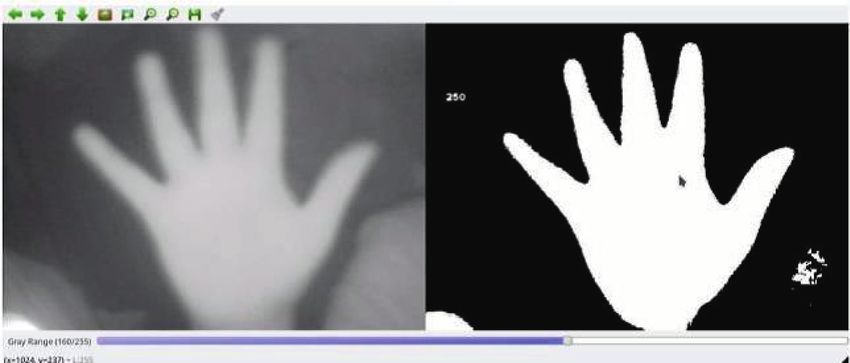
2                                                                               Advances in Materials Science and Engineering

the electromagnetic spectrum of the detected bodies, forms         performance of this proposal is analyzed about different sce-
luminous images visible to the human eye. The risk of common       narios such as lighting variation or camera movement, different
eye illnesses has been linked to high ambient temperatures.        types of gestures, sensitivity, or bias by people, among others.
This type of infrared shot is associated with night shots or the
possibility of seeing in very dark situations [2].                 2. Methodology
                                                                   For the development of this work, it was decided to adopt the
1.1. Review of Literature. Hameed et al. [3] proposed de-          improved cascade methodology used in software develop-
veloping a gesture recognition system to communicate               ment [6] because this methodology establishes the stages of
through a more natural human-computer interaction. The             the software life cycle so that the beginning of each phase
main objective is to create a robust and efficient segmen-           must wait. However, the end of the previous one allows the
tation algorithm based on colour spaces and morphological          improvement of prior stages, if necessary. In Figure 1, the
processing necessary for skin colour detection, image              scheme of the methodology that includes three steps is
background removal, and variable lighting conditions. In           shown.
work, the OpenCV library was used for monitoring and a                  The first stage, named “hardware adaptation,” refers to
perimeter travel algorithm to detect the hand contour.             all the activities to obtain the camera with the necessary
    According to [4], detection of gestures is one of the          modifications and the best alternative for capturing the
important parts of HCI, which is why he proposes a work in         desired image to continue with the process. In the second
which the detection of gestures is done through pre-               stage, “image processing and feature extraction,” essential
processing of images to reduce noise in addition to using          aspects are defined for the features to be compared and the
support vector machines (SVM) for the detection and ex-            structure of the library to be built. The third stage, “gesture
traction of the region where the hands are located using           recognition and implementation,” refers to how the training
prominent characteristics with an appearance-based                 is achieved to detect gestures and implement the library in an
approach.                                                          application.
    This segmentation technique is based on combining two
unsupervised clustering approaches such as K-means and
                                                                   2.1. Hardware Adaptation. This section presents the hard-
expectation maximization. The experimental results showed
                                                                   ware structure and its modifications to obtain an infrared
that this technique succeeds in correctly segmenting the           camera with the necessary characteristics for the project.
hand from the body, the face, the arm of a person, and other       Figure 2 shows a diagram of the camera and the essential
elements found in the image, which was taken with variable
                                                                   additions to convert it into an infrared camera.
lighting conditions in real-time.
                                                                       First, the web camera (Figure 2(a)) model COM-105
    Ito et al. [5] developed a method of obtaining hand
                                                                   with a 480-pixel CMOS sensor is modified so that the ICR
characteristics from image sequences, specifically when a
                                                                   filter is eliminated following the procedure explained in
person performs the signs of the Japanese sign language to
                                                                   (WANG 2013). Subsequently, to make adequate lighting of
recognise the words of a said language in a complex
                                                                   the scene that would be evaluated during the tests, building
background. For recognition, the hidden Markov model
                                                                   an array of LEDs (Figure 2(c)) is necessary.
(HMM) technique is used using six features of the face and
                                                                       In a second phase, this structure is built using an ar-
hands. The results presented indicate that the objective of
                                                                   rangement of 10 LEDs model TN130BF, whose greater il-
monitoring the face and hands is met.                              lumination amplitude angle allows the objects to be
    On the other hand, in [6], a method of predicting the          segmented more completely, unlike other diode models.
poses of an articulated hand is presented in real-time with a
                                                                       Finally, some materials that allow filtering the infrared
depth camera to carry out the interaction in an environment
                                                                   light are used to determine the elements present in the
of mixed reality and to study the effects of models of real and
                                                                   image (Figures 2(a) and 2(b)). The materials used were
virtual articulated hands in a simulator. Random decision
                                                                   selected considering the wavelength captured by each of the
forests were used to carry out the recognition, which proved
                                                                   materials, carrying out experimental tests to determine the
to have better results in real-time applications, avoiding the
                                                                   one that offered the appropriate capture of the hand and the
typical errors in the use of these technologies and showing
                                                                   gestures performed. At the end of these tests, the negative
low consumption of computational resources and high
                                                                   of a roll photographic film was selected as the material
precision.
                                                                   (Figure 3), allowing observing elements with a wavelength
    In this work, an infrared camera is built from small           between 800 nm and 1000 nm.
modifications at the hardware level of a conventional webcam,
achieving a clean image, and through the segmentation of the
scene, the hand is identified, finally leading to a gesture rec-     2.2. Image Processing and Feature Extraction. The term
ognition process. The contribution of this work can be de-         “digital image processing” refers to the use of a computer to
termined as obtaining a device that allows images to be            process digital images. We can also call it the application of
captured with the characteristics mentioned earlier and with       computer algorithms in order to obtain a better image or
which the possibility of being used in projects that require       extract useful information. After the camera had been
capturing scenes. It should be noted that the tests are carried    modified, it had to be checked to see whether the acquired
out on a set of relevant data from the area. Based on this, the    pictures had enough information to recognise one-handed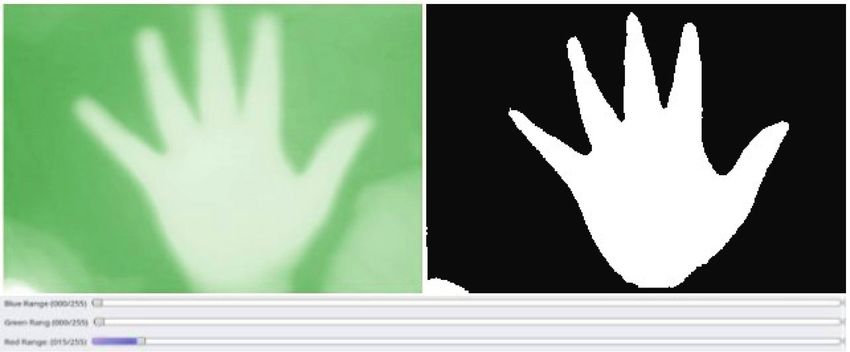
Advances in Materials Science and Engineering                                                                                    3

                                                        Hardware Adaptation

                                                Image processing and feature extraction

                                               Gesture recognition and implementation

                                         Figure 1: Scheme of the proposed methodology.

                                (a)                           (b)                            (c)
                                           Figure 2: Chamber schematic and additions.

                                                                          Because one of the characteristics of the images captured
                                                                      by an infrared camera is that the objects reflect this type of
                                                                      light, the use of this channel was analysed for a program to
                                                                      transform the information in it into another image at a scale
                                                                      of greys to support better segmentation of the hand in the
                                                                      image. This transformation offered an improvement in
                                                                      segmentation, which is why it was selected to continue using
                                                                      the grayscale. In image five, you can see the image resulting
                                                                      from this process.
                                                                          Since the hand has been segmented, the defining
                                                                      characteristics must be extracted. These characteristics will
                                                                      be obtained from the analysis of the contour of the hand and
                                                                      the location of the centroid of the hand.
                                                                          The hand contour is obtained as a sequence of points
                                                                      using the algorithm developed by Satoshi in [7] and is
                                                                      implemented in the OpenCV library. Once received, the
                                                                      convex envelope (larger polygon that surrounds a figure in
          Figure 3: Photographic film negative strip.                  the image) and its defects (deep points between the convex
                                                                      envelopes) must be found [8–14]. This allows determining
                                                                      the space occupied by the hand and locating the fingertips, as
motions. A library of functions based on the C++ language             shown in Figure 5. In the figure, you can see the beginning
and the OpenCV library [7] were created to carry out the              and end of a defect that corresponds to the union of the
verification.                                                          space between the fingers of the hand and their tip.
    The first step to carry out is the hand segmentation in the            After the location of the largest polygon, which corre-
foreground from the rest or background of the captured                sponds to the hand with the fingers included, the centroid of
image. The way selected to perform this segmentation is               the hand is determined using the detected polygon
based on threshold segmentation where, based on values                (Figure 6).
established by a person, a colour image was obtained by the               With the above, it is determined that the characteristics
camera constructed through a mask that verifies pixel by               to be used to identify the gestures would be defined by a
pixel, if the numerical value of each one of these pixels is in       defect and the centroid, as defined in Table 1.
the range that defines a hand. Otherwise, it is determined                 With the above, it is established that 20 characteristics
that that pixel does not belong to the hand. Figure 4 shows           are used to represent an extended hand to which the width
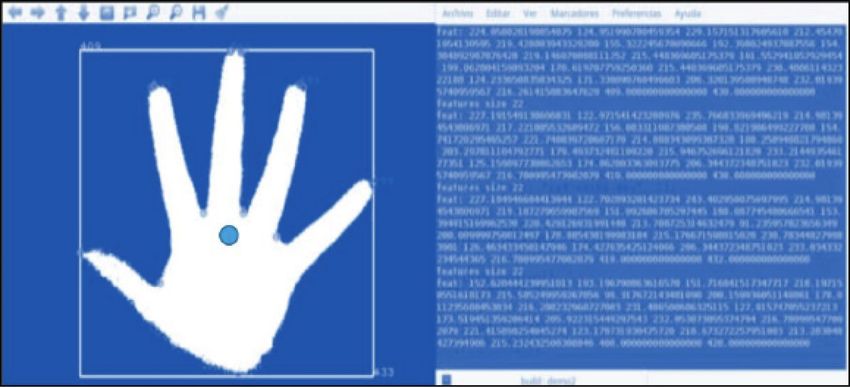
the process for establishing the threshold for a colour               and height of the hand are added to make a total of 22
channel found in the images.                                          elements to analyse (Figure 7).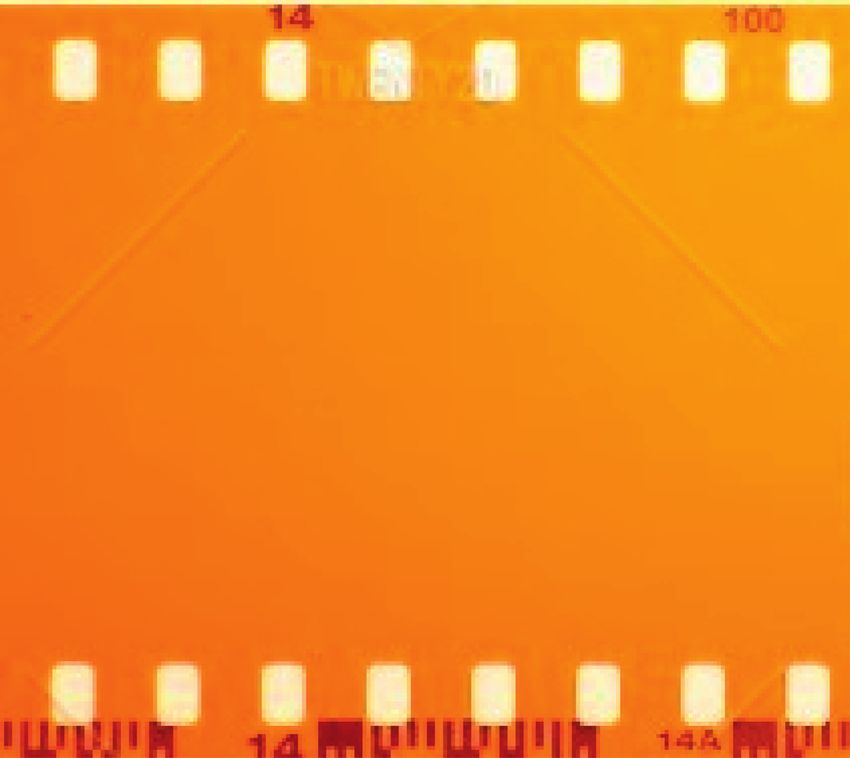
4                                                                                  Advances in Materials Science and Engineering

           Figure 4: Assignment of the threshold for the channel with the colour red and segmented with that information.

                         Figure 5: Threshold assignment for grayscale and segmented with such information.

                                                                                          Centroid
                                                                                         x=m10/my
                                                                                         =m01/m0

                             Figure 6: Location and description of the convex envelope and its defects.

                                          Table 1: Description of extracted characteristics.
Feature in the picture                                                                          Feature extracted from the image
                                                                                                   Distance from start to finish
Default                                                                                       Starting distance to the deepest point
                                                                                           Distance from the end to the deepest point
                                                                                               Distance from start to the centroid
Centroid
                                                                                               Distance from end to the centroid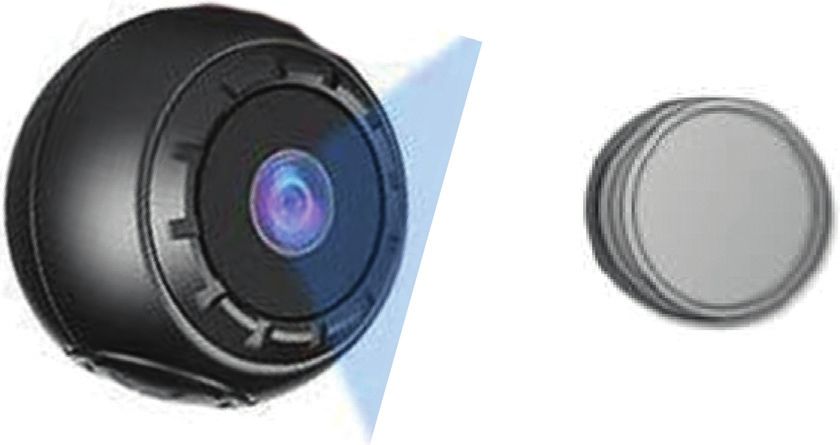
Advances in Materials Science and Engineering                                                                                  5

                                   Hight                                           End

                                                                                    Deepest

                                                                                      Beginning

                                                                                         Centroid

                                            Width
                                           Figure 7: Description of extracted features.

                          Figure 8: Hand identification with five sides extended and features removed.

3. Results                                                         4. Conclusions and Future Work
It can be concluded that both the built camera and the             With the project’s development, it can be concluded that
implemented library can support the detection and recog-           both the built camera and the implemented library can
nition of hand gestures. This was achieved using the tech-         support the detection and recognition of hand gestures. It
nique of vector support machines (SVM) [15], which learns          should be noted that the technologies developed are rela-
to classify data into two different classes. An implementation      tively inexpensive. Based on this, the performance of this
of SVM is included in the OpenCV library with which it was         proposal is evaluated in a variety of circumstances, including
possible to use it.                                                illumination changes or camera movement, various sorts of
    To perform the training of the machines, the extraction        gestures, and people’s sensitivity or prejudice, among others.
of characteristics of various shots taken with the developed       We will look at how infrared camera pictures may be utilized
library was executed, and each gesture shot was labelled as        to segment, categorize, and recognise one-handed move-
five fingers and four fingers. Examples of the parts are              ments in various illumination circumstances in this post,
presented in Figure 8.                                             which could be part of the consideration when compared
    For each gesture of extended fingers, 55 samples were           with some of the works previously carried out and analysed
used, with which the machines were trained to later verify         in the related works section. However, the results obtained
with images captured directly from the camera turned on.           open the possibility of improving the technologies developed
Each gesture is checked separately with another motion             after reviewing the negative aspects that were found. One of
where the fingers are not separated, as shown in Figure 8.          them, for example, is the affectation of the identification of
    The results obtained allowed us to observe that the            gestures due to the distance between the camera and the
development carried out identifies in a better way the gesture      hand that makes the gestures, since when training vector
of five fingers against the motion without extended fingers           support machines with a characteristic such as height and
than the gesture of four fingers against that of.                   width, the samples used in training may not have been
6                                                                                    Advances in Materials Science and Engineering

sufficient to avoid being susceptible to errors due to such               [7] S.. Michahial, “Hand gesture recognition using support vector
distance. Additionally, regarding the modified hardware, it is               machine,” International Journal of Engineering Science, vol. 4,
proposed to change the type of diodes used by another with a                p. 42, 2015.
greater amplitude angle to cover more visible space or also to          [8] S. Saleh, M. Rahman, and K. Pavel, “Comparative study on the
change the material used for filtering infrared light so that                software methodologies for effective software development,”
                                                                            International Journal of Scientific Engineering and Research,
they adjust to the values used by LEDs. With the devel-
                                                                            vol. 8, pp. 1018–1025, 2017.
opment of this work, it was possible to implement a bio-                [9] M. L. Thivagar, A. S. Al-Obeidi, B. Tamilarasan, and
metric system consisting of a hardware module for the                       A. A. Hamad, “Dynamic analysis and projective synchroni-
acquisition of infrared images and a software module for                    zation of a new 4D system,” in IoT and Analytics for Sensor
digital image processing and pattern recognition, capable of                Networksp. þ, Springer, Singapore, 2022.
carrying out the tasks of capture, registration, and validation        [10] J. S. Supancic, G. Rogez, Y. Yang, J. Shotton, and D. Ramanan,
of the authenticity of people using the patterns of the                     “Depth-based hand pose estimation: data, methods, and
vascular network of the dorsal aspect of the hand. Finally, it              challenges,” in Proceedings of the 2015 IEEE International
is possible to modify the library developed to avoid con-                   Conference on Computer Vision (ICCV), Washington, DC,
sidering a part of the arm as part of the hand, which could                 USA, December 2015.
                                                                       [11] N. Umadevi and I.R Divyasree, “Development of an efficient
also be the reason why there were some problems in
                                                                            hand gesture recognition system for human computer in-
identifying the size of the hand. In addition, the proposed                 teraction,” International Journal of Engineering and Computer
method guarantees the extraction of the region of interest in               Science, vol. 5, no. 2, 2016.
a similar area for each of the images, avoids the use of               [12] C. Wang and Z. Zhang, “Development CMOS sensor image
fixation devices to centre the hand in the desired position,                 acquisition algorithm based on wireless sensor networks,”
and eliminates the influences caused by small displacements                  Sensors and Transducers, vol. 156, pp. 10–17, 2013.
and rotations that may be presented in the capture of images.          [13] S. Sengan, O. I. Khalaf, D. K. Vidya Sagar, D. K. Sharma,
                                                                            L Arokia Jesu Prabhu, and A. A. Hamad, “Secured and
Data Availability                                                           privacy-based IDS for healthcare systems on E-medical
                                                                            data using machine learning approach,” International
The data underlying the results presented in the study are                  Journal of Reliable and Quality E-Healthcare, vol. 11, no. 3,
available within the article.                                               pp. 1–11, 2022, þ.
                                                                       [14] S. Jha, S. Ahmad, H. A. Abdeljaber, A. A. Hamad, and
                                                                            M. B. Alazzam, “A post COVID machine learning approach in
Conflicts of Interest                                                       teaching and learning methodology to alleviate drawbacks of
                                                                            the e-whiteboards,” Journal of Applied Science and Engi-
The authors declare that they have no conflicts of interest
                                                                            neering, vol. 25, no. 2, pp. 285–294, 2021, þ.
regarding the publication of this paper.                               [15] Z. Ren, J. JMeng, and J. Yuan, “Depth camera based hand gesture
                                                                            recognition and its applications in Human-Computer-Interaction,”
References                                                                  in Proceedings of the ICICS 2011 8th International Conference on
                                                                            Information, Communications and Signal Processing, Singapore,
 [1] P. Dhamanskar, A. C. Poojari, H. S. Sarwade, and R. R. D’silva,        December 2011.
     “Human computer interaction using hand gestures and
     voice,” in Proceedings of the 2019 International Conference on
     Advances in Computing, Communication and Control
     (ICAC3), pp. 1–6, Mumbai, India, December 2019.
 [2] V. Harini, V. Prahelika, I. Sneka, and P. Adlene Ebenezer,
     “Hand gesture recognition using OpenCV and Python,” New
     Trends in Computational Vision and Bio-inspired Computing,
     vol. 174, pp. 1711–1719, 2020.
 [3] A. H. Hameed, E. A. Mousa, and A. A. Hamad, “Upper limit
     superior and lower limit inferior of soft sequences,” Inter-
     national Journal of Engineering & Technology, vol. 7, no. 4.7,
     pp. 306–310, 2018, þ.
 [4] S. Sengan, O. I. Khalaf, S. Priyadarsini, D. K. Sharma,
     K. Amarendra, and A. A. Hamad, “Smart healthcare security
     device on medical IoT using raspberry Pi,” International
     Journal of Reliable and Quality E-Healthcare, vol. 11, no. 3,
     pp. 1–11, 2022, þ.
 [5] S.-S. Ito, M. Ito, and M. Fukumi, “Japanese sign language
     classification is based on gathered images and neural net-
     works,” International Journal of Advances in Intelligent In-
     formatics, vol. 5, p. 243, 2019.
 [6] C. Keskin, F. Kirac, Y. E. Kara, and L. Akarun, “Real time hand
     pose estimation using depth sensors,” in Proceedings of the
     2011 IEEE International Conference on Computer Vision
     Workshops (ICCV Workshops), pp. 1228–1234, Barcelona,
     Spain, November 2011.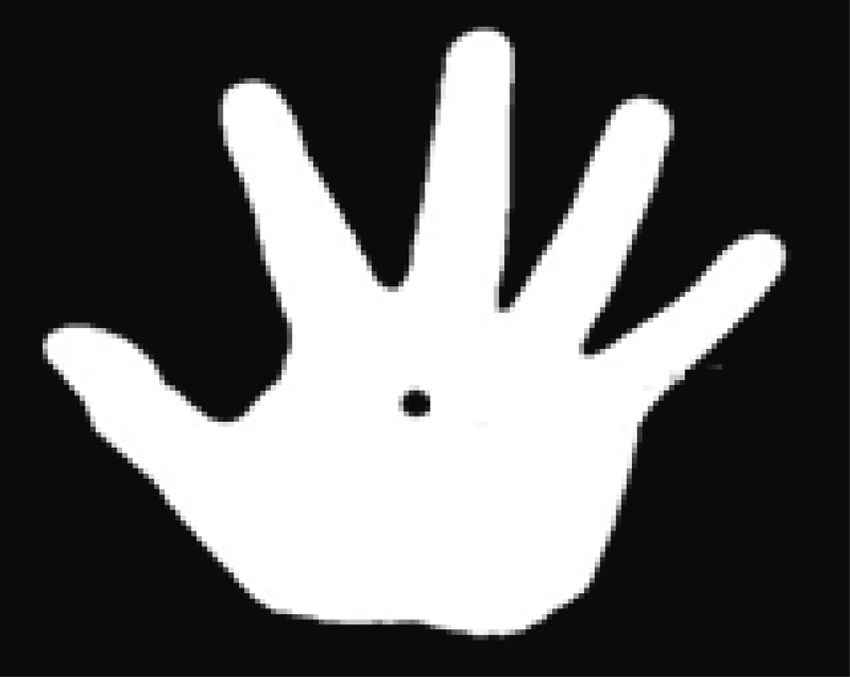
You can also read


