Verb class effects on word order - Evidence from corpora Elisabeth Verhoeven
←
→
Page content transcription
If your browser does not render page correctly, please read the page content below
Berlin‐Stuttgart meeting on Psych verbs
                                                         Stuttgart
                                                       21.11.2014

Verb class effects on word order
       Evidence from corpora

             Elisabeth Verhoeven
       elisabeth.verhoeven@cms.hu‐berlin.de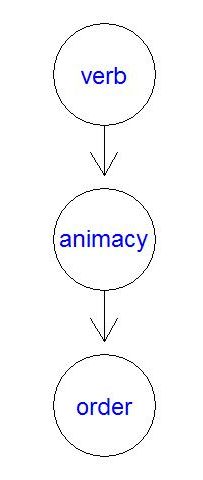
Introduction
Object experiencer verbs with a [–agentive] stimulus behave like unaccusative
verbs, i.e., they have a lower stimulus:
e.g. Belletti & Rizzi 1988, Landau 2010

(1)        [ agent                [ patient              V]]
              (NOM)                   (–NOM)

(2)        [ experiencer          [ stimulus             V]]
              (–NOM)                  (NOM)
Only bracketing (not labeling) is relevant for the predictions on linearization.

Syntactic phenomena supporting these assumptions:
properties of experiencer verbs in nominalization, reflexivization,
passivization, extraction possibilities, binding
(see e.g. Bayer 2004, Fanselow 2000, Grewendorf 1989, Wunderlich 1997 on German)
Predictions for linearization
These assumptions about constituent structure motivate predictions for the
linearization. Under neutral contextual conditions (i.e., if operations due to
discourse features such as ‚topic‘ do not apply,) we expect:
(1) NOM –NOM
for transitive verbs (including experiencer‐object verbs with agentive stimuli)
(2) – NOM NOM
for unaccusatives (including experiencer‐object verbs with non‐agentive stimuli)
These hypotheses are confirmed by intuitive judgments:
‐ for dative experiencer verbs such as gefallen
(see Lenerz 1977, Hoberg 1981, Primus 2004 on German)
‐ with some controversies for accusative experiencer verbs such as interessieren
(see in particular Fanselow 2000, 2003, Haider & Rosengreen 2003)Empirical challenge Can we use the methodological advances of current empirical reseach (corpus, experiment) in order to resolve controversies involved in singular observations/intuitive judgments? The motivation is apparent: corpus/experimental approaches offer techniques to eliminate bias (of the observer) and to warrant replicability of the empirical findings. This program is a challenge: corpus/experimental data involve variation coming from sources that are irrelevant for the question at issue (e.g., contextual variation, speaker variation, variation due to speech production factors such as avoiding ambiguity risks). However, this program is promissing: It promises empirically precise statements, disentangling the role of several related factors (e.g., animacy or context) and observation of exact behaviour of single verbs/verb classes.
Experiencer‐first
Experiencer‐first effects are reported in several empirical studies
(sentence processing, speech production, acceptability judgements, corpus)

Scheepers 1997; Scheepers et al. 2000; Haupt et al. 2008, Ferreira 1994, Lamers & De Hoop 2014,
Bader & Häussler 2010

Relevance of corpus frequencies
‐   Basic assumption
    deviations from the canonical order of the arguments must be motivated by discourse
    features; the canonical order is expected to be contextually unrestricted, i.e., to appear in a
    larger array of contexts than the triggered alternatives. This expectation applies to the order
    of the arguments and not to every deviation from the basic order (see, e.g., head‐movement
    in V2)

‐   Limits of the inferences from frequencies to structure
    contexts triggering movement may be particularly frequent in discourse (e.g., subject
    topicalization, etc.).
Experiencer‐first: questions
Experiencer‐first effects are reported in several empirical studies
(sentence processing, speech production, acceptability judgements, corpus)
Scheepers 1997; Scheepers et al. 2000; Haupt et al. 2008, Ferreira 1994, Lamers & De Hoop 2014,
Bader & Häussler 2010
Independency of experiencer‐first
Are the experiencer‐first effects in speech production independent from
the intervention of other semantic and pragmatic factors?
We know the following dependencies:
experiencer ~ topic & topic ~ first
experiencer animate & animate ~ topic & topic ~ first
A part of the experiencer‐first effects in speech production can certainly be
explained by the correlation with topics. Is there another part of experiencer‐first
that is not reducible to its preference for particular discourse properties?Experiencer‐first: questions Previous empirical studies do not address the distinction between agentive and non‐agentive EO verbs, which is however crucial for the syntactic analysis Experiencer‐first and agentivity Do the experiencer‐first effects in speech production relate to the totality of experiencer‐object verbs or to the subset of non‐agentive EO verbs?
Contents

Method:       Corpus study (German)
Question A:   Independency of experiencer‐first effects
Question B:   Experiencer‐first effects and agentivity
Method
German: Corpus study
corpus         W‐öffentlich of COSMAS database, Written Language,
               2.291.520.000 word forms
extracted      10 verbs for every verb class (four verb classes)
               1000 tokens per verb (randomized): total 40000 tokens
               (background: verb as random factor)
valid tokens   main clauses with two realized arguments (pronouns
               excluded due to particular rules in German)
               total: 40 000; valid: 4319
decoding       order: SO vs. OS
               voice: active vs. non‐active
               field: XVfinY (prefield), VfinXY (middlefield)
               animacy: animate vs. inanimate
               definiteness: definite vs. indefinite
Verb classes Dative Experiencer‐Object verbs imponieren ‘impress’, gefallen ‘please’, widerstreben ‘be reluctant’, etc. Accusative Experiencer‐Object ±agentive verbs nerven ‘bother‘, überraschen ‘surprise’, ärgern ‘annoy’, etc. Accusative Experiencer‐Object non‐agentive verbs interessieren ‘concern’, wundern ‘astonish’, freuen ‘give pleasure’ , etc. Canonical transitive verbs beeinträchtigen ‘impair’, behindern ‘hinder’, schützen ‘protect’, etc. (particular subclass of canonical verbs with include animacy configurations similar to EO verbs; the question is whether EO effects are restricted to experiencers and not to achieve generalizations about the behaviour of all canonical transitive verbs)
Acceptability study
Agentivity test frame with control verbs:
X entschied, Y zu V ‚X decided to V Y‘                          agent-oriented adverb
                                                                                        2   3   4   5   6

Agent‐oriented adverb:                                      classified as
                                                       6    non-agentive
X V Y absichtlich ‚X V Y on purpose‘

                                        control verb
                                                       4

scalar acceptability judgments
                                                       2                                    classified as
(1: non‐acceptable; 7: acceptable)                                                           ± agentive

                                                                      freuen
                                                                  wundern
                                                            interessieren
                                                                befremden
                                                              bedruecken
                                                                 entsetzen
                                                                       ekeln
                                                               faszinieren
                                                                 empoeren
                                                                  anwidern
                                                           enttaeuschen
                                                                  aufregen
                                                                   irritieren
                                                              amuesieren
                                                                langweilen
                                                                      reizen
                                                             erschrecken
                                                                    aergern
                                                           ueberraschen
                                                                     nerven
n of speakers: 32

                                                                         EO accusative verbs
Acceptability study
Where does the gradience
in this data come from? agent-oriented adverb
2 3 4 5 6
Agentivity is not scalar. A verb either
classified as
allows for an agentive reading or not. 6 non-agentive
The scalar judgments reflect the
control verb
possibility to imagine a context in which 4
the verb is used as agentive. If this is true,
the gradience should correlate classified as
2
with the likelihood of such contexts ± agentive
in speech production.
freuen
wundern
interessieren
befremden
bedruecken
entsetzen
ekeln
faszinieren
empoeren
anwidern
enttaeuschen
aufregen
irritieren
amuesieren
langweilen
reizen
erschrecken
aergern
ueberraschen
nerven
Can we predict the frequencies of OS
by means of the agentivity judgments? EO accusative verbsIndependency of experiencer‐first
Questions
A. Do verb classes have an influence on word order?
A1. (If yes) is this influence independent from other factors (animacy/definiteness)?
A2. (If yes) where is the locus of the influence?
    ‐ thematic relation of the undergoer: patient vs. experiencer
    ‐ thematic properties of the actor: agentive/non‐agentive
    ‐ case: dative vs. accusative

                  patient                            experiencer

                                    accusative                              dative

                            ±agentive                        non‐agentive

V‐classes:
                canonical          E.ACC ±ag        E.ACC –ag               E.DAT
Examined factors
verb class canonical
E.ACC ±agentive
E.ACC non‐agentive
E.DAT
clausal domain middlefield (basic configuration)
prefield (derived configuration)
animacy disharmonic (animate O & inanimate S)
other permutations
definiteness disharmonic (definite O & indefinite S)
other permutations
random factor verbCases of interest SX order, prefield Der Versuch reizt den Trainer jedenfalls. ‘The attempt appeals to the trainer anyway.’ (NUN06/APR.02092) SX order, middlefield Und jedes Mal entsetzten die jugendlichen Täter die Richter mit ihrer Kaltschnäuzigkeit. ‘And every time the adolescent delinquents appalled the judges with their coolness. (RHZ01/MAI.13687) XS order, prefield Den Regisseur interessiert von nun an eine Frage. ‘From now on, the director is interested in one question.’ (SOZ06/AUG.00423) XS order, middlefield Und ohnehin interessierten das erfreulich junge Publikum weniger die Ehrengäste... ‘And anyway, the young public was less interested in the guests of honor…’
Animacy and clausal domain
                                        middlefield                                                       prefield
                                     (total = 452 clauses)                                          (total = 2424 clauses)

                                                        CANONICAL                                                            CANONICAL
                          100                                                                 100
                                                        E.ACC ±ag                                                            E.ACC ±ag
                                                        E.ACC -ag                                                            E.ACC -ag
                          80                            E.DAT                                 80                             E.DAT
% of XS out of n tokens

                                                                    % of XS out of n tokens
                          60                                                                  60

                          40                                                                  40

                          20                                                                  20

                           0                                                                   0
                                disharmonic           other                                         disharmonic         other
Agentivity and OS
Is agentivity a good predictor for the choice of OS in the middle field?
acceptability with agent oriented adverbs
2 3 4 5 6
Statistic results
1.00
An effect of agentivity on word
order is obtained in GLMM (–.4,
i.e., increasing acceptability in 0.75
the tests correlates with
p of OS in corpus
decreasing OS frequency).
However, this effect does not 0.50
reach the significance level.
0.25
0.00
2 4 6
acceptability with control verbsResults I: verb‐class contrasts
AIC patient experiencer
accusative dative
±agentive non‐agentive
2470.1 α β γ
2475.7 α β γ δ
Comparison of all models (fourfold, threefold, twofold contrasts) reveals that the
maximal goodness of fit is reached by "Canonical vs. E.ACC vs. E.DAT"
(Log‐likelihood test comparing this model with the full model: not significant).
Calculations with the function glmer of the R‐package lme4 (Bates et al. 2011)Results II: confirmed effects
definiteness
main effect and interaction effects not statistically confirmed (LLT : not significant).
verb class : animacy
log‐likelihood test: χ2(2) = 13.4, p < .01
canonical verbs: no animacy effect
EO.ACC: experiencer fronting with disharmonic animacy
EO.DAT: experiencer fronting independent of animacy
source of the case effect: blocking effect with ACC&harmonic
verb class : field
log‐likelihood test: χ2(2) = 13.9, p < .001
larger effects of class in the middlefield than in the prefield
relevance: assumptions about German syntax; previous findings (Bader & Häussler 2010)
animacy : field
log‐likelihood test: χ2 (1) = 9.1, p < .01
larger effect of disharmonic animacy in the middlefield.Thematic role ambiguity
Is the difference between accusative and dative verbs due to the high
potential of thematic role ambiguity of acc/nom?
‐ Relevant in this respect are the clauses without disharmonic animacy.
‐ Structural ambiguity is more frequent with accusative (25.2%) than with dative (2.9%) verbs
‐ All structurally ambiguous clauses are disambiguated in favour of a nom‐first clause.
‐ However, the role of ambiguity does not explain the different frequencies of OS order: In the
subset of nonambiguous clauses, the OS order is significantly more frequent with dative
verbs (38.5%) than with accusative verbs (4.9%); χ2=42.3, pConclusions Agentivity (i.e. the distinction between ±agentive and non‐agentive) does not have a significant impact on corpus frequencies: The effect of agentivity does not relate to the lexical entry, but to the non‐agentive reading! disharmonic cases: non‐agentive reading (for all EO verbs) non‐disharmonic cases: agentive and non‐agentive readings are possible; an asymmetry in frequencies would be possible; however, almost exclusively NOM‐ ACC order (possibly for independent reason)
Experiencer‐first and animacy
Experiencer‐first and animacy Independency of experiencer‐first Are the experiencer‐first effects in speech production independent from the intervention of other semantic and pragmatic factors? We know the following dependencies: experiencer ~ topic & topic ~ first experiencer animate & animate ~ topic & topic ~ first A part of the experiencer‐first effects in speech production can certainly be explained by the correlation with topics. Is there another part of experiencer‐first that is not reducible to its preference for particular discourse properties? The analysis so far (generalized mixed logit model) confirmed the effect of ANIMACY and the effect of VERB CLASS. We also need to assess the effects of these factors on each other, in order to examine whether VERB CLASS has an effect that is independent from ANIMACY.
Dependencies between factors
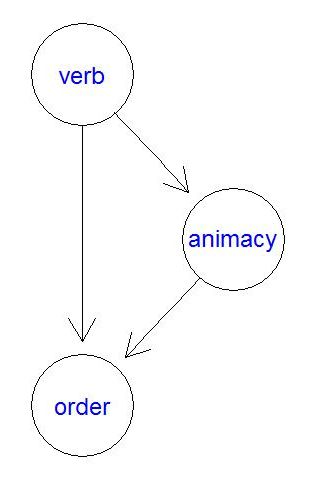
 Probabilistic dependency between VERB CLASS, ANIMACY, and WORD ORDER:
 we fitted Bayesian networks in order to find the dependency model that
 displays the maximal goodness of fit.

 Method:
 pairwise comparisons of each class of experiencer‐object verbs with the baseline (canonical
 verbs): presentation of the middlefield data
 (calculations made with the additive Bayesian network algorithm, Lewis 2013, R‐package abn)
Possible models
Model 1 Model 2 Model 3
EO verbs and animacy Word order is The effect of EO
influence word order only influenced verbs on word order is
independently of each by verb class. an epiphenomenon.
other
Log‐marginal likelihood (higher values indicate better fit)
EO dat –385.1 –383.8 –415.9
EO acc (–ag) –240.5 –247.1 –251.6
EO acc (ag) –336.3 –352.3 –343.9EO acc, –ag
most probable
directed acyclic graph (DAG)
calculated with the additive Bayesian network verb
algorithm, Lewis (2013); R: "abn"
can EO
Model 1 .72 .28
dish. an.
verb T F
can .06 .94
} VA
EO .78 .22
OS
verb dish. an. T F
can T .00 1.0
} VO
EO T .73 .27
log marginal likelihood
} AO
can F .00 1.0
for model: –240,5 } VO
EO F .08 .92EO dat
most probable
directed acyclic graph (DAG)
calculated with the additive Bayesian network verb
algorithm, Lewis (2013); R: "abn"
can EO
Model 2 .50 .50
dish. an.
verb T F
can .06 .94
} VA
EO .91 .09
OS
verb dish. an. T F
can T .00 1.0
} VO
EO T .80 .20
log marginal likelihood can F .00 1.0
for model: –383,8 } VO
EO F .50 .50Conclusion
Independency of experiencer‐first
Are the experiencer‐first effects in speech production independent from the
intervention of animacy?
‐ Yes, the experiencer‐first effect in the middlefield is not reducible to animacy, i.e., it is
not epiphenomenal.
‐ The fact that this also holds true for EO agentive verbs is in line with the view that these
verbs most frequently occur as non‐agentive in speech production.
‐ Difference between dative and accusative EO verbs:
An effect of animacy is cumulated to the experiencer‐first effect with accusative verbs.
It is not necessary to assume an additional effect of animacy for dative EO verbs:
precisely, such an effect is descriptively visible, but a model involving this effect does not
have a better goodness‐of‐fit.Conclusion
Implications for the syntax of EO verbs
Under the assumption that corpus frequencies are informative for the
necessity of licensing noncanonical word order the results show:
‐ Dative psych verbs:
Preferential experiencer < stimulus linearization with dative psych verbs (across animacy
conditions) is compatible with assumptions about an unaccusative syntax of this verb
group (see similar results in the acceptability study in Temme & Verhoeven 2014)
‐ Accusative psych verbs:
No significant effect of agentivity
Taking into account (a) that all verbs in the disharmonic data are non‐agentive and (b)
there are probably some independent reason banning ACC‐NOM linearizations in the
non‐disharmonic data, the observed frequencies do not allow conclusions for the
unaccusativity question.Berlin‐Stuttgart meeting on Psych verbs
Stuttgart
21.11.2014
Verb class effects on word order
Evidence from corpora
Elisabeth Verhoeven
elisabeth.verhoeven@cms.hu‐berlin.deYou can also read


