Victorian Kangaroo Harvest Management Plan 2021-2023 - Department ...
←
→
Page content transcription
If your browser does not render page correctly, please read the page content below
Victorian Kangaroo Harvest
Management Plan
2021-2023
Acknowledgment
    We acknowledge and respect Victorian Traditional Owners as the
    original custodians of Victoria's land and waters, their unique ability to
    care for Country and deep spiritual connection to it. We honour Elders
    past and present whose knowledge and wisdom has ensured the
    continuation of culture and traditional practices.
    We are committed to genuinely partner, and meaningfully engage, with
    Victoria's Traditional Owners and Aboriginal communities to support the
    protection of Country, the maintenance of spiritual and cultural practices and
    their broader aspirations in the 21st century and beyond.

© The State of Victoria Department of Environment, Land, Water and Planning 2021
                  This work is licensed under a Creative Commons Attribution 4.0 International licence. You are free to re-use the work
                  under that licence, on the condition that you credit the State of Victoria as author. The licence does not apply to any
                  images, photographs or branding, including the Victorian Coat of Arms, the Victorian Government logo and the
Department of Environment, Land, Water and Planning (DELWP) logo. To view a copy of this licence, visit
http://creativecommons.org/licenses/by/4.0/
ISBN 978-1-76105-353-5 (pdf)

Disclaimer
This publication may be of assistance to you but the State of Victoria and its employees do not guarantee that the publication is without
flaw of any kind or is wholly appropriate for your particular purposes and therefore disclaims all liability for any error, loss or other
consequence which may arise from you relying on any information in this publication.

Accessibility
If you would like to receive this publication in an alternative format, please telephone the
DELWP Customer Service Centre on 136186, email customer.service@delwp.vic.gov.au,
or via the National Relay Service on 133 677 www.relayservice.com.au. This document is
also available on the internet at www.delwp.vic.gov.au.
Contents

1.               Introduction ........................................................................................................ 2

2.               Legislative context............................................................................................. 3
2.1.             Victorian legislative context ......................................................................................................... 3
2.2.             Commonwealth legislative context ............................................................................................. 4

3.               Administrative arrangements ........................................................................... 5

4.               Goal and objectives ........................................................................................... 6
4.1.             Goal ................................................................................................................................................. 6
4.2.             Objectives....................................................................................................................................... 6

5.               Requirements, management actions and targets ........................................... 7
Objective 1. Ensure that commercial kangaroo harvesting in Victoria is ecologically
sustainable. ...................................................................................................................................................... 8
Objective 2. Ensure that commercial kangaroo harvesting in Victoria is humane and animal
welfare is protected. ......................................................................................................................................14
Objective 3. Ensure that commercial kangaroo harvesting activities are appropriately
regulated. ........................................................................................................................................................16
Objective 4. Effectively monitor and enforce compliance. ........................................................................19
Objective 5. Facilitate adaptive management and research. ....................................................................21
Objective 6. Maintain openness, accountability and transparency. ........................................................23
Objective 7. Work with Traditional Owners to provide opportunities for participation. ........................25

6.     Managing the kangaroo harvesting program alongside the ATCW
system… .......................................................................................................................... 26

7.               Review and evaluation .................................................................................... 26

Appendix 1 – Biology, ecology and conservation of Victorian kangaroos................ 28
Distribution and conservation status ..........................................................................................................28
Biology ............................................................................................................................................................29

Appendix 2 – Threats and assessment of impacts ...................................................... 30
Threats ............................................................................................................................................................30
Impacts of harvesting....................................................................................................................................32

References ...................................................................................................................... 35

                                                                                                    Victorian Kangaroo Harvest Management Plan                         1
                                                                                                                                     2021-2023
1. Introduction
This plan has been developed to guide the sustainable harvest of kangaroos in Victoria. The plan has been
prepared so that it may be treated as a ‘recognised wildlife management plan’ under section 28A(1)(h) of the
Wildlife Act 1975 and enables the authorisation of the harvesting activities that support this plan.
This plan remains in force until 31 December 2023 or until replaced by a new approved plan (if sooner).
Authorisations in support of this plan will generally be issued for 12 months at a time (on a calendar year
basis).
This plan permits the commercial harvest of Eastern Grey and Western Grey kangaroos on private land in
designated harvest zones. Harvest on certain areas of public land may be permitted in future, but only where
specified for particular locations.
At the commencement of the program harvesting and processing for pet food only will be permitted.
However, in future this restriction may be relaxed to allow harvesting and processing for human
consumption. Therefore, this plan is written so that it provides for harvesting for both human consumption
and pet food.
The plan describes the requirements for the operation of Victoria’s kangaroo harvesting program under a
series of objectives, with associated management actions for enacting the requirements and, where
appropriate, targets to help measure adherence to the requirements.
This plan is written solely to manage the commercial harvest of Eastern and Western Grey kangaroos in
Victoria and does not consider the management of kangaroos beyond this. The provision of commercial
harvest arrangements under this plan does not replace the ability for landholders to apply for an Authority to
Control Wildlife (ATCW) to control kangaroos for damage mitigation purposes on their own property.
The Department of Jobs, Precincts and Regions (DJPR) and its agents will be responsible for administering
the kangaroo harvesting program in line with the requirements of this plan and monitoring and enforcing
compliance of program participants. The Department of Environment, Land, Water and Planning (DELWP)
will be responsible for maintaining the plan, including managing kangaroo population surveys and quota-
setting.
The commercial harvest arrangements are intended to be complementary to the ATCW system that allows
landholders to undertake kangaroo control for damage mitigation purposes. Control of kangaroos under the
ATCW system ,has traditionally been the only option for Victorian landholders seeking to control kangaroos
on their property. By providing an alternative means to have kangaroos taken from a property, the kangaroo
harvesting program may replace some control that is currently managed through the ATCW system, though
to what extent this might occur is unknown. The ATCW system will remain available to landholders who sit
outside harvest zones or who do not wish to engage a harvester.
2 Victorian Kangaroo Harvest Management Plan
2021-20232. Legislative context
2.1. Victorian legislative context
Relevant Victorian legislation and regulation is described below.
Wildlife Act 1975
The purposes of the Wildlife Act 1975 (the Wildlife Act) are:
“(a) to establish procedures in order to promote-
(i) the protection and conservation of wildlife; and
(ii) the prevention of taxa of wildlife from becoming extinct; and
(iii) the sustainable use of and access to wildlife; and
(b) to prohibit and regulate the conduct of persons engaged in activities concerning or related to
wildlife.”
While commercial use of wildlife is not incompatible with the objectives of the Wildlife Act, any use of
wildlife must be undertaken in a sustainable manner and in the context of all the Wildlife Act’s purposes.
All Victorian kangaroo species are protected under the Wildlife Act. It is an offence to hunt, take or
destroy protected wildlife unless in accordance with a licence or authorisation issued under the Wildlife
Act.
Authorisations to take and destroy wildlife can be issued for a range of purposes. One of the purposes is
“to support a recognised wildlife management plan” (s28A(1)(h)). This plan is prepared so that it can be
treated as a recognised wildlife management plan under which kangaroo harvesters can be authorised to
destroy, possess, sell and dispose of kangaroos for commercial purposes.
The Wildlife Act also provides for regulations to establish a licensing framework to enable the legal use of
wildlife for a range of purposes. The Wildlife Regulations 2013 prescribe relevant licence categories and
their conditions.
Wildlife Regulations 2013
The Wildlife Regulations 2013 prescribe a ‘Wildlife Processor Licence’, issued and administered by
DELWP. While many Wildlife Processors process wildlife only to produce fur, skins or leather, a Wildlife
Processor that is also licensed to operate a ‘Pet Meat Processing Facility’ under the Meat Industry Act
1993 may process wildlife to produce pet food. Wildlife Processor Licences are subject to conditions, and
can be issued annually or 3 yearly.
Holders of a Wildlife Processor Licence are required to keep record books and submit them to DELWP
annually. DELWP wildlife officers undertake random inspections of all commercial licence holders to
monitor compliance with the legislation and licence conditions. For the purposes of this program,
processors taking kangaroo carcasses may also be subject to inspections by DJPR or its agents.
Meat Industry Act 1993
The Meat Industry Act 1993 (Meat Industry Act) establishes the legal framework for regulation of meat
production for human consumption and pet food. It enables the setting of standards for meat production.
Pet food is produced in Victoria through ‘Pet Meat Processing Facilities’ which wholesale, package and/or
prepare pet food/meat for sale. Kangaroos are treated as game under the Meat Industry Act and as such
can be processed for human consumption (if permitted under this program in the future) at a licensed
‘Game Meat Processing Facility’.
Pet meat processing facilities and game meat processing facilities require a licence under the Meat
Industry Act, administered by Victoria's meat and seafood safety regulatory body, PrimeSafe. Licences
are issued annually, commencing on 1 July of each year, and applicants pay a licence fee. PrimeSafe
licensees are required to engage directly a third-party auditor to conduct audits. PrimeSafe also conducts
Victorian Kangaroo Harvest Management Plan 3
2021-2023unannounced inspections to ensure compliance with licensing requirements. Further, the Meat Industry
Act regulates field depots and harvest vehicles used for the commercial harvesting of game unless these
are subject to exemption under the Act.
Pet meat processing facilities and game meat processing facilities are required to implement a Food
Safety Plan (also known as a Quality Assurance Program) identifying approved suppliers of meat.
Licensed meat processing facilities can only receive carcasses from approved suppliers who have
satisfied certain requirements. Approved suppliers are required to undertake training that satisfies
national standards. For the purposes of this program, authorisation under the Wildlife Act to act as a field
harvester of kangaroos will satisfy these requirements.
Pet meat processing facilities must also comply with the 'Standard for the Hygienic Production of Pet
Meat (PISC Technical Report 88 – Amended 2009)', which prescribes outcomes and the methods for
achieving those outcomes.
Should it be permitted under this program, harvesters and processors of wild game for human
consumption are required to comply with the Australian Standard for the Hygienic Production of Wild
Game Meat for Human Consumption (AS 4464: 2007). This standard outlines the requirements for the
harvesting and processing of game to ensure harvested game meat is fit for human consumption.
Further, the Meat Industry Act regulates field depots and harvest vehicles used for the commercial
harvesting of game for human consumption and pet food, unless these are subject to exemption under
the Act.
Prevention of Cruelty to Animals Act 1986
Under the Prevention of Cruelty to Animals Act 1986 (POCTA Act) it is an offence if a person does
something, or omits to do something, that results in the pain and suffering of any animal – including
kangaroos. However, offences under the POCTA Act (except for those in Part 3 – scientific procedures)
do not apply to anything done specifically in accordance with the Wildlife Act (refer to section 6(1B) of the
POCTA Act). This exemption applies to any activities undertaken in accordance with an authorisation
given under the Wildlife Act.
2.2. Commonwealth legislative context
Approval under the Environment Protection and Biodiversity Conservation Act 1999 (EPBC Act) is required
before permits can be issued for the overseas export of Australian native wildlife products. As part of the
application for approval, this plan has been prepared for consideration as a Developmental Wildlife Trade
Operation.
The EPBC Act states that the Commonwealth Minister responsible for the environment may approve a
wildlife trade operation for a maximum of three years. The EPBC Act specifies that such approval must only
be given if the Commonwealth Minister is satisfied that:
• the operation is consistent with the objectives of Part 13A of the EPBC Act
• the operation will not be detrimental to:
i. the survival of a taxon to which the operation relates; or
ii. the conservation status of a taxon to which the operation relates; and
• the operation will not be likely to threaten any relevant ecosystem including (but not limited to) any habitat
or biodiversity; and
• if the operation relates to the taking of live specimens that belong to a taxon specified in the regulations—
the conditions that, under the regulations, are applicable to the welfare of the specimens are likely to be
complied with; and
• such other conditions (if any) as are specified in the regulations have been, or are likely to be, satisfied.
In deciding whether to declare this plan as a wildlife trade operation, the Commonwealth Minister must also
have regard to whether:
4 Victorian Kangaroo Harvest Management Plan
2021-2023• legislation relating to the protection, conservation, or management of the species to which the plan relates
is in force in the State or Territory concerned
• the legislation applies throughout the State or Territory concerned
• in the opinion of the Minister, the legislation is effective.
A developmental operation is intended to collect data and develop monitoring programs to inform the
development of a longer-term Wildlife Trade Management Plan (WTMP). The Victorian Government intends
to pursue approval of a WTMP in the future.
Animal welfare standards for the commercial harvesting and non-commercial culling of kangaroos are
detailed in the National Code of Practice for the Humane Shooting of Kangaroos and Wallabies for
Commercial Purposes and the National Code of Practice for the Humane Shooting of Kangaroos and
Wallabies for Non-Commercial Purposes, respectively (www.environment.gov.au/biodiversity/trade-use/wild-
harvest/kangaroo/practice.html). All kangaroos must be killed following these codes or any subsequent
relevant nationally-endorsed code(s) that replace these documents.
3. Administrative arrangements
The Secretary, DELWP is responsible for giving authorisations under section 28A(1) of the Wildlife Act. With
regard to giving authorisations to harvesters to support this plan, the Secretary has delegated the power to
make decisions to senior officers of the Game Management Authority (GMA). The GMA is delivering this
function as an agent of DJPR.
The GMA is accordingly responsible for giving authorisations to harvesters. In order to give an authorisation
to a harvester, the delegate must be satisfied that the authorisation is necessary to support this plan.
Approval of this plan by the Secretary, DELWP, enables this plan to be treated as a recognised wildlife
management plan.
PrimeSafe is responsible for the issuing of licenses to Game Meat Processing Facilities, Pet Meat
Processing Facilities, Field Depots and Harvest Vehicles, where these facilities need to be licensed under
the Meat Industry Act. PrimeSafe will monitor compliance with licensing requirements at these facilities and
take enforcement action as necessary where breaches of the Meat Industry Act are identified. Field
harvesters do not need to be approved or licensed by PrimeSafe for the harvesting of kangaroos.
Administration of the program, including issuing authorisations, monitoring harvest quotas and linking
landholders with harvesters is managed via an online system. Relevant powers of the Secretary, DELWP
have been delegated to Service Victoria to enable the operation of the system. Service Victoria is delivering
this function as an agent of DJPR.
The appointment of officers of the GMA as authorised officers under the Conservation, Forests and Lands
Act 1987 for the purposes of the Wildlife Act allows the GMA to carry out the compliance functions described
in this plan.
The Secretary, DELWP retains responsibility for this plan and for ensuring the sustainability of kangaroo
populations via the setting of quotas. DJPR will report on quota allocations and harvest numbers to DELWP
on a monthly basis. DELWP will maintain the sustainable harvest model, arrange for population surveys to
be undertaken and prepare quota reports each year for the following year. DELWP will also be responsible
for decisions to reduce or suspend quotas in any zone as indicated by population threshold models.
Victorian Kangaroo Harvest Management Plan 5
2021-2023Policy (Kangaroo Harvest Program administration and
Management Plan) compliance
DELWP DJPR
Service
GMA
Victoria
PrimeSafe
4. Goal and objectives
4.1. Goal
The goal of the Victorian Kangaroo Harvest Management Plan is to provide for the sustainable use of
kangaroos in a way that protects animal welfare.
The goal makes clear that sustainable kangaroo populations and good animal welfare outcomes are the
highest priorities.
4.2. Objectives
Seven objectives are described in the Plan to achieve the goal stated above:
1. Ensure that commercial kangaroo harvesting in Victoria is ecologically sustainable.
Removal of kangaroos from the population, whether by commercial harvesting or under the ATCW
system, must not reduce kangaroo populations to the extent that normal population dynamics are
affected or populations cannot recover. The level of commercial harvesting must be balanced with
control by landholders under the ATCW system to ensure that all take of kangaroos remains within
sustainable levels. Controls will be placed on harvesting activities based on the best available
knowledge of Victorian kangaroo populations and kangaroo population dynamics/breeding biology,
to ensure harvesting is undertaken sustainably.
2. Ensure that commercial kangaroo harvesting in Victoria is humane and animal welfare is
protected.
To meet legal requirements and community expectations, commercial kangaroo harvesting must be
undertaken with the welfare of the kangaroos as the highest priority. Controls will be placed on
harvesting activities to ensure harvesters are required to adhere to recognised animal welfare
standards, and that they are capable of doing so.
3. Ensure that commercial kangaroo harvesting and processing activities are appropriately
regulated.
6 Victorian Kangaroo Harvest Management Plan
2021-2023Regulating the activities of harvest participants via suitable authorisation and licensing regimes will
provide a mechanism to manage and monitor risks. This will be achieved through the interaction of
this plan with authorisations and the inclusion of appropriate conditions on licences and
authorisations.
4. Effectively monitor and enforce compliance.
Compliance with the requirements of the plan by participants in kangaroo harvesting is essential to
protect animal welfare, ensure sustainable kangaroo populations, and ensure the community’s
confidence in Victoria’s commercial harvesting program. Compliance can be promoted and achieved
through several measures ranging from education and information provision, effective record-
keeping and reconciliation, through to proactive audits and enforcement actions including
prosecution of alleged offences.
5. Facilitate adaptive management and research.
Establishing a commercial kangaroo harvest provides new opportunities for collecting information for
the management of the commercial harvest as well as broader kangaroo management approaches
in Victoria. Learning from the outcomes of management approaches and continuously applying
improvements will be actively pursued.
6. Maintain openness, accountability and transparency.
A diverse range of stakeholders are interested in kangaroo management. These include landholders,
state and commonwealth agencies, pet food processors, kangaroo harvesters, animal welfare
groups and members of the public. Community confidence in the design and implementation of the
program, particularly in relation to protecting animal welfare and population sustainability, is essential
to maintain social licence for the commercial kangaroo harvest. This is particularly important for
Victoria, given that harvesting kangaroos specifically for commercial purposes is a new approach in
this state. An important element of ensuring improved community confidence is providing a
transparent and open account of the operation and outcomes of the commercial harvest and this
plan.
7. Work with Traditional Owners to provide opportunities for participation.
The Victorian Government is committed to supporting and enabling Victorian Aboriginal culture and
access to Country, as well as to facilitating opportunities for economic participation where they exist.
Some Victorian Traditional Owners have expressed a desire to harvest kangaroos (among other
wildlife) for traditional and cultural purposes as well as for meat. Some groups have also expressed
an interest in financial and employment opportunities that may arise from program administration
and compliance roles in the kangaroo harvesting program. Working together with Traditional Owners
to develop specific arrangements to facilitate these opportunities is essential to ensure their needs
and aspirations are addressed.
5. Requirements, management actions and targets
A series of requirements with corresponding management actions is described below. The requirements and
management actions will guide the activities undertaken under the plan.
Some management actions have corresponding indicators or targets to enable assessment of the
effectiveness of the plan in achieving its aims and the overarching goal.
Victorian Kangaroo Harvest Management Plan 7
2021-2023Objective 1. Ensure that commercial kangaroo harvesting in Victoria is ecologically sustainable.
Ecological sustainability of the kangaroo harvest will be managed based on sustainable harvest principles and the best available information about
kangaroo populations throughout their Victorian range. Management must ensure that viable populations of kangaroos are maintained throughout their
range to achieve this objective.
This plan permits the commercial harvesting of Eastern Grey and Western Grey kangaroos on private land in designated areas of Victoria (and, if
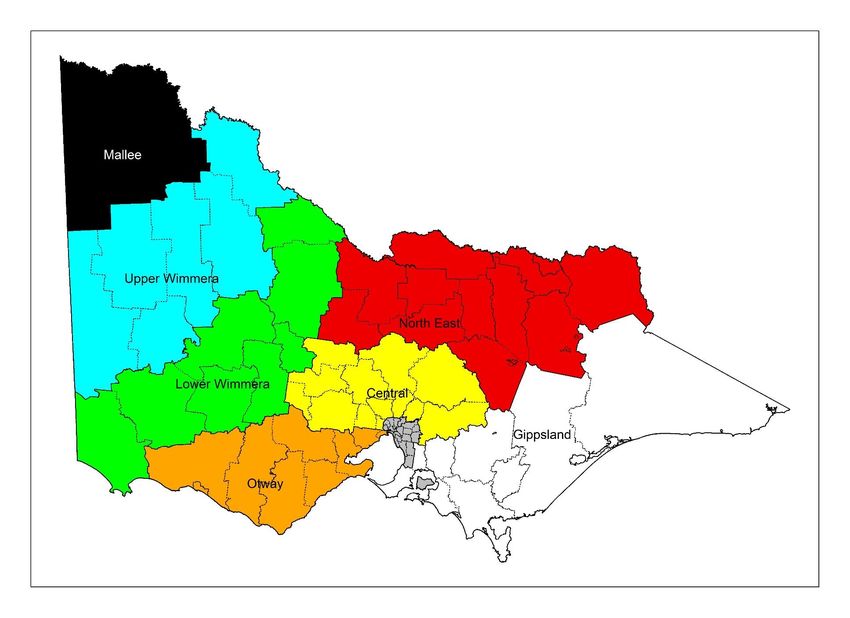
specified in future, nominated areas of public land). The state has been divided into seven harvest zones (shown in Figure 1 and further described in
Table 1). The harvest zones are based on groupings of ecologically similar local government areas (LGAs)(also called zone segments for the purposes
of this plan). Metropolitan Melbourne is excluded from harvest zones and harvesting may not occur in the metropolitan LGAs that are not named in
Table 1. Areas of public land, from which harvesting is excluded under current arrangements (unless otherwise specified in future), will act as sanctuary
zones for the harvested species.
Annual commercial quotas will be set in each harvest zone. For quota purposes, Eastern and Western Grey kangaroos will be treated as “grey
kangaroos”, primarily because of the expected difficulty in distinguishing between the two species under harvest conditions. The species both occur in
the Mallee, Upper Wimmera and Lower Wimmera harvest zones; the remaining harvest zones only have Eastern Grey kangaroos.
Having a single quota for both species is considered to pose little risk to the sustainability of either species. Both species’ ranges extend well beyond
Victoria and both are considered secure in Victoria and nationally. In areas where the two species overlap, harvesting can reasonably be expected to
take place at the ratio at which the two species occur, given that there are no significant differences in habitat preference or behaviour between the two
that would make it more likely that a harvester would encounter one over the other.
Harvesters will be required to report after harvest on the number of each species harvested. Reported data will be closely monitored to ensure the
harvest of each species is aligned with known population ratios in areas where the species overlap. Ground surveys of the two species in 2017, 2018
and 2020 provide an indication of ratios at the LGA level and this data will continue to be captured in future surveys. Should it become apparent that
one species is being disproportionately harvested, the approach will be changed.
The commercial quota for a zone is the maximum number of kangaroos that may be harvested for commercial purposes in that zone in a given period.
While quotas will typically be issued on an annual basis, for the life of this plan they will be reviewed on a quarterly basis to enable close monitoring of
take under the commercial program and ATCW systems. Tags allocated to harvesters will not exceed the quota. Once the commercial quota is
exhausted, no more tags will be allocated for that zone until the quota is renewed in the following calendar year.
Quotas will be calculated based on population estimates and accepted proportional harvest strategies, used in other kangaroo harvesting jurisdictions.
A precautionary approach is being taken given the lack of long-term abundance or demographic data for Victorian kangaroo populations, which limits
the ability to construct well-informed stochastic models for assessing the risks of harvest policies. Under this plan, the total sustainable quota for take of
grey kangaroos will be set at 10% of the estimated population; this will include take under both the commercial harvest and the ATCW system. The
commercial quota will therefore be less than 10% of the total estimated population. This is necessary given the current levels of control under the
ATCW system – which accounts for the majority of the proposed sustainable level of take – and the uncertainty around the degree to which commercial
harvesting may replace damage mitigation control. The proportion of the population available for commercial harvest may be adjusted under future
plans if a substantial proportion of ATCW control transfers across to the commercial harvest.
In the event that harvesting is permitted on specified areas of public land in future, a ‘special quota’ will be identified for each specified area. The special
quota will be in addition to the annual commercial quota for each harvest zone. All kangaroo control on public land currently occurs under an ATCW.
8 Victorian Kangaroo Harvest Management Plan
2021-2023Any harvesting that occurs on specified public land will directly replace control that would otherwise be undertaken under an ATCW; therefore, the
provision of a special quota for public land harvesting will not increase the total number of kangaroos taken annually. Public land managers are required
to produce a kangaroo management plan that identifies the required scale of control in order to receive an ATCW. An approved kangaroo management
plan will similarly be required before a special quota allocation is given.
Requirements Management actions Indicators / targets
Populations of kangaroo species covered by - Population models use latest survey data, - Models were created by DELWP for 100% of
the plan will be estimated annually. Population harvest data, ATCW data and climate variables harvest zones by August 2020 and will be
estimates will be generated from population to estimate kangaroo populations in order to updated in October each year.
models developed for the purpose. inform quotas.
DELWP will undertake aerial and/or ground - DELWP undertook aerial and ground surveys - 100% of survey zones are surveyed in the first
kangaroo population surveys at regular in all zones during the first year of operation of year of the program.
intervals to inform population models and quota the program (2020).
setting. - 100% of surveys are undertaken at the
- Surveys will be undertaken according to the frequency specified by Scroggie et al (2017)
methodology described in Scroggie et al (2017) and Moloney et al (2018)
and Moloney et al (2018), available via
https://www.wildlife.vic.gov.au/our-
wildlife/kangaroos.
- In future years, DELWP will undertake surveys
according to the frequency recommended in
Scroggie et al (2017) and Moloney et al (2018)..
Harvest quotas will be set annually in each - Commercial harvest quotas are set by - Commercial harvest quotas are as described
harvest zone. Quotas will be calculated using a DELWP each year in accordance with this plan. in a quota report published on the DELWP
proportional harvesting strategy based on website by the end of each year for the
sustainable levels of take for grey kangaroos. - Quotas commence at 1 January each year, following year.
and harvest does not exceed allocations as
stated in quota reports.
- During the life of this plan, quotas will be
reviewed on a quarterly basis (March, June,
September) and adjusted if control under
ATCW exceeds expected levels.
- The commercial harvest quota is set at less
than 10% of the total estimated population of
grey kangaroos.
Victorian Kangaroo Harvest Management Plan 9
2021-2023- The commercial harvest quota is set using
population estimates generated by DELWP
using population surveys and/or population
models developed for the purpose.
- Commercial harvest quotas for the following
year are published in a quota report prior to the
end of each year.
- Subject to approval under the EPBC Act to
enable overseas export of wildlife products
obtained in accordance with this plan, DELWP
advises the Commonwealth of commercial
harvest quotas through a quota report for the
following calendar year by the end of each year.
- If harvesting is permitted on a specified area
of public land, a special quota is allocated for
that area. The special quota allocation will be
identified from an approved kangaroo
management plan developed for that specified
area. If a special quota is allocated following the
publication of the quota report, DELWP will
notify the Commonwealth prior to the
commencement of harvesting in that area.
Where the special quota is identified for the
following year prior to the publication of the
quota report it will be included in that report.
Triggers will be established to suspend harvest - DELWP will determine threshold densities - Thresholds / triggers for suspension or
or reduce proportional quota allocations if under which harvest in a given harvest zone reduction of harvest are developed by DELWP
estimated population numbers within a should be suspended or reduced. during the plan’s lifespan, incorporating data
particular harvest zone fall below a collected under the plan.
predetermined threshold. - Prior to the development of these thresholds,
ATCW and harvest data will be monitored - Following development of thresholds, all
monthly and quota allocation reviewed on a relevant quotas are suspended if population
quarterly basis. estimates fall below the thresholds.
In the event of environmental factors or a - DELWP and DJPR will notify harvesters of the - 100% of reports of non-compliance are
significant natural event that may affect suspension of harvesting in a zone or zone investigated and appropriate action taken
kangaroo populations in the short term (for segment if local environmental factors or a where possible.
example bushfire or flood), harvesting may be
10 Victorian Kangaroo Harvest Management Plan
2021-2023suspended in an affected zone or zone significant event have or may have significant
segment, with immediate effect. impacts on kangaroos in that area.
Any decision to recommence harvesting in a - Where harvesting has been declared
zone or zone segment following a suspension suspended in a zone or zone segment,
will be informed by an analysis of the expected harvesters must not carry out any harvesting in
impacts of the event or environmental factors that zone or zone segment, even if they are in
on kangaroos in that area. possession of tags that would otherwise allow
them to do so.
- Where harvesting has been suspended in a
zone segment, the quota for the harvest zone
that segment is in will be reduced proportional
to the estimated population in that zone
segment. If a decision is made to recommence
harvesting, the full quota will be reinstated.
Decisions on allocation of the quota will be - Where there is an absence of data or
made with regard to the precautionary principle. uncertainty in data analysis, a conservative
approach is taken to setting quotas to ensure
harvest remains at sustainable levels.
Victorian Kangaroo Harvest Management Plan 11
2021-2023Figure 1. Kangaroo harvest zones for commercial kangaroo harvesting in Victoria.
12 Victorian Kangaroo Harvest Management Plan
2021-2023Table 1. Local Government Areas (zone segments) contained in each kangaroo harvest zone in Victoria.
Zone LGAs Zone LGAs Zone LGAs
Mallee Mildura Central Ballarat North East Alpine
Brimbank Benalla
Upper Wimmera Buloke Hepburn Campaspe
Hindmarsh Hume Greater Bendigo
Horsham Macedon Ranges Greater Shepparton
Swan Hill Melton Indigo
West Wimmera Mitchell Mansfield
Yarriambiack Moorabool Moira
Mount Alexander Strathbogie
Lower Wimmera Ararat Murrindindi Towong
Central Goldfields Nillumbik Wangaratta
Gannawarra Whittlesea Wodonga
Glenelg Yarra Ranges
Loddon
Northern Grampians Gippsland Bass Coast
Pyrenees Baw
Southern Grampians Cardinia
Casey
Otway Colac Otway East Gippsland
Corangamite Latrobe
Golden Plains Mornington Peninsula
Greater Geelong South Gippsland
Hobsons Bay Wellington
Moyne
Surf Coast
Warrnambool
Wyndham
Victorian Kangaroo Harvest Management Plan 13
2021-2023Objective 2. Ensure that commercial kangaroo harvesting in Victoria is humane and animal welfare is protected.
Good animal welfare outcomes are of the highest priority in managing Victoria’s commercial harvest.
The nationally-endorsed standard for humane commercial harvest of kangaroos is described in the National Code of Practice for the Humane Shooting
of Kangaroos and Wallabies for Commercial Purposes (the National Code). All kangaroo harvesters in Victoria will be required to comply with the
National Code and any future standards that might replace it.
Compliance with the National Code will be required through the application of minimum standards as a prerequisite for harvesting authorisation, and the
inclusion of related conditions on the authorisation. Noncompliance will be treated as a breach of authorisation condition, with appropriate penalties
applied.
Requirements Management actions Targets / indicators
Kangaroo harvesters will be required to - Prior to receiving authorisation, new - 100% of new harvesters will hold a valid
demonstrate minimum standards of harvesters demonstrate (via the online platform) firearms proficiency accreditation.
competency set out in the National Code prior that they hold a valid firearms proficiency
to receiving authorisation to harvest under the - 100% of new harvesters have completed a
accreditation.
Plan. recognised Game Harvester competency
- Prior to receiving authorisation, new program.
harvesters demonstrate (via online platform)
- 100% of new harvesters confirm that they hold
that they have completed a recognised Game
a valid firearms licence.
Harvester competency program*.
- Prior to receiving authorisation, harvesters
confirm that they hold a firearms licence.
- A copy of the National Code is provided to all
new applicants with their authorisation and is
made available on the website for the
harvesting program.
*Any accredited Game Harvester competency
program that meets the requirements for licensing in
another kangaroo harvesting jurisdiction will be
recognised.
Harvesters will be required to comply with the - Authorisation conditions for commercial - 100% of reports of non-compliance are
National Code (and any future iterations). harvest of kangaroos will require that investigated and appropriate action taken
harvesters take kangaroos in accordance with where possible.
the National Code.
14 Victorian Kangaroo Harvest Management Plan
2021-2023- Appropriate compliance action is taken when
harvesters are found to have breached
authorisation conditions in relation to animal
welfare.
Victorian Kangaroo Harvest Management Plan 15
2021-2023Objective 3. Ensure that commercial kangaroo harvesting activities are appropriately regulated.
Kangaroo harvesters and processors must hold suitable permissions under both the Wildlife Act and the Meat Industry Act in order to participate in the
program. The current legislative basis for the authorisation and licensing arrangements are described in section 2.
Conditions will be applied to licences and authorisations that reflect the requirements set out in this plan.
Participants will be required to adhere to tagging procedures as described in this plan and enacted via conditions.
The authorising environment that determines permission requirements will be reviewed in the first year of the operation of the commercial harvest. If
necessary, new or updated arrangements will be put in place.
Requirements Management actions Targets / indicators
All participants will be required to hold the - All kangaroo harvesters operating under this - 100% of harvesters hold an authorisation
appropriate authorisations and licences under plan hold an authorisation under section under the Wildlife Act.
relevant Victorian legislation. 28A(1)(h) of the Wildlife Act.
- 100% of harvesters are listed as an Approved
- All kangaroo harvesters operating under this Supplier.
plan are listed as an Approved Supplier under
- 100% of processors hold a Wildlife Processor
the Food Safety Plan of a participating Pet Meat
licence.
Processor or Game Meat Processor.
- 100% of processors hold a Pet Meat
- All kangaroo processors operating under this
Processor licence or Game Meat Processor
plan hold a Wildlife Processor licence under the licence.
Wildlife Act.
- 100% of field depot operators hold a Game
- All kangaroo processors operating under this Meat Processing Facility (Field Depot) licence.
plan hold a Pet Meat Processor licence or
Game Meat Processor licence under the Meat - 100% of harvest vehicle operators hold a
Industry Regulations. Game Meat Processing Facility (Harvest
Vehicle) licence.
- Operators of all field depots operating under
this plan hold a Game Meat Processing Facility
(Field Depot) licence as specified in
PrimeSafe’s Wild Game Meat Harvesting
Guidelines.*
- Operators of all harvest vehicles operating
under this plan hold a Game Meat Processing
Facility (Harvest Vehicle) licence as specified in
PrimeSafe’s Wild Game Meat Harvesting
Guidelines.*
16 Victorian Kangaroo Harvest Management Plan
2021-2023*The licensing requirements for pet food vehicles
were introduced in early 2020 and operators had until
15 October 2020 to obtain the necessary licences for
their vehicles. After this date enforcement action will
be taken in relation to any unlicensed vehicles used
for this purpose in Victoria.
Conditions will be applied to authorisations and - Standard conditions reflecting the - 100% of authorisation and licence holders are
licences that reflect the requirements of this requirements of this plan are included on provided with and aware of the conditions of their
plan, to ensure that participants are required to authorisation templates and provided to every licence or authorisation.
conduct their activities consistent with the plan. authorised harvester.
- 100% of authorisation and licence holders are
- Conditions to facilitate this plan are included advised of changes to conditions before they are
on Wildlife Processor licences. implemented.
- Holders of authorisations and licences are
informed in writing of changes to conditions
prior to those changes being implemented.
- Conditions will be reviewed and updated as
required, in response to changes in regulatory
arrangements or operational/administrative
policies.
DJPR or its agent will issue kangaroo - The number of tags issued does not exceed - 100% of kangaroos killed by a harvester
harvesters with tags corresponding to an the commercial quota for any zone in any year. operating under a harvester authorisation have
allocation of the harvest quota for each zone. tags affixed (except pouch young and young at
Tags will be restricted based on the quota for a - DJPR or its agent specifies a maximum
foot).
given year for each harvest zone. A tag must be number of tags available to a harvester at one
affixed to the carcass of each kangaroo killed time and makes this information publicly
by a harvester. The maximum number of tags available. Tags issued in a single allocation to a
available to a harvester at any one time will be harvester do not exceed this number.
set by DJPR or its agent, applied in an - Each kangaroo killed by a harvester must
equitable and consistent way, and the have a tag affixed regardless of whether or not
information made available to participants prior
the kangaroo is removed from the property for
to application for a quota allocation.
processing.
- Tagging is not, however, required for pouch
young and young at foot that are euthanised in
accordance with the National Code.
Victorian Kangaroo Harvest Management Plan 17
2021-2023- No harvester receives a new allocation of tags
until their previous allocation has been partly
exhausted, in line with business rules at the
time.
- In the event a special quota is issued for a
specified area of public land, the land manager
advises DJPR or its agent how many tags to
issue to each of its nominated harvesters.
Reporting systems will enable geotagging of - Tags are barcoded and the reporting platform - 100% of scanned tags are being used in the
harvest locations to ensure harvesting is enables scanned tags to be automatically correct zone.
occurring only where permitted and that tags geotagged.
are being used in the correct zones. - 100% of scanned tags are being used only
where permitted (i.e. on private land).
18 Victorian Kangaroo Harvest Management Plan
2021-2023Objective 4. Effectively monitor and enforce compliance.
Compliance activity will be based on a compliance framework that identifies risks associated with the harvesting system and describes actions to
mitigate those risks. Tracking and reporting for compliance purposes will be enabled via effective information systems.
DJPR is responsible for supporting, monitoring and enforcing compliance with the requirements of this plan; the GMA will act as an agent of DJPR to
deliver these functions in its behalf. Where it is unclear whether a suspected or detected offence is arising from the commercial harvest or outside it, the
GMA and DELWP will work together in the first instance to determine responsibility for further action. PrimeSafe is responsible for ensuring compliance
with the Meat Industry Act.
Requirements Management actions Targets / indicators
DJPR will produce educational material - Suitable educational material is prepared prior - 100% of harvesters receive educational
outlining the requirements of this plan, as to the commencement of the commercial material when given an authorisation.
reflected in authorisation and licence harvest program.
conditions, and distribute to all participants.
- Educational material is distributed to
authorised harvesters upon giving the
authorisation.
- Educational material is made available on the
website for the harvesting program.
DJPR will ensure there are no barriers to the - Suitable training providers are engaged with - Suitable training is made available locally to
delivery of relevant local training opportunities by the end of 2020 to plan for the delivery of harvesters and potential harvesters by the end of
in Victoria to ensure all participants can meet appropriate local training opportunities. 2020.
the pre-requisites for authorisation and their
obligations under the National Code.*
*As noted in Objective 2, any accredited Game
Harvester competency program that meets the
requirements for licensing in another kangaroo
harvesting jurisdiction will be recognised.
DJPR or its agent(s) will undertake risk-based - DJPR or its agent prepares, and provides to - A Wildlife Act compliance plan for the
compliance activity to monitor compliance with DELWP, an annual compliance plan that following year is provided to DELWP by DJPR
the requirements of this plan. describes planned compliance activity under or its agent(s) by November each year.
the Wildlife Act. The plan includes identification
- 100% of Pet Meat Processing Facilities and
of compliance priorities, and planning for
Game Meat Processing Facilities are audited
unannounced and programmed field
four times per year for compliance with Meat
Industry Act requirements.
Victorian Kangaroo Harvest Management Plan 19
2021-2023inspections, records audits and processor - 100% of licensed field depots and harvest
inspections. vehicles are audited once every year for
compliance with Meat Industry Act
- Compliance with the Meat Industry Act is
requirements.
monitored and enforced in line with existing
compliance requirements and protocols under
that Act.
Where activity that does not meet the - DJPR or its agent will develop a compliance - 100% of reports of non-compliance will be
requirements of this plan is detected or matrix that establishes a consistent approach to investigated.
suspected, it will be investigated and decisions about compliance/enforcement
appropriate compliance action taken, if activities.
necessary.
- Reports of activities in breach of authorisation
and licence conditions are investigated to the
fullest extent possible and, where appropriate,
offenders are issued with official warnings or
prosecuted, or action taken in respect to their
licence or authorisation, as appropriate.
The accuracy of industry returns will be - DJPR or its agent will monitor industry returns - 50% of active harvester returns per year are
monitored and discrepancies investigated. and undertake regular audits to detect audited.
discrepancies.
Intelligence and information relevant to the - Agreements for the sharing of information and - Agencies share all relevant information with
commercial harvesting of kangaroos in Victoria intelligence relating to commercial kangaroo other agencies as agreed or requested.
will be shared between DJPR (including its harvesting are established between DELWP
agents) and DELWP, in accordance with the - DJPR or its agent provides compliance
and DJPR (including its agents).
requirements of the Privacy and Data reporting to DELWP on a quarterly basis.
Protection Act 2014. - Compliance records are maintained in a
database and compliance information shared
with other agencies as agreed or requested.
- Compliance performance reporting by DJPR
to DELWP is undertaken on a quarterly basis.
Intelligence and information relevant to the - The development of cross-border agreements
commercial harvesting of kangaroos in Victoria for the sharing of intelligence and information is
will be shared between Victoria and pursued.
neighbouring states (NSW and SA).
20 Victorian Kangaroo Harvest Management Plan
2021-2023Objective 5. Facilitate adaptive management and research.
This plan and the requirements it outlines will be updated on a regular basis as lessons from its application are recorded and applied. It is expected that
this will particularly be the case within the first year of the operation of the commercial harvest.
Research into particular aspects of kangaroo ecology, harvest management or land use practices can also assist in ensuring that the commercial
harvest is sustainable over the long term. While there is a large body of research on the ecology and management of kangaroos, there are information
gaps which, when filled, may lead to improved management of the commercial harvest.
Requirements Management actions Targets / indicators
A review of the operation and administrative - The following will be considered in each - A programmed review is undertaken in 2021.
arrangements for the Kangaroo Harvesting review:
Program will occur during 2021. The operation - A programmed review is undertaken each
of the plan will be reviewed on an annual basis - all relevant data from the review period, subsequent year by DELWP.
by DELWP. including harvest data, ATCW data,
harvester numbers, compliance data
- the effectiveness of arrangements in
achieving the objectives of the plan
- the efficiency of administrative
arrangements.
Changes to program arrangements will be - Issues with program arrangements and the
captured by DELWP or DJPR as they are requirements of this plan are captured as they
identified, and actioned as required to improve become apparent.
efficiency and effectiveness.
- Program arrangements and the requirements
of this plan are amended in a timely way where
necessary improvements are identified.
Changes will be made to this plan and the - Any changes made are communicated to - 100% of changes will be communicated to
program by DELWP, DJPR and the GMA, as participants and other relevant stakeholders participants and other stakeholders.
needed. prior to their implementation.
- A range of communication methods will be
used, e.g. letters, email, website
communication.
Victorian Kangaroo Harvest Management Plan 21
2021-2023DELWP will use kangaroo population survey - Population survey data gained from regular - 100% of population survey data is included in
data to build a long-term population data set for surveys is compiled and used to inform future the data set.
Victorian kangaroos to inform future decision-making.
management of kangaroos.
Sustainable harvest models will be regularly - Sustainable harvest models are updated on - 100% of relevant data is fed into sustainable
updated and refined by DELWP using data from an annual basis, using data collected over the harvest models.
kangaroo population surveys and harvest previous year from all relevant sources.
returns, ATCW information and other relevant
data sources. This data will be used to inform
the next year’s quotas.
Research opportunities and collaboration with - As knowledge gaps are identified they will be
research institutions, stakeholders and other captured in a spreadsheet or database kept for
jurisdictions that have commercial kangaroo the purpose.
harvesting will be actively pursued by DELWP,
to fill existing knowledge gaps and conduct - Research opportunities are identified and
adaptive management experiments (e.g. pursued based on identified knowledge gaps.
biology, ecology, disease, genetics, behaviour,
survey techniques, processing practices, etc.).
Information-and knowledge-sharing - DELWP will participate in forums, conferences
opportunities are actively pursued by DELWP. etc as opportunities arise.
22 Victorian Kangaroo Harvest Management Plan
2021-2023Objective 6. Maintain openness, accountability and transparency.
Transparency and accountability will be achieved through openly sharing current information and data about the commercial kangaroo harvest. In many
cases this can be achieved by making reports and data available online. Responsiveness to media requests will also play a role.
Community feedback will be invited at any time via dedicated channels.
Requirements Management actions Targets / indicators
DELWP and DJPR will make relevant - The most up-to-date versions available of all - 100% of relevant documents are made
documents available online to ensure relevant documents are made accessible via available online.
information about the requirements of this plan the website for the harvesting program.
and the operation of the program are accessible
to all interested parties. Relevant documents include:
- the current version of this plan
- a summary of harvest return data on an
annual basis
- quota reports for the following year,
within two weeks of their finalisation and
submission to the Commonwealth
- the annual compliance plan
- reports on quota allocated and quota
harvested in each zone
- reports on the total take of kangaroos
across both the commercial harvest and
the ATCW system in each zone
A designated avenue for community feedback - A dedicated website for the harvesting - Customer Contact Centre details are included
on the program and this plan will be made program is developed and communicated via in 100% of relevant media and communications
available and clearly communicated to relevant channels. material.
members of the public and interested
stakeholders. - The Customer Contact Centre details are
provided via the website for the harvesting
program, and in relevant media and
communications material.
- Knowledge Articles are prepared by DELWP
and DJPR and provided to the Customer
Victorian Kangaroo Harvest Management Plan 23
2021-2023Contact Centre, along with relevant contacts for
further information.
Relevant officers from DELWP, DJPR or - Responses to media requests are prepared
DJPR’s agent, as appropriate, will respond to where directed to do so.
media requests, including participating in media
interviews.
The review process for the program will provide - An opportunity for key stakeholders to provide
opportunity for stakeholders to provide feedback is built into the review process.
feedback for consideration during the review.
Pending approval of this or a future plan as a - Reporting requirements to the Commonwealth - An annual report on the operation of any such
WTMP, an annual report on the operation of are undertaken in accordance with the approved plan for the previous year is
this management plan will be prepared by requirements of the EPBC Act. submitted to the Commonwealth by 31 March
DELWP for submission to the Commonwealth. each year.
Scientific approaches, including survey - Peer review of updated survey methods and
methods and the sustainable harvest model the sustainable harvest model is sought by
developed for Victoria, will be subjected to peer DELWP through universities or government
review. agencies.
24 Victorian Kangaroo Harvest Management Plan
2021-2023You can also read


