Vocabulary Learning via Optimal Transport for Neural Machine Translation
←
→
Page content transcription
If your browser does not render page correctly, please read the page content below
Vocabulary Learning via Optimal Transport
                                 for Neural Machine Translation
               Jingjing Xu1 , Hao Zhou1 , Chun Gan1,2†, Zaixiang Zheng1,3†, Lei Li1
                                       1
                                         ByteDance AI Lab
                        2
                          Math Department, University of Wisconsin–Madison
                                       3
                                         Nanjing University
            {xujingjing.melody,zhouhao.nlp,lileilab}@bytedance.com
                                      cgan5@wisc.edu
                                zhengzx@smail.nju.edu.cn

                           Abstract                               2018; Al-Rfou et al., 2019; Wang et al., 2020).
        The choice of token vocabulary affects the per-           The key idea of these approaches is selecting the
        formance of machine translation. This paper               most frequent sub-words (or word pieces with
        aims to figure out what is a good vocabulary              higher probabilities) as the vocabulary tokens.
        and whether one can find the optimal vocab-               In information theory, these frequency-based ap-
        ulary without trial training. To answer these             proaches are simple forms of data compression to
        questions, we first provide an alternative un-            reduce entropy (Gage, 1994), which makes the re-
        derstanding of the role of vocabulary from the
                                                                  sulting corpus easy to learn and predict (Martin
        perspective of information theory. Motivated
        by this, we formulate the quest of vocabular-             and England, 2011; Bentz and Alikaniotis, 2016).
        ization – finding the best token dictionary with             However, the effects of vocabulary size are not
        a proper size – as an optimal transport (OT)              sufficiently taken into account since current ap-
        problem. We propose VOLT, a simple and                    proaches only consider frequency (or entropy) as
        efficient solution without trial training. Em-            the main criteria. Many previous studies (Sennrich
        pirical results show that VOLT outperforms                and Zhang, 2019; Ding et al., 2019; Provilkov
        widely-used vocabularies in diverse scenar-
                                                                  et al., 2020; Salesky et al., 2020) show that vocab-
        ios, including WMT-14 English-German and
        TED’s 52 translation directions. For example,             ulary size also affects downstream performances,
        VOLT achieves 70% vocabulary size reduc-                  especially on low-resource tasks. Due to the lack
        tion and 0.5 BLEU gain on English-German                  of appropriate inductive bias about size, trial train-
        translation. Also, compared to BPE-search,                ing (namely traversing all possible sizes) is usually
        VOLT reduces the search time from 384 GPU                 required to search for the optimal size, which takes
        hours to 30 GPU hours on English-German                   high computation costs. For convenience, most
        translation. Codes are available at https:                existing studies only adopt the widely-used set-
        //github.com/Jingjing-NLP/VOLT.
                                                                  tings in implementation. For example, 30K-40K
                                                                  is the most popular size setting in all 42 papers
1       Introduction                                              of Conference of Machine Translation (WMT)
Due to the discreteness of text, vocabulary con-                  through 2017 and 2018 (Ding et al., 2019).
struction ( vocabularization for short) is a prereq-                 In this paper, we propose to explore auto-
uisite for neural machine translation (NMT) and                   matic vocabularization by simultaneously consid-
many other natural language processing (NLP)                      ering entropy and vocabulary size without expen-
tasks using neural networks (Mikolov et al., 2013;                sive trial training. Designing such a vocabulariza-
Vaswani et al., 2017; Gehrmann et al., 2018;                      tion approach is non-trivial for two main reasons.
Zhang et al., 2018; Devlin et al., 2019). Cur-                    First, it is challenging to find an appropriate objec-
rently, sub-word approaches like Byte-Pair En-                    tive function to optimize them at the same time.
coding (BPE) are widely used in the commu-                        Roughly speaking, the corpus entropy decreases
nity (Ott et al., 2018; Ding et al., 2019; Liu et al.,            with the increase of vocabulary size, which bene-
2020), and achieve quite promising results in prac-               fits model learning (Martin and England, 2011).
tice (Sennrich et al., 2016; Costa-jussà and Fonol-              On the other side, too many tokens cause to-
losa, 2016; Lee et al., 2017; Kudo and Richardson,                ken sparsity, which hurts model learning (Allison
    †
        This work is done during the internship at ByteDance AI   et al., 2006). Second, supposing that an appropri-
Lab.                                                              ate measurement is given, it is still challenging to

                                                              7361
                    Proceedings of the 59th Annual Meeting of the Association for Computational Linguistics
                 and the 11th International Joint Conference on Natural Language Processing, pages 7361–7373
                               August 1–6, 2021. ©2021 Association for Computational Linguistics
4.00 Eo 30.0 translation tasks, including WMT-14 English-
Entropy German translation, TED bilingual translation,
3.95 BLEU 29.5
3.90 and TED multilingual translation. Empirical re-
3.85 29.0
sults show that VOLT beats widely-used vocabu-
Entropy
BLEU
3.80 28.5 laries in diverse scenarios. Furthermore, VOLT is
3.75 28.0 a lightweight solution and does not require expen-
3.70
27.5 sive computation resources. On English-German
3.65
translation, VOLT only takes 30 GPU hours to find
3.60 3000 4000 5000 6000 7000 8000 9000 27.0
Size vocabularies, while the traditional BPE-Search so-
lution takes 384 GPU hours.
Figure 1: An illustration of marginal utility. We sample
BPE-generated vocabularies with different sizes from
Eo-En translation and draw their entropy (See Eq.2)
2 Related Work
and BLEU lines. “Star” represents the vocabulary with
Initially, most neural models were built upon
the maximum marginal utility. Marginal utility (See
Eq.1) evaluates the increase of benefit (entropy de- word-level vocabularies (Costa-jussà and Fonol-
crease) from an increase of cost (size). losa, 2016; Vaswani et al., 2017; Zhao et al.,
2019). While achieving promising results, it is
a common constraint that word-level vocabularies
solve such a discrete optimization problem due to fail on handling rare words under limited vocabu-
the exponential search space. lary sizes.
To address the above problems, we propose Researchers recently have proposed several ad-
a VOcabulary Learning approach via optimal vanced vocabularization approaches, like byte-
Transport, VOLT for short. It can give an appro- level approaches (Wang et al., 2020), character-
priate vocabulary in polynomial time by consider- level approaches (Costa-jussà and Fonollosa,
ing corpus entropy and vocabulary size. Specifi- 2016; Lee et al., 2017; Al-Rfou et al., 2019),
cally, given the above insight of contradiction be- and sub-word approaches (Sennrich et al., 2016;
tween entropy and size, we first borrow the con- Kudo and Richardson, 2018). Byte-Pair Encoding
cept of Marginal Utility in economics (Samuelson, (BPE) (Sennrich et al., 2016) is proposed to get
1937) and propose to use Marginal Utility of Vo- subword-level vocabularies. The general idea is
cabularization (MUV) as the measurement. The to merge pairs of frequent character sequences to
insight is quite simple: in economics, marginal create sub-word units. Sub-word vocabularies can
utility is used to balance the benefit and the cost be regarded as a trade-off between character-level
and we use MUV to balance the entropy (bene- vocabularies and word-level vocabularies. Com-
fit) and vocabulary size (cost). Higher MUV is pared to word-level vocabularies, it can decrease
expected for Pareto optimality. Formally, MUV the sparsity of tokens and increase the shared
is defined as the negative derivative of entropy features between similar words, which probably
to vocabulary size. Figure 1 gives an example have similar semantic meanings, like “happy” and
about marginal utility. Preliminary results verify “happier”. Compared to character-level vocabu-
that MUV correlates with the downstream perfor- laries, it has shorter sentence lengths without rare
mances on two-thirds of tasks (See Figure 2). words. Following BPE, some variants recently
Then our goal turns to maximize MUV in have been proposed, like BPE-dropout (Provilkov
tractable time complexity. We reformulate our dis- et al., 2020), SentencePiece (Kudo and Richard-
crete optimization objective into an optimal trans- son, 2018), and so on.
port problem (Cuturi, 2013) that can be solved Despite promising results, most existing sub-
in polynomial time by linear programming. In- word approaches only consider frequency while
tuitively, the vocabularization process can be re- the effects of vocabulary size is neglected. Thus,
garded as finding the optimal transport matrix trial training is required to find the optimal size,
from the character distribution to the vocabulary which brings high computation costs. More
token distribution. Finally, our proposed VOLT recently, some studies notice this problem and
will yield a vocabulary from the optimal transport propose some practical solutions (Kreutzer and
matrix. Sokolov, 2018; Cherry et al., 2018; Chen et al.,
We evaluate our approach on multiple machine 2019; Salesky et al., 2020).
736212 defined by the sum of token entropy. To avoid the
10 effects of token length, here we normalize entropy
with the average length of tokens and the final en-
8
Count tropy is defined as:
6
4
1 X
Hv = − P (i) log P (i), (2)
lv i∈v
2
0 where P (i) is the relative frequency of token i
0.75 0.50 0.25 0.00 0.25 0.50 0.75 1.00
Spearman Score
from the training corpus and lv is the average
length of tokens in vocabulary v.
Figure 2: MUV and downstream performance are pos-
itively correlated on two-thirds of tasks. X-axis clas-
Preliminary Results To verify the effectiveness
sifies Spearman scores into different groups. Y-axis
shows the number of tasks in each group. The middle
of MUV as the vocabulary measurement, we con-
Spearman score is 0.4. duct experiments on 45 language pairs from TED
and calculate the Spearman correlation score∗ be-
tween MUV and BLEU scores. We adopt the same
3 Marginal Utility of Vocabularization and widely-used settings to avoid the effects of
In this section, we propose to find a good vocabu- other attributes on BLEU scores, such as model
lary measurement by considering entropy and size. hyper-parameters and training hyper-parameters.
As introduced in Section 1, it is non-trivial to find We generate a sequence of vocabularies with in-
an appropriate objective function to optimize them cremental sizes via BPE. All experiments use the
simultaneously. On one side, with the increase of same hyper-parameters. Two-thirds of pairs show
vocabulary size, the corpus entropy is decreased, positive correlations as shown in Figure 2. The
which benefits model learning (Bentz and Alikan- middle Spearman score is 0.4. We believe that it is
iotis, 2016). On the other side, a large vocabu- a good signal to show MUV matters. Please refer
lary causes parameter explosion and token spar- to Section 5 for more dataset details and Appendix
sity problems, which hurts model learning (Alli- A for more implementation details.
son et al., 2006). Given MUV, we have two natural choices to
To address this problem, we borrow the con- get the final vocabulary: search and learning. In
cept of Marginal Utility in economics (Samuel- the search-based direction, we can combine MUV
son, 1937) and propose to use Marginal Utility of with widely-used vocabularization solutions. For
Vocabularization (MUV) as the optimization ob- example, the optimal vocabularies can be obtained
jective. MUV evaluates the benefits (entropy) a by enumerating all candidate vocabularies gener-
corpus can get from an increase of cost (size). ated by BPE. While being simple and effective,
Higher MUV is expected for higher benefit-cost it is not a self-sufficient approach. Furthermore,
ratio. Preliminary results verify that MUV corre- it still requires a lot of time to generate vocabu-
lates with downstream performances on two-thirds laries and calculate MUV. To address these prob-
of translation tasks (See Figure 2). According to lems, we further explore a learning-based solution
this feature, our goal turns to maximize MUV in VOLT for more vocabulary possibilities. We em-
tractable time complexity. pirically compare MUV-Search and VOLT in Sec-
tion 5.
Definition of MUV Formally, MUV represents
the negative derivation of entropy to size. For sim- 4 Maximizing MUV via Optimal
plification, we leverage a smaller vocabulary to es- Transport
timate MUV in implementation. Specially, MUV
is calculated as: This section describes the details of the proposed
approach. We first show the general idea of VOLT
−(Hv(k+m) − Hv(k) )
Mv(k+m) = , (1) in Section 4.1, then describe the optimal transport
m
solution in Section 4.2, followed by the implemen-
where v(k), v(k + m) are two vocabularies with tation details in Section 4.3.
k and k + m tokens, respectively. Hv represents ∗
https://www.statstutor.ac.uk/
the corpus entropy with the vocabulary v, which is resources/uploaded/spearmans.pdf
7363#tok
4.1 Overview #chr
a 160
Enumerating
a b c ab bc ac abc … Finding the
a 200 possible compositions
a 200 160 0 0 0 0 40 0 0 optimal composition b 100
We formulate vocabulary construction as a dis- b 100 b 100 0 100 0 0 0 0 0 0 c 60
c 100 c 100 0 0 60 0 0 40 0 0 ac
crete optimization problem whose target is to find 40
Corpus Char Vocab Transport Matrices Token Vocab
the vocabulary with the highest MUV according
to Eq. 1. However, the vocabulary is discrete and Figure 3: An illustration of vocabulary construction
such discrete search space is too large to traverse, from a transport view. Each transport matrix represents
a vocabulary. The transport matrix decides how many
which makes the discrete optimization intractable.
chars are transported to token candidates. The tokens
In this paper, we simplify the original discrete with zero chars will not be added into the vocabulary.
optimization problem by searching for the optimal
vocabulary from vocabularies with fixed sizes. In-
tuitively, MUV is the first derivative of entropy ac- where lv is the average length for tokens in v(t),
cording to the vocabulary size (Eq. 1), and we in- P (i) is the probability of token i. However, no-
troduce an auxiliary variable S (S is an incremen- tice that this problem is in general intractable due
tal integer sequence) to approximate the computa- to the extensive vocabulary size. Therefore, we
tion by only computing MUV between vocabulary instead propose a relaxation in the formulation
sizes as adjacent integers in S. of discrete optimal transport, which can then be
Formally, S = {i, 2 · i, ..., (t − 1) · i, · · · } where solved efficiently via the Sinkhorn algorithm (Cu-
each timestep t represents a set of vocabularies turi, 2013).
with the number up to S[t]. For any vocabulary, its Intuitively, we can imagine vocabulary con-
MUV score can be calculated based on a vocabu- struction as a transport process that transports
lary from its previous timestep. With sequence S, chars into token candidates with the number up to
the target to find the optimal vocabulary v(t) with S[t]. As shown in Figure 3, the number of chars is
the highest MUV can be formulated as: fixed, and not all token candidates can get enough
chars. Each transport matrix can build a vocab-
ulary by collecting tokens with chars. Different
arg max Mv(t) = transport matrices bring different transport costs.
v(t−1)∈ VS[t−1] ,v(t)∈VS[t]
1 The target of optimal transport is to find a transport
arg max − Hv(t) − Hv(t−1) , matrix to minimize the transfer cost, i.e., negative
v(t−1)∈VS[t−1] ,v(t)∈VS[t] i
entropy in our setting.
where VS[t−1] and VS[t] are two sets containing 4.2 Vocabularization via Optimal Transport
all vocabularies with upper bound of size S[t −
1] and S[t]. Due to exponential search space, we Given a set of vocabularies VS[t] , we want to find
propose to optimize its lower bound: the vocabulary with the highest entropy. Conse-
quently, the objective function in Eq. 4 becomes
1
arg max max Hv(t) − max Hv(t−1) .
t i v(t)∈VS[t] v(t−1)∈VS[t−1] 1 X
(3) min P (i) log P (i),
v∈VS[t] lv
i∈v
where i means the size difference between t − 1 P
Token(i) i∈v len(i)
vocabulary and t vocabulary. MUV requires the s.t. P (i) = P , lv = .
i∈v Token(i) |v|
size difference as a denominator. Based on this
equation, the whole solution is split into two steps: Token(i) is the frequency of token i in the vo-
1) searching for the optimal vocabulary with the cabulary v. len(i) represents the length of token
highest entropy at each timestep t; 2) enumerating i. Notice that both the distribution P (i) and the
all timesteps and outputing the vocabulary corre- average length lv depend on the choice of v.
sponding to the time step satisfying Eq. 3.
The first step of our approach is to search for the Objective Approximation To obtain a tractable
vocabulary with the highest entropy from VS[t] . lower bound of entropy, it suffices to give a
Formally, the goal is to find a vocabulary v(t) such tractable upper bound of the above objective func-
that entropy is maximized, tion. We adopt the merging rules to segment raw
text similar with BPE where two consecutive to-
1 X kens will be merged into one if the merged one is
arg max − P (i) log P (i), (4)
v(t)∈VS[t] lv(t)
i∈v(t)
in the vocabulary. To this end, let T ∈ VS[t] be
7364the vocabulary containing top S[t] most frequent estimate P (j|i) where len(i) is the length of token
tokens, C be the set of chars and |T|, |C| be their i. Formally, the distance matrix is defined as
sizes respectively. Since T is an element of VS[t] ,
− log P (j|i) = +∞, if j ∈
/i
clearly, we have D(i, j) = − log P (j|i) = − log 1 , otherwise
len(i)
1 X 1 X Furthermore, the number of chars is fixed and we
min P (i) log P (i) ≤ P (i) log P (i). (5)
v∈VS[t] lv i∈v lT i∈T set the sum of each row in the transport matrix to
the probability of char j. The upper bound of the
Here we start from the upper P bound of the above char requirements for each token is fixed and we
objective function, that is l1T i∈T P (i) log P (i) set the sum of each column in the transport matrix
and then search for a refined token set from T. In to the probablity of token j. Formally, the con-
this way, we reduce the search space into the sub- straints are defined as:
sets of T. Let P (i, j) be the joint probability dis- X
tribution of the tokens and chars that we want to | P (i, j) − P (i)| ≤ , (9)
j
learn. Then we have
X XX and
P (i) log P (i) = P (i, j) log P (i)
X
P (i, j) = P (j). (10)
i∈T i∈T j∈C
i
XX
= P (i, j) log P (i, j) Given transport matrix P and distance matrix
i∈T j∈C
| {z } (6) D, the final objective can be formulated as:
L1
XX
+ P (i, j)(− log P (j|i)) .
arg min −H(P ) + hP , Di ,
i∈T j∈C
| {z } P ∈R|C|×|T|
X X
L2
s.t. P (i, j) = P (j), | P (i, j) − P (i)| ≤ ,
i j
The details of proof can be found at Appendix C.
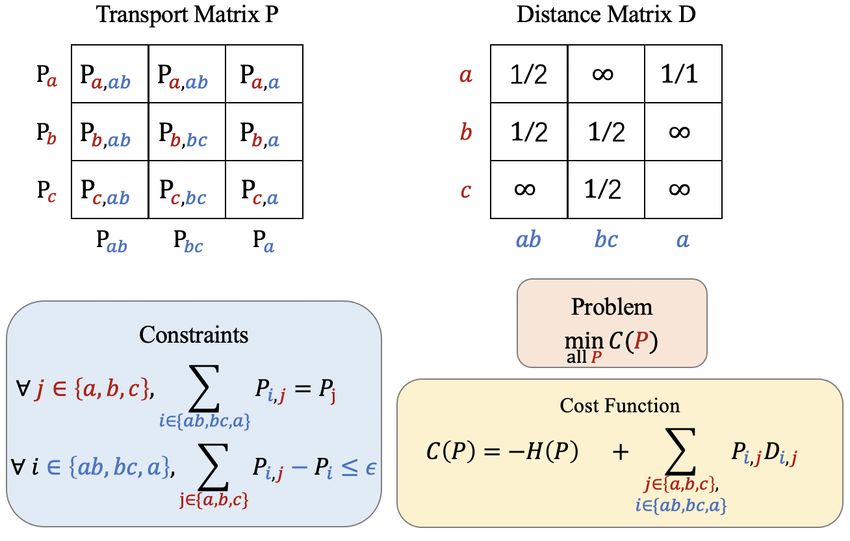
Since L1 is nothing but the negative entropy of the with small > 0. Figure 4 shows the details
joint probability distribution P (i, j), we shall de- of optimal transport solution. Strictly speaking,
note it as −H(P ). this is an unbalanced entropy regularized optimal
Let D be the |C| × |T| matrix whose (i, j)-th transport problem. Nonetheless, we can still use
entry is given by − log P (j|i), and let P be the the generalized Sinkhorn algorithm to efficiently
joint probability matrix, then we can write find the target vocabulary as detailed in Section
XX 4.6 of Peyré and Cuturi (2019). The algorithm de-
L2 = hP , Di = P (i, j)D(i, j). (7) tails are shown in Algorithm 1. At each timestep t,
i j
we can generate a new vocabulary associated with
In this way, Eq. 6 can be reformulated as the entropy scores based on the transport matrix P .
following objective function which has the same Finally, we collect these vocabularies associated
form as the objective function in optimal transport: with entropy scores, and output the vocabulary sat-
isfying Eq. 3.
min hP , Di − γH(P ). (8)
P ∈Rm×n 4.3 Implementation
Setup of OT From the perspective of optimal Algorithm 1 lists the process of VOLT. First,
transport, P can be regarded as the transport ma- we rank all token candidates according to their
trix, and D can be regarded as the distance matrix. frequencies. For simplification, we adopt BPE-
Intuitively, optimal transport is about finding the generated tokens (e.g. BPE-100K) as the token
best transporting mass from the char distribution candidates. It is important to note that any seg-
to the target token distribution with the minimum mentation algorithms can be used to initialize to-
work defined by hP , Di. ken candidates. Experiments show that different
To verify the validness of transport solutions, initialization approaches result in similar results.
we add the following constraints. First, to avoid We simply adopt BPE-100K for bilingual transla-
invalid transport between char j and token i, we tion and BPE-300K for multilingual translation in
set the distance to +∞ if the target token i does this work. All token candidates with their proba-
1
not contain the char j. Otherwise, we use len(i) to bilities are then used to initialize L in Algorithm 1.
7365Algorithm 1: VOLT
Input: A sequence of token candidates L ranked by
frequencies, an incremental integer sequence S
where the last item of S is less than |L|, a character
sequence C, a training corpus Dc
|C| |T|
Parameters: u ∈ R+ , v ∈ R+
vocabularies = []
for item in S do
// Begin of Sinkhorn algorithm
Initialize u = ones() and v = ones()
T = L[: item]
Calculate token frequencies P (T) based on Dc
Calculate char frequencies P (C) based on Dc
Figure 4: The details of optimal transport. The objec- Calculate D
tive function is the sum of negative entropy and trans- while not converge do
port cost. Each element D(i, j) in the distance matrix u = P (T)/Dv
is the negative log of 1/n where n is the length of token v = P (C)/D T u
i. It defines the distance between char j and token i. To optimal matrix = u.reshape(-1, 1) * D *
avoid invalid transport between char j and token i, we v.reshape(1, -1)
set the distance to infinite if the target token i does not // End of Sinkhorn algorithm
entropy, vocab = get vocab(optimal matrix)
contain the char j. vocabularies.append(entropy,vocab)
Output v ∗ from vocabularies satisfying Eq. 3
The size of the incremental integer sequence S
is a hyper-parameter and set to (1K, ..., 10K) for
dataset is processed following Ott et al.
bilingual translation, (40K, ..., 160K) for multi-
(2018). We choose newstest14 as the test set.
lingual settings. At each timestep, we can get
the vocabulary with the maximum entropy based 2. TED bilingual dataset: We include two set-
on the transport matrix. It is inevitable to handle tings: X-to-English translation and English-
illegal transport case due to relaxed constraints. to-X translation. We choose 12 language-
We remove tokens with distributed chars less than pairs with the most training data. We use the
0.001 token frequencies. Finally, we enumerate language code according to ISO-639-1 stan-
all timesteps and select the vocabulary satisfying dard† . TED data is provided by Qi et al.
Eq. 3 as the final vocabulary. (2018).
After generating the vocabulary, VOLT uses a
greedy strategy to encode text similar to BPE. To 3. TED multilingual dataset: We conduct exper-
encode text, it first splits sentences into character- iments with 52 language pairs on a many-to-
level tokens. Then, we merge two consecutive to- English setting. The network is trained on
kens into one token if the merged one is in the all language pairs. We adopt the same pre-
vocabulary. This process keeps running until no processing pipeline in the WMT-14 En-De
tokens can be merged. Out-of-vocabulary tokens dataset.
will be split into smaller tokens.
5.2 Main Results
5 Experiments Vocabularies Searched by VOLT are Better
than Widely-used Vocabularies on Bilingual
To evaluate the performance of VOLT, we conduct
MT Settings. Ding et al. (2019) gather 42 pa-
experiments on three datasets, including WMT-14
pers that have been accepted by the research track
English-German translation, TED bilingual trans-
of Conference of Machine Translation (WMT)
lation, and TED multilingual translation.
through 2017 and 2018. Among these papers,
5.1 Settings the authors find that 30K-40K is the most popular
range for the number of BPE merge actions. Fol-
We run experiments on the following machine lowing this work, we first compare our methods
translation datasets. See Appendix B for more with dominant BPE-30K. The results are listed in
model and training details. Table 1. As we can see, the vocabularies searched
by VOLT achieve higher BLEU scores with large
1. WMT-14 English-German (En-De) dataset:
†
This dataset has 4.5M sentence pairs. The http://www.lingoes.net/en/translator/langcode.htm
7366Table 1: Comparison between vocabularies search by VOLT and widely-used BPE vocabularies. VOLT achieves
higher BLEU scores with large size reduction. Here the vocabulary size is adopted from the X-En setting.
Bilingual WMT-14 TED
En-X De Es PTbr Fr Ru He Ar It Nl Ro Tr De Vi
BPE-30K 29.31 39.57 39.95 40.11 19.79 26.52 16.27 34.61 32.48 27.65 15.15 29.37 28.20
VOLT 29.80 39.97 40.47 40.42 20.36 27.98 16.96 34.64 32.59 28.08 16.17 29.98 28.52
X-En De Es PTbr Fr Ru He Ar It Nl Ro Tr De Vi
BPE-30K 32.60 42.59 45.12 40.72 24.95 37.49 31.45 38.79 37.01 35.60 25.70 36.36 27.48
VOLT 32.30 42.34 45.93 40.72 25.33 38.70 32.97 39.09 37.31 36.53 26.75 36.68 27.39
Vocab Size (K) De Es PTbr Fr Ru He Ar It Nl Ro Tr De Vi
BPE-30K 33.6 29.9 29.8 29.8 30.1 30.0 30.3 33.5 29.8 29.8 29.9 30.0 29.9
VOLT 11.6 5.3 5.2 9.2 3.3 7.3 9.4 3.2 2.4 3.2 7.2 8.2 8.4
Table 2: Comparison between vocabularies search by VOLT and BPE-1K, recommended by Ding et al. (2019) for
low-resource datasets. Here we take TED X-En bilingual translation as an example. This table demonstrates that
vocabularies searched by VOLT are on par with heuristically-searched vocabularies in terms of BLEU scores.
X-En Es PTbr Fr Ru He Ar It Nl Ro Tr De Vi Avg
BPE-1K 42.36 45.58 40.90 24.94 38.62 32.23 38.75 37.44 35.74 25.94 37.00 27.28 35.65
VOLT 42.34 45.93 40.72 25.33 38.70 32.97 39.09 37.31 36.53 26.75 36.68 27.39 35.81
Vocab Size (K) Es PTbr Fr Ru He Ar Ko It Nl Ro Tr De Avg
BPE-1K 1.4 1.3 1.3 1.4 1.3 1.5 4.7 1.2 1.2 1.2 1.2 1.2 1.6
VOLT 5.3 5.2 9.2 3.3 7.3 9.4 3.2 2.4 3.2 7.2 8.2 8.4 6.0
size reduction. The promising results demonstrate families and have diverse characters. We compare
that VOLT is a practical approach that can find VOLT with BPE-60K, the most popular setting in
a well-performing vocabulary with higher BLEU multilingual translation tasks. Table 3 lists the full
and smaller size. results. The size of the searched vocabulary is
around 110K. As we can see, VOLT achieves bet-
Vocabularies Searched by VOLT are on Par ter BLEU scores on most pairs.
with Heuristically-searched Vocabularies on
Low-resource Datasets. Ding et al. (2019) VOLT is a Green Vocabularization Solution.
study how the size of BPE affects the model per- One advantage of VOLT lies in its low resource
formance in low-resource settings. They conduct consumption. We compare VOLT with BPE-
experiments on four language pairs and find that Search, a method to select the best one from
smaller vocabularies are more suitable for low- a BPE-generated vocabulary set based on their
resource datasets. For Transformer architectures, BLEU scores. The results are shown in Table 4.
the optimal vocabulary size is less than 4K, around In BPE-Search, we first define a vocabulary set
up to 2K merge actions. We compare VOLT including BPE-1K, BPE-2K, BPE-3K, BPE-4K,
and BPE-1K on an X-to-English bilingual setting. BPE-5K, BPE-6K, BPE-7K, BPE-8K, BPE-9K,
The results are shown in Table 2. We can see BPE-10K, BPE-20K, BPE-30K. Then, we run full
that VOLT can find a good vocabulary on par experiments to select the best vocabulary. Table 4
with heuristically searched vocabularies in terms demonstrates that VOLT is a lightweight solution
of BLEU scores. Note that BPE-1K is selected that can find a competitive vocabulary within 0.5
based on plenty of experiments. In contrast, VOLT hours on a single CPU, compared to BPE-Search
only requires one trials for evaluation and only that takes hundreds of GPU hours. The cost of
takes 0.5 CPU hours plus 30 GPU hours to find BPE-Search is the sum of the training time on
the optimal vocabulary. all vocabularies. Furthermore, we also compare
VOLT with MUV-Search as introduced in Section
VOLT Works Well on Multilingual MT Set- 3. MUV-Search is a method that combines MUV
tings. We conduct a multilingual experiment. and popular approaches by selecting the vocabu-
These languages come from multiple language lary with the highest MUV as the final vocabulary.
7367Table 3: Comparison between VOLT and widely-used BPE vocabularies on multilingual translation. VOLT
achieves higher BLEU scores on most pairs.
X-En Es Pt-br Fr Ru He Ar Ko Zh-cn It Ja Zh-tw Nl Ro
BPE-60K 32.77 35.97 31.45 19.39 26.65 22.28 14.13 15.80 29.06 10.31 15.03 26.83 26.44
VOLT 33.84 37.18 32.85 20.23 26.85 22.17 14.36 16.59 30.44 10.75 15.73 27.68 27.45
X-En Tr De Vi Pl Pt Bg El Fa Sr Hu Hr Uk Cs
BPE-60K 16.74 25.92 21.00 18.06 34.17 30.41 29.35 20.49 26.66 17.97 28.30 22.18 22.08
VOLT 17.55 27.01 22.25 18.93 35.64 31.77 31.27 20.05 27.45 19.00 29.25 23.34 23.54
X-En Id Th Sv Sk Sq Lt Da My Sl Mk Fr-ca Fi Hy
BPE-60K 24.58 17.92 30.43 24.68 28.50 19.17 34.65 13.54 20.59 28.23 27.20 15.13 17.68
VOLT 25.87 18.89 31.47 25.69 29.09 19.85 36.04 13.65 21.36 28.54 28.35 15.98 18.44
X-En Hi Nb Ka Mn Et Ku Gl Mr Zh Ur Eo Ms Az
BPE-60K 18.57 35.96 16.47 7.96 15.91 13.39 26.75 8.94 13.35 14.21 21.66 19.82 9.67
VOLT 18.54 35.88 15.97 7.96 16.03 13.20 26.94 8.40 12.67 13.89 21.43 19.06 9.09
Table 4: Results of VOLT, MUV-Search and BPE- Table 5: Comparison between VOLT and strong base-
Search. MUV-Search does not require full training and lines. VOLT achieves almost the best performance with
saves a lot of costs. Among them, VOLT is the most a much smaller vocabulary.
efficient solution. MUV-Search and VOLT require ad-
ditional costs for downstream evaluation, which takes
En-De BLEU Parameters
around 32 GPU hours. “GH” and “CH” represent GPU
hours and CPU hours, respectively. (Vaswani et al., 2017) 28.4 210M
(Shaw et al., 2018) 29.2 213M
(Ott et al., 2018) 29.3 210M
En-De BLEU Size Cost (So et al., 2019) 29.8 218M
(Liu et al., 2020) 30.1 256M
BPE-Search 29.9 12.6K 384 GH
MUV-Search 29.7 9.70K 5.4 CH + 30 GH SentencePiece 28.7 210M
VOLT 29.8 11.6K 0.5 CH + 30 GH WordPiece 29.0 210M
VOLT 29.8 188M
We generate a sequence of BPE vocabularies with Table 6: Vocabularies searched by VOLT are bet-
incremental size 1K, 2K, 3K, 4K, 5K, 6K, 7K, 8K, ter than widely-used vocabularies on various archi-
9K, 10K, 20K. For t-th vocabulary v(t), its MUV tectures. Here “better” means competitive results but
score is calculated according to v(t) and v(t − 1). much smaller sizes.
We enumerate all vocabularies and select the vo-
cabulary with the highest MUV as the final vocab- En-De Approach BLEU Size
ulary. The comparison between VOLT and MUV- BPE-30K 29.3 33.6K
Transformer-big
Search is shown in Table 4. Although MUV- VOLT 29.8 11.6K
Search does not require downstream full-training, BPE-30K 26.4 33.6K
Convolutional Seq2Seq
it still takes a lot of time to generate vocabular- VOLT 26.3 11.6K
ies and calculate MUV. Among them, VOLT is the
most efficient approach.
dataset. Table 5 shows surprisingly good results.
5.3 Discussion Compared to the approaches in the top block,
We conduct more experiments to answer the fol- VOLT achieves almost the best performance with
lowing questions: 1) can a baseline beat strong ap- a much smaller vocabulary. These results demon-
proaches with a better vocabulary; 2) can VOLT strate that a simple baseline can achieve good re-
beat recent vocabulary solutions, like Sentence- sults with a well-defined vocabulary.
Piece; 3) can VOLT work on diverse architectures?
VOLT Beats SentencePiece and WordPiece.
A Simple Baseline with a VOLT-generated Vo- SentencePiece and WordPiece are two variants of
cabulary Reaches SOTA Results. We compare sub-word vocabularies. We also compare our ap-
VOLT and several strong approaches on the En-De proach with them on WMT-14 En-De translation
7368to evaluate the effectiveness of VOLT. The mid- They also have similar downstream performance.
dle block of Table 5 lists the results of Senten- Therefore, from an empirical perspective, BPE
Piece and WordPiece. We implement these two with VOLT size is also a good choice.
approaches with the default settings. We can ob-
serve that VOLT outperforms SentencePiece and 6 Conclusion
WordPiece by a large margin, with over 1 BLEU In this work, we propose a new vocabulary search
improvements. approach without trail training. The whole frame-
VOLT Works on Various Architectures. This work starts from an informtaion-therotic under-
work mainly uses Transformer-big in experiments. standing. According to this understanding, we for-
We are curious about whether VOLT works on mulate vocabularization as a two-step discrete op-
other architectures. We take WMT-14 En-De timization objective and propose a principled op-
translation as an example and implement a Convo- timal transport solution VOLT. Experiments show
lutional Seq2Seq model. The network uses the de- that VOLT can effectively find a well-performing
fault settings from Fairseq‡ . We set the maximum vocabulary in diverse settings.
epochs to 100 and average the last five models as
Acknowledgments
the final network for evaluation. Table 6 demon-
strates that vocabularies searched by VOLT also We thank the anonymous reviewers, Demi Guo,
works on Convolutional Seq2Seq with competi- for their helpful feedback. Lei Li and Hao Zhou
tive BLEU but much smaller size. In this work, are corresponding authors.
we verify the effectiveness of VOLT on architec-
tures with standard sizes. Since model capacity is
also an important factor on BLEU scores, we rec- References
ommend larger vocabularies associated with more Rami Al-Rfou, Dokook Choe, Noah Constant, Mandy
embedding parameters for small architectures. Guo, and Llion Jones. 2019. Character-level lan-
guage modeling with deeper self-attention. In The
VOLT can Bring Slight Speedup During Train- Thirty-Third AAAI Conference on Artificial Intelli-
gence, AAAI 2019, The Thirty-First Innovative Ap-
ing. We evaluate the running time for VOLT vo-
plications of Artificial Intelligence Conference, IAAI
cabulary and BPE-30K on WMT En-De transla- 2019, The Ninth AAAI Symposium on Educational
tion. The model with VOLT-searched vocabu- Advances in Artificial Intelligence, EAAI 2019, Hon-
lary (11.6k tokens) can process 133 sentences per olulu, Hawaii, USA, January 27 - February 1, 2019,
second, while the model with BPE-30K (33.6k pages 3159–3166. AAAI Press.
tokens) only executes 101 sentences per second. Ben Allison, David Guthrie, and Louise Guthrie. 2006.
All experiments run on the same environment (2 Another look at the data sparsity problem. In Text,
Tesla-V100-GPUs + 1 Gold-6130-CPU), with the Speech and Dialogue, 9th International Conference,
TSD 2006, Brno, Czech Republic, September 11-15,
same beam size for decoding. The speedup mainly 2006, Proceedings, volume 4188 of Lecture Notes in
comes from larger batch size with reduced embed- Computer Science, pages 327–334. Springer.
ding parameters. We also find that although VOLT
Christian Bentz and Dimitrios Alikaniotis. 2016. The
reduces the Softmax computations, it does not sig- word entropy of natural languages. arXiv preprint
nificantly boost the Softmax running time due to arXiv:1606.06996.
optimized parallel computation in GPUs.
Wenhu Chen, Yu Su, Yilin Shen, Zhiyu Chen, Xifeng
VOLT Vocabularies and BPE Vocabularies are Yan, and William Yang Wang. 2019. How large a
Highly Overlapped. For simplification, VOLT vocabulary does text classification need? A varia-
tional approach to vocabulary selection. In Proceed-
starts from BPE-segmented tokens. We take WMT ings of the 2019 Conference of the North American
En-De as an example to see the difference be- Chapter of the Association for Computational Lin-
tween VOLT vocabulary and BPE vocabulary. The guistics: Human Language Technologies, NAACL-
size of VOLT vocabulary is around 9K and we HLT 2019, Minneapolis, MN, USA, June 2-7, 2019,
Volume 1 (Long and Short Papers), pages 3487–
adopt BPE-9K vocabulary for comparison. We 3497. Association for Computational Linguistics.
find that these two vocabularies are highly over-
lapped, especially for those high-frequency words. Colin Cherry, George F. Foster, Ankur Bapna, Orhan
Firat, and Wolfgang Macherey. 2018. Revisiting
‡ character-based neural machine translation with ca-
https://github.com/pytorch/fairseq/
tree/master/examples/translation pacity and compression. In Proceedings of the 2018
7369Conference on Empirical Methods in Natural Lan- 2018: System Demonstrations, Brussels, Belgium,
guage Processing, Brussels, Belgium, October 31 - October 31 - November 4, 2018, pages 66–71. As-
November 4, 2018, pages 4295–4305. Association sociation for Computational Linguistics.
for Computational Linguistics.
Jason Lee, Kyunghyun Cho, and Thomas Hofmann.
Marta R. Costa-jussà and José A. R. Fonollosa. 2016. 2017. Fully character-level neural machine trans-
Character-based neural machine translation. In Pro- lation without explicit segmentation. Transactions
ceedings of the 54th Annual Meeting of the Associ- of the Association for Computational Linguistics,
ation for Computational Linguistics, ACL 2016, Au- 5:365–378.
gust 7-12, 2016, Berlin, Germany, Volume 2: Short
Xiaodong Liu, Kevin Duh, Liyuan Liu, and Jianfeng
Papers. The Association for Computer Linguistics.
Gao. 2020. Very deep transformers for neural ma-
Marco Cuturi. 2013. Sinkhorn distances: Lightspeed chine translation. CoRR, abs/2008.07772.
computation of optimal transport. In Advances in Nathaniel FG Martin and James W England. 2011.
Neural Information Processing Systems 26: 27th Mathematical theory of entropy. 12. Cambridge uni-
Annual Conference on Neural Information Process- versity press.
ing Systems 2013. Proceedings of a meeting held
December 5-8, 2013, Lake Tahoe, Nevada, United Tomas Mikolov, Ilya Sutskever, Kai Chen, Gregory S.
States, pages 2292–2300. Corrado, and Jeffrey Dean. 2013. Distributed rep-
resentations of words and phrases and their com-
Jacob Devlin, Ming-Wei Chang, Kenton Lee, and positionality. In Advances in Neural Information
Kristina Toutanova. 2019. BERT: pre-training of Processing Systems 26: 27th Annual Conference on
deep bidirectional transformers for language under- Neural Information Processing Systems 2013. Pro-
standing. In Proceedings of the 2019 Conference ceedings of a meeting held December 5-8, 2013,
of the North American Chapter of the Association Lake Tahoe, Nevada, United States, pages 3111–
for Computational Linguistics: Human Language 3119.
Technologies, NAACL-HLT 2019, Minneapolis, MN,
USA, June 2-7, 2019, Volume 1 (Long and Short Pa- Myle Ott, Sergey Edunov, David Grangier, and
pers), pages 4171–4186. Association for Computa- Michael Auli. 2018. Scaling neural machine trans-
tional Linguistics. lation. In Proceedings of the Third Conference on
Machine Translation: Research Papers, WMT 2018,
Shuoyang Ding, Adithya Renduchintala, and Kevin Belgium, Brussels, October 31 - November 1, 2018,
Duh. 2019. A call for prudent choice of sub- pages 1–9. Association for Computational Linguis-
word merge operations in neural machine transla- tics.
tion. In Proceedings of Machine Translation Summit
XVII Volume 1: Research Track, MTSummit 2019, Gabriel Peyré and Marco Cuturi. 2019. Computational
Dublin, Ireland, August 19-23, 2019, pages 204– optimal transport. Found. Trends Mach. Learn.,
213. European Association for Machine Translation. 11(5-6):355–607.
Ivan Provilkov, Dmitrii Emelianenko, and Elena Voita.
Philip Gage. 1994. A new algorithm for data compres- 2020. Bpe-dropout: Simple and effective subword
sion. C Users Journal, 12(2):23–38. regularization. In Proceedings of the 58th Annual
Sebastian Gehrmann, Yuntian Deng, and Alexander M. Meeting of the Association for Computational Lin-
Rush. 2018. Bottom-up abstractive summarization. guistics, ACL 2020, Online, July 5-10, 2020, pages
In Proceedings of the 2018 Conference on Empirical 1882–1892. Association for Computational Linguis-
Methods in Natural Language Processing, Brussels, tics.
Belgium, October 31 - November 4, 2018, pages Ye Qi, Devendra Singh Sachan, Matthieu Felix, Sar-
4098–4109. Association for Computational Linguis- guna Padmanabhan, and Graham Neubig. 2018.
tics. When and why are pre-trained word embeddings
useful for neural machine translation? In Proceed-
Diederik P. Kingma and Jimmy Ba. 2015. Adam: A ings of the 2018 Conference of the North American
method for stochastic optimization. In 3rd Inter- Chapter of the Association for Computational Lin-
national Conference on Learning Representations, guistics: Human Language Technologies, NAACL-
ICLR 2015, San Diego, CA, USA, May 7-9, 2015, HLT, New Orleans, Louisiana, USA, June 1-6, 2018,
Conference Track Proceedings. Volume 2 (Short Papers), pages 529–535. Associa-
tion for Computational Linguistics.
Julia Kreutzer and Artem Sokolov. 2018. Learning to
segment inputs for NMT favors character-level pro- Elizabeth Salesky, Andrew Runge, Alex Coda, Jan
cessing. CoRR, abs/1810.01480. Niehues, and Graham Neubig. 2020. Optimizing
segmentation granularity for neural machine trans-
Taku Kudo and John Richardson. 2018. Sentencepiece: lation. Machine Translation, pages 1–19.
A simple and language independent subword tok-
enizer and detokenizer for neural text processing. In Paul A Samuelson. 1937. A note on measurement of
Proceedings of the 2018 Conference on Empirical utility. The review of economic studies, 4(2):155–
Methods in Natural Language Processing, EMNLP 161.
7370Rico Sennrich, Barry Haddow, and Alexandra Birch.
2016. Neural machine translation of rare words with
subword units. In Proceedings of the 54th Annual
Meeting of the Association for Computational Lin-
guistics, ACL 2016, August 7-12, 2016, Berlin, Ger-
many, Volume 1: Long Papers. The Association for
Computer Linguistics.
Rico Sennrich and Biao Zhang. 2019. Revisiting low-
resource neural machine translation: A case study.
In Proceedings of the 57th Conference of the As-
sociation for Computational Linguistics, ACL 2019,
Florence, Italy, July 28- August 2, 2019, Volume 1:
Long Papers, pages 211–221. Association for Com-
putational Linguistics.
Peter Shaw, Jakob Uszkoreit, and Ashish Vaswani.
2018. Self-attention with relative position represen-
tations. In Proceedings of the 2018 Conference of
the North American Chapter of the Association for
Computational Linguistics: Human Language Tech-
nologies, NAACL-HLT, New Orleans, Louisiana,
USA, June 1-6, 2018, Volume 2 (Short Papers),
pages 464–468. Association for Computational Lin-
guistics.
David R. So, Quoc V. Le, and Chen Liang. 2019.
The evolved transformer. In Proceedings of the
36th International Conference on Machine Learn-
ing, ICML 2019, 9-15 June 2019, Long Beach, Cal-
ifornia, USA, volume 97 of Proceedings of Machine
Learning Research, pages 5877–5886. PMLR.
Ashish Vaswani, Noam Shazeer, Niki Parmar, Jakob
Uszkoreit, Llion Jones, Aidan N. Gomez, Lukasz
Kaiser, and Illia Polosukhin. 2017. Attention is all
you need. In Advances in Neural Information Pro-
cessing Systems 30: Annual Conference on Neural
Information Processing Systems 2017, 4-9 Decem-
ber 2017, Long Beach, CA, USA, pages 5998–6008.
Changhan Wang, Kyunghyun Cho, and Jiatao Gu.
2020. Neural machine translation with byte-level
subwords. In The Thirty-Fourth AAAI Conference
on Artificial Intelligence, AAAI 2020, The Thirty-
Second Innovative Applications of Artificial Intelli-
gence Conference, IAAI 2020, The Tenth AAAI Sym-
posium on Educational Advances in Artificial Intel-
ligence, EAAI 2020, New York, NY, USA, February
7-12, 2020, pages 9154–9160. AAAI Press.
Lei Zhang, Shuai Wang, and Bing Liu. 2018. Deep
learning for sentiment analysis: A survey. Wiley In-
terdisciplinary Reviews: Data Mining and Knowl-
edge Discovery, 8(4).
Yi Zhao, Yanyan Shen, and Junjie Yao. 2019. Re-
current neural network for text classification with
hierarchical multiscale dense connections. In Pro-
ceedings of the Twenty-Eighth International Joint
Conference on Artificial Intelligence, IJCAI 2019,
Macao, China, August 10-16, 2019, pages 5450–
5456. ijcai.org.
7371Appendix A: MUV the averaged model to generate translation results.
For multilingual translation, all approaches run 10
To evaluate the relationship between MUV and epochs and we adopt the last model for evaluation.
BLEU scores, we conduct experiments on 45 lan- We calculate case-sensitive tokenized BLEU for
guage pairs (X-En) with most resources (including evaluation.
ar-en, eg-en, cs-en, da-en, de-en, el-en, es-en, et-
en, fa-en, fi-en, fr-ca-en, fr-en, gl-en, he-en, hi-en,
hr-en, hu-en, hy-en, id-en, it-en, ja-en, ka-en, ko-
en, ku-en, lt-en, mk-en, my-en, nb-en, nl-en, pl-en,
pt-br-en, pt-en, ro-en, ru-en, sk-en, sl-en, sq-en, sr-
en, sv-en, th-en, tr-en, uk-en, vi-en, zh-cn-en, zh-
tw-en) from TED and calculate the Spearman cor-
relation score beween MUV and BLEU. We merge
all bilingual training data together and pre-train a
multilingual network. To avoid the effects of un-
steady BLEU scores, we use the multilingual net-
work to initialize bilingual networks. All bilingual
datasets are segment by four multilingual vocabu-
laries, including BPE-20K, BPE-60K, BPE-100K,
BPE-140K. In this way, we can get four bilingual
corpora for each translation task. The MUV is cal-
culated based on these corpora. For each corpus,
we leverage a corpus with a smaller vocabulary
to calculate MUV. For example, the MUV score
of Ar-En (BPE-20K) is calculated based on Ar-
En (BPE-20K) and Ar-En (BPE-10K). It is impor-
tant to note that all corpora adopt the same inter-
val, 10K, to calculate MUV. All bilingual datasets
share the same model hyper-parameters and train-
ing hyper-parameters (Please refer to Appendix B
for more implementation details). We set the max-
imum training epoch to 50 and average the last five
models as the final network for evaluation.
Appendix B: Experiments
Models. We use Fairseq to train a Transformer-
big model with the same setting in the original pa-
per (Ott et al., 2018). The input embedding and
output embeddings are shared. We use the Adam
optimizer (Kingma and Ba, 2015) with a learning
rate 5e-4 and an inverse sqrt decay schedule. The
warm-up step is 4, 000, the dropout rate is 0.3,
the update frequency is 4, the number of tokens
is 9, 600, or 4, 800 in a single batch.
Training and Evaluation. We run WMT-14 En-
De experiments with 8 GPUs, TED bilingual
translation with 4 GPUs, TED multilingual trans-
lation with 16 GPUs. We set a beamwidth to
4 for En-De and 5 for the other. For bilingual
translation, we run approaches 40 epochs, aver-
age the last five models on all datasets, and use
7372Appendix C: Proofs for Eq. 6
X XX
P (i) log P (i) = P (i, j) log P (i)
i∈T i∈T j∈C
XX P (i)
= P (i, j) log P (i, j) ·
P (i, j)
i∈T j∈C
XX XX P (i)
= P (i, j) log P (i, j) + P (i, j) log
P (i, j)
i∈T j∈C i∈T j∈C
XX XX
= P (i, j) log P (i, j) + P (i, j)(− log P (j|i)) .
i∈T j∈C i∈T j∈C
| {z } | {z }
L1 L2
7373You can also read


