VV14 PRISMA March 2019 - Arianespace
←
→
Page content transcription
If your browser does not render page correctly, please read the page content below
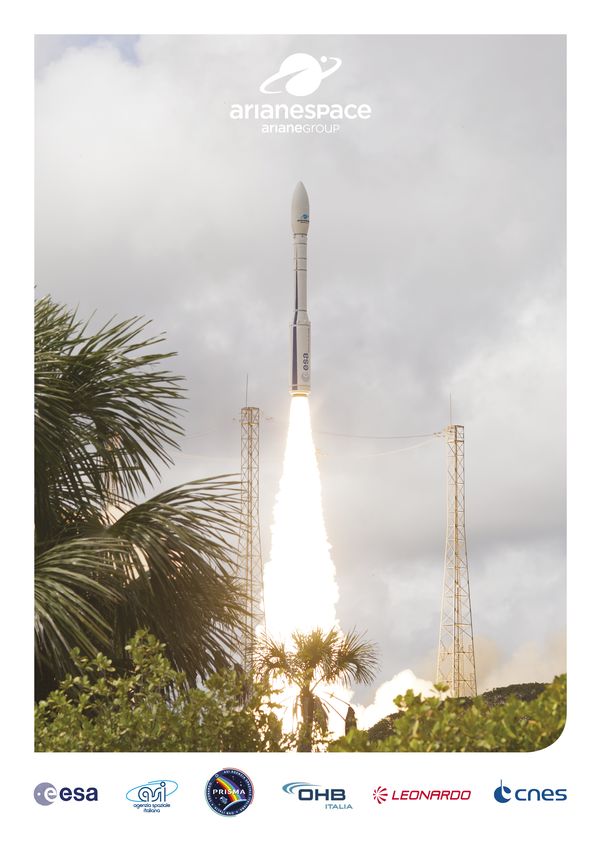
LAUNCH KIT

 March 2019

VV14
   PRISMA

VV14
        PRISMA

                                          FLIGHT VV14: WITH VEGA, ARIANESPACE TO
                                          LAUNCH PRISMA, AN ITALIAN EARTH
                                          OBSERVATION SATELLITE
                                          For its third mission of the year, and the 14th Vega flight since this launcher began
                                          operations at the Guiana Space Center in 2012, Arianespace will orbit the PRISMA
                                          Earth observation satellite on behalf of the ASI Italian space agency within the
                                          scope of a contract with OHB ITALIA.
                                          In conducting this mission for Italy, Arianespace once again proves that Vega is a
                                          multi-purpose launch vehicle, perfectly tailored to address the growing Earth
                                          observation satellite market.
                                          Flight VV14 will mark the 12th Vega mission dedicated to Earth observation, with
                                          PRISMA to become the 70th Earth observation satellite launched by Arianespace
                                          overall.

CONTENTS                                   The PRISMA satellite

                                          PRISMA (PRecursore IperSpettrale della Missione Applicativa) was built for the ASI Italian space
> THE LAUNCH
                                          agency by OHB ITALIA as prime contractor, with LEONARDO responsible for the payload. Vega
VV14 mission                              will deliver the satellite into a Sun-synchronous Low Earth Orbit (SSO) for its Earth observation
Pages 2-4                                 mission.

The PRISMA Satellite                      PRISMA will provide major applications to protect both our planet and Italy’s national
Page 5                                    environmental safety. Equipped with a state-of-the-art electro-optical instrument, made by a
                                          medium resolution photo camera sensitive to all the visible range (panchromatic) and by an
                                          innovative hyperspectral sensor, it will employ these capabilities for environmental monitoring,
> FURTHER                                 resources management, identification and classification of crops, fight against pollution, etc.
INFORMATION
                                          PRISMA will be the third satellite launched at the service of ASI by Arianespace, whose backlog
Vega launch vehicle                       comprises two other spacecraft for the Italian space agency: a pair of COSMO-SkyMed Second-
Page 6                                    Generation satellites on Soyuz and Vega C, for Thales Alenia Space on behalf of ASI and the
VV14 launch campaign                      Italian Ministry of Defence.
Page 7                                    The PRISMA satellite was designed and manufactured by a consortium of Italian companies led
                                          by OHB ITALIA SpA and LEONARDO SpA. OHB ITALIA is responsible for overall program
Countdown and flight
                                          management, planning, systems engineering, development and integration of the platform and
sequence
                                          all validation activities. LEONARDO is responsible for the design, development, integration,
Page 8
                                          testing and calibration of hyperspectral sensor and panchromatic camera.
Vega mission profile                      PRISMA will be the 25th OHB satellite orbited by Arianespace, with the total comprised of three
Page 9                                    dedicated satellites and 22 constellation satellites. Eight OHB satellites remain in Arianespace’s
Arianespace                               backlog, including four Galileo satellites to be launched on the next-generation Ariane 62
and the Guiana Space                      version.
Center
Page 10                                    Arianespace at the service of Italian and European institutional needs
                                          So far, Arianespace has lofted seven institutional satellites and five auxiliary payloads for Italian
                                          customers and institutions, such as ASI, the Italian Ministry of Defense and Telespazio, a joint-
                                          venture between LEONARDO and Thales.
                                          PRISMA also will be the 126th mission, as well as the 155th satellite, launched by Arianespace
                                          on behalf of European institutions using its family of launchers.
                                          With 20 additional missions currently comprised in its backlog (representing 24 satellites),
                                          Arianespace continues to serve the strong, strategic interests of European institutions by
                                          providing them with an independent access to space.

PRESS CONTACT          Claudia Hoyau
                       c.hoyau@arianespace.com                 #VV14                      @arianespace                      @arianespaceceo
                       +33 (0)1.60.87.55.11                     arianespace.com           youtube.com/arianespace           arianespace

For more information, visit us on arianespace.com                       2                                                        @arianespace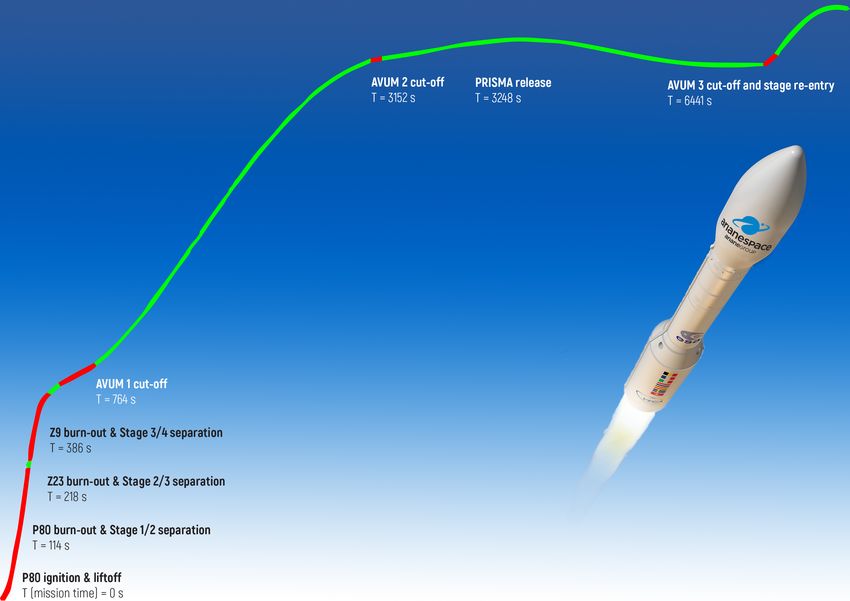
VV14
        PRISMA

                                           Vega, a commercial and operational success

                                          Arianespace’s family of launchers was expanded in 2012 with the addition of Vega, a new-
                                          generation vehicle for flights carrying small to medium-sized satellite payloads.
                                          The industrial prime contractor for Vega is Avio, based in Colleferro, Italy.
                                          Since its entry into service, Vega has performed 13 successful missions, orbited 28 satellites
                                          and delivered a combined payload mass of 13,816.5 kg to orbit.
                                          Offering a payload capacity of 1.5 metric tons into low Earth orbit (LEO), Vega was purpose-
                                          built for launching small scientific or Earth observation satellites. Consequently, 11 of Vega’s
                                          13 successfully completed missions were dedicated to Earth observation, when more than half
                                          of its on-board satellites were designed for Earth observation missions (15 out of 28 spacecraft).
                                          10 Vega/Vega C launches are currently included in Arianespace’s backlog, which has a total of
                                          52 launches overall. One-third of these are for European institutions, while two-thirds are for
                                          export customers.

For more information, visit us on arianespace.com                      3                                                      @arianespace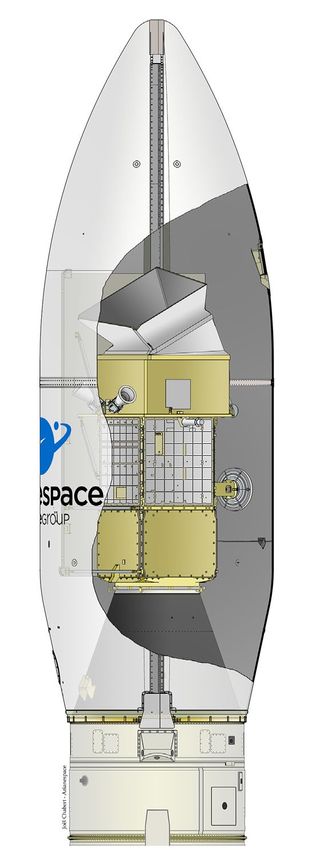
VV14
       PRISMA

MISSION DESCRIPTION
The 14th Vega launch from the Guiana Space Center (CSG) will place the PRISMA
satellite into a Sun-synchronous orbit (SSO).
The launcher will be carrying a total payload of approximately 953.5 kg.

The launch will be performed from the Vega Launch Complex (SLV) in Kourou, French
Guiana.

DATE AND TIME
        Liftoff is scheduled for Thursday, March 21, 2019, at exactly:
        > 9:50:35 p.m., in Washington, D.C.
        > 10:50:35 p.m., local time in French Guiana
        > 01:50:35, Universal Time (UTC), on March 22, 2019
        > 2:50:35 a.m., in Paris and Rome, on March 22, 2019
        > 10:50:35 a.m., in Tokyo, on March 22, 2019.

MISSION DURATION
        The nominal mission duration (from liftoff to separation of the satellite) is:
                                     54 minutes, 8 seconds.

TARGETED ORBIT
        Orbit                                Altitude at separation               Inclination
        SSO                                  Approx. 615 km.                      97.88 degrees
                                             Semi major axis: 6,993 km.

THE LAUNCH AT A GLANCE
Following liftoff from the Guiana Space Center, the powered phase of Vega's first three stages will
last six minutes and 26 seconds. After this first phase, the launcher’s third stage will separate from
the upper composite, which includes the AVUM upper stage, a payload adapter and the satellite. The
lower three stages will fall back into the sea.
The AVUM upper stage will ignite its engine for the first time, operating for about four minutes and
30 seconds, followed by a ballistic phase lasting approximately 39 minutes. The AVUM stage will then
reignite its engine for about one minute and 12 seconds, prior to releasing PRISMA about one minute
and 36 seconds after the engine is shut down.
PRISMA will be released 54 minutes and 8 seconds after liftoff.

VEGA PAYLOAD CONFIGURATION

> Payload: PRISMA
> Weight at liftoff: 879 kg.
> Vega Payload Adaptor (PLA)

For more information, visit us on arianespace.com                         4                              @arianespace
VV14
       PRISMA

THE PRISMA SATELLITE

CUSTOMERS                                   OHB ITALIA on behalf of the Italian space agency ASI
SYSTEM PRIME CONTRACTOR                     OHB ITALIA
PAYLOAD PRIME CONTRACTOR                    LEONARDO
MISSION                                     Earth observation
PLATFORM                                    Specific
MASS AT LAUNCH                              879 kg.
STABILIZATION                               3 axis
PROPULSION                                  Chemical (hydrazine)
BATTERIES                                   Li-Ion
TARGETED ORBIT                              Sun-synchronous orbit at 615 km.
DESIGN LIFE                                 5 years after commissioning phase

PRESS CONTACTS
                     Italian space agency ASI                   OHB ITALIA SPA                     LEONARDO
                     Giuseppina Piccirilli                      Marianne Wosala                    Rosita Bruzzo
                     Head of press office                       External Relations                 Chief Stakeholder Office – Media Relations
                     Tel: +39 06 8567 431                       Tel: +39 02 380 48 213             Tel: +39 06 3247 3902
                     E-mail: giuseppina.piccirilli@asi.it       E-mail: MWosala@cgspace.it         E-mail: rosita.bruzzo@leonardocompany.com
                     website: www.asi.it                        website: www.cgspace.it            website: www.leonardocompany.com

For more information, visit us on arianespace.com                        5                                                   @arianespace
VV14
PRISMA
THE VEGA LAUNCH VEHICLE
AVIO, the production prime contractor, delivers the Vega launcher to Arianespace.
Payload fairing
(RUAG Space)
Payload adaptor
AVUM structure
(Airbus Spain)
(Airbus)
Integration & testing AVUM engine
(Avio) (KB Yuzhnoye)
AVUM
Production, integration & testing
(Avio)
ZEFIRO-9
Interstage - 2/3
(Rheinmetall)
Production, integration & testing
(Avio)
ZEFIRO-23
Interstage - 1/2
(Airbus Netherlands)
P80 engine
Integration & testing (Europropulsion)
(Avio)
P80
Interstage - 0/1
(S.A.B.C.A)
Thrust vector control system
(P80, Zefiro 9, Zefiro-23 & AVUM)
S.A.B.C.A
P80 nozzle
(ArianeGroup)
Igniters (P80, Zefiro-9 & Zefiro-23)
APP
Avionics
Thales, IN-SNEC, Selex Avionica,
CRISA, RUAG Space, SAFT
For more information, visit us on arianespace.com 6 @arianespaceVV14
PRISMA
LAUNCH CAMPAIGN: VEGA – PRISMA
SATELLITE AND LAUNCH VEHICLE CAMPAIGN TIMETABLE
DATE SATELLITE ACTIVITIES LAUNCH VEHICLE ACTIVITIES
January 11, 2019 Arrival in French Guiana of PRISMA at Felix Eboué Campaign start review - Transfer of P80
Airport (Cayenne) stage
January 17, 2019 Short functional test (SFT) on the PRISMA satellite
January 28, 2019 Z9 integration
January 29, 2018 Transfer of PRISMA to the EPCU Payload
Preparation Complex
January 30, 2019 Interstage 1/2 integration
January 31, 2019 Fitcheck of PRISMA on his adaptor
February 1, 2019 Z23 integration
February 7 to 8, 2019 AVUM integration
February 8, 2019 Start of electrical checks
February 13, 2019 Fueling operations of PRISMA
February 19, 2019 Integration of PRISMA on the payload adaptor
February 22, 2019 Synthesis control test
February 26, 2019 Encapsulation in Vega’s payload fairing
SATELLITE AND LAUNCH VEHICLE CAMPAIGN FINAL TIMETABLE
DATE SATELLITE ACTIVITIES LAUNCH VEHICLE ACTIVITIES
Thursday, February 28, 2019 Transfer of upper composite from EPCU to
SLV (Vega Launch Site)
Friday, March 1, 2019 Upper composite integration on the launcher
Monday, March 4 Fueling operations for AVUM and RACS (Roll and
to Saturday, March 9, 2019 Attitude Control Subsystem)
Monday, March 11, 2019 Rehearsal
Tuesday March 12 Additional checks
to Friday, March 15, 2019
Monday, March 18, 2019 Arming of Z23/Z9, AVUM and fairing
Tuesday, March 19, 2019 Arming of P80
Wednesday, March 20, 2019 Launch readiness review (RAL), final preparation
of launcher and final inspections of the fairing
Thursday, March 21, 2019 Final launch countdown
For more information, visit us on arianespace.com 7 @arianespaceVV14
PRISMA
COUNTDOWN AND FLIGHT SEQUENCE
The countdown comprises all final preparation steps for the launcher, the satellite and the launch site, including
the steps leading up to authorization of P80 first-stage ignition.
TIME EVENT
- 09 h 10 min Start of final countdown
- 06 h 00 min Activation of Multi-Functional Unit (MFU)
- 05 h 40 min Activation of Inertial Reference System (IRS)
- 05 h 40 min Activation of telemetry
- 05 h 10 min Activation of Safeguard Master Unit (SMU)
- 04 h 50 min Removal of safety devices
- 04 h 40 min Activation of onboard computer and loading of flight program
- 04 h 30 min IRS alignment and checks
- 03 h 15 min Mobile gantry withdrawal (45 min.)
- 02 h 25 min IRS alignment and checks after withdrawal of gantry
- 01 h 15 min Activation of the telemetry transmitter after withdrawal of gantry
- 01 h 15 min Activation of transponders and receptors
- 00 h 50 min Launcher system ready
- 00 h 10 min Final weather report prior to launch
- 00 h 04 min Start of synchronized sequence
T-O 00 s LIFTOFF
+ 00 h 01 min 54 s 1st stage (P80) separation
+ 00 h 01 min 55 s 2nd stage (Zefiro-23) ignition
+ 00 h 03 min 38 s 2nd stage (Zefiro-23) separation
+ 00 h 03 min 51 s 3rd stage (Zefiro-9) ignition
+ 00 h 03 min 56 s Fairing separation
+ 00 h 06 min 26 s 3rd stage (Zefiro-9) separation
+ 00 h 08 min 06 s 1st ignition of AVUM
+ 00 h 12 min 44 s 1st cut-off of AVUM
+ 00 h 51 min 20 s 2nd ignition of AVUM
+ 00 h 52 min 32s 2nd cut-off of AVUM
+ 00 h 54 min 08 s Separation of the PRISMA satellite
+ 01 h 43 min 52 s 3rd ignition of AVUM
+ 01 h 47 min 22 s 3rd cut-off of AVUM
For more information, visit us on arianespace.com 8 @arianespaceVV14
PRISMA
MISSION PROFIL
For more information, visit us on arianespace.com 9 @arianespaceVV14
PRISMA
ARIANESPACE AND THE GUIANA SPACE CENTER
ARIANESPACE, THE WORLD’S FIRST LAUNCH SERVICES COMPANY
Arianespace was founded in 1980 as the world’s first launch services & solutions company. Arianespace is a subsidiary of Ariane-
Group, which holds 74% of its share capital; the balance is held by 15 other shareholders from the European launcher industry.
Since the outset, Arianespace has signed over 540 launch contracts and launched approx. 600 satellites. More than half of the
commercial satellites now in service around the globe were launched by Arianespace.
The company posted sales of more than 1.4 billion euros in 2018.
The company’s activities are worldwide, with the headquarters in Evry, France (near Paris); the Guiana Space Center in French
Guiana, where the Ariane, Soyuz and Vega launch pads are located; and offices in Washington, D.C., Tokyo and Singapore. Ari-
anespace offers launch services to satellite operators from around the world, including private companies and government agen-
cies. These services call on three launch vehicles:
> The Ariane 5 heavy-lift launcher, operated from the Guiana Space Center in French Guiana.
> The Soyuz medium-lift launcher, currently in operation at the Guiana Space Center, the Baikonur Cosmodrome in Kazakhstan
and shortly the Vostochny Cosmodrome in Russia.
> The Vega light-lift launcher, also operated from the Guiana Space Center.
Building on its complete family of launchers, Arianespace has won over half of the commercial launch contracts up for bid world-
wide in the past two years. Arianespace now has a backlog of more than 700 satellites to be launched.
THE GUIANA SPACE CENTER: EUROPE’S SPACEPORT
For more than 40 years, the Guiana Space Center (CSG), Europe’s Spaceport in French Guiana, has offered a complete array of
facilities for rocket launches. It comprises primarily the following:
> The CNES/CSG technical center, including various resources and facilities that are critical to launch base operations, such as
radars, the telecom network, weather station, receiving sites for launcher telemetry, etc.
> Payload processing facilities (ECPU), in particular, the S5 facility.
> Ariane, Soyuz and Vega launch complexes, comprising the launch zones and launcher integration buildings.
> Various industrial facilities, including those operated by Regulus, Europropulsion, Air Liquide Spatial Guyane and ArianeGroup
– all participating in the production of Ariane 5 components. A total of 40 European manufacturers and local companies are
involved in launcher operations.
Europe’s commitment to independent access to space is based on actions by three key players: the European Space Agency (ESA),
the French space agency CNES (Centre National d’Etudes Spatiales) and Arianespace. ESA is responsible for the Ariane, Soyuz and
Vega development programs. Once these launch systems are qualified, ESA transfers responsibility to Arianespace as the operator.
ESA has helped change the role of the Guiana Space Center, in particular by funding the construction of the launch complexes,
payload processing buildings and associated facilities. Initially used for France’s space program, the Guiana Space Center has
evolved into Europe’s own Spaceport, according to the terms of an agreement between ESA and the French government. To ensure
that the Spaceport is available for its programs, ESA takes charge of the lion’s share of the CNES/CSG fixed expenses, and also
helps finance the fixed costs for the ELA launch complexes.
CNES has several main responsibilities at the Guiana Space Center. It designs all infrastructure and, on behalf of the French gov-
ernment, is responsible for safety and security. It provides the resources needed to prepare the satellites and launchers for mis-
sions. Whether during tests or actual launches, CNES is also responsible for overall coordination of operations and it collects and
processes all data transmitted from the launcher via a network of receiving stations to track Ariane, Soyuz and Vega rockets
throughout their trajectories.
ARIANESPACE IN FRENCH GUIANA
In French Guiana, Arianespace is the contracting authority in charge of operating the family of three launchers: Ariane, Soyuz and
Vega.
For Vega, Arianespace supervises the integration and inspection of the launcher constructed by ELV/Avio, the production prime
contractor. At the same time, Arianespace coordinates the preparation of satellites in the payload preparation facility (EPCU)
operated by CNES/CSG, handles the integration of satellites and preparation of the payload composite up to its transfer on the
launcher to the Vega launch zone (ZLV), and also works with ELV/Avio teams in charge of the launcher to conduct the final
countdown and launch from Launch Control Center No. 3 (CDL3).
Arianespace deploys a top-flight team and technical facilities to get launchers and satellites ready for launch. Building on this
unrivalled expertise and outstanding facilities in French Guiana, Arianespace is the undisputed benchmark in the global launch
services market.
For more information, visit us on arianespace.com 10 @arianespaceYou can also read


