Walking and Working Surfaces - OSHA CFR 1915 vs. 1910 - PRESENTED BY: YANIV ZAGAGI, IN MSC, CIH, CSP - NSRP
←
→
Page content transcription
If your browser does not render page correctly, please read the page content below
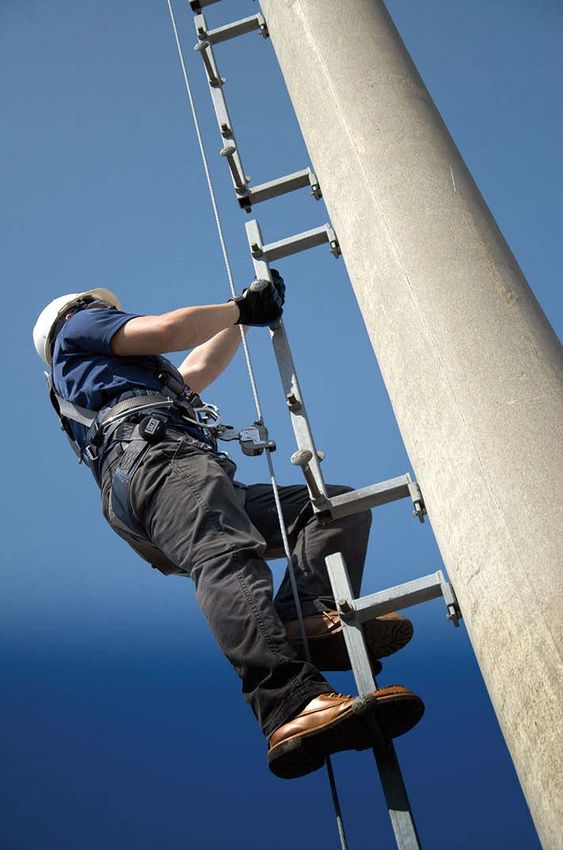
Walking and Working Surfaces
– OSHA CFR 1915 vs. 1910
PRESENTED BY: YANIV ZAGAGI, IN MSC, CIH, CSP
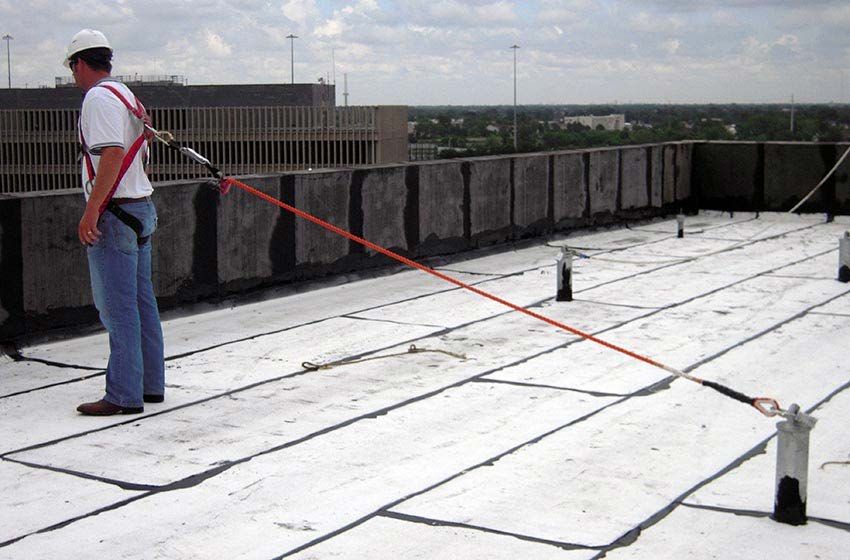
Walking and Working Surfaces
A P P L I C A B L E S TA N D A R D S A N D S C O P E S

• 1910 Subpart D
    • This subpart applies to all general industry workplaces. It covers all walking-
      working surfaces unless specifically excluded by an individual section of this
      subpart

• 1915 Subpart D Scaffolds, Ladders and Other Working
  Surfaces
    • The provisions of this section shall apply to all ship repairing, shipbuilding
      and shipbreaking operations except that paragraphs (b)(8) through (b)(10)
      and paragraphs (c) through (f) of this section shall only apply to ship
      repairing and shipbuilding operations and shall not apply to shipbreaking.

• 1915 Subpart F General Working Conditions
    • The provisions of this subpart apply to general working conditions in
      shipyard employment, including work on vessels, on vessel sections, and at
      landside operations, regardless of geographic location.

                                        ___
OSHA
29 CFR 1915.4 - DEFINITIONS.

• (j) The terms ship repair and ship repairing mean any
  repair of a vessel including, but not restricted to,
  alterations, conversions, installations, cleaning, painting,
  and maintenance work.

• (k) The term shipbuilding means the construction of a
  vessel including the installation of machinery and
  equipment.

• (l) The term shipbreaking means any breaking down of a
  vessel's structure for the purpose of scrapping the vessel,
  including the removal of gear, equipment or any
  component part of a vessel.

                              ___
Walking and Working Surfaces - Changes
Old Rule – Subpart D                         New Rule – Subpart D
1910.21 – Definitions                        1910.21 – Scope and Definitions
1910.22 – General Requirements               1910.22 – General Requirements
1910.23 – Guarding Floor and Wall Openings
                                             1910.23 - Ladders
and Holes
1910.24 – Fixed Industrial Stairs            1910.24 – Step Bolts and Manhole Steps
1910.25 – Portable Wood Ladders              1910.25 - Stairways
1910.26 – Portable Metal Ladders             1910.26 - Dockboards
                                             1910.27 – Scaffolds and Rope Descent
1910.27 – Fixed Ladders
                                             Systems
1910.28 – Safety Requirements for            1910.28 – Duty to Have Fall Protection and
Scaffolding                                  Falling Object Protection
1910.29 – Manually Propelled Mobile Ladder 1910.29 – Fall Protection Systems and Falling
Stands and Scaffolds (towers)              Object Protection – Criteria and Practices
1910.30 – Other Working Surfaces           1910.30 – Training Requirements
                                         ___
Timeline for Compliance
Final Subpart D Section and Requirement                                       Compliance Date
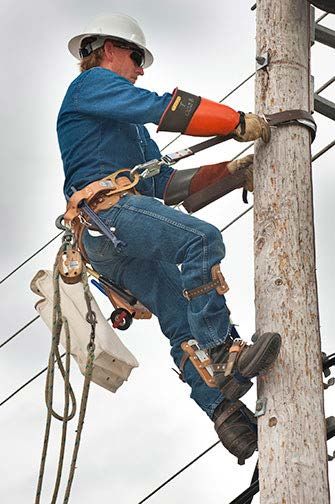
1910.30(a) - Train exposed employees on fall hazards                          May 17, 2017
1910.30(b) - Train employees who use equipment covered by the new             May 17, 2017
rule
1910.27(b)(1) - Inspect and certify permanent anchorage points for            November 20, 2017
rope descent systems
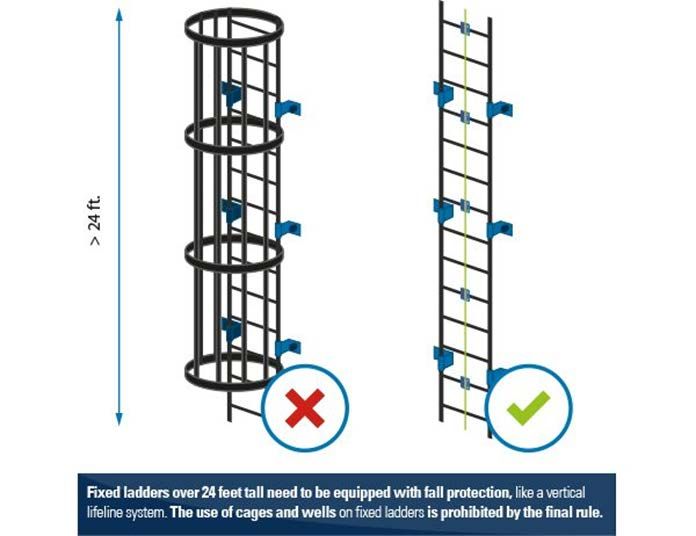
1910.28(b)(9)(i)(B) - For fixed ladders over 24 feet, install personal fall   November 19, 2018
arrest or ladder safety systems on new fixed and on replacement
ladders or ladder sections, including ladder systems on advertising
structures
1910.28(b)(9)(i)(A) - Ensure existing fixed ladders over 24 feet are          November 19, 2018
equipped with a cage, well, personal fall arrest system, or ladder
safety system
1910.28(b)(9)(i)(D) - Replace those cages and wells used as fall              November 18, 2036
protection with ladder safety or personal fall arrest systems on all
fixed ladders over 24 feet                       ___
Walking and Working Surfaces
                 1915                               1910
1915.80(b) Definitions applicable          1910.21 – Scope and Definitions
to this subpart.
• Authorized employee                      • Authorized means an
  An employee who                            employee who the
  performs one or more of                    employer assigns to
  the following                              perform a specific type of
  lockout/tags-plus
  responsibilities:                          duty, or allows in a
    • Executes the lockout/tags-             specific location or area.
      plus procedures;
    • Installs a lock or tags-plus
      system on machinery,
      equipment, or systems; or
    • Services any machine,
      equipment, or system
      under lockout/tags-plus
      application.

                                     ___
Walking and Working Surfaces
                  1915                               1910
1915.80(b) Definitions applicable         1910.21 – Scope and Definitions
to this subpart.                          • Hole means a gap or open
• Not available                             space in a floor, roof,
                                            horizontal walking-working
                                            surface, or similar surface that
                                            is at least 2 inches (5 cm) in
                                            its least dimension

                                    ___
Walking and Working Surfaces
                 1915                                  1910
1915.83(a)(1) Steam supply                 1910.21 – Scope and Definitions
system, and                                • Competent person means a
                                             person who is capable of
1915.83(c)(3) Electric shore                 identifying existing and
power                                        predictable hazards in any
                                             personal fall protection system or
• A responsible vessel's                     any component of it, as well as in
                                             their application and uses with
  representative, a contractor, or           related equipment, and who has
  any other person who is                    authorization to take prompt,
                                             corrective action to eliminate the
  qualified by training,                     identified hazards.
  knowledge, or experience                 • Qualified describes a person who,
                                             by possession of a recognized
                                             degree, certificate, or professional
                                             standing, or who by extensive
                                             knowledge, training, and
                                             experience has successfully
                                             demonstrated the ability to solve
                                             or resolve problems relating to the
                                             subject matter, the work, or the
                                             project.
                                     ___
Walking and Working Surfaces
                  1915                               1910
1915.80(b) Definitions applicable         1910.21 – Scope and
to this subpart.                          Definitions
• Not available                           • Low-slope roof means a roof
                                            that has a slope less than or
                                            equal to a ratio of 4 in 12
                                            (vertical to horizontal).
                                          • Manhole steps means steps
                                            that are individually attached to,
                                            or set into, the wall of a
                                            manhole structure.

                                    ___
Walking and Working Surfaces
                1915                                1910
1915.80(b) Definitions applicable         1910.21 – Scope and Definitions
to this subpart.
                                          • Opening means a gap or open
• Walkway. Any surface,                     space in a wall, partition,
  whether vertical, slanted, or             vertical walking-working
  horizontal, on which                      surface, or similar surface that
  employees walk, including                 is at least 30 inches (76 cm)
                                            high and at least 18 inches (46
  areas that employees pass                 cm) wide, through which an
  through, to perform their job             employee can fall to a lower
  tasks. Walkways include, but              level.
  are not limited to, access              • Walking-working surface
  ways, designated walkways,                means any horizontal or
  aisles, exits, gangways,                  vertical surface on or through
  ladders, ramps, stairs, steps,            which an employee walks,
  passageways, and scaffolding.             works, or gains access to a
  If an area is, or could be,               work area or workplace
  used to gain access to other              location (i.e. parking lots)
  locations, it is to be
  considered a walkway
                                    ___
Walking and Working Surfaces
1915 1910
1915.81 – General Working 1910.22 – General
Conditions: Housekeeping
Requirements: Housekeeping
• The employer shall eliminate
slippery conditions, such as Employers are required to
snow and ice, on walkways and inspect walking-working
working surfaces as necessary. surfaces regularly and as
If it is not practicable for the
employer to remove slippery needed and identify, control,
conditions, the employer either and as much as possible
shall: prevent hazardous conditions.
• Restrict employees to • Surface conditions -
designated walkways and
working surfaces where Walking-working surfaces are
the employer has maintained free of hazards
eliminated slippery such as sharp or protruding
conditions; or objects, loose boards,
• Provide slip-resistant corrosion, leaks, spills, snow,
footwear and ice
___Walking and Working Surfaces
1915 1910
1915.81 – General Working 1910.22 – General
Conditions: Housekeeping Requirements: Housekeeping
• The employer also shall ensure that
each walkway: • Inspection, maintenance, and
repair
• Provides adequate passage; • The employer must ensure:
• Is clear of debris, including solid Walking-working surfaces are
and liquid wastes, that may inspected, regularly and as
create a hazard for employees; necessary, and maintained
• Is clear of tools, materials,
in a safe condition.
equipment, and other objects that • Hazardous conditions on
may create a hazard for walking working surfaces are
employees; and corrected or repaired before
an employee uses the
• Is clear of hoses and electrical walking-working surface
service cords. again. If the correction or
repair cannot be made
• While a walkway or part of a walkway immediately, the hazard must
is being used as a working surface, be guarded to prevent
the employer shall cordon off that employees from using the
portion to prevent it from being walking-working surface until
used as a walkway. the hazard is corrected or
repaired; and
___Walking and Working Surfaces
1915 1910
1915.81 – General Working 1910.22 – General
Conditions: Housekeeping Requirements: Housekeeping
• Not available • When any correction or
repair involves the
. structural integrity of the
walking-working surface, a
qualified person performs
or supervises the
correction or repair.
___Walking and Working Surfaces
1915 1910
1915.72 – Scaffolds, Ladders 1910.23 – Ladders
and Other Working Surfaces:
Ladders Ladders are inspected before
initial use in each work shift to
• The use of ladders with broken identify any visible defects that
or missing rungs or steps, could cause employee injury.
broken or split side rails, or
other faulty or defective • Each employee faces the
construction is prohibited. ladder when climbing up or
When ladders with such down it.
defects are discovered, they • Each employee uses at least
shall be immediately one hand to grasp the
withdrawn from service. ladder when climbing up and
Inspection of metal ladders down it.
shall include checking for
corrosion of interiors of open Note: OSHA replaced the word
end, hollow rungs. “three points of contact” with “at
least one hand.”
___Walking and Working Surfaces
1915 1910
1915.76(a) – Scaffolds, Ladders 1910.23 – (d) Fixed ladders
and Other Working Surfaces:
Access to cargo spaces and (4) The side rails of through or side-
confined spaces step ladders extend 42 inches (1.1
m) above the top of the access level
• When any fixed ladder is or landing platform served by the
visibly unsafe, the employer ladder. For parapet ladders, the
shall prohibit its use by access level is:
employees. (i) The roof, if the parapet is
cut to permit passage through
the parapet; or
(ii) The top of the parapet, if
the parapet is continuous;
• (7) Grab bars extend 42 inches
(1.1 m) above the access level or
landing platforms served by the
ladder;
___Walking and Working Surfaces
1915 1910
1915.71(k)(1) - Scaffolds, Ladders 1910.24 Step bolts and manhole
and Other Working Surfaces: steps
Access to and guarding of dry docks
• (2) The employer must ensure
and marine: Scaffolds or staging that each manhole step installed on or
• Access from below to staging after January 17,2017:
more than 5 feet above a floor, • (i) Has a corrugated, knurled,
deck or the ground shall consist of dimpled, or other surface that
minimizes the possibility of an
well secured stairways, cleated employee slipping;
ramps, fixed or portable ladders
• (ii) Is constructed of, or coated
meeting the applicable with, material that protects against
requirements of 1915.72 or rigid corrosion if the manhole step is
type non-collapsible trestles with located in an environment where
parallel and level rungs. corrosion may occur;
• (3) The employer must ensure
that each manhole step is inspected
at the start of the work shift and
maintained in accordance with
§1910.22.
___Walking and Working Surfaces
1915 1910
1915.71 – Scaffolds, 1910.27 – Scaffolds and
Ladders and Other Rope Descent Systems
Working Surfaces: • Scaffolds shall be designed
Scaffolds or staging by a qualified person and
shall be constructed and
• No scaffold shall be erected, loaded in accordance with
moved, dismantled or altered that design
except under the supervision
of competent persons. • Before the scaffold is used,
direct connections shall be
evaluated by a competent
person who shall confirm,
based on the evaluation, that
the supporting surfaces are
capable of supporting the
loads to be imposed.
___Walking and Working Surfaces
1915 1910
1915.77 – Scaffolds, Ladders 1910.27 – Scaffolds and
and Other Working Surfaces:
Working Surfaces Rope Descent Systems
• When employees are working • Ramps and walkways 6 feet
aloft, or elsewhere at elevations or more above lower levels
more than 5 feet above a solid shall have guardrail
surface, either scaffolds or a systems
sloping ladder, meeting the
requirements of this subpart, shall
be used to afford safe footing, or
the employees shall be protected
by safety belts and lifelines
meeting the requirements of §§
1915.159 and 1915.160.
___Walking and Working Surfaces
1915 1910
• Not available Rope Descent Systems
• Before any rope descent system
is used, the building owner must
inform the employer, in writing
that the building owner has
identified, tested, certified, and
maintained each anchorage so it
is capable of supporting at least
5,000 pounds, in any direction, for
each employee attached.
• The information must be based
on an annual inspection by a
qualified person and
certification of each anchorage
by a qualified person, as
necessary, and at least every 10
years.
___Walking and Working Surfaces
1915 1910
• Not available Rope Descent Systems
• No rope descent system is used
for heights greater than 300 feet
above grade unless the employer
demonstrates that it is not feasible
to access such heights by any other
means or that those means pose a
greater hazard than using a rope
descent system
• Each employee who uses the
rope descent system is trained
___Walking and Working Surfaces
1915 1910
1915.77 – Scaffolds, Ladders § 1910.28 – Duty to Have
and Other Working Surfaces: Fall Protection and Falling
Working Surfaces Object Protection
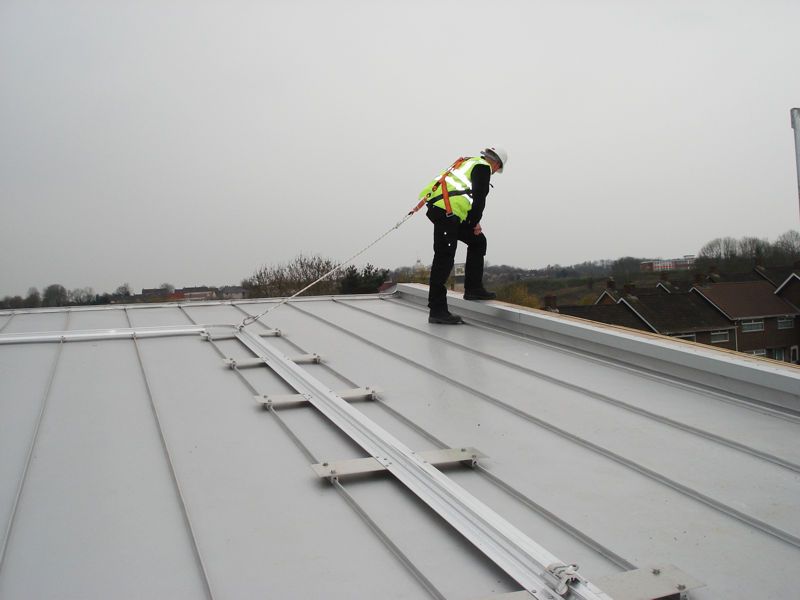
• When employees are working • The employer must ensure that
aloft, or elsewhere at elevations each employee on a walking-
more than 5 feet above a solid working surface with an
surface, either scaffolds or a unprotected side or edge that
sloping ladder, meeting the is 4 feet or more above a
requirements of this subpart, shall
lower level is protected from
falling by one or more of the
be used to afford safe footing, or following
the employees shall be protected
by safety belts and lifelines • Guardrail systems;
meeting the requirements of §§ • Safety net systems; or
1915.159 and 1915.160. • Personal fall protection
systems, such as personal
fall arrest, travel restraint,
or positioning systems.
___Walking and Working Surfaces
1915 1910
• Not available 1910.28 – Duty to Have Fall
Protection and Falling Object
Protection
• When the employer can
demonstrate that the use of
fall protection systems is not
feasible on the working side of
a platform used at a loading
rack, loading dock, or teeming
platform, the work may be
done without a fall protection
system, provided:
• The work operation for
which fall protection is
infeasible is in process;
• Access to the platform is
limited to authorized
employees; and,
• The authorized employees
are trained
___Walking and Working Surfaces
1915 1910
1915.73 – Scaffolds, Ladders and 1910.28 – Duty to Have Fall
Other Working Surfaces: Guarding of Protection and Falling Object
deck openings and edges
Protection
• When employees are working in the
vicinity of flush manholes and other • The employer must ensure each
small openings of comparable size in the employee is protected from falling
deck and other working surfaces, such through any hole (including
openings shall be suitably covered or skylights) that is 4 feet or more
guarded to a height of not less than 30 above a lower level by one or
inches, except where the use of such
guards is made impracticable by the more of the following:
work actually in progress. • Covers;
• When employees are working around • Guardrail systems;
open hatches not protected by coamings • Travel restraint systems; or
to a height of 24 inches or around other
large openings, the edge of the opening • Personal fall arrest systems.
shall be guarded in the working area to
height of 36 to 42 inches, except where
the use of such guards is made • Note: OSHA defines a hole as any
impracticable by the work actually in
progress. opening greater than 2 inches
___Walking and Working Surfaces
1915 1910
1915.71 – Scaffolds, Ladders and 1910.28 – Duty to Have Fall
Other Working Surfaces: Scaffolds Protection and Falling Object
or staging
Protection
• Scaffolding, staging, runways, or
working platforms which are • The employer must ensure each
supported or suspended more than 5 employee on a runway or similar
feet above a solid surface, or at any walkway is protected from falling 4
distance above the water, shall be feet or more to a lower level by a
provided with a railing which has a top guardrail system.
rail whose upper surface is from 42 to • Each employee less than 4 feet
45 inches above the upper surface of above dangerous equipment is
the staging, platform, or runway and a protected from falling into or onto
midrail located halfway between the the dangerous equipment by a
upper rail and the staging, platform, or guardrail system or a travel
runway. restraint system, unless the
equipment is covered or guarded to
eliminate the hazard.
___Walking and Working Surfaces
1915 1910
1915.73 – Scaffolds, Ladders and 1910.28 – Duty to Have Fall
Other Working Surfaces: Guarding Protection and Falling Object
of deck openings and edges
Protection
• When employees are working in the
vicinity of flush manholes and other • Openings
small openings of comparable size in • surface near an opening,
the deck and other working surfaces, including one with a chute
such openings shall be suitably attached, where the inside
covered or guarded to a height of not bottom edge of the opening is
less than 30 inches, except where the less than 39 inches (99 cm)
use of such guards is made above that walking-working
impracticable by the work actually in surface and the outside bottom
progress. edge of the opening is 4 feet (1.2
• When employees are working around m) or more above a lower level
open hatches not protected by is protected from falling by the
coamings to a height of 24 inches or use of:
around other large openings, the edge • Guardrail systems;
of the opening shall be guarded in the • Safety net systems;
working area to height of 36 to 42
inches, except where the use of such • Travel restraint systems; or,
guards is made impracticable by the • Personal fall arrest systems
work actually in progress.
___Walking and Working Surfaces
1915 1910
• Not available 1910.28 – Duty to Have Fall
Protection and Falling Object
Protection
• Fixed Ladders
• Existing Fixed Ladders
• Each fixed ladder installed before
November 19, 2018 is equipped
with:
• Personal fall arrest system,
• Ladder safety system,
• Cage, or well;
• Note: A Ladder safety system is a
system designed to eliminate or
reduce the possibility of falling from a
ladder. LSS typically include a carrier,
safety sleeve, lanyard, connections,
and body harnesses. Cages and wells
are no longer treated as ladder safety
systems.
___Walking and Working Surfaces
1915 1910
• Not Available 1910.28 – Duty to Have Fall
Protection and Falling Object
Protection
• Fixed Ladders
• New Fixed Ladders
• Each fixed ladder installed on
and after November 19, 2018, is
equipped with:
• Personal fall arrest system
or
• Ladder safety system;
___Walking and Working Surfaces
1915 1910
• Not available 1910.28 – Duty to Have Fall
Protection and Falling Object
Protection
• Fixed Ladders
• Replacement Ladders
• When a fixed ladder, cage, or
well, or any portion of a section
thereof, is replaced, a personal
fall arrest system or ladder safety
system is installed in at least that
section of the fixed ladder, cage,
or well where the replacement is
located; and
• Final deadline for Ladders
• On and after November 18,
2036, all fixed ladders are
equipped with a personal fall
arrest system or a ladder safety
system.
___Walking and Working Surfaces
1915 1910
1915.71 – Scaffolds, 1910.28 – Duty to Have
Ladders and Other Fall Protection and Falling
Working Surfaces: Object Protection
Scaffolds or staging • Stairways
• Ramps and stairways shall be • The employer must ensure
provided with 36-inch each employee exposed to an
handrails with midrails. unprotected side or edge of a
stairway landing that is 4 feet
or more above a lower level
is protected by a guardrail or
stair rail system.
• Each flight of stairs having at
least 3 treads and at least 4
risers is equipped with stair
rail systems and handrails.
___Walking and Working Surfaces
1915 1910
• Not available 1910.28 – Duty to Have Fall
Protection and Falling Object
Protection
• Work on low-slope roofs
• When work is performed less than 6
feet from the roof edge, the
employer must ensure each employee
is protected from falling by a guardrail
system, safety net system, travel
restraint system, or personal fall
arrest system
___Walking and Working Surfaces
1915 1910
• Not available 1910.28 – Duty to Have Fall
Protection and Falling Object
Protection
• Work on low-slope roofs
• When work is performed at least 6
feet (1.6 m) but less than 15 feet
(4.6 m) from the roof edge, the
employer must ensure each
employee is protected from falling
by using a guardrail system, safety
net system, travel restraint system,
or personal fall arrest system. The
employer may use a designated
area when performing work that is
both infrequent and temporary.
___Walking and Working Surfaces
1915 1910
• Not available 1910.28 – Duty to Have Fall
Protection and Falling Object
Protection
• Work on low-slope roofs
• When work is performed 15 feet or
more from the roof edge, the
employer must:
• Protect each employee from
falling by a guardrail system,
safety net system, travel restraint
system, or personal fall arrest
system or a designated area.
The employer is not required
to provide any fall protection,
provided the work is both
infrequent and temporary; and
• Implement and enforce a work
rule prohibiting employees
from going within 15 feet of
the roof edge without using fall
protection.
___Walking and Working Surfaces
1915 1910
1915.73 – Scaffolds, Ladders and 1910.28 – Duty to Have Fall
Other Working Surfaces: Guarding Protection and Falling Object
of deck openings and edges Protection
• When employees are exposed to • Walking-working surfaces not
unguarded edges of decks, platforms, otherwise addressed. Except as
flats, and similar flat surfaces, more provided elsewhere in this section or
than 5 feet above a solid surface, the by other subparts of this part, the
edges shall be guarded by adequate employer must ensure each employee
guardrails meeting the requirements on a walking-working surface 4 feet
of 1915.71(j)(1) and (2), unless the (1.2 m) or more above a lower level is
nature of the work in progress or the protected from falling by:
physical conditions prohibit the use or
installation of such guardrails. • Guardrail systems;
• Safety net systems; or
• Personal fall protection systems, such
as personal fall arrest, travel restraint,
or positioning systems.
___Walking and Working Surfaces
1915 1910
1915.71 – Scaffolds, Ladders and 1910.29 – Fall Protection
Other Working Surfaces: Scaffolds
or staging Systems and Falling
• When necessary, to prevent tools and
Object Protection: Criteria
materials from falling on men below, and Practices
toeboards of not less than 1 x 4 inch
lumber shall be provided. • Protection from falling objects. When
an employee is exposed to falling
objects, the employer must ensure
that each employee wears head
protection that meets the
requirements of subpart I of this part.
In addition, the employer must protect
employees from falling objects by
implementing one or more of the
following:
___Walking and Working Surfaces
1915 1910
1910.29 – Fall Protection Systems and
• Not available Falling Object Protection: Criteria and
Practices
• Ladder safety systems. The employer
must ensure:
• Each ladder safety system allows
the employee to climb up and down
using both hands and does not
require that the employee
continuously hold, push, or pull any
part of the system while climbing;
• The connection between the carrier
or lifeline and the point of
attachment to the body harness or
belt does not exceed 9 inches (23
cm);
• The design and installation of
mountings and cable guides does
not reduce the design strength of
the ladder; and
• Ladder safety systems and their
support systems are capable of
withstanding, without failure, a drop
test consisting of an 18-inch (41-
cm) drop of a 500-pound (227-kg)
weight.
___Walking and Working Surfaces
1915 1910
• Not available 1910.29 – Fall Protection Systems
and Falling Object Protection:
Criteria and Practices
• A competent person or qualified
person must inspect each knot in a
lanyard or vertical lifeline before
any employee uses the lanyard or
lifeline.
• The employer must ensure that
each horizontal lifeline is designed,
installed, and used under the
supervision of a qualified person
and is part of a complete personal
fall arrest system that maintains a
safety factor of at least two.
• Personal fall protection systems must be
inspected before initial use during
each work shift for mildew, wear,
damage, and other deterioration, and
defective components must be removed
from service.
• Body belts are prohibited as part of a
personal fall arrest system
___Walking and Working Surfaces
1915 1910
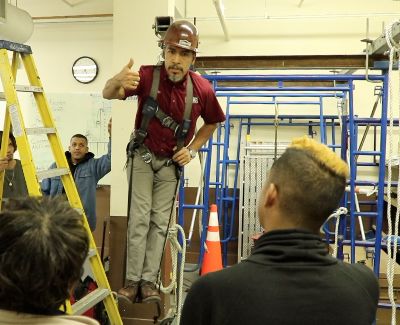
• Not applicable 1910.29 – Training
• Employers must provide
information and training to each
worker in a manner the worker
understands:
• Before any employee is
exposed to a fall hazard,
the employer must provide
training for each employee
who uses personal fall
protection systems or who
is required to be trained as
specified elsewhere in this
subpart. Employers must
ensure employees are
trained in the requirements
of this paragraph on or
before May 17, 2017.
___Walking and Working Surfaces
1915 1910
• Not applicable 1910.29 – Training
• The employer must train
each employee on or
before May 17, 2017 in the
proper care, inspection,
storage, and use of
equipment covered by this
subpart before an
employee uses the
equipment.
• The employer must retrain
an employee when the
employer has reason to
believe the employee does
not have the understanding
and skill required by
paragraphs (a) and (b) of
this section.
___Thank you for not falling a sleep
Adjourn
This Photo by Unknown Author is licensed
under CC BY-NC-SAYou can also read


