WHAT YOU DIDN'T KNOW, BUT NEED TO - Self-Insurance ...
←
→
Page content transcription
If your browser does not render page correctly, please read the page content below

WHAT YOU DIDN’T KNOW, BUT NEED TO
 In 2016, 7 million people
will try to conceive through                 200,000 BORN
natural pregnancy, but only                WITH CONGENITAL
5 million will be successful               HEALTH PROBLEMS

                                              1,000,000
   20% of women are                           MISCARRY
     born with low
    ovarian reserve
                                              2,000,000
                                            UNSUCCESSFUL

                                                             1
THE BIOLOGICAL REALITY OF FERTILITY

        § Biologically, women are made to have babies between ages 16 and 25
        § A woman’s egg quantity and quality starts to decline at age 28
        § At age 20, 90% of a woman’s eggs are chromosomally NORMAL
        § By age 40, 90% of a woman’s eggs are chromosomally ABNORMAL

                        Each month, a fertile 30-year-old has
                     only A 20% CHANCE of conceiving naturally

            WOMEN ARE HAVING CHILDREN LATER

    On average, women under 30                                  70% of women reach 40
    want 2.7 children                                          without hitting that target

                                 1970       2006       TODAY
                                                                            20% OF WOMEN
MORE WOMEN ARE HAVING                                                        ARE CHILDLESS
THEIR FIRST CHILD AFTER 35         1          8         20                  INVOLUNTARILY
                                  100        100        100
                                                                               BY AGE 45

                                                                                             2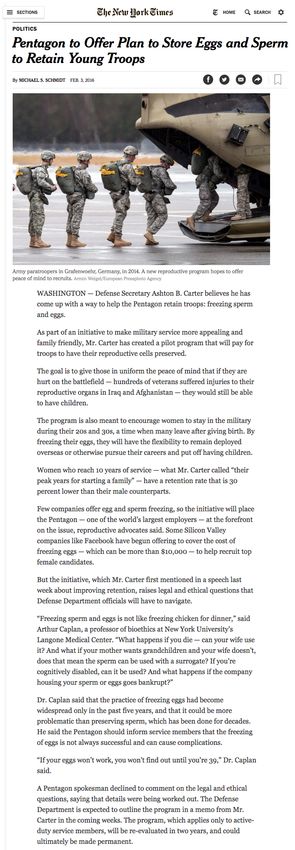
CHANGING VIEWS ON PARENTHOOD

   § Couples with higher levels of education delay
     parenthood and have higher rates of infertility
   § Married couples are delaying parenthood to
     ensure financial stability
   § More same sex couples are choosing to have
     children than ever before

          COST IMPACT OF INFERTILITY IN THE U.S.

                                 62%                                FROM

                                    ARE                     § MULTIPLE BIRTHS
                                 DELIVERED
   2/3            1/3
                                                $1B
                                 PRE-TERM                   § CESAREAN
     OF             OF
                                                            § PRE-TERM DELIVERIES
CONVENTIONAL    “SUCCESSES”
                  LEAD TO                                         RELATED TO
  IVF CYCLES
     FAIL        MULTIPLE                          IN         FERTILITY TREATMENT
                  BIRTHS
                                 90%           HEALTHCARE         PAID
                                                  COST       BY THE HEALTH PLAN
                                    ARE
                                 CESAREAN                        / EMPLOYER

                                                                                    3
COST IMPACT OF INFERTILITY ON EMPLOYERS AND PLANS
                          INFERTILITY TREATMENTS RESULT IN
                A 27% RATE OF MULTIPLES (TWINS OR MORE)
                 IVF Effectiveness*                        31%
                                                                              Normal
                 Twin Delivery Rate                        27%               Twin Rate
                 Pre-Term Delivery Rate                65% – 90%               1.5%
                 C-Section Rate                            90%

                 Total Avg. Delivery                   $150k/Twins
                 and NICU Cost                        $391k/Triplets

COST IMPACT OF INFERTILITY ON EMPLOYERS AND PLANS

§ Patients without or with
  a limited benefit are
  incentivized to transfer
  2+ embryos to decrease                  $8,400
                                                   $150K
  out of pocket costs                     SINGLE
                                                   TWINS               $391K
                                                                       TRIPLETS
§ 90% of people believe you
  must insert 2 embryos to
  improve your success rates

                                                                                         4
BUT INFERTILITY IMPACTS MORE THAN COST

   § Mothers of twins are more frequently on sick leave, hospitalized
   § 90% of people with infertility issues are willing to change employers
   § 68% of people without infertility issues say they highly value the benefit

                61% OF PEOPLE BELIEVE
     INFERTILITY IS MORE STRESSFUL THAN DIVORCE

INFERTILITY IN EMPLOYEES CAN RESULT IN INCREASED

   ABSENTEEISM               PRESENTEEISM                DEPRESSION

       NICU                     STOP LOSS            EMPLOYEE ATTRITION

                                                                                  5
SOME STATES MANDATE FERTILITY COVERAGE
                                                 MANDATE         MANDATE           INCLUDES         EXCLUDES       IVF COVERAGE
STATE                           DATE ENACTED     TO COVER        TO OFFER        IVF COVERAGE     IVF COVERAGE          ONLY
Arkansas                           1987             X1                                                                  X
California                         1989                             X                                  X2
Connecticut                        1989             X                                 X
Hawaii                             1987             X                                                                   X3
Illinois                           1991             X                                 X4
Louisiana                          2001                                                                X
Maryland                           1985             X5                                                                  X
Massachusetts                      1987             X                                 X
Montana                            1987             X6
New Jersey                         2001             X                                 X
New York                           1990                                                                X7
Ohio                               1991             X8
Rhode Island                       1989             X                                 X
Texas                              1987                             X                                                   X
West Virginia                      1977             X8

                    BUT MANY FAIL DUE TO THE FINE PRINT...
        1.   Includes a lifetime maximum benefit of not less than $15,000
        2.   Excludes IVF, but covers gamete intrafallopian transfer (GIFT)
        3.   Provides a one-time only benefit covering all outpatient expenses arising from IVF
        4.   Limits first-time attempts to four oocyte retrievals. If a child is born, two complete oocyte retrievals for a
             second birth are covered. Businesses with 25 or fewer employees are exempt from having to provide
             the coverage specified by the law
        5.   Businesses with 50 or fewer employees do not have to provide coverage specified by law
        6.   Applies to HMOs only; other insurers specifically are exempt from having to provide the coverage
        7.   Provides coverage for the "diagnosis and treatment of correctable medial conditions." Does not
             consider IVF a corrective treatment
        8.    Applies to HMOs only

                       AND SELF-INSURED/ERISA PLANS ARE EXEMPT!
                                                                                                                                  See Source 19

                                                                                                                                                  6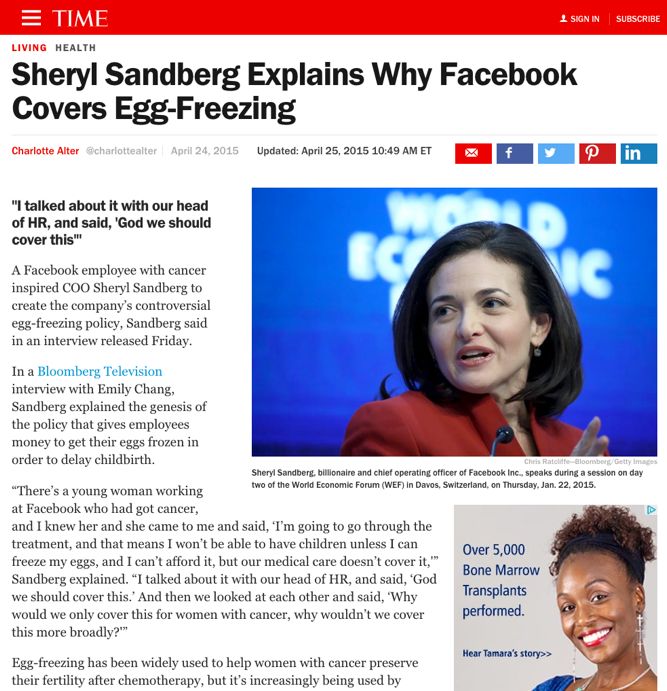
EMPLOYER COVERAGE TODAY
 § 25% of employers with 500+ employees offer fertility as
   part of their health care benefits. 19% cover IVF, 12%
   cover medication and 9% cover non-IVF treatments
 § Employers offer a fixed dollar defined benefit (avg. 10K)
 § Infertility benefit is treated like a voluntary benefit in
   terms of coverage (lifetime max, opt in)
 § Use of traditional health plan administrator networks
 § Plan administrators commonly require several rounds
   of IUI before IVF is authorized
 § Members pay upwards of 50k out of pocket after
   coverage is exhausted

                 MORE RECENT EMPLOYER TRENDS
          Benefits executives recognizing the need to support employees
                        through this very difficult life event
§ Employers moving away from plans and towards employing
  fertility specialty health vendors
§ Value-based programs offer full treatment cycle coverage
  as opposed to a defined dollar benefit (employers offering
  between 1-4 full treatment cycles)
§ Focus is to include high touch, personalized member
  support as part of infertility program
§ Egg freezing is covered by 5% of all large employers and
  growing rapidly (11% of employers offer it in the Northeast)

                                                                          7
COMMON INFERTILITY DEFINED BENEFIT
  DOES NOT SUPPORT A VALUE-BASED CARE MODEL
    Conventional Treatment Plan - Fee for Service with Lifetime Maximum
                             Service                        Cost         Success Rate
    IUI w/meds (avg. 3 cycles)                            $9,000          0%-16%
    IVF Fresh                                             $12,000           31%
    Freeze-All Cycle                                      + $4,000          40%
    Add on: ICSI                                          + $1,800          36%
    Add on: Assisted Hatching                             + $750            41%
    Add on: PGS                                           + $5,000          61%
    IVF Medications                                       + $5,000           N/A
    Total Retail Cost (For Average 1 Treatment)          $37,550          31-61%
                                                                                    See Sources 2, 16

LEAST EXPENSIVE TREATMENTS OFTEN LEAST EFFECTIVE
  Health Plan Rules Often Require 3 to 6 IUIs Before IVF Treatment

   IVF Success Rates by Age             IUI Success Rates by Age     §     Increases the chances
                                                                           of multiple births
   40%    for women under 35           16%    for women under 35
                                                                     §     Patients with
   31%    for women aged 35-37         11%    for women aged 35-39
                                                                           previously failed IUI
   22%    for women aged 38-40         5%     for women aged 40-42         attempts often
   12%    for women aged 41-42                                             demand 2+ embryo
                                       1%     for women aged 43-44         transfers during a
   4%     for women aged 43-44
                                                                           single IVF cycle

                                                                                                        8
ACCELERATED PATH TO IVF IS COST EFFECTIVE
  Benefit Design Needs To Support The Most Effective Treatment, The First Time

    Boston IVF/Harvard ‘Accelerated Path to IVF’ Trial:
        § Conventional Treatment = Unstimulated and stimulated IUI
        § Accelerated Treatment = No stimulated IUI (i.e., fast-track to IVF)

                          66.8% of patients in Accelerated Path
                          delivered a baby as opposed to 31%

                                                                                 See source list items 1, 5

SOLUTION: VALUE-BASED BUNDLED TREATMENT BENEFIT

      A full cycle treatment benefit, instead of a dollar limit, that includes the initial
      consult, diagnostic testing, and all infertility treatment options, including the
        latest embryo screening technologies, to increase per cycle success rates,
             decrease time to pregnancy and support a single embryo transfer.

     § Members and their doctors make treatment decision based on
       effectiveness, not cost and coverage.
     § Employers decide how many treatment cycles they wish to cover
     § Coverage is combined with a personalized education and support program

                                                                                                              9
COVERAGE FOR ALL TREATMENT TYPES

          IUI                     FRESH               FROZEN             FROZEN EMBRYO               EGG
(artificial insemination)       IVF CYCLE            IVF CYCLE              TRANSFER               FREEZING

   Natural verses             IVF Stimulation,     Stimulated cycle       Medicated frozen         Stimulation,
   medicated, HCG            retrieval and fresh      with freeze        cycle, with embryo        egg retrieval
      trigger and           embryo transfer. Day   embryos up front       thaw and transfer      and vitrification
     intrauterine                 3 vs day 5                                                     (no fertilization)
    insemination

       INCLUDE COVERAGE FOR THE LATEST TECHNOLOGY

                                                                                        Supports Single Embryo
  PRE-IMPLANTATION GENETIC SCREENING (PGS)                                                Transfer And Higher
  A procedure designed to assess embryo quality, ensuring that a viable                    IVF Success Rates
  embryo is transferred increasing success & decreasing miscarriage

  EEVA
  Non-Invasive embryo predictive test aiding in embryos selection

  INTRACYTOPLASMIC SPERM INJECTION (ICSI)
  Technology to inject sperm directly into the egg for optimal fertilization

  ASSISTED HATCHING
  A small hole is made in the zona pellucida to improve embryo implantation

                                                                                                                      10
SIGNIFICANTLY IMPROVED OUTCOMES
IVF CYCLE IUI CYCLE SINGLE EMBRYO MULTIPLES
SUCCESS RATE SUCCESS RATE TRANSFER RATE RATE
63% 20% 64% 4%
National Average: National Average: National Average: National Average:
35% 11% 21% 27%
POSITIVE ROI WITH VALUE-BASED TREATMENT CYCLE
CURRENT APPROACH VALUE-BASED APPROACH
$10,000 Lifetime Maximum, 1 Bundled IVF Treatment Cycle
Benefit Structure $5,000 Rx Benefit $5,000 Rx Benefit
Number of Eligible Members 15,000 15,000
Total Fertility Treatment Cost $2,658,000 $2,157,000
Total Company Covered Cost $938,000 $1,088,000
Total Member Responsibility
$1,720,000 $1,069,000
(After Benefit Exhausted)
COSTS RESULTING FROM INFERTILITY TREATMENT-RELATED PREGNANCIES
Total Number of Pregnancies 58 61
Total Number of Babies 73 64 80%
Total Babies Resulting From Multiple Births 29 6 Decrease
Total Maternity and NICU Costs* $2,055,000 $1,105,000 in Twin Babies
Total Fertility Investment plus
$4,713,000 $3,262,000
Maternity and NICU Costs
27%
Total Company Covered Cost $2,993,000 $2,193,000 Decrease
Total Company Savings $800,000 in Company Cost
Total Member OOP Savings $651,000
11EGG FREEZING IS BECOMING WIDELY ACCEPTED AS
AN IMPORTANT EMPLOYEE RETENTION TOOL
THE LATEST IN EGG FREEZING
VITRIFICATION COST OF EGG FREEZING STORAGE
Ultra-rapid egg freezing, Storage of frozen
verses traditional Averages between eggs ranges from
$6k-12K per cycle
slow freezing $500-$800 per year
AVERAGE AGE OF HOW LONG CAN I
THAW SUCCESS PRESERVE FERTILITY?
WOMAN = 35 yrs
Recent studies report Unmarried women ASRM guidelines
integrity of egg and couples who need support a healthy
woman implanting
preserved >90% to delay parenthood embryo to age 55
12EGG FREEZING FACTS
PERSONALIZED CARE MODEL TO SUPPORT AND EDUCATE MEMBERS
Fertility
Fertility
Outcomes
Nurses
and Cost
Personalized
Genetic Case
Counselors Managemen
t
Patient Care Advocates (PCA)
provide coordination, support,
and access to experts
Adm inistration
Digital App of Adoption
for Education & Surrogacy
and Support Reim bursem en
t
Surrogacy Embryology
Consulting Consulting
13DIGITAL TOOLS IMPROVE MEMBER BEHAVIOR
AND OUTCOMES
MEMBER EXPERIENCE ENHANCED
This process is very intricate and there is a lot of information flying around,
so it is helpful when we have folks like you that make our lives easier.
Words cannot fully express my immense gratitude for you and the wealth of
information that you provide on infertility. You are doing an amazing service
for people who go through so much pain and disappointment, with very
little understanding from those who have never walked this path in life.
Thank you. Thank you. Thank you.
14PROVIDERS FEEL SUPPORTED
It’s great to see companies recognizing the challenges some couples are having building their family.
Progyny is offering those companies a better fertility benefit program, while also educating and further
guiding couples through the often difficult journey ahead. Progyny has developed a model that works!
SHELDON B. JOSEPHS, FACHE, REPRODUCTIVE SCIENCE CENTER OF THE SF BAY AREA
With streamlined and targeted evaluation and straightforward access to high level treatment,
Progyny has enabled the patient to complete their fertility journey faster than ever before.
DR. ALAN COPPERMAN, RMA NY
THE IMPORTANCE OF A FERTILITY BENEFITS PLAN
§ Companies that do not offer coverage for
infertility treatments end up paying more in
downstream maternity, delivery and NICU
expenses related to these members.
§ Fertility benefits that offer a defined dollar
maximum (average of $10K) drive members to
the least expensive, least effective treatments
with higher rates of twins.
§ There is a positive return on investment (ROI)
by adding a robust fertility benefit.
See source list items 18
15THE IMPORTANCE OF A FERTILITY BENEFITS PLAN
§ Members without comprehensive coverage suffer
longer and have higher rates of depression,
absenteeism, presenteeism, medical expenses
and often leave their company.
§ Companies that offer egg freezing support their
female workforce and attract talent.
§ The optimal benefit includes personal member
care advocate to educate about the most
effective treatments and guide members through
the opaque and emotional process.
See source list items 18
RESULT:
EMPLOYERS CAN HELP
THEIR EMPLOYEES
ACHIEVE THE DREAM
OF HAVING A SINGLE,
HEALTHY BABY
16SOURCES
1. 2015 Infertility in America - http://www.rmanj.com/wp-content/uploads/2015/04/RMANJ_Infertility-In-America-SurveyReport-_04152015.pdf
2. 2009 - 2013 SART Data - https://www.sartcorsonline.com/rptCSR_PublicMultYear.aspx?ClinicPKID=0 and http://www.SART.org
3. Analysis of Advanced Reproductive Births from 2005-2009 conducted by large health plan
4. Assisted Reproductive Technology Surveillance — United States, 2010 - http://www.cdc.gov/mmwr/preview/mmwrhtml/ss6209a1.htm
5. Prevalence of infertility in the United States as estimated by the current duration approach and a traditional constructed approach - http://www.fertstert.org/article/S0015-
0282(12)02449-1/fulltext
6. Delayed Childbearing: More Women Are Having Their First Child Later in Life - http://www.cdc.gov/nchs/data/databriefs/db21.pdf
7. Three Decades of Twin Births in the United States, 1980–2009 - http://www.cdc.gov/nchs/data/databriefs/db80.htm
8. Analysis of 2012 health plan data conducted by Wakely Consulting for Progyny
9. PBS Newshour - http://www.pbs.org/newshour/updates/freeze-eggs/
10. Obstetrical and neonatal outcomes from the BEST Trial - http://www.ajog.org/article/S0002-9378(13)01081-8/pdf
11. IUI success rates - http://www.hfea.gov.uk/iui-success-rate.html
12. ASRM Guides for Parents – Multiples - https://www.asrm.org/uploadedFiles/ASRM_Content/Resources/Patient_Resources/Fact_Sheets_and_Info_Booklets/multiples.pdf
13. ASRM Guides for Parents – Age & Fertility -https://www.asrm.org/uploadedFiles/ASRM_Content/Resources/Patient_Resources/Fact_Sheets_and_Info_Booklets/agefertility.pdf
14. ASRM Guides for Parents – ART - https://www.asrm.org/uploadedFiles/ASRM_Content/Resources/Patient_Resources/Fact_Sheets_and_Info_Booklets/ART.pdf
15. A randomized clinical trial to evaluate optimal treatment for unexplained infertility: the fast track and standard treatment (FASTT) trial - http://www.fertstert.org/article/S0015-
0282(09)00866-8/fulltext
16. Use of cryo-banked oocytes in an ovum donation programme: a prospective, randomized, controlled, clinical trial. http://www.ncbi.nlm.nih.gov/pubmed/20591872
17. How Plans Can Improve Outcomes And Cut Costs for Preterm Infant Care http://www.managedcaremag.com/archives/1001/1001.preterm.html
18. Are We at the Edge of a Second Sexual Revolution? http://singularityhub.com/2016/09/06/are-we-at-the-edge-of-a-second-sexual-revolution/
19. State Infertility Insurance Laws http://www.asrm.org/insurance.aspx
THANK YOU
17You can also read


