Worldwide COVID-19 Situation Report
←
→
Page content transcription
If your browser does not render page correctly, please read the page content below

Worldwide – December 22, 2020

Worldwide COVID-19
Situation Report

 Authors:      Zach Huffman, Regional Analyst – Asia/Pacific
               Josh Strongin, Lead Intelligence Analyst – North America
               James Burr, Intelligence Analyst – RIMC
               Zachary Nelson, Senior Regional Analyst – Latin America & the Caribbean
               Carolyn Pucillo, Regional Analyst – Middle East & North Africa
               Kimberly Doyle, Senior Regional Analyst – Sub-Saharan Africa

    Contact: Zachary.Huffman@everbridge.com

    OVERVIEW
    There have been more than 77.7 million cases of novel coronavirus (COVID-19) worldwide and
    more than 1.7 million deaths. According to the World Health Organization (WHO), the rate of
    new infections and new deaths increased over the past week, with new cases rising by six
    percent and deaths by four percent. The majority of new cases over the last week were in North
    and South America, while most new deaths occurred in Europe. The numbers of new cases and
    new deaths being reported declined in the WHO-designated Eastern Mediterranean and South-
    East Asia regions, the former of which is comprised mainly of countries in the Middle East and
    North Africa, and the latter of which is made up of South and Southeast Asian countries. The
    highest numbers of new infections over the past week were reported in the United States, Brazil,
    the United Kingdom, Russia, Germany, Turkey, India, Italy, France, and Colombia.
    Note: the European Centre for Disease Prevention and Control (ECDC), from which much of the
    Worldwide COVID-19 Situation Report’s table data is drawn, recently changed its schedule for
    reporting data from daily to weekly. For this reason, the most recent date in the table for this
    Situation Report is from December 17. Updated data from the ECDC will be released on
    December 23 and December 30, and is expected to be updated every Thursday starting in
    January.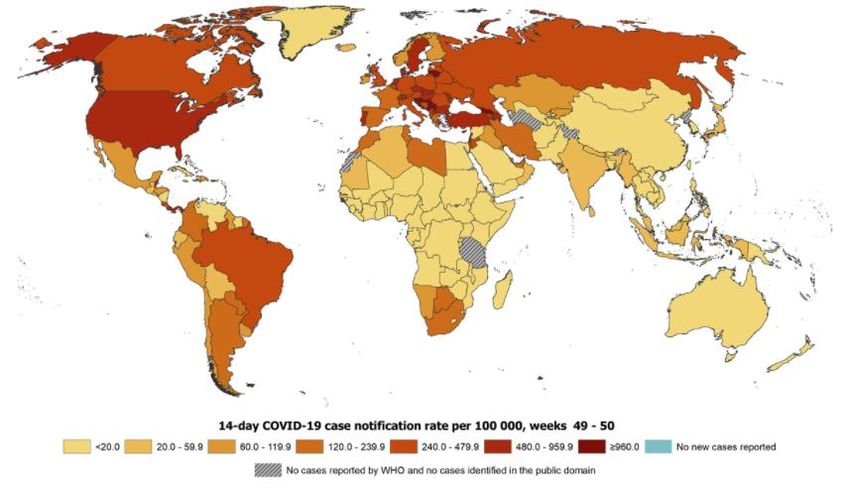
Fourteen-Day Cumulative Number of Reported COVID-19 Cases per 100,000 People

                                                          Source: European Centre for Disease Prevention and Control (ECDC)

©2020 Everbridge    Everbridge.com - 25 Corporate Drive, Suite 400. Burlington, MA, US 01803
                                                                                                                              2
Confirmed Cases Worldwide as of Tuesday Morning, December 17
                                     December         December                                           December   December
              Country/Region                                                     Country/Region
                                        17                8                                                 17          8
               United States         16,256,754      14,954,332                      Hungary             283,870    256,367
                    India            9,884,100       9,703,770                        Serbia             266,432    226,209
                    Brazil           6,901,952       6,623,911                        Jordan             259,614    244,069
                   Russia            2,653,928       2,488,912                         Nepal             248,423    241,995
                   France            2,376,852       2,295,908                       Ecuador             202,110    198,244
              United Kingdom         1,849,403       1,737,960                       Panama              193,007    179,230
                     Italy           1,843,712       1,742,557                       Georgia             191,063    169,649
                    Spain            1,751,884       1,702,328                     Kazakhstan            186,277    180,777
                 Argentina           1,498,160       1,466,309                United Arab Emirates       184,949    177,577
                 Colombia            1,425,774       1,377,100                         Japan             179,653    163,929
                 Germany             1,337,078       1,197,709                       Bulgaria            179,449    164,185
                   Mexico            1,250,044       1,182,249                        Croatia            175,886    152,239
                   Poland            1,135,676       1,067,870                     Azerbaijan            175,874    149,765
                     Iran            1,108,269       1,051,374                        Belarus            160,295    148,953
                   Turkey             995,471         545,711                  Dominican Republic        154,692    149,138
                     Peru             984,973         975,116                       Costa Rica           153,169    146,421
                  Ukraine             900,666         821,947                        Armenia             148,682    142,928
               South Africa           860,964         817,878                         Bolivia            147,150    145,657
                 Indonesia            617,820         581,550                        Lebanon             146,520    138,096
               Netherlands            612,746         563,608                         Kuwait             146,218    144,599
                  Belgium             611,284         592,479                          Qatar             141,121    140,086
                   Czechia            581,079         551,070                        Slovakia            132,984    117,283
                     Iraq             574,634         566,015                      Guatemala             129,282    125,674
                    Chile             571,919         562,142                        Moldova             126,518    117,495
                  Romania             556,335         517,236                          Oman              126,240    125,115
                Bangladesh            490,533         479,743                       Palestine            124,657    113,755
                   Canada             460,743         423,054                         Greece             124,534    116,721
                Philippines           449,400         441,399                          Egypt             121,575    118,847
                  Pakistan            440,787         423,179                        Ethiopia            116,769    113,735
                  Morocco             399,609         381,188                       Honduras             114,359    111,023
                Switzerland           372,329         352,875                         Tunisia            111,361    104,329
               Saudi Arabia           359,888         358,922                       Denmark              109,758     92,649
                    Israel            357,859         347,331                       Myanmar              108,342    100,431
                  Portugal            348,744         325,071                      Venezuela             107,177    104,442
                  Sweden              341,029         278,912                      Puerto Rico           107,158     99,486
                                                                                   Bosnia and
                   Austria             320,036         303,157                    Herzegovina            101,117     94,944
                             Source: European Centre for Disease Prevention and Control (ECDC), and various media outlets

©2020 Everbridge              Everbridge.com - 25 Corporate Drive, Suite 400. Burlington, MA, US 01803
                                                                                                                               3
Confirmed Cases Worldwide as of Tuesday Morning, December 17
                                           December       December                                     December   December
                   Country/Region                                               Country/Region
                                              17              8                                           17          8
                      Slovenia               96,314          86,288               Mozambique            16,954     16,326
                      Lithuania              95,021          77,426                  Namibia            16,536     15,219
                      Paraguay               93,582          88,723                   Angola            16,188     15,648
                       Algeria               92,102          88,825             French Polynesia        15,747     15,107
                        Kenya                91,892          88,579                   Cyprus            15,101     12,867
                                                                              Democratic Republic
                          Libya              90,779          87,097               of the Congo          14,512     13,749
                        Bahrain              89,143          88,111                   Guinea            13,457     13,264
                    Mainland China           86,789          86,646                 Maldives            13,368     13,213
                       Malaysia              83,475          74,294                 Botswana            12,873     11,531
                      Kyrgyzstan             77,674          75,690                 Tajikistan          12,704     12,469
                        Ireland              76,185          74,468                  Jamaica            11,710     11,184
                      Uzbekistan             75,094          74,206                Cape Verde           11,357     11,063
                   North Macedonia           73,638          68,332                    Malta            11,254     10,659
                        Nigeria              73,175          69,645                Zimbabwe             11,246     10,839
                      Singapore              58,320          58,273                Mauritania           10,971     9,516
                         Ghana               53,014          52,274                  Uruguay            9,708      7,505
                     Afghanistan             49,273          47,716                     Haiti           9,565      9,389
                        Albania              48,530          43,683                    Cuba             9,423      8,906
                        Kosovo               46,580          43,324                   Gabon             9,351      9,278
                     South Korea             43,484          38,755                    Belize           9,295      7,953
                      El Salvador            41,880          40,345                     Syria           9,166      8,490
                     Montenegro              41,426          38,562                Hong Kong            7,969      7,076
                     Luxembourg              41,272          38,215                 Bahamas             7,674      7,579
                        Norway               41,003          38,322                  Andorra            7,338      7,084
                       Sri Lanka             32,790          28,580                    Guam             7,106      7,019
                        Finland              30,810          27,881           Trinidad and Tobago       6,879      6,775
                       Australia             28,031          27,972                  Eswatini           6,768      6,529
                        Uganda               27,532          23,200                  Rwanda             6,659      6,191
                         Latvia              25,675          21,520                    Congo            6,200      5,774
                      Cameroon               25,359          24,752                  Malawi             6,066      6,051
                     Cote dIvoire            21,680          21,507                  Guyana             5,920      5,697
                         Sudan               21,386          19,747                 Nicaragua           5,887      5,838
                        Zambia               18,274          17,931                     Mali            5,814      5,290
                        Estonia              18,055          15,226                  Djibouti           5,728      5,708
                     Madagascar              17,638          17,513                   Iceland           5,557      5,496
                        Senegal              17,075          16,553                 Suriname            5,353      5,325
                             Source: European Centre for Disease Prevention and Control (ECDC), and various media outlets

©2020 Everbridge            Everbridge.com - 25 Corporate Drive, Suite 400. Burlington, MA, US 01803
                                                                                                                             4
Confirmed Cases Worldwide as of Tuesday Morning, December 17
December December December December
Country/Region Country/Region
17 8 17 8
Equatorial Guinea 5,195 5,166 Comoros 628 616
Aruba 5,049 4,966 Faroe Islands 528 510
Central African Republic 4,936 4,922 Mauritius 523 505
United Republic of
Somalia 4,579 4,579 Tanzania 509 509
Thailand 4,237 4,107 Bhutan 438 432
Burkina Faso 4,030 3,315 Bermuda 431 306
Gambia 3,782 3,770 Isle of Man 373 370
Curaçao 3,624 3,136 Cambodia 359 350
Togo 3,251 3,111 Cayman Islands 298 290
South Sudan 3,223 3,181 Barbados 296 287
Benin 3,090 3,073 Guernsey 289 288
Guinea Bissau 2,447 2,442 Saint Lucia 275 270
Sierra Leone 2,445 2,428 Seychelles 202 184
Bonaire, Saint Eustatius
Lesotho 2,285 2,150 and Saba 173 169
Niger 2,258 1,894 Brunei Darussalam 152 151
Yemen 2,083 2,383 Antigua and Barbuda 148 146
San Marino 1,947 1,800 Northern Mariana Islands 113 111
Saint Vincent and the
United States Virgin Islands 1,828 1,649 Grenadines 98 87
Jersey 1,779 1,388 Dominica 88 85
Liberia 1,771 1,676 British Virgin Islands 80 73
Chad 1,770 1,728 Grenada 69 41
New Zealand 1,740 1,729 Macau 46 46
Liechtenstein 1,514 1,431 Fiji 46 44
Vietnam 1,397 1,367 Laos 41 41
Sint Maarten 1,249 1,141 New Caledonia 36 35
Gibraltar 1,075 1,055 Timor Leste 31 31
Sao Tome and Principe 1,009 1,002 Saint Kitts and Nevis 28 25
Mongolia 912 888 Holy See 26 26
Turks and Caicos islands 769 756 Greenland 19 18
Falkland Islands
Western Sahara 766 766 (Malvinas) 19 17
Taiwan 740 718 Solomon Islands 17 17
Burundi 729 698 Montserrat 13 13
Papua New Guinea 725 671 Anguilla 10 9
Eritrea 711 649 Marshall Islands 4 4
Diamond Princess Cruise
Ship 696 696 Wallis and Futuna 3 3
Monaco 668 641 Vanuatu 1 1
Source: European Centre for Disease Prevention and Control (ECDC), and various media outlets
©2020 Everbridge Everbridge.com - 25 Corporate Drive, Suite 400. Burlington, MA, US 01803
5SPREAD OF COVID-19: ASIA/PACIFIC
COVID-19 cases in the Asia-Pacific region have climbed to at least 12,640,501, while deaths have reached at
least 195,945. Outbreaks are continuing in much of East Asia, with the situations in Hong Kong, Japan, and
South Korea proceeding unabated, while new cases have been reported in parts of mainland China and
Mongolia. In several countries in Southeast Asia, virus cases remain on a general upward climb, and Thailand
has reported a recent spike due to a cluster at a seafood market near Bangkok. India’s overall number of new
cases continues to fall. In Australia, a significant cluster near Sydney is expanding, with resultant restrictions
placed on Sydney and on travel out of the area to other states and territories. While there continues to be
progress toward the more widespread rollout of COVID-19 vaccines, there remains a risk of virus clusters
emerging in areas where the outbreak was previously under control, as illustrated by the cases of Australia
and Thailand, and bringing associated lockdowns and other disruptions.
East Asia
China
• Chinese authorities continue to report mostly imported COVID-19 cases; however, several local
infections have been confirmed in recent days, most notably an outbreak in the city of Dalian in
Liaoning Province. More than 12 virus cases have occurred in Dalian since December 15, including eight
on Monday, of which six were asymptomatic, which the Chinese government does not include in the
country’s official tally. Officials have again blamed the origin of the cluster on imported frozen
products.
o No widespread lockdown restrictions have been reported in Dalian, but officials are advising
residents of Jinpu New Area to remain at home if not out for essential reasons.
o Other recent cases of local transmission have been reported in Beijing, along with continuing
cases in Heilongjiang and Sichuan Provinces.
• Officials in Sichuan Province plan to make COVID-19 vaccines available to the general public beginning
in early February after first responders and other at-risk groups are inoculated.
Hong Kong
• Hong Kong’s number of new locally transmitted COVID-19 cases has fluctuated between 53 and 78 for
the past several days.
• Current social distancing restrictions are being extended until at least January 6, and officials have
warned that they may be increased if the outbreak worsens. In-person schooling has been suspended
until at least January 10.
• As of Tuesday, flights from the United Kingdom have been suspended due to the new virus strain
circulating in the UK.
©2020 Everbridge Everbridge.com - 25 Corporate Drive, Suite 400. Burlington, MA, US 01803
6Japan
•Japan averaged more than 2,700 new COVID-19 cases per day over the past week as the country’s
outbreak continues to expand. Cumulative infections in the country are now above 200,000, and the
death toll has climbed above 3,000.
o Most recent deaths have been reported in Aichi, Chiba, Hokkaido, Hyogo, Kanagawa, Osaka,
Saitama, and Tokyo.
• The medical system remains strained, and the Tokyo government plans to offer additional
compensation to hospitals treating COVID-19 patients, along with testing centers and pharmacies that
operate for extended hours during the holiday season.
Mongolia
• Lockdown measures are being reimposed in Ulaanbaatar from 6:00 AM local time on Wednesday,
December 23, until at least 6:00 AM on January 6 due to additional virus cases detected in the capital.
The lockdown is expected to include such measures as the closure of nonessential businesses and stay-
at-home orders for those not out for essential reasons.
South Korea
• An average of more than 1,000 new COVID-19 cases were reported daily in South Korea over the last
week. The country set new records for daily deaths and daily new infections on multiple days the past
week.
• With the hospital system remaining under strain, media sources report that several COVID-19 deaths
this month have occurred before patients were able to be admitted to crowded hospitals. Such cases
have been reported in Seoul, Gyeonggi Province, and other locations. Hundreds of COVID-19 patients
in Seoul have had to wait for two days or more to be accepted at a hospital.
• Private gatherings of more than four people are being banned until at least January 3.
Taiwan
• Taiwan this week announced its first locally transmitted case of COVID-19 since April. The patient had
contact with an international pilot who was infected.
o Taiwan’s Centers for Disease Control (CDC) is advising people who were at locations visited by
the pilot to monitor their health conditions and seek medical attention if experiencing COVID-
19 symptoms. A list of affected locations is available here:
https://www.cdc.gov.tw/En/Category/ListContent/tov1jahKUv8RGSbvmzLwFg?uaid=k72hT71K
xrunjqeDZEnDKA.
Southeast Asia
Indonesia
• Indonesia’s COVID-19 outbreak continues to grow, with the country averaging more than 6,900 new
daily cases for the past week. More than 20,000 people have now died from the virus in Indonesia.
©2020 Everbridge Everbridge.com - 25 Corporate Drive, Suite 400. Burlington, MA, US 01803
7• Anti-virus restrictions in Jakarta have been extended again and will now remain in place until at least
January 3.
Malaysia
•Malaysia averaged around 1,538 new COVID-19 infections daily over the past week, with many new
cases continuing to be reported in Kuala Lumpur and Selangor. Overall case numbers are continuing to
trend upward.
• Conditional movement control orders (CMCO) remain in place for Kuala Lumpur, Sabah, and parts of
Johor, Negeri Sembilan, Perak, Pulau Pinang, and Selangor through at least December 31. In these
areas, bars and clubs remain closed, and some other restrictions are in place.
• International students will be allowed to travel to Malaysia starting January 1.
• The government has made deals for COVID-19 vaccines with AstraZeneca and Pfizer/BioNTech, and is
working on deals with CanSino Biologics and Sinovac from China, and the Gamaleya Institute in Russia.
Some vaccines are also expected to be acquired from the WHO’s COVAX program. Malaysian
authorities expect to have enough vaccines to inoculate over 80 percent of the population, with
vaccinations planned to start in February. First responders and those in at-risk groups will be prioritized
for vaccination.
Myanmar
• An average of around 1,067 new COVID-19 cases were reported daily in Myanmar over the past week,
with confirmed cases continuing to decline steadily for the past month.
• Private hospitals are expanding COVID-19 testing and treatment in order to assist government
hospitals that continue to be strained by the pandemic.
• Lockdown restrictions have been lifted in Mandalay, but the government continues to advise people to
avoid crowded locations.
• Parks, lakes, and other such public locations in Yangon have been closed ahead of the holiday period in
an effort to prevent any spike in infections due to larger gatherings.
Thailand
• Thailand’s COVID-19 cases have spiked over the past few days due to the discovery of a cluster
centered on the Mahachai seafood market in Samut Sakhon, southwest of Bangkok. As of Tuesday,
more than 1,000 infections connected to the cluster have been confirmed. The majority of cases have
been detected in migrant workers from Myanmar employed at the market, and lockdown restrictions
have been imposed on the market and its environs.
o Testing is being carried out for around 10,000 workers and others connected to the cluster.
• Officials have indicated that further anti-virus restrictions may be implemented by later this week, but
no details have yet been released on what such directives might entail.
©2020 Everbridge Everbridge.com - 25 Corporate Drive, Suite 400. Burlington, MA, US 01803
8South Asia
India
• India confirmed an average of around 24,135 new COVID-19 cases every day for the last week. Fewer
than 20,000 new infections were reported on Monday, the first time the daily number has been that
low since the beginning of July.
• India will ban flights to and from the UK starting on Wednesday due to the new virus strain circulating
in the UK. The suspension will last through at least the end of the year.
o Authorities plan to trace anyone who arrived in India from the UK since November 25 for
possible testing if they are displaying COVID-19 symptoms.
• Media sources report that the Indian government is expected to approve AstraZeneca’s vaccine by
next week, with inoculations likely to begin in January.
Oceania
Australia
• Australia’s COVID-19 cluster that was detected last week in the Northern Beaches suburb of Sydney
has continued to expand, with as many as 90 infections now linked to the outbreak. Residents in the
Northern Beaches are under a stay-at-home order.
• Further restrictions have been implemented in the Greater Sydney area in response to the Northern
Beaches cluster, including a limit of ten people at home gatherings and limits on the number of people
at religious services and other events.
o The Northern Territory, Queensland, Victoria, and Western Australia have banned entry for
those who have been in Greater Sydney and are not traveling for essential purposes, while
most other states and territories continue to require quarantines for those who have been in
the area.
SPREAD OF COVID-19: NORTH AMERICA
United States
The COVID-19 situation in the U.S. remains poor as the country continues to report a record number of cases,
hospitalizations, and deaths. The seven-day daily case average has risen to over 215,000 and on Friday,
December 18, the U.S. reported over 250,000 cases in a single day for the first time ever. The increases come
even as a number of states in the Midwest and Northeast have begun to report decreases in cases, but record
numbers have been buoyed by a worsening situation in California, the new epicenter of the U.S. outbreak.
While testing has also continued to increase, with the seven-day testing average over 1.8 million, the national
test positivity rate has also risen and is now over 11 percent, suggesting that the U.S. is still missing positive
©2020 Everbridge Everbridge.com - 25 Corporate Drive, Suite 400. Burlington, MA, US 01803
9cases and allowing undetected spread of the virus. After reporting a slight decrease in hospitalizations over
the weekend, hospitalizations again increased on Monday and over 115,000 people were hospitalized due to
COVID-19. The ongoing record increase in hospitalizations has also led to a record number of deaths with the
seven-day daily death average now over 2,600. Last week, the U.S. reported over 3,400 deaths in a single day
twice and reported over 10,000 deaths in a three-day stretch. Public health officials have warned that travel
related to the Christmas holiday could lead to a further surge in cases and have cautioned people to limit
travel and gatherings, similar to warnings for the Thanksgiving holiday last month. There are currently
7,359,900 active cases, while an estimated 10,807,200 people have recovered. As of Tuesday, at least
18,057,100 COVID-19 cases and at least 319,827 deaths have been reported throughout the United States.
©2020 Everbridge Everbridge.com - 25 Corporate Drive, Suite 400. Burlington, MA, US 01803
10Canada
Canada is also reporting record numbers of new cases and hospitalizations; however, the overwhelming
majority of new cases are currently being reported in Ontario and Quebec, much like at the beginning of the
Canadian COVID-19 outbreak. The seven-day daily case average has increased to over 6,600 and last week
Canada reported its first day of over 7,000 cases. The national per capita rate of new cases has increased to
176.2 per million people; however, Ontario and Quebec are the only provinces currently reporting increases in
per capita average. Even as the western provinces of Alberta, Manitoba, and Saskatchewan are reporting
decreases, all three provinces are reporting higher per capita rates of new cases compared to the national
average and Alberta continues to report the highest of any province at 341.5. Record hospitalizations are also
continuing in Canada and as of Monday, over 3,600 people were hospitalized due to COVID-19. Increases in
daily deaths are also persisting and the seven-day average has risen to 111. The increases in Ontario and
Quebec have led to new restrictions in both provinces with Ontario announcing a new provincewide lockdown
beginning on December 26, while Quebec’s new restrictions have stopped short of instituting a full lockdown.
There are currently 77,361 active cases, while an estimated 423,621 people have recovered. As of Tuesday, at
least 515,314 COVID-19 cases and at least 14,332 deaths have been reported in Canada.
Recent Developments
• The U.S. and Canada announced the ongoing border closure to nonessential travel between the two
countries would be extended again through at least January 21.
• In response to reports of a new, more infectious strain of COVID-19 in the UK, Canada banned all
passenger flights from the UK between December 21 and December 24. Exception to the temporary
ban includes cargo flights, technical stops where passengers do not disembark, and emergency or
previously authorized situations.
• In response to multiple instances of people receiving the Pfizer/BioNTech COVID-19 vaccine suffering
serious allergic reactions, the U.S. Centers for Disease Control and Prevention (CDC) issued a warning
recommending that any person who has a known severe allergic reaction to any ingredients in the
vaccine to not receive it. People with histories of severe allergic reactions to other medications or
things not related to the vaccine may still get vaccinated. Vaccine providers have been advised that
everyone receiving the vaccine should be monitored for at least 15 minutes and those with a history of
allergic reactions for at least 30. Full CDC advice on allergic reactions and the Pfizer/BioNTech vaccine
can be viewed at the following link: https://www.cdc.gov/coronavirus/2019-
ncov/vaccines/safety/allergic-reaction.html.
• The Canadian government announced that the Canada Emergency Wage Subsidy program has been
extended through at least March 13, 2021. The program initially began in March 2020 and allows
companies affected by COVID-19 a wage subsidy rate of up to 75 percent. Full details on the
announcement can be viewed at the following link: https://www.canada.ca/en/department-
finance/news/2020/12/government-announces-wage-subsidy-rate-increase-to-75-per-cent.html.
©2020 Everbridge Everbridge.com - 25 Corporate Drive, Suite 400. Burlington, MA, US 01803
11• Last week, the U.S. Labor Department announced the number of Americans applying for new
unemployment benefits rose to 885,000, the highest weekly number since September. In total, at least
20.6 million Americans are currently receiving some type of unemployment benefits.
• Last week, the U.S. Food and Drug Administration (FDA) authorized the first over-the-counter rapid
COVID-19 antigen at-home test. The test was designed by Ellume, an Australian manufacturer, and the
company anticipates three million tests will be produced over the next month. The tests will cost US
$30 and be available for purchase at local pharmacies and online. Full details on the FDA authorization
can be viewed at the following link: https://www.fda.gov/news-events/press-
announcements/coronavirus-covid-19-update-fda-authorizes-antigen-test-first-over-counter-fully-
home-diagnostic.
• On Monday, December 21, armed protesters demonstrated outside the Oregon State Capitol in
opposition of ongoing restrictions within the state. Several dozen people participated in the action,
which included the group attempting to enter the Capitol after it had been closed for a special
legislative session to pass COVID-19 relief bills. The group allegedly used chemical agents and bear
spray against law enforcement and at least two people were arrested. While anti-restriction protests
have occurred intermittently in both the U.S. and Canada, this marked the most significant action since
the spring.
SPREAD OF COVID-19: EUROPE
As of Tuesday, December 22, the cumulative COVID-19 caseload in Europe, the Caucasus, and Central Asia has
risen to at least 21,605,000, including more than 497,000 deaths. The biweekly incidence and pace of new
infections have continued to rise amid the approaching Christmas period. Several of the most impacted
countries in the region, including Denmark and the Netherlands, appear to be moving toward a possible third
wave, with cases steadily increasing in recent weeks. Conversely, other countries, most notably Italy and Spain,
appear to be bringing their current waves under control, with new cases stabilizing. The increasing rate of new
infections and deaths has prompted a growing number of countries to impose anti-infection measures, including
France, which introduced a nationwide nightly curfew, and Germany and the United Kingdom, where authorities
have closed nonessential businesses and implemented new lockdown measures in an attempt to curtail travel
and gatherings. Nevertheless, it is expected that larger gatherings during the Christmas period will heighten the
risk of transmission and likely contribute to a sharp spike in new infections in the coming weeks. Moreover, as
the pandemic continues to evolve and cases continue to increase, there is a heightened potential for other
countries to follow suit and reinstate or harden their COVID-19 restrictions.
The recent emergence of a mutated SARS-CoV-2 variant, known as VUI2020/01, in the United Kingdom has
prompted numerous countries both inside and outside of Europe to temporarily ban travel to and from the
country. European nations such as Belgium, France, Germany, Italy, the Netherlands, Spain, and Switzerland,
have imposed a precautionary ban on travel into their respective territories from the UK for the foreseeable
future. It is worth noting that VUI-202012/01 has purportedly also been detected in Belgium, Denmark, and the
Netherlands; however, there were no indications of associated bans on travel from mainland Europe into other
©2020 Everbridge Everbridge.com - 25 Corporate Drive, Suite 400. Burlington, MA, US 01803
12countries in the region. Authorities in the UK suggest that this novel strain may have contributed to a recent
uptick in case incidence, although it is reportedly not associated with higher morbidity. While initial analyses of
the mutant strain indicate that it may be up to 70 percent more transmissible than other COVID-19 variants in
circulation, officials have assured that they do not foresee the diagnosis of the mutant strain to have any impact
on the progress of the vaccination program currently underway in the UK. The appearance of this new mutant
strain coincides with the EU’s preparation to authorize a vaccination for use in the bloc’s 27 member states. On
December 21, the European Commission ratified the BioNTech/Pfizer COVID-19 vaccine following a positive
recommendation from the European Medicines Agency (EMA). In response to concerns surrounding the efficacy
of the approved inoculation in relation to the newly discovered strain, Emer Cooke, the executive director of
the EMA, has stated that “there is no evidence” that the vaccine against COVID-19 is ineffective against the
novel strain. While the exact day when vaccine shipments will leave factories is unclear, forecasts suggest that
the first immunizations are on course to be administered in the region on December 27, with priority generally
awarded to healthcare workers, the elderly, and other high-risk groups. The President of the European
Commission, Ursula von der Leyen, has indicated that future authorizations would follow. The EMA is set to
review Moderna Inc.’s COVID-19 vaccine candidate on January 6, while also continually reviewing inoculations
from Oxford/AstraZeneca and Johnson & Johnson.
• Tier 4 restrictions and travel bans imposed on the UK by other countries are likely to incur supply chain
disruptions to businesses from a variety of sectors, such as manufacturing, due to delays in imports and
exports or cancellations of deliveries. Most notably, it raises potential concerns about food shortages at
a time of year when the UK produces very little of its own food and relies heavily on produce delivered
from the continent by road.
• On December 22, approximately 3,000 trucks remained stranded in England following the closure of the
border with France, and the backlog will reportedly take days to clear. Over the Christmas period, an
estimated 10,000 trucks travel between the port of Dover and the port of Calais per day.
• Germany’s airline Lufthansa is readying to cut a further 30,000 jobs this month, with an additional 10,000
anticipated to go in 2021. The airline is currently targeting employee roles abroad; however, next year,
Germany-based positions are expected to go due to negative impacts on the aerospace industry amidst
COVID-19 restrictions.
• In Britain, the Office for National Statistics revealed that retail sales fell by 3.8 percent in November on
the previous month following the imposition of lockdowns and restrictions that shut stores, ending a six-
month trend of rising sales. A 19 percent fall in clothing sales followed the closure of most department
stores and non-essential shops. Supermarkets and food stores, however, increased sales by 3.1 percent,
and the lockdown bolstered online shopping to a record total of 31.4 percent of all spending.
UPDATES AROUND THE REGION:
The daily number of cases in the United Kingdom has surged in recent weeks amid the onset of a possible third
wave following the identification of a new mutant strain of COVID-19, known as VUI2020/01. Despite this, the
number of daily deaths has fluctuated during this time. The largest daily case jump was recorded on December
©2020 Everbridge Everbridge.com - 25 Corporate Drive, Suite 400. Burlington, MA, US 01803
1320, and the greatest number of mortalities occurred on December 16, totaling 35,928 and 612, respectively.
Hospitalization rates are high in eastern England, with some cities exceeding hospitalization levels from the first
wave of the pandemic. The nation’s death toll currently stands at 67,616, second only to Italy in the bloc. In
response to the spike in infections and the new COVID-19 variant, Prime Minister Boris Johnson announced
tougher restrictions for parts of South East England, including London, which moved into a new Tier 4 on
December 20, wherein residents are to stay at home with the exception of essential activities until further
notice. Media reports have emerged indicating that additional police units are being deployed to major
transport hubs across the affected areas to enforce compliance with restrictive measures. Furthermore, in an
effort to address rising daily case incidence in their respective nations, the governments of Northern Ireland,
Scotland, and Wales have announced lockdowns. In Northern Ireland, a lockdown is expected to begin on
December 26 and will likely entail closing all non-essential retail establishments and limiting the hospitality
sector to takeaway services. From December 26, mainland Scotland will be locked down for at least three weeks,
resulting in non-essential shops, cafés, pubs, restaurants, and hairdressers to close. Only essential travel will be
permitted. In Wales, non-essential shops, close contact services, gyms, and leisure centers are closed as of
December 20. As of this writing, there has been no indication as to how long these measures are expected to
remain in effect.
The British Ministry of Health has highlighted that the new novel variant may be associated with faster
proliferation, with estimates indicating that it may be up to 70 percent more transmissible than other variants
in circulation. Nevertheless, it is unknown at this time to what extent the increase in infections in all age groups
is due to the new strain. Although the new variant is primarily concentrated in Tier 4 areas in England, it is also
present in lower tiered areas around the country. Public Health England has emphasized that every region has
recorded cases and the county risks seeing a continuous upsurge if infections are allowed to spread further. Tier
4 rules will be reviewed on December 30, as part of the wider review of all tier restrictions, with updated
guidance expected. The possibility that further restrictive measures on movement and/or gatherings may be
imposed across England in the coming days and weeks in an effort to curb viral spread cannot be discounted.
While there is no indication that the new variant is more lethal than current or previous COVID-19 iterations,
several European nations, including Belgium, France, Germany, Italy, the Netherlands, Spain, and Switzerland,
have temporarily banned travel to and from the UK. It cannot be ruled out that other countries take similar
action in the coming weeks. Investigations into potential consequences of this outbreak are ongoing, despite
preliminary analyses indicating that the emergence of the strain is unlikely to impinge vaccination efforts in the
UK and potentially elsewhere.
Media reports have emerged indicating that associated restrictions and travel bans are resulting in disruptions
to cargo transport, and British ports, which have already been under pressure due to COVID-19 restrictions and
a recent surge in worldwide container traffic, are under increasing strain. Disruptions to cargo transport may
result in shortages of produce and associated rising prices within the UK in the coming weeks. Moreover, Royal
Mail has reportedly suspended deliveries of packages and letters from the UK to mainland Europe, and postal
services from other countries in the region, such as Germany, to the UK have likewise been suspended until
further notice. It is recommended to be observant to the potential for disruptions to supply chains throughout
the UK and potential future shortages of produce in the country.
©2020 Everbridge Everbridge.com - 25 Corporate Drive, Suite 400. Burlington, MA, US 01803
14During the past two weeks, daily new infections have been surging rapidly in the Netherlands, with daily cases
numbering over 6,000 since December 8, continuing the trend of rising infections after the December 5 gift-
giving celebrations marking the birthday of Saint Nicholas. On December 20, the country recorded 13,032
infections, the largest single daily figure documented since the onset of the pandemic. Conversely, daily new
deaths have reached a plateau in the past two weeks, with the highest number of deaths being recorded on
December 15 and 18, with 86 and 84, respectively, before dropping off in recent days. The upturns have ushered
in a five-week lockdown across the nation, which is in effect as of December 15, and expected to last for a period
of five weeks. Public places such as gyms, museums, cinemas, and hairdressers are closed until January 19, while
supermarkets, banks, and pharmacies remain open. Schools are closed until January 18. Residents are advised
to stay at home whenever possible and households are not authorized to have more than two visitors, with the
exception of December 24 to 26, when they can welcome up to three. Possible changes to restrictive measures
for the Christmas season and the start of the new school year in January will be reviewed by government officials
and, if ratified, will be announced in the coming days. Health Minister Hugo de Jonge has announced that
vaccinations are expected to begin being administered on January 8 with the first injections allocated for
healthcare workers.
Daily new cases in Italy have been on a downward trend since mid-November. On December 22, 10,870 new
infections were recorded, marking a 62 percent decrease from the 28,334 infections documented on November
22. Nonetheless, the nation is currently experiencing the highest number of daily deaths since the end of March,
with an average of 615 deaths per day between December 8 and 22. While daily new deaths have dropped
slightly in the past few days, such downturns have been seen previously and were followed by surges; as such,
there were 887 deaths recorded on December 10 and a further 846 documented on December 15. The nation
has now suffered 69,214 COVID-19-related fatalities, surpassing the UK as the most impacted European country.
Despite recent promising trends, the possibility that daily case incidence and daily new deaths may rise
significantly in the foreseeable future cannot be ruled out. Indeed, the health ministry recently announced that
an estimated one in 30 Italians have been infected since the virus first appeared in the country in February.
Many Italian regions are under partial lockdown, under a three-tier system, and a ban on travel between
different regions from December 21 to January 6 has been announced. In addition, people will not be allowed
to leave their hometowns on December 25 and 26 and January 1, aside for certain exemptions. Churches will
remain open; however, a daily curfew from 10:00 PM to 5:00 AM may stymie Midnight Mass participation.
Restrictions are variable on a regional basis, and it is advised to continue monitoring developments associated
with local measures.
Infection rates and mortalities in France have declined sharply since the peak of the second wave last month
and have remained constant during the past two weeks. There were some 5,797 cases and 351 deaths recorded
on December 22, representing decreases of 58 percent and 29 percent, respectively, between December 8 and
22. Prime Minister Jean Castex lifted the lockdown on December 15, as daily infection rates and hospital
intensive care unit occupancy remained below the prescribed thresholds. In a further attempt to prevent a new
uptick in COVID-19 infections, a nationwide nightly curfew is in effect between 8:00 PM and 6:00 AM local time,
with the exception of December 24, and will remain in place until at least January 20. Travel between regions in
France is permitted and establishments such as schools and shops are open. Restaurants, cafés, cinemas,
museums, and ski resort lifts remain closed, along with universities, which will be closed until at least February.
©2020 Everbridge Everbridge.com - 25 Corporate Drive, Suite 400. Burlington, MA, US 01803
15On December 20, the government barred the entry of trucks from the UK for 48 hours in response to the
outbreak of the mutant strain. On December 22, an agreement was reached between the respective countries’
governments, whereby passengers from the UK have been permitted to enter France from December 23 with a
negative COVID-19 test result. Health officials continue to warn of the risk of a third wave of infection if people
fail to heed the advice of health authorities in the coming weeks.
The epidemiological situation in Germany has deteriorated consistently since December 8. The average number
of new daily COVID-19 infections has undergone an increase in recent weeks. On December 18, health officials
documented 31,553 new cases and 838 new deaths, the highest single-day respective totals to date, and both
metrics appear to be on an upward trajectory. In response to this uptick, President Frank-Walter Steinmeier has
tightened measures in an attempt to curb daily infection numbers amidst the festive period. A new nationwide
lockdown was implemented on December 16 and is slated to last until January 10, whereby all non-essential
shops will be closed, and gatherings will be limited to a maximum of five people from two households.
Nevertheless, the possibility that additional restrictive measures will be imposed in the next week, both locally
and nationally, cannot be ruled out. Health Minister Jens Spahn has indicated that COVID-19 vaccinations are
expected to begin being administered on December 27, with the first doses reportedly designated for occupants
of care homes.
In Spain, data from the health ministry also showed 7,530 new COVID-19 cases were recorded on December 22,
bringing the total number of infections since the onset of the pandemic to 1,830,110. Nonetheless, there has
been a stable drop in daily case incidence in recent days, following a surge between December 15 and 18, which
resulted in a high of 10,419 infections being documented on December 18, the highest daily total in over a
month. The period since December 8, meanwhile, has been characterized by sporadic spikes in daily deaths. The
mean number of daily mortalities recorded during the past fortnight is 192, the highest average in a month. It
is worth noting that, while daily new deaths have shown a promising trend in the past few weeks, an uptick in
daily deaths is possible in the foreseeable future alongside a potential surge in daily new infections during the
Christmas period. In response, the government has approved a set of directives for the period between
December 23 and January 6 to stem possible resurgent infections. During this window, travel between regions
will be allowed, provided people are visiting friends and family. Social gatherings on December 24, 25, and 31,
and January 1 will be limited to ten people. Curfews remain in effect across the country, with variability by
region in the times between which movement is prohibited; curfews begin between the hours of 10:00 PM and
12:00 AM local time depending on location and end at 6:00 AM. Regional governments, however, can modify
curfew times and can also close regional borders for travel if deemed necessary. The current nationwide curfew
will be extended to 1:30 AM on December 24 and 31.
Health authorities in Portugal documented 98 COVID-19-related deaths on December 13, the highest daily total
since the inception of the virus. After a relatively mild first wave, daily cases rose sharply in the second, but have
plateaued in recent weeks. Daily deaths on the other hand, have numbered above 55 since December 8,
representing the greatest average death toll across a given two-week period to date. President Marcelo Rebelo
de Sousa extended the state of health emergency until December 23, with media reports suggesting that it is
expected to be further extended until January 7. Under the state of emergency, working from home is
mandatory for people in the top three of the four tiers, affecting more than 80 percent of the population. These
©2020 Everbridge Everbridge.com - 25 Corporate Drive, Suite 400. Burlington, MA, US 01803
16areas also have a curfew in place between 11:00 PM and 5:00 AM local time. Despite such restrictions, rules
have been relaxed. Namely, travel between regions will be allowed from December 23 to 26, and on December
24 and 25, the curfew will be from 2:00 AM to 5:00 AM. Government officials have indicated that a vaccination
plan is projected to have almost one million people vaccinated against COVID-19 between January and April.
In Denmark, daily new cases have been on an upward trajectory since December 8. There were some 4,508
cases recorded on December 18, a new record, while 21 deaths were documented on December 21, the highest
number since early April. Daily new deaths have experienced an uptick over the past few weeks after having
held steady since the first wave of the pandemic. To address these trends, additional restrictions have been
imposed nationwide to mitigate the spread of COVID-19 from December 16, whereby catering establishments
are only authorized to offer takeaway services and facilities such as gyms, museums, cinemas, and sports centers
are closed. Furthermore, all retail businesses, with the exception of supermarkets, pharmacies, and other stores
which sell daily essentials, will be closed from December 25 through January 3. Travel between different regions
of the country is authorized, and health authorities have no plans at this time to impose travel restrictions.
Daily case incidence in the Czech Republic has been rising since December 8 and there were 3,387 cases
documented on December 22. Daily new deaths have been increasing, although they appear to have possibly
reached a plateau in the past few days. There were 86 deaths recorded on December 22, compared with the
128 deaths on December 15, which marked the highest single-day death toll since November 28. In an effort to
curb the spread of COVID-19 in the country, new restrictive measures are in effect as of December 18, whereby
restaurants, hotels, and indoor sports venues are closed, public gatherings will be limited to six people, both
inside and outside, and there is a nationwide nightly curfew between the hours of 11:00 PM and 5:00 AM local
time. Retail establishments remain open. The possibility of further restrictions being imposed in the future in
the event of a spike in new cases and deaths in the coming weeks cannot discounted.
SPREAD OF COVID-19: LATIN AMERICA AND THE CARIBBEAN
As of Tuesday, December 22, the cumulative COVID-19 caseload in Latin America and the Caribbean has risen
to at least 14,837,727. This amounts to an increase of 8.6 percent since the last worldwide Situation Report
was issued on December 8, which is very close to the 8.4 percent increase observed during the previous two-
week period. Over the last week, both Brazil and Colombia have broken their previous records for the most
new cases of COVID-19 recorded in a single day. Brazil continues to report the highest cumulative caseload in
the region (7,263,619), followed by Argentina (1,547,138), Colombia (1,518,067), Mexico (1,325,915), Peru
(997,517), and Chile (589,604). The region-wide death toll has climbed to 489,178.
Many countries across Latin America and the Caribbean have ratcheted up mobility restrictions ahead of the
upcoming holidays. Nevertheless, public non-compliance with anti-infection measures remains a widespread
©2020 Everbridge Everbridge.com - 25 Corporate Drive, Suite 400. Burlington, MA, US 01803
17challenge, and it is expected that Christmas and New Year’s Eve gatherings will likely contribute to a sharp
spike in new infections in the coming weeks.
In recent days, several countries throughout the region (including Argentina, Chile, and Colombia) have
suspended commercial flights to and from the United Kingdom, after a new and potentially more contagious
mutant variant of COVID-19 was discovered in the country. Some Latin American governments have taken
even more stringent measures. Peru, for instance, has banned all flights to and from Europe for at least two
weeks. Concerns about the growing number of infections in Brazil have similarly led to Uruguay and Suriname
once again closing their land, air, and maritime borders to all non-essential traffic. Given the current trajectory
of the situation, it appears likely that additional governments throughout Latin America and the Caribbean will
reinstate more stringent border controls and movement restrictions in the coming days and weeks.
Latest Developments in Worst-Affected Countries
Brazil
• The average number of new daily COVID-19 infections across Brazil has risen sharply over the last week,
surpassing the previous record that had been set in July.
• Public health authorities have expressed concern that the public will increasingly flout health protocols
with the onset of summer. Beaches in Rio de Janeiro and other parts of the country have grown
increasingly crowded in recent weeks.
• Starting on December 30, all new arrivals from foreign countries will be required to provide proof of a
negative RT-PCR (real-time reverse transcription polymerase chain reaction) COVID-19 test to their airline
prior to departure. The test must be administered no more than 72 hours beforehand.
• Brazil’s Federal Supreme Court has issued an injunction allowing state governments to purchase COVID-19
vaccines that have been approved by international health agencies, even if they have yet to be authorized
by the Brazilian National Health Surveillance Agency (ANVISA).
Argentina
• The average daily incidence of new COVID-19 cases in Argentina has risen over the last week and a half.
• On Tuesday, December 22, the Argentine Ministry of Health indicated that it was assessing the prospect of
closing the country’s borders once again, as was done at the onset of the pandemic. Epidemiologists have
indicated that they are currently more concerned about the rising number of infections in neighboring
Brazil than the emergence of the new COVID-19 variant in the UK.
©2020 Everbridge Everbridge.com - 25 Corporate Drive, Suite 400. Burlington, MA, US 01803
18• The administration of President Alberto Fernández has reportedly come close to striking a deal with U.S.
drugmaker Pfizer that would guarantee Argentina 1,500,000 doses of the company’s COVID-19 vaccine
between January and March.
Colombia
• The average number of new daily cases of COVID-19 across Colombia has sharply increased over the last
week, surpassing the previous record that was set in August. The country’s cumulative caseload has
surpassed the milestone of 1.5 million.
• Public health officials have attributed the “second wave” of infections to the uptick in holiday gatherings.
Multiple cities have reintroduced more stringent anti-infection measures.
o Starting on Monday, December 21, Bogotá reinstated a series of mobility restrictions known as
“pico y cédula.”
▪ While the policy is in effect, each family must designate a single individual to leave the
home for shopping, banking, etc. Individuals with IDs ending in even numbers are permitted
to leave the home for such errands on odd-numbered dates, and vice versa.
▪ Exceptions are granted for healthcare needs, trips to the pharmacy, and legal/financial
services requiring the presence of multiple people.
▪ The policy is slated to remain in effect through January 15.
o In Medellín, the pico y cédula policy will be in effect from December 22 through December 31.
Additionally, a continuous curfew will run from 8:00 PM local time on December 24 to 6:00 AM on
December 26, and from 8:00 PM on December 31 through 6:00 AM on January 2.
o In Cartagena, pico y cédula will be observed in 11 districts from December 22 until January 16.
Mexico
• The average daily incidence of new COVID-19 infections in Mexico has fluctuated over the last week,
remaining slightly below the record high that was set in early December.
• On Saturday, December 19, Mexico City and the surrounding state of Estado de México reverted to the
“red” level of the country’s color-coded “traffic light” reopening program. Both are tentatively slated to
remain in this phase at least through January 10.
o The “red light” is the most restrictive level of lockdown. It necessitates the closure of all non-
essential businesses and activities. Essential sectors that will remain exempt include
industry/manufacturing, healthcare, energy, financial services, grocery stores, take-out food, public
transit, funeral services, construction, and various repair shops.
©2020 Everbridge Everbridge.com - 25 Corporate Drive, Suite 400. Burlington, MA, US 01803
19o The Mexico City Metro has temporarily shut down service to multiple stations in an effort to curb
non-essential movement.
o Hospitals across Mexico City are reportedly 82 percent full, and those throughout Estado de México
have reportedly exceeded 75 percent of their maximum capacity.
o Nevertheless, numerous activist groups have organized marches throughout downtown Mexico
City to protest against the anti-infection measures. More demonstrations of this nature will likely
take place while the “red light” restrictions remain in effect.
• Dr. Mike Ryan, the executive director of the WHO’s Health Emergencies Program, has stated that Mexico
never truly emerged from the “first wave” of COVID-19 infections to grip the country.
Peru
• The average number of new daily COVID-19 cases in Peru is at roughly the same level as it was two weeks
ago, following moderate fluctuation.
• As of this writing, Lima has not yet finalized any deals with drugmakers to purchase COVID-19 vaccines.
This can be largely be attributed to the political turbulence that the country has recently experienced,
having three different presidents in less than a week in early November.
• Still, the Peruvian Ministry of Health reports that the country will receive its first COVID-19 vaccines
through the World Health Organization’s COVAX (COVID-19 Vaccines Global Access) program in the first
quarter of 2021.
• Due to concern about the emergence of a new and potentially more infectious variant of COVID-19 in the
UK, President Francisco Sagasti announced a two-week ban on all flights to and from Europe on Monday,
December 21.
Chile
• The average number of new daily COVID-19 cases throughout Chile has steadily risen since early
December, reaching a level not seen since early August.
• Troops from the Chilean Army have been tasked with manning checkpoints and conducting audits
throughout the Santiago Metropolitan Region, to ensure compliance with the latest COVID-19 restrictions.
Last week, the capital reverted to a more stringent set of anti-infection measures under the country’s
“Paso a Paso” (Step by Step) reopening plan.
• The Chilean Army has evacuated 36 infected personnel from the Bernardo O'Higgins Riquelme Base in
Antarctica. The outbreak marks the first time that COVID-19 has appeared on the continent.
©2020 Everbridge Everbridge.com - 25 Corporate Drive, Suite 400. Burlington, MA, US 01803
20Other Updates around the Region
• The average number of new daily COVID-19 infections in Belize hit a record high on December 9, but has
since fallen sharply. An indefinite nationwide nightly curfew from 8:00 PM to 5:00 AM entered into effect
on December 20.
• Ecuador declared a 30-day state of emergency on December 20. All travelers arriving from or transiting
through the European Union, the UK, Australia, or South Africa must present a negative PCR test that was
taken within the last ten days. A 15-day nightly curfew from 10:00 PM to 4:00 AM was also enacted, along
with restrictions on alcohol and new maximum occupancy limits for stores, hotels, and restaurants. All
social gatherings have been capped at ten people, and new driving restrictions have been imposed.
• Honduran authorities have announced that all mobility restrictions will be lifted between the hours of 5:00
AM and 10:00 PM on December 24, 25, 31, and January 1. Bars and nightclubs will be required to remain
closed.
• Puerto Rico received 47,500 doses of Moderna’s COVID-19 vaccine on Monday, December 21. Another
shipment with 21,400 doses of the Pfizer/BioNTech vaccine is scheduled to arrive on Wednesday.
Authorities have indicated that the doses should be sufficient to inoculate all of the territory’s front-line
medical personnel, police officers, firefighters, and utility workers.
• In an attempt to stem new imported cases of COVID-19, Suriname closed all of its land, air, and maritime
borders on December 22. Exceptions will be granted for select categories of essential travel.
• Starting on Monday, December 21, Uruguay closed all of its land, air, and maritime borders to non-
essential travel. More than 500 troops from the nation’s army and navy have been deployed to 25
checkpoints along the border with Brazil and Argentina. All borders will remain open to the flow of cargo
and humanitarian aid.
SPREAD OF COVID-19: MIDDLE EAST AND NORTH AFRICA
As of December 22, the cumulative COVID-19 caseload for the Middle East and North Africa (MENA) region
has risen to 7,191,166, including 139,268 virus-related deaths. This amounts to an increase of about 28
percent since the last Worldwide Situation Report was issued on December 8, compared to approximately 20
percent from November 25-December 7. The large jump is likely at least partially due to a recent change in
reporting methods in Turkey which led to the country recording approximately a 140 percent increase over
the past two weeks, skewing overall data upward, as most countries individually recorded decreasing infection
rates, with only a handful experiencing slight rises. Turkey has taken over as the worst-affected country in the
region in terms of total caseload, followed by Iran, Iraq, Pakistan, and Morocco.
©2020 Everbridge Everbridge.com - 25 Corporate Drive, Suite 400. Burlington, MA, US 01803
21Despite most countries appearing to have gained control of their outbreaks, health experts warn of a general
resurgence during the upcoming Christian holidays and the New Year, as civilians gather for celebrations and
ceremonies both outdoors and indoors. Concerns of a resurgence also arose as mutated strains of the virus
were detected in the United Kingdom (UK) and South Africa over the past few days, causing many countries to
either completely shut down their borders or suspend travel to and from effected nations. Although not much
is currently known about the variant strains of COVID-19, officials speculate that existing vaccines will still be
effective against it. Indeed, over the past two weeks, MENA countries have increasingly authorized the use of
various vaccines, including the Pfizer, Moderna, and Sinopharm vaccines. Although nationwide vaccination
campaigns breathe new hope into promises for economic recovery and return to normalcy in the long term,
inoculation programs may not be significantly effective in the immediate future. Concerns remain regarding
how effective vaccines will be, and accessibility to vaccines in poorer countries and refugee camps. Moreover,
the introduction of the vaccine, coupled with general sense that the pandemic has died down, may lead to
people becoming increasingly negligent regarding anti-virus measures. As such, most nations are likely to
continue familiar anti-COVID-19 measures for the foreseeable future, and renewed internal lockdowns are
possible in some areas where the outbreak is worsening.
The rate of infection across the region has accelerated over the past two weeks, compared to a relatively
stable period between August and November. However, most nations witnessed decreasing rates of
infection or negligible increases, suggesting the jump may be attributed to the significant resurgence seen in
Turkey over the past two weeks.
• The rate at which COVID-19 is spreading throughout the MENA region has increased since the last
worldwide Situation Report was issued on December 8 to 27.91 percent, compared to 19.39 percent
from November 25-December 7.
• Case incidence has increased over the past two weeks in Israel (9.38%), possibly due in part to recent
Hanukkah celebrations, which saw large crowds gathering, reportedly ignoring social distancing
directives.
• As the rate of infection continues to rise in Egypt (6.25%), on December 20, an official stated that the
true number of infections is at least ten times the official number. The country also recorded its
highest number of daily cases since July on December 21, at 718 cases over the previous 24 hours.
• Saudi Arabia recorded only eight virus-related deaths over the past 24 hours, marking the lowest death
toll since last spring, as the rate of infection (0.62%) continues to decline.
• Other countries in the Gulf, including Qatar (1.5%), Oman (2.25%), Kuwait (2.28%), and Bahrain
(2.65%), continue to boast the slowest rates of infection, suggesting the Gulf region has largely gained
control of the virus outbreak.
Concerns of a resurgence of the virus intensified over the past week, following the detection of variant
strains of COVID-19 in the UK and South Africa. In response, a handful of countries have implemented travel
restrictions, either completely closing borders or suspending flight from effected countries. Cargo transport
via airplanes, ships and trucks are largely excluded from the border lockdowns.
• In Saudi Arabia, the government announced on December 21 that all international flights have been
suspended for one week, except for foreign travelers currently in the Kingdom returning to their
©2020 Everbridge Everbridge.com - 25 Corporate Drive, Suite 400. Burlington, MA, US 01803
22You can also read


