Zimbabwe's International Re-engagement - The Long Haul to Recovery - Chatham House Report
←
→
Page content transcription
If your browser does not render page correctly, please read the page content below
Chatham House Report
Knox Chitiyo and Steve Kibble

Zimbabwe’s
International
Re-engagement
The Long Haul to Recovery
Chatham House Report
Knox Chitiyo and Steve Kibble
April 2014

Zimbabwe’s
International
Re-engagement
The Long Haul to Recovery
Chatham House has been the home of the Royal Institute
of International Affairs for ninety years. Our mission is
to be a world-leading source of independent analysis,
informed debate and influential ideas on how to build
a prosperous and secure world for all.

The Royal Institute of International Affairs                                        ISBN 978 1 78413 007 7

Chatham House                                                                       A catalogue record for this title is available from the British Library.
10 St James’s Square
London SW1Y 4LE                                                                     Cover inage © Getty Images.
T: +44 (0) 20 7957 5700                                                             Typeset by Soapbox, www.soapbox.co.uk
F: + 44 (0) 20 7957 5710
www.chathamhouse.org                                                                Printed and bound in Great Britain by Latimer Trend and Co Ltd

Charity Registration No. 208223                                                     The material selected for the printing of this report is manufactured from
                                                                                    100% genuine de-inked post-consumer waste by an ISO 14001 certified mill
© The Royal Institute of International Affairs, 2014                                and is Process Chlorine Free.
Chatham House, the Royal Institute of International Affairs, does not express
opinions of its own. The opinions expressed in this publication are the
responsibility of the authors.

All rights reserved. No part of this publication may be reproduced or
transmitted in any form or by any means, electronic or mechanical including
photocopying, recording or any information storage or retrieval system, without
the prior written permission of the copyright holder. Please direct all enquiries
to the publishers.

ii | Chatham House
Contents
About the Authors iv
Acknowledgments iv
List of Acronyms v
Executive Summary and Recommendations vii
Maps of Zimbabwe and the Region x
1 Introduction 1
2 The Post-election Political Landscape 3
3 Zimbabwe’s Economy: Crisis and Resilience 8
4 The Way Ahead: ZIMASSET and Templates for Success 17
5 The Security Sector 22
6 Zimbabwe and the Region 26
7 Zimbabwe and the West 30
8 Conclusion 34
Chatham House | iiiAbout the Authors Acknowledgments Knox Chitiyo is an Associate Fellow of the Chatham House This report was written following visits to Zimbabwe Africa Programme. He is also Chair of the Britain Zimbabwe in 2013. The authors would like to thank the numerous Society and was previously Head of the Africa Programme at individuals who took time to share their expertise and the Royal United Services Institute. He was Senior Lecturer opinions, and Christopher Vandome, Administrator and in War Studies and History at the University of Zimbabwe Research Assistant, Africa Programme, Chatham House, and the Deputy Director of the Centre for Defence Studies. for his input. All errors, of course, remain the responsibility He has taught at the Zimbabwe Staff College and at regional of the authors. The research and publication of the report defence institutions, and has published on Zimbabwean and were funded by the Chatham House Director’s Research wider African defence, development and diaspora issues. He Innovation Fund. was an election monitor in Zimbabwe in 2000 and Sudan in 2010 as part of the International Observer Group. He is on the Council of the Institute of Commonwealth Studies. Steve Kibble holds a doctorate in southern African politics from the University of Leeds. He has lobbied and written extensively on Southern Africa, Eastern Africa and Timor- Leste for the Catholic Institute for International Relations (now Progressio), for which he worked from 1990 until retiring in 2013. He was a founder member of the Zimbabwe Europe Network (ZEN), a pan-European information and lobbying network. He retired as ZEN chair in December 2013. iv | Chatham House
List of Acronyms

AEC      African Economic Community                     OFAC       US Treasury Office of Foreign Assets
                                                                   Control
ANC      African National Congress
                                                        REC        Regional Economic Community
AU       African Union
                                                        SADC       Southern African Development Community
BMATT    British Military Advisory and Training Team
                                                        SDN        Specially Designated Nationals
CIO      Central Intelligence Organisation (Zimbabwe)
                                                        SMP        Staff Monitoring Programme
CISSA    Committee of the Intelligence and
         Security Services of Africa                    SSR        Security-sector reform
COMESA   Common Market for Eastern and                  STERP      Short- term Economic Recovery Programme
         Southern Africa
                                                        UNWTO      United Nations World Tourism Organization
CSOs     Civil society organizations
                                                        ZANLA      Zimbabwe African National Liberation Army
CZI      Confederation of Zimbabwe Industries
                                                        ZANU–PF    Zimbabwe African National Union–Patriotic
DRC      Democratic Republic of the Congo                          Front
EAC      East African Community                         ZAPU       Zimbabwe African People’s Union
FADM     Mozambique’s national forces (Forças           ZBC        Zimbabwe Broadcasting Corporation
         Armadas da Defesa de Moçambique)
                                                        ZDF        Zimbabwe Defence Forces
FDI      Foreign direct investment
                                                        ZEC        Zimbabwe Electoral Commission
FLS      Frontline states
                                                        ZESA       Zimbabwe Electricity Supply Authority
GNU      Government of National Unity
                                                        ZETF       Zimbabwe Economic Task Force
GPA      Global Political Agreement
                                                        ZIA        Zimbabwe Investment Authority
HIFA     Harare International Festival of the Arts
                                                        ZIDERA     Zimbabwe Democracy and Economic
HIPC     Heavily Indebted Poor Countries                           Recovery Act
IDASA    (South African) Institute for Democracy in     ZIMASSET Zimbabwe Agenda for Sustainable Socio-
         Africa                                                  Economic Transformation
IMF      International Monetary Fund                    ZIPRA      Zimbabwe People’s Revolutionary Army
MDC-N    Movement for Democratic Change –               ZMDC       Zimbabwe Minerals and Diamond Corporation
         Ncube
                                                        ZNA        Zimbabwe National Army
MDC-T    Movement for Democratic Change –
                                                        ZPS        Zimbabwe Prison Services
         Tsvangirai
                                                        ZRP        Zimbabwe Republic Police
NCA      National Constituent Assembly
                                                        ZSE        Zimbabwe Stock Exchange
NGO      Non-governmental organization
                                                        ZUNDE      Zimbabweans United for Democracy
NSC      National Security Council

                                                                                                    Chatham House | v
Zimbabwe’s International Re-engagement: The Long Haul to Recovery
About the Africa Programme
About the Africa Programme
The Africa Programme at Chatham House develops independent Current research areas include:
policy-focused research on issues affecting individual states of
• Governance and transparency
Africa, their relations in the international system and African
• Piracy and armed non-state actors
regional and continental politics.
• Africa and the international system
Since its establishment in 2002, the Africa Programme has • Peace and security
grown to become one of the world’s leading independent centres • Resources and society
for policy research and debate on the continent’s international
The Africa Programme has an international network of research
politics. With the transformation of Africa’s international
partners around the world and works closely with other
position, the Programme has worked to improve the quality
institutes to promote analysis with a global perspective.
of information available to international policy- and decision-
makers. Programme events provide the opportunity for world-renowned
figures from across Africa and beyond to offer their perspectives
The Programme’s research priorities emphasize issues affecting
on issues pertinent to the national, regional and international
individual African states and the continent as a whole that are
politics of the continent. More information is available at
currently under-researched, and the major African issues of main
www.chathamhouse.org/africa.
interest to the international community.
vi | Chatham HouseExecutive Summary and Recommendations
A landslide victory by the Zimbabwe African National Zimbabwe faces daunting but not insurmountable economic
Union–Patriotic Front (ZANU–PF) in Zimbabwe’s elections challenges that have to be addressed by the government in
in 2013 resulted in its comprehensive recapture of the state. cooperation with other local and foreign stakeholders.
The endorsement of the results by the Southern African
The past year has seen more business closures in Zimbabwe
Development Community (SADC), the Common Market
than at any time since 2008; emigration has increased, as
for Eastern and Southern Africa (COMESA), the African
has the cost of living; and poor service delivery remains
Union (AU) and the UN confirmed ZANU-PF’s grip on
a national bone of contention. In order to improve the
power. It also symbolized Zimbabwe’s readmittance into the
economy, the government needs to engage and partner
international community, although the United Kingdom,
local stakeholders. It must also upgrade its portfolio of
European Union, United States, Australia and others
international economic relations. Although Zimbabwe
expressed deep concerns about the credibility of the polls.
had engaged with the international financial community
Many international actors want to bring closure to more under the GNU, the latest economic crisis is pushing the
than 17 years of political crisis in Zimbabwe. The invitation government to try to accelerate progress on the ‘re-set’
by the EU to President Robert Mugabe to attend the fourth with the World Bank, the International Monetary Fund,
EU–Africa summit in Brussels in April signalled both a the African Development Bank, the Paris Club and other
response to African pressure and the desire to normalize international financial institutions.
relations. President Mugabe, however, decided to boycott
The policy options for the government are increasingly
the summit. On 20 February, the EU also agreed to suspend
limited as a result of the liquidity crisis. Zimbabwe, which
most sanctions on Zimbabwe except in the defence sphere
endured an austerity economy under the GNU, now has
and on President Mugabe and his wife Grace (until a review
to respond to a crisis economy in many sectors. Some of
in February 2015). Memories of a near-decade of economic
its problems are of long standing: the adoption of the
crisis from 2000 to 2008 are still vivid, and debate continues
multi-currency system in 2009 ceded monetary policy to
in and between Europe and the United States over how
international actors, the declining tax base dramatically
quickly bilateral relations should be fully normalized. Some
reduced the fiscal policy space, and a decade of uncertainty
believe that meaningful change will not occur in Zimbabwe
has resulted in low levels of investment, a diminished
until the 90-year-old president no longer governs, hence the
consumer base and a reduction in the manufacturing
extension of the personal sanctions.
sector. Corruption is also a major problem.
Given the results of the 2013 election, the lifting of most EU
This report highlights the huge challenges Zimbabwe
sanctions and the continued economic challenges facing
faces; but it also notes there are some positive indicators.
the country, this report argues in favour of accelerating
The government, through its dialogue with the local and
Western re-engagement with Zimbabwe now, rather than
international business sector and other stakeholders, and
after presidential change. Leadership transitions can often
through its re-engagement drive, has indicated that it is
disrupt expectations in the short run. Although inter- and
taking the economic challenges seriously and wants to re-
intra-party political disputes will continue, the Zimbabwean
stabilize the economy.
government can no longer blame the West for the country’s
continued economic underperformance. The economy Economic collapse is not inevitable but if Zimbabwe is
stabilized under the Government of National Unity (GNU) to avoid this outcome, the government needs to adopt
that was in office from 2009 to 2013, but the resulting policies to build international business confidence, support
economic growth was ‘dead’ growth: impressive figures technocratic and entrepreneurial expertise at home as well
that did not lead to any substantial increases in human as reaching out to a sizable and skilled diaspora population,
development indicators or employment. The last 18 months encourage good governance and reduce inequality.
of the GNU actually saw a contraction of the economy, with
reduced growth, increased inflation and unemployment
and underemployment. Finance Minister Patrick Chinamasa Recommendations
admitted to Zimbabwe’s acute liquidity crisis in March,
stating that ‘The [central] bank does not hold any gold This report assesses the principal economic and political
reserves except for gold coins, which were valued at challenges and opportunities facing Zimbabwe, and offers
$501,390 as at the end of January 2014.’ recommendations to help normalize the country’s relations
with the West. Sustainably improved relations will depend
Whether the deepening of this economic crisis is a result
on the new government’s track record on good governance
of the disputed 2013 polls or whether the new ZANU-PF
and human rights but the report recognizes that, although
government inherited an economy that was already in
the electoral legitimacy debate will continue to divide
accelerated decline remains disputed. What is certain is that
Zimbabweans, the reality is that ZANU-PF, which was the
Chatham House | viiZimbabwe’s International Re-engagement: The Long Haul to Recovery
Executive Summary and Recommendations
senior partner in the GNU, is the dominant force in politics 4. The government has outlined its economic vision
and – despite its internal frictions – will remain so for some in the Zimbabwe Agenda for Sustainable Socio-
time to come. The opposition, civil society, business sector Economic Transformation (ZIMASSET), which was
and other voices are important, but engagement with the produced in consultation with the business sector and
Zimbabwe government is pivotal. Such engagement should outlines key sectors for rejuvenation. There should
be cautious, thoughtful and not uncritical. be a complementary document outlining the
key immediate challenges to implementing this
At the same time, ZANU-PF needs to learn from its past
vision and a roadmap showing how the government
mistakes and to acknowledge that Zimbabwe’s future will
proposes to address this over the next 12 to 18 months.
be increasingly determined by its own tactical decisions.
With the suspension of most sanctions and associated
measures, anti-Western rhetoric will harm re-engagement Acting regionally
efforts. Just as the EU has reached out to improve relations
1. Zimbabwe cannot be examined in isolation from its
by suspending most of its sanctions, Zimbabwe should
regional context. There is a growing underclass in
reciprocate, demonstrating that it is serious about re-
southern Africa and, if the crisis of poverty is not
engagement including through domestic governance and
speedily addressed, this could increase political
economic reforms and pro-poor policies.
instability. Zimbabwe and neighbouring countries
All of Zimbabwe’s major political parties have repeatedly region are advocating a regional ‘renaissance’ and
demonstrated undemocratic behaviour in by-elections, promoting the ‘region-brand’. But to ensure that these
primary elections and national elections. The real challenge are not just rhetorical aspirations, southern African
for Zimbabwean politics is not simply electoral democracy: governments should pay as much attention to human
it is to create a genuinely inclusive participatory democracy. development issues as they do to GDP figures and
Failure to do this will result in an increasingly apathetic focus on regional pro-poor policies.
public withdrawing from electoral processes which they see
as irrelevant.
International engagement
1. With the economic stakes so high, and with growing
The economy
economic interdependence, constructive engagement
1. Although Zimbabwe faces an economic crisis and is in between Zimbabwe and the West should entail
some ways an ‘emergency economy’, the picture is not a process to end all sanctions and targeted
one of total disaster. There are numerous institutions, measures, as well as a pragmatic dialogue that
organizations and businesses that are functioning recognizes mutual interests and responsibilities. The
and doing so through smart strategies, competent process of suspending sanctions is well under way,
management, good leadership and partnerships. with only those on President Mugabe and his wife,
For Zimbabwe’s economy to survive and thrive the and on imports and exports of defence equipment,
government will have to adopt the ‘best practice’ remaining in place. Provided there is no deterioration
template in a national consultative, multiple- in the governance and human rights situation, the EU
stakeholder approach. should let the suspended appropriate measures
under Article 96 of the Cotonou Agreement fully
2. Zimbabwe’s re-entry into the global system brings
expire on 1 November 2014. This should be followed
with it the challenge and opportunity of engaging
in February 2015 by further suspension or even the
potential investors in terms not of ideological
lifting of all non-defence-related EU sanctions if there
divisions but of competitive advantage. If it is to
has been no serious deterioration in the governance
attract investment it must demonstrate that it is a
and human rights situation.
worthwhile business destination and partner in
a global economy crowded with competitor nations. 2. Western policy should move away from singling
This includes clarifying indigenization provisions for out Zimbabwe and become more regionally
business and supporting a land audit. focused, consistently supporting sustainable
economic growth and transformation, grounded in
3. A Zimbabwe Economic Task Force (ZETF) needs
good governance and human rights.
to be established to bring together political,
business and other stakeholders in a forum to 3. Zimbabwe’s government should seek to
advise on and assist in lifting the country out of its re-engage in international diplomatic and
economic crisis. business forums, including seeking to rejoin the
Commonwealth.
viii | Chatham HouseZimbabwe’s International Re-engagement: The Long Haul to Recovery
Executive Summary and Recommendations
4. Although Zimbabwe’s ‘Look East’ policy and 2. Combating poverty, especially among women, and
south-south partnerships will continue apace, the encouraging education for girls should become a
government should also set out in detail how it national priority.
plans to re-engage the West. The Foreign Ministry’s
3. Zimbabwe’s parliamentary committees are important
2013–15 Strategic Plan could be supplemented by
forums for oversight and accountability. The
a White Paper outlining the changing context of
government needs to provide adequate funding to
regional, continental and global relations.
ensure the Civil Service Commission, the Defence
5. The UK and Zimbabwe governments should Forces Commission, the Prisons and Correctional
establish a Zimbabwe–United Kingdom Bilateral Service Commission and the Judicial Service
Forum to discuss matters of mutual concern. Commission can fulfil their mandates, including by
holding government agencies to account.
Opposition and civil society 4. Corruption remains a major economic challenge and
a major disincentive to local and foreign institutional
1. The post-GNU political landscape has changed,
investment. The currently moribund Anti-corruption
and Zimbabwe’s opposition and civil society will
Commission needs to be reactivated and given
have to undergo a period of reform and renewal to
a proper mandate, independence and powers to
remain effective influences. The opposition and
investigate, report on and end the culture of financial
the government should work towards consensual
impunity. This in turn requires political will and
or bipartisan politics, particularly in responding
support at the highest level.
to the various economic challenges the country
faces. The government on its own cannot reinvigorate
the economy. This will require a truly national effort Diaspora engagement
that – even if only temporarily – brings together
1. The Zimbabwean diaspora has an important part to
political, economic and social stakeholders in a
play in the country’s recovery as well as in its own
collective effort to address the economic crisis.
success abroad. The diaspora in the United Kingdom
Otherwise, all parties will lose credibility.
will need to manage its internal differences and craft
a collective vision if it is to be seen in Harare as a
Electoral reform serious partner in Zimbabwe’s development, and
in London as a partner in UK policy-making on the
1. The Zimbabwe Electoral Commission should
country and the region.
ensure there is a credible and transparent
electoral roll as recommended by SADC, the AU 2. A dedicated ministry for the diaspora should be
and other local and foreign bodies (including the established in Zimbabwe to address issues such as
commission itself) during the 2013 election. These investment, remittances, the diaspora vote, diaspora
issues should be addressed ahead of the next general return, the economy and wider diaspora–Zimbabwe
elections, scheduled for 2018. partnerships. This would give more impetus to the
current re-engagement drive between Zimbabwe and
the diaspora.
Good governance and human rights
1. There needs to be a wider debate on questions of
citizenship, identity and the role of civil society,
as well as the role and effectiveness of the various
commissions established under the new constitution.
Chatham House | ixZimbabwe’s International Re-engagement: The Long Haul to Recovery
Executive Summary and Recommendations
Map 1: Zimbabwe
Cahora Bassa
Lusaka Luangwa Zumbo Dam
Kafue Kanyemba Cahora
Mazabuka Bassa
Namwala
Chirundu
Monze Makuti MOZAMBIQUE Tete
ZAMBIA Kariba
Kariba Dam
Muzarabani
MASHONALAND
Choma Lake Kariba Centenary Mount Darwin
Mulobezi Karoi Mhangura
Changara
Siyakobvu MASHONALAND CENTRAL
Kalomo Zave
WEST Kildonan Bindura Shamva
Masuku Siabuwa Mutoko
ST
Seshek e Maamba Chinhoyi Glendale
Kazungula Binga EA
NAMIBIA Harare
D
Livingstone
AN
Kasane
AL
Victoria Falls Gokwe Chitungwiza Marondera Catandica
Nyanga
ON
Matetsi Chegutu
Kachikau Kamativi
SH
Hwange Dahlia Kadoma
Hwedza Rusape
MA
Pandamatenga (Gwayi River)
Dete Nyazura
Lupane Kwekwe Manica
Redcliff Chivhu
Mutare
M ATABE LE LAN D MIDLANDS Chimoio
Eastnor Gweru Mvuma MANICALAND
N ORT H
Hot Springs
BOTSWAN A Inyati Shurugwi Gutu
Chimanimani
Glenclova Dombé
Bulawayo Birchenough Chipinge
Masvingo
Nata Esigodini Zvishavane Bridge
Plumtree
Espungabera
Mosetse MASVINGO
Makgadikgadi
National capital Pan Antelope Gwanda Nandi Mill
Mine
Provincial capital Triangle
West Nicholson
West Chiredzi
Town, village Francistown
Rutenga
Major airport MATABELELAND Mbizi
SOUTH
UE
International boundary Makado ZIMBABWE
Q
Provincial boundary
BI
M
Thuli
ZA
O
Selebi-Pikwe Beitbridge
M
0 50 100 150 km Malvernia
Messina
0 50 100 mi
SOUTH AFRICA .
Source: UN Department of Peacekeeping Operations, Cartographic Section, Map No. 4210 Rev. 1, January 2004. The boundaries and names shown and designations
used on this map do not imply endorsement or acceptance by the author or Chatham House.
Map 2: Zimbabwe
Yaoundé
and the region Turkana S
Mogadishu
Libreville UGANDA KENYA
GO
GABON RWANDA Nairobi
ON
C DEMOCRATIC Kigali Lake
Victoria
Brazzaville REPUBLIC Bujumbura
OF THE BURUNDI
Cabinda Kinshasa Lake
CONGO Tanganyika Dodoma
(ANGOLA)
Dar es Salaam
TANZANIA
Luanda
Lake
ATLANTIC Nyasa
ANGOLA
OCEAN Lilongwe
ZAMBIA MALAWI
Helena Lusaka
(UK) Lake
Kariba Harare
ZIMBABWE MOZAMBIQUE
NAMIBIA MADAGASCAR
BOTSWANA
Windhoek Gaborone
Pretoria
Maputo
Mbabane
SWAZILAND
Bloemfontein
Maseru INDIAN
SOUTH LESOTHO
AFRICA OCEAN
Cape Town
Source: UN Department of Field Support, Cartographic Section, Map No. 4045 Rev. 7, November 2011.
x | Chatham House1. Introduction
Zimbabwe’s 2013 general elections were disputed before Zimbabwe faces multiple economic challenges. But
and after the polls and resulted in a comprehensive defeat ZANU-PF has the opportunity to rescue it from failure. Re-
for the opposition and the formal recapture of the state stabilization requires a stimulus and a clear plan of action
by the Zimbabwe African National Union–Patriotic Front for the short to medium term. There is also need for a multi-
(ZANU–PF), which had in fact never ceded significant stakeholder, inclusive Economic Task Force to liaise with the
power. Following the disputed process and results of the finance ministry and parliament in establishing and helping
elections, there have been calls from some quarters for to implement a plan of action with benchmarks to revive the
an early re-run of the polls. The various issues related to economy in the critical 2014–15 period.
the electoral process that were raised by numerous local,
Southern African Development Community (SADC) and Part of any strategy for economic revival
African Union (AU) observers, and confirmed by the
must be political will to support and enable
Zimbabwe Electoral Commission (ZEC), with regard to
urban voter disenfranchisement, have yet to be resolved. anti-corruption measures. The ongoing
Blaming ZANU-PF alone for Zimbabwe’s ‘democratic ‘Salarygate’ series of public-sector pay
deficit’ ignores the lack of democratic accountability often scandals, linked to ZANU-PF factionalism,
demonstrated by all the major parties in primary elections, are disincentives to trade, aid and
by-elections, party meetings and other forums, not just in
investment.
2013–14 but over the past decade. Building participatory
democracy across the board in all the political parties and
Part of any strategy for economic revival must be political
civil society is the real challenge between now and the
will to support and enable anti-corruption measures. The
2018 polls.
ongoing ‘Salarygate’ series of public-sector pay scandals,
The election left the opposition fragmented, but this does linked to ZANU-PF factionalism, are disincentives to
not mean the end of opposition politics or civil society in trade, aid and investment. The government has stated
Zimbabwe. For ZANU-PF the succession debate within the that the fight against corruption is a national priority,
party will continue but the immediate challenge is to re- and the Office of the President and cabinet have initiated
stabilize an economy in crisis. For millions of Zimbabweans investigations into some of the scandals. But it is just as
the real issue is not elections but economic survival. important to revive and empower an independent Anti-
Elections are of critical importance but the idea that early Corruption Commission with the backing of the Office of
polls would be a panacea for Zimbabwe’s economic woes is the President to fulfil its mandate. Attacking corruption and
impractical and mythologizes their impact. The government building accountability are crucial for generating local and
now faces simultaneous crises of confidence and both high international confidence.
and low expectations.
There are some examples of successful organizations and
The Zimbabwe Agenda for Sustainable Socio-Economic economic initiatives in Zimbabwe and among the diaspora.
Transformation (ZIMASSET) aims to expand the economy These offer blueprints for success and demonstrate that
in the medium term by tackling deep-rooted structural business is possible in the country. Best practices from these
issues, but Zimbabwe desperately needs an immediate success stories must be learnt and applied more widely.
financial stimulus to generate confidence and attract foreign
Zimbabwe remains a potential medium power in Africa and
investment. The scrapping of the Zimbabwean dollar
could have some agency in global affairs. This increases
for the US dollar and the South African rand, known as
expectations on its capacity to perform and effectively use
‘dollarization’, by the Government of National Unity (GNU)
its capabilities and resources – but Zimbabwe also has to
in 2009 provided such a stimulus, but the cost of short-term
develop a foreign policy reflective of an era of domestic
stability has been a deep liquidity crisis.
economic austerity.
The focus on impressive growth figures for Zimbabwe
The international spotlight has moved from Zimbabwean
and the wider regional economy has obscured the human
politics to the economy, but the concerns of international
stories behind the statistics. The Human Development
actors regarding governance remain. The February EU
Index should be prioritized at least as much as statistics on
review of sanctions has already led to some incremental
growth. The ‘growth myth’ obscures the growing poverty
progress with the suspension of sanctions on eight more of
across southern Africa, and the socio-economic and socio-
the inner circle of ZANU-PF; and the process of removing
political implications of an increasingly marginalized
sanctions indicates a normalization of relations with
underclass. Under the GNU the country posted promising
Zimbabwe. However, President Robert Mugabe and his
growth figures, but this has not translated into marked
wife, Grace, remain under sanctions, and an embargo on
improvements in living standards or employment.
exports of weapons from the EU and imports to the EU
Chatham House | 1Zimbabwe’s International Re-engagement: The Long Haul to Recovery
Introduction
from Zimbabwe Defence Industries, the state-owned arms This report argues that Zimbabwe now stands at a
manufacturer, also continues. With their lifting, ZANU-PF crossroads: the decisions the ZANU-PF government makes
will no longer be able to blame international sanctions for now to tackle the country’s significant challenges will
the country’s domestic economic challenges but will need to determine whether the path taken is one of economic
demonstrate economic policy competence to attract crucial improvement and international normalization, or one of
investment. failure. The report suggests that an international attitude
of waiting for a change of government before engagement
Relations between the European Union and Zimbabwe will
is not necessary and would be counterproductive, not only
slowly improve despite President Mugabe’s boycott of the
for Zimbabwe but for the region. However, the window
EU–Africa summit in April 2014. The decision to invite him
of opportunity for the government to take remedial
prompted criticism from many sources in Europe and the
action is narrow. The key challenge is for economic clarity
United Kingdom in particular. The ZANU-PF government is
and political will to address a range of issues including
keen to highlight how it plans to turn round the economy
corruption, indigenization and investment. Clarity –
and rejoin international forums. An important part of this
particularly regarding a short- or medium-term plan of
would be for it to rejoin the Commonwealth.
action – is a prerequisite for economic re-stabilization.
2 | Chatham House2. The Post-election Political Landscape
The July 2013 general election in Zimbabwe marked the The 2013 elections
formal end of the coalition Government of National Unity
(GNU) government that was established in 2009. The The end of the GNU in 2013 marked the end of the inter-
2013 elections were the first to be held under the new party politics of accommodation and negotiation that
constitution, which had been approved in a national had to some extent coexisted with the fractious dynamics
referendum in March that same year. They resulted in a of the coalition. Under the GNU, despite serious inter-
landslide win for ZANU-PF with 197 of the 270 seats in the party differences, the ministerial stakeholders, and Prime
National Assembly, while the Movement for Democratic Minister Morgan Tsvangirai and President Mugabe, had
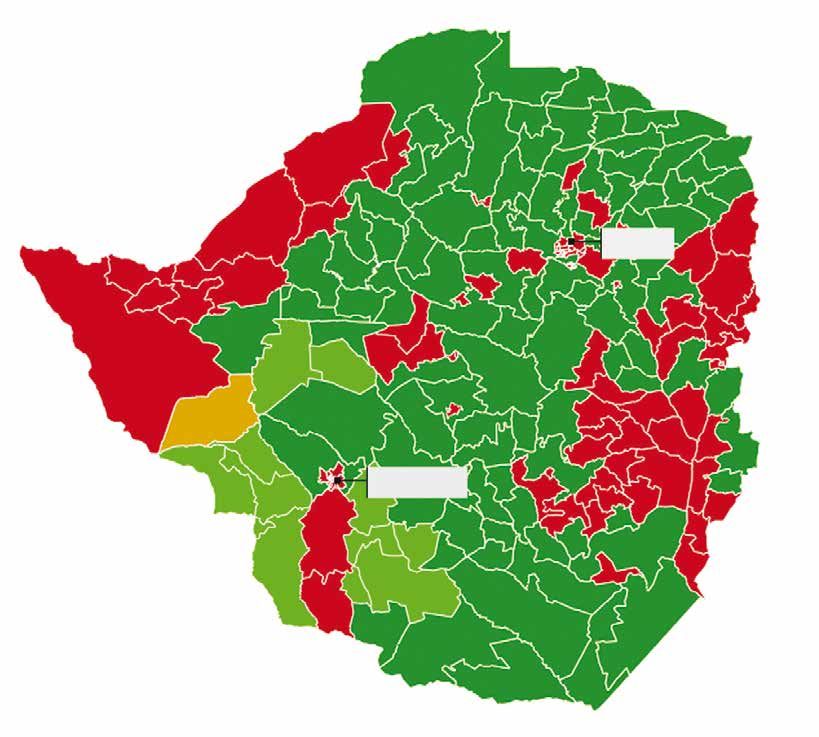
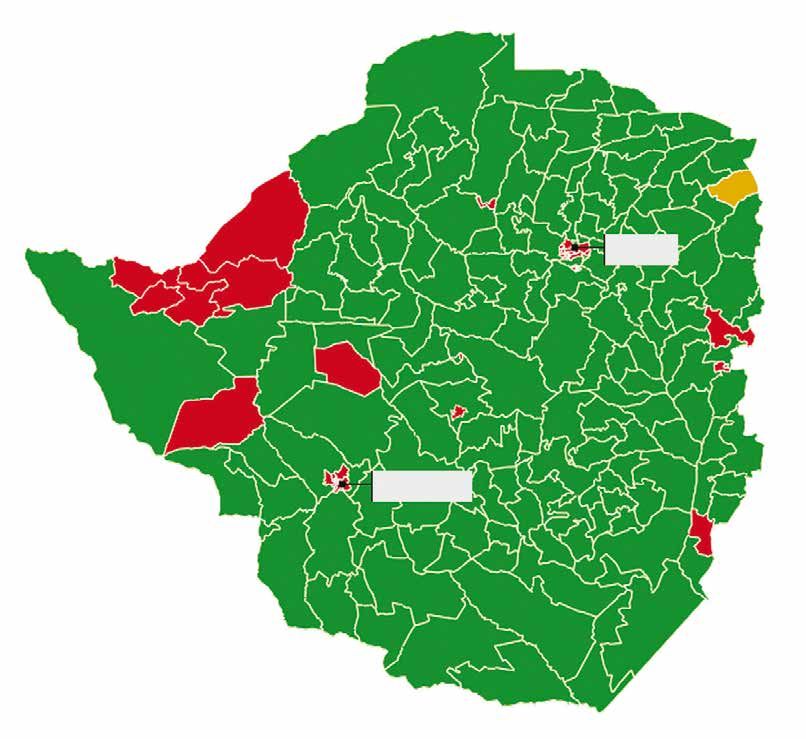
Change–Tsvangirai (MDC-T) won 70 seats (see Figure 1 managed to establish a working relationship that enabled
for the geographical distribution of party results in the the March 2013 constitutional referendum (and ‘yes’ vote).1
last two parliamentary elections). The elections process
and results have been divisive, with the MDC-T and many After the referendum, and despite fierce opposition
civil society observers alleging that the polls were rigged from rival party leaders Tsvangirai and Ncube, Mugabe
to ensure a victory for ZANU-PF and President Mugabe. announced that the harmonized elections would take place
ZANU-PF has continued to assert that it was a genuine vote. on 31 July 2013. Tsvangirai and Ncube, in a rare show
Beyond the recriminations, and the ongoing struggles to of unity, insisted that, given that many of the prescribed
control the 2013 electoral narrative, what is clear is that reforms in the Global Political Agreement (GPA) and
the elections were transformative and have redefined particularly electoral reform had not been implemented,
Zimbabwe’s political space. Under the GNU the MDC-T, its and that the voters roll was still far from ready, the July date
rival the MDC-N led by Welshman Ncube and ZANU-PF left an impossibly short timespan for electoral preparations.
had reluctantly shared political space and power, although They pressed instead for a date in September or October
ZANU-PF’s control of strategic ministries made it the senior 2013, after the UN World Tourism Summit in August, which
partner. was due to be jointly hosted by Zimbabwe and Zambia.
Despite SADC’s recommendation for a postponement of the
ZANU-PF’s victory, however disputed, has enabled it to polls (following the Maputo meeting in June) the elections
completely recapture the state. Its margin of victory does were held on 31 July–1 August 2013.2 The general elections
not mean the end for opposition politics and civil society in were preceded by internal primary elections for all the
Zimbabwe, but it does mean that they will have to adapt to political parties in June and July. Local civil society and
the new political environment to have any influence. regional and international organizations, including SADC,
Figure 1: Parliamentary election results by constituency, 2008 and 2013
2008 2013 Zanu-PF
MDC-Tsvangirai
Independent
MDC
Harare Harare
Bulawayo Bulawayo
Source: Zimbabwe Electoral Commission.
1
All three parties in the GNU pushed for a ‘yes’ vote in the 16–17 March 2013 Constitutional Referendum. Approximately 2 million Zimbabweans voted; the ‘yes’ vote
was 94.5 per cent.
2
The 31 June 2013 Maputo Summit recommendation was that the Zimbabwe election be delayed by two weeks from the announced date of 31 July. Zimbabwe’s
Constitutional Court, however, ratified the July date.
Chatham House | 3Zimbabwe’s International Re-engagement: The Long Haul to Recovery
The Post-election Political Landscape
the Common Market for Eastern and Southern Africa whether the elections were credible or not. The key question
(COMESA) and the AU, were accredited as observers. For going forward is what impact these polls will have on
the first time, Zimbabwean diaspora in southern African Zimbabwe’s politics.
countries and the United Kingdom sent a combined
observer group.
The official results as released by the ZEC on 3 August
Internal change in ZANU-PF: a new policy
indicated a sweeping win for ZANU-PF. The party won a approach
total of 197 seats in the National Assembly, with the MDC-T
winning 70 seats. The smaller MDC-N won two seats, and one The 2013 outcome re-establishes a single-party government
seat went to an independent candidate. The MDC-T refused and confirms ZANU-PF as the domestic political
to accept the results, insisting that the elections had been hegemon. Its parliamentary majority will allow it to pass or
extensively rigged. Local civil society observers and members block legislation. The size of its victory, and the subsequent
of the general public, particularly in the urban areas, also internal convulsions within the MDC and other parties,
pointed out numerous anomalies in the process. On 8 July the mean that the ruling party now sees the MDC-T less as
ZEC itself admitted to flaws in the polls, saying that 512,000 an existential threat and more as a rival to be managed,
people had been turned away or assisted to vote by election contained and reduced until the 2018 elections. Within
officials.3 ZANU-PF insisted that the poll result was legitimate ZANU-PF, the factional strife among the camps of different
and reflected the party’s intensive grassroots mobilization contenders is accelerating as its elite positions itself for the
and voter-registration drive. The casting vote was given by party and national succession to Mugabe; recent reports
SADC and the AU, which endorsed the polls. SADC declared suggest that Justice Minister Emmerson Mnangagwa is in the
the polls ‘free and fair’, while the AU preferred to call them box seat with backing from the military and China.6 Contrary
‘credible’. Although the opposition continue to contest to previous practice, much of the denunciation and exposure
the results, the global community (including the UN) also of corruption and massively inflated parastatal senior
accepted the result. The United States, United Kingdom, EU salaries has been conducted in the media, including the state
and Australia, however, expressed their deep concerns about media.7 The November 2013 provincial executive elections,
the credibility of the elections and withheld endorsement. which were important for candidates positioning themselves
ahead of the December ZANU-PF annual conference and
2015 congress, revealed major rifts within the party. Amid
The battle for control of the electoral
allegations of rigging and other electoral anomalies in
narrative continues, centred on whether three provinces, ZANU-PF called a halt to proceedings and
the elections were credible or not. The key announced an extraordinary politburo meeting to bridge the
question going forward is what impact these divide. The politburo meeting, held on 23 November and
polls will have on Zimbabwe’s politics. chaired by President Mugabe ratified the election results for
Manicaland, Midlands and Mashonaland Central provinces.
Since the announcement of the results, there have been a Elections in the remaining seven provinces were held in
number of election reports by local civil society observers, December, ahead of the party conference. The allegations,
from SADC and from the AU.4 The MDC-T has also published from within the party, that ZANU-PF had rigged its own
its report on the alleged rigging of the elections.5 The battle elections have given ammunition to critics who charge that
for control of the electoral narrative continues, centred on this is a ‘portrait in miniature’ of the anomalies of the 2013
general elections.8
3
All the political parties confirmed that the majority of those turned away were in the urban areas. MDC-T and civil society estimated that 750,000 to 1 million urban
voters had been disenfranchised.
4
There have been a numerous reports on the July elections. Among many others, both official and unofficial, these include the Zimbabwe Electoral Support Network
(ZESN); SADC Observer Mission (SADC-EOM); Southern African Development Committee Council of Non-Governmental Organisations (SADC–NANGO); AU Election
Observer Mission (AU EOM); Zimbabwe Diaspora Observer Group; SADC Parliamentary Forum Election Observer Mission to Zimbabwe; and the MDC-T Elections
Rigging Report. All the official reports to date have pointed out the flawed voters roll and issues around assisted voting and media access. But there are wide divergences
on the final verdicts. The SADC, AU and COMESA reports, although noting electoral flaws and recommending remedial action ahead of the next elections, have given
detailed, reasoned decisions on their endorsements of the overall conduct and outcome of the polls as being credible. The ZESN report, on the other hand, listed numerous
irregularities in the electoral process, which made the outcome ‘not credible’. The MDC-T report alleges that ‘the July elections were massively rigged’ by a network of
groups and organizations hired by the ZANU-PF system. To date there have not been any publicly available reports on the July polls from the ZEC or ZANU-PF.
5
See the MDC-T Election Rigging report, New Zimbabwe, http://www.newzimbabwe.com/news-12993-MDC-T+election+rigging+report,+Part+1/news.aspx.
6
Itai Gwatidzo Mushekwe, ‘Mnangagwa takes secret oath as standby Zimbabwe President’, Bulawayo 24 News, 31 January 2014.
7
Peta Thorneycroft, ‘Media reveal Mugabe’s cronies graft in parastatals’, IOL News, 2 February 2014. Among others affected are Air Zimbabwe, Zimbabwe Broadcasting
Corporation, Marange Diamonds and the Public Services Medical Aid Society whose director was receiving a reported $230,000 per month. Interestingly, the head of
the Anti-corruption Commission is charged with defrauding the commission of $435,000.
8
Following the Politburo meeting which ratified the provincial results in Manicaland, ZANU-PF stated that it was logistical problems, not chaos or intra-party
factionalism, which had led to the cancellation of polls in the remaining seven provinces.
4 | Chatham HouseZimbabwe’s International Re-engagement: The Long Haul to Recovery
The Post-election Political Landscape
In what is likely to be a ‘legacy’ presidency for Mugabe, Opposition parties and civil society
increased factional fighting over who will succeed him
could lead to greater political destabilization. The likely The election results were a massive shock for the
front-runners are Vice President Joice Mujuru and opposition parties. The two MDCs were trounced in
Mnangagwa. Both have strategic support within the party local, parliamentary and presidential polls. Although the
and Mngangagwa also has the support of the military. But credibility question will continue to be a major part of
although there is enormous speculation about who will the MDC-T’s narrative, it has also admitted to making a
succeed Mugabe, and various stakeholders are jostling for number of costly strategic errors while in the GNU that
current and potential future power, ZANU-PF has a tradition were reflected in the polls. Zimbabwe’s opposition now has
of consensus decision-making. This is exemplified in the to operate in a political space that is dominated nationally,
Central Committee and Politburo. Mugabe has indicated regionally and across the continent by ZANU-PF. Since it has
that he wishes to see out his term and his elevation in the been out of government, there has been a hollowing out of
AU and SADC emphasizes this point. It is thus unlikely that the opposition.
the ZANU-PF Congress at the end of 2014 will substantively While challenging the credibility of the general elections,
discuss the presidential succession issue; but there will the MDC-T has faced questions about the fairness of its
be intense power struggles for other leadership positions own primary elections in June. A number of high-ranking
within the party as party members keep their eyes on the officials have left, or have been ‘disciplined’, suspended or
2018 ‘prize’. In the event of an expedited succession process expelled for voting against the party, and also for publicly
owing to Mugabe’s health issues, any potential successor advocating that Tsvangirai should step down as leader.10 The
would require party as well as constitutional endorsement. MDC-T also faces its own succession struggles. Tsvangirai
The 2013 elections assured Mugabe of another five years remains popular with the grassroots and is the unifying
in office and the opportunity to make this a ‘legacy’ term. figure in the party; there is no obvious successor figure.
With Zimbabwe facing severe economic problems and But others insist that the MDC-T, having lost consecutive
with continued factionalism within the party, Mugabe elections, needs renewal, starting with its leader. It has been
has stressed that he will serve his full term. He remains reported that President Ian Khama of Botswana has also
the unifying figure within ZANU-PF and is reported by advised Tsvangirai to step down.11 The party has not been
some to feel a genuine duty to push through the promises destroyed by the election results but it has been severely
made by the party in the run-up to the elections. Mugabe’s weakened. To regain lost ground it will have to transform
agenda has broad support within the party and is likely to itself and find a post-neoliberal narrative. Given its move
be endorsed at the 2015 party congress; but questions may from a mass-struggle position in 2003 into an elite-pact
remain about whether he will contest the 2018 elections, position from 2009, it is difficult to see where it will go
who will be his eventual successor and whether it will be from here. The MDC has been described as structurally
a ‘guided’ or ‘people’s’ democracy within ZANU-PF. The weak, following the disarray and disappointment of 2013,
new cabinet, announced nearly a month after the elections, but there is potential support for a dynamic process of
retained many of the previous ZANU-PF stalwarts (albeit change ahead of the next elections, with a well-articulated
reassigned to new ministries). There is, however, a new programme centred on some of the party’s strong
generation of technocrats among the deputy ministers and individuals.12
this may hint at the careful balancing between veterans The current MDC-T position is that the elections were
and ‘Young Turks’, and ideologues and pragmatists, which stolen, that only a credible re-run and a legitimate result
Mugabe performed in appointing the new government.9 The will transform the economy; and that the electorate
biggest single challenge for the new ZANU-PF government, will vote out a ZANU-PF government that can mobilize
and the one on which it will be judged, is whether the new resources to rig an election but that is unable to bring
cabinet can meet the test of economic credibility. about economic change. There is no doubt that the
9
For some in civil society this is a false distinction. One activist opined in February 2014 ‘though there are young Turks with a wish to modernise and fraternise, they
are trapped in the post liberation clichés of race and indigenousness, of “never a colony again”, of patronage and the consequent need for corruption and looting. Part
of ZANU’s problem is that it can never be trusted – regionally, globally, but also by its own population – until it deals with the processes that make it untrustworthy, but
alas those are the processes that sustain it and that are bound into its DNA … the charm offensives e.g. Nhema, or Walter Mzembi (Tourism) or Jonathan Moyo (Media)
all have a friendly façade, but still have the underlying control, monopoly, “right to rule” fist beneath the velvet’.
10
The imposition of candidates in the MDC-T’s 2013 primary elections in June–July 2013 caused division the party and alienated some grassroots supporters. After the
party’s defeat in the general elections, a number of senior party officials, including Roy Bennett, Ian Kay and others, publicly called for leadership renewal. They have
since been ‘disciplined’ by the party.
11
‘Step down, Khama tells Tsvangirai’, The Herald, 20 February 2014.
12
Recent communication with the authors from the director of a small NGO in Harare.
Chatham House | 5Zimbabwe’s International Re-engagement: The Long Haul to Recovery
The Post-election Political Landscape
elections were significantly flawed, but the reality is that seen the closure of a number of its offices nationwide. It is
there is no prospect of an early re-run despite calls by unclear whether – and in what form – the party will survive.
the MDC-T and other opposition voices: with no current ZAPU, which was cash-strapped before the elections, has
regional and continental support for this, early elections barely been visible since. There is an emerging ‘third wave’
are simply not on the agenda. Such calls also ignore the of new mainly technocratic political groups and a number
fact that the same electoral structures and personnel of new political parties have been formed. In August 2013,
remain in place and there are still outstanding problems some disgruntled MDC-T members who had been barred
with the electoral roll. from standing as independent candidates in the primary
and general elections formed the Zimbabwe Independent
While the opposition was disappointed by the election
Alliance (ZIA). In September, the National Constitutional
process and results, it seemed unable to mobilize
Assembly (NCA) civil society coalition became a political
support from voters whose interest are economic rather
party, advocating a pan-Africanist agenda. The new
than ideological. In addition, while the opposition
Zimbabweans United for Democracy (ZUNDE) party is also
was disappointed by the election process and results it
challenging the mainstream. But most of these parties have
is also possible that ZANU-PF’s mass mobilization of its
been riven by internal factionalism from the outset and,
support base and empowerment message had a greater
with no real grassroots structures or national leverage, it
resonance than the MDC’s more complex economic
is doubtful that the third wave will be able to reach critical
messaging, particularly with rural voters.
mass any time soon.
There are signs, however, that the MDC-T is realizing that
its political ‘opt-out’ approach guarantees irrelevance. Opposition politics and civil society will
Hence the party’s call in February for a national dialogue
endure and find ways of adaptation, but
as an ‘opt-in’ strategy for political relevance. Between now
and the 2018 elections, there will be some change in the there is no doubt that it is a transformed
MDC-T leadership – partly through natural attrition and political environment.
partly imposed. But whether there will be a thorough or
cosmetic overhaul of the leadership and strategies remains Civil society too will have to adapt. International funding
unclear. Following the MDC-T National Executive meeting for civil society organizations (CSOs) and opposition parties
in January Elton Mangoma, a founding member of the is declining, and ZANU-PF’s dominance of the political
party, was formally reprimanded by the party over a letter landscape and ownership of the patriotic-nationalist
calling for Tsvangirai to step down and is now suspended. narrative mean that civil society will have to complement
Tsvangirai, who became chief signatory to the party strategies of confrontation with ones of negotiation and
accounts at the same meeting, increased his control of the accommodation where appropriate, if they are to survive.
party and remains popular with the grassroots. He is likely This civil society transformation is already beginning to
to be re-confirmed as party leader at the next party congress happen as local CSOs find new pathways to operate in a new
which has been brought forward from 2016 to 2015; but the political dispensation through forming tactical alliances.
leadership issue will remain and is likely to widen the rifts For instance, the combined protests of civil society groups,
within the party, possibly leading to another breakaway ratepayers and supporters from all the political parties
group. Nevertheless, the MDC-T will remain the largest and forced the new government to stop the demolition of ‘illegal
most established opposition party for the foreseeable future; dwellings’ in the Ruwa municipality just outside Harare.14
it has a ‘shadow cabinet’ and grassroots structures, and will In the short to medium term, with economic pressures
retain influence in local government and elsewhere; but it is rather than political rights as the pressing concern for
a party in search of a strategy. most, it is in the arena of the domestic economy and human
development that the opposition and civil society voices can
Meanwhile, despite its spokesperson Karuone Chihwayo’s be heard most effectively and could be a route to address
insistence that the party is ‘death- and storm-resistant’, human rights concerns. Opposition politics and civil society
the MDC-N has been rocked by a spate of defections and will endure and find ways of adaptation, but there is no
expulsions, such as those involving former MP Siyabonga doubt that it is a transformed political environment. In
Ncube and the former Bulawayo deputy mayor, Alderman particular, human rights NGOs, which are consistently
Charles Mpofu.13 Since November 2013 the MDC-N has targeted by the state for allegedly promoting a regime-
also allegedly been facing a major financial crisis that has change agenda, will find it more difficult.
13
See ‘Welshman Ncube still in control’, Nehanada Radio, 24 November 2013.
14
In October 2013 the government cracked down on unauthorized dwellings in Ruwa, near Harare. There were also threats to widen the operations to Harare and
Chitungwiza. The blitz raised fears of a repeat of Operation Murambatsvina [Remove the Rubbish] in which thousands were left homeless and destitute after a
nationwide crackdown on illegal dwellings.
6 | Chatham HouseZimbabwe’s International Re-engagement: The Long Haul to Recovery
The Post-election Political Landscape
Regional and international political Zimbabwe is now seen by SADC as an anchor state in the
engagement region. Mugabe was elected as the SADC deputy chair
and becomes the chair later in 2014. In January he was
The SADC and AU endorsement of the elections – however also elected as first deputy chair of the AU, which makes
controversial – propelled Zimbabwe back to the global him eligible for its chair in 2015,16 and Zimbabwe also
community of nations. A former SADC elections observer plans to be more active at the UN. Such changes may put
gave his perspective: pressure on the West to normalize engagement with the
What we (SADC) wanted was a decisive result for either of the government.17
parties. After the violence of June 2008 we did not want a run-off
election, or a re-run election. It would be violent and we would
be blamed for the violence. The MDC were in government. They
had four years to change the system but they were out-played. The
elections are now history – they should stop complaining and look
to the future.15
15
Confidential interview, London, October 2013.
16
‘Mugabe voted as AU Deputy Chair’, The Herald, 30 January 2014.
17
Alex Bell, ‘Africa threatens EU summit snub over Mugabe’, SWRadioAfrica, 3 February 2014.
Chatham House | 73. Zimbabwe’s Economy: Crisis and Resilience
Zimbabwe’s government faces daunting economic The agricultural sector also shrank, reeling from the land
challenges, and its available policy options are increasingly designations, whereby land was identified for acquisition
limited. The adoption of the multi-currency system in by the government for the purpose of redistribution, and
2009 ceded monetary policy to international actors, the fluctuating global prices for tobacco and sugar. Famine
declining tax base dramatically reduced the fiscal policy struck some parts of the country, accompanied by cholera.
space, and a decade of uncertainty has resulted in low levels And yet the economy did not utterly collapse. Despite the
of investment, a diminished consumer base and a reduction brain drain the public sector and civil service continued.
in the manufacturing sector. The ongoing liquidity crisis is Salaries were sometimes paid late by government, and
severely constricting the economy and, after the country incomes were outstripped by the cost of living; but wages
endured an austerity economy under the GNU, ZANU-PF were still paid. Financial institutions, although debilitated
now has to deal with what is rapidly becoming a crisis by an increasingly worthless local currency, went on
economy across many sectors. functioning. National resilience and adaptation, and
diaspora remittances,18 were vital in helping Zimbabwe
The government says it is actively confronting these issues
to survive the first decade of the century. The end of that
and the economy is at the top of its agenda, but there is still
decade then saw modest economic growth partly driven
great uncertainty surrounding the multi-currency system,
by the emergence of a new business and black-market
indigenization and land ownership. Other observers see
elite and a new black middle class. Many of the new
a state of paralysis. If the country is to attract investment
landowners were able to farm it well within the constraints
it must demonstrate that it is a worthwhile business
of shortages of inputs and machinery. To some extent
destination and partner in a global economy crowded with
Zimbabwe became a nation of resilient entrepreneurs,
competitor countries. It must demonstrate its competitive
although almost entirely within the informal sector.
advantage as an investment destination. The emphasis must
This spirit of adaptive entrepreneurship, as much as the
be on stability and certainty.
technicalities of dollarization, has helped drive modest but
fragile economic growth since 2009, although the economic
Figure 2: GDP growth (%)
decline since October 2013 may undermine this.
%
15
10
Bureaucracy and ease of doing business
5
Improving Zimbabwe’s record with regard to the ease of
0 doing business is important if a recovery is to be successful.
-5 Bureaucratic bottlenecks and corruption stifle local and
-10 international investment. Countries such as Nigeria and
-15
Kenya are seen as having a greater problem of systemic
corruption than Zimbabwe, but both also have higher
-20
2004 2006 2008 2010 2012 2014 2016 2018 ratings for ‘ease of doing business’.19 It is the combination
of economic crisis, corruption and bureaucracy that
Source: IMF.
deters potential investors. The economy will take time to
re-stabilize but streamlining the sometimes cumbersome
From 2000 to 2008, the economy shrank by 50 per cent,
bureaucracy along an ‘ease of doing business’ pathway is
putting it back at a level equivalent to what it was in 1953
crucial. Sichoni Takolezi, the head of operations for the
(see Figure 2). The political stalemate and violence resulted
Zimbabwe Investment Authority (ZIA), has commented:
in the availability of jobs in the formal sector shrinking
‘Issues such as unnecessary delays in accessing permits, poor
by 80 per cent. The civil service was also hit by a massive
infrastructure and unreliable utilities do not augur well for
‘brain drain’ and resultant inefficiencies as those who
attracting foreign capital.’20 The ZIA is part of the business
remained formally employed also had to ‘moonlight’, taking
community’s drive for business reforms, such as the ‘one-
on private jobs to survive. The manufacturing sector, and
stop-shop’ concept and speeding up permit processes.
particularly engineering, nearly collapsed completely.
18
Diaspora remittances through formal channels have diminished by an estimated 15 per cent since the election. See ‘Diaspora remittances drop’, NewsDay, 4 February
2014; Alex Bell, ‘Diaspora bond rejection a sign of ZANU-PF “distrust”’, SWRadio Africa, 24 December 2013.
19
The 2013 World Bank Doing Business report ranked Zimbabwe 175th overall out of 185 countries surveyed, for ease of doing business. It did note, however,
that Zimbabwe had improved its rankings in the specific areas of trading across borders, starting a business and signing contracts. According to Transparency
International, Zimbabwe declined six places to become the 157th most corrupt nation out of 177; see ‘Act on corruption, Zimbabwean industry tells government’,
The Source, 5 February 2014.
20
‘China emerges consistent top investor since 2010’, The Sunday Mail, 24 November 2013, http://www.sundaymail.co.zw/index.php?option=com_content&view=arti
cle&id=39751:china-emerges-consistent-top-investor-since-2010#.UpI7M8SgHnM.
8 | Chatham HouseYou can also read


