NSW Koala Research Plan 2019-28 - A 10-year plan under the NSW Koala Strategy - Office of Environment and ...
←
→
Page content transcription
If your browser does not render page correctly, please read the page content below
NSW Koala Research Plan
2019–28
A 10-year plan under the
NSW Koala Strategy
© 2019 State of NSW and Office of Environment and Heritage
With the exception of photographs, the State of NSW and Office of Environment and
Heritage are pleased to allow this material to be reproduced in whole or in part for
educational and non-commercial use, provided the meaning is unchanged and its source,
publisher and authorship are acknowledged. Specific permission is required for the
reproduction of photographs.
The Office of Environment and Heritage (OEH) has compiled this plan in good faith,
exercising all due care and attention. No representation is made about the accuracy,
completeness or suitability of the information in this publication for any particular purpose.
OEH shall not be liable for any damage which may occur to any person or organisation
taking action or not on the basis of this publication. Readers should seek appropriate advice
when applying the information to their specific needs.
All content in this publication is owned by OEH and is protected by Crown Copyright, unless
credited otherwise. It is licensed under the Creative Commons Attribution 4.0 International
(CC BY 4.0), subject to the exemptions contained in the licence. The legal code for the
licence is available at Creative Commons.
OEH asserts the right to be attributed as author of the original material in the following
manner: © State of New South Wales and Office of Environment and Heritage 2019.

Published by:
Office of Environment and Heritage
59 Goulburn Street, Sydney NSW 2000
PO Box A290, Sydney South NSW 1232
Phone: +61 2 9995 5000 (switchboard)
Phone: 1300 361 967 (OEH and national parks enquiries)
TTY users: phone 133 677, then ask for 1300 361 967
Speak and listen users: phone 1300 555 727, then ask for 1300 361 967
Email: info@environment.nsw.gov.au
Website: www.environment.nsw.gov.au

Report pollution and environmental incidents
Environment Line: 131 555 (NSW only) or info@environment.nsw.gov.au
See also www.environment.nsw.gov.au

ISBN 978-1-925755-33-6
OEH 2019/0038
February 2019

Find out more about your environment at:

www.environment.nsw.gov.au
Contents
1.   The need for a koala research plan                                            1
     1.1 Objectives and aims                                                        1
2.   Background to the Koala Research Plan                                          4
     2.1 The NSW Chief Scientist and Engineer’s Report                              4
     2.2 The NSW Koala Strategy                                                     5
3.   Developing the Koala Research Plan                                             6
     3.1 Expert elicitation of knowledge gaps                                       6
     3.2 Koala Research Symposium                                                   7
4.   Key knowledge gaps                                                             9
5.   Implementing the research plan                                                13
     5.1   Call for proposals                                                      14
     5.2   Evaluation of proposals                                                 14
     5.3   Future Koala Research Symposia                                          15
     5.4   Monitoring and evaluation                                               16
     5.5   Linking research to actions                                             16
6.   References                                                                    17
Appendix A – Research questions identified during the expert
   elicitation workshop                                                            18

List of tables
Table 1    Key knowledge gaps                                                       9
Table 2    Criteria to be used to evaluate research proposals                      14
Table A.1 The list of research questions developed by participants in the expert
          elicitation workshop for the 8 priority research actions, noting that
          prioritisation depends on the budget available                           18
Table A.2 The list of research questions developed by participants in the expert
          elicitation workshop for the lower priority management actions           20

List of figures
Figure 1 The overall project logic for the NSW Koala Research Plan                  2
Figure 2 Process and timeline for implementing the NSW Koala Research Plan         13

                                          iii
NSW Koala Research Plan (2019-2028)
1. The need for a koala research plan
The NSW Koala Strategy (NSW Office of Environment and Heritage 2018a) includes as an
action the preparation of a koala research plan. But why is such a plan needed, and what
should it include? A lot is known about koalas, sufficient in many cases to allow action
relating to their conservation; however, there are many situations where the information is
incomplete. In parallel with taking action, there is a need to know more about koalas,
effective mitigation of threats, and the social and economic opportunities for successful
implementation of koala recovery strategies. The knowledge base should be continually
updated (McAlpine et al. 2015), and this need is heightened as koalas react to a changing
environment (e.g. a changing climate).
In general, these knowledge gaps can be addressed through research. While it is recognised
there must be a balance between responsive mode research and targeted research (see
Box 1), and that in some cases a program of targeted research can limit technical excellence
(House of Lords Science and Technology Committee 2010), in the case of research required
for a specific conservation outcome, the balance should be towards targeted research.
Determining how research should be targeted, and prioritised, is a primary driver for
developing a research plan.
Box 1
Responsive mode research
Proposals are driven wholly by what the applying investigator wants to research. Each
proposal is considered and assessed on its own merits.
Targeted research
Proposals fit within a pre-defined specification for a narrow research area.
Further, the research plan should make clear the linkages between research and koala
policy. Koala policy must be related directly to sound knowledge and research and where
possible, koala research should be clearly directed towards policy and conservation
outcomes. Where management actions are undertaken, outcomes must be monitored and
learnings applied to modifying future actions (i.e. an adaptive management framework).
The research plan should have long-term goals and programs and accommodate the various
research funding cycles. After the initial plan, subsequent updated plans should build on the
earlier plans and refresh the content. The research plan should not inhibit curiosity driven
research, but rather direct limited funds for koala conservation to research topics that will
have the greatest benefit.
1.1 Objectives and aims
The NSW Koala Research Plan is a 10-year plan. It is a dynamic document that will be
reviewed, evaluated and updated at regular intervals throughout its life.
The objectives of the NSW Koala Research Plan are to:
• increase our overall knowledge of koalas and their threats in a targeted manner
• coordinate research and data collection on koalas within New South Wales in a manner
that facilitates both research and policy development/actions
1NSW Koala Research Plan (2019-2028)
• foster engagement and understanding between koala researchers and policy makers so
that the best possible outcomes are achieved for koalas (see Gibbons et al. 2008;
McAlpine et al. 2015; Hogg et al. 2017), and
• engage the community in the development of the plan and participating in the research
program.
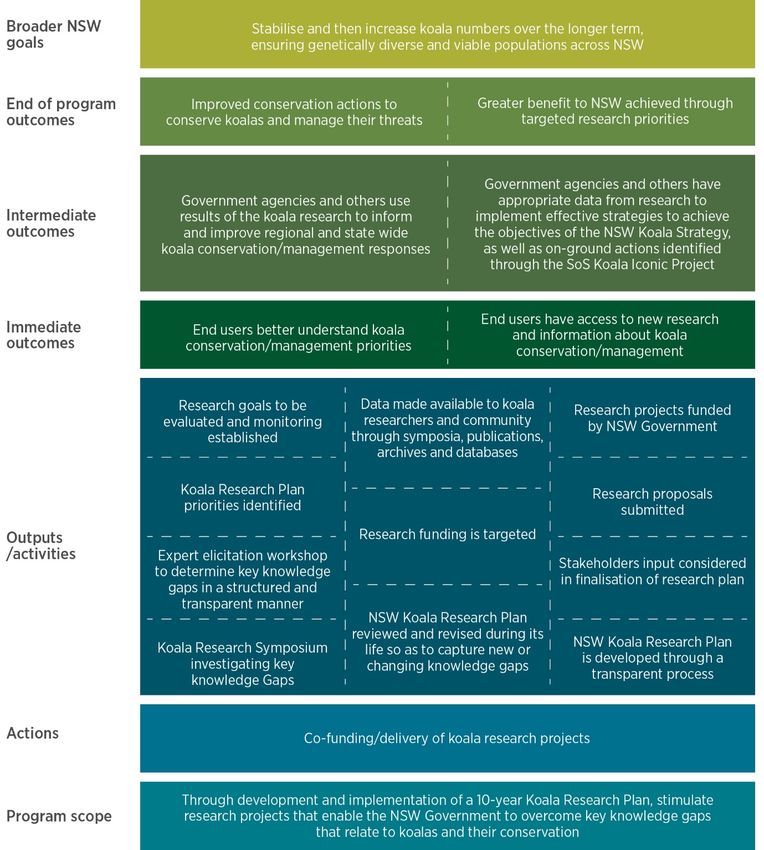
The overall project logic of the koala research plan is shown in Figure 1.
Figure 1 The overall project logic for the NSW Koala Research Plan
2NSW Koala Research Plan (2019-2028)
To this end, the research plan will:
• Identify and prioritise key knowledge gaps. In the context of this plan, a key knowledge
gap is one that, as a result of being addressed through research, will likely increase the
effectiveness of koala conservation actions and/or their likelihood of implementation.
• Outline the process by which research grant applications will be sourced, including
assessment criteria.
• Outline how progress and outputs of the individual research projects will be monitored
and evaluated.
• Outline how progress and outputs of the overall research plan will be monitored,
evaluated and revised over the life of the plan.
The NSW Koala Research Plan is a dynamic document that will be accompanied by several
supporting documents. It is expected the plan and supporting documents will change over
the life of the plan so anyone using the plan should ensure they are using the most recent
version. All documents relating to the research plan can be accessed at:
www.environment.nsw.gov.au/koalas
3NSW Koala Research Plan (2019-2028)
2. Background to the Koala Research Plan
The concept of the Koala Research Plan has been recognised as an important part of koala
conservation planning throughout the development and implementation of the NSW Koala
Strategy. The two distinct stages that have most led to the development of the Koala
Research Plan (including identification of knowledge gaps) are detailed below.
2.1 The NSW Chief Scientist and Engineer’s Report
In 2016 the then NSW Chief Scientist and Engineer, Mary O’Kane, undertook a review of the
decline of koalas across New South Wales. The review resulted in a report presented to the
NSW Minister for the Environment, which included 11 key recommendations, all related to
the key recommendation of developing a NSW Koala Strategy (NSW Chief Scientist and
Engineer 2016).
The report highlighted the importance of knowledge and research in the conservation of
koalas. In particular, the report highlighted that while many threats to koalas are well known
‘there is still much to learn about many of these existing threats and the most effective
actions to mitigate them.’ The report states that as a result of the recommended NSW Koala
Strategy, ‘our scientific knowledge of koala populations, dynamics and health will be
substantially increased’.
Recommendation 8 of the report relates specifically to a koala research plan:
Recommendation 8
That Government, through the Office of Environment and Heritage, convenes
[…] within 12 months of receiving this report [a symposium] for scientists active
in koala research and land managers to develop a koala research plan. 1
The report then elaborates on the recommendation and highlights some knowledge gaps
and research priorities:
The koala research plan should build on the koala research priorities identified in
the strategy and provide seed funding to support researchers to build
collaborative grants applications such as Australian Research Council and
Environmental Trust bids.
A biennial symposium, organised and facilitated by the NSW Office of
Environment and Heritage, should refresh the koala research plan and share
research findings to feed back into the strategy’s delivery. General outcomes of
the symposium should be agreed upon and made available to community
members and land managers in a suitable form to permit them to act on the best
available science.
An immediate set of research priorities has been identified through this review.
These include knowledge gaps relating to key koala populations:
• better understanding of the impact of managed and wild fire on koala habitat
1 The recommendation has been edited to focus on those elements that relate to koala research and the
research plan.
4NSW Koala Research Plan (2019-2028)
• local population movements and viability in relation to connectivity, roads and
dogs
• cumulative impacts on koala populations from pressures of native forest
harvesting, fire and dogs
• effectiveness of offset and rehabilitation activities
• cumulative impacts on koala gene flow from fragmented habitat and populations
• results from the Koala Genome Consortium to better inform disease research
including chlamydia and koala retrovirus (KoRV)
• climate change impacts and identification of climate refugia
• key socio-economic and institutional barriers to the effective implementation of
koala conservation strategies
• effectiveness of management strategies to minimise impacts on koala populations
including development consent for residential subdivision and mitigation activities
for reducing mortality on roads.
2.2 The NSW Koala Strategy
Because of the key recommendation of the report by the NSW Chief Scientist and Engineer
(2016), the NSW Koala Strategy was developed and released in May 2018 (NSW Office of
Environment and Heritage 2018a). Building our knowledge is one of the four pillars of the
strategy and built into that pillar is research, directed by a research plan.
Specifically, the NSW Koala Strategy states that:
A research plan will be developed and further refined at a research symposium
in 2018. The plan will identify priority gaps that need to be addressed. … The
NSW Government is committing funding to support this research plan and to
leverage further funding through linkage grants and partnerships.
The strategy also includes several specific research questions/projects that have research
funds already attached to them. These include investigating:
1. How koalas are responding to regeneration harvesting 2 on the North Coast of New
South Wales. This specific project is being run by the Natural Resources Commission
and is not part of the research plan. Related research proposals may however be
considered under this plan (see Section 4).
2. The effectiveness and challenges of undertaking the relocation/translocation of koalas.
Translocation in this context refers to reintroducing koalas from existing NSW
populations to improve genetic diversity and health of local populations.
3. The impacts of chlamydia on koala populations and identifying potential management
options.
4. Trialling chlamydia vaccines to increase the number of healthy and disease-free koalas
and significantly decrease the incidence of the disease.
2 Regeneration harvesting as referred to in the NSW Koala Strategy is referred to as ‘intensive harvesting’ in the
Coastal Integrated Forestry Operations Approval (IFOA) (see www.epa.nsw.gov.au/your-environment/native-
forestry/integrated-forestry-operations-approvals/coastal-ifoa)
5NSW Koala Research Plan (2019-2028)
3. Developing the Koala Research Plan
Development of the NSW Koala Research Plan involved two steps that built upon the work
completed during the preparation of the report by the NSW Chief Scientist and Engineer and
the NSW Koala Strategy. These two steps are described below.
3.1 Expert elicitation of knowledge gaps
It is known that different stakeholders will have different views on contributing factors ranging
across the significance of threats, knowledge gaps and ultimately research priorities. To
address and account for the range of views, a logical, transparent and structured process
was put in place that focused on expert elicitation and structured decision-making so as to
identify and prioritise key knowledge gaps.
The NSW Government engaged researchers from the Centre for Environmental and
Economic Research (CEER) at the University of Melbourne to design an elicitation process
and facilitate an elicitation workshop. Participants in the workshop were chosen by the NSW
Office of Environment and Heritage in consultation with the CEER group, based on their
knowledge of koalas and koala conservation/management. Selection emphasised recruiting
diverse participants from a range of professional backgrounds (i.e. years of experience,
specialisation, regional knowledge and affiliations). There was a further emphasis on
achieving demographic diversity, particularly in relation to age and gender. Finally, the
number of participants was limited to ensure the expert elicitation process was feasible in a
workshop setting. In total, 25 participants attended the two-day workshop, held on 24 and 25
July 2018.
The full report (Hemming et al. 2018) detailing the process and results of the expert
elicitation is provided as an accompanying document to this research plan. A summary is
provided below.
3.1.1 Summary of the expert elicitation of knowledge gaps
The aim of the expert elicitation workshop was to develop an understanding of the key
knowledge gaps impeding the successful management of koala populations in the wild
across New South Wales. This understanding led to the development of a series of research
questions, targeted at addressing the uncertainty that, if resolved, will provide the most
benefit to the viability of koalas in New South Wales.
In the elicitation process, the steps of structured decision-making were used to:
Specify the management objective and associated performance measure: a long-term
genetically diverse and viable koala population in New South Wales (NSW Office of
Environment and Heritage 2018a), measured in the workshop as the number of breeding
female koalas in the wild (per Koala Management Area – KMA) in 60 years (2079).
Identify the key threats to the persistence of koala populations in six different KMAs across
New South Wales, then develop a series of alternative management actions that could be
employed to reduce the impact of the key threats.
Use structured expert elicitation to predict the consequences, with uncertainty, of the
alternative actions on the persistence of koala populations in six different KMAs across New
South Wales. Predictions were made under two climate change scenarios.
Use a sensitivity analysis to explore the uncertainty around the efficacy of the alternative
management actions to prioritise where research could most effectively be applied to inform
the conservation/management of koalas in New South Wales.
The workshop findings suggested that:
6NSW Koala Research Plan (2019-2028)
• Participants specified approximately 24 threats to koalas across New South Wales, with
major threats including habitat loss and habitat fragmentation, disease, bushfires, cars
and roads, and climate change (including drought and heatwaves).
• Many threats were shared across KMAs. For example, habitat loss (and habitat
connectivity loss/fragmentation) was consistently listed by respondents as the first-
ranked threat across all KMAs. Likewise, the threat posed by disease was relatively
consistent as a top three threat. As expected, the frequency at which key threats were
mentioned by experts, and their ranking, did vary across KMAs. For example, cars and
roads were considered a greater threat by more participants in KMA1 (North Coast) and
KMA2 (Central Coast), while more participants viewed bushfires and wildfires as a
number one threat in KMA3 (South Coast) and KMA5 (Southern Tablelands), and
climate change was considered as a higher ranked threat in KMA5 and KMA6
(Western Slopes and Plains).
• Using structured elicitation, the consequences of 14 actions (targeted at the key threats)
were predicted for the year 2079. The following actions were identified as being of most
value for targeting for potential research questions, given uncertainty about climate
change. The relevant KMA is noted in brackets, though the associated research
questions could be relevant to any region with the associated key threat:
○ Habitat Restoration (KMA2 and KMA4 (Northern Tablelands))
○ Climate Change Refuges (KMA5)
○ Climate Change Water Supply (KMA6)
○ Habitat Logging Controls (KMA1)
○ Disease Insurance Population (KMA6)
○ Fire Asset Protection (KMA3 and 5).
• The remaining actions were, comparatively, unlikely to be implemented or unlikely to
have a positive effect on koala abundance (or both).
• Eighteen key research questions were subsequently identified. Prioritisation of these
research questions is dependent on the size of the research budget, and the estimated
likelihood of the different climate change scenarios. However, it would appear research
into habitat restoration should be prioritised, as the predicted gains for koalas are
greatest, regardless of budget and uncertainty due to climate change. Examples of
relevant research questions and topics include:
○ ‘Future proofing’ revegetation
○ What is adequate habitat?
○ Strengthening private land partnerships
○ What private land is most at risk and the most valuable to protect?
The full elicitation report can be found at: NSW Koala Research Plan: Expert elicitation of
knowledge gaps
3.2 Koala Research Symposium
Following on from the elicitation workshop, a Koala Research Symposium was held on
16 November 2018. The aim of the symposium was to present the elicitation findings to a
broad audience of people involved with koala research, management and care, and to get
feedback on any significant gaps in the elicitation results. The symposium was intended to
build upon, not replace, the results of the elicitation workshop. As such, no formal elicitation
process was followed, rather the additional input was sourced through four facilitated Q&A
sessions with a panel of four or five participants with expertise in the panel topic. Questions
and discussion were generated among the panel and audience. The four session topics
were:
7NSW Koala Research Plan (2019-2028)
1. habitat identification and management
2. climate change, extreme weather events and fire
3. disease
4. other research questions.
A total of 82 people attended the research symposium.
The research symposium proved particularly useful for the broad topic of disease. Actions
related to disease did not generally score highly during the expert elicitation in terms of
effectiveness or likelihood of implementation. The research symposium was able to further
investigate the options for this topic.
8NSW Koala Research Plan (2019-2028)
4. Key knowledge gaps
Key knowledge gaps have come from four sources:
1. NSW Chief Scientist and Engineer’s Report (NSW Chief Scientist and Engineer 2016)
2. NSW Koala Strategy (NSW Office of Environment and Heritage 2018a)
3. knowledge gap elicitation (Hemming et al. 2018)
4. the Koala Research Symposium.
A summary of the key knowledge gaps, presented by source and theme, is shown in Table
1.
These knowledge gaps should lead to research questions; examples of research questions
derived from the knowledge gap elicitation are shown in Appendix A.
Table 1 Key knowledge gaps
Broad theme Source of knowledge gap
(sub-theme)
Chief Scientist’s NSW Koala Key knowledge Research
Report Strategy gap elicitation Symposium
Climate change • Changes in • Koala habitat
and extreme availability of suitability
weather events preferred koala under different
(habitat) habitat climate change
including scenarios and
eucalypt leaf identifying and
quality categorising
ranked
climate-risk
refugia
Climate change • Climate • Climate • Identifying key
and extreme change change characteristics
weather events impacts and refuges of refuges (e.g.
(refugia) identification of leaf water,
climate refugia microclimates)
Climate change • Climate • Effects of
and extreme change water artificial water
weather events supply supply at the
(water supply) population
level
• Natural
waterway
protection/
restoration vs
artificial water
supply
Disease • Dynamics of
(dynamics of emergence
emergence) and re-
emergence of
disease in
expanding or
translocated
populations
9NSW Koala Research Plan (2019-2028)
Broad theme Source of knowledge gap
(sub-theme)
Chief Scientist’s NSW Koala Key knowledge Research
Report Strategy gap elicitation Symposium
Disease • Causes and • Impacts of
(impacts) impacts of treatment and
chlamydia and rehabilitation
other diseases on populations
(including
management
options) 1
Disease • Disease
(insurance insurance
populations) population
Disease (risk • A disease risk
mapping) map for koalas
incorporating
targeted
management
strategies
Habitat • Future habitat • Landscape
(landscape) availability thresholds and
cumulative
impacts
Habitat (logging) • Habitat logging • Habitat logging • Focus on
controls 2 controls 2 disturbance
regimes
Habitat • What is driving
(occupancy) koala
occupancy
across the
landscape? Is
unoccupied
habitat
necessarily
bad habitat?
• What is good
quality/
adequate
habitat?
• The processes
and
mechanisms
that underlie
landscape
change
patterns and
drive species
loss
Habitat • Effectiveness • Habitat • Future proofing
(restoration) of offset and restoration restoration
rehabilitation activities
activities
10NSW Koala Research Plan (2019-2028)
Broad theme Source of knowledge gap
(sub-theme)
Chief Scientist’s NSW Koala Key knowledge Research
Report Strategy gap elicitation Symposium
Other • Cumulative • Links between • Ecological
(cumulative impacts on heatwave and consequences
threats) koala other threats to of fuel
populations koalas such as reduction and
from pressures the onset of their impact on
of native forest chlamydia koalas and the
harvesting, fire broader
and dogs ecosystem,
e.g. weed
invasion,
increased
predator
access, etc.
Other (fire) • Better • Bushfire risk • Fire asset • Understanding
understanding and the impact protection the resilience
of the impact of bushfire of populations
of managed management in terms of
and wild fire on activities such their response
koala habitat as planned to hazard
burns to reduction
address the burning and
risk wildfire events
Other (genetics) • Cumulative • Factors driving
impacts on genetic
koala gene diversity
flow from throughout
fragmented different parts
habitat and of the koala’s
populations range
• Defining
discrete koala
populations
Other • Effectiveness • Using disease
(management of as an indicator
effectiveness) management of population
strategies to health and
minimise following that
impacts on the
koala effectiveness
populations of
including management
development actions
consent for • Using
residential demographic
subdivision modelling and
and mitigation sensitivity
activities for analysis to
reducing determine
mortality on effectiveness
roads of
management
actions
11NSW Koala Research Plan (2019-2028)
Broad theme Source of knowledge gap
(sub-theme)
Chief Scientist’s NSW Koala Key knowledge Research
Report Strategy gap elicitation Symposium
Other • Local • Demographic
(population population modelling and
viability) movements sensitivity
and viability in analysis
relation to
connectivity,
roads and
dogs
Other (socio- • Key socio- • The true cost
economic) economic and of private land
institutional conservation
barriers to the • Economic and
effective social barriers
implementation to
of koala implementation
conservation of conservation
strategies measures
• Conserving
koala habitat in
the most
efficient and
economical
way
• The dollar
costs of
vaccination vs
the
effectiveness
Other • Impacts, • Assessing
(translocation) challenges and what is good
potential koala habitat in
benefits of areas with no
relocation evidence of
/translocation 3 use by koalas
(such as for
translocation)
Notes:
1: Two research projects related to disease have been identified in the NSW Koala Strategy and have
discrete funding attached to them: a) a research project to better understand the impacts of chlamydia on
koala populations and to identify potential management options; b) trialling chlamydia vaccines to increase
the number of healthy and disease-free koalas and significantly decrease the incidence of the disease.
2: The NSW Koala Strategy identifies how koalas are responding to regeneration harvesting on the North
Coast of New South Wales as a research priority. This project is being run by the Natural Resources
Commission and is not included as part of this research plan.
3: The NSW Koala Strategy identifies the effectiveness and challenges of undertaking the relocation/
translocation of koalas as a research priority with discrete funding attached to it.
12NSW Koala Research Plan (2019-2028)
5. Implementing the research plan
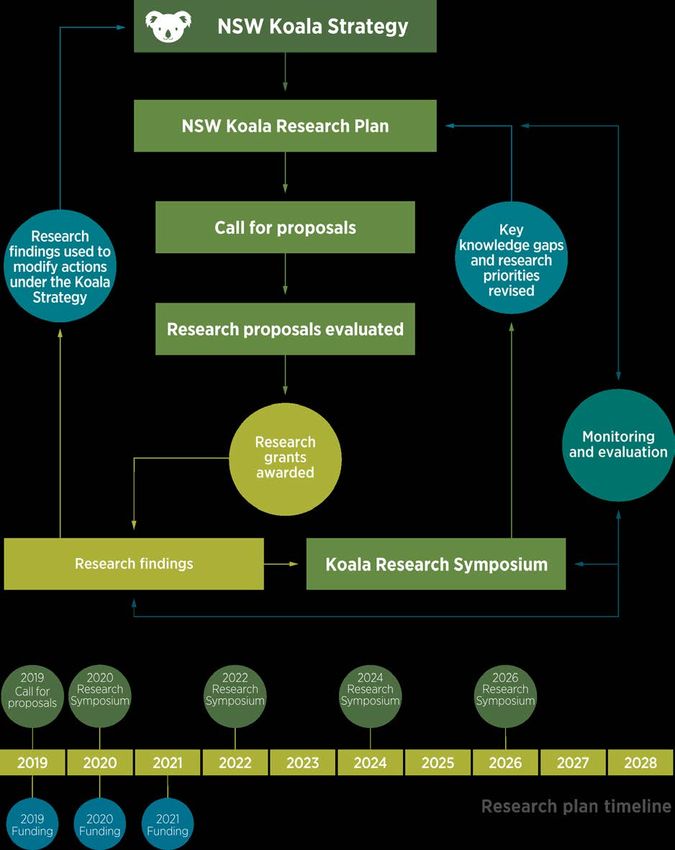
The process and timing of implementing the research plan is shown in Figure 2. Details of
the steps in the process are presented in the sections following.
Figure 2 The process and timeline for implementing the NSW Koala Research Plan
13NSW Koala Research Plan (2019-2028)
5.1 Call for proposals
To provide consistency and transparency in decision-making and financial negotiations, the
call for proposals will follow the NSW Office of Environment and Heritage Research
Procurement Guidelines (2018–2021) (NSW Office of Environment and Heritage 2018b).
With the key research priorities identified in this plan, there will be an initial open call for
proposals. The call will include the specific targeted research questions identified in the
NSW Koala Strategy as well as a more general call for research proposals that align with the
broader key knowledge gaps (Table 1).
Details of the application process, the funds available (and the funding priorities), the
evaluation and reporting requirements, and the proposed grant contract will form part of the
call for proposals.
During the life of the research plan there will be additional calls for proposals. The timing and
nature of any additional calls for proposals will depend on: research funds allocated to
successful proposals from previous calls; additional funds allocated to the research plan;
and, updated key knowledge gaps (see Section 5.3).
5.2 Evaluation of proposals
All proposals received will be subject to a rigorous evaluation process that will consider the
criteria outlined in Table 2.
Table 2 Criteria to be used to evaluate research proposals
Appropriateness of proposed research approach
a) Clear research objectives
b) Relevance of proposed research in addressing key knowledge gaps
c) Demonstrated understanding of how the research outcomes may address the effectiveness
and/or likelihood of implementation of actions related to koala conservation
d) Clear scientific merit of research, including methods
Understanding of issues and feasibility of project delivery
a) Clear timeframes for project kick-off and deliverables
b) Likelihood of cost-effective delivery against stated objectives within timeframes
c) Identified risks and mitigations
d) Demonstrated capacity to work collaboratively and share data with other researchers as
required
Demonstrated capacity to produce high-quality research
a) CVs and publication record demonstrating a track record of high-quality, peer-reviewed research
in a relevant research area
b) Details of intended research products and dissemination (including peer-reviewed publications
and presentation of results at the Koala Research Symposia (Section 5.3))
Cost estimate for deliverables
a) Clear budget breakdown, including justification
b) Details of ‘in-kind’ or additional external funding
14NSW Koala Research Plan (2019-2028)
It is expected that the successful research proposals will adhere to principles outlined in the
NSW Office of Environment and Heritage Scientific Rigour Position Statement 3. The
principles include:
1. Appropriate design, including:
a. establishing a clear objective
b. selecting a scientifically sound and appropriate method
c. ensuring the people involved have relevant skills and experience to undertake the
work
d. peer review of the design before implementation
2. Meticulous implementation, including:
a. adhering to the adopted method, and documenting variations
b. ensuring data are reproducible, secure, discoverable and accessible
3. Objective analysis and reporting of results, including:
a. ensuring evidence supports results and conclusions
b. peer review prior to publishing data, results and conclusions
c. publishing results in appropriate media.
Proposals will be evaluated against the criteria by a panel brought together for this purpose.
The panel may call on technical experts to provide comment on the methods in individual
proposals. A shortlist of research proposals recommended for funding will be prepared by
the panel and will be endorsed by the Koala Strategy Board.
5.3 Future Koala Research Symposia
A Koala Research Symposium will be held every two years (Figure 2) and will be an
opportunity to include a broad range of stakeholders in reviewing the progress of research
initiated under the research plan, as well as reviewing the plan and having input into any
change of research priorities. It is expected that as research initiated under the Koala
Research Plan is completed, research priorities identified in the plan will change. The Koala
Research Symposia will be an opportunity to reflect on the key knowledge gaps and
research priorities, leading to a revision of the research plan.
The broad objectives of the Koala Research Symposia will be to:
• resent and review progress with research initiated under the Koala Research Plan (this
will include presentations from research groups funded under the research plan)
• present and review overall progress in implementing the Koala Research Plan, including
links back to the NSW Koala Strategy (Section 5.5)
• review and revise the key knowledge gaps identified in the Koala Research Plan.
Information from the Koala Research Symposium, along with information obtained through
monitoring and evaluation of the research plan (Section 5.4), will be used to revise/update
the Koala Research Plan. This will then direct priorities for future calls for proposals.
3 The NSW Office of Environment and Heritage (OEH) Scientific Rigour Position Statement is available at:
www.environment.nsw.gov.au/-/media/OEH/Corporate-Site/Documents/Research/Our-science-and-
research/oeh-scientific-rigour-position-statement-2013.pdf
15NSW Koala Research Plan (2019-2028)
5.4 Monitoring and evaluation
5.4.1 Monitoring progress of individual research projects
Every research project under the Koala Research Plan will have a set of objectives and
deliverables identified at the project’s inception, agreed upon and included in the grant
contract. Progress towards meeting these objectives and producing these deliverables will
be reported on every six months.
5.4.2 Evaluating benefits and success of the Koala Research Plan
A detailed evaluation plan will be prepared for the Koala Research Plan. The evaluation plan
will consider:
• aims and objectives of the Koala Research Plan
• research projects funded under the plan as well as their objectives and deliverables
• allocation of funding and value for money
• dissemination of the research results
• availability/sharing of data generated by the funded research
• the realised benefits of the research in the form of resultant changes in management
decisions linked to project outcomes.
The results of the evaluation will be presented at the Koala Research Symposia.
5.5 Linking research to actions
Vital to the success of the Koala Research Plan will be the linking of the research findings to
actions that will improve the conservation of koalas (Figure 1). The links may be made
through several pathways, including:
• new or revised actions in the NSW Koala Strategy
• changes in policy relating to koalas and their threats
• changes in implementation of on-ground actions relating to koalas and their threats (e.g.
through the SoS Iconic Koala Project 4).
The Koala Research Plan has been prepared on the premise that research supported under
the plan should address key knowledge gaps: those gaps that, when addressed, have the
best chance of increasing the effectiveness of actions or the likelihood that actions will be
implemented. This premise has been considered in the elicitation process (Hemming et al.
2018) and will be included in the assessment criteria for research proposals (Section 5.2).
Research supported under the Koala Research Plan must lead to clear changes in how we
manage koalas and their threats. Ultimately, the management/policy changes must lead to
net increases in long-term koala viability attributes.
4More details about the SOS Iconic Koala Project can be found at: www.environment.nsw.gov.au/research-and-
publications/publications-search/saving-our-species-iconic-koala-project-2017-to-2021
16NSW Koala Research Plan (2019-2028)
6. References
Gibbons P, Zammit C, Youngentob K, Possingham HP, Lindenmayer DB, Bekessy S,
Burgman M, Colyvan M, Considine M, Felton A, Hobbs RJ, Hurley K, McAlpine C, McCarthy
MA, Moore J, Robinson D, Salt D and Wintle B 2008, Some practical suggestions for
improving engagement between researchers and policy-makers in natural resource
management, Ecological Management & Restoration vol.9, pp.182–186, doi:10.1111/j.1442-
8903.2008.00416.x
Hemming V, Hoffmann M, Jarrad F and Rumpff L 2018, NSW Koala Research Plan: Expert
Elicitation, report prepared by the Centre of Environmental and Economic Research,
University of Melbourne, Sydney NSW.
Hogg CJ, Grueber CE, Pemberton D, Fox S, Lee AV, Ivy JA and Belov K 2017, ‘Devil Tools
& Tech’: A Synergy of Conservation Research and Management Practice, Conservation
Letters vol.10, pp.133–138, doi:10.1111/conl.12221
House of Lords Science and Technology Committee 2010, Setting priorities for publicly
funded research, UK House of Lords, London, available at:
www.publications.parliament.uk/pa/ld200910/ldselect/ldsctech/104/104i.pdf
McAlpine C, Lunney D, Melzer A, Menkhorst P, Phillips S, Phalen D, Ellis W, Foley W,
Baxter G, de Villiers D, Kavanagh R, Adams-Hosking C, Todd C, Whisson D, Molsher R,
Walter M, Lawler I and Close R 2015, Review: Conserving koalas: A review of the
contrasting regional trends, outlooks and policy challenges, Biological Conservation vol.192,
pp.226–236, doi:10.1016/j.biocon.2015.09.020
NSW Chief Scientist and Engineer 2016, Report of the Independent Review into the Decline
of Koala Populations in Key Areas of NSW, NSW Chief Scientist and Engineer, Sydney,
Australia, available at: www.chiefscientist.nsw.gov.au/reports
NSW Office of Environment and Heritage 2018a, NSW Koala Strategy, NSW Office of
Environment and Heritage, Sydney NSW, available at: www.environment.nsw.gov.au/-
/media/OEH/Corporate-Site/Documents/Animals-and-plants/Threatened-species/nsw-koala-
strategy-18250.pdf
NSW Office of Environment and Heritage 2018b. Research Procurement Guideline 2018 –
2021. A Guideline for assessing funding for research services or for providing funding to
research partners. NSW Office of Environment and Heritage, Sydney, Australia.
17NSW Koala Research Plan (2019-2028)
Appendix A – Research questions identified during
the expert elicitation workshop
Table A.1 The list of research questions developed by participants in the expert elicitation
workshop for the eight priority research actions, noting that prioritisation depends
on the budget available
‘Other values’ includes where participants specified objectives relevant to research other than
koalas, ‘Research’ specifies the research questions or details, and ‘Interacting’ lists interacting
threats/drivers that participants felt were relevant. The other KMAs that the research might be
relevant to are noted.
Research theme Details
Habitat restoration (developed for KMAs 4 and 2, but relevant across KMAs)
Future proofing revegetation Other values: Cost
Research: Where should revegetation activities be targeted?
What are the most viable species to plant under climate uncertainty
(changing species, soils) and where?
How long would revegetation take to become useful habitat to koalas,
and is this altered under different climate change scenarios?
Consider research around leaf chemistry, and inoculated trees.
Interacting: Climate change, soil chemistry, genetics of revegetation
species
What is adequate habitat? Other values: Cost, development
Research: Research to understand the optimum and importantly the
minimum habitat requirements for koalas, to guide investment and
restoration in optimal habitats
Interacting: Climate change, development, disease, population
dynamics
Strengthening private land Other values: Social values, cost
partnerships Research: Social survey to understand drivers and barriers for
protection of koala habitat on private land. What barriers are preventing
scientists and private land managers working together to map and study
koala populations? Who signs up to policies to protect koala habitats on
their land, and why? What are the social implications / stigma of signing
up to such schemes? What incentives are required? What are the costs
to the landowner?
What private land is most at risk Other values: Social values, cost
and the most valuable for us to Research: Can we predict the best land parcels to target if we focus our
protect? efforts on working with landowners on protection of koala habitat? Can
we predict the probability of land clearing?
Interacting: Development, climate change, population dynamics
Drought/climate change refuge (developed for KMA5, but also most relevant to KMAs 4 and 6)
Exploring the potential of occupied Other values: Cost, agricultural values
and unoccupied refuge areas on Research: Exploring the efficacy of ‘potential’ refuges under different
private and public land (i.e. ‘extreme event’ scenarios (i.e. drought/hot day duration). Requires
riparian, alpine areas) assessment of potential refuges in relation to: projected carrying
capacity (available water and extent of palatable food supply), historical
koala occupation, migration or translocation potential, risk of dieback,
and likelihood of success on private land. Management scenarios to
explore include with/without restoration around water sources, and/or
incentive schemes for private landholders
Interacting: Disease
18NSW Koala Research Plan (2019-2028)
Research theme Details
Climate change water supply (developed for KMA6, but also relevant to KMAs 4 and 5)
At what density of water points Other values: Cost
does supplementing water in the Research: Does supplementing water in the landscape increase
landscape increase resilience of resilience in individuals? Do individual effects translate to population
koala populations? effects?
Interacting: Extreme heat and drought, disease
Can we deliver water in more Other values: Cost
natural ways, such as restoring Research: How can water be delivered and maintained at a useful/large
creek lines, etc., retaining and enough scale to be effective? Perhaps a longer-term more natural
maintaining natural water bodies in approach could be supplemented with ‘blinky’ drinkers (or similar) in the
the landscape? short term
Interacting: Climate change, extreme heat and drought, disease,
habitat quality and connectivity
What is the feasibility of filling man Other values: Cost, farming community, other native species
made water points? Research: Explore the willingness of farmers to supply water to wildlife,
and the role of incentives. Are there multiple viability delivery methods,
i.e. alternatives to blinky drinkers?
Interacting: Climate change, extreme heat and drought, disease,
habitat quality and connectivity, private land
Does the need for koalas to Research: Monitoring of populations where watering already applies
regularly come to specific watering Interacting: Climate change, extreme heat and drought, disease,
points in the landscape modify habitat quality and connectivity
population dynamics, e.g. alter
home ranges of koalas?
Do watering points influence the Research: Unintended consequences unknown, potential for disease
spread of disease and/or introduce transmission by changes to density around waterpoints and
pathogens from other species? transmission through waterpoints
Interacting: Climate change, disease, habitat quality, habitat
connectivity
Fire asset protection (developed for KMAs 3 and 5)
What fire regime(s) possibly Other values: Cost, social acceptability
benefit koalas? Research: To understand the role fire plays in koala habitat creation
and provision of suitable habitat for koalas. Can we modify marginal
habitats for koalas using fire?
Interacting: Habitat quality, climate change, disease
What is good quality feeding Research: Understanding the chemical composition of leaves that best
habitat for koalas? suit koalas. What is adequate vs good quality koala habitat?
Requires: Definition and identification of koala habitat
Interacting: Climate change (drought)
Impacts of fire on koala habitat and Research: Understand the ability of koalas to persist during ‘crunch
food resources points’ in low and high populations (immediately after fire). Involves
understanding the nutritional requirements for food sources after fire, the
ability to feed on epicormic regrowth, the reconfiguration of habitat after
fire, and the ability of koalas to recover.
Interacting: Dog control, distance from roads
What does a successful inter- Other values: Landholder acceptance, cost (management and
agency koala asset protection plan agricultural outputs), risk to life/property.
look like? Research: Developing a spatial inter-agency koala asset protection plan
and investigating the risk of failure (for koalas) over time and space
under high severity wildfire scenarios (i.e. effectiveness of plan, and
prioritisation of life/property objectives)
Requires: Understanding of koala asset areas in relation to fire history
(i.e. refugia)
Interacting: Distance from populated areas
19NSW Koala Research Plan (2019-2028)
Research theme Details
Is current protection adequate to Other values: Cost, political acceptability
ensure persistence of the isolated Research: Perform a risk assessment for the one isolated population of
single population of koalas in koalas known in this management area, which are already protected
KMA3? under Flora reserve status. Fire is actively excluded, and rapid response
is likely but also critical to their persistence. Is this level of protection
going to ensure persistence of koalas in this area?
Interacting: Climate change, disease, population dynamics, habitat
quality
Habitat logging control (developed for KMA1, but relevant to other KMAs with logging as a key threat,
e.g. KMA3)
Exploring the impact of logging Other values: Cost
strategies on koala populations Research: Explore costs and benefits (risk) at a landscape scale of the
over time on private and public different logging scenarios: high impact logging, various types of
land ‘sustainable’ logging, and no logging (Public land)
Interacting: Private Native Forestry under current policies
Understanding the risk to koalas of Other values: Koalas (survival, health)
changes in the palatability of Research: Understanding changes in the palatability of species for
species of logging regrowth koalas in logging regrowth
Interacting: Climate change scenarios, microbiome
Disease insurance population (developed for KMA6)
For disease, how do we reduce Other values: Cost
spread and prevalence in a drier Research: Is reduced fecundity controlling disease in KM6, and how is
climate? this likely to vary under a drier climate?
Interacting: Climate change, disease, wildfire, habitat quality, habitat
connectivity
Table A.2 The list of research questions developed by participants in the expert elicitation
workshop for the lower priority management actions
‘Other values’ includes where participants specified objectives relevant to research other than
koalas, ‘Research’ specifies the research questions or details, and ‘Interacting’ lists interacting
threats/drivers that participants felt were relevant.
Research theme Details
Road infrastructure (developed for KMAs 1 and 2)
Exploring consequences of Other values: Development impacts, cost
alternative strategies for road Research: Compare and explore efficacy of re-routing, overpasses,
development enclaves, etc., compared to business as usual management
Understanding best targeted dog Other values: Cost
attack management strategies Research: Compare and explore efficacy of education and free
training campaigns, compared to policing/fines for non-compliance
Interacting: Road density and time since fire
How can new technologies help to Other values: Development impacts, cost, social acceptability
stop collisions with koalas? Research: Trial new technologies, e.g. GPS alert system, virtual
fencing, others yet to be trialled
What should be included in a baseline Other values: Koalas, development, cost
monitoring program aimed at Research: Research aimed at understanding the most accurate and
detecting changes in road mortality cost-effective methods to monitor the effectiveness of road strategies
for koalas? and to develop a database to record this information. Investigate the
likelihood that such a monitoring program would have sufficient power
to detect changes
20NSW Koala Research Plan (2019-2028)
Research theme Details
Habitat legislation (developed for KMA2, but relevant to KMAs with significant urban koala
populations, e.g. KMA1)
Are there opportunities in sleeper Other values: Cost, social, development impacts
development areas? Research: Research to understand percentage of habitat in sleeper
development areas (i.e. land over which a development application
has been approved, but which has not yet started). What options are
available to buy back/retain critical habitat in these areas, and if a buy
back / planning legislation change was enacted where would the best
opportunities result, and would this result in a rapid increase in
clearing?
Interacting: Climate change, disease, critical habitats
What is the likelihood of removal or Other values: Development impacts, cost
decline in quality of revegetation Research: Revegetation efforts are taking place to protect and
sites? restore koala habitats; however, there is uncertainty about how long
the management of these areas will last, and what safeguards are in
place to prevent future development of these areas. Such information
could be useful to strengthen legislation, or to avoid revegetation in
areas where it cannot be sustained and protected in perpetuity
Interacting: Development pressure, funding
Habitat logging control (developed for KMA3, but relevant to other KMAs with logging as a key threat,
e.g. KMA1)
What is the likelihood, and impact, of Other values: Cost, logging industry impacts, political and social
various logging scenarios on koalas? acceptability
Research: If koalas do occur in other parts of KMA3 (or do in the
future) what is the likelihood, and impact, of various logging scenarios
on koalas? To understand how logging practices, past and present,
affect koalas
Interacting: Climate change, disease, habitat quality, habitat
connectivity
Is restoring logged areas a viable Other values: Cost, social acceptability
option for koala habitat restoration? Research: To understand how restoration of logged areas, past and
present, affects koalas. Can we increase koala habitat through
restoring logged forests? Where should we and how do we effectively
restore koala habitat? This might include: what species to use/plant,
can we use fire as a tool to create habitat?, ensuring adequate
connectivity
What is the viability of repopulating alternative habitat? For this we
need to know what constitutes adequate (or even better ‘good’) koala
habitat (previous research themes). Can repopulation be achieved
through improved connectivity, rather than translocations? Past
experience indicates translocations are challenging
Interacting: Disease, translocation
What are the barriers to expansion of Research: To understand the ranges in koala tolerance of varying
the existing koala population? quality habitats. Why do koalas occur here and not in other seemingly
suitable habitat? What are the drivers that caused contraction of
koala distribution to a single area in KMA3?
Are koalas currently occupying marginal habitat?
Interacting: Disease
21NSW Koala Research Plan (2019-2028)
Research theme Details
Disease (relevant to all KMAs)
Disease risk assessment Other values: Social values, cost
Research: Develop a disease risk map for koalas: Understand the
spatial prevalence and dynamics of diseases (including sarcoptic
mange, kidney stones, cryptococcus, chlamydia, etc.) under different
koala populations (i.e. high vs low density, isolated vs continuous,
etc.)
Interacting: Climate change scenarios and changes to food
availability (extent and palatability), and varying (urban and rural)
threats
Disease management: Develop Other values: Cost
management strategies for Research: Management strategies could include: vaccinate, treat,
populations in different risk zones vary other threats, etc. Uncertainties and research questions include:
(see above)
• What is the effect of diseases on reproduction rate, and do they
create a more sustainable reproduction rate given declines in
habitat?
• Is there a threshold (in koala numbers) for when treatment is
considered an effective and required management intervention?
For example, is there a minimum percentage of koalas requiring
vaccination to be effective?
• What is the spread of disease between other mammals and
livestock?
• Is there the potential for mutation of disease following ineffective
vaccinations? Are there other perverse outcomes?
• Why is disease a problem for some populations and not others?
• What are other novel methods for controlling disease?
• How long do treatments last?
Are there diseases which are natural Research: Undertake historic/forensic research to understand the
to koala populations? time at which diseases entered koala populations – are some
diseases just naturally present?
Who is being treated? And is it Research: Research to collate a centralised database of koala
effective? treatment which can be used to document treatment success of
koalas
Do treatments help the broader koala Other values: Cost
population? Research: Methods to effectively monitor population size (and
disease status?) of koalas. What are effective, quick, cheap, ethical,
techniques that will enable us to survey the population? Can we draw
on new technologies?
Examining the chlamydia re-infection Research: Study koalas after vaccination and release, in relation to
rate of koalas the microbiome of these individuals
Improve the microbiome of individuals Research: Exploring ways to improve the microbiome of individuals
in the field, vs before release, where vaccination is possible
Other
What other methods do we have to Other values: Cost
monitor koalas? Research: Explore other methods of monitoring than tracking faecal
counts (i.e. thermal imaging, autonomous drones, etc.)
Interacting: Fire, disease
How sensitive is investment in koala Other values: Cost, policy adherence
protection to climate change? Research: Climate change will have effects on a range of species,
and on humans. How sensitive are current policies to these
competing threats and how can we best safeguard koalas under
policy and resource uncertainty?
Interacting: Climate change, human displacement, changes to
livelihood
22NSW Koala Research Plan (2019-2028)
Research theme Details
What are the existing population Research: To understand fundamental population dynamics and
dynamics and habitat occupancy of habitat occupancy of single isolated populations, in order to manage
KMA3’s single isolated population? them under climate change
Investigate the nature and drivers of koala population size and
dynamics:
• isolated population (one) of low density, geographic barriers
• risk of stochastic events, i.e. fire, disease, especially under
increased climate change
• inbreeding effects
Interacting: Disease, fire, genetic diversity
Determining the impacts of Research: What were the historical population changes, drivers (e.g.
interactions between climate, disease, dry climate) of peaks and declines across the landscape?
disease, habitat suitability and koala How can we explain the current ageing population?
dynamics to target management Long-term longitudinal study of the interactions between climate,
responses (e.g. through long-term disease, habitat suitability and koala dynamics to target management
longitudinal studies) responses on private and public land
Nature and drivers of koala population size and dynamics:
• habitat loss
• population flux, ‘boom and bust’ cycle, boom may be related to
rainfall, disease may be related to bust
• spatial ‘patchy’ distribution
• suspect overall decline
• large size and variability of region
• private land management dominates
• ageing population
Interacting: Climate change, disease, wildfire, habitat quality, habitat
connectivity, private land
The impact of emerging agricultural Research: Document and explore scenarios of clearing koala habitat
industries on coastal remnant as a result of emerging industries (e.g. blueberry farming)
populations Interacting: Climate change, disease
The impact of dieback in disturbed Research: Understand the role of dieback on persistence of koala
(lantana dominated) areas populations, in areas dominated by lantana
Interacting: Climate change scenarios
Risk of sea level rise to koalas in Research: Understanding the risk of sea level rise (via salinisation,
coastal areas flooding) on persistence of koala populations in coastal areas, with a
focus on swamp mahogany habitat
Exploring the social, ecological and Other values: Cost, social acceptance
economic implications of ‘walking Research: Explore and cost alternative strategies for koala protection
away’ under development and management budget scenarios, including a
‘walk away’ strategy
Interacting: Habitat loss/urban development
23You can also read


