Boys Tennis Manual For Coaches 2020
←
→
Page content transcription
If your browser does not render page correctly, please read the page content below
2020
Boys Tennis
  Manual
 For Coaches

  Ohio High School Athletic Association
          4080 Roselea Place
         Columbus, Ohio 43214
 Ph: 614-267-2502 ~ Fax: 614-267-1677
       Web Site: www.ohsaa.org
Table of Contents

                                                                                 PAGE
Cover Letter to Coaches
                                                                                  2
OHSAA Mission Statement
                                                                                  3
2020 Rules Interpretation Meetings- Online Meetings for 2019-20 Tennis Season     3
*Please use a desktop or laptop computer- not a
Chromebook device
Calendar/Important Dates                                                          4

OHSAA Contact Information
                                                                                  4
Regulations
     OHSAA Tennis Sports Regulations – 2019-20 (note regulation 2)                6
     Revised Non-Interscholastic Rule-Summary                                     11
     Waiver Request Form                                                          13
     Summary of Tennis Regulations                                                14
     OHSAA General Regulations – 2019-20                                          16
     OHSAA Tournament Regulations – 2019-20 (Sectional, District and State)       16
     Information on Concussion Management                                         16
     Service Animal Information                                                   22
OTCA Playing the Match                                                            23
On Court Monitors                                                                 24
Making Calls                                                                      25
Coaching                                                                          26
Medical Conditions                                                                27
OTCA Code of Conduct                                                              28
Tie-Break Procedure-Note 10-point tiebreaker permitted in dual matches in lieu    29
      of third set when the match has been determined. Note change in
      tournament regulations regarding 10 point tiebreaker and No Ad Scoring
OTCA Team Tournament                                                              30
OTCA Awards                                                                       30

                                                 1
Ohio High School Athletic Association
                                        4080 Roselea Place, Columbus, OH 43214
                                       Telephone: 614.267.2502 Fax: 614.267.1677
                                                Website: www.ohsaa.org

TO: Tennis Coaches- Boy’s Tennis

FROM: Roxanne M. Price, Senior Director of Compliance/Tennis Administrator

RE: 2020 OHSAA Tennis Regulations and Related Materials

Welcome to the 2020 boys’ tennis season… the 101st year of boys’ tennis in Ohio. May you have a successful and
enjoyable season. This tennis manual is intended as a guide to assist with the coaching and administration of
interscholastic boy’s tennis. In addition to this manual, the OHSAA has developed an online rules meeting that
highlights information relevant to the coaching of interscholastic tennis in Ohio. You should, if you have an
opportunity to do so, review this manual prior to viewing the online rules meeting. Included in this manual are the
sports regulations for tennis as adopted by the OHSAA Board of Directors, and a summary of the general sports
regulations that apply to all recognized sports of the OHSAA. Additional information regarding the OHSAA bylaws
and constitution can be found in the current edition of the OHSAA Handbook or on our website at www.ohsaa.org.
Please refer to our handbook or website for information regarding scholarship (credits/subjects), age, residency,
transfers, recruiting and other issues that may affect a student’s eligibility for interscholastic athletics. It is the
responsibility of the athletic administrator and/or principal to determine a student’s eligibility for participation in tennis.
Please direct all questions regarding student eligibility to the appropriate school administrator.

 State rules interpretation meetings are held online every school year. The online meeting has replaced face to face
meetings. It becomes available Wednesday, January 29, 2020 at 9:00 a.m. Instructions for viewing, and availability
are detailed in the early pages of this manual. We hope you will encourage your assistant and middle school
coaches to view the online rules presentation. The purpose of the “Rules Interpretation Meetings” is to give you a
thorough understanding of the interpretation of OHSAA Tennis Regulations as well as the national playing rules that
have been adopted by the OHSAA. There was a significant change in the non-interscholastic rule for tennis
implemented during the 2018-19 school year. Please note in the 2019-20 Tennis Regulations that during dual
matches ONE coach from each team is permitted to stand or sit near the net post (near, not lean on the post or stand
so close as to interrupt play). This is indicated in tennis regulation 1.14. I have received complaints that multiple
coaches from the same school team have been standing or sitting near the net post which has been
imposing/intimidating for the opponent.

The USTA Handbook of Tennis Rules and Regulations 2019 Edition (Friend at Court [FAC]) will serve as the
official rules of tennis, unless modified by the OHSAA. Many USTA rules are outlined in the OHSAA tennis
regulations and some of these rules may have been modified so that they are in alignment with OHSAA
sports regulations. Please use this link https://www.nfhs.org/media/1019875/2019-friend-at-
court.pdf to obtain current information related to the USTA rules of tennis.

An interscholastic tennis contest shall consist of three individual singles and two doubles participants. Participants
may not compete in both singles and doubles in the same interscholastic contest. Stacking is not permitted. The
requirement is that in a given contest the coach is required to play the singles players and doubles teams in rank
order.

 Coaching and instruction in boys tennis begins on March 9, 2020. Refer to the tennis regulations included in
this manual for scrimmage and regular season match limitations. Also note that although a girl may play on the boy’s
tennis team, any girl who played in a scrimmage or a match on the girls’ tennis team during the fall of 2019 is
                                                               2
ineligible to compete on the boys’ team in the spring of 2020. Schools with separate “varsity” teams (varsity A, varsity
B), or separate non-varsity teams must have separate schedules. No team or individual may participate in more than
the allotted number of contests during the school season or during any given day.

You will also want to note that if a school tennis team and/or individual violates the out of state travel
regulation (Bylaw 9), including practicing out of state, the team/individual will not be permitted to participate
in the OHSAA state tennis tournament. Any student who participates in a non-school contest/event on or after the
non-interscholastic date (April 13, 2020) without obtaining a pre-approved waiver from the OHSAA Executive
Director’s office, will also be ineligible for the OHSAA state tennis tournament.

These materials have been provided to assist you with the coaching and administration of tennis. Take the time to
read and review all the information presented to you. If you have any questions, or I can be of assistance, please do
not hesitate to contact me at (614) 267-2502 or email me at rprice@ohsaa.org, email is preferred. Include the name
of the school at which you coach. Tim Voegeli and Mike McGee are the rules interpreters for tennis. Their contact
information is included on page 5 of this manual.

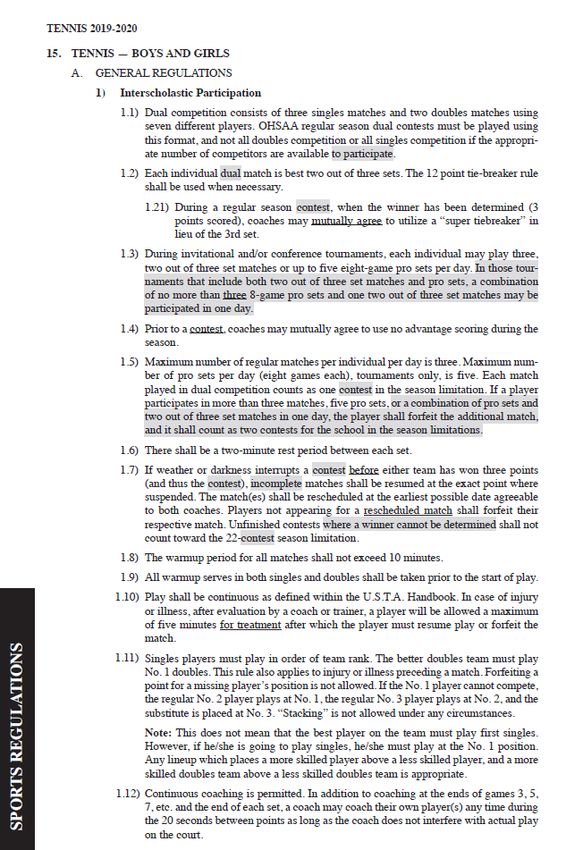
ONE FINAL MATTER: IT HAS BEEN BROUGHT TO MY ATTENTION THAT MANY COACHES ARE
COMPLETING/ENDING A DUAL CONTEST WHEN A TEAM REACHES THREE (3) POINTS. THE
INTENT OF INTERSCHOLASTIC TENNIS IS TO PROVIDE PARTICIPATION OPPORTUNITIES TO
STUDENTS! A DUAL CONTEST DOES NOT CONCLUDE WHEN THE FIRST TEAM REACHES 3
POINTS (THREE WINS). IF DARKNESS OR SOME OTHER CIRCUMSTANCE INTERFERES WITH
BEING ABLE TO COMPLETE THE CONTEST THEN IT IS UNDERSTOOD THAT YOU MAY
CONCLUDE THE CONTEST AND THE REMAINING MATCHES.

WHEN A WINNER HAS BEEN DETERMINED, COACHES MAY MUTUALLY AGREE TO UTILIZE A
“SUPER TIEBREAKER” IN LIEU OF THE THIRD SET (SEE TENNIS REGULATION 1.21). DO NOT END
THE INTERSCHOLASTIC CONTEST SIMPLY BECAUSE A WINNER HAS BEEN DETERMINED.
PERMIT STUDENTS TO PARTICIPATE!

                                        MISSION STATEMENT
The Ohio High School Athletic Association’s mission is to serve our member schools and enrich interscholastic
opportunities for students.

                  TENNIS RULES INTERPRETATION MEETINGS
By OHSAA Board of Directors regulation, any school sponsoring interscholastic contests in high school tennis, or
wishing to have an individual participate in the OHSAA state tournament, must have the head coach, assistant
coach, or athletic administrator participate in a rules interpretation meeting. For the sport of tennis, these meetings
are held online every academic year.

                         Instructions and Tips for Completing the Rules Meeting Online

          All Coaches will access the state rules meetings through their myOHSAA accounts

Coaches should contact their athletic administrator if they do not have an account. The
athletic administrator will need to add the coach to the school’s staff management in
myOHSAA. This will generate an email invitation from info@myOHSAA.org to the coach.
Coaches should look for this email in their inbox, junk or spam folders. Once the email is
received, coaches should open the email and click the link inside and use the “Register”
portion of the screen to create an account. Follow all prompts to create login credentials,
verify your email address and complete your contact information. Once the account is
created and all dashboard items completed, a blue button for the school will be added to
                                                           3
your account. Click the button and use the State Rules Meeting link in the left column to
access the list of meetings.
1. Your myOHSAA profile will be updated to reflect your viewing of an on-line meeting.
2. Please do not call the OHSAA Office for verification.
3. If you viewed the tennis online meeting in the fall (2019), you coach at the same
member school, and you received verification for fall 2019 ‘attendance,’ there is no need
to view a meeting for spring 2020.

      The ONLINE Rules Meeting link will be live on WEDNESDAY, January 29, 2020 at 9:00 a.m.
The last day for completion of the online version without penalty is Thursday, March 26, 2020. Thereafter, a $50.00 late fee is
charged for access to the online version. Contact Ms. Andrea Heiberger if you need to gain access to the meeting after the
deadline.

PLEASE NOTE: Our attendance software system hasn’t always cooperated with the relationship between the Online Rules
Meetings and tablets and/or mobile devices—these devices allow you to complete the course but does not ask for or provide us
any information, resulting in you receiving no credit for reviewing the online meeting. We suggest you use a desktop or laptop
computer to make sure you receive proper credit for completing the rules meeting.

                                               IMPORTANT DATES
                                      2020 OHSAA BOYS TENNIS CALENDAR

            March 9               First Day of Coaching and Mandatory Instruction Permitted
           March 27               First Regular Season Contest Permitted
            April 13              Non-Interscholastic Competition No Longer Permitted w/o Approved Waiver
            April 27              Deadline for Entering or Withdrawing from the OHSAA Tournament w/o penalty
             May 3                Tournament Draw/Seeding Date- 2:00 p.m.
       May 11-May 16#             Sectional Tournaments
        May 18-May 23             District Tournaments
          May 29-30               State Tournament – Lindner Family Tennis Center-Mason, OH
# Unless an earlier date is established by a District Athletic Board (no earlier than two days prior to the established
date). Thus, the sectional tournament could start as early as May 9, 2020.

                                       OHSAA CONTACT INFORMATION
        OHSAA Office – 4080 Roselea Place, Columbus, OH 43214 ~ 614-267-2502 ~ 614-267-1677 (fax)

         Name                          Title                           Responsibilities                            E-Mail
                            OHSAA Senior Director of
                                                             Oversees the sport & coordinates          rprice@ohsaa.org
Roxanne Price               Compliance/Tennis
                                                             the tournaments
                            Administrator
                                                                                                       aheiberger@ohsaa.org
                                                             Assists in the coordination of the
Andrea Heiberger            Program Coordinator
                                                             sport & tournaments

                                                                4
For Tennis Rules interpretations, please contact one of our OHSAA State Rules Interpreters.

                  Interpreter                       Phone                             E-Mail

            Tim Voegeli                         937-271-7690                tim.voegeli@earthlink.net

            Mike McGee                          330-606-5287                 mmcgee0225@aol.com

 For matters of eligibility or compliance, please consult with your athletic director or principal first. It is their
responsibility to be knowledgeable of OHSAA Bylaws, and to call or email the OHSAA for clarification, if
necessary. If your athletic administrator is not readily available, you may email me at rprice@ohsaa.org.
Include the name of the school at which you coach.

                     Name                            Title                            E-Mail

            Dr. Deborah Moore         Senior Director of Compliance            dmoore@ohsaa.org

            Roxanne Price             Senior Director of Compliance             rprice@ohsaa.org

                                                         5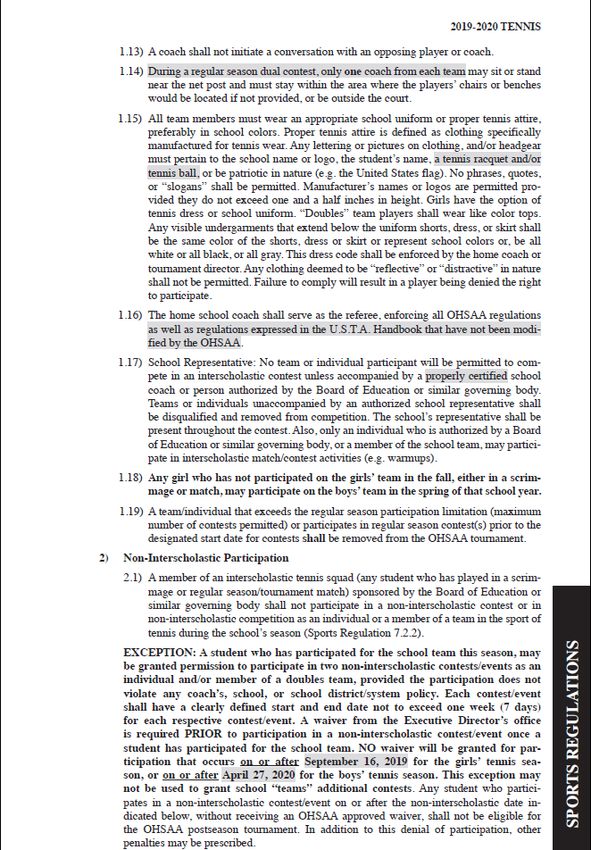
TENNIS SPORT REGULATIONS

           6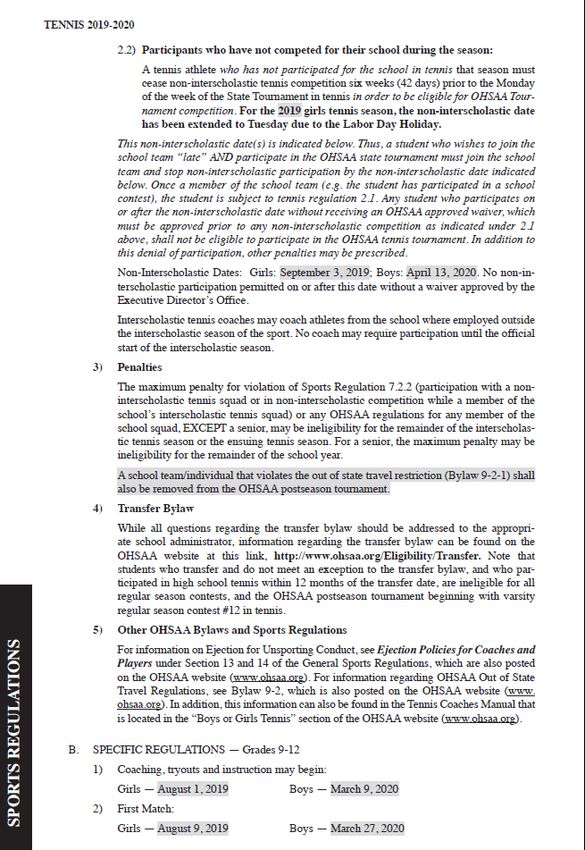
7
8

9
10
THE INFORMATION DIRECTLY ABOVE AND BELOW HAS BEEN COPIED DIRECTLY FROM THE ONLINE
RULES MEETING. THE INFORMATION REGARDING THE PERMISSIBLITY OF STUDENTS TO PARTICPATE IN
TWO NON-INTERSCHOLASTIC CONTESTS/EVENTS WHILE A MEMBER OF THE SCHOOL TEAM IS FURTHER
DETAILED IN THE 2019-2020 TENNIS REGULATIONS!

                                          11
THERE IS A CONSEQUENCE, DENIAL OF PARTICIPATION IN THE OHSAA TENNIS TOURNAMENT,
FOR STUDENTS WHO DO NOT ADHERE TO WHAT IS INDICATED IN REGARD TO NON-
INTERSCHOLASTIC PARTICIPATION. A WAIVER IS REQUIRED IN ORDER FOR A MEMBER OF A
SCHOOL TEAM TO PARTICIPATE NON-INTERSCHOLASTICALLY. ANY STUDENT WHO HAS NOT
PARTICIPATED FOR THE SCHOOL TEAM, WHO PARTICPATES ON OR AFTER THE NON-
INTERSCHOLASTIC DATE INDICATED, SHALL ALSO BE INELIGIBLE FOR PARTICIPATION IN THE
OHSAA TENNIS TOURNAMENT.
ALL WAIVER REQUESTS MUST BE SUBMITTED BY THE APPROPRIATE SCHOOL ADMINISTRATOR (E.G
ATHLETIC DIRECTOR OR PRINCIPAL) TO THE EXECUTIVE DIRECTOR’S OFFICE (i.e. Roxanne Price)
IT IS YOUR RESPONSIBILITY AS A
SCHOOL COACH TO ENSURE THAT STUDENTS WHO
PARTICIPATE ON YOUR SCHOOL TEAM ARE KNOWLEGEABLE
AS TO WHAT IS AND IS NOT PERMITTED IN REGARD TO
PARTICIPATION ON NON-SCHOOL TEAMS, AND IN NON-SCHOOL
(E.G. USTA/CLUB/CHARITY) EVENTS DURING YOUR SCHOOL
SEASON.
12OHIO HIGH SCHOOL ATHLETIC ASSOCIATION
4080 Roselea Place, Columbus, Ohio 43214
614-267-2502
FAX 614-267-1677
www.ohsaa.org
2020 WAIVER REQUEST
Tennis Non-Interscholastic Rule*
Please complete and return to Roxanne Price at rprice@ohsaa.org
OHSAA regulations permit schools to request a waiver of General Sports Regulation 7.2.2 – Participating
on Non-School Teams. The waiver, permitting non-interscholastic participation during the school season
once a student has participated on the school team, may be granted up to two times per school season.
Each waiver is good for one event. To be considered one event, all play in the event must have an
established start and end date not to exceed 7 consecutive days. No waivers will be granted for events
taking place after April 26, 2020. This waiver request must be submitted by a school administrator.
NO waivers from a coach, student, or student’s parent(s) will be acknowledged.
Name of Member School Making Request: ____________________________________________________
Name of Student Making Request: _________________________________________ Grade: _____________
1st Request ____ 2nd Request ____ (check one)
Name of Non-Interscholastic Event: _________________________________________________________
Location of Event (City, State): _____________________________________________________________
Date(s) of Event: ________________________________________
Head Coach’s Name: ______________________________ Email: __________________________________
Athletic Director’s Name: ____________________________
Email:_____________________________________
Athletic Director’s Signature: __________________________________________________________________
Email request to rprice@ohsaa.org or Fax to 614-267-1677 Attn: Roxanne Price (email preferred).
Office Use Only:
Approval By: ________________________________________ Date: _______________
Signature of OHSAA Administrator
*This request does not waive tennis regulation 2.0, which prohibits a student from participating in the OHSAA Tennis Tournament if that student continues to
participate on or after the established non-interscholastic date prior to participating on the school team. Any participation on or after the non-interscholastic date,
in the absence of receiving an approved waiver, shall prohibit the student from participation in the OHSAA Tennis Tournament.
13The following is a summary of the sports regulations as they apply to match protocol and to the postseason
tournaments. Items addressed are warm up periods, rest periods, foot faults, equipment, etc. There is also more
extensive information on the continuous coaching rule.
Summary of Tennis Regulations and 2020 Tournament Information
1. Eligibility
1.1 OHSAA eligibility bylaws apply to all participants.
1.2 OHSAA Sport Regulation #7 – Non-Interscholastic Programs.
2. Rules of Play
2.1 Current U.S.T.A. rules for singles and doubles play apply unless specifically modified by the OHSAA.
2.2 During invitational and/or conference tournaments, each participant may play three, two of three set
matches or up to five eight game pro sets per day, OR a combination of no more than three 8-game pro
sets and one two out of three set matches per day. The OHSAA tournament does not permit pro sets.
2.3 Players and coaches are requested to assist in starting matches on schedule. A ten-minute default rule
may be enforced. It is not mandatory that the home team give the visitors extended time for pre-match
warm-ups.
2.4 All warm-up serves in both singles and doubles shall be taken prior to the start of play.
2.5 Play shall be continuous as defined by U.S.T.A. Regulations. In case of injury or illness, after
evaluation by a coach or trainer, a player will be allowed a maximum of five minutes for treatment after
which the player must resume play or forfeit the match.
2.6 Singles players must play in order of team rank. The better doubles team must play No. 1 doubles.
This rule also applies to injury or illness preceding a match. Forfeiting a point for a missing player's
position is not allowed. If the No. 1 player cannot compete; the regular No. 2 player plays at No. 1, the
regular No. 3 player plays at No. 2 and the substitute is placed at No. 3 “Stacking" is not allowed under
any circumstances.
2.7 Either player may call a “let” if interference occurs, but the player calling a “let” must be in control of the
ball. A “let” will not be allowed after a player has hit and erred.
2.8 Players are warned not to catch balls before they strike the court.
2.9 In case of foot faults the coach (not players) should notify the tournament manager. The tournament
manager will handle the violations and may assign a foot fault judge if necessary. Once a
coach/monitor has been assigned, foot fault infractions can be called from outside the court.
2.10 Players are requested to record scores on scoreboards as they change ends when scoreboards are
provided.
2.11 The winner of each match will report the score to the tournament manager, return used balls and then
be notified of the schedule time of his/her next match.
2.12 In tennis there will be a two-minute break between each set.
2.13 There shall be a minimum of thirty minutes between matches in the sectional tournaments and a
minimum of forty-five minutes between matches in district tournaments for all competitors, weather
permitting. During the state tournament, there will be a minimum of one hour between matches,
weather permitting. Consider weather conditions (e.g. heat and humidity) and the intensity of a match
when determining a rest period.
3. Equipment
3.1 Only "championship" quality, "approved by the U.S.T.A." balls shall be used in matches.
3.2 The home team will furnish two or three balls for the matches unless other arrangements have been
made between the coaches.
3.3 The home team coach shall determine whether new balls will be used for third sets. The decision and
announcement to the players should be made in advance of the start of play.
3.4 Tennis racquets and strings shall conform to current U.S.T.A. standards.
3.5 Singles sticks shall be used in all sectional, district, and state tournaments.
144. Officials
4.1 The home team coach shall serve as the referee, but both coaches are responsible for assuring that
USTA and OHSAA regulations are followed.
4.2 All matches should begin at the specified starting time. Individual matches may be delayed a
predetermined period of time to accommodate a player late for a legitimate reason (IF A MATCH IS TO
BE FORFEITED, IT MUST BE THE 3RD SINGLES OR 2ND DOUBLES MATCH THAT IS FORFEITED).
4.3 Either coach may request a foot-fault judge or line judge. It is the home coach’s responsibility to make
such assignments. Parents, high school students and general spectators from either of the two
competing schools should not be assigned this responsibility.
4.4 A player may request interpretation of a rule from his/her coach or the opposing coach during play but
may not engage an opposing coach in conversation, nor may the student’s coach violate the continuous
coaching regulation.
5. Conduct, Character, Discipline
5.1 Ethical conduct of players and coaches should be exhibited at all times. Coaches and players are
reminded that Code Violations can be given prior to, during, and after a match has concluded.
5.2 During participation in regular season and OHSAA tournaments any student or coach ejected for
unsporting conduct or flagrant foul shall be ineligible for the remainder of that day as well as for all
contests in that sport until two regular season/tournament contests at the same level are played. The
home/host coach shall be responsible for reporting player/coach ejections.
The tournament manager shall report individuals ejected for unsporting conduct during an OHSAA
tournament to the OHSAA. The Executive Director’s Office will investigate the situation and may
impose additional penalties in accordance with Bylaw 11, if the situation warrants it.
Participation in athletic contests is a privilege. Everyone is expected to conduct him or herself in an
exemplary manner while participating.
6. Coaching
6.1 In addition to at the end of games 3, 5, 7, etc. and the end of each set, a coach may coach their own
player(s) any time during the 20 seconds between points as long as the coach does not interfere with
actual play…coaching cannot interrupt the continuous play rule. There can be absolutely no coaching
during actual match play.
6.2 Coaching may only take place where facilities permit it. Matches on other courts cannot be interfered
with. A coach may sit or stand near the net post (only one coach {board approved} is permitted to sit
or stand during a dual match near the net post), and all coaches (when more than one is permitted)
must stay within the area where the players’ chairs or benches would be located if not provided. The
coach’s movement shall be limited so as not to distract the players. A coach may change courts when
his/her movement will not interrupt play. It is permissible to coach from outside of a fenced court, on an
empty adjacent court where the coach may stand and/or at the doubles sideline on the same side of
his/her own player… if the coaching does not interfere with other matches occurring simultaneously or
the match in progress. Coaches shall in no way distract an opposing player. Coaches may coach within
the lines of the court only during a changeover or set break.
6.3 A coach shall not initiate a conversation with an opposing player or in any way get involved with an on-
court situation, except at the request of the player(s) or opposing coach in accordance with what is
already permitted. At no time should a player initiate a conversation with an opposing coach.
6.4 Coaching is not permitted during an OHSAA match by anyone other than the school's assigned Board
approved tennis coaches. All coaches must have the proper ODE/OHSAA credentials. Member schools
permitting non-certified coaches to coach may incur a fine and be subject to additional penalties,
including those imposed by the Ohio Department of Education.
6.5 The use of signals, cheering (as opposed to applause), vile suggestions, and the like, during play, is
considered unsporting and is not permitted.
6.6 Penalties for Continuous Coaching Violations: The purpose of continuous coaching is to be able to
quickly offer advice to the player without delaying play. If a coach violates the guidelines for continuous
coaching, he/she will receive a warning for the first violation. Subsequent violations will result in his/her
player receiving a point penalty on the court where the violation occurred. (Continuous coaching
penalties are similar to time violations.)
157. Please refer to the Tennis Regulations regarding:
a. Uniforms- hats/visors, as well as shirts, shorts, and dresses are considered part of the uniform and
uniform regulations shall apply.
b. Code of Conduct
2020 Tournament Schedule
Sectional: May 11-16, 2020# (Specific dates to be established by each respective District Athletic Board).
District: May 18-23, 2020 (Specific dates to be established by each respective District Athletic Board).
State: May 29-30, 2020 Lindner Family Tennis Center- Mason, OH
# Unless an earlier date is established by a District Athletic Board (no earlier than two days prior to the
established date). Thus, the sectional tournament may start as early as May 9, 2020.
OHSAA GENERAL SPORTS REGULATIONS
General Sports regulations for 2019-20 can be found in the OHSAA handbook (also available on the website,
www.ohsaa.org) These rules pertain to tournament deadlines, instructional programs and open gyms, media
regulations (including the filming of athletic contests by schools and spectators), transportation to and from
interscholastic contests, scrimmages, interrupted contest(s), alcohol and illegal drugs, and the OHSAA’s inclement
weather policy, etc. Please refer to these regulations when you have questions about the items mentioned above. To
locate the General Sports Regulations, highlight “Sports” and select “Tennis”. The General Sports Regulations can
be found on the left-hand side of the page.
Note that the General Sports Regulations address Heat Acclimation, which is also further addressed in the online
rule’s presentation. Heat has been more of an issue during the boy’s tennis season but can be an issue during early
practice sessions and contests during the girls season.
SPORTS REGULATIO
TOURNAMENT REGULATIONS – Sectional, District, State
OHSAA Boys Tennis Tournament Regulations are available at www.ohsaa.org after approval by the Board of
Directors. On the web site, under “Sports” select Tennis – Boys. The tournament regulations are listed under
“Tournament Information” on the left side.
Information on Concussion Management
CONCUSSION REGULATIONS – UPDATED FOR 2013-14
DATE OF IMPLEMENTATON – APRIL 26, 2013
Implementation of State Law and NFHS Playing Rules Related to Concussion
and Concussed Athletes and Return to Play Protocol
Notwithstanding the leading role that the Ohio High School Athletic Association has played in
16the area of developing policies concerning concussion prevention, recognition and
management, in December of 2012, Ohio’s Governor Kasich signed into law legislation that
was passed by Ohio’s 129th General Assembly which incorporated much of what the OHSAA
regulations previously mandated. This law adds several aspects to previous OHSAA
regulations. Therefore, in order to be fully compliant with this law as signed by our Governor,
modifications have been made to OHSAA policy. These modifications are set forth in these
updated Concussion Regulations.
It is important for all individuals involved in interscholastic athletics to recognize the potential for catastrophic
injury and even death from concussions. Thus, it is extremely important that each coach, administrator,
contest official and medical support personnel review their responsibilities in protecting students. Further both
students and parents have responsibilities in this area as well.
Note: It has always been the ultimate responsibility of the coaching staff, in all sports, to ensure that students
are only put into practice or contests if they are physically capable of performing. However, all individuals
involved in the conduct of interscholastic competition have responsibilities in this endeavor.
In January 2011, the OHSAA Board of Directors adopted a sports regulation which incorporated the National
Federation of State High School Associations (NFHS) playing rules related to concussion recognition and
management. On April 26, 2013, legislation adopted by Ohio’s General Assembly on concussion and head
injuries in youth sports became effective. On February 14, 2013, the OHSAA Board of Directors mandated that
these regulations become effective on April 26, 2013 for the remainder of the spring sports season and
thereafter. This OHSAA regulation, as amended to incorporate this recent legislation, now reads:
Any student, while practicing for or competing in an interscholastic contest, who exhibits signs,
symptoms or behaviors consistent with having sustained a concussion or head injury (such as loss of
consciousness, headache, dizziness, confusion or balance problems) shall be immediately removed
from the practice or contest by either of the following:
1) The individual who is serving as the student’s coach during that practice or competition.
2) An individual who is serving as a contest official or referee during that practice or competition.
RETURN TO PLAY PROTOCOL
If a student is removed from practice or competition due to a suspected concussion or head injury, the coach
or referee who removes the student shall not permit the student, ON THE SAME DAY THE STUDENT IS
REMOVED, to return to that practice or competition or to participate in any other practice or competition for
which the coach or contest official is responsible. Thereafter, which means no earlier than the next day, the
coach or contest officials shall not permit the student to return to practice or competition until both of the
following conditions are satisfied:
1) The student’s condition is assessed by either of the following:
a. A physician, who is a person authorized under Chapter 4731 of the Ohio Revised
Code (OCR) to practice medicine and surgery or osteopathic medicine or surgery
(M.D. or D.O.)
b. Any other licensed health care provider that the school district board of
education or other governing authority of a chartered or non-chartered
nonpublic school, authorizes to assess the student who has been removed
from practice or competition.
2) The student receives written authorization that it is safe for the student to return to practice or
competition from a physician or other licensed health care provider authorized to grant the
clearance. Click here http://ohsaa.org/medicine/AuthorizationToReenter.pdf to retrieve the
OHSAA’s Medical Authorization to Return To Play (RTP) form.
A school district board of education or governing authority of a chartered or non-chartered nonpublic school
may authorize a licensed health care provider who is NOT a PHYSICIAN to make an assessment and grant
authorization for a student to return to participation ONLY if the provider is acting in accordance with one of
17the following as applicable to the provider’s authority to practice in Ohio:
1) In consultation with a physician;
2) Pursuant to the referral of a physician;
3) In collaboration with a physician, or
4) Under the supervision of a physician.
Note: A physician or other licensed health care provider who makes an assessment or grants clearance for a
student to return to participation may be a volunteer.
COACHES REQUIRMENTS
All coaches, paid and volunteer, must possess a current Department of Education-issued Pupil Activity
Program/Coaching Permit. When renewing this permit, the coach will be required to complete an online
concussion education course as stipulated in the section entitled Approved Online Concussion Education
Course. This course is valid for three years and expires at the time the Pupil Activity Program/Coaching
Permit expires. There is a new coaching requirement for the 2017-18 school year. See your Athletic Director.
CONTEST OFFICIALS REQUIRMENTS
New legislation signed into law by the Governor provides that no school “shall permit” an individual to
referee interscholastic athletic contests unless the individual holds a Pupil Activity Program/Coaching
Permit or has successfully completed within the last three years a training program in concussion
recognition. Therefore, all OHSAA licensed officials shall possess either a current Department of Education-
issued Pupil Activity Program/Coaching Permit or show evidence of completing an approved online
concussion education course as stipulated in the section entitled Approved Online Concussion
Education Courses. This course is valid for three years from the date of completion.
STUDENT AND PARENT REQUIREMENTS
All students and their parents or legal guardians shall review and sign the “Concussion Information Sheet”
which has been developed by the Ohio Department of Health and which shall be distributed by OHSAA
member schools to all students and their parents prior to each sports season. Students and parents shall
review and sign this form each year and should keep a copy of the form. In addition, parents and students are
encouraged to complete an approved concussion education course. The Concussion Information Sheet can
be found here:
http://www.healthyohioprogram.org/~/media/HealthyOhio/ASSETS/Files/injury%20prevention/concussion/Inter
scholastic%20Concussion%20Form%20-%20ODH%20Revised%202.ashx
APPROVED ONLINE CONCUSSION EDUCATION COURSES
The following free online training courses have been approved by the Ohio Department of Health for
coaches and
CONTEST OFFICIALS:
National Federation of State High School Associations Concussion in Sports - What you Need to Know:
http://www.nfhslearn.com/electiveDetail.aspx?courseID=38000
(This free online course is available through the NFHS. Click the “order here” button, and complete a brief registration
form to take the course. Follow these steps to complete the course:
1. Click on the button that says, “Please Login to Order.” In the window that appears, click “Register Now.”
2. When your registration is complete, you may "order" the free concussion course offered along the left-hand
side of the page. Continue following prompts. Although it may look like you will be charged for the course,
there is no cost.
3. Once you've completed "Checkout," you will be able to take the free online course.
184. When you have completed and passed the course, you have the option of printing a certificate of
completion.
5. All Ohio Officials should select this option to print, retain a copy of the certificate and carry it with them to all
contests.
Centers for Disease Control and Prevention Heads Up Concussion in Youth Sports On-Line Training
Program: http://www.cdc.gov/concussion/HeadsUp/online_training.html -
PLEASE NOTE: Both courses offer a “certificate of completion” upon successful passage. The NFHS course allows
organizations to search for and track coaches and other individuals such as contest officials who have completed the
course, while the CDC course does not.
FREQUENTLY ASKED QUESTIONS
1. What are the “signs, symptoms, or behaviors consistent with a concussion?” The National
Federation rule lists some of the signs, symptoms and behaviors consistent with a
concussion. The U.S. Department of Health and Human Services, Centers for Disease
Control and Prevention has published the following list of signs, symptoms and behaviors
that are consistent with a concussion:
SIGNS OBSERVED BY OTHERS SYMPTOMS REPORTED BY ATHLETE
• Appears dazed or stunned • Headache
• Is confused about assignment • Nausea
• Forgets plays • Balance problems or dizziness
• Is unsure of game, score, or opponent • Double or fuzzy vision
• Moves clumsily • Sensitivity to light or noise
• Answers questions slowly • Feeling sluggish
• Loses consciousness • Feeling foggy or groggy
• Shows behavior or personality changes • Concentration or memory problems
• Cannot recall events prior to hit • Confusion
• Cannot recall events after hit
2. Who is responsible for administering this rule?
All individuals who have responsibilities and duties in the interscholastic athletics environment are
responsible: coaches, contest officials, administrators, students, parents and medical personnel.
3. What is the role of coaches in administering this rule?
• Coaches are to review and know the signs and symptoms of concussion and to prohibit any
athlete who displays these signs or symptoms from participating in a practice or a contest.
• Coaches are not medical professionals and have no authority to determine whether or not a
student has sustained a concussion. The coach is responsible for insuring that the student’s
parents are notified and the student is referred to a medical professional.
• Coaches shall be aware that any student removed from a practice or a contest due to a
suspected concussion or head injury shall not return to participation on the same day as
the removal.
• Coaches shall possess a current Pupil Activity Program/Coaching Permit and shall take one of
the approved online concussion courses upon renewal of the permit.
4. What is the role of contest officials in administering the rule?
• Officials are to review and know the signs and symptoms of concussion and to direct
immediate removal of any student who displays these signs or symptoms. When informing the
head coach about removal of an athlete, the official shall be accompanied by another (second)
official if possible.
19• An official shall not permit the athlete who has been removed under this rule to return to
competition that same day.
• If a contest official is aware that a student has been permitted to return to competition on the
same day as removal, that official shall immediately stop play and remove that student from
competition and report the incident to the OHSAA.
• Note that officials are not medical professionals and have no authority to determine whether or
not a student has sustained a concussion. The official is responsible for directing removal
when he or she observes signs and symptoms that may indicate a student is concussed.
• All Officials shall possess either a current Pupil Activity Program/Coaching Permit or shall
complete one of the online concussion courses which are valid for three years from the date of
completion.
• At initial licensure or renewal of the OHSAA officiating permit, the official shall indicate that he
or she has either a current Pupil Activity Program/Coaching Permit or has completed one of
the approved online concussion courses.
• All officials should carry with them evidence of completion of one of these options at all times
while officiating a contest.
• Officials are required to submit to the OHSAA the “OHSAA Concussion Report” within 48
hours whenever a student has been removed from a contest under this regulation.
5. What are the expectations of student-athletes in concussion management?
•While all individuals involved in the interscholastic athletics program have a responsibility
to recognize the potential for catastrophic injury and even death from concussions, it is
also the responsibility of student-athletes to recognize the signs, symptoms and behaviors
consistent with a concussion.
•Student-athletes who exhibit symptoms such as loss of consciousness, headache,
dizziness, confusion or balance problems, have the responsibility to report these
immediately to their coach and/or health care professional. Teammates also share the
responsibility to report these symptoms when they are exhibited by a fellow student-
athlete.
Student-athletes shall review and sign, on an annual basis, along with their parents or
legal guardians, the Ohio Department of Health’s Concussion Information Sheet found on
the OHSAA website and at this link
http://www.healthyohioprogram.org/~/media/HealthyOhio/ASSETS/Files/injury%20prevention/con
cussion/Interscholastic%20Concussion%20Form%20-%20ODH%20Revised%202.ashx
6. Who decides if an athlete has not been concussed and/or who has recovered from a
concussion?
• Only an M.D. (Medical Doctor), D.O. (Doctor of Osteopathy), or another health care provider
approved by the school’s Board of Education or other governing body who is acting in accordance
with one of the following as applicable to the provider’s authority to practice in Ohio:
1) In consultation with a physician;
2) Pursuant to the referral of a physician;
3) In collaboration with a physician;
4) Under the supervision of a physician.
is empowered to make the on-site determination that an athlete has not received a concussion.
Even if that determination has been made, however, the student may not return to practice or
competition on the same day he/she has been removed from a practice or competition (see
No. 7 below).
• If any one of these physicians or authorized medical providers has answered that “yes” there
has been a concussion, that decision is final.
207. Can an athlete return to play on the same day as he/she has been removed from a practice
or competition for a suspected concussion?
• No, under no circumstances can that athlete return to play that day.
• No coach or contest official shall allow a student to return to practice or to competition on any
day after the initial removal until that student has been assessed and cleared for return with
written authorization by a physician or licensed health care provider authorized by the
school.
• If the event continues over multiple days, then the designated event physician has ultimate
authority over return to play decisions.
8. Once the day has concluded, who can issue authorization to return to practice/competition
in the sport for a student who has diagnosed with a concussion?
• Once a concussion has been diagnosed by a physician or other approved health care provider,
only a physician or approved provider can authorize subsequent Return To Play (RTP), and
such authorization shall be in writing to the administration of the school. This written RTP
authorization shall be kept at the school indefinitely as a part of that student’s permanent
record. Click here http://ohsaa.org/medicine/AuthorizationToReenter.pdf to access the OHSAA
“Medical Authorization to Return to Play” Form.
• School administration shall then notify the coach as to the permission to return to practice or
play.
9. What should be done after the student is cleared by an appropriate health care professional?
• After a clearance has been issued, the student’s actual return to practice and play should
follow a graduated protocol.
• The National Federation of State High School Associations has included the following
graduated protocol in its Suggested Guidelines for Management of Concussion in Sports:
(Note: This is simply a suggested protocol. The appropriate health care professional who
issues the clearance may wish to establish a different graduated protocol.)
NFHS SUGGESTED MEDICALCLEARANCE RETURN TO PLAY PROTOCOL
1. No exertional activity until asymptomatic.
2. When the athlete appears clear, begin low-impact activity such as walking, stationary bike, etc.
3. Initiate aerobic activity fundamental to specific sport such as running or skating, and may also
begin progressive strength training activities.
4. Begin non-contact skill drills specific to sport such as dribbling, fielding, batting, etc.
5. Full contact in practice setting.
6. Game play/competition.
• Athlete must remain asymptomatic to progress to the next level. (It is often suggested that an
athlete not be allowed to progress more than one level per day.)
• If symptoms recur, athlete must return to previous level and should be reevaluated by an
appropriate health care professional.
• Medical check should occur before contact. (Final written clearance from the medical
professional shall be obtained before the athlete engages in any unrestricted or full
contact activity.)
QUICK LINKS FROM THE OHIO DEPARTMENT OF HEALTH
Ohio Department of Health Concussion Information Sheet
http://www.healthyohioprogram.org/~/media/HealthyOhio/ASSETS/Files/injury%20prevention/concussion/Int
erscholastic%20Concussion%20Form%20-%20ODH%20Revised%202.ashx
21Online Concussion Management Training - http://www.healthyohioprogram.org/concussion.aspx#Training
Ohio’s Return to Play Law: Frequently Asked Questions -
http://www.healthyohioprogram.org/~/media/HealthyOhio/ASSETS/Files/injury%20prevention/concussion/Frequently
%20Asked%20Questions%20Updated%202513.ashx
Ohio’s Return to Play Law: What Coaches and Referees Need to Know -
http://www.healthyohioprogram.org/~/media/HealthyOhio/ASSETS/Files/injury%20prevention/concussion/Return%20
to%20Play%20-%20What%20Coaches%20Need%20to%20Know%20-%20School%20Sports%20-%20Final.ashx
Ohio’s Return to Play Law: What Parent/Guardians Need to Know -
http://www.healthyohioprogram.org/~/media/HealthyOhio/ASSETS/Files/injury%20prevention/concussion/Return%20
to%20Play%20-%20What%20Parents-Guardians%20Need%20to%20Know%20-%20School%20Sports%20-
%20Final.ashx
ADDITIONAL CONCUSSION RESOURCES
Ohio Department of Health, Violence and Injury Prevention Program - Sports/Recreation Traumatic Brain Injuries -
http://www.healthyohioprogram.org/vipp/child/tbi.aspx
CDC Heads Up: Concussion in Youth Sports
Nationwide Children’s Hospital – Concussion Information Toolkit - http://www.nationwidechildrens.org/concussion-
toolkit
CDC Materials on Returning to School for Parents, School Nurses and Educators -
http://www.cdc.gov/concussion/HeadsUp/schools.html
Ohio Legislative Service Commissioner HB 143 Bill Analysis - http://www.lsc.state.oh.us/analyses129/12-hb143-
129.pdf
Brain Injury Association of Ohio – www.biaoh.org
SERVICE ANIMAL INFORMATION
It is the position of the Ohio High School Athletic Association that all individuals, including those with disabilities, shall
have access to OHSAA tournaments and regular season contests conducted by the member schools. This
statement is designed to apprise all OHSAA member schools and tournament managers of the law relating to these
accommodations for persons with disabilities and to remind the membership of obligations as it relates to this law.
According to the federal law known as the Americans with Disabilities Act, see complete reference here
https://www.ada.gov/service_animals_2010.htm , only dogs are recognized as service animals and are defined as
“dogs which are individually trained to do work or perform tasks for people with disabilities.” Under this law, as an
organization which serves the public, the OHSAA and its member schools, shall allow these service animals to
accompany people with disabilities in all areas of facilities where the public is normally allowed to go.
The service dog must be harnessed, leashed or tethered unless these devices interfere with the service animal’s
work or the individual’s disability prevents using these devices. In that case, the individual must maintain control of
the animal.
When it is not obvious what service the dog provides, only limited inquiries are allowed. Staff members may ask two
questions: 1) Is the dog a service animal required because of a disability? and 2) What work or task has the
22dog been trained to perform? Staff shall not ask about the person’s disability, require medical documentation,
require a special identification card or training documentation for the dog, or ask the dog to demonstrate its ability to
perform the work or task.
We thank you in advance for making these accommodations for people who have disabilities so that they may fully
enjoy the events that are sponsored by the Ohio High School Athletic Association and its member schools. If you
have questions, as always, please contact a representative of your District Athletic Board for a sectional or district
tournament or the sport administrator on our staff for all other inquiries.
THE INFORMATION THAT FOLLOWS IS
PRESENTED IN COLLABORATION WITH THE
OHIO TENNIS COACHES ASSOCIATION
(OTCA)
THERE ARE MANY REFERENCES IN THE FOLLOWING INFORMATION TO
INFORMATION THAT IS CONTAINED WITHIN FRIEND AT COURT (FAC) 2019 THE
USTA HANDBOOK of TENNIS RULES and REGULATIONS. The information which follows
has been extracted from the 2019 FAC. The link to the 2019 USTA Friend at Court is:
https://www.nfhs.org/media/1019875//2019-friend-at-court.pdf
PLAYING THE MATCH
1.1 RULES (ITF FAC and OHSAA TENNIS REGULATIONS)
23Unless modified by the OHSAA, the USTA Rules and Regulations will be used as described or referred to
in The Friend at Court (FAC) 2019. Coaches should be familiar with the USTA regulations (which may
include International Tennis Federation (ITF) Rules.
MAKING LINE CALLS
During a match, it is the responsibility of the player to make his/her own calls. When there is doubt, the call
must be made in favor of the opponent. An out call must be made immediately. If a player feels that his/her
opponent is making incorrect calls, he/she may request a monitor for the match THROUGH his/her coach.
Remember the three-chance rule. Accept the first incorrect call as an honest mistake; question the
second; and you may request a monitor after the third.
1.2 REFEREE
The home coach will serve as the referee, enforcing all OHSAA and USTA regulations. Both coaches may
and shall enforce all rules. Although it is indicated that a coach serves as referee a coach must be ON
THE COURT to be able to reverse calls when requested.
PRE-MATCH INSTRUCTIONS
Prior to the start of the match the coach of the home team will call all the participants and coaches together to explain
the rules. He/she will:
1. Provide his/her line-up card in writing to the visiting coach and receive the visiting coach’s line-up card
in writing.
2. Introduce both coaches as match officials.
3. Introduce any assistant coaches at the match.
4. Announce that all regular season matches will be two out of three tie-breaker sets or the appropriate
number of pro sets (conference or invitational tournaments only). Refer to the OHSAA Tennis
Regulations regarding a 10-point match tiebreaker in lieu of 3rd set. Participants will have a 10-minute
warm-up.
5. Inform participants about restroom facilities and water.
6. Inform participants what to do in case of inclement weather.
7. Inform participants of any idiosyncrasies of the courts and facilities, such as overhead wires, etc.
8. Inform the participants that the OHSAA/OTCA point penalty system (Code of Conduct) will be enforced.
9. Supply two (2) or three (3) new USTA approved tennis balls. The use of new balls for the third set is
optional for regular season matches. It should be indicated prior to the match if new balls for the third
set are to be provided. The same regulations hold for all courts.
PLEASE REFER TO THE OHIO TENNIS COACHES’ ASSOCIATION CODE OF CONDUCT LOCATED NEAR THE
END OF THE MANUAL FOR INFORMATION REGARDING CODE VIOLATIONS/PENALTIES.
1.3 ON- COURT MONITORS
If a request is made for a monitor to go on-court, the monitor will only rule on calls which are challenged by
the players with a verbal request. The decision of the monitor is final! To continue to argue a call after a
monitor has ruled may result in an unsporting conduct penalty. The only calls made automatically by the
monitor are obvious foot faults and lets. Monitors should not be other players, parents or general spectators
from either of the two competing schools.
Players should be informed of the responsibilities of the monitors and the proper procedure for making
appeals. It is still the player’s responsibility to keep the score.
241.31 If a single monitor is used, he/she should position themselves at the net post. The only call the monitor may
make is an obvious foot fault and service lets. (There is no warning). All other calls are made by the players.
All appeals must be verbal and directed to the monitor. If the monitor cannot make the call, the call will stand. The
monitor’s decision is final.
1.3.2 If dual monitors are used (it is suggested that it be a coach from each team) they will place themselves at
opposite sides of the net post. Coach A will be responsible for his/her sideline and the north baseline and service
line. Coach B is responsible for his/her sideline and the south baseline and service line.
The monitor may defer to the other monitor for help in making a call. If neither can make the call, the call stands. All
appeals must be verbal and directed to the appropriate monitor. THE DECISION OF THE MONITOR IS FINAL.
CB
1.4 FOOT FAULTS
Players may not call foot faults on one another.
Players should inform their coach if they suspect foot faulting is taking place. Only coaches/monitors can
call foot faults. Coaches/monitors need not be directly on the court to make foot fault calls.
1.5 MAKING CALLS
A. Player makes calls on their own side of net. A player calls all shots landing on, or aimed at, the
player’s side of the net. This includes “Not Ups,” Through Balls, Double Bounces, Touches, etc.
Any ball coming towards a player is his/her call.
B. The opponent gets benefit of the doubt. When a match is played without officials, the players are
25responsible for making decisions, particularly line calls. There is a subtle difference between player
decisions and those of an on-court official. An official impartially resolves a problem involving a call,
whereas a player is guided by the principle that any doubt must be resolved in favor of an
opponent.
C. Ball touching any part of a line is good. If any part of a ball touches a line, the ball is good. A
ball 99% out is still 100% good.
(PART-2 THE CODE, PAGE 37)
1.6 FOREIGN LANGUAGE
If a player makes a loud outburst in a language that the official or coach does not understand, the official
should caution the player that further foreign language outbursts that are not understood by the official will
be penalized in the Point Penalty System as unsportsmanlike conduct.
1.7 COACHING
Please refer to Summary of Tennis Regulations and 2020 Tournament Information for more
complete continuous coaching rules. 6.1 and 6.2 from the aforementioned section are listed below:
• In addition to at the end of games 3, 5, 7, etc. and the end of each set, a coach may coach
their own player(s) any time during the 20 seconds between points as long as the coach does
not interfere with actual play…coaching cannot interrupt the continuous play rule. There can
be absolutely no coaching during actual match play.
• Coaching may only take place where facilities permit it. Matches on other courts cannot be
interfered with. A coach may sit or stand near the net post (only one coach permitted to sit or
stand during a dual match near the nest post) and all coaches (when more than one is
permitted) must stay within the area where the players’ chairs or benches would be located if
not provided. The coach’s movement shall be limited so as not to distract the players. A coach
may change courts when his/her movement will not interrupt play. It is permissible to coach
from outside of a fenced court, on an empty adjacent court where the coach may stand and/or
at the doubles sideline on the same side of his/her own player… if the coaching does not
interfere with other matches occurring simultaneously or the match in progress. Coaches shall
in no way distract an opposing player. Coaches may coach within the lines of the court only
during a changeover or set break.
1.8 ELECTRONIC DEVICES
1. If the cell phone of a player (or that player’s coach on the court) rings during the match, said
player will receive a warning and each subsequent offense will be assessed a point penalty.
2. If the cell phone of a player (or that player’s coach on the court) rings while the ball is in play,
that player loses the point being played.
3. The use of ANY electronic devices such as cell phones, digital messaging systems, radios,
mp3 players, CD and DVD players, cassette players, and watches that receive digital
messages to receive coaching and other information is prohibited. FIRST OFFENSE, the
player will be warned, and each subsequent offense will be a point penalty.
1.9 CALLING THE SCORE-THE SERVER’S RESPONSIBILITY/DISPUTES
The Server shall announce the game score before the first point of the game and the point score before
each subsequent point of the game. If a disagreement occurs and cannot be resolved between the players,
points that can be agreed upon count and the match is resumed at the point where both agree. Disputes
over the score shall be resolved by using one of the following methods, which are listed in the order of
preference (The Code, #31- #32, page 40):
26a. Count all points and games agreed upon by the players and replay only the disputed points or games.
b. Play from a score mutually agreeable to all players.
c. Spin a racket or toss a coin.
d. See the 2018 Friend at Court (page 40) for other examples of scoring disputes.
2.0 HINDRANCES
A player who claims a hindrance must stop play as soon as possible
Talking when a ball is in play:
• Singles players should not talk during points
• Talking between doubles partners when the ball is moving toward them is allowed.
• Doubles players should not talk when the ball is moving toward their opponent’s court.
• When talking interferes with an opponent’s ability to play a ball, it is a hindrance.
The Code- #33-38 for Hindrance Issues (FAC page 40-41). ITF Rules of Tennis, #26 (2018 FAC, page 13)
2.1 MEDICAL TIMEOUT AND BLEEDING TIMEOUT
OHSAA regulations indicate that a medical timeout consists of evaluation time as determined by the
official/referee plus a maximum of five minutes for treatment. The time allotted for evaluation and treatment
should not exceed 15 minutes. Please note that under USTA regulations the treatment time is limited to
three minutes. USTA regulations may be modified by the OHSAA for interscholastic tennis.
In the case of stoppage of play involving bleeding, body fluids, asthma attacks, and/or diabetic attacks, the
affected player is entitled time to stop the bleeding/body fluids and clean the affected area, administer
medication or administer insulin (insulin medication may be administered either on or off the court). If
clothing becomes soaked with blood or body fluids, the player must change clothing. When there is a
stoppage in play due to an issue involving blood or body fluids, the stoppage shall not be counted as an
injury timeout. Ensure the court is cleaned and dispose of all contaminated items.
If the bleeding/body fluids or the removal of the blood/body fluids, asthma attack, or insulin attack takes
more than 15 minutes or if the official in charge determines that the continuation of the match would likely
involve continued interruptions, such as after the third stoppage of play, and thus would not be fair to the
opponent, the official shall require the player who is bleeding/body fluids/or having an asthma attack or
insulin attack to retire.
Players shall not receive a medical timeout or treatment any time during a match, a warm-up or rest
period for general player fatigue (fatigue not accompanied by cramps, vomiting, dizziness, blisters,
etc.). Medical timeouts are not to be used to “rest.”
2.2 TOILET/CHANGE OF ATTIRE BREAKS
A toilet/change of attire break consists of a reasonable amount of time when an official determines that there
is a genuine need. No coaching is allowed during a toilet/change of attire break.
When possible, these breaks should be taken during a set break. If this is not possible, then the break
should be taken at an odd game changeover. Breaks taken at other times should be limited to true
emergencies.
Gastrointestinal problems are medical problems that are governed by medical timeout provisions and not by
the toilet break provisions.
COACHING IS NOT PERMITTED DURING THE SUSPENSION OF PLAY FOR EITHER A MEDICAL
TIME-OUT OR A TOILET BREAK (USTA Regulations III.E and III.F)
27You can also read


