2022 Two Sessions:
Ensuring Stability
Amid Global
Uncertainty
←
→
Page content transcription
If your browser does not render page correctly, please read the page content below
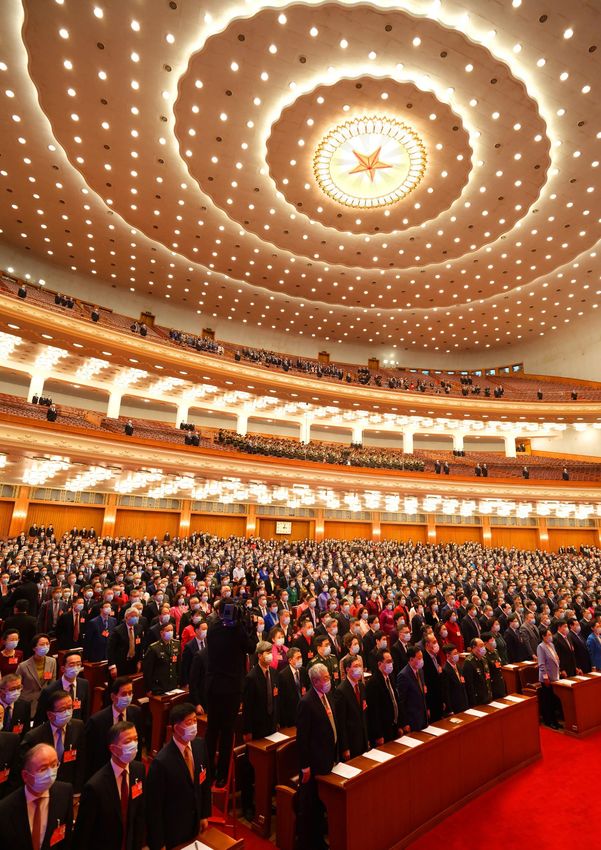
2022 Two Sessions: Ensuring Stability Amid Global Uncertainty

2                                                2022 Two Sessions: Ensuring Stability Amid Global Uncertainty

Introduction
An air of realism permeated this year’s annual meetings of the                weeks produce a significant outbreak similar to the current
National People’s Congress (NPC) and Chinese People’s Political               situation in Hong Kong, achieving the economic goals will become
Consultative Conference (CPPCC)—collectively known as the Two                 more challenging and will bring increased disruption to business.
Sessions. Compared to the guarded optimism exhibited at the
                                                                              This year’s Two Sessions arrived at a critical moment, wedged
meetings a year ago, the Chinese leadership painted a more
                                                                              between significant milestones. The 100th anniversary of the
somber picture of the myriad headwinds facing the country.
                                                                              Communist Party of China (CPC) was celebrated last July, and the
Premier Li Keqiang, delivering his final Government Work Report as            20th Party Congress will convene later this year, which is expected
premier, said China is under multiple pressures exerted by                    to see Xi Jinping confirmed for a third five-year term at the helm of
shrinking demand, disrupted and vulnerable supply chains, and                 the country. It also came on the heels of Beijing hosting the Winter
weakening expectations. "This year our country will encounter                 Olympic Games, despite the global pandemic and a national zero-
many more risks and challenges," Li stated. Although praise was               Covid policy, and a diplomatic boycott of the Games led by the US
given to the accomplishments of the past year, the government                 and a handful of other Western governments.
identified challenges ahead that spanned economic development,
                                                                              Although the political gathering mostly focused on domestic affairs,
price inflation, investment, logistics, climate change, technology
                                                                              looming in the background is the war in Ukraine, which has
supply chain, food security, energy supply, employment, and
                                                                              amplified themes of concern. Discussions around national security
innovation.
                                                                              and self-sufficiency featured prominently, including technology,
In what was arguably the most downbeat national assessment                    energy and food security, amid concerns over commodity inflation
since the global financial crisis, the reports released this year             and supply chain vulnerabilities. At a press conference, Li called the
underscored a heightened alertness to threats posed by an                     situation in Ukraine "disconcerting" and pledged "utmost efforts" to
increasingly volatile, grave and uncertain external environment.              support negotiations for peace, but he also refrained from
Domestically, China is also grappling with a sluggish recovery in             condemning Russia. As China walks a diplomatic tightrope while
consumption and investment. At the same time, after a significant             mitigating potential collateral impact of Western sanctions, the
period with the Chinese mainland effectively Covid-free, the                  unfolding crisis will test Beijing’s resolve over its "no limits"
country in recent weeks is witnessing a series of outbreaks that is           friendship with a country that has become isolated under
testing its "dynamic zero" Covid strategy.                                    international censure.
Even with these very real challenges, the government surprised                For decades, Chinese leaders have sought to balance the perpetual
many observers by setting the target for GDP growth at "around                and sometimes conflicting objectives of economic growth, reform,
5.5%" for this year. As we note on page 4, many provincial targets            and stability. From this year’s meetings, it is clear that stability is
have been set significantly higher. Maintaining growth to ensure              paramount. All other goals, including growth and reform, will be
stability was an underlying focus of the Two Sessions. The target             seen through the prism of ensuring economic and social stability
will be reached with a ramp-up of financial stimulus measures,                and national security. With tension with the US and its allies
including tax incentives and business support policies together with          expected to continue, if not escalate, Beijing’s efforts to become
commitments to move ahead with key infrastructure projects.                   more self-reliant and resilient will only intensify.
Beyond external uncertainties, the wild card is the pandemic—
should the increase in cases in the Chinese mainland in recent

    Key 2022 development targets:
                                                                              ◼ > 11 million new urban jobs
    ◼ around 5.5% GDP growth
                                                                              ◼ around 3% CPI increase
    ◼ ≤5.5% urban unemployment
                                                                              ◼ steady increase in volume and quality of imports and exports
    ◼ growth in personal income to match economic growth
                                                                              ◼ >650 million tons grain output
    ◼ basic equilibrium in balance of payments
                                                                              ◼ "energy consumption per unit of GDP to be assessed with appropriate
    ◼ further improvement in environment & reduction in major pollutants
                                                                                 flexibility within the framework of the 14th Five Year Plan"

                                                                                                                              © BRUNSWICK GROUP 2022
Key Takeaways
◼ Stability, stability, stability: Focus on ensuring stability      ◼ Carbon commitments: The ambitious environmental
  permeated the Two Sessions. Growth and reform will be seen          commitments made in the 14th Five-Year Plan remain—
  through the prism of stability in the year ahead. As a result,      including to hit peak emissions before 2030 and carbon
  expect near-term reform plans, including environmental goals,       neutrality by 2060—but expect the transition to renewables to
  to be pulled back in the interest of maintaining stability and      be pushed back in the near term, in the interest of stability and
  economic momentum.                                                  energy security concerns. The 2030 and 2060 targets still stand,
                                                                      but coal usage may not decrease as fast as many hoped.
◼ Self-reliance at the fore: Trade tensions and fractured supply
  chains have drawn the importance of self-sufficiency into stark   ◼ Border controls: While many parts of the world look to
  relief for central policymakers, who emphasized the principle       resume travel, do not expect any change to China’s strict
  throughout the meetings, with special attention paid to core        border controls in the near term, as Premier Li committed to
  technologies like chips and as well as food security. Expect        "strengthen epidemic controls in port-of-entry cities." The
  investment decisions to be strongly influenced by the               commitment to a dynamic zero-Covid policy remains
  imperative to secure supply chains, from inbound and                unwavering. All signs point towards the borders remaining
  outbound investments through to merger reviews.                     largely closed until at least after the 20th Party Congress later
                                                                      this year. This will put further pressure on companies in China
◼ Challenging growth target: The target of "around 5.5%" GDP
                                                                      hiring and retaining international staff, as well as vital cross-
  growth in 2022 exceeded expectations, and will be challenging
                                                                      border team engagement.
  to achieve given continuing headwinds from a weak property
  market, rising commodity prices and ongoing economic              ◼ Decoupling challenges continue: In recent years companies
  volatility associated with Covid-19.                                have been forced to navigate policies and calls to decoupling
                                                                      critical sectors. The war in Ukraine adds new pressures for
◼ Financial stimulus to increase: To support economic growth
                                                                      companies to navigate as China walks a tightrope between its
  this year, the government has increased business tax incentives
                                                                      recently declared "no limits" to friendship with Russia, while
  and other business support measures, together with
                                                                      avoiding violating increasing sanctions imposed on the country.
  commitments to move forward on significant infrastructure
  projects. Having avoided major financial stimulus over the past   ◼ New leadership, same path: Later this year the 20th Party
  two years, these measures are designed to boost growth and          Congress will usher in China’s new leadership team, many of
  prevent urban unemployment from exceeding 5.5%.                     whom will be in key roles for at least the next five years or
                                                                      longer. Understanding who rises in this round, and who is set to
◼ Employment first: Creating jobs remains a structural priority
                                                                      rise further underneath, is critical to understanding China’s
  to both ensure the full workforce is leveraged for economic
                                                                      direction. But do not expect a change in the fundamental near-
  development, and to ensure stability. The government aims to
                                                                      term policy orientation, given the expectation that Xi Jinping will
  create more than 11 million new jobs this year.
                                                                      take a third five-year term.
◼ Consumption under pressure: Domestic consumption
                                                                    ◼ Covid outbreaks: Having been largely Covid-free through last
  remains a vital economic pillar, yet while spending has
                                                                      year, one of the most significant uncertainties is the potential
  remained robust through much of the pandemic it is evident
                                                                      for Covid to spread across the Chinese mainland this year,
  that confidence is waning and not evenly spread across the
                                                                      causing periodic and even significant lockdowns as the country
  country. Expect actions to boost consumption and demand.
                                                                      continues to employ its "dynamic zero" playbook. Businesses
◼ Common prosperity: Despite minimal mention in the annual            must be prepared for disruption to business continuity and
  government reports, the emphasis on improving equity and            internal travel. The impact on economic growth in China would
  quality of life came through clearly in the Two Sessions’ focus     be consequential, as it would be to other economies as they
  on expanding social services and working to enhance social          focus on getting back on their feet after their own pandemic
  mobility.                                                           challenges.

                                                                                                              © BRUNSWICK GROUP 2022
4 2022 Two Sessions: Ensuring Stability Amid Global Uncertainty
Macroeconomy Provincial GDP growth targets
The official outlook for 2022 was stern. Premier Li Keqiang
acknowledged that China’s economy faces "triple pressures of
shrinking demand, disrupted supply and weakening expectations." >8% 7% - 8% 6.5% - 7% 6% - 6.5% 5.5% - 6% 5% - 5.5%
Anhui Gansu Inner Mongolia Liaoning Beijing
The Covid-19 pandemic continues, and China remains cut off from Hainan
Tibet Jiangxi Hunan Jilin Heilongjiang Tianjin
the world with near-zero international travel; the global economy Hubei Sichuan Zhejiang Shanghai
Guizhou Henan Shaanxi Jiangsu
faces a sluggish and volatile recovery; and commodity prices and Yunnan Shanxi Xinjiang Shandong
inflation have been rising. Domestically, consumer spending is Ningxia Hebei Guangdong
Fujian Chongqing
weakening with poor consumer sentiment due to slow income Guangxi Qinghai
growth and continuing sporadic Covid-19 outbreaks, while public
and private sector investment are also lagging. Foreign trade, which
grew 21.4% in 2021, also faces uncertainties due to Covid-19 and
supply chain challenges.
Contribution of consumption, investment
and exports to China's real GDP growth
12.0
10.0 8% or higher
7% - 8%
8.0
6.5% - 7%
6.0
6% - 6.5%
4.0 5.5% - 6%
2.0 5% - 5.5%
0.0
Sources: Local government work reports; government websites
-2.0
-4.0 The state also moved to address market concerns and help
-6.0 dampen recent shocks to market sentiment, including efforts to
stabilize power supply, with measures to limit the coal volatility that
2009
2020
2017
2010
2012
2013
2014
2015
2016
2018
2019
2021
2011
led to widespread power shortages in the latter half of 2021.
Regulatory tightening on the property market, which contributes
Consumption Investment about a third of China’s GDP, will also ease slightly as lending
Net Exports GDP growth (real, %) requirements for homebuyers and developers loosen, providing
some relief to the industry.
Source: National Bureau of Statistics
Officials and domestic economists alike believe that the target,
while difficult, is obtainable. The local consensus view holds that
stable, precise policy support, combined with correction of some
But despite these challenges, Premier Li announced an ambitious
2021 missteps, can drive the recovery of market sentiment and
growth target, exceeding many expectations by aiming to achieve
consumption necessary to fuel a strong rebound through the
"around 5.5%" growth in 2022. The official explanation was that
second quarter and hit the target.
China needs to accelerate growth to ensure people can make ends
meet and fend off risks, while stabilizing employment and providing
jobs for the country’s next 10 million college graduates. However,
one reason that may be more salient to economic planners is that
relatively slow average annual growth of 5.1% over the past two Tech & Innovation
years means China needs to accelerate growth if it will meet the
targets set in the 14th Five-Year Plan. While that plan did not set a Last year saw a tectonic shift in the policy environment for China’s
formal growth target for the 2021-2025 period, government- internet tech giants, who scrambled to become compliant after
affiliated economists have said average annual growth of 5.5% to growing accustomed to a relatively laissez-faire approach in
6% would be ideal to achieve its objectives. preceding years. Renewed political focus on "disorderly expansion
of capital" among other factors drove a spate of crackdowns from
Particularly given the private business community’s increasing antitrust campaigns to restructuring of risk-generating fintech
pessimism, the target feels bullish. Fiscal policy will be key—while businesses.
government spending is not set to expand significantly, central
policymakers said they will target spending more precisely. There have been some signs of abatement—prominent economist
Infrastructure investment is still important but will not be as Liu Shangxi proposed at the Two Sessions to promote development
aggressive as in the past, for example with less railway construction over regulation and improve transparency. While last year’s
as focus shifts to water conservancy projects, power plants and regulatory reset will not be rolled back, regulators may think twice
integration of existing transit networks. In the meantime, monetary about taking such abrupt hard turns in the future, given the market
policy remains "prudent," but official economists are quick to note turbulence they fueled in 2021.
that the central bank has an ample toolbox at its disposal.
© BRUNSWICK GROUP 2022
5 2022 Two Sessions: Ensuring Stability Amid Global Uncertainty
The Two Sessions called for platforms to lower their fees and China’s 2030 carbon peak and 2060 carbon neutrality goals still
lighten the burden on SMEs, as well as for regulators to continue stand, but will be achieved more gradually than previously
working to ensure fair competition, but such measures are not anticipated. The Government Work Report made clear that
meant to destroy internet firms, nor are they an example of the regulators will not pull the plug on coal projects until new
government favoring "hard" tech like chips over "soft" tech like renewable capacity has proven fully adequate. In the meantime, the
consumer platforms. China is interested in ensuring healthy medium-term solution will be to apply clean coal technology
development of its "platform economy" at the same time it fosters wherever possible.
self-sufficiency in so-called hard tech, a much longer-term goal
Bureaucrats are still working out specific quantitative goals and
than the recent correction in soft tech regulation.
implementation plans by sector—it will be up to lower-level officials
The overarching goal remains accelerating the economic transition to determine how to implement central directives without moving
and turning innovation rather than investment into the primary too quickly or slowly.
growth driver. Central leadership acknowledged that the country’s
"capacity to support innovation is lacking in key areas" and is
working to address weak points. The National Development and
Reform Commission (NDRC) set a goal to "strengthen science and Property
technology for greater self-reliance and give better play to the
supporting role of scientific and technological innovation" in 2022. The property sector is set to benefit from moderate regulatory
The state planner is aiming for faster breakthroughs in core loosening as policymakers seek to keep the industry afloat after
technologies in key fields like biomedicine and energy, achieved via unprecedented restrictions on borrowing put systemically important
stronger support for innovation centers like Beijing and Shanghai, developers like Evergrande Group into default in 2021.
as well as so-called "strategic emerging industry clusters" which are Since October, restrictions on house purchases and lending to
home to the industrial chains that support growing fields like new developers have softened slightly, but the measures have thus far
materials. The central government also announced a 10-year action failed to reverse a sharp decline in sales.
plan for basic research, facilitating application of sci-tech advances
by improving use of funds and encouraging more private The Two Sessions indicated that this cautiously dovish approach will
investment with tax breaks. continue in the coming months as the "healthy development" of the
industry remains under stress. Economically struggling local
governments may seek to promote sales with measures such as
cutting minimum down payment requirements. Property tax failed
Climate Change to appear on the government work agenda this year, suggesting
that pilots originally slated to start this year will likely be postponed.
China is slowing its phase-out of coal-fired power, after widespread
power shortages due to coal volatility in 2021 made it clear that Regardless of such softening, the years of high-speed growth
energy security is a higher priority in the near-term than a rapid driven by generous bank lending and ever-rising home prices are
transition to renewables. In a meeting with Two Sessions delegates gone for good. The paramount principle that "houses are for living
from Inner Mongolia, Xi stressed that the green transformation in, not for speculation" still applies, as the Government Work Report
can’t be achieved overnight, and the country "can’t throw away its reiterated. Property will remain a key economic sector, but
meal before it’s found the next one." developers must transform their business models to cater to
consumers rather than market speculators.
China's energy mix Subsidized housing is one way the government is seeking to
100% 6000 support the industry while improving housing equity. The Ministry
of Housing and Urban-Rural Development set a goal in February to
80% 5000
build 2.4 million subsidized apartments this year, more than twice
4000 as many as in 2021. This will lift investment, but the planned scale
60% over the next five years is still only a third of previous shanty town
3000
renovation initiatives.
40%
2000
20% 1000 Sales of top 100 Chinese property developers
0% 0
1400 80%
2001
2003
2005
2007
2009
2021
1978
1985
1991
1993
1995
1997
1999
2011
2013
2015
2017
2019
1200 60%
Coal 1000 40%
Petroleum Total energy consumption 800 20%
Non-fossil fuels (million tons of coal equivalent)
600 0%
Source: National Bureau of Statistics
400 -20%
This year’s meetings scrapped the yearly target for energy 200 -40%
consumption per unit of GDP, which the country failed to achieve
0 -60%
last year, and localities have been instructed to prioritize stable
2021-03
2021-04
2021-05
2021-06
2021-07
2021-08
2021-09
2022-01
2022-02
2021-10
2021-12
2021-11
power supply over targets. Instead, energy targets will be evaluated
on a five-year basis with new renewable capacity and consumption
of fossil fuels for purposes other than power generation excluded
from audits, offering more flexibility to balance energy security and Sales (billion RMB) % change, year on year
transition needs.
Source: China Real Estate Information Corp
© BRUNSWICK GROUP 2022
Urbanization and Rural                                                  Self-Reliance
Revitalization                                                          In recent years, trade tensions with the US have accelerated
                                                                        Beijing’s efforts to become more self-reliant and resilient to external
Cities are playing an increasingly significantly role in China’s        shocks. The Two Sessions saw a heightened focus on self-reliance
economic growth—the top 24 richest cities recorded GDP of more          and security, which underlie every topic on the government’s
than RMB 1 trillion in 2021, accounting for about 40% of China’s        agenda. The increased emphasis underscores growing concerns
economy. In addition to the traditional powerhouses on the east         over geopolitical uncertainties, from the state of the US-China
coast, inland provinces and the Chengdu-Chongqing mega city             relationship to the evolving Ukraine crisis, with implications for
cluster in western China are new growth engines and hubs of             energy security, agricultural commodities, and supply chains.
migration. Li encouraged foreign businesses to invest in the central
                                                                        Dual circulation: Self-reliance has been a key pillar of China’s
and western regions in an effort to further foster their development.
                                                                        "dual circulation" strategy, formulated in 2020 to respond to what is
China hopes to narrow inequality by making county towns the new         seen as an increasingly hostile and uncertain global environment.
centers of urbanization and links between the rural countryside and     Through the strategy, China wants to increase international reliance
larger megacities. The central government allocated RMB 2.67            on China’s markets and make domestic consumption its own
trillion directly to the city and county levels last year to support    primary economic pillar, while reducing the country’s dependence
investment in education, healthcare, elderly care, and basic            on international supply chains and demand, thereby making the
housing, and the Ministry of Finance said it will further expand the    economy more resistant to external shocks. Although the reports
scope this year. Such spending, alongside a suite of reforms            released at the Two Sessions made no explicit reference to "dual
encouraging people to move into urban areas such as loosening of        circulation," policies to increase "internal circulation" by boosting
the hukou household registration system, means 64.72% of Chinese        domestic market and demand remain a top priority.
had moved into cities or towns as of the end of 2021, just shy of the
65% urbanization target China set for 2025. County towns are also
becoming centers of consumption, including for new energy                                  Per capita disposable income and
vehicles, home appliances, local services, logistics, and e-
                                                                                                 consumer expenditure
commerce.
                                                                         40000                                                                   20
But rural areas have also gained political importance, as the
country’s leadership seeks to achieve common prosperity and              35000
ensure the countryside isn’t left behind. China achieved both its                                                                                15
goals of building a "moderately prosperous society" and eliminating      30000
extreme poverty in 2020—"holy grails" achieved after decades of
                                                                         25000                                                                   10
effort. However, the risk of sliding back into poverty still remains,
and last year, 2.4 million people struggling to make a living were       20000
included into special financial support programs to prevent them
                                                                          15000                                                                  5
from falling back under the poverty line. This year’s meetings also
put a "10,000 businesses help 10,000 villages" program in place to        10000
encourage rural people starting agriculture and animal husbandry                                                                                 0
businesses.                                                                5000

                                                                               0                                                                 -5
                                                                                   2000 2002 2004 2006 2008 2010 2012 2014 2016 2018 2020

                                                                                   Disposable income (RMB)        Disposable income growth
                                                                                   Consumer spending              (% change on a year earlier)
                                                                                                                  Consumer spending growth
                                                                         Source: National Bureau of Statistics

                                                                                                                     © BRUNSWICK GROUP 2022
7 2022 Two Sessions: Ensuring Stability Amid Global Uncertainty
Food security: Food self-sufficiency has long been a priority for
Chinese policymakers and featured strongly last year in the 14th Common Prosperity
Five-Year Plan, but market turmoil from the Ukraine crisis has made
Since its rekindling by Xi Jinping in August 2021, the concept of
ensuring food supply and supporting agricultural production even
"common prosperity" has become a topline mantra for
more important. "Who will feed China? China must feed itself by
policymakers to encourage social equality. When Deng Xiaoping
being self-reliant," Xi said at a meeting with advisors from the
famously said in 1985 that "we should let some people and some
agriculture, welfare and social security sectors, while emphasizing
regions get rich first," he went on to clarify that the goal was to
the need to "fill the rice bowl of Chinese people mainly with
"gradually achieve common prosperity." The CPC sees achieving
Chinese grain." The target for annual grain output was kept at over
common prosperity as a core part of socialism. After China
650 million tons, despite severe challenges after flooding delayed
declared a "comprehensive victory in the battle against poverty" last
2021 wheat planting. Agricultural tech was highlighted as "the
year, the drive to achieve that goal has accelerated.
ultimate solution to safeguarding food security," and officials called
to double down on efforts to make technological breakthroughs in The slogan’s egalitarian undertones initially led to market
agriculture and strengthen the seed industry. speculation and confusion last summer, sending concern through
the luxury market, and prompting officials to clarify that it does not
Manufacturing and technology: China has accelerated its efforts
mean "robbing the rich to give to the poor." While this year’s
to boost self-reliance in technology and manufacturing amid
reports made very few references to common prosperity and
frictions with the US, particularly following US sanctions against
Premier Li mentioned it only once in his speech, it is premature to
Chinese technology companies and restrictions on the sale of
conclude that the phrase’s lack of prominence suggests a policy
critical technologies. Cognizant of supply chain disruptions like chip
rollback. Its underlying principles still came through strongly in the
shortages not abating due to geopolitical complexities, there was a
Two Sessions, with a clear emphasis on strengthening the social
greater emphasis on self-reliance in core technologies, with the
fabric and addressing weak links in people’s wellbeing.
government pledging to increase tax cuts for R&D spending,
ensure supply of raw materials and key parts, and increase lending Measures were laid out to open channels for social mobility—an
to manufacturers. In particular, with the US’s recent passing of the import element to common prosperity—such as efforts to boost
America COMPETES Act, which is aimed at increasing US incomes, enhance education equality, improve social services,
competitiveness vis-à-vis China with a proposed investment of $52 stabilize employment, expand vocational skills training, improve
billion to support US production of semiconductors, there were also access to public services for migrant workers, and relax hukou
growing calls from delegates at the Two Sessions to accelerate restrictions. During the Two Sessions, Xi also called for more
Chinese chip production self-sufficiency. Domestic innovation attention and care for the elderly and children in rural areas.
remains a key priority, and the government will pour more Eldercare and childcare will continue to grow in importance as the
resources into strategic sectors such as semiconductors, AI, and 5G, country grapples with population ageing and attempts to rebalance
as well as emerging industries including biotechnology, new its demographics, with a new promise of tax write-offs for expenses
materials, aviation and aerospace, and new energy. Expect securing incurred in caring for children under three as part of its program to
supply chains to strongly influence investment decisions. encourage families to have a third child.
Filling the Chinese rice bowl with Chinese grain
Rice Wheat Corn
200 200 400
150 150 300
100 100 200
50 50 100
0 0 0
2008
2020
2000
2002
2006
2008
2020
2000
2002
2006
2008
2020
2000
2002
2006
2004
2004
2004
2012
2014
2010
2012
2014
2016
2018
2010
2014
2016
2018
2010
2012
2016
2018
Domestic production (million tons)
Sources: USDA; National Bureau of Statistics
Domestic consumption8 2022 Two Sessions: Ensuring Stability Amid Global Uncertainty
Hong Kong China and the World
Discussion of Hong Kong at the Two Sessions was overshadowed While the Two Sessions mostly focus on domestic affairs, much of
by the city’s raging Covid-19 outbreak, which has forced the Special the discussion on domestic policy was grounded in a profound
Autonomous Region (SAR) government to delay its Chief Executive understanding of the challenges posed by a rapidly evolving global
election originally slated for this month. While Premier Li Keqiang environment. The political gathering took place at a critical
said Beijing supports the choice to delay, he noted that the election juncture, as China celebrated its smooth organization of the Beijing
should be conducted in "strict accordance" with the Basic Law, Olympic Winter Games while confronting significant geopolitical
which some observers interpret as a signal that Beijing prefers the headwinds and worsening criticism over Beijing’s policies related
polls not be delayed any further. The remark has also drawn to Xinjiang, Hong Kong, Tibet, the South China Sea, and Taiwan.
questions on whether Beijing will bring incumbent Carrie Lam back
External observers watched closely for signs of a firmer line on the
for a second-term bid, given the central government’s failure to
unfolding Ukraine crisis. China is walking a tightrope trying to
indicate any other preferred candidate.
balance its close partnership with Russia against growing calls in the
Li noted "firm commitment to the letter and spirit of the policy of West for Beijing to play a bigger role as peacemaker. Official
One Country, Two Systems," a consistent annual refrain. Yet this rhetoric has so far tried to maintain a relatively neutral stance to the
year he added that Beijing "will ensure that the central government extent possible with a lean towards Moscow’s "legitimate security
exercises overall jurisdiction" over the two SARs and the importance concerns," refraining from criticizing Russia or referring to its
of upholding the "principle that Hong Kong and Macao should be actions as an invasion. In a press conference during the Two
governed by patriots." Sessions, State Councilor and Foreign Minister Wang Yi reiterated
that China respects the sovereignty and territorial integrity of all
Premier Li and the NDRC in their reports called out steps to support
countries, which include both Russia and Ukraine, before going on
the further integration of Hong Kong and Macao into the Greater
to reaffirm China’s commitment to its friendship with Russia. "No
Bay area, including the ability "to study, work and live in the
matter how precarious and challenging the international situation
mainland cities of the Greater Bay Area."
may be, China and Russia will maintain strategic focus and steadily
Li further spelled out the central government’s expectations for the advance our comprehensive strategic partnership of coordination
next administration. The Government Work Report called on the for a new era," Wang said. One thing is for sure: as Moscow
SAR to enhance its status as a center of international finance, trade grapples with an unprecedented scale of Western sanctions, China
and shipping, though omitting its role as a center for international is contemplating what an isolated Russia means for its own position
legal services despite their inclusion in the 14th Five-Year Plan. while trying to mitigate the sanctions’ secondary impacts.
Hong Kong is also expected to see tightened supervision of senior On the trade front, multiple countries have joined the EU’s case at
officials’ appointments following the city’s electoral overhaul and the WTO accusing China of blocking goods from Lithuania due to
imposition of the National Security Law. Li Zhanshu, chairman of its relationship with Taipei. The China-EU Comprehensive
the National People’s Congress, pledged to "improve" the system Agreement on Investment (CAI), initially celebrated domestically,
under which Beijing exercises its comprehensive rule over Hong was put into a deep freeze by the European Parliament in May last
Kong. Analysts interpret the phrase as underscoring concerns about year. Meanwhile, the Chinese government promised to deliver on
the process for appointing senior officials outlined in a the Regional Comprehensive Economic Partnership (RCEP) and
communiqué issued at the height of the city’s social unrest in 2019. make "earnest endeavors" to join the Comprehensive and
Progressive Agreement for Trans-Pacific Partnership (CPTPP) and
Xia Baolong, director of the State Council’s Hong Kong and Macau the Digital Economy Partnership Agreement (DEPA). Trade tensions
Affairs Office, added at meetings with Hong Kong CPPCC members between China and the Western world show no sign of abating.
that the "One Country, Two Systems" principle would not need to
change after 2047, stressing that Beijing would not govern Hong
Kong directly, but instead instruct its leadership during times of
uncertainty.
© BRUNSWICK GROUP 20229 2022 Two Sessions: Ensuring Stability Amid Global Uncertainty
Looking Ahead: Rising Stars to Watch from the Politburo
20th Party Congress
Ding Xuexiang (丁薛祥)
The Two Sessions are an important annual event in the political Xi’s chief of staff, thus one of his most trusted
calendar. But the real focus this year is the 20th Party Congress, confidants and a frequent companion on official trips,
which is expected to be held in October or November, when the 60-year-old Ding combines a sci-tech background
Communist Party of China will unveil its new leadership team for and experience in most Party departments, but has
the next five years. All signs point to Xi Jinping securing a third no experience running a province or major city.
five-year term as head of the Party. A third term would be
unprecedented in the reform and opening-up period, and was Li Xi (李希)
set in motion as a possibility with the removal of the presidential
The Guangdong Party Secretary has solid leadership
term limit in 2017.
experience across diverse geographical regions,
Beyond Xi’s third term as Secretary General of the Party, including Gansu, Shaanxi, Shanghai, Liaoning and
predicting future Party leaders has become more challenging Guangdong. Despite having no previous direct
since long-standing norms and patterns that have governed the overlap with Xi, Li is widely considered a Xi loyalist.
rise of leaders since the 1990s were brought into question over Li is turning 66.
the last five years. Age, experience and affiliation were previously
seen as reliable criteria. Politburo members younger than 67 Li Qiang (李强)
were usually expected to retain seats, while those 68 and older Li is Shanghai Party Secretary, historically a strong
typically retired, but that rule no longer strictly applies. Affiliations, position to become Politburo Standing Committee
for example to politically prominent families or the Communist member. In 2007, Li, then Wenzhou municipal Party
Youth League, have seen significantly diminished influence. Secretary, was chosen to be Xi’s chief of staff in
Extensive provincial leadership experience, especially in poorer Zhejiang. Li carries a solid track record governing
provinces, while still valued, is also no longer as strong an regions critical to the Chinese economy (Zhejiang,
advantage. Jiangsu and Shanghai). Li is turning 63.
Functional considerations, however, are still important for
promotions. Since Zhou Enlai served as the first Premier of China, Chen Quanguo (陈全国)
all Premiers have been promoted from Vice Premiers. A new Chen’s tenure as Xinjiang Party Secretary ended in
Premier with strong capacity to manage socioeconomic policy December, but he has not yet received subsequent
will sit on the Politburo Standing Committee as Li Keqiang appointments. Prior to Xinjiang, he led Tibet for five
completes his two five-year terms (the term limits for years. Previously, Chen worked closely with Li Keqiang
administrative functions are defined by law, unlike Party in Henan as his deputy governor. Chen is turning 67.
positions). Another functional personnel decision keenly watched
by the international community will be selection of the Politburo Chen Min’er (陈敏尔)
foreign affairs lead, as 72-year-old Yang Jiechi will most likely
The Chongqing Party Secretary spent five years on
retire.
the Zhejiang Party Standing Committee under Xi’s
In Xi’s "new era," senior leaders have been promoted from more leadership. After notable achievements governing the
diverse backgrounds. Expertise in science and engineering, now poverty eradication bottleneck in Guizhou, he was
national strategic priorities, are especially well regarded. Many entrusted to take over Chongqing when its Party chief
with previous working relationships with Xi have also been fast- Sun Zhengcai was investigated months before the 19th
tracked for promotions, indicating that Xi can more freely place Party Congress in 2017. Chen is turning 62.
favored officials in key positions, a trend likely to continue and
influence the reshuffling of the Party’s Central Committee.
Hu Chunhua (胡春华)
The Vice Premier currently oversees the important
economic portfolio. Hu worked in Tibet for almost 20
years after graduating from Peking University and was
a top leader in the Communist Youth League. He was
Secretary
appointed a provincial governor at 45 and remains
General
one of the youngest members of the Chinese
leadership at 59.
Politburo
Standing Committee
(currently 7 members)
Cai Qi (蔡奇)
The Beijing Party Secretary served with Xi in Fujian
Politburo and Zhejiang in the 1990s and 2000s. In Beijing, Cai
(currently 25 members) oversaw the Winter Olympic Games and led
the restructuring of the city with manufacturing,
Central Committee commerce and non-core government functions to
(currently 375 including alternate members) outside of Beijing. Cai is turning 67.
© BRUNSWICK GROUP 202210 2022 Two Sessions: Ensuring Stability Amid Global Uncertainty
Rising Stars to Watch from the Central Committee
Ma Xingrui (马兴瑞) Zhang Guoqing (张国清)
Appointed Party Secretary of the Xinjiang The Liaoning Party Secretary spent most of
Autonomous Region in December 2021, Ma his career in Norinco, China’s largest defense
entered politics as Vice Minister of Industry manufacturer. From 2013, Zhang took
and Information Technology in 2013 after political office in Chongqing and Tianjin
working at China Aerospace Science and municipalities, where he rose to the positions
Technology Corporation. He was soon sent of mayor. Zhang is turning 58.
to Guangdong and later became governor
of Guangdong. Ma is turning 63.
Wang Yi (王毅) Yuan Jiajun (袁家军)
The Foreign Minister will be 69 in October, Yuan was a chief architect of China’s
but the Party continues to need experienced Shenzhou spaceships before entering politics
hands to navigate heightened geopolitical in the Ningxia Hui Autonomous Region in
tensions. He is a career diplomat for almost 2012. He was transferred to Zhejiang in 2014
40 years and previously served as and is now running the province's
ambassador to Japan. designated "Common Prosperity
Demonstration Zone." Yuan is turning 60.
Yin Li (尹力) Shen Yiqin (谌贻琴)
The Fujian Party Secretary is a public health The Guizhou Party Secretary is the only
expert with extensive leadership experience current female provincial Party chief. Shen
in health-related central government bodies. rose through the ranks in her native Guizhou
Since 2015, Yin has broadened his province from a teacher at the provincial
governance capacity in Sichuan and Fujian. Party School to governor and finally Party
As Covid-19 has become an unavoidable Secretary of the province. Her gender and
consideration in policymaking, Yin’s expertise identity as a Bai ethnic minority makes her
could be valuable. Yin is turning 60. stand out among peers. Shen is turning 63.
He Lifeng (何立峰) Chen Yixin (陈一新)
The National Development and Reform The Secretary General of the Central Political
Commission Chairman oversees the and Legal Affairs Commission has been
country’s macro-economic planning instrumental in the reshuffling of the police
including realizing the ambitious carbon and legal system in the past two years. Chen
peak and neutrality targets. He was Xi’s served under Xi in Zhejiang in the early
secretary in Xiamen. He is turning 67. 2000s, after which his promotions sped up.
Chen is turning 63.
Ying Yong (应勇)
The Hubei Party Secretary was President of
the Zhejiang Provincial High Court when Xi
was Party Secretary of the province. After the
Covid-19 outbreak in Wuhan, Ying, then
mayor of Shanghai, was sent to lead Hubei
through the crisis. Ying is turning 65.
© BRUNSWICK GROUP 2022Two Sessions Backgrounder
What are the Two Sessions? What is the CPPCC?
The Two Sessions, or Lianghui (两会) as the sessions are The Chinese People’s Political Consultative Conference (CPPCC) is
commonly known in China, are the annual gathering of the a political advisory body that consists of representatives from
National People’s Congress (全国人民代表大会) and the Chinese industry, academia, business, entertainment, politics, and other
People’s Political Consultative Conference (中国人民政治协商会 areas. The National Committee of the Chinese People’s Political
议). Typically held during the first two weeks in March, they took Consultative Conference (中国人民政治协商会议全国委员会)
place this year from March 4 to 11. meets on an annual basis in parallel with the NPC. This year was
the 5th Session of 13th CPPCC.
What is the NPC?
The National People’s Congress (NPC) is China’s highest legislative
body and has sole responsibility for enacting legislation in the
country. The full NPC meets once a year and enacts and amends
basic laws relating to the Constitution, criminal offences, civil
affairs, state organs and other relevant matters. When the NPC is
not in session, the Standing Committee of the NPC is tasked with
enacting and amending laws, except for basic laws which must be
enacted by the NPC.
The NPC is also responsible for electing and appointing members
to central state organs—including the Standing Committee of the
NPC, the President of the People’s Republic of China (currently Xi
Jinping) and the Premier of the State Council (currently Li
Keqiang). Based on nominations by the Premier, the NPC is also
responsible for appointing China’s vice premiers, state councilors
and ministers. This year was the 5th Session of the 13th NPC.
The 13th NPC was formed in March 2018 and will serve a five-
year term.
© BRUNSWICK GROUP 202212 2022 Two Sessions: Ensuring Stability Amid Global Uncertainty
Brunswick Group
Brunswick is an advisory
firm specializing in The Authors
business-critical issues. Yan MEI, Senior Partner and Chair of China
We help companies build ymei@brunswickgroup.com
trusted relationships with With over 20 years’ experience in media, Yan is a senior advisor in
geopolitics, public affairs, M&A, corporate reputation, and crisis.
all their stakeholders.
When clients turn to us, it’s because they St. John MOORE, Partner and Head of Beijing
know that engaging effectively with smoore@brunswickgroup.com
everyone who has a stake in the St. John has advised Chinese and foreign firms on public affairs and
company is about more than managing issue management since moving to Beijing in the 1990s.
perceptions – it is essential to making
business work.
Quinton CHAN, Partner
Brunswick is one firm globally. Delivering qchan@brunswickgroup.com
anywhere, we have a reputation for high- An award-winning media professional, Quinton joined Brunswick from the Hong
caliber, highly experienced people who Kong Jockey Club after more than 20 years in journalism.
have diverse backgrounds and skills.
It means whatever the task, no matter Qing XI, Partner
how complex or where it is in the world, qxi@brunswickgroup.com
we can assemble the right expertise from
More than 20 years advising on public affairs, including leading government
right across the firm.
affairs and communications for Pfizer China.
Our purpose is to help the great value
creating organizations of the world play Catherine HUANG, Director, China Government Affairs Lead
a more successful role in society. chuang@brunswickgroup.com
Founded in London in 1987, we established Extensive in-house and advisory experience navigating complex government and
our China presence in 2004 and today public affairs matters impacting businesses operating in China.
have a team of more than 100 based in
Beijing, Hong Kong and Shanghai.
Baijia LIU, Director
bliu@brunswickgroup.com
BEIJING Baijia, a veteran journalist before joining Brunswick, advises clients on cross-border
communications and political and economic issues in China.
2605 Twin Towers (East),
12B Jianguomenwai Avenue,
Beijing, 100022, China Yadan OUYANG, Director
+86 (10) 5960-8600 youyang@brunswickgroup.com
Previously a journalist at The Economist, Yadan advises clients on public affairs
HONG KONG and crisis management with a focus on cross-border and geopolitical risks.
12 Floor, Dina House,
11 Duddell Street, Central Matthew MILLER, Director
Hong Kong SAR mmiller@brunswickgroup.com
+852 3512-5000
More than 20 years in journalism across Greater China including with Reuters,
Bloomberg, and the South China Morning Post.
SHANGHAI
1003 JC Plaza,
1225 Nanjing Road West, Gavin CROSS, Account Director
Shanghai, 200040, China gcross@brunswickgroup.com
+86 (21) 6039-6388 Gavin joined Brunswick from the research arm of Caixin, where he worked as
a senior analyst advising clients on Chinese macroeconomic policy.
www.brunswickgroup.com
June DENG, Executive
jdeng@brunswickgroup.com
June joined Brunswick from the research arm of Caixin, where she worked as an
analyst advising clients on China public affairs.
© BRUNSWICK GROUP 2022You can also read


