A Data-driven Hierarchical Control Structure for Systems with Uncertainty
←
→
Page content transcription
If your browser does not render page correctly, please read the page content below
A Data-driven Hierarchical Control Structure for Systems with Uncertainty
                                                                             Lu Shi, Hanzhe Teng, Xinyue Kan, and Konstantinos Karydis

                                              Abstract— The paper introduces a Data-driven Hierarchical                    the environment is limited, methods based on principles of
                                           Control (DHC) structure to improve performance of systems                       adaptive control [7] can apply. An appealing feature of these
                                           operating under the effect of system and/or environment                         methods is that they can provide some form of performance
                                           uncertainty. The proposed hierarchical approach consists of
                                           two parts: 1) A data-driven model identification component to                   and safety guarantees (e.g., regarding system stability). De-
                                           learn a linear approximation between reference signals given                    spite their overall effectiveness, such methods can still be
arXiv:2009.05914v1 [eess.SY] 13 Sep 2020

                                           to an existing lower-level controller and uncertain time-varying                challenged in two key ways. First, when the intensity of the
                                           plant outputs. 2) A higher-level controller component that                      uncertainty affecting system behavior violates the underlying
                                           utilizes the identified approximation and wraps around the                      controller assumptions. Second, when modeling errors [8],
                                           existing controller for the system to handle modeling errors
                                           and environment uncertainties during system deployment. We                      such as unmodeled dynamics, render the model invalid [4].
                                           derive loose and tight bounds for the identified approximation’s                To address the problem of unmodeled dynamics, data-driven
                                           sensitivity to noisy data. Further, we show that adding the                     control techniques have been proposed.
                                           higher-level controller maintains the original system’s stability.                 Machine learning methods, such as Gaussian Process [9],
                                           A benefit of the proposed approach is that it requires only                     [10], or Deep Neural Networks [11], can be used to either
                                           a small amount of observations on states and inputs, and it
                                           thus works online; that feature makes our approach appealing                    model the system [12], [13] or determine control inputs [14],
                                           to robotics applications where real-time operation is critical.                 [15] following a black-box input-output training procedure.
                                           The efficacy of the DHC structure is demonstrated in simula-                    However, as state dimensionality and system structure com-
                                           tion and is validated experimentally using aerial robots with                   plexity increase (e.g., by using ‘deeper’ neural networks),
                                           approximately-known mass and moment of inertia parameters                       the aforementioned methods may be challenged when it
                                           and that operate under the influence of ground effect.
                                                                                                                           comes to be implemented in real-time for robotics research
                                                                  I. I NTRODUCTION                                         (e.g., [16]–[18]). One way to address this issue is by adopting
                                              As robots increasingly venture outside of the lab, the                       a hierarchical structure to involve deep neural networks in
                                           effect of uncertainty within the system and/or at the robot-                    control design. Instead of designing new controllers directly,
                                           environment interactions becomes more pronounced. Moti-                         reference trajectories are generated to deal with uncertainty
                                           vating examples include the influence of surface effects for                    through learning [19], [20]. Unfortunately, certain limita-
                                           Unmanned Aerial Vehicles (UAVs), unknown flow dynam-                            tions still exist even when adopting a hierarchical structure.
                                           ics for marine robots, and inherently uncertain leg-ground                      Neural-network-based approaches require a large body of
                                           contacts for legged robots.                                                     data to train well [21]. At the same time, they remain limited
                                              Central to exploiting system and robot-environment un-                       in terms of offering some form of performance and safety
                                           certainty is the ability to quickly identify deviations from                    guarantees, although this is currently an active research topic
                                           nominal behaviors based on data collected during robot                          (e.g., [20], [22], [23]).
                                           deployment. Pre-deployment model identification and cali-                          Besides neural-network-based approaches, dimensionality
                                           bration tools (e.g., [1]–[3]) can help improve model-based                      reduction and dynamics decomposition approaches can play
                                           control. However, even though such models can be obtained                       an important role in data-driven algorithms. Methods like
                                           with high precision, the presence of uncertain, time-varying                    DMD (Dynamic Mode Decomposition [24]), EDMD (Ex-
                                           disturbances during deployment may turn the utilized model                      tended DMD [25]), POD (Proper Orthogonal Decomposi-
                                           invalid to the extent that an otherwise well-tuned controller                   tion [26], [27]) and their various kernel [28] and tensor [29]
                                           will fail [4]. A way to tackle this is to incorporate Uncertainty               extensions have been successfully applied to across areas. A
                                           Quantification (UQ) into control design.                                        benefit of decomposition algorithms is that they can signifi-
                                              Methods using UQ, like a-priori estimation, rely heavily                     cantly reduce the amount of data required for approximating
                                           on the employed model structure. Generated models are                           a system’s model through data (e.g., [30]–[32]).
                                           usually complex and hard to incorporate into controller                            Fueled by the potential of hierarchical methods and
                                           design in practice [5], [6]. When prior information about                       dimensionality-reduction approaches, this paper presents a
                                                                                                                           new Data-driven Hierarchical Control (DHC) structure to
                                              The authors are with the Dept. of Electrical and Computer Engineering,       handle uncertainty. The approach hinges on DMD with
                                           University of California, Riverside. Email: {lshi024, hteng007, xkan001,
                                           karydis}@ucr.edu.                                                               Control (DMDc [33]) to learn a higher-level controller and
                                              We gratefully acknowledge the support of NSF under grants #IIS-              then generate a refined reference to improve an existing
                                           1910087 and #IIS-1724341, and ONR under grant #N00014-19-1-2264. Any            lower-level controller’s performance (Fig. 1). Our approach
                                           opinions, findings, and conclusions or recommendations expressed in this
                                           material are those of the authors and do not necessarily reflect the views of   can be particularly appropriate in practice when a low-level,
                                           the National Science Foundation.                                                high-rate, pre-tuned controller is already in place, and a
second higher-level controller is wrapped around the lower-
level one to allow for the system to operate under uncer-
tainty. The quadrotor UAV is one illustrative case, where it
is now common practice to employ a hierarchical control
structure [34], [35]. The low-level controller is responsible
for controlling the attitude of the robot, while the high-level
controller determines its position.
   Succinctly, the paper’s contribution is twofold.                     Fig. 1. Overview of the Data-driven Hierarchical Control (DHC) structure
                                                                        proposed in this work. Model identification (via spectral methods) is
   • We propose a hierarchical control structure that refines           combined with a linear controller to adjust the reference input given to
      a reference signal sent to a lower-level controller to deal       an existing (pre-tuned) lower-level controller.
      with uncertainty. The structure builds on top of a model-
      identification block based on DMDc, and is shown that             uncertainties and remedy for them in real-time, respectively
      it retains stability of the underlying controller.                (Fig. 1). The low-level controller and the original plant are
   • We analyze the sensitivity of DMDc to noisy data,
                                                                        combined into a new plant. The model identification block
      and provide loose and tight bounds for the model                  is built from DMDc and estimates linear operators  and B̂
      identification component of our method.                           from new plant output and reference signals. The identified
                                                                        operators are then used by the higher-level controller to refine
Furthermore, we evaluate and validate the methodology using
                                                                        the reference signal sent to the new plant.
aerial robots both in simulation and experimentally. In turn,
this effort can help design controllers able to learn how to            B. Control Procedure
harness uncertain aerodynamics, such as ground effect. A                   At timestep k + 1, the outer controller refines the original
supplementary video can be found at https://youtu.                      reference rk+1 given to the lower-level controller as per
be/OznDCskVnJU.                                                         r̂k+1 = Âk r̂k + B̂k rk+1 . To estimate Âk and B̂k using
                II. T ECHNICAL BACKGROUND                               DMDc, we treat the measured state xk as the “input” and
                                                                        the refined references r̂k and r̂k+1 as the evolving “output.”
   Dynamic Mode Decomposition (DMD) can characterize
                                                                        The reason for doing so is that the controller operates on the
nonlinear dynamics through analysis of an approximated lin-
                                                                        reference signal, which in turn needs to be “learned” based
ear system [36]. Most relevant to our work here, DMD with
                                                                        on observed system state. Then, DMDc operates on the linear
control (DMDc)–an extension of the original DMD [37]—
                                                                        approximation r̂k+1 = Âk r̂k + B̂k xk . Note that to avoid
aims to incorporate the effect of external inputs [33].
                                                                        singularities, we check the rank of the measurement matrices
   The goal of DMDc is to analyze the relation between a fu-
                                                                        used to approximate models. After an initialization for M
ture system measurement ξk+1 ∈ Rn , a current measurement
                                                                        steps,1 the identification process repeats to refine the esti-
ξk ∈ Rn , and the current input uk ∈ Rm . For each triplet of
                                                                        mated model until the control task is finished (Algorithm 1).
measurement data (ξk+1 , ξk , uk ), a pair of linear operators
A ∈ Rn×n , and B ∈ Rn×m is determined to approximate                         Algorithm 1: DHC Procedure
                      ξk+1 ≈ Aξk + Buk .                         (1)     1    initialize: Set r̂i = ri and evolve the system for the
                                                                               first M time steps. Then compute
   Operators A and B are selected as the best-fit solution for                                              M         M
                                                                               (Â0 , B̂0 ) = DM Dc({r̂i }i=1 , {xi }i=1 )
all triplets of available data. Given observations and inputs up         2    for k ≥ M do
to time instant M arranged in vectors Ξ = [ξ1 , ξ2 . . . , ξM −1 ],      3        repeat
ΞP = [ξ2 , ξ3 . . . , ξM ], and U = [u1 , u2 . . . , uM −1 ], approx-    4             Outer Controller: Refine reference based on
imation (1) can be rewritten compactly as                                                approximated model: r̂k+1 = Âk r̂k + B̂k rk+1 .
                            " #
                 h        i Ξ                                            5             Plant: Propagate the system with r̂k+1 :
                  A B            = AP ΩT ≈ ΞP .                   (2)                    xk+1 = g(r̂k+1 , wk ) , where g is the evolving
                             U
                                                                                         law of real plant and wk the uncertainty.
Then we could seek the best-fit solution as:                             6             Model: Check rank of measurement matrices.
                                      T †                                                if full column rank then
                        AP = ΞP (Ω ) ,                                                                                 k+1        k+1
                                                                         7                  (Âk , B̂k ) = DM Dc({r̂i }    , {xi }    )
where † denotes the pseudo-inverse. The problem can                      8                 else
be solved immediately by Singular Value Decomposition
                                                                         9                (Âk , B̂k ) = (Âk−1 , B̂k−1 )
(SVD), or QR decomposition, among others [38], [39].
                                                                        10           k ←k+1
  III. DATA - DRIVEN H IERARCHICAL C ONTROL (DHC)                       11        until control task is finished;
A. Controller Structure
   Given an existing low-level controller for a plant of                   1 From a general standpoint, (2) can be solved when m + n + 1 linearly
interest, the proposed DHC structure adds a model identifi-             independent measurements are available [33]. Thus, a lower bound for M
cation block and a higher-level (“outer”) controller to extract         is m + n + 1. In this work we set M = m + n + 1.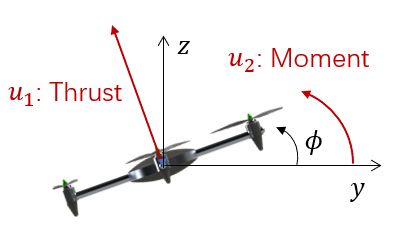
C. Stability Analysis Corollary 2.2. The estimation error of problem (2) is
Let the underlying low-level controller be stable, and bounded by the measurements’ noise intensity, i.e.
consider the origin as the reference, i.e. rk = 0. Given the kδAP k
≤ κ(Ω)2 tan(θ) + κ(Ω)
kδΩk
+ κ(Ω) sec(θ)
kδΞP k
, (5)
kAP k kΩk kΞP k
Lyapunov function V (xk ) = xTk xk , we calculate ∆V (xk ) =
V (xk+1 ) − V (xk ) = g(r̂k+1 , wk+1 )T g(r̂k+1 , wk+1 ) − xTk xk . where κ(Ω) is the condition number of observation matrix
When r̂k+1 = Âk r̂k + B̂k rk+1 , we have g(r̂k+1 , wk+1 ) = Ω, and θ = arccos kA P Ωk
kΞP k .
T
rk+1 = 0. Then, ∆V (xk ) = rk+1 rk+1 − xTk xk = 0 − Proof of Corollary 2.2: The proof follows directly from
T T
xk xk → ∆V (xk ) = −xk xk . Lemma 2.1 by setting H = Ω, z = ATP , and s = ΞTP .
Thus, V decays over time and satisfies V (0) = 0. From kδsk
Lemma 2.3 [A tighter bound]. Let = ksk . In the case
the standard Lyapunov argument, the equilibrium rk = 0
that kδsk = kδHk, the sensitivity of (3) is reduced to
is then stable. Hence, wrapping the outer controller around
the underlying plant respects the stability properties of the kẑ − zk
≤ κ(H)(1 + kẑk) . (6)
original lower-level controller. kzk
IV. S ENSITIVITY TO N OISY DATA Proof of Lemma 2.3: From system (3), we have
The model identification block extracts dynamics when H(ẑ − z) = δs − δHẑ ,
measurement data are noisy. Below we analyze the sensitivity
to noisy data and derive two estimation error bounds. and it follows that
Lemma 2.1. Consider the system
ẑ − z = (H T H)−1 H T δs − (H T H)−1 H T δHẑ .
p×q p×t
Hz =s , H∈R , s∈R
(3) Then,
(H + δH)ẑ = s + δs , δH ∈ Rp×q , δs ∈ Rp×t
The sensitivity of system (3) to perturbations in s and H is kẑ − zk = k(H T H)−1 H T k(kδsk + kδHkkẑk) .
kẑ−zk
≤ κ(H)2 tan(θ) + κ(H)
kδHk
+ κ(H) sec(θ)
kδsk
. (4) Setting kδsk = kδHk yields
kzk kHk ksk
where κ(H) is the condition number of linear operator H, kẑ − zk = k(H T H)−1 H T kkδsk(1 + kẑk)
and θ = arccos kHzk = k(H T H)−1 H T kksk(1 + kẑk)
ksk .
Proof of Lemma 2.1: Start with the normal equations ≤ k(H T H)−1 H T kkHkkzk(1 + kẑk)
H T Hz = H T s . = κ(H)kzk(1 + kẑk) ,
which concludes the proof.
The first-order perturbation relation is
Corollary 2.4. When the disturbance occurs in observed
δH T Hz + H T δHz + H T Hδz = δH T s + H T δs , states, i.e. kδΞP k = kδΞk = kδΩk a tighter error bound is
which we re-arrange to get kδAP k kδΞp k
≤ κ(Ω) (1 + kÂp k) . (7)
kAP k kΞp k
δz = (H T H)−1 δH T (s − Hz) + (H T H)−1 H T (δs − δHz).
Proof of Corollary 2.4: The proof follows directly from
Define r = s − Hz, and let σ1 , . . . , σp be singular values of Lemma 2.3 by setting H = Ω, z = ATP , and s = ΞTP .
H. Then, Toy Example: Consider the simple linear system
kδzk ≤k(H T H)−1 kkδHkkrk " #
ξ1
" #" #
1 2 ξ1
" #
1
+ k(H T H)−1 H T k (kδsk + kδHkkzk) . = + u . (8)
ξ2 3 4 ξ2 0.7 k
k+1 k
Setting kHk = σ1 , k(H T H)−1 k = 1/σq2 , we can derive [40]
We add zero-mean white noise to corrupt state observations,
kδHk 1 i.e. N (0, σ 2 ), with σ ∈ [0.05, 1] in 0.05 increments. The
kδzk ≤ krk + (kδsk + kδHkkzk) . initial condition is set at [0.01, 0.01]. We perform a Monte
σq2 σq
Carlo simulation for 10, 000 trials to produce the average
Dividing both sides by kzk and after some algebraic error. With reference to Fig. 2, the effect of the disturbance
manipulation so that kδHk and kδsk only appear in ratios increases as variance increases (as expected). The general
of kδHk kδsk
kHk and ksk , as κ(H) = σ1 /σq , we get bound given in (5) expands at higher rates than the tighter
kδzk krk kδHk
ksk kδsk kδHk
one we obtain via (7) as the noise variance increases.
kzk
≤ κ(H)2 kHkkzk kHk
+ κ(H) kHkkzk ksk
+ kHk
.
V. C ONTROL S TRUCTURE E XPERIMENTS
Then with
krk krk
kHkkzk ≤ kHzk = tan(θ) , We demonstrate the utility and evaluate the performance
ksk ksk of DHC in simulating a planar quadrotor with different noise
kHkkzk ≤ kHzk = sec(θ) ,
intensity, and then test experimentally with a quadrotor flying
we arrive at (4). under the influence of ground effect.• Model Predictive Control (MPC): A linear MPC is
designed directly with model (9) at hand. The prediction
and control horizon is set to be 10 and 2, and the pitch
angle φ is constrained in the interval [−π/2, π/2].
• Model Reference Adaptive Control (MRAC): A param-
eter adaptation rule is used together with the previously
described MPC to adjust the controller parameter so that
the output of the plant tracks the output of the reference
model having the same reference input. The adaptation
rule is designed based on [42] as
dm
Fig. 2. Estimation sensitivity to perturbation
kδAP k
and predicted bounds = a1 (yd − y) + b1 (zd − z)
kAP k dt
as noise magnitude increases.
dIxx
= a2 (yd − y) + b2 (zd − z)
dt
A. Simulation in a Planar Quadrotor where the weights were selected empirically to a1 =
While quadrotor dynamics is well understood, there is a b1 = 0.1 and a2 = b2 = 10−4 . To tune the weights, we
certain limit on the degree of variations in parameters like first chose their order to be consistent with the physical
mass and moment of inertia that model-based controllers can quantity they relate to. Then, we solved a sequential
handle. Such variations make the utilized model inaccurate, optimization problem to identify those parameter values
which in turn may render the controller unstable. Online that maximize MRAC’s performance.
adjustment can help quantify model errors and inform the • DHC: Our method also uses the linear MPC as the
controller so as to maintain stable operation. underlying controller. Then, we follow the steps in
Algorithm 1 to simulate the system.
3) Simulation: The quadrotor’s task is to reach position
[3; 5] m from initial condition [0; 0] m. We analyze the per-
formance of each controller in two cases: when parameters
are uncertain with low noise intensity (c1) where σm = 0.2m
and σIxx = 0.2Ixx , and with high noise intensity (c2) where
Fig. 3. Planar quadrotor.
σm = 0.6m and σIxx = 0.6Ixx . Perturbations in model
parameters are generated at initialization of each simulated
1) System Description: The planar quadrotor depicted in trial by sampling from normal distributions. Distribution
Fig. 3 can be modeled as [41] means are the nominal values for m and Ixx . Distribution
variances are selected as above. Once the perturbation is
mÿ = −u1 sin φ sampled, it remains constant for the duration of the trial.2
mz̈ = u1 cos φ − mg . For every different condition we perform 10 trials.
4) Results and Discussion: Simulation results suggest that
Ixx φ̈ = u2
all controllers can stabilize the system in low noise intensity
Linearization around hover configurations yields (see Table I). However, as noise intensity increases SFC fails.
Linear MPC converges faster than all other methods, but
03×3 I3×3
04×2
produces increasingly large steady-state error. MRAC can
0 0 −g
reduce such steady-state errors, at the expense of longer
ξ̇ =
ξ + 1/m
0 u ,
(9)
0 0 0 03×3 settling time (within 2%) and larger control effort, and could
0 1/Ixx
0 0 0 possibly cause a large overshoot as in SFC. Despite its
efficiency shown here, tuning MRAC can be tedious, and
where ξ = [y, z, φ, ẏ, ż, φ̇] and u = [u1 − mg, u2 ]. In all its performance relies a lot on the tuned weights. On the
simulations, nominal parameter values match those of the other hand, our proposed DHC structure keeps updating the
physical Crazyflie robot used later for experiments, that is, model that implicitly includes noise. As such, it can quickly
m = 0.03kg, Ixx = 1.43 × 10⁻⁵ kgm2 , and g = 9.8m/s2 . extract refined dynamics from uncertain data to maintain
2) Controller Design: Besides our proposed DHC struc- system stability faster, with less control energy and smaller
ture, we design and compare against a State Feedback Con- steady state error. Further, as the disturbance gets embedded
troller (SFC), a linear Model Predictive Controller (MPC), in the learned model, the performance of controller does not
and a Model Reference Adaptive Controller (MRAC). deteriorate significantly as noise intensity increases.
• State Feedback Controller (SFC): With the closed-loop
2 The specific selection of constant perturbations in model parameters
system poles set at [0.9;0.8;-0.9;-0.8;0.95;-0.95], we get emulates the case of inaccurate measurements of mass and inertia of the
" # vehicle; these values may be approximately known (or estimated), but do not
−0.0001 −0.0243 −0.0008 0.0012 0 0.0149 change during operation. The robustness properties of the proposed control
Kp = .
−0.0000 −0.0000 −0.0000 −0.0000 0 −0.0000 structure to general perturbations is analyzed in Section IV.TABLE I
P ERFORMANCE OF DIFFERENT CONTROLLERS IN LINEAR PLANAR QUADROTOR MODEL
Settling time Total control effort to stabilize Steady state error Overshoot
Case Controller
Ts (s) Σ|u| |xdesired − xsteady | |xmax − xsteady |/|xsteady |
SFC 1.95 1.2453 [0;0] 2.5828
MPC 0.04 0.6020 [0.6846;0.7740] 0
c1 MRAC 0.72 11.1852 [ 0.2986;0.7038] 1.4575
DHC 0.38 4.0847 [0;0.0011] 0
SFC Unstable \ \ \
MPC 0.04 0.6032 [1.6951;1.1906] 0
c2 MRAC 0.92 11.0816 [ 1.0351;1.0357] 0.9718
DHC 0.38 3.6052 [0;0.0085] 0
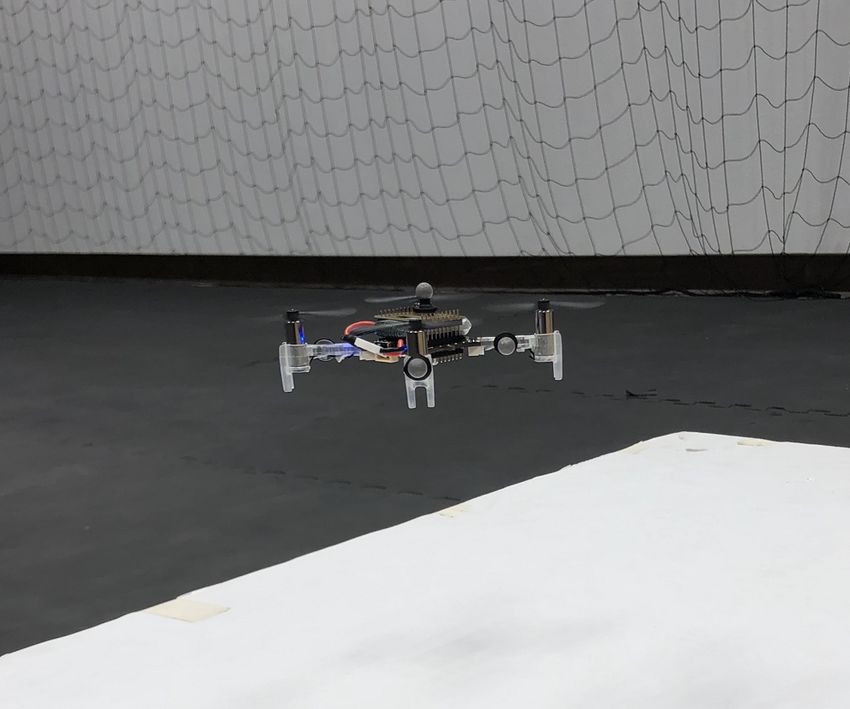
B. Controlling a Crazyflie Quadrotor Under Ground Effect r = 0.023 m. We collect data at three distinct heights
We evaluate experimentally our DHC structure on a h ∈ {ho + r, ho + 2r, ho + 3r}, and while flying at six
Crazyflie quadrotor operating under the influence of ground distinct forward speeds v ∈ {0.4, 0.6, 0.8, 1.0, 1.2, 1.4} m/s.
effect over sustained periods of time. Ground effect [43] Experiments are run with the four aforementioned control
manifests itself as an increase in the generated rotor thrust structures. This leads to a total of 72 distinct case studies.
given constant input rotor power [44] when operating close to For each case study, we collect data from 10 repeated trials.
the ground or over other surfaces. When operating in ground To minimize depleting battery effects, a fully charged battery
effect, the dynamics of the robot-environment interaction is used at the beginning of each 10-trial experimental session.
change to a degree that an underlying model tuned for mid- Position data are collected via motion capture (VICON).
air operation may no longer be valid [4], [27]. In turn, model 3) Results and Discussion: Experimental results (Figs. 5
mismatches caused by varying robot-environment interaction and 6) reveal that wrapping the proposed hierarchical struc-
(i.e. a form of uncertainty) degrade the robot’s performance, ture around a low-level controller (red curves in figures) can
both in terms of stability [45] and control. As we show below, help keep the quadrotor closer to the desired height when
controllers unaware of ground effect will tend to raise the compared to the standalone original controller (blue curves),
height of the robot when the latter flies sufficiently close on average. This indicates that incorporating model iden-
over an obstacle. This behavior may lead to crashes when tification and controller adaptation modules through DHC
operating in confined and cluttered environments. Wrapping helps the overall control structure adjust better and faster to
DHC around such a controller can help the robot adjust the uncertain perturbations as, in this case, ground effects.
impact of ground effect without any specific models for it.
1) Controller Design: We follow the controller structure
shown in Fig. 1 (as in simulation). We test using two distinct
lower-level controllers: a nonlinear geometric controller [46],
and a PID controller. Controller gains are those pre-tuned by
the manufacturer. Hence, note that the controllers have been
tuned for operation in mid-air, not in near-ground operation.
The controllers are different from those in simulation since
1) they are often used in practice, and 2) their underlying
performance in simulation would depend on quality of tuning
(especially for PID) and would thus not add significant value
beyond the controllers already tested in simulation.
We evaluate the performance of both low-level controllers
with and without DHC wrapped around them. The task is
to fly at a constant height between an initial and a goal
position (Fig. 4). During part of the trajectory, the robot flies
over an obstacle which creates sustained ground effect and
influences robot behavior. Performance is quantified in terms
of deviating from the desired height due to the ground effect. Fig. 5. 1 σ error plots for the standalone geometric controller (blue circle)
and PID controller (blue star), and with wrapped DHC (red circle and star).
Furthermore, model/controller adaptation appears to per-
form better at low distances from the ground and as the
Fig. 4. (Left) Experimental setup, and (Right) the Crazyflie. Sample forward velocity increases. This observation is in line with
experiments can be viewed at https://youtu.be/OznDCskVnJU.
aerodynamics suggesting that 1) ground effect starts dimin-
2) Experiment: The robot is commanded to follow 2.4 m ishing when the flying height above the obstacle increases
straight-line constant-height trajectories. The height of the to d > 3r, and 2) as forward speed increases both ground
obstacle is ho = 0.290 m. The robot propeller radius is effect and drag affect rotorcraft flight in still not well-Fig. 6. Trajectories of the Crazyflie tasked to fly at desired heights, d, over the obstacle (green dashed-dotted) and various forward speeds, v, under
ground effect with standalone geometric controller (blue solid) and PID controller (blue dashed), and with wrapped DHC (red dashed and solid). Obstacle
locations (black) are shown for clarity.
understood ways [44]. Hence, through this experiment we an online data-driven approach to learn a model of input
show how DHC can be used to render a controller adaptive reference and true outputs. 2) DHC utilizes the derived model
to environment changes that excite unmodeled dynamics. to keep refining a reference signal given to an underlying
The hierarchical structure may still remain bound to the low-level controller to ensure system performance in the
low-level controller’s possible limitations, as shown in simu- presence of system and/or system-environment uncertainty.
lation. In the experiments, this is observed as forward speed We showed that DHC retains the stability properties of
increases. After clearing out the obstacle, the controller’s the underlying lower-level controller, and further determined
apparent steady-state error seems to increase (c.f. bottom lower bounds for our method’s sensitivity to noisy data.
two rows of Fig. 6) at higher speeds. While this may be an
artefact of the limited experimental volume, the settling time The utility and performance of the proposed approach are
of the controller with and without DHC still increases. Future tested in simulation and experimentally with a quadrotor.
work will investigate the interplay between the lower-level The test cases were designed to excite specific types of
controller and DHC, and consider different hierarchical adap- uncertainty that are common in practice: 1) constant model
tive control structures to change an underlying controller’s parameter errors in simulation; and 2) variable uncertain
behavior more drastically when needed. robot-environment interaction experimentally through opera-
tion under ground effect. Results suggest that DHC can suc-
VI. C ONCLUSIONS cessfully be wrapped around existing controllers in practice,
The paper introduced a Data-driven Hierarchical Control to improve their performance by discovering and harnessing
(DHC) structure with two key functions. 1) DHC utilizes unmodeled dynamics during deployment.R EFERENCES [22] T. Westenbroek, D. Fridovich-Keil, E. Mazumdar, S. Arora, V. Prabhu,
S. S. Sastry, and C. J. Tomlin, “Feedback linearization for unknown
[1] S. Zarovy, M. Costello, A. Mehta, G. Gremillion, D. Miller, B. Ran- systems via reinforcement learning,” arXiv preprint:1910.13272, 2019.
ganathan, J. S. Humbert, and P. Samuel, “Experimental study of gust [23] M.-B. Radac, R.-E. Precup, E.-L. Hedrea, and I.-C. Mituletu, “Data-
effects on micro air vehicles,” AIAA Atmospheric Flight Mechanics driven model-free model-reference nonlinear virtual state feedback
Conference, p. 7818, 2010. control from input-output data,” in 26th Mediterranean Conf. on
[2] G. S. Aoude, B. D. Luders, J. M. Joseph, N. Roy, and J. P. How, Control and Automation (MED). IEEE, 2018, pp. 1–7.
“Probabilistically safe motion planning to avoid dynamic obstacles [24] J. H. Tu, C. W. Rowley, D. M. Luchtenburg, S. L. Brunton, and J. N.
with uncertain motion patterns,” Autonomous Robots, pp. 51–76, 2013. Kutz, “On dynamic mode decomposition: theory and applications,”
[3] C. Powers, D. Mellinger, A. Kushleyev, B. Kothmann, and V. S. A. ”Journal of Computational Dynamics”, 2014.
Kumar, “Influence of aerodynamics and proximity effects in quadrotor [25] M. O. Williams, I. G. Kevrekidis, and C. W. Rowley, “A data–driven
flight,” Int. Symp. on Experimental Robotics (ISER), 2012. approximation of the koopman operator: Extending dynamic mode
[4] K. Karydis, I. Poulakakis, J. Sun, and H. G. Tanner, “Probabilistically decomposition,” Journal of Nonlinear Science, vol. 25, no. 6, pp.
valid stochastic extensions of deterministic models for systems with 1307–1346, 2015.
uncertainty,” The International Journal of Robotics Research, vol. 34, [26] A. Chatterjee, “An introduction to the proper orthogonal decomposi-
no. 10, pp. 1278–1295, 2015. tion,” Current science, pp. 808–817, 2000.
[5] H. Yoon, D. B. Hart, and S. A. McKenna, “Parameter estimation and [27] K. Karydis and M. A. Hsieh, “Uncertainty quantification for small
predictive uncertainty in stochastic inverse modeling of groundwater robots using principal orthogonal decomposition,” in Int. Symp. on
flow: Comparing null-space monte carlo and multiple starting point Experimental Robotics. Springer, 2016, pp. 33–42.
methods,” Water Resources Research, pp. 536–553, 2013. [28] I. Kevrekidis, C. Rowley, and M. Williams, “A kernel-based method
[6] M. L. Rodrguez-Arvalo, J. Neira, and J. A. Castellanos, “On the impor- for data-driven koopman spectral analysis,” Journal of Computational
tance of uncertainty representation in active slam,” IEEE Transactions Dynamics, vol. 2, no. 2, pp. 247–265, 2015.
on Robotics, vol. 34, no. 3, pp. 829–834, 2018. [29] P. Gelß, S. Klus, J. Eisert, and C. Schütte, “Multidimensional approx-
[7] I. D. Landau, R. Lozano, and M. M’Saad, Adaptive Control, J. W. imation of nonlinear dynamical systems,” Journal of Computational
Modestino, A. Fettweis, J. L. Massey, M. Thoma, E. D. Sontag, and and Nonlinear Dynamics, vol. 14, no. 6, p. 061006, 2019.
B. W. Dickinson, Eds. Berlin, Heidelberg: Springer-Verlag, 1998. [30] I. Abraham and T. D. Murphey, “Active learning of dynamics for data-
[8] D. Q. Mayne, J. B. Rawlings, C. V. Rao, and P. O. Scokaert, driven control using koopman operators,” arXiv preprint:1906.05194,
“Constrained model predictive control: Stability and optimality,” Au- 2019.
tomatica, vol. 36, no. 6, pp. 789–814, 2000. [31] S. L. Brunton, B. W. Brunton, J. L. Proctor, and J. N. Kutz, “Koop-
[9] D. Piga, M. Forgione, S. Formentin, and A. Bemporad, “Performance- man invariant subspaces and finite linear representations of nonlinear
oriented model learning for data-driven mpc design,” IEEE Control dynamical systems for control,” PloS one, vol. 11, no. 2, p. e0150171,
Systems Letters, vol. 3, no. 3, pp. 577–582, 2019. 2016.
[10] K. Pereida and A. P. Schoellig, “Adaptive model predictive control [32] M. Haseli and J. Cortés, “Approximating the koopman operator using
for high-accuracy trajectory tracking in changing conditions,” CoRR, noisy data: noise-resilient extended dynamic mode decomposition,” in
2018. American Control Conf. (ACC). IEEE, 2019, pp. 5499–5504.
[11] G. Shi, X. Shi, M. O’Connell, R. Yu, K. Azizzadenesheli, A. Anand- [33] J. L. Proctor, S. L. Brunton, and J. N. Kutz, “Dynamic mode
kumar, Y. Yue, and S. Chung, “Neural lander: Stable drone landing decomposition with control,” SIAM Journal on Applied Dynamical
control using learned dynamics,” CoRR, 2018. Systems, vol. 15, no. 1, pp. 142–161, 2016.
[12] C. D. McKinnon and A. P. Schoellig, “Experience-based model [34] V. Kumar and N. Michael, “Opportunities and challenges with au-
selection to enable long-term, safe control for repetitive tasks under tonomous micro aerial vehicles,” The International Journal of Robotics
changing conditions,” IEEE/RSJ Int. Conf. on Intelligent Robots and Research, vol. 31, no. 11, pp. 1279–1291, 2012.
Systems (IROS), pp. 2977–2984, 2018. [35] N. Michael, D. Mellinger, Q. Lindsey, and V. Kumar, “The grasp
[13] T. Wang, H. Gao, and J. Qiu, “A combined adaptive neural network and multiple micro-uav testbed,” IEEE Robotics & Automation Magazine,
nonlinear model predictive control for multirate networked industrial vol. 17, no. 3, pp. 56–65, 2010.
process control,” IEEE Transactions on Neural Networks and Learning [36] I. Mezić, “Analysis of fluid flows via spectral properties of the
Systems, vol. 27, no. 2, pp. 416–425, 2015. koopman operator,” Annual Review of Fluid Mechanics, vol. 45, pp.
[14] M. T. Frye and R. S. Provence, “Direct inverse control using an 357–378, 2013.
artificial neural network for the autonomous hover of a helicopter,” [37] P. J. Schmid, “Dynamic mode decomposition of numerical and exper-
IEEE Int. Conf. on Systems, Man, and Cybernetics (SMC), pp. 4121– imental data,” Journal of fluid mechanics, vol. 656, pp. 5–28, 2010.
4122, 2014. [38] G. Strang, Introduction to Linear Algebra. Wellesley, MA: Wellesley-
[15] H. Suprijono and B. Kusumoputro, “Direct inverse control based on Cambridge Press, 2009.
neural network for unmanned small helicopter attitude and altitude [39] C. L. Lawson and R. J. Hanson, Solving least squares problems, ser.
control,” Journal of Telecommunication, Electronic and Computer Classics in Applied Mathematics. Society for Industrial and Applied
Engineering (JTEC), pp. 99–102, 2017. Mathematics (SIAM), 1995.
[16] S. A. Nivison and P. P. Khargonekar, “Development of a robust [40] G. H. Golub and C. F. Van Loan, Matrix Computations, 3rd ed. The
deep recurrent neural network controller for flight applications,” in Johns Hopkins University Press, 1996.
American Control Conf. (ACC). IEEE, 2017, pp. 5336–5342. [41] F. Sabatino, “Quadrotor control: modeling, nonlinearcontrol design,
[17] B. J. Emran and H. Najjaran, “Adaptive neural network control of and simulation,” 2015.
quadrotor system under the presence of actuator constraints,” in IEEE [42] R. Ibarra, S. Florida, W. Rodrı́guez, G. Romero, D. Lara, and I. Pérez,
International Conference on Systems, Man, and Cybernetics (SMC), “Attitude control of a quadrocopter using adaptive control technique,”
2017, pp. 2619–2624. in Applied Mechanics and Materials, vol. 598. Trans Tech Publ,
[18] S. Bansal, A. K. Akametalu, F. J. Jiang, F. Laine, and C. J. Tomlin, 2014, pp. 551–556.
“Learning quadrotor dynamics using neural network for flight control,” [43] W. Johnson, Rotorcraft Aeromechanics, ser. Cambridge Aerospace
in IEEE Conf. on Decision and Control (CDC), 2016, pp. 4653–4660. Series. Cambridge University Press, 2013.
[19] Q. Li, J. Qian, Z. Zhu, X. Bao, M. K. Helwa, and A. P. Schoellig, [44] X. Kan, J. Thomas, H. Teng, H. G. Tanner, V. Kumar, and K. Karydis,
“Deep neural networks for improved, impromptu trajectory tracking “Analysis of ground effect for small-scale uavs in forward flight,” IEEE
of quadrotors,” IEEE Int. Conf. on Robotics and Automation (ICRA), Robotics and Automation Letters, vol. 4, no. 4, pp. 3860–3867, 2019.
pp. 5183–5189, 2017. [45] S. Aich, C. Ahuja, T. Gupta, and P. Arulmozhivarman, “Analysis of
[20] S. Zhou, M. K. Helwa, and A. P. Schoellig, “Design of deep neural ground effect on multi-rotors,” Int. Conf. on Electronics, Communica-
networks as add-on blocks for improving impromptu trajectory track- tion and Computational Engineering (ICECCE), pp. 236–241, 2014.
ing,” IEEE Conf. on Decision and Control (CDC), pp. 5201–5207, [46] T. Lee, M. Leok, and N. H. McClamroch, “Geometric tracking control
2017. of a quadrotor uav on se(3),” IEEE Conf. on Decision and Control
[21] M. K. Helwa, A. Heins, and A. P. Schoellig, “Provably robust learning- (CDC), pp. 5420–5425, 2010.
based approach for high-accuracy tracking control of lagrangian
systems,” IEEE Robotics and Automation Letters, vol. 4, no. 2, pp.
1587–1594, 2019.You can also read


