A tale of two cities: the rise and fall of listings
←
→
Page content transcription
If your browser does not render page correctly, please read the page content below
Advancing economics in business

January 2021

A
Thetale  of two
      risks      cities:algorithms
             of using    the rise and fall of
listings
in business: demystifying AI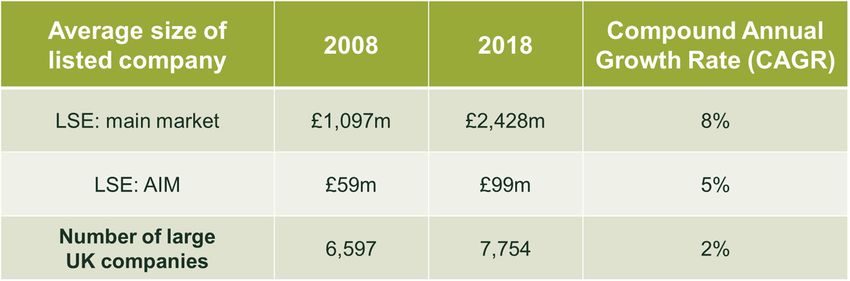
A tale of two cities: the rise and fall of listings

                       Contact
                       Jonathan Haynes
                       Senior Consultant

The decline in European public equity
markets has sparked concern from
policymakers about how to revive
listings. Behind this overall declining
trend, there is a notable variation
between financial centres. The
contrasting experiences of Sweden and
                                                   Figure 1 Net changes in the number of listed companies between
the UK highlight how more flexibility in
some aspects of the listing rules and              2010 and 2018
corporate governance might encourage
more listings                                      Note: Each net listings value is calculated as the number of listings in 2018 minus the number of listings in 2010.
                                                   Source: Oxera analysis of stock exchange data; WFE.
This article is part of a series on primary
and secondary equity markets in the EU,           conditions. Two key papers are Lowry                                        a sustained period. This is the case for
based on research conducted by Oxera for          (2003), and Gao, Ritter and Zhu (2013),                                     France, Germany, the Netherlands, and,
the European Commission. For Oxera’s              which both find that the number of IPOs is                                  notably, the UK—as we discuss below.
final report, see Oxera (2020), ‘Primary and      positively related to futures sales growth of
secondary equity markets in the EU’, report       publicly traded companies and future GDP
prepared for the European Commission,             growth.5
                                                                                                                              The decline of UK plc
September, https://bit.ly/3t3gOJl.
                                                                                                                              The number of companies listed on the
                                                  Some of the economies that have grown
                                                                                                                              London Stock Exchange (LSE) fell by
As discussed in November’s Agenda in              (e.g. that of Poland) have also recorded
                                                                                                                              378 between 2010 and 2018, the largest
focus,1 recent years have seen a fall in the      strong stock market growth over the
                                                                                                                              numerical fall among European markets.
number of initial public offerings (IPOs)         same period. On the other hand, some
                                                                                                                              The decline represents a 21% fall in listed
in many regions.2 At the European level,          stock markets (e.g. in Spain) experienced
                                                                                                                              companies in just eight years. This has
the number of listings fell from 7,392 in         sustained and significant expansion in listed
                                                                                                                              occurred as new listings have failed to
2010 to 6,538 in 2019—a net loss of 854           stocks before the financial crisis in 2008, but
                                                                                                                              keep pace with delistings.
companies from the public equity markets.         this trend has tailed off as macroeconomic
This represents a 12% reduction in the total      conditions have worsened.
                                                                                                                              While the number of listed companies
number of listed companies across Europe,
                                                                                                                              in the UK has fallen since 2010, market
while GDP rose by 24% over the same               With respect to larger financial centres
                                                                                                                              capitalisation has increased over the same
period.                                           in Europe, Sweden and Italy have been
                                                                                                                              period, implying that UK listed companies
                                                  the exceptions in terms of growth in the
                                                                                                                              have also (on average) become larger.
The decline in public equity markets has          number of listed companies. In both cases
                                                                                                                              Table 1 shows how the average size of
sparked concerns from policymakers about          (and particularly in Italy), the increase in
                                                                                                                              a company listed on the LSE markets
how to revive listings.3 While overall listings   the number of listed companies has been
                                                                                                                              increased by the equivalent of 5–8% per
have been in decline for some time at the         driven by the successful performance of
                                                                                                                              year between 2008 and 2018.
pan-European level, closer analysis of the        SME-focused markets (such as AIM Italia
data reveals variation across countries           and First North).6
                                                                                                                              At the same time, a significant number of
(Figure 1). Comparing these different
                                                                                                                              companies have exited public markets. Of
trends and the experiences in European            The other larger financial centres have been
                                                                                                                              the 23 acquisition-driven delistings from
financial centres can help to identify best       either fairly flat or in a long-term decline for
practices and areas for improvement.

Some of the observed variation between
countries can be readily explained.
For example, if a country has relatively
immature capital markets, the rate of
growth might naturally be expected to be
higher.

Furthermore, higher economic growth
and stock market expansion are related.
It has long been documented that IPOs
often occur in waves (Ibbotson and Jaffe,
                                                  Table 1 Increasing size of UK companies, 2008–18
1975).4 Various reasons for this have been
suggested in the academic literature,
                                                  Note: Average size calculated as total market capitalisation divided by number of listed companies. ‘Main market’ covers listed UK
including fluctuations in investor sentiment,
                                                  companies. ‘AIM’ covers all AIM listed companies. ‘Number of large companies’ refers to listed and unlisted companies with at least 250
fluctuations in demand for capital driven by
                                                  employees.
macroeconomic conditions, fluctuations in
                                                  Source: Oxera analysis of London Stock Exchange statistics; CMA (2020), ‘The state of UK competition’, November, https://bit.ly/2NxaN7c.
information asymmetry, and product market
                                                                                                                                                                January 2021                1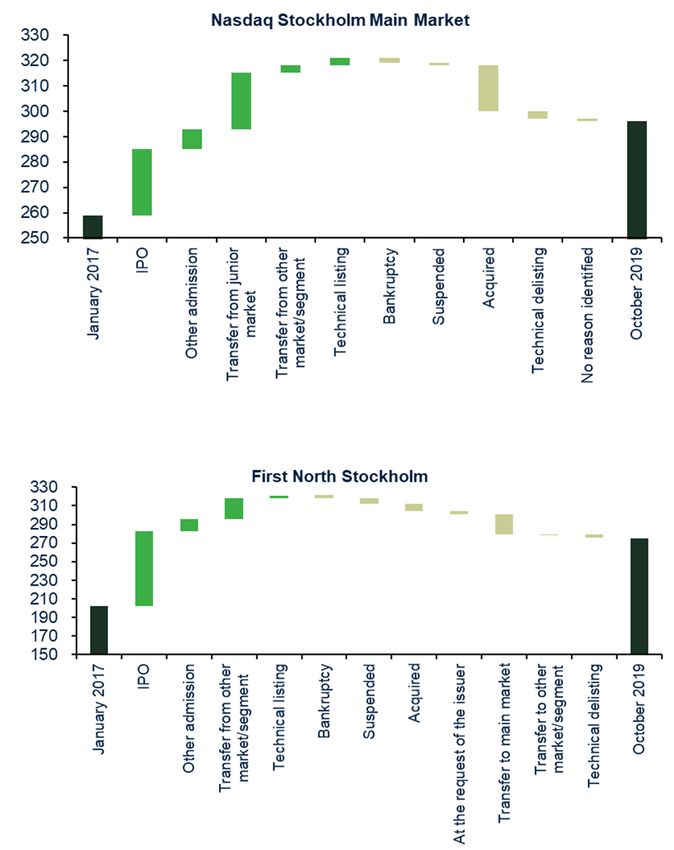
A tale of two cities: the rise and fall of listings
by developments in SME-focused markets,
which more than doubled in size (in terms
of listed companies) between 2010 and
2019 (as shown in Figure 3).
As shown in Figure 4 overleaf, IPOs were
the most common entry route onto the
two largest Swedish markets. However,
unlike most other European markets, the
second most common source of listing on
Nasdaq Stockholm came from companies
transferring up from the largest SME-
focused market (First North). In terms of
flow away from public markets, Nasdaq
Stockholm and First North are also notable
in terms of the absence of voluntary
delistings, with only three delistings
occurring at the request of the issuer
(see Figure 4 overleaf).
Figure 2 Departures from LSE main market, 2017–19
Note: Data covers January 2017 to end-September 2019. Data excludes firms identified as investment vehicles, REITs and VCTs. What can be learned from the
Source: Oxera analysis.
experience of Sweden?
the LSE main market shown in Figure 2, problems of limited liquidity that listed SMEs
Our analysis, based on interviews with a
around 60% were due to M&A activity with already face.
range of stakeholders, highlights a range
another listed company (e.g. the acquisition
of reasons for Sweden’s success, including
of food wholesale operator Booker Group There have been some recent market-led
the following.
by the supermarket chain Tesco in March attempts to increase liquidity in UK SME
2018). Around 35% were due to acquisition stocks. For example, Aquis Stock Exchange
• A smooth IPO process—although
by an unlisted company or investment has introduced an incentive scheme in
listing rules are largely harmonised at
vehicle (i.e. the assets left public markets which participating market makers receive
an EU level, participants emphasised
completely). the option to purchase Aquis shares, in
that there was a collaborative
return for fulfilling quoting obligations on
relationship between the regulator,
Although the UK remains the largest high-growth stocks listed on its Apex market
exchanges and advisers.
financial centre in Europe in terms of segment.9
number of listings, our analysis also shows
• Tax incentives—Sweden introduced
that the UK has more than 3,500 large
unlisted companies that would be eligible to
Swedish success the ‘investeringsparkonto’ (a type of
savings account) in 2012 to promote
list but have not listed. The UK has Europe’s
In contrast to the trends observed in many households’ savings and investments
largest listing gap, followed by Italy (2,911)
other European countries, Sweden has in stocks/securities and to simplify
and Germany (2,833).7
witnessed a large increase in the number of taxation.
listings. This trend has largely been driven
Why are some firms choosing not to
list? The results of our issuer survey and
stakeholder interviews show that control
is a key influencing factor in the listing
decision—and loss of control is widely
cited by unlisted companies as the most
important reason for remaining private.
Although mechanisms (e.g. dual-class
shares) exist to facilitate the listing of
companies willing to sacrifice a higher
valuation for more control, the UK has
largely been reluctant to diverge from a
principle of one-share-one-vote. Large
companies with a multi-class share
structure can list on the London Stock
Exchange, one recent example being The
Hut Group—however, such listings are
excluded from the FCA’s premium listing
segment and are therefore ineligible for
inclusion in most major indices. As a result,
such listings are generally rare (see
Figure 5).
Another key concern has been around
Figure 3 Number of listed companies in Sweden, 2010–19
the reduction in advisers servicing SMEs
Note: Data excludes certain equity-like instruments, including ETFs, listed equity investment vehicles and REITs. ‘Main markets’ includes
(11% of delistings from AIM between 2017
companies listed on Nasdaq Stockholm Main Market and NGM Equity. ‘SME markets’ designates companies listed on First North
and 2019 were attributed to the lack of a
Stockholm, Nordic MTF Sweden and Spotlight Stock Market.
Nominated Adviser).8 This can compound
Source: Oxera analysis of stock exchange data.
January 2021 2A tale of two cities: the rise and fall of listings
Although EU technology companies like
Spotify may choose to list overseas due to
the depth of capital available in financial
centres such as the USA, interview
feedback from market participants noted
that most large US institutional investors
can access EU capital markets with relative
ease. Moreover, in the case of Spotify, no
new capital was raised at the initial listing,
suggesting that the choice of overseas
listing may be more related to other factors,
such as the location of peers, flexibility
around listing rules, and higher valuations.
A post-COVID resurgence?
Despite the uncertainty and economic
impact of COVID-19, there has been a
relative increase in new listings in 2020,
particularly in the UK.13 Is this a potential
indicator of a resurgence in European
primary markets?
The COVID-19 pandemic has re-
emphasised the important role that equity
markets play in the wider economy. One
of the key benefits of listing is access to
additional equity finance and, for those
already listed, the ability to quickly tap
the market for additional funding via
secondary raisings.14 It is therefore
perhaps unsurprising that there has been
a resurgence in share issuance in recent
months.
The impact of COVID-19 and the resulting
lockdowns have left many corporates
needing quick access to additional capital
to fill funding gaps. In the UK, for example,
the Bank of England recently estimated that
Figure 4 Net admissions and delistings on Nasdaq Sweden firms could face a cash flow deficit in the
2020–21 financial year of up to £180bn.15
Note: Technical delisting includes companies that undertake a name change, cancel their existing equity ISIN, and create a new equity
ISIN with a given year due to restructuring. The single transfer from First North Stockholm to other market/segment was to Spotlight Stock In many cases, follow-on equity issuances
Market. were completed relatively quickly (with
Source: Oxera analysis of Nasdaq data. over 80% occurring as pure accelerated
bookbuilds or cash placings).16 The median
• The role of local pension funds—the exchanges, First North differs from other under-pricing for UK follow-on offerings
Swedish public pension reserve funds SME markets in only requiring new larger than $5m in size was slightly larger
(so-called ‘AP funds’) have historically companies to provide one audited IFRS- in 2020 compared to previous years
had large allocations of assets in listed compliant financial report. This may (approximately 4.5% in 2020 compared to
equities (approximately 40–45% in have been a factor in attracting younger, 3.89% for 2015–19), likely reflecting the
2017).10 Large institutional investors rapidly growing companies to list. higher information asymmetries associated
like these funds can often act as an with such deals.
‘anchor’ investor in IPOs. • Dual-class shares—Swedish
companies are permitted to issue Although some market participants raised
• Private equity exits—IPOs can shares with limited voting rights and/or concerns about the lack of retail investor
provide a way for existing shareholders multiple voting rights, and multi-class involvement in the initial wave of follow-on
to diversify their own portfolios and share structures are relatively common offerings,17 there are also some encouraging
have been a particularly common exit compared to other European financial signs—for instance, Compass Group’s
route for private equity firms in Sweden centres.12 This last point is illustrated in $2.4bn equity issuance.18
(a recent example is the IPO of Nordnet Figure 5 overleaf.
AB, a digital investment platform Clearly there are lessons that policymakers
previously owned by Nordic Capital However, despite Sweden’s relative success can learn from the regulatory and market
and Öhman Group). This is despite the in attracting new listings, it is notable that one response to COVID-19, particularly around
proportion of IPO exits declining at a of the most high-profile listings of a Swedish the impact of more flexible disclosure rules
European level over time.11 company in recent years (Spotify) did not take and retail investor involvement.
place on a Swedish stock exchange. Instead,
• Listing rules—while the rules for Spotify opted for a direct listing on the New Although the data above highlights the
Nasdaq Stockholm are broadly in York Stock Exchange (NYSE) in 2018. strength of the UK equity market in enabling
line with other large European stock listed companies to efficiently access
January 2021 3A tale of two cities: the rise and fall of listings
Examining the variation in trends across
European markets is a helpful starting place
for policymakers looking to revive listings.
Sweden is one example of a country that
has actually increased the number of listed
companies. Our interviews with market
participants revealed a number of factors
behind Sweden’s success relative to other
European financial centres, such as the
UK. Notable differences between Sweden
and the UK relate to use of multi-class
shares among listed companies, as well
as operating history requirements. It is
therefore perhaps unsurprising that these
issues have arisen in the context of the UK
Listings Review Call for Evidence.19
Other financial centres in the USA and Asia
have also demonstrated flexibility in the use
of multi-class share structures, as well as
openness to innovation around alternative
listing mechanisms (such as direct listings
and SPACs). If European equity markets
Figure 5 Multi-class share firms in the EU, 2016 wish to remain globally competitive and
attractive places to list, it may be that similar
Note: The data comprises share classes and votes per share for publicly listed firms in the EU that were part of the MSCI All Country World
flexibility is required.
Index in 2016.
Source: Kim, J., Matos, P. and Xu, T. (2018), ‘Multi-Class Shares Around the World: The Role of Institutional Investors’, November.
Contact
additional finance, Figure 6 also shows that term trend of stagnating public markets.
UK IPO activity was virtually nonexistent When placed in the context of the past
during the first eight months of 2020. IPO decade, the value of UK IPOs in 2020 was jonathan.haynes@oxera.com
volumes on UK exchanges did increase broadly in line with previous years.
Jonathan Haynes
slightly from the end of Q3 onwards, with
two large domestic IPOs in September Moreover, while there has been a relative
(THG Holdings and Guild eSports). rebound in the number of European IPOs in callum.watling@oxera.com
2020, the increase remains very small when
Callum Watling
Was 2020 an anomaly in terms of IPO compared to new listing activity in the USA
activity? A certain amount of IPO activity is (although many of these are Special Purpose
cyclical, and the numbers of IPOs will vary Acquisition Companies (SPACs)) and Asia.
according to economic conditions. Clearly,
the impact of COVID-19 will have caused
some companies to postpone or rethink
Continued decline? 1
Oxera (2020), ‘Private retreat: are we witnessing the decline of
public equity markets?’, Agenda in focus, November, https://bit.
planned listings, and there is a pipeline ly/2YnUPPa.
Despite a small increase in IPOs for some
of companies that have announced plans
European financial centres in the last few 2
In equity markets, investors meet to buy and sell shares in a
to IPO in 2021 (such as Dr. Martens and firm. An initial public offering (IPO) is where a private company
months of 2020, it does not appear that the
Moonpig in London). However, Figure 6 first sells shares to investors on the public market.
structural decline in public equity markets is
points towards the continuation of a longer- 3
For example, the UK Listings Review, chaired by Lord Hill, was
likely to reverse without policy intervention. launched by the UK government on 19 November 2020, and
the European Commission published its new action plan for the
Capital Markets Union on 24 November 2020. See HM Treasury
(2020), ‘Policy Paper: UK Listings Review’, 19 November, https://
bit.ly/3r2rkOS; and European Commission (2020), ‘Capital
markets union new action plan: A capital markets union for
people and businesses’, 24 September, https://bit.ly/3aeIy55.
4
Ibbotson, R. G. and Jaffe, J. F. (1975), ‘“Hot issue” markets’,
Journal of Finance, 30:4, pp. 1027–42, https://bit.ly/2YsR5eZ.
5
Lowry, M. (2003), ‘Why does IPO volume fluctuate so much?’,
Journal of Financial Economics, 67:1, pp. 3–40, https://bit.
ly/3j5KEs9; Gao, X., Ritter, J. R. and Zhu, Z. (2013), ‘Where
have all the IPOs gone?’, Journal of Financial and Quantitative
Analysis, 48:6, pp. 1663–92, https://bit.ly/3cihLHD.
6
SME refers to small and medium-sized enterprises.
7
See section 7 of our report: Oxera (2020), ‘Primary and
secondary equity markets in the EU’, report prepared for the
European Commission, September, https://bit.ly/39rLjkq.
8
Firms listed on AIM are required to retain an advisory firm (called
a Nominated Adviser, or NOMAD) to assist with the admission
process and ongoing obligations associated with being listed. See
section 5.2 of our report: Oxera (2020), ‘Primary and secondary
equity markets in the EU’, report prepared for the European
Commission, September, https://bit.ly/3iUZEsL.
9
Aquis Exchange (2020), ‘AQSE launches market maker
Figure 6 IPO equity issuance on UK exchanges, 2010–20 incentive scheme’, Press release, November, https://bit.
ly/36mbZAZ.
Note: Data converted from USD to GBP using annual average spot rate published by Bank of England. 10
OECD (2019), ‘Annual survey of large pension funds and public
pension reserve funds’, https://bit.ly/3iSuUIG.
Source: Oxera analysis of Dealogic data.
January 2021 4A tale of two cities: the rise and fall of listings
11
Pitchbook (2020), ‘European PE breakdown’, https://bit.ly/3acFGFS.
12
Shares without voting rights are prohibited. For companies with multi-class share structures, a 10-to-1 voting rights differential is most typical. See: OECD (2019), ‘OECD Corporate Governance Factbook
2019’, https://bit.ly/3j18Zz5; Brett, A. (2019), ‘Assessing control: measuring the alignment between economic exposure and voting power and controlled companies’, MSCI Methodology Paper, April, https://bit.
ly/3iSiOPV.
13
For example, see Gopinath, S. (2020), ‘Lockdown winners drive Europe’s IPO market to surpass 2019’, Bloomberg, 15 December, https://bloom.bg/3pvGbBe.
14
See section 4.2 of our report: Oxera (2020), ‘Primary and secondary equity markets in the EU’, report prepared for the European Commission, September, https://bit.ly/3t3mcvV.
15
Bank of England (2020), ‘Financial Stability Report ‘, December, https://bit.ly/2YnOxik.
16
Oxera analysis of Dealogic data.
17
All Investors (2020), ‘An urgent call for UK PLCs, industry bodies, regulators, investors, investment banks and the financial ecosystem to protect individual shareholder rights during upcoming capital raises’,
https://bit.ly/3a9TosZ.
18
Thomas, D. and Mooney, A. (2020), ‘Compass seeks $2bn in biggest fundraising since pandemic began’, Financial Times, 19 May, https://on.ft.com/3oovi2U.
19
See: HM Treasury (2020) ‘Call for Evidence – UK Listings Review’, 19 November 2010, https://bit.ly/3prJ4TE; QCA (2021), ‘QCA response to the UK Listings Review’, 5 January, https://bit.ly/3t3iS3M.
January 2021 5You can also read


