Accelerating Regular Expression Matching Over Compressed HTTP
←
→
Page content transcription
If your browser does not render page correctly, please read the page content below
Accelerating Regular Expression Matching Over
                     Compressed HTTP

    Abstract— This paper focuses on regular expression matching                 matches consecutive repeated and non-repeated strings (e.g.,
over compressed traffic. The need for such matching arises                      a pattern prefix followed by a pointer to a repeated string).
from two independent trends. First, the volume and share of                     DPI algorithms rely mostly on finite automata. In case of
compressed HTTP traffic is constantly increasing, mostly with                   string matching, every state within the automaton corresponds
GZIP that uses back-references to repeated strings. Second, due                 to a single string. Therefore, storing the information about the
to their superior expressibility, current Deep Packet Inspection
engines use regular expressions more and more frequently.
                                                                                previously traversed states is sufficient to determine the amount
                                                                                of bytes of the input text that may be safely skipped when
    We present an algorithmic framework to accelerate such                      encountering a pointer within a compressed input (as discussed
matchings, taking advantage of information gathered when the                    in Section II). In case of regular expressions, every state may
traffic was initially compressed. Our algorithm is based on                     represent a wide set of strings with various lengths, as for
calculating (for every byte) the minimum number of (previous)                   example, in the presence of the ‘*’ operator. For instance,
bytes that can be part of a future regular expression matching.
When inspecting a back-reference, only these bytes should be
                                                                                given the pattern ‘ab+c’, the input strings ‘abc’ and
taken into account, thus enabling one to skip repeated strings                  ‘abbbbc’, cannot be distinguished based on the information
almost entirely without missing a match. We show that our                       of the automaton state alone as both input strings scan leads
generic framework works with either NFA-based or DFA-based                      to the same state. To overcome this problem, we provide an
implementation and gains performance boost of more than 70%.                    algorithm that evaluates a new parameter called Input-Depth,
Moreover, it can be readily adapted to most existing regular                    which relates to the length of the input shortest suffix that
expression matching algorithms, which usually are based either                  leads to the current state from the automaton’s root.
on NFA, DFA or combinations of the two. Finally, we discuss
other applications in which calculating the number of relevant                      We provide an algorithmic framework called Accelera-
bytes becomes handy, even when the traffic is not compressed.                   tion of Regular expression matching over Compressed HTTP
                                                                                (ARCH), which uses the Input-Depth parameter. Two system
                         I.   I NTRODUCTION                                     designs are derived from this framework with respect to the
                                                                                two distinct DPI approaches, namely: two phase inspection —
    Deep packet inspection (DPI) is a crucial component in                      string based pre-filtering accompanied by an non-deterministic
many of today’s networking applications, such as security,                      finite automaton (NFA) scan for regular expression matching,
traffic shaping, and content filtering. It is considered a sys-                 and a single pass inspection — deterministic finite automaton
tem performance bottleneck, since it involves inspecting the                    (DFA)-based regular expression matching. Our experiments
packet’s payload in addition to its header. Recently, especially                show that the first system design, denoted by ARCH-NFA,
due to the proliferation of mobile devices with limited band-                   skips up to 79% of the inspected traffic and thus gains
width, DPI components have to deal also with compressed                         more than 4.8 times performance boost with respect to the
traffic. This adds an additional performance penalty as the data                second phase of regular expression matching. This design has a
have to be decompressed prior to being inspected. Finding                       significant practical importance as it relates to the architecture
an efficient solution is crucial as nowadays the majority of                    used by the popular Snort [2] intrusion prevention system
Web-sites uses compression.1 HTTP compression is done with                      (IPS). Our second system design, denoted by ARCH-DFA,
the DEFLATE/GZIP protocol, which uses pointers to repeated                      also skips up to 79% of the inspected traffic and gains more
strings within the traffic. Current literature focuses on DPI over              than 3.4 times performance boost for moderate size pattern
compressed traffic for patterns that consist of strings rather                  sets. Next we show how ARCH applies on large pattern sets
than regular expressions. However, contemporary DPI engines                     that require a multi-DFA design to avoid state-space explosion.
are required to support also regular expressions.                               This design maintains almost the same average skip ratio of
    This paper aims at providing a generic solution to acceler-                 78% and gain performance boost of 3.3 times.
ate any regular expression matching on compressed traffic. As                      This paper has the following contributions:
such, it applies to a wide range of methods for regular expres-
sion matching over plain-text (namely, uncompressed) traffic.                      1)    Study the challenges of regular expression matching
The inspection is accelerated by avoiding scanning repeated                              over compressed traffic.
strings within the input text (namely, the strings represented as                  2)    A new method to allow the extraction of entire
pointers in DEFLATE/GZIP), which were in a sense “already                                matched sub-strings for automata-based matching.
scanned”. Extra care should be taken to detect and handle                          3)    The first algorithmic framework that accelerates reg-
delicate cases such as those where the regular expression                                ular expression matching over compressed traffic.
  1A
                                                                                   4)    Two architectural designs that achieve a significant
       recent report from July 2014 shows that over 57.8% of the Internet Web
sites use HTTP compression. When looking at the top 1000 most popular sites,
                                                                                         performance improvement over traditional regular
over 83% of them use HTTP compression [1].                                               expression matching.
II. BACKGROUND by an adversary for denial-of-service attack (DoS) on the DPI
element itself [13], [14]. In NFA, upon inspecting a symbol b
A. Compressed HTTP in a current state s, one may need to transit to multiple next
Compressed HTTP (namely, content coding for HTTP) is states (namely, by traversing all the outgoing edges of states
a standard method defined in RFC 2616, which standardizes s with label b) . A common implementation is to maintain at
HTTP 1.1 [3]. Three content coding methods are described each time a set of active states S; for each input byte b this set
in that RFC: GZIP, DEFLATE and COMPRESS. Practically, should be recomputed by traversing all b-labeled edges from
only the former two coding schemes are used. Since GZIP is every state s ∈ S.
a variant of DEFLATE, this paper handles both algorithms in In practice, security tools such as Snort [2], which has a
the same way. The GZIP algorithm [4] has two underlying large rule-set, uses a pre-filter based solutions. The pre-filter
compression techniques: LZ77 and Huffman coding. performs string matching on extracted strings from the regular
1) LZ77 compression reduces data size by identify- expressions. Upon a match of all strings of a specific rule, the
ing repeated strings within the last 32KB of un- full regular expression scan is invoked using an NFA. The pre-
compressed data. The algorithm replaces each such filter itself can be accelerated in the case of compressed traffic
repeated string by a pointer with (distance, length) based on prior art that provide solutions for string matching
format, where distance indicates the distance in bytes (as described in the following subsection), while the NFA part
of the repeated string from the current location and may be accelerated using our ARCH-NFA solution.
length indicates the number of bytes to copy from
that point. For example the string: ‘abcdefabcx’ C. String Matching Over Compressed Traffic
may be compressed to ‘abcdef(6,3)x’. LZ77 is an adaptive compression since each symbol is
2) Huffman coding further reduces the size of the data determined dynamically by the data. Therefore, there is no
by assigning variable-size code-words for symbols, way to perform DPI without decompressing the data first [15].
thus enabling to encode frequent symbols with fewer Since decompression is a fairly inexpensive process, the
bits. real challenge is to optimize the scanning process of the
GZIP compression first compresses the data using LZ77 decompressed data. The main idea behind the acceleration
compression and then it encodes the literals and pointers using algorithm is to take advantage of information gathered by
Huffman coding. Specifically, the algorithm in this paper is the decompression phase to skip scanning significant parts of
based on the characteristics of the LZ77 compression. the data. The LZ77 pointer represents a repeated string, and
more specifically, one that was already scanned. Therefore,
it is possible to skip scanning most of the bytes represented
B. Deep Packet Inspection Algorithms
by the pointer without missing any pattern. Still, a naïve
DPI involves processing of the packet payload to identify approach of just keeping track of previous matches does not
occurrences of a set of predefined patterns. These patterns suffice due to a case where a pattern crosses a border of a
are expressed as either a string or a regular expression. Early repeated string. For example, given a pattern‘nbc’ and an input
network IPSs relied solely on string matching, which is usually string ‘abcdnbxn(7,5)c’, while no match occurred at the
based on some variant of the Aho-Corasick [5] algorithm. This repeated string‘bcdnb’, there are matches of both its left and
method uses a DFA to recognize multiple string signatures in right borders.
a single pass and its running time is deterministic and linear
This problem is tackled by the ACCH algorithm [15],
in input size.
which works only on string matches and cannot handle reg-
Over the last years, security threats become more so- ular expressions. In a nutshell, ACCH applies a DFA-based
phisticated and require complex signatures, which can no scanning and, upon encountering a repeated string, it works as
longer be expressed as strings. Therefore, most security tools follows:
incorporate a regular expression matching engine. Regular
expressions add basically three operators to string matching: 1) Scan the left border of the repeated string and update
concatenation (of two expressions), alternation (OR, ‘|’) and scan results.
Kleene closure (‘*’ or ‘+’) and are defined recursively over 2) Check whether the previous scan results of the re-
these operators [6]. Such engines are typically implemented peated string contains matches.
using either a DFA or an NFA. 3) Scan the right border of the repeated string and
update scan results.
DFA scans the input in linear time, but uses huge amount 4) Update estimated scan results of skipped bytes within
of memory due to the infamous state-space explosion problem. the repeated string.
Approaches to tackle this problem include keeping cache of
recently visited states [7], adding instructions to automaton In ACCH, scan results of previous bytes are stored in a
edges [8], using edge compression techniques [9], [10], and 32K-entries Status-Vector. Status values are determined by the
using multiple DFAs [11] where only some are activated [12]. state s which is reached when scanning the byte. Specifically,
Our ARCH-DFA solution is based on A-DFA [10] and the it depends on the DFA-Depth of state s, which is defined as
design that handles large pattern sets is inspired by Hybrid- the length of the shortest path from root to s. There are three
FA [12]. possible status values:
NFA, on the other hand, uses linear space but has worst- • MATCH: a pattern was matched (ends in the scanned
case quadratic time complexity [6], which may be exploited byte).
2• UNCHECK: DFA-Depth(s) is below a threshold pa- LZ77 compression to simplify matching in files. However, their
rameter CDepth (in practice, CDepth is set to 2). suggestion is not implemented in today’s Web traffic. Farach
et. al [24] deals with pattern matching over LZ77. However,
• CHECK: otherwise. the algorithm matches only a single pattern and requires two
ACCH uses the Status-Vector in the following manner: passes over the compressed text (file), which does not comply
to the ‘on-the-fly’ processing requirement of network domains.
Left Border Scan — Upon processing a repeated string,
ACCH scans j bytes in the repeated string until reaching a The ACCH algorithm [15], discussed in details in Sec-
state s where j ≥ DFA-Depth(s). From this point on, any tion II, was the first algorithm to tackle the problem of multi-
pattern prefix is already included in the repeated string area. pattern matching over compressed HTTP traffic. Following
We refer to the first j bytes of the repeated string as the left this work, another algorithm, named SPC [25], analyzes the
border of the pointer. usage of the Wu-Manber pattern matching algorithm [26]
instead of the DFA-based Aho-Corasick [5] algorithm that
Repeated Pattern Detection — This procedure examines lies at the core of ACCH. SPC provides superior performance
the values of the bytes of repeated string in the Status-Vector, results over ACCH in the case of normal traffic while its
starting at its (j + 1)th byte. If some byte m has a MATCH worst-case performance is very poor. Note that there is no
value, ACCH estimates the DFA-Depth of a state reached by variant of the Wu-Manber algorithm that is applicable for
the DFA had the scan continued until m. If this estimation regular expression matching, thus SPC cannot be used in
is m or more, then the previously matched pattern was not our case. Another algorithm, named SOP [27], focuses on
repeated entirely. Otherwise, ACCH reports a matched pattern minimizing the memory footprint required by the ACCH data
according to the pattern within the repeated string and marks structures. SOP algorithm, with some few adaptations, may be
that byte by MATCH status. ACCH estimates the DFA-Depth combined with our algorithm to save space. Finally, Berger
value of a skipped byte using the status of the corresponding and Mortensen [28] provide a hardware scheme that supports
referred byte. Specifically, an UNCHECK status implies that the decompression phase, but does not deal with the scanning
the byte’s DFA-Depth is at most CDepth. As a CHECK of the compressed data itself.
status does not bound DFA-Depth, ACCH searches for the last
UNCHECK occurrence prior the position m of the referred All the above mentioned works are limited to exact string
byte. If UNCHECK was located n bytes prior to m, then the matching systems rather than to devices based on regular-
DFA-Depth can be bound by CDepth+n. expression–matching. Sun et al. [29] suggested a method
of performing regular expression matching over compressed
Right Border Detection — ACCH should determine the HTTP. Still that method handles only simple cases, where
position from which it starts inspection again so that no pattern the DFA is either at its root state or at a state with a direct
(whose prefix is part of the repeated string suffix) is missed. transition from the root state. Practically, the DPI engine may
This is done by estimating the DFA-Depth of the repeated traverse to deeper DFA states. Furthermore, an attacker may
string’s last byte (say this estimation is d) and scanning (from easily craft an input that causes the DFA traversal into areas in
s0 ) the last d bytes of the repeated string. which the algorithm of Sun et al. fails to support. Robustness
Update Status of Skipped Bytes — Skipped bytes cannot against such attacks is crucial as IDS’s are a preferred target
obtain their status from the scan procedure. Therefore, ACCH for denial-of-service attacks.
copies the status value for the skipped bytes from the repeated
string. Note that since ACCH skips only after it ensures that IV. T HE ARCH F RAMEWORK
there is no pattern whose prefix started prior to the repeated
string, the retrieved value of the estimated DFA-Depth could This section presents our framework: Acceleration of Reg-
be only equal or higher than its actual value (namely, setting ular expression matching over Compressed HTTP (ARCH).
a byte as CHECK while it should be UNCHECK). Notice Conceptually, ARCH is based on the same ideas as the ACCH
that such a mistake leads to minor reduction in the amount of algorithm (as described at Section II-C), which works only for
skipped bytes but never to a miss-detection. string matchings. One of the key insights used in ACCH is that
the DFA-Depth of a state represents the longest suffix of the
input that can still be part of a (future) match. This property
III. R ELATED W ORK
holds for string matches and it greatly simplifies the design
HTTP compression is a very popular method in the In- of ACCH, as it enables both left- and right-border resolution
ternet. There are many works (e.g., [16]–[18]) that suggest based solely on the state of the DFA.
acceleration of the compression method itself to support high
request volume from high-end servers.These papers support the Unfortunately, for regular expression matching this prop-
compression layer of the data without referring to the context erty does not hold since a state may represent an input of
of processing the data itself as in the case of DPI. variable lengths. This can happen as a result of an alternation
between different-length expressions or in the presence of a
As noted in Section II, HTTP compression uses LZ77 Kleene closure (namely, ‘*’ or ‘+’). An example of a state
compression. There are various researches in the literature with an ambiguous depth in the presence of an alternation op-
regarding pattern matching methods over the Lempel-Ziv com- erator is depicted at Fig. 1, which represents an automaton for
pression family [19]–[22]. However, the LZW/LZ78 variants the pattern ‘(apple|pear)s’. The DFA-Depth(s5 ) value is
are more attractive and simple for pattern matching than 4 since it is its shortest path length from s0 . Therefore, in the
LZ77, thus all the above works are not applicable to our case of an input byte sequence of: ‘zpplesxa(7,5)s’, the
case. Klein and Shapira [23] suggested a modification to the DFA-Depth after scanning the string ‘apple’ at the repeated
3TABLE I. S IMULATION OF ARCH OVER ACTIVE S TATES NFA.
S1 p S2
p S3
l S4
e S5 s S6
a Input Active States Input-Depth Max
S0 e e Character Set Input-Depth
p r
p z s 0 , s 1 , s7 0, 1, 1 1
S7
e S8
a S9
f s 0 , s 7 , s8 0, 2, 2 2
\n s0 0 0
z s 0 , s 1 , s7 0, 1, 1 1
Fig. 1. DFA for ‘(apple|pear)s’. Failure transitions are marked with a s 0 , s 2 , s7 0, 2, 2 2
red dashed arrows. Failure transitions to states with DFA-Depths 0 and 1 are
omitted for clarity.
b s 0 , s 3 , s7 0, 3, 3 3
c s 0 , s 4 , s7 0, 4, 4 4
f s 0 , s5 , s 7 , s 8 0, 5, 5, 5 5
e s 0 , s 7 , s9 0, 6, 6 6
S0 z S1 a S2 b S3 c S4 f S5 g S6
z
*
S7 f S8 e S9
[^\n]
Fig. 3. NFA of pattern set: ‘zabcfg’, ‘z[^\n]*fg’.
based and DFA-based implementations, where in the former
Fig. 2. DFA for ‘ab+c+’. The right table indicates the input data and its
DFA-Depth as derived from the automaton while scanning the input. the value can be calculated precisely, while in the latter it can
only be estimated. In the next sections, we will discuss these
calculations and estimations as well as the correctness of the
string would be 4, while the minimal input suffix that should ARCH algorithm in detail.
have been scanned to reach s5 from root is 5. Wrong DFA-
Depth may lead to miss-detection in ACCH. V. I NPUT-D EPTH C ALCULATION FOR NFA-BASED
I MPLEMENTATIONS
An example of a state with an ambiguous depth in the
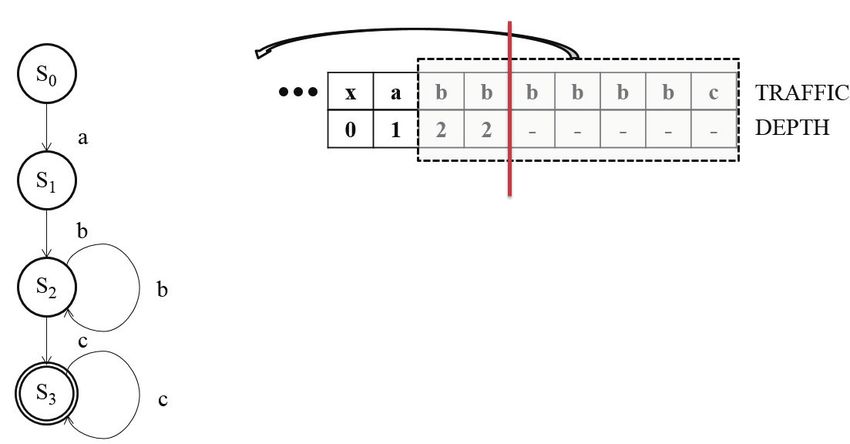
presence of a Kleene closure, is demonstrated in Fig. 2. The Recall that one possibility to provide regular expression
DFA is for ‘ab+c+’ and an input of ‘bbbbbbcxa{8,7}’ matching is to use NFA, which is usually a compact but
for which the repeated string is ‘bbbbbbc’. The repeated slow data structure. We start our discussion with such im-
string scan starts at s1 . After scanning two ‘b’ characters the plementations as they are simpler and help to grasp a better
automaton is still at s2 , hence the DFA-Depth(s2 ) does not understanding of ARCH (DFA-based Implementations pose
change and is still 2. Thus, the left border detection of ACCH extra complications on top of ARCH and are discussed in
would have been completed at this point, skipping the rest of Section VI). Moreover, NFA is currently used by the popular
the repeated string and resuming scan at the right border. This, Snort IDS, and therefore, accelerating its operations has a merit
of course, leads to a miss-detection, which is unacceptable. on its own.
Therefore, a key challenge behind ARCH is to calculate ARCH maintains an Input-Depth value for each active
the minimum number of (previous) bytes that can be part of a state. Namely, given an input prefix T , an active state s, an
future regular expression matching. This number is captured by input byte b, and a subsequent active state s′ such that there is
the Input-Depth parameter, which is defined precisely below. It a transition between s and s′ with a label b, the value of Input-
is important to notice that unlike ACCH’s DFA-Depth, Input- Depth(Tb,s’) is set to Input-Depth(T,s)+1. The only exception
Depth depends both on the automaton state and the inspected is at the start state of the NFA (which is always active) and
input. for which Input-Depth(T,s0 ) is always zero. Naturally, when
ARCH needs to determine left or right border of a pointer it
Definition 1. For a given automaton, let s0 be the start state uses the maxsis active Input − Depth(T, s). Fig. 3 depicts
and s be the current state after scanning input text T with the an NFA for the patterns ‘zabcfg’ and ‘z[^\n]*fg’. The
automaton. Let Input-Depth(T, s) be the length of the shortest execution of ARCH for input ‘zf\nzabcfe’ and the NFA
suffix of T in which inspection starting at s0 ends at s. are illustrated in Table I.
We note that in the case of string matching, Input-Depth VI. I NPUT-D EPTH E STIMATION FOR DFA-BASED
equals DFA-Depth. In fact, ARCH framework uses the ACCH I MPLEMENTATIONS
algorithm to calculate possible scan skipping by replacing the
DFA-Depth parameter with Input-Depth parameter along with The task of Input-Depth calculation is more challenging
specific implementations for the different setups, as described when a DFA is used for regular expression matching. This is
in the sequel. Thus, if there is no match, the Status-Vector because, unlike NFA, a DFA transition may results either in
value CHECK is determined according to whether Input-Depth increasing the Input-Depth (by one) or decreasing the Input-
is greater than CDepth and if not the value is UNCHECK. Depth (by any value). In this section, we provide an upper
The calculation of Input-Depth is done differently in NFA- bound on the Input-Depth using two methods: by simple and
4complex states and by positive and negative transitions. As a ڙ R r ڙ
ڙ
rule, we use the upper bound as the value of the Input-Depth in u
ڙ ڙ
the ARCH framework. Thus, we take a conservative approach R
ڙ ڙ
S s
and never miss a match. Yet, the tighter the upper bound is, ڙ
the higher the skip ratio we achieve. (a) Closure (b) Alternation
ڙ
A. Estimation based on Simple and Complex States R r S
As noted above, Input-Depth cannot be always derived (c) Concatenation
from DFA-Depth. Still, there are cases were we can derive
Fig. 4. The basic operators considered in Thompson’s construction [30].
it safely. In fact, we could split the DFA states into two kinds:
those which represent a fixed string expression (where Input-
Depth equals DFA-Depth) and those which represent a set of d
c sz x
strings with various lengths. For instance, at the DFA of Fig. 2, b
states s0 and s1 are simple and states s2 and s3 are complex. a-e [^dx]
More formally, this is captured in the following definition: a sx c sy x
Definition 2. A simple state s is a state for which all possible a [^ex]
e
input strings that upon scan from s0 terminate at s has the b c sw x
same length. All other states are complex.
Fig. 5. DFA for pattern set {‘ac[a-e]*x’, ‘abcd*x’, ‘aabce*x’}.
Input-Depth estimation by simple and complex states
works as follows: upon traversal to a simple state, Input-
Depth is set to the DFA-Depth of the state; upon traversal B. Estimation based on Positive and Negative Transitions
to a complex state, Input-Depth is incremented by one.
In this section we present the positive and negative tran-
Our algorithm detects simple and complex states based sition technique which relies on the observation that Input-
on the DFA construction procedure as described by Thomp- Depth depends on the transition between two states rather
son [30]. Thopmson’s construction has three significant stages: than only the state in its endpoint. For example, Fig. 5
NFA construction from expressions, ǫ-transitions removal, and shows that transition from sx to sy should increase the Input-
finally, DFA construction based on the resulting NFA. The Depth, transition between sz to sy should leave the Input-
basic idea of our algorithm is that we mark simple and complex Depth unchanged, and transition between sw to sy should
states during the NFA construction, and then we transfer these decrease the Input-Depth by 1. This implies that the Input-
marks to the final DFA. The NFA construction is defined Depth calculation cannot solely depend on sy .
over the three basic regular expressions operators as in Fig. 4.
The operands are regular expressions R and S. All states are Thus, we define two types of transitions: A positive-
marked as simple by default and stay that way unless specified transition, which increases Input-Depth by one (e.g. a byte
otherwise. The complex states are marked according to each was added to the pattern’s prefix) and negative-transition,
regular expression operator as follows: which either decreases or leaves Input-Depth unchanged. The
challenge is to detect negative-transitions and determine the
• Kleene Closure (Fig. 4(a)): Mark all states as com- exact change they apply on the Input-Depth value.
plex.
Negative-transition detection is performed in two stages.
• Alternation (Fig. 4(b)): If either states r or s are In the first stage, for each state we calculate a candidate
complex, mark state u as complex. label, denoted by c-label(s), which helps detecting negative
transitions in the second stage. Let L(s) be the set of all input
• Concatenation (Fig. 4(c)): If state r is complex, mark strings that are accepted by s. We choose c-label(s) ∈ L(s)
all states of S as complex. such that c-label(s).length ≤ l(s).length for any l(s) ∈ L(s).
We refer to the second stage of the Thompson construction (as
After the above procedure the following claim holds (the described at Section VI-A), which is the subset-construction
proof is at the appendix): that constructs a DFA from an NFA. The c-label(s) parameter
Claim 1. If a state s is simple then all possible input strings, is determined by integrating a line into the subset-construction
whose scan from s0 terminates at s, have the same length. algorithm (as in Alg. 1 Line 7). The algorithm uses the
following basic NFA operations:
The simple/complex state marks are transferred through the
Thompson construction stages to the final DFA as follows: the • ǫ-closure(T) — The set of NFA states reachable from
ǫ-transition removal stage only removes redundant transitions some NFA state s in set T on ǫ-transitions alone.
and states, therefore, all remaining states are still marked. • move(T,a) — The set of NFA states to which there is
Next, the NFA is transformed into a DFA using the subset- a transition on input symbol a from some state s in
construction method, which traverses the entire NFA and T.
creates a DFA state for each possible set of active states. This
DFA state is marked simple if and only all the NFA states in Basically, the subset-construction algorithm traverses all
its active states set are simple. NFA active state sets (Line 1) using all possible input symbols
5(Line 3) in a breadth-first search (BFS) manner. Each unique 1 foreach state T in Dstates do
NFA active set T results in a corresponding DFA state (Line 6). 2 R=Anchored-NFA(move(c-label(T)));
When a transition from a DFA state T (which also represents 3 foreach input symbol a do
an NFA active set) results in a DFA state U , which was 4 U=Dtran[T,a];
never visited before, the algorithm creates a c-label(U ) by 5 if ǫ-closure(move(R, a))6= ∅ then
concatenating c-label(T ) and the transition label (Line 7). Note 6 Dtran[T,a].positive=true;
that there may be more transitions that lead to DFA state 7 else
U along the construction. Still, since a BFS is used for the 8 Dtran[T,a].positive=false;
NFA traversal, and the c-label(U ) was generated upon the first 9 end
transition that reaches U , c-label(U ) must be no longer than 10 end
any other label in L(U ), as required. 11 end
Algorithm 2: Marking positive/negative transitions.
Data: Dstates, Dtrans — containers for DFA states and
transitions respectively. Initially, ǫ-closure({s0 })
is the only state in Dstates and it is unmarked. should.
1 while there is an unmarked state T in Dstates do
At this point, each transition at the DFA is marked as either
2 mark T;
positive or negative. The next step would be to determine
3 foreach input symbol a do
the Input-Depth upon DFA traversal as described in Alg. 3.
4 U = ǫ-closure(move(T, a));
The straightforward case is upon a traversal over a positive
5 if U is not in Dstates then
transitions, for which the Input-Depth is incremented by one
6 add U as an unmarked state to Dstates;
(Line 3). To handle negative transitions we use the classifi-
7 set c-label(U)=c-label(T) ⊕ a;
cation of simple and complex DFA states as explained at the
8 end
previous subsection. If a negative transition leads to a simple
9 Dtran[T, a] = U;
state, the Input-Depth is set to this state’s DFA-Depth (Line 6).
10 end
Upon a negative transition to a complex state the Input-Depth
11 end
should be decremented by the delta between the labels’ lengths
Algorithm 1: Modified subset construction algorithm. as described at Lines 8–9. We note that this algorithm does
not support some corner cases (e.g., when a regular expression
At the second stage, for each state T ∈ Dstates we iterate contains multiple loops and has a negative transition to another
over all its transitions and determine whether they are negative regular expression that contains only some of these loops), thus
or positive. For that we define a structure called Anchored-NFA, our algorithm just increments Input-Depth by one as it is its
which is the NFA constructed from all regular expressions from the maximal possible value. For that matter ARCH always
the related DFA after they were anchored; namely, after they provides an upper bound on the value of Input-Depth, and
were restricted to be matched from the beginning of the input therefore, never misses a match.
(represented by the ‘^’ operator in the PCRE [31] package).
Each transition (T, U ) with label a is inspected as follows: the
1 U=Dtran[T,a];
algorithm traverses the Anchored-NFA using c-label(T ) and
2 if Dtran[T,a] is positive then
receives an output of an active states set R in the Anchored-
3 Input-Depth++;
NFA (Line 2). If there exist an iteration with label a from R,
4 else
then transition (T, U ) is positive (Lines 4–6). The rest of the
5 if U is simple then
transitions are marked as negative. The intuition behind this
6 Input-Depth=U.DFA − Depth;
algorithm is that a negative transition from T to U with label
7 else
a applies that there is a suffix of c-label(T ) ⊕ a that leads
8 Decrease=c-label(T) − c-label(U);
from the root to U . Therefore, a string such as c-label(T ) ⊕
9 Input-Depth=Input-Depth − Decrease;
a cannot be accepted by the Anchored-NFA, rather only its
10 end
suffix. Thus, lack of transition at the Anchored-NFA applies a
11 end
negative transition at the DFA.
Algorithm 3: ARCH-DFA Input-Depth Maintenance.
For example, consider the patterns ‘ab+c+d’ and ‘bc+e’.
The resulting DFA from our modified subset construction is
depicted in Fig. 6(a) and its full-matrix representation along VII. F ROM T HEORY TO P RACTICE : ARCH-DFA S YSTEM
with its calculated c-label(s) values is depicted at Fig. 6(c). A RCHITECTURE
After running Alg. 2 using the DFA and the Anchored-NFA
(depicted in Fig. 6(b)) all negative, positive (underline) and Observe that the problematic case of ARCH is where
loop (circled) transitions are marked. All negative transitions the algorithm cannot skip any bytes. This case may hap-
are marked with dashed red arrows at Fig. 6(a). Note that the pen upon a closure operator over a wide range of char-
algorithm distinguishes between the “self-loop” of states {0}, acters (such as ‘.*’), which causes its following states
{0,1} and {0,5} as a negative transition and the “self-loop” of to be complex and have only positive transitions, hence
states {0,2,5}, {0,3,6} and {0,6}, which are marked positive. the Input-Depth never decreases. For instance, consider the
This is the desired outcome as in the former case Input-Depth pattern ‘AdminServlet.*(userid|adminurl)’ (which
should not increase upon loop traversal, while in the latter it was extracted from Snort’s rule set); after matching the prefix
6c-label(s) a b c d e
- 0 0,1 0,5 0 0 0
c-e a 0,1 0,1 0,2,5 0 0 0
d,e
a b 0,5
a b c 0,1 0,5 0,6 0 0
a c a
b
c-e c-e b c d * b c d ab 0,2,5 0,1 0,2,5 0,3,6 0 0
0,1 0,2,5 0,3,6 0,4
a b a 1 2 3 4
b b bc 0,6 0,1 0,5 0,6 0 0,7
0 e 0
a a
b c a e abc 0,3,6 0,1 0,5 0,3,6 0,4 0,7
0,5 0,6 0,7 b c e
d d,e 5 6 7 bce 0,7
b b c b 0,1 0,5 0 0 0
c-e c abcd 0,4 0,1 0,5 0 0 0
(a) DFA (b) Anchored-NFA (c) Transition table
Fig. 6. Data structures used for the positive/negative transition marking for pattern set: {‘ab+c+d’, ‘bc+e’}.
‘AdminServlet’, Input-Depth cannot decrease since any Prefix-
ARCH-DFA
character can be a part of the pattern and may be followed by
the either ‘userid’ or ‘adminurl’. Thus, ARCH cannot
skip scanning characters in such cases as it never finds the
left border of a pointer (see Section II-C). This implies
Tail- Tail- Tail-
that whenever a closure operator acts upon a wide range of ARCH-DFA
Tail-DFA
ARCH-DFA ARCH-DFA
Tail-DFA Tail-DFA
characters, the effectiveness of ARCH reduces. In some cases,
the benefit of ARCH becomes smaller than its overhead. In
Fig. 7. Illustration of the Hybrid ARCH-DFA System architecture.
such cases we would like to just run a regular DFA rather
than ARCH-DFA to avoid the ARCH-DFA overhead, which
is approximately 11% (see details in Section VIII) due to VIII. E XPERIMENTAL R ESULTS
additional memory accesses to the status-vector. We note that
only 8.1% of the rules in the set that was derived from Snort In this section we evaluate the performance benefits of
and fits compressed Web traffic (i.e. Web traffic from server ARCH on rule-sets from the Snort IPS. The Snort24, Snort31,
to client) contains ‘.*’ expressions. A more frequent wide- and Snort34 rule-sets were retrieved from Becchi’s "Regular
range Kleene closure is of the form ‘[^\n]*’.Still, since we Expression Processor" package [32]. The Snort135 rule-set
deal with HTML data, the new-line occurs on average after 75 was extracted from Snort’s "web-client.rules" (February 2014).
characters, and therefore, the automaton “escapes” the above- These rules relate to Web traffic . Table II summarizes the basic
mentioned case of only positive transitions, and therefore, characteristics of the rule-sets used in the experiments.
does not harm much the ARCH performance, as described
in Section VIII. Additionally, when Input-Depth increases A. Data Set
along scanning, ARCH never detects a pointer’s left border,
implying status vector checkups are redundant. We note that The data set contains 2301 compressed HTML pages,
nowadays, the incurred overhead in the above-mentioned case downloaded by a Web crawler from 500 popular sites taken
is practically negligible, future pattern sets or implementations from the Alexa Web-site [33]. The size of the data is 358MB
might be different. in uncompressed form and 61.2MB in compressed form.
B. ARCH performance
A design that ARCH may benefit from is the Hybrid-
FA of Becchi et al. [12]. Inspired by this design, ARCH In this section we compare ARCH with a baseline al-
system breaks the regular expressions into a prefix set of all gorithm, which uses the same underlying automaton scheme
expressions, which are represented by a single prefix ARCH- (NFA or DFA) without performing any byte skipping. We
DFA (which is analogues to the head-DFA in [12]), and a set of define Rs as the scanned character skip ratio — the ratio of
tail ARCH-DFAs which represent the entire regular expressions characters scanned using ARCH out of the total size of the
set. The prefix ARCH-DFA is always active, while only a input data. We define Rt as the scan time ratio — ARCH’s
small part of the tail ARCH-DFAs are also active. This way running time compared to the baseline algorithm’s running
the resulting hybrid automaton has a small memory footprint time.
as compared to the corresponding DFA, with the penalty of
traversing several automatons in parallel. Using the above- TABLE II. RULE - SETS CHARACTERISTICS
mentioned architecture leaves us the freedom to decide in
Rule Set Snort24 Snort31 Snort34 Snort135
advance whether to use a tail ARCH-DFA or a tail DFA in the Number of Rules 24 31 34 135
case where the overhead of ARCH is higher than its benefit % Rules with Kleene Closure 37.5 41.9 38.2 89.6
as depicted at Fig. 7. % Rules with Char Ranges ≥ 50 50 48.4 41.1 51.9
7&!! &!!
% %
%! %!
$ $
Cumulative %
Cumulative %
$! $!
# #
#! #!
" "
"! "!
! !
& ' ( $ &" & ' ( $ &"
Input Depth Input Depth
Snort24 Snort31 Snort34 Snort24 Snort31 Snort34
Fig. 8. Input Depth Cumulative Distribution (NFA) Fig. 9. Input Depth Cumulative Distribution (DFA)
ARCH-NFA was implemented using active states NFA as this case, as in the simpler pattern sets, the overhead of ARCH
its baseline algorithm, as described in Section V. Table III is approximately 11%.
shows statistics regarding its performance. The average skip
rate Rs is 77.99%, which in turn results in a significant IX. C ONCLUSION
performance improvement in terms of Rt (77.21% on average).
Compared to the overall performance, the overhead of ARCH- ARCH started as an effort to adapt prior art of string
NFA is less than 1%. Since ARCH-NFA’s running time is matching over compressed traffic to the regular expression
approximately 40 times longer than ARCH-DFA’s, the relative matching domain in a straightforward manner. We uncovered
overhead of ARCH is negligible. On the other hand, the space wide set of complexities of both algorithmic and architectural
requirements for ARCH-NFA are 18 times smaller than those aspects that the new domain holds. We aimed at providing a
of ARCH-DFA. generic method that fits a wide range of solutions, therefore
we analyzed both NFA and DFA setups and aimed at both
ARCH-DFA was implemented using A-DFA [10] as its moderate simple pattern sets and large complex ones. For
baseline algorithm. The implementation performs InputDepth that we proposed three architectures: ARCH-NFA, ARCH-
estimation based on simple and complex states as described DFA and the hybrid ARCH-DFA. These architectures were
in Section VI-A. This estimation has a lower overhead while implemented and gained significant performance boost over
the benefit gained by the more precise estimation of the posi- current DPI designs of 67%–79%.
tive/negative transitions is not significant on our data sets. Two An important product of this research is the discovery of
system setups were implemented for ARCH-DFA. The first the Input-Depth parameter. Beside the fact that it is a crucial
uses a single DFA for the entire rule-set and is therefore useful construct for regular expression matching over compressed
for pattern sets with moderate size which do not exhibit state traffic, we found that there are other applications for which it is
explosion, such as: Snort24, Snort31, and Snort34. Table III important. A surprising fact is that there is no straightforward
shows statistics regarding the performance of ARCH-DFA. method to extract the string that relates to a matched pattern
ARCH-DFA achieved an average skip rate Rs of 77.69% and without rescanning the packet. The only information about
a performance boost in Rt of 69.19%. Note that in this case the input that is available at this point is the position in the
the overhead of ARCH is more notable and is almost 11%. input in which the match occurred. Input-Depth allows this
As discussed in Section VII, this overhead is mostly due to functionality as it indicates the number of bytes that should be
additional memory references to the Status-Vector as compared extracted from the input up to the match position.
to the baseline algorithm.
A related application may be to determine the number of
The second setup uses a hybrid design consisting of a prefix bytes that should be stored to handle cross-packet DPI. Instead
ARCH-DFA, which encodes the prefixes of the pattern set, and of buffering entire packets, a DPI engine may just store a
multiple tail ARCH-DFAs as described in Section VII. This matched pattern-prefix at each packet’s suffix. This application
setup is useful for pattern sets with considerable size and high has even more benefit in the case of out-of-order packets,
complexity, which cause state-space explosion (e.g. Snort135). where in order to be able to retrieve a matched string several
The average skip ratio Rs is 77.88% while the average gained packets should be buffered.
performance boost in terms of Rt is 69.41%. We note that in
R EFERENCES
TABLE III. ARCH P ERFORMANCE [1] W3Tech, “Usage of Compression for websites,” 2014.
Rule Set Snort24 Snort31 Snort34 Snort135 http://w3techs.com/technologies/details/ce-compression/all/all.
NFA Characters Skipped 79.44% 75.86% 78.66% - [2] “Snort: The Open Source Network Intrusion Detection System.”
Time Saved 79.29% 74.56% 77.78% - http://www.snort.org.
DFA Setup Single Single Single Hybrid
Characters Skipped 79.04% 75.64% 78.38% 78.46% [3] “Hyper[t]ext [t]ransfer [p]rotocol – [http]/1.1,” June 1999. [RFC] 2616,
Time Saved 70.97% 67.46% 69.14% 70.08% http://www.ietf.org/rfc/rfc2616.txt.
Number of Matches 168603 1333 8000 77801 [4] P. Deutsch, “Gzip file format specification,” May 1996. RFC 1952,
Run-time NFA/DFA 38.46 45.45 40 - http://www.ietf.org/rfc/rfc1952.txt.
8[5] A. V. Aho and M. J. Corasick, “Efficient string matching: an aid to [28] M. Berger and B. Mortensen, “Fast pattern matching in compressed
bibliographic search,” Commun. ACM, vol. 18, pp. 333–340, June 1975. data packages,” in GLOBECOM Workshops (GC Wkshps), 2010 IEEE,
[6] J. E. Hopcroft, R. Motwani, and J. D. Ullman, Introduction to Au- pp. 1591–1595, Dec 2010.
tomata Theory, Languages, and Computation. Pearson/Addison Wesley, [29] Y. Sun and M. S. Kim, “Dfa-based regular expression matching on
3rd ed., 2007. compressed traffic,” in Communications (ICC), 2011 IEEE International
[7] R. Sommer and V. Paxson, “Enhancing byte-level network intrusion Conference on, pp. 1–5, June 2011.
detection signatures with context,” in CCS, pp. 262–271, 2003. [30] K. Thompson, “Programming techniques: Regular expression search
[8] R. Smith, C. Estan, and S. Jha, “Xfa: Faster signature matching with algorithm,” Commun. ACM, vol. 11, pp. 419–422, June 1968.
extended automata,” in Security and Privacy, 2008. SP 2008. IEEE [31] “PCRE - perl compatible regular expressions.” http://www.pcre.org.
Symposium on, pp. 187–201, May 2008. [32] M. Becchi, “Regular expression processor.” http://regex.wustl.edu.
[9] S. Kumar, S. Dharmapurikar, F. Yu, P. Crowley, and J. Turner, [33] “Alexa: The web information company,” Dec 2011.
“Algorithms to accelerate multiple regular expressions matching for http://www.alexa.com/topsites.
deep packet inspection,” in Proceedings of the 2006 conference on
Applications, technologies, architectures, and protocols for computer
communications, pp. 339–350, 2006. A PPENDIX
[10] M. Becchi and P. Crowley, “An improved algorithm to accelerate regular Proof: We will prove Claim VI-A by induction, showing
expression evaluation,” in ACM/IEEE ANCS, pp. 145–154, 2007.
that it holds for each NFA construction step. Recall that each
[11] F. Yu, Z. Chen, Y. Diao, T. V. Lakshman, and R. H. Katz, “Fast
and memory-efficient regular expression matching for deep packet such step takes an operator and one or two operands and
inspection,” in Proceedings of the 2006 ACM/IEEE symposium on constructs an NFA part.
Architecture for networking and communications systems, pp. 93–102,
2006. Induction base: The first NFA construction step may take
[12] M. Becchi and P. Crowley, “A hybrid finite automaton for practical deep as operand a single character. This expression by definition
packet inspection,” in ACM CoNEXT, pp. 1:1–1:12, December 2007. contains no complex states. The first operator may be either
[13] Y. Afek, A. Bremler-Barr, Y. Harchol, D. Hay, and Y. Koral, “Mca2: a Kleen closure or concatenation with an empty expression.
Multi-core architecture for mitigating complexity attacks,” in Pro- The former case results in marking all states as complex,
ceedings of the Eighth ACM/IEEE Symposium on Architectures for thus the above claim still holds. The latter case constructs
Networking and Communications Systems, ANCS ’12, (New York, NY, a simple state. Still, since this state represents a string of
USA), pp. 235–246, ACM, 2012.
length 1, the above claim also holds. An alternation requires
[14] R. Smith, C. Estan, and S. Jha, “Backtracking algorithmic complexity
attacks against a nids,” in Computer Security Applications Conference, two expressions thus it cannot be used at the first construction
2006. ACSAC ’06. 22nd Annual, pp. 89–98, Dec 2006. step. Therefore the induction base holds.
[15] A. Bremler-Barr and Y. Koral, “Accelerating multipattern matching Induction step: Assume that the above claim holds for k
on compressed http traffic,” IEEE/ACM Trans. Netw., vol. 20, no. 3,
pp. 970–983, 2012. construction steps. We prove for the k + 1 construction step.
[16] P. Rauschert, Y. Klimets, J. Velten, and A. Kummert, “Very fast gzip
Assume on the contrary that there is a state s, marked as
compression by means of content addressable memories,” in TENCON simple, which after construction step k+1 has two input strings
2004. 2004 IEEE Region 10 Conference, vol. D, pp. 391–394 Vol. 4, of different length that upon scan from s0 terminate at s. Let s
Nov 2004. be part of expression S. We now inspect each operator. For a
[17] J. Franklin, “Hardware accelerated compression,” May 23 2006. US Kleen closure over expression S all its states would have been
Patent 7,051,126. marked as complex. Since s is simple, this is a contradiction.
[18] K. Ma and W. Chen, “Method and apparatus for efficient hardware For a concatenation of expression S to R, assuming there are
based deflate,” Dec. 11 2007. US Patent 7,307,552.
at least two input strings with different length that lead to s,
[19] A. Amir, G. Benson, and M. Farach, “Let sleeping files lie: Pattern then r, the last state of R must have also at least two such input
matching in z-compressed files,” Journal of Computer and System
Sciences, pp. 299–307, 1996. strings. In this case r should have been marked as complex
[20] T. Kida, M. Takeda, A. Shinohara, and S. Arikawa, “Shift-and approach prior step k + 1. Thus, tall states of S including s should
to pattern matching in lzw compressed text,” in 10th Annual Symposium have been marked complex at step k + 1, which again is a
on Combinatorial Pattern Matching (CPM 99), 1999. contradiction. The only option left is the alternation operator.
[21] G. Navarro and M. Raffinot, “A general practical approach to pattern Note that this operator does not change marks for states inside
matching over ziv-lempel compressed text,” in 10th Annual Symposium the operand expressions, rather it creates two additional states
on Combinatorial Pattern Matching (CPM 99), 1999. prior and after the expressions. Thus our assumption could take
[22] G. Navarro and J. Tarhio, “Boyer-moore string matching over ziv-lempel place only if s is a newly created state at step k + 1. The new
compressed text,” in Proceedings of the 11th Annual Symposium on
Combinatorial Pattern Matching, pp. 166 – 180, 2000.
state before the expression accepts only an empty string, which
is not the case for s. Therefore, s must have been the new state
[23] S. Klein and D. Shapira, “A new compression method for compressed
matching,” in Proceedings of data compression conference DCC-2000, after the expressions. Since s is simple, both expressions’ last
Snowbird, Utah, pp. 400–409, 2000. state must be simple. The only case where two input strings
[24] M. Farach and M. Thorup, “String matching in lempel-ziv compressed with different lengths could have reach s from s0 is if both
strings,” in 27th annual ACM symposium on the theory of computing, expressions represent a string with different length. But in this
pp. 703–712, 1995. case s would have been marked as complex, which is again a
[25] A. Bremler-Barr, Y. Koral, and V. Zigdon, “Shift-based pattern matching contradiction. Thus the claim holds for k + 1 and the proof of
for compressed web traffic.,” in HPSR, pp. 222–229, IEEE, 2011. the induction is complete.
[26] S. Wu and U. Manber, “A fast algorithm for multi-pattern searching,”
Tech. Rep. TR-94-17, Department of Computer Science, University of
Arizona, May 1994.
[27] Y. Afek, A. Bremler-Barr, and Y. Koral, “Space efficient deep packet
inspection of compressed web traffic,” Comput. Commun., vol. 35,
pp. 810–819, Apr. 2012.
9You can also read


