ACTA - PIPA - SOPA - impact on the internet? - Dienstag, 27. März 12
←
→
Page content transcription
If your browser does not render page correctly, please read the page content below

ACTA – PIPA – SOPA - impact on the internet?

Dienstag, 27. März 12
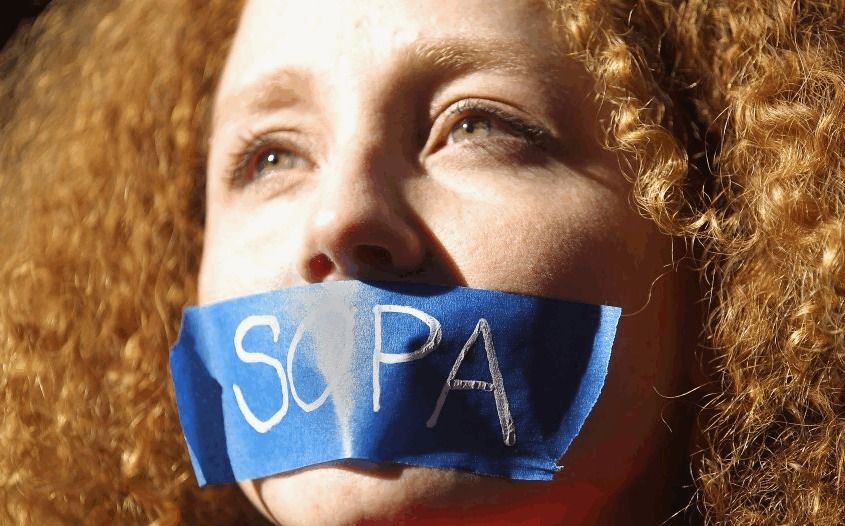
Dienstag, 27. März 12

EMOTINALLY HIGH UP

Dienstag, 27. März 12
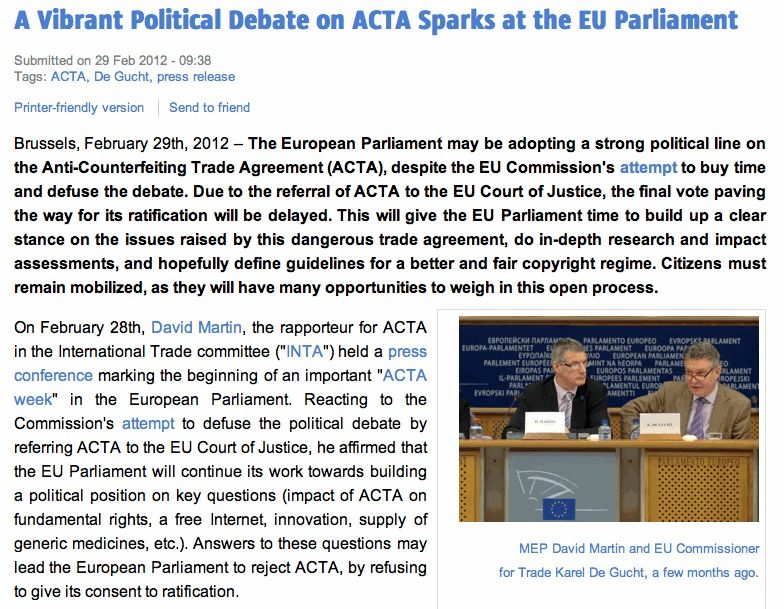
http://en.wikipedia.org/wiki/Anti-Counterfeiting_Trade_Agreement
ACTA wikipedia
§ The Anti-Counterfeiting Trade Agreement (ACTA) is a multinational treaty for
the purpose of establishing international standards for intellectual property
rights enforcement. The agreement aims to establish an international legal
framework for targeting counterfeit goods, generic medicines and
copyright infringement on the Internet, and would create a new governing
body outside existing forums, such as the World Trade Organization, the
World Intellectual Property Organization, or the United Nations.
§ The agreement was signed in October 2011 by Australia, Canada, Japan,
Morocco, New Zealand, Singapore, South Korea and the United States. In
January 2012, the European Union and 22 countries which are member states
of the European Union signed as well, bringing the total number of signatories
to 31. After approval (ratification) by 6 countries, the convention will come into
force.
§ Supporters have described the agreement as a response to "the increase in
global trade of counterfeit goods and pirated copyright protected works".
Large intellectual property-based organizations such as the MPAA and
Pharmaceutical Research and Manufacturers of America were active in the
treaty's development.
Dienstag, 27. März 12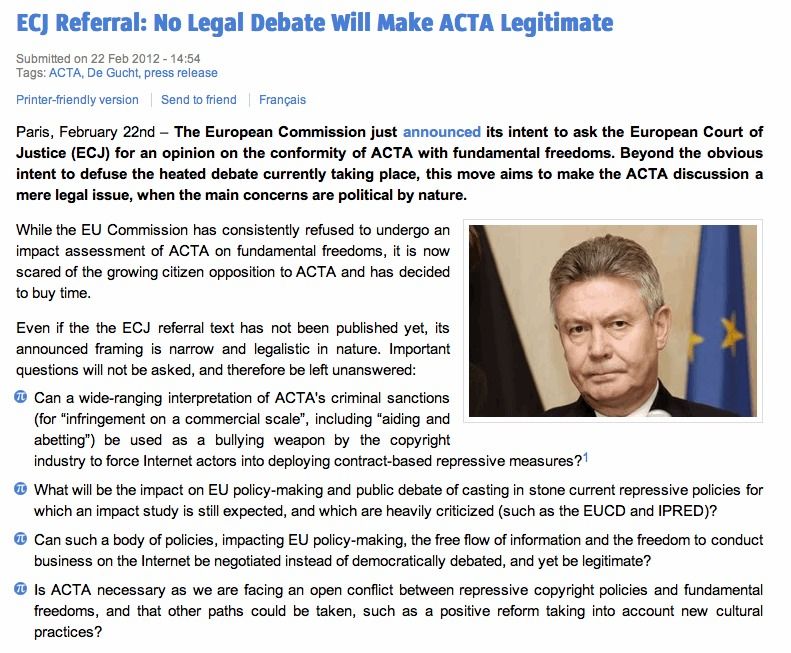
ACTA how it developed
§ Not in a stand way in an international body
§ Apart from the participating governments, an advisory committee
of large US-based multinational corporations was consulted on the
content of the draft treaty. ( including the Pharmaceutical Research,
International Intellectual Property Alliance... )
§ ACTA was first developed by Japan and the United States in 2006.
§ Canada, the European Union (represented in the negotiations by the
European Commission, the EU Presidency and EU Member States.) and
Switzerland joined the preliminary talks throughout 2006 and 2007.
§ Official negotiations began in June 2008, with Australia, Mexico,
Morocco, New Zealand, the Republic of Korea and Singapore joining the
talks.
§ Mexico withdrew Mexico from ACTA negotiations on 30 September
2010.
Dienstag, 27. März 12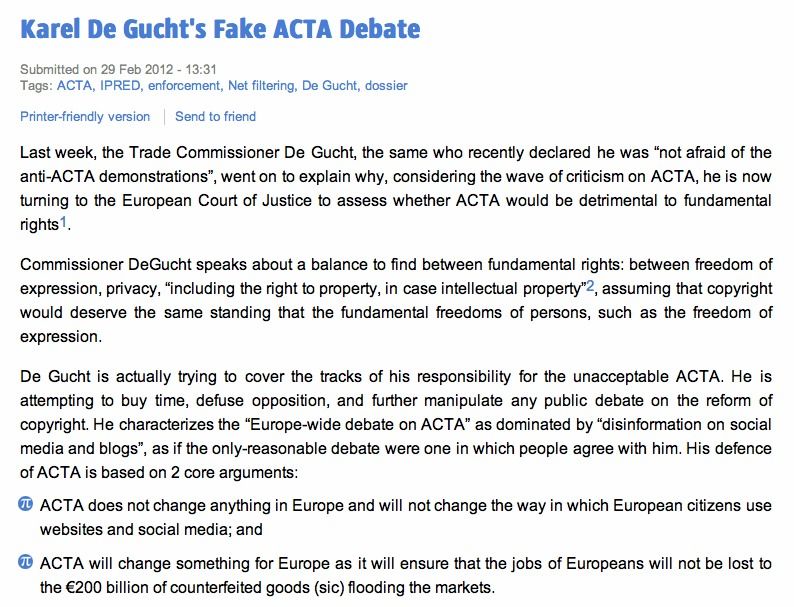
ACTA content and layout
§ Chapter I: Initial Provisions and General Definitions
15 April 2011 - 6 chapters with 45 articles
– scope of the agreement
– relations to other agreements.
– It asserts that obligations from other agreements still exist with entry into
force of this agreement
– applies only those intellectual property rights existing in the country
applying the treaty
– Countries may impose stricter measures than the treaty requires
– should share (confidential) information for law enforcement purposes
– The treaty explicitly also applies to Free Zones .
§ Chapter II: Legal Framework for Enforcement of Intellectual Property Rights
– Chapter II is divided in five sections.
§ Section 1: General Obligations
– requirements to implement the provisions in law
– to have fair procedure as well as "proportionality between the seriousness
of the infringement, the interests of third parties, and the applicable
measures, remedies and penalties"
Dienstag, 27. März 12
ACTA content and layout
§ Section 2: Civil Enforcement
– rights holders have access to civil or administrative procedures and
possibility for judges "to issue an order against a party to desist from an
infringement".
– judges may also require in civil procedure pirated copyright goods and
counterfeit trademark goods to be destroyed.
– judges may ask (alleged) infringers to provide information on the
goods it "controls".
• see Hutter Singapore - KGB
– a Party's judicial authorities may consider inter alia any legitimate
measure of value submitted by a rights holder, including lost profits, the
value of infringed property as per market price, or the suggested retail
price.
• highly critizized clause
Dienstag, 27. März 12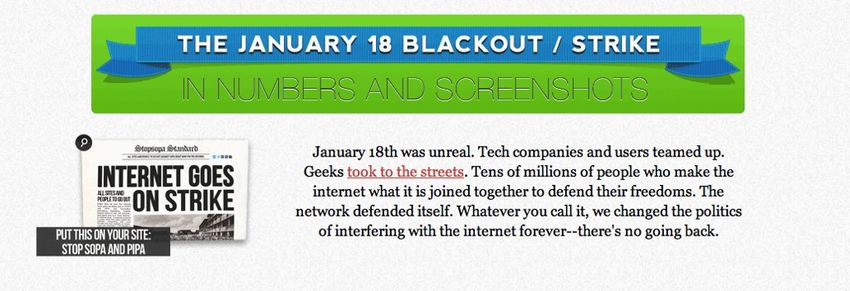
ACTA content and layout
§ Section 3: Border Measures
– At borders, officials may act on suspect goods on their own initiative or
upon request of a "rights holder".
– For goods in transit, the requirements do not have to enacted by a state.
– "Small consignment" for commercial use are included in the border
provisions
– "goods of a non-commercial nature contained in travellers’ personal
luggage" are excluded from the scope.
Dienstag, 27. März 12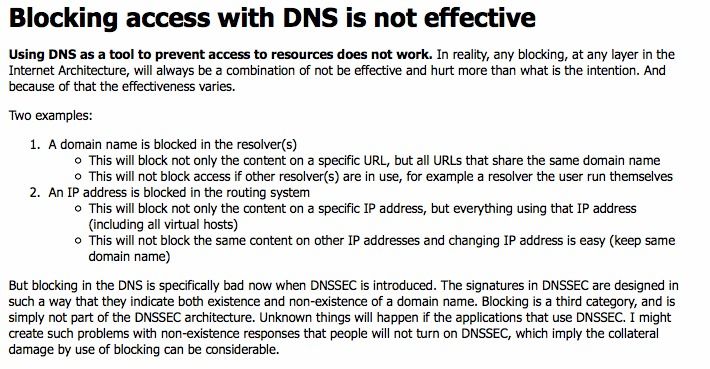
ACTA content and layout
§ Section 4: Criminal Enforcement
§ Article 23: Criminal Offenses
– At least "wilful trademark counterfeiting or copyright or related rights
piracy on a commercial scale" should be punishable under criminal law.
• According to European Digital Rights, the article "provides an extremely
low threshold" when considering that the scope includes "acts" and
because consequences for infringement can include criminal penalties.
§ Article 24: Penalties
– Penalties that Parties should have in their criminal system should "include
imprisonment as well as monetary fines", which are sufficiently high
for discouragement of actions forbidden under the treaty.
Dienstag, 27. März 12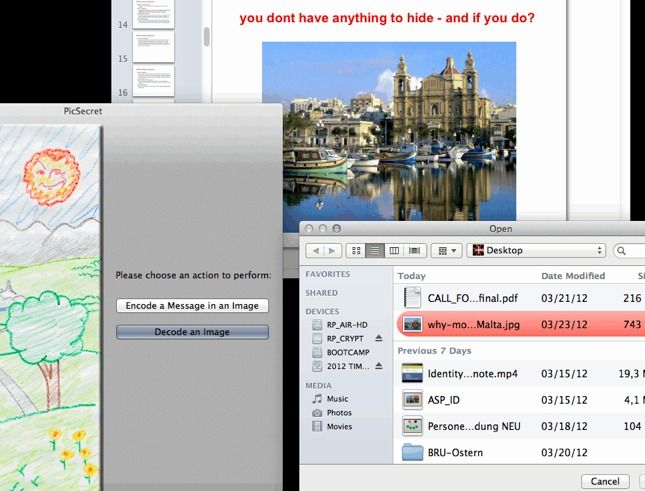
ACTA content and layout
§ Section 5: Enforcement of Intellectual Property Rights in the Digital
Environment
§ Article 27: Enforcement in the Digital Environment
– In the digital environment, also Civil and Criminal enforcement should
be available "to permit effective action against an act of infringement of
intellectual property rights which takes place in the digital environment".
– Infringement over digital networks should be enforced in a manner, which
"preserves fundamental principles such as freedom of expression, fair
process, and privacy" .
– Against circumvention of systems to prevent copying measures should
be implemented
• Critics of this article, such as the European Digital Rights, have raised
concerns that its emphasis on the role of corporations in enforcement
"promotes the policing and even punishment of alleged infringements
outside normal judicial frameworks", while failing effective to "ensure
effective remedies against such interferences with fundamental rights"
Dienstag, 27. März 12ACTA content and layout
§ Chapter III: Enforcement Practices
§ Article 28: Enforcement Expertise, Information, and Domestic Coordination
– Parties are expected to cultivate expertise within agencies tasked with
enforcing intellectual property rights, promote internal coordination, and
facilitate joint actions.
– They are also compelled to collect and utilize statistical data, as well as
"other relevant information concerning intellectual property rights
infringements", to prevent and combat infringement as necessary.
– The article also indicates that parties shall "endeavour to promote, where
appropriate, the establishment and maintenance of formal or informal
mechanisms, such as advisory groups, whereby [their] competent
authorities may receive the views of right holders and other relevant
stakeholders."
Dienstag, 27. März 12ACTA content and layout
§ Article 42: Amendments
– Parties may submit proposed amendments to the Committee for review,
which would then determine whether or not the proposed amendment
should be presented for potential ratification, acceptance, or approval.
Successful amendments would become effective 90 days after all parties
have provided their respective instruments of ratification, acceptance,
or approval to the depositary.
Dienstag, 27. März 12the ACTA landscape Dienstag, 27. März 12
protest against ACTA

Dienstag, 27. März 12
Dienstag, 27. März 12
you dont have anything to hide - and if you do?

Dienstag, 27. März 12
ACTA AND STEGANOGRAPHY

Dienstag, 27. März 12
WOULD YOU USE?

                        crypto if you have
                        something to hide?

                        if you really have
                        something to hide
                        crypto is not best as
                        it provokes suspicion

Dienstag, 27. März 12
IT IS ABOUT CYBER - ALTERNATIVES?
Howard Smith at London Cymer Nov 2011:
80% can be prevented Computerhygene
It is more about prevention
Very big issue: different jusrisdictions making it
impossible to follow up
Possibly securing and making transparent the origin
would be helpful
like DNSSEC (obligation when it comes to eBusiness?)
like jurisdicton aware transport layers?
** PROBLEM SPAM
** PROBLEM DISTANT CONTRACTS
Dienstag, 27. März 12PIPA
SHOULD WE SET A SIGN OR A BAR ?
Dienstag, 27. März 12PIPA WIKIPEDIA
‣ The PROTECT IP Act (Preventing Real Online Threats to Economic
http://en.wikipedia.org/wiki/PROTECT_IP_Act
Creativity and Theft of Intellectual Property Act, or PIPA) is a proposed law
with the stated goal of giving the US government and copyright holders
additional tools to curb access to "rogue websites dedicated to infringing
or counterfeit goods", especially those registered outside the U.S.[1] The bill
was introduced on May 12, 2011, by Senator Patrick Leahy (D-VT)[2] and 11
bipartisan co-sponsors. The Congressional Budget Office estimated that
implementation of the bill would cost the federal government $47 million
through 2016, to cover enforcement costs and the hiring and training of 22
new special agents and 26 support staff. The Senate Judiciary Committee
passed the bill, but Senator Ron Wyden (D-OR) placed a hold on it.
✴The PROTECT IP Act is a re-write of the Combating Online Infringement
and Counterfeits Act (COICA), which failed to pass in 2010. A similar
House version of the bill, the Stop Online Piracy Act (SOPA), was
introduced on October 26, 2011.
✴In the wake of online protests held on January 18, 2012, Senate Majority
Leader Harry Reid announced that a vote on the bill would be postponed
until issues raised about the bill were resolved.
Dienstag, 27. März 12PIPA „the highlights“
§ „information location tool shall take technically feasible and reasonable
measures, as expeditiously as possible, to remove or disable access to
the Internet site associated with the domain name set forth in the order“
§ Nonauthoritative domain name servers would be ordered to take
technically feasible and reasonable steps to prevent the domain name
from resolving to the IP address of a website that had been found by the
court to be "dedicated to infringing activities.“
§ The website could still be reached by its IP address, but links or users
that used the website’s domain name would not reach it.
– BLACK MARKET /BLAK SERVICES
§ OPPSERS Mozilla Corporation, Facebook, Electronic Frontier
Foundation, Yahoo!, eBay, American Express, reddit, Google, Reporters
Without Borders, Human Rights Watch, English Wikipedia ...
Dienstag, 27. März 12PIPA content
§ ENHANCING ENFORCEMENT AGAINST ROGUE WEBSITES
OPERATED AND REGISTERED OVERSEAS.
✤(a) COMMENCEMENT OF AN ACTION.
• (1) IN PERSONAM.
The Attorney General may commence an in personam action against
• (A) a registrant of a nondomestic domain name used by an Internet
site dedicated to infringing activities; or
• (B) an owner or operator of an Internet site dedicated to infringing
activities accessed through a non-domestic domain name.
• (2) IN REM.
If through due diligence the Attorney General is unable to find a person
described in subparagraphs (A) or (B) of paragraph (1), or no such
person found has an address within a judicial district of the United
States, the Attorney General may commence an in rem action against
a non-domestic domain name used by an Internet site dedicated to
infringing activities.
Dienstag, 27. März 12PIPA content
✤ (b) ORDERS OF THE COURT.
• (1) IN GENERAL.
On application of the Attorney General following the commencement of
an action under this section, the court may issue a temporary
restraining order, a preliminary injunction, or an injunction, in accordance
with rule 65 of the Federal Rules of Civil Procedure, against the non-
domestic domain name used by an Internet site dedicated to
infringing activities, or against a registrant of such domain name,
or the owner or operator of such Internet site dedicated to infringing
activities, to cease and desist from undertaking any further activity
as an Internet site dedicated to infringing activities, if
★(A) the domain name is used within the United States to access
such Internet site; and
★(B) the Internet site
✴(i) conducts business directed to residents of the United
States; and
✴(ii) harms holders of United States intellectual property
rights.
Dienstag, 27. März 12PIPA content
• (2) DETERMINATION BY THE COURT.
For purposes of determining whether an Internet site conducts
business directed to residents of the United States under paragraph (1)
(B)(i), a court may consider, among other indicia, whether
★(A) the Internet site is providing goods or services described in
section 2(7) to users located in the United States;
★(B) there is evidence that the Internet site is not intended to provide
✴(i) such goods and services to users located in the United States;
✴(ii) access to such goods and services to users located in the
United States; and
✴(iii) delivery of such goods and services to users located in the
United States;
★(C) the Internet site has reasonable measures in place to prevent
such goods and services from being accessed from or delivered to
the United States;
★(D) the Internet site offers services obtained in the United States; and
★(E) any prices for goods and services are indicated in the
currency of the United States.
Dienstag, 27. März 12PIPA content
✤(d) REQUIRED ACTIONS BASED ON COURT ORDERS.
• (1) SERVICE.
A Federal law enforcement officer, with the prior approval of the court,
may serve a copy of a court order issued pursuant to this section
on similarly situated entities within each class described in paragraph
(2). Proof of service shall be filed with the court.
• (2) REASONABLE MEASURES.
After being served with a copy of an order pursuant to this subsection:
★(A) OPERATORS.
✴(i) IN GENERAL.
An operator of a nonauthoritative domain name system server
shall take the least burdensome technically feasible and
reasonable measures designed to prevent the domain name
described in the order from resolving to that domain name’s
Internet protocol address, except that
๏(I) such operator shall not be required
‣ (aa) other than as directed under this subparagraph, to modify
its network, software, systems, or facilities;
Dienstag, 27. März 12PIPA content
‣ (bb) to take any measures with respect to domain name
lookups not performed by its own domain name server or
domain name system servers located outside the United
States; or
‣ (cc) to continue to prevent access to a domain name to which
access has been effectively disable by other means; and
๏(II) nothing in this subparagraph shall affect the limitation on the
liability of such an operator under section 512 of title 17, United
States Code.
✴(ii) TEXT OF NOTICE.
The Attorney General shall prescribe the text of the notice
displayed to users or customers of an operator taking an action
pursuant to this subparagraph. Such text shall specify that the
action is being taken pursuant to a court order obtained by
the Attorney General.
★(B) FINANCIAL TRANSACTION PROVIDERS.
A financial transaction provider shall take reasonable measures,
as expeditiously as reasonable, designed to prevent, prohibit, or
suspend its service from completing payment transactions
involving customers located within the United States and the Internet
site associated with the domain name set forth in the order.
Dienstag, 27. März 12PIPA content
★ (C) INTERNET ADVERTISING SERVICES.
An Internet advertising service that contracts with the Internet site
associated with the domain name set forth in the order to provide
advertising to or for that site, or which knowingly serves advertising to
or for such site, shall take technically feasible and reasonable
measures, as expeditiously as reasonable, designed to
✴(i) prevent its service from providing advertisements to the
Internet site associated with such domain name; or
✴(ii) cease making available advertisements for that site, or paid
or sponsored search results, links or other placements that
provide access to the domain name.
★(D) INFORMATION LOCATION TOOLS.
An information location tool shall take technically feasible and
reasonable measures, as expeditiously as possible, to
✴(i) remove or disable access to the Internet site associated with
the domain name set forth in the order; or
✴(ii) not serve a hypertext link to such Internet site.
Dienstag, 27. März 12PIPA content
• (3) COMMUNICATION WITH USERS.
Except as provided under paragraph (2)(A)(ii), an entity taking an
action described in this subsection shall determine whether and
how to communicate such action to the entity’s users or customers.
• (4) RULE OF CONSTRUCTION.
For purposes of an action commenced under this section, the obligations
of an entity described in this subsection shall be limited to the actions set
out in each paragraph or subparagraph applicable to such entity, and no
order issued pursuant to this section shall impose any additional
obligations on, or require additional actions by, such entity.
• (5) ACTIONS PURSUANT TO COURT ORDER.
★(A) IMMUNITY FROM SUIT.
No cause of action shall lie in any Federal or State court or
administrative agency against any entity receiving a court order
issued under this subsection, or against any director, officer,
employee, or agent thereof, for any act reasonably designed to
comply with this subsection or reasonably arising from such
order, other than in an action pursuant to subsection (e).
Dienstag, 27. März 12PIPA content
★(B) IMMUNITY FROM LIABILITY.
Any entity receiving an order under this subsection, and any
director, officer, employee, or agent thereof, shall not be liable to
any party for any acts reasonably designed to comply with this
subsection or reasonably arising from such order, other than in
an action pursuant to subsection (e), and any actions taken by
customers of such entity to circumvent any restriction on access to
the Internet domain instituted pursuant to this subsection or any act,
failure, or inability to restrict access to an Internet domain that is the
subject of a court order issued pursuant to this subsection despite
good faith efforts to do so by such entity shall not be used by any
person in any claim or cause of action against such entity, other than
in an action pursuant to subsection (e).
Dienstag, 27. März 12PIPA content
§ ELIMINATING THE FINANCIAL INCENTIVE TO STEAL INTELLECTUAL
PROPERTY ONLINE.
✤(a) IN GENERAL.
No financial transaction provider or Internet advertising service shall be
liable for damages to any person for voluntarily taking any action
described in section 3(d) or 4(d) with regard to an Internet site if the
entity acting in good faith and based on credible evidence has a
reasonable belief that the Internet site is an Internet site dedicated to
infringing activities.
✤(b) INTERNET SITES ENGAGED IN INFRINGING ACTIVITIES THAT
ENDANGER THE PUBLIC HEALTH.
• (1) REFUSAL OF SERVICE.
A domain name registry, domain name registrar, financial trans-
action provider, information location tool, or Internet advertising
service, acting in good faith and based on credible evidence, may
stop providing or refuse to provide services to an infringing Internet
site that endangers the public health.
Dienstag, 27. März 12counter PIPA activities Dienstag, 27. März 12
PIPA concerns
§ Technical objections to DNS blocking and redirection
– does it work?
§ Civil liberties issues
– is it proportionate
§ Concern for user-generated sites
– who can be made reliable
§ Business and innovation issues
– does it tap on IPR
Dienstag, 27. März 12PIPA and DNS blocking
§ Brings up again prehaps heats up ICAN debate
– who is in control public/private
– Internet Governance and the EU
§ Legal Autonomy of nations (versus DNS)
– DNS - blocking and scope of jurisdictions
§ Alternative DNS
– the move might encourage alternatives - introducing further
security risk
§ „DNS – RETAINERS might show up“
– is DNS blocking effective in „those communities“
Dienstag, 27. März 12DNS blocking
http://stupid.domain.name/node/1248
§ DNS blocking might jeopardize DNSSEC
Dienstag, 27. März 12PIPA and colateral damage
– Collateral damage: False Litigation – people who are opposing
SOPA and PIPA believe that neither piece of legislation would
do enough to protect against false accusations.
– Collateral Damage: Meanwhile, sites that host user-generated
content will be under pressure to closely monitor users’
behavior. It could be a huge liability for startups.
– Collateral Damage: “takes the risk of frivolous litigation… to
the entire Internet.”
– Collateral Damage: “a tremendous chilling effect on people trying
to conduct political discourse and trying to use content in a fair
use context.”
– Collateral Damage: SOPA and PIPA, in their current forms would
be ineffective in dealing with rogue websites and would entail
significant “collateral damage” in terms of stifling innovation and
attenuating free speech.
Dienstag, 27. März 12PIPA and NON US jurisdictions
§ SOPA provisions are designed to have an extra-
territorial effect in countries around the world.
§ NON-U.S. businesses and websites could easily find
themselves targeted by SOPA. The bill grants the
U.S. "in rem" jurisdiction over any website that does
not have a domestic jurisdictional connection.
§ Millions rely on the legitimate sites that are affected
by the legislation. If non-Americans remain silent,
they may ultimately find the sites and services
they rely upon silenced by this legislation.
§ U.S. intellectual property strategy has long been
premised on exporting its rules to other
countries.
Dienstag, 27. März 12PIPA and jurisdictions
§ different jurisdictions still will have different opinions in
a specific situation
§ technology does not really allow for this
differentiation
§ DNS shopping in countries not subscribing to ACTA /
PIPA / SOPA spirit
§ leading to unreliable secondary DNS being a major
thread
Dienstag, 27. März 12PROVIDERS and censoring
§ To what extent are providers oblidged to execute
„censoring“
§ Encryped content is evading censoring in any case
§ Even more: Stega-Content poses immense problems
§ Are closed groups (black communities...) favored by
such legislation?
§ How does dynamic content relate to this legislation /
agreement?
would it legally affect skype for example?
Dienstag, 27. März 12Who what is in the focus
§ stakeholders are the content providers
§ users needs and whishes are not in the focus
Dienstag, 27. März 12Will it be long term effective
§ DNS is only half way
– think of illegality of SPAM
§ So far prohibitors did not really survive the internet
– think of Crypto banning
– think of key escrow
§ It indirectly legalizes what some arab countries do and
did
– this has a potential of bouncing back
Dienstag, 27. März 12Can we learn from this
§ enhancing legal certaintiy by enriching DNS with
§ trusted source
§ securing DNS
PERHAPS EUROPE SHOULD THINK ABOUT
TECHNOLOGICAL VALID ALTERNATIVES
BUT WILL THIS HAPPEN? see ONS
Dienstag, 27. März 12PIPA and APPs
§ APPS as content providers
§ APPS as location distorter
§ APPS as DNS shadower
Dienstag, 27. März 12PIPA and legal agreements
§ Nation a decides
§ Nation a and Nation b do not generally recognize
decisions by courts
§ How to block DNS?
Dienstag, 27. März 12PIPA referral hiding
§ http://www.youtube.com/watch?v=zWRvaatXTho
(GERMAN)
§ „Die Telefonprotokolle Vorlesung“
§ It is illegal to report on on ongoing trials
§ However: It is legal to academically discuss (and reflect
in the media this dicussion) jusridical interesting
background
§ As in this case „referral hiding“ could be used to
circumvent in an analog way
Dienstag, 27. März 12Dienstag, 27. März 12
SOPA

          The Stop Online Piracy Act (SOPA) is a United States bill
          introduced by U.S. Representative Lamar S. Smith(R-TX) to
          expand the ability of U.S. law enforcement to fight online
          trafficking in copyrighted intellectual property and counterfeit
          goods. Provisions include the requesting of court orders to bar
          advertising networks and payment facilities from conducting
          business with infringing websites, and search engines from
          linking to the sites, and court orders requiring Internet service
          providers to block access to the sites. The law would expand
          existing criminal laws to include unauthorized streaming of
          copyrighted content, imposing a maximum penalty of five years
          in prison. A similar bill in the U.S. Senate is titled the
          PROTECT IP Act (PIPA).

Dienstag, 27. März 12
Dienstag, 27. März 12
SOPA content
§ ACTION BY ATTORNEY GENERAL TO PROTECT U.S. CUSTOMERS AND
PREVENT U.S. SUPPORT OF FOREIGN INFRINGING SITES.
✤ (a) Definition.
✤ For purposes of this section, a foreign Internet site or portion thereof is a
“foreign infringing site” if
✤ (1) the Internet site or portion thereof is a U.S.-directed site and is used by
users in the United States;
• (2) the owner or operator of such Internet site is committing or facilitating
the commission of criminal violations punishable under section 2318,
2319, 2319A, 2319B, or 2320, or chapter 90, of title 18, United States
Code; and
• (3) the Internet site would, by reason of acts described in paragraph (1),
be subject to seizure in the United States in an action brought by the
Attorney General if such site were a domestic Internet site.
✤ (b) Action By The Attorney General.
✤ (1) IN PERSONAM.
• The Attorney General may commence an in personam action against
✴(A) a registrant of a domain name used by a foreign infringing site;
or
✴(B) an owner or operator of a foreign infringing site
Dienstag, 27. März 12SOPA content
• (2) IN REM.
If through due diligence the Attorney General is unable to find a
person described in subparagraph (A) or (B) of paragraph (1), or no
such person found has an address within a judicial district of the
United States, the Attorney General may commence an in rem action
against a foreign infringing site or the foreign domain name used
by such site.
• (3) NOTICE.
Upon commencing an action under this subsection, the Attorney
General shall send a notice of the alleged violation and intent to
proceed under this section
✴(A) to the registrant of the domain name of the Internet site
✦(i) at the postal and electronic mail addresses appearing in the
applicable publicly accessible database of registrations, if any,
and to the extent such addresses are reasonably available; and
✦(ii) via the postal and electronic mail addresses of the registrar,
registry, or other domain name registration authority that
registered or assigned the domain name of the Internet site, to
the extent such addresses are reasonably available; or
Dienstag, 27. März 12SOPA content
✴(B) to the owner or operator of the Internet site
✦(i) at the primary postal and electronic mail addresses for such
owner or operator that is provided on the Internet site, if any,
and to the extent such addresses are reasonably available; or
✦(ii) if there is no domain name of the Internet site, via the postal
and electronic mail addresses of the Internet Protocol
allocation entity appearing in the applicable publicly accessible
database of allocations and assignments, if any, and to the
extent such addresses are reasonably available; or
✴(C) in any other such form as the court may provide, including as
may be required by rule 4(f) of the Federal Rules of Civil
Procedure.
• (4) SERVICE OF PROCESS.
For purposes of this section, the actions described in this subsection
shall constitute service of process.
Dienstag, 27. März 12SOPA content
✤ (c) Actions Based On Court Orders.
• (1) SERVICE.
A process server on behalf of the Attorney General, with prior
approval of the court, may serve a copy of a court order issued
pursuant to this section on similarly situated entities within each class
described in paragraph (2). Proof of service shall be filed with the
court.
• (2) REASONABLE MEASURES.
After being served with a copy of an order pursuant to this subsection,
the following shall apply:
Dienstag, 27. März 12SOPA content
✴A) SERVICE PROVIDERS.
✦(i) IN GENERAL.
A service provider shall take technically feasible and
reasonable measures designed to prevent access by its
subscribers located within the United States to the foreign
infringing site (or portion thereof) that is subject to the order,
including measures designed to prevent the domain name of
the foreign infringing site (or portion thereof) from resolving to
that domain name’s Internet Protocol address. Such actions
shall be taken as expeditiously as possible, but in any case
within 5 days after being served with a copy of the order, or
within such time as the court may order.
✦(ii) LIMITATIONS.
A service provider shall not be required
๏(I) other than as directed under this subparagraph, to modify
its network, software, systems, or facilities;
๏(II) to take any measures with respect to domain name
resolutions not performed by its own domain name server; or
๏(III) to continue to prevent access to a domain name to which
access has been effectively disabled by other means.
Dienstag, 27. März 12SOPA content
✦(iii) CONSTRUCTION.
Nothing in this subparagraph shall affect the limitation on the
liability of a service provider under section 512 of title 17,
United States Code.
✦(iv) TEXT OF NOTICE.
The Attorney General shall prescribe the text of any notice
displayed to users or customers of a service provider taking
actions pursuant to this subparagraph. Such text shall state
that an action is being taken pursuant to a court order obtained
by the Attorney General.
✴(B) INTERNET SEARCH ENGINES.
A provider of an Internet search engine shall take technically
feasible and reasonable measures, as expeditiously as possible,
but in any case within 5 days after being served with a copy of the
order, or within such time as the court may order, designed to
prevent the foreign infringing site that is subject to the order, or
a portion of such site specified in the order, from being served as
a direct hypertext link.
Dienstag, 27. März 12SOPA content
✴(C) PAYMENT NETWORK PROVIDERS.
✴(i) PREVENTING AFFILIATION.
A payment network provider shall take technically feasible and
reasonable measures, as expeditiously as possible, but in any case
within 5 days after being served with a copy of the order, or within such
time as the court may order, designed to prevent, prohibit, or suspend
its service from completing payment transactions involving
customers located within the United States or subject to the
jurisdiction of the United States and the payment account
๏ (I) which is used by the foreign infringing site, or portion thereof, that
is subject to the order; and
๏ (II) through which the payment network provider would complete
such payment transactions.
✦(ii) NO DUTY TO MONITOR.
✦A payment network provider shall be considered to be in compliance
with clause (i) if it takes action described in that clause with respect
to accounts it has as of the date on which a copy of the order is
served, or as of the date on which the order is amended under
subsection (e).
Dienstag, 27. März 12SOPA content
• (3) COMMUNICATION WITH USERS.
Except as provided under paragraph (2)(A)(iv), an entity taking an action described
in this subsection shall determine the means to communicate such action to the
entity’s users or customers.
• (4) ENFORCEMENT OF ORDERS.
✴(A) IN GENERAL.
✴To ensure compliance with orders issued pursuant to this section, the
Attorney General may bring an action for injunctive relief
✦(i) against any entity served under paragraph (1) that knowingly and
willfully fails to comply with the requirements of this subsection to compel
such entity to comply with such requirements; or
✦(ii) against any entity that knowingly and willfully provides or offers to
provide a product or service designed or marketed for the
circumvention or bypassing of measures described in paragraph (2) and
taken in response to a court order issued pursuant to this subsection, to
enjoin such entity from interfering with the order by continuing to provide or
offer to provide such product or service.
✴(B) RULE OF CONSTRUCTION.
The authority granted the Attorney General under subparagraph (A)(i) shall be
the sole legal remedy to enforce the obligations under this section of any entity
described in paragraph (2).
Dienstag, 27. März 12SOPA content
✴(C) DEFENSE.
A defendant in an action under subparagraph (A)(i) may establish an
affirmative defense by showing that the defendant does not have the
technical means to comply with this subsection without incurring an
unreasonable economic burden, or that the order is not authorized by this
subsection. Such showing shall not be presumed to be a complete defense but
shall serve as a defense only for those measures for which a technical
limitation on compliance is demonstrated or for such portions of the order as
are demonstrated to be unauthorized by this subsection.
✴(D) DEFINITION.
For purposes of this paragraph, a product or service designed or marketed
for the circumvention or bypassing of measures described in paragraph (2)
and taken in response to a court order issued pursuant to this subsection
includes a product or service that is designed or marketed to enable a
domain name described in such an order
✦(i) to resolve to that domain name’s Internet protocol address
notwithstanding the measures taken by a service provider under
paragraph (2) to prevent such resolution; or
✦(ii) to resolve to a different domain name or Internet Protocol address
that the provider of the product or service knows, reasonably should know,
or reasonably believes is used by an Internet site offering substantially
similar infringing activities as those with which the infringing foreign site, or
portion thereof, subject to a court order under this section was associated.
Dienstag, 27. März 12SOPA content
• (5) IMMUNITY.
✴(A) IMMUNITY FROM SUIT.
Other than in an action pursuant to paragraph (4), no cause of action shall lie
in any Federal or State court or administrative agency against any entity served
with a copy of a court order issued under this subsection, or against any
director, officer, employee, or agent thereof, for any act reasonably
designed to comply with this subsection or reasonably arising from such
order.
✴(B) IMMUNITY FROM LIABILITY.
Other than in an action pursuant to paragraph (4)
✦(i) any entity served with a copy of an order under this subsection, and
any director, officer, employee, or agent thereof, shall not be liable for
any act reasonably designed to comply with this subsection or reasonably
arising from such order; and
✦(ii) any
๏ (I) actions taken by customers of such entity to circumvent any restriction
on access to the foreign infringing site, or portion thereof, that is subject to
such order, that is instituted pursuant to this subsection, or
๏ (II) act, failure, or inability to restrict access to a foreign infringing site,
or portion thereof, that is subject to such order, in spite of good faith efforts
to comply with such order by such entity,
✴shall not be used by any person in any claim or cause of action against
such entity.
Dienstag, 27. März 12SOPA content
§ SEC. 103. MARKET-BASED SYSTEM TO PROTECT U.S. CUSTOMERS
AND PREVENT U.S. FUNDING OF SITES DEDICATED TO THEFT OF
U.S. PROPERTY.
✤(a) Definitions.
In this section:
• (1) DEDICATED TO THEFT OF U.S. PROPERTY.
An “Internet site is dedicated to theft of U.S. property” if
✴(A) it is an Internet site, or a portion thereof, that is a U.S.-directed site
and is used by users within the United States; and
✴(B) either
✦(i) the U.S.-directed site is primarily designed or operated for the
purpose of, has only limited purpose or use other than, or is marketed
by its operator or another acting in concert with that operator for use in,
offering goods or services in a manner that engages in, enables, or
facilitates
๏ (I) a violation of section 501 of title 17, United States Code;
๏ (II) a violation of section 1201 of title 17, United States Code; or
๏ (III) the sale, distribution, or promotion of goods, services, or materials
bearing a counterfeit mark, as that term is defined in section 34(d) of the
Lanham Act or section 2320 of title 18, United States Code; or
Dienstag, 27. März 12SOPA content
§ SEC. 104. IMMUNITY FOR TAKING VOLUNTARY ACTION AGAINST
SITES DEDICATED TO THEFT OF U.S. PROPERTY.
No cause of action shall lie in any Federal or State court or administrative agency against,
no person may rely in any claim or cause of action against, and no liability for damages to
any person shall be granted against, a service provider, payment network provider,
Internet advertising service, advertiser, Internet search engine, domain name registry, or
domain name registrar for taking any action described in section 102(c)(2), section 103(d)
(2), or section 103(b) with respect to an Internet site, or otherwise voluntarily blocking
access to or ending financial affiliation with an Internet site, in the reasonable belief that
• (1) the Internet site is a foreign infringing site or is an Internet site dedicated to theft of
U.S. property; and
• (2) the action is consistent with the entity’s terms of service or other contractual rights.
Dienstag, 27. März 12OUTLOOK
§ Uncertainty - possibly lowering the progress of online
activities
§ It has an anti SME trend
§ It will heat up agian the ICAN debate
§ It brings legal aspects cross borders cross juristiction
into the debate
Dienstag, 27. März 12EMOTINALLY HIGH UP Dienstag, 27. März 12
Dienstag, 27. März 12
§ http://www.big-screen.de/deutsch/pages/news/
allgemeine-news/2012_01_18_8212_zahlreiche-
webseiten-beteiligen-sich-am-sopa-protest.php
§ https://www.laquadrature.net//acta
Dienstag, 27. März 12You can also read


