ADF 13 Thematic Pool ADF 13 REPLENISHMENT MEETING - Asian Development Bank
←
→
Page content transcription
If your browser does not render page correctly, please read the page content below
ASIAN DEVELOPMENT FUND (ADF)
                   ADF 13 REPLENISHMENT MEETING
                      11–12 February 2020             Manila, Philippines

                          ADF 13 Thematic Pool

This document is being disclosed to the public in accordance with ADB’s Access to Information Policy.

                                           December 2019
ABBREVIATIONS
ADB – Asian Development Bank
ADF – Asian Development Fund
CA – concessional assistance
COL – concessional ordinary capital resources lending
CPA – country performance assessment
DMC – developing member country
DRR disaster risk reduction
FCAS – fragile and conflict-affected situations
GNI – gross national income
IDA – International Development Association
OCR – ordinary capital resources
OECD – Organisation for Economic Co-operation and Development
RCI – regional cooperation and integration
RHS – regional health security
RPGs – regional public good
SDG – Sustainable Development Goal
SIDS – small island developing states
SIGI – Social Institutions and Gender Index
NOTE
In this report, “$” refers to United States dollars, unless otherwise stated.
In preparing any country program or strategy, financing any project, or by making any designation
of or reference to a particular territory or geographic area in this document, the Asian
Development Bank does not intend to make any judgments as to the legal or other status of any
territory or area.CONTENTS
Page
EXECUTIVE SUMMARY I
I. INTRODUCTION 3
II. ROLE AND THEMATIC SCOPE 4
A. Rationale for an ADF 13 Grant Thematic Support 4
B. Strategic Areas of the ADF 13 Thematic Pool 4
C. Other ADF 13 Special Attention Areas Supported by the Thematic Pool 7
III. COUNTRY GROUP COVERAGE AND DIFFERENTIATED TREATMENT OF
COUNTRIES 7
IV. ALLOCATION PROCESS AND GOVERNANCE ARRANGEMENT 8
V. PROJECT ELIGIBILITY CRITERIA 11
VI. SELECTION AND PRIORITIZATION CRITERIA AND CORRESPONDING
SCORECARD 13
VII. ISSUES FOR DONORS’ GUIDANCE 15
APPENDIXES
1. Concessional Assistance Countries 16
2. Linkages Between Strategy 2030, the ADF 13 Areas for Special Attention, and the
Proposed ADF 13 Allocation Framework 18EXECUTIVE SUMMARY
Background. Building on the first Asian Development Fund (ADF) 13 replenishment meeting
where donors agreed that ADF 13 resource allocation framework would continue to adopt a hybrid
system, consisting of country- and theme-based components, this paper lays out the scope and
mechanism of the proposed ADF 13 thematic pool. This paper is complemented by three
companion thematic papers on regional public goods (RPGs), disaster risk reduction (DRR) and
climate adaptation, and the Sustainable Development Goal (SDG) 5’s transformative gender
agenda.1
Feedback from donors. During the first ADF 13 meeting, most donors supported the proposed
thematic pool but requested additional information on its structure, including the eligibility and
selection criteria. Some donors expressed reservations over the concept of the thematic pool,
while a few preferred to retain set-asides separately. Donors broadly recognized that some ADF
grants may be necessary to address specific challenges, while some donors highlighted their
preference for a larger share for the country-based allocation system. Some donors supported
access to ADF grants for group B countries for some specific challenges; others were skeptical
or expressed reservations. Some donors remained opened to giving access to group B countries,
provided that stringent criteria apply and “regional public goods” is clearly defined. Various donors
mentioned that allocation of the thematic pool resources for gender and climate adaptation related
projects should not replace operations to mainstream gender and climate in ADF-funded
operations. Some donors noted a preference not to include gender or climate adaptation set-
asides, preferring that the ADF focuses on mainstreaming these topics. Other donors highlighted
that going beyond mainstreaming is important, and noted that additional efforts, such as the
thematic pool, would complement mainstreaming in the poorest and most vulnerable countries in
Asia and the Pacific.
Purpose of the paper. This paper is a response to these comments and further justifies why
additional themes are proposed in comparison to ADF 12, why ADF grants should be accessible
for projects in group B countries on a very selective basis, and why funds should be pooled
together. It also clarifies how ADF grants from the thematic pool will be allocated.
Strategic scope of the ADF 13 thematic pool. The thematic pool will be used to support the
achievement of the six ADF 13 special attention areas to respond to the main challenges in the
poorest and most vulnerable developing member countries (DMCs), in alignment with Strategy
2030 with a focus on the following strategic areas: (i) fostering regional cooperation and
integration (RCI), including the provision of RPGs; (ii) supporting DRR and climate adaptation;
and (iii) achieving the SDG 5’s transformative gender agenda.
Catalytic role. The provision of ADF grants from the thematic pool will increase the awareness
of governments and unlock projects that otherwise would not take place and cannot be
mainstreamed into projects. Project eligibility criteria will target projects with large economic
returns (even if financial returns are low), and underinvested activities with positive externalities.
.
Country coverage. The thematic pool will support projects in the 25 concessional assistance
DMCs—group A countries, including International Development Association (IDA)-gap countries,
1 The following papers were prepared for the second ADF 13 replenishment meeting: ADB. 2019. Supporting Regional
Public Goods with the ADF 13 Thematic Pool. Manila; ADB; 2019. Supporting Disaster Risk Reduction and Climate
Adaptation with the ADF 13 Thematic Pool. Manila.; and ADB. 2019. Supporting Sustainable Development Goal 5:
Transformative Gender Agenda with the ADF 13 Thematic Pool. Manila.ii and, on a very selective basis, group B countries. Access to ADF grants under the thematic pool for projects in group A countries at low risk of debt distress, IDA-gap countries, and group B countries is important because there are still significant challenges and unfinished agendas in these countries, including regional health security, environmental preservation, gender equality, and DRR and climate adaptation. Priority will be given to fragile and conflict-affected situations and small island developing states. A maximum of 10% of the thematic pool resources will support projects in group B countries or involving group B countries, in the case of multi-country projects. Project eligibility criteria will be more stringent for projects in group B countries. Different leveraging ratios will be required for projects in group A countries and for projects in group B countries. Size and rationale for pooling grant resources. Twenty-one percent of the total ADF 13 (in comparison to 26% of the total ADF 12) is proposed for the thematic pool. Pooling grant resources, allowing some flexibility of resource allocation across strategic areas, and applying a unified allocation process will increase the responsiveness to demand from eligible countries over the ADF cycle and maximize the efficiency of resource utilization. Allocation process. Grants from the ADF 13 thematic pool will be allocated to projects not countries. In order to give enough time for commitment of resources, resource allocation will be frontloaded to the first 3 years of the cycle, subject to availability of resources. Indicative shares will be established upfront for each strategic area (40% for fostering RCI, including the provision of RPGs; 40% for supporting DRR and climate adaptation; and 20% for achieving the SDG5’s transformative gender agenda) and the absolute amount for each indicative share can vary by 20%. When necessary, the ADF grant amounts for the three strategic areas may be adjusted across the thematic pool within the 20% variation. If more than 20% adjustment is needed, it would be discussed with donors during the annual donors’ consultation meetings and the ADF 13 midterm review. The implementation of the thematic pool and resource utilization will also be reported to donors during the annual donors’ consultation meetings and the ADF 13 midterm review. Project selection and prioritization. The thematic pool will be allocated following a project selection and prioritization process, where a scorecard will be introduced. The regional departments of the Asian Development Bank (ADB) will submit project proposals in the form of a concept proposal with required information in the area for scoring. The submitted proposals will be first screened based on a set of eligibility criteria. Each project meeting the eligibility criteria will subsequently be scored by an ADB internal committee composed of staff from ADB’s Sustainable Development and Climate Change Department; the Strategy Policy and Partnerships Department, and regional departments. The eligible projects will be assigned scores based on the following criteria: (i) project’s development impact in the relevant strategic area(s), (ii) location in countries with improved or prudent debt management, (iii) location in countries where portfolio performance is high, (iv) multi-country and multi-thematic, and (v) leverage of other financing sources and innovativeness. A bonus point will be given for projects in fragile and conflict-affected situations and small island developing states. Projects with the highest scores will get funds from the thematic pool. Projects with a score below 1 will be excluded. Donors’ guidance is sought on the proposed: (i) role and thematic scope of the ADF 13 thematic pool, (ii) country group coverage, and (iii) resource allocation process.
3

                                           I.       INTRODUCTION

1.      The Asian Development Fund (ADF) 13 will be the first ADF to implement the Strategy
2030 of the Asian Development Bank (ADB) during its full cycle. ADF 13 is a critical instrument to
implement ADB’s corporate strategy in line with major global commitments, including the
Sustainable Development Goals (SDGs), that donors, developing member countries (DMCs), and
ADB have pledged to support. Strategy 2030 will be guiding the implementation of ADF 13. ADF
13 will mainstream Strategy 2030’s seven operational priorities in the poorest and most vulnerable
DMCs, and sustain its effort to eradicate extreme poverty.

2.      Building on the first ADF13 replenishment meeting where donors agreed that ADF 13
resource allocation framework will continue to adopt a hybrid system, consisting of country- and
theme-based components, this paper lays out the scope and mechanism of the proposed ADF
13 thematic pool. This paper is complemented by three companion thematic papers on regional
public goods (RPGs), disaster risk reduction (DRR) and climate adaptation, and SDG 5’s
transformative gender agenda. 1

3.      During the first ADF 13 meeting, most donors supported the proposed thematic pool but
requested additional information on its structure, including the eligibility and selection criteria.
Some donors expressed reservations over the concept of the thematic pool, while a few preferred
to retain set-asides separately. Donors broadly recognized that some ADF grants may be
necessary to address specific challenges, while some donors highlighted their preference for a
larger share for the country-based allocation system. Some donors supported access to ADF
grants for group B countries for some specific challenges; others were skeptical or expressed
reservations. Some donors remained open-minded to giving access to group B countries,
provided that stringent criteria apply and “regional public goods” is clearly defined. Various donors
mentioned that allocation of the thematic pool resources for gender and climate adaptation related
projects should not replace operations to mainstream gender and climate in ADF-funded
operations. Some donors noted a preference not to include gender or climate adaptation set-
asides, preferring that the ADF focuses on mainstreaming these topics. Other donors highlighted
that going beyond mainstreaming is important, and noted that additional efforts, such as the
thematic pool, would complement mainstreaming in the poorest and most vulnerable countries in
Asia and the Pacific.

4.      This paper is a response to these comments and further justifies why additional themes
are proposed in comparison to ADF 12, why ADF grants should be accessible for projects in group
B countries on a very selective basis, why funds should be pooled , and clarifies how ADF grants
from the thematic pool will be allocated.

5.       Section II presents the role and the thematic scope of the ADF 13 thematic pool. Section
III clarifies the country group coverage. Section IV presents the allocation process and
governance arrangement. Section V presents broad project eligibility criteria for each strategic
area while detailed criteria and examples of projects are provided in the companion thematic
papers. Section VI presents the selection and prioritization principles and corresponding
scorecard. Section VIII summarizes issues for donors’ guidance.

1   The following papers were prepared for the second ADF 13 replenishment meeting: ADB. 2019. Supporting Regional
    Public Goods with the ADF 13 Thematic Pool. Manila; ADB; 2019. Supporting Disaster Risk Reduction and Climate
    Adaptation with the ADF 13 Thematic Pool. Manila.; and ADB. 2019. Supporting Sustainable Development Goal 5:
    Transformative Gender Agenda with the ADF 13 Thematic Pool. Manila.
4
II. ROLE AND THEMATIC SCOPE
A. Rationale for an ADF 13 Grant Thematic Support
6. Roles of grants. Grant assistance is critical to supporting the poorest and most vulnerable
countries that do not have the capacity to service new external loans, even on concessional terms.
This is why country-based ADF allocations support countries at high and moderate risk of debt
distress and will continue to address debt sustainability issues under ADF 13. In addition, some
projects may require some grants to materialize even if there are no significant capacity issues,
at the country level. In this case, grants are critical to support underinvested areas with positive
externalities and projects with large economic returns (even if financial returns are low), that
otherwise would not take place.
7. Catalytic role of the thematic pool. The primary role of the ADF 13 thematic pool will be
to provide some ADF grants to projects that otherwise would not take place. The ADF 13 thematic
pool is meant to support these priority development objectives that cannot easily be
mainstreamed into projects, It will support activities with positive externalities, with the provision
of ADF grants to increase the awareness of governments and unlock projects that are
underinvested.
B. Strategic Areas of the ADF 13 Thematic Pool
8. Mainstreaming Strategy 2030 and supporting the ADF 13 special attention areas.
ADF 13 will be the first ADF to implement ADB’s Strategy 2030 during its full cycle.2 ADF 13 is a
critical instrument to implement ADB’s corporate strategy in line with major global commitments,
including the SDGs, which donors, DMCs, and ADB have pledged to support. The thematic pool
will support the implementation of Strategy 2030’s seven operational priorities in the poorest and
most vulnerable DMCs, and sustain its effort to eradicate extreme poverty with a focus on the
second operational priority (accelerating progress in gender equality), third operational priority
(tackling climate change, building climate and disaster resilience, and enhancing environmental
sustainability), and the seventh operational priority (fostering regional cooperation and integration
or RCI). It will be a crucial instrument to support most of the proposed six ADF 13 areas for special
attention (Appendix 2).3
9. ADF 12 grants are already used to catalyze (i) investments in RCI through the regional
set-aside, (ii) investments in regional health security (RHS) through the regional health security
grants, and (iii) investments in DRR through the DRR financing mechanism. The ADF 13 thematic
pool will continue to support investments in DRR, continue to support RCI with a greater focus on
RPGs, which include RHS, and will also catalyze investments to support climate adaptation and
gender equality.
1. Continuation of Thematic Support for Regional Cooperation and
Integration, and Disaster Risk Reduction
10. Continuation of support for investments in regional cooperation and integration in
group A countries. The thematic pool will be the continuation of the ADF 12 regional set-aside
for group A countries accessing ADF grants. The thematic pool will provide ADF grants using the
2 ADB. 2018. Strategy 2030: Achieving a Prosperous, Inclusive, Resilient, and Sustainable Asia and the Pacific.
Manila.
3 The ADF 13 special attention area on supporting private sector operations in frontier markets on a pilot basis will be
achieved through the proposed private sector window.5
same leveraging ratio as under ADF 124 to support greater and higher-quality connectivity
between economies and expanded global and regional trade and investment opportunities in line
with the recent operational plan to implement strategy 2030 seventh operational priority.5
11. Continuation of support for disaster risk reduction. In line with the ADF 12 DRR
financing mechanism, the thematic pool of ADF grants will continue to support disaster resilience.
To encourage countries to invest in DRR, ADF grants will be provided with a leveraging ratio to
mobilize other funds from other sources. As for the ADF 12 DRR financing mechanism, the
required leveraging ratio will be lower for countries in greatest need and higher for countries with
access to other sources. Allocation will be on a project basis. The objective of the thematic pool
is to encourage investments in DRR to strengthen disaster resilience and to contribute to
sustainable, inclusive development.
2. Proposed New Features of Thematic Component under ADF 13
12. Greater focus on regional public goods. The thematic pool will also support RPGs.
These are goods, activities, or services whose benefit is shared by two or more countries.
According to the operational plan to implement Strategy 2030’s seventh operational priority
(fostering RCI), efforts will be made to increase and diversify ADB support to RPGs, which include
three outcomes (i) regional capacity to mitigate and/or adapt to climate change strengthened,
(ii) environmental protection and sustainable management of shared natural resources expanded,
and (iii) regional education and health services expanded and improved. A key rationale for grant-
funded RPG interventions is to capture the positive externalities that an investing country does
not enjoy and mitigate the negative externalities imposed beyond its national boundaries. ADF 13
grants from the thematic pool will be used to demonstrate the benefits of projects with regional
public good properties and incentivize governments to opt for these investments. On RPGs, the
thematic pool will focus on environmental protection and sustainable management of shared
natural resources, which include ocean health, and biodiversity and ecosystem services and
regional health security.
13. Additional strategic area: supporting climate adaptation. Climate change and
associated disasters such as sea level rise, increasing temperature and ocean acidification
threaten the long-term sustainability of development in Asia and the Pacific. Climate change and
its associated disasters particularly affect the lives and livelihoods of poor and vulnerable people.
Climate finance reporting shows that investment in adaptation is lagging. Adaptation costs are
likely to increase over time, even as the world tries to limit a global rise in temperatures. Recent
estimates show that investing $1.8 trillion globally in five climate adaptation areas (strengthening
early warning systems, making new infrastructure resilient, improving dryland agriculture crop
production, protecting mangroves, and making water resources management more resilient) from
2020 to 2030 could generate $7.1 trillion in total new benefits.6
14. Since 2013, ADB has been mainstreaming climate resilience into projects. Experience
shows that in the majority of cases, adaptation measures have focused on climate proofing of
assets (building climate resilience of projects). Lessons highlight the need to recognize the intra-
4 Under ADF 12, regional projects must be partially financed from participating countries’ allocations and of the total
concessional financing, two- thirds will come from the regional pool and one-third from country allocations.
5 ADB. 2019. Strategy 2030 Operational Plan for Priority 7: Fostering Regional Cooperation and Integration, 2019–
2024. Manila.
6 Global Commission on Adaptation. 2019. Adapt Now: A Global Call for Leadership on Climate Resilience.
https://cdn.gca.org/assets/2019-09/GlobalCommission_Report_FINAL.pdf6
and inter-sectoral linkages between assets and to consider building resilience of the wider
systems in which an asset is located. For high risk geographical areas/sectors, this requires a
shift in approach—designing infrastructure projects in response to climate risks (building climate
resilience through projects). Additional ADF grants from the proposed ADF 13 thematic pool will
encourage this shift to happen at scale. ADF grants for adaptation would incentivize the uptake
of projects or project components/outputs with primary objective of building resilience at a system
level.7 Such projects would have higher chances of leveraging additional concessional finance
from global climate funds such as the Green Climate Fund.
15. Additional strategic area: supporting the Sustainable Development Goal 5’s
transformative gender agenda. There have been notable improvements in gender equality in
Asia and the Pacific in the past two decades. However, persistent gender gaps remain in the labor
market, wage gaps, access to essential services, and decision-making. In addition, past gender
equality gains are under constant threats by emerging global and regional challenges, such as
disaster impacts, economic shocks, demographic changes, job replacement by advanced
technology. ADB’s gender mainstreaming approach in the past has significantly contributed to
improving women’s access to service access through education, health, agriculture, finance, and
infrastructure sectors. However, it has been less successful in systematically raising women’s
decision-making power and leadership, as well as influencing discriminatory sociocultural norms
that perpetuate gender inequalities. The operational plan to implement the second Strategy 2030
operational priority (accelerating progress in gender equality), recognizes that, to step up to
accelerate and sustain the gender equality impacts, it is essential to go beyond standard gender
mainstreaming and mobilize grants and technical assistance targeted to pilot test, demonstrate,
and replicate innovative approaches to narrowing persisting gender gaps and entrenched gender
discriminations through “transformative” approaches.
16. The transformative gender agenda is defined by the ambitious gender targets in SDG 5,
which provide strategic entry points for challenging the discriminatory social norms that drive such
inequalities. SDG 5 targets include gender-based violence, unpaid care and domestic work,
gendered social norms, reproductive and sexual health and rights, legal reforms for gender
equality, women’s voice and leadership, and women’s access to economic resources and
technology. Evidence indicates that tackling these policy areas would not only accelerate
narrowing persisting gender inequalities but also have positive impacts in achieving other SDGs,
such as poverty reduction (SDG 1), health (SDG 3), education (SDG 4), decent work (SDG 8),
and climate action (SDG 13).8 The additional ADF grants from the thematic pool will play a
complementary role to ADB’s standard gender mainstreaming by piloting new approaches and
scaling up effective existing effective gender mainstreaming approaches, which face resistance
from some governments (Section V).
17. Summary. Consequently, the ADF 13 thematic pool will have three strategic areas:
(i) fostering RCI, including the provision of RPGs; (ii) supporting DRR and climate adaptation; and
(iii) achieving SDG 5’s transformative gender agenda.
7 For example, additional ADF grants can support projects on strengthening coastal resilience by adopting a
combination of integrated solutions that factor risk-sensitive land use planning, nature based solutions, early warning
systems, protective infrastructure, and community awareness to deal with changing climate risks rather than only
protecting land from sea level rise through hard shore protection measures.
8 ADB and United Nations Women. 2018. Gender Equality and the Sustainable Development Goals in Asia and the
Pacific: Baseline and Pathways for Transformative Change by 2030. Manila: ADB.7
C. Other ADF 13 Special Attention Areas Supported by the Thematic Pool
18. Supporting fragile and conflict-affected situations and small island developing
states. The thematic pool will also provide additionality to fragile and conflict-affected situations
(FCAS) and small island developing states (SIDS), which are more vulnerable than other
countries to the challenges addressed by the pool. FCAS and SIDS will be prioritized in the
allocation of ADF grants to support projects in group A and B.
19. Enhancing debt sustainability. The thematic pool will play a positive role in
strengthening debt sustainability. It will provide additional resources to address challenges without
risking the deterioration of the debt situation of countries accessing ADF grants. In addition, one
of the proposed project selection criteria is to prioritize projects in countries with prudent or
improved performance in fiscal, debt and budget management and projects in group B countries
will be eligible for ADF grants only if their fiscal, debt and budget management is assessed as
prudent 9 or have improved. This is expected to help in mitigating the risk of moral hazard
associated with excessive borrowing. This feature will complement the proposed alignment with
the International Development Association (IDA) Sustainable Development Finance Policy.10
III. COUNTRY GROUP COVERAGE AND DIFFERENTIATED TREATMENT OF
COUNTRIES
20. The thematic pool will support projects in the 25 concessional assistance (CA) DMCs
(Appendix 1) —the group A countries (which include IDA gap11 countries) and, on a very selective
basis, projects in group B countries. Priority will be given to FCAS and SIDS.
21. Providing access to additional ADF grants for projects in group A at low risk of debt
distress, IDA gap countries and group B countries is important because there are still significant
challenges and unfinished agendas in these countries, including regional health security,
environmental preservation, gender equality and disaster risk reduction and climate adaptation.
These challenges are especially affecting the lives and livelihoods of poor and vulnerable people.
For instance, among the 13 CA countries with Social Institutions and Gender Index (SIGI)12 from
the Organisation for Economic and Co-operation Development, some IDA gap DMCs and group
B DMCs are in the high or very high category,13 which means they have highly restrictive
institutions for women’s and girls’ rights.14 According to the World Economic Forum’s Global
Gender Gap Report 2020,15 which ranks 153 countries worldwide, 9 of the 14 CA countries with
9 To be assessed as prudent, the unweighted average of criteria 2–3 (fiscal policy and debt policy and management)
and criteria 13–14 (quality of budgetary and financial management budget and revenue and efficiency of revenue
mobilization) from the existing country performance assessment (CPA) should be equal or above 3.
10 Other proposals for enhancing debt sustainability are presented in a separate ADF 13 paper: ADB. 2020. Enhancing
Debt Sustainability. Paper prepared for the second ADF 13 replenishment meeting. Philippines. 11–12 February.
11 IDA gap countries have GNI per capita above the operational cutoff for IDA eligibility for more than 2 consecutive
years and are assessed as such by IDA. The operational cutoff is $1,175 (2018 prices).
12 TheSIGI brings together quantitative and qualitative measures of institutions in terms of their discrimination in the
forms of formal and informal laws, attitudes and practices that restrict women’s and girls’ access to rights, justice and
empowerment opportunities. The 2019 edition of the SIGI ranks 120 economies. The remaining 60 countries are not
ranked due to missing data for one or more indicators.
13 These countries are Myanmar, Pakistan and Bangladesh.
14 ADB and UN Women. 2018. Gender Equality and the Sustainable Development Goals in Asia and the Pacific.
Bangkok.
15 World Economic Forum. 2020. Global Gender Gap Report 2020. Geneva. The 2020 report benchmarks 153 countries
on their progress towards gender parity on a scale from 0 (disparity) to 1 (parity) across four thematic dimensions8
available dataare ranked in the bottom tier. Some of these 9 DMCs belong to group B, the IDA
gap category, or to group A at low risk of debt distress.16 Of the 15 countries worldwide with the
highest estimated disaster risk,17 some DMC belong to group A at low risk of debt distress and
some belong to group B.18 Finally, as per ND-GAIN Country Index, which ranks 181 countries
according to vulnerability to climate change in combination with readiness to improve resilience,
several group B countries have high vulnerability and low readiness.
22. A maximum of 10% of the thematic pool resources will support projects in group B
countries or multicountry projects involving group B countries.
23. Project eligibility criteria will be more stringent for projects in group B countries. For
instance, while prudent and improved debt management is a prioritization and selection criteria
for projects in group A countries, this criterion is proposed to be a necessary condition for projects
in group B countries and will be part of the eligibility criteria. Projects in group B countries will be
eligible for ADF grants only if the countries’ fiscal management, debt management and budget
management are assessed as prudent (footnote 10) or have improved. The thematic pool will
provide grants that will be mixed with other funds to support projects. Different leveraging ratios
will be required for projects in group A countries and for projects in group B countries. A project
meeting all the eligibility criteria which is prioritized according to the selection principles will be
allocated a maximum of one-fourth of its cost from the thematic pool if it is in a group B country
while a similar project will be allocated a maximum of two-thirds of its cost if it is in a group A
country.
IV. ALLOCATION PROCESS AND GOVERNANCE ARRANGEMENT
24. Rationale for pooling grant resources. Pooling existing set-asides, expanding their
scope and allowing flexibility of resource allocation across strategic areas will increase the
responsiveness to demand from eligible countries over the ADF cycle and maximize the efficiency
of resource utilization. Instead of having different resource allocation processes for different
thematic priorities, a unified resource allocation process based on annual project selection will be
applied to the three strategic areas (Table 1).
(economic participation, educational attainment, health and survival, and political empowerment) and provides
country rankings.
16 These countries are Bhutan, Myanmar, Nepal, Pakistan, Papua New Guinea, and Timor-Leste.
17 Bündnis Entwicklung Hilft and Ruhr University Bochum–Institute for International Law of Peace and Armed Conflict
(IFHV). 2018. WorldRiskReport 2018. Berlin.
18 These countries are Bangladesh, Cambodia, Papua New Guinea, and Timor-Leste.9
Table 1: Comparison of the ADF 12 Set-Asides and the Proposed ADF 13 Thematic Pool
ADF 12 Set-Asides Main Allocation Features ADF 13 Thematic Pool Main Allocation Features
ADF Regional set-aside Project-based allocation
Provide additional grants to For projects in group A countries
projects supporting RCI at high and moderate risk of debt
including regional public distress
goods
Provide additional grants to cover
two-thirds of the project cost Project-based allocation
Regional health security Project-based allocation
grants Provide additional For projects in group A and
For projects in group A and group grants to projects group B countries
Provide additional grants to B countries supporting regional
projects supporting regional cooperation and Provide additional grants to
health security Provide additional grants to cover integration including cover a maximum of two-
two-thirds of the project cost in regional public goods, thirds of the project cost in
group A countries, and one-fourth disaster risk reduction, group A countries, and a
in group B countries climate adaptation and maximum of one-fourth in
Disaster risk reduction Country-based allocation SDG5 transformative group B countries
financing mechanism gender agenda
For all group A countries
Provide additional grants
(one-half of the project cost Provide additional grants to cover
in group A at low risk of one-half of disaster reduction risk
debt distress, and two- related activities in group A at low
thirds of the project cost in risk of debt distress, and two-
group A at moderate risk) to thirds of disaster reduction risk
support disaster risk related activities in group A at
reduction moderate risk
ADF = Asian Development Fund, RCI = regional cooperation and integration, SDG = Sustainable Development Goal.
Source: Asian Development Bank.
25. A size of 21% of the total ADF 13 (in comparison to 26% of the total ADF 12) is proposed
for the thematic pool. Depending on the size of ADF 13 replenishment, this could be translated to
a lower amount for the strategic areas already covered, in comparison to ADF 12.
26. Indicative shares for the three strategic areas. The proposed shares for the strategic
area in supporting DRR and climate adaptation and fostering RCI, including provision of RPGs,
are based on demand for RCI and DRR under ADF 12. A smaller size is proposed for the new
strategic area addressing the SDG 5’s transformative gender agenda (Figure 1).
Figure 1: Summary of the Scope of the Thematic Pool and Indicative Shares
Fostering regional cooperation and integration,
40%
including the provision of regional public goods
Supporting climate adaptation and disaster risk
40%
reduction
Achieving the SDG 5 Transformative Gender
Agenda 20%
SDG = Sustainable Development Goal.
Source: Asian Development Bank.10
27. Project-based allocation. Resources will be allocated to projects not countries, just like
in the allocation of the ADF12 regional set-aside. In order to give enough time for commitment of
resources, resources will be allocated during the first 3 years of the cycle, subject to availability
of resources. For example, 40% of each of the notional envelopes are expected to be allocated
before the first year, 35% before the second year, and 25% before the third year (Figure 2).
Figure 2: Example of Resource Allocation Process
Before Year 1 Year 1 Year 2
End of 2020 End of 2021 End of 2022
- Call for - Call for - Call for
proposals sent proposals sent proposals sent
in September in September in September
for up to 40% for up to 35% for the Year 3
of the thematic of the thematic remaining End of 2023
pool of pool of resources
Allocation of Year 4
resources resources - Applications remaining
from RDs 2024
- Applications - Applications resources
from RDs from RDs received in corresponding Commitment of
received in received in October to cancelled all ADF grant
October October - Selection of projects that resources
- Selection of - Selection of projects and were selected
projects and projects and list during previous
list list communicated years
communicated communicated by the
by the by the Committee to
Committee to Committee to RDs by
RDs by RDs by December
December December
ADF = Asian Development Fund, RD = regional departments.
Source: Asian Development Bank.
28. Project selection and prioritization process. The allocation of the thematic pool will
follow a project selection and prioritization process, where a scorecard will be introduced. ADB’s
regional departments will submit project proposals in the form of a concept proposal with required
information in the areas for scoring. The submitted proposals will be first screened against a set
of eligibility criteria. Each project meeting the eligibility criteria will subsequently be scored by an
ADB internal committee composed of staff from ADB’s Sustainable Development and Climate
Change Department, the Strategy, Policy and Partnerships Department, and regional
departments. The eligible projects will be assigned scores based on the following criteria:
(i) project’s development impact in the relevant strategic area(s); (ii) location in countries with
improved or prudent debt management; (iii) location in countries where portfolio performance is
high; (iv) multi-country and multi-thematic; and (v) leverage of other financing sources and
innovativeness. A bonus point will be given for projects in FCAS and SIDS.
29. Flexibility and governance arrangements. Indicative shares will be established upfront
for each strategic area and the absolute amount for each indicative share can vary by 20%.
When necessary, the ADF grant amounts for the three strategic areas may be adjusted across
the thematic pool within the 20% variation. This is to ensure some responsiveness to eligible
countries’ demand over the ADF 13 cycle and maximize the efficiency of resource utilization. If a
more-than-20% adjustment is needed, this will be discussed with donors during the annual
donors’ consultation meetings and the ADF 13 midterm review. The implementation of the
thematic pool and resource utilizations will also be reported to donors during the annual donor’s
consultation meetings and the ADF 13 midterm review.11
30. Canceled and delayed projects. If projects selected to be supported by the thematic pool
drop out of the pipeline, ADF grants from the thematic pool will be returned to the pool for
reallocation during the cycle. In general, once selected, projects will have 2 years to be approved
and committed, within the ADF cycle. After 2 years, the ADF grants from the thematic pool will be
returned to the thematic pool for reallocation or to the performance-based allocation pool of
resources.
31. Monitoring and reporting. Utilization of the thematic pool will be reported to donors
during the annual donor consultation meetings and reviewed at the midterm of ADF 13.
V. PROJECT ELIGIBILITY CRITERIA
32. Project eligibility criteria for each strategic area are presented in Tables 2–4. Projects and
discrete project components and/or outputs that cannot be mainstreamed into projects and
projects with large economic returns (even if financial returns are low) and underinvested activities
in areas with positive externalities are targeted. Comprehensive project eligibility criteria and
examples of projects are presented in the companion thematic papers.
Table 2: Project Eligibility Criteria for Projects Addressing Regional Cooperation and
Integration and Regional Public Goods
In Group A Countries In Group B Countries
Stand-alone projects and discrete project Stand-alone projects and discrete project
components and/or outputs pertaining to the three components/outputs pertaining only to “increased
strategic priorities outlined in the new RCI and diversified RPGs” are eligible.
Operational Plan for 2019–2024 are eligible:
(i) greater and higher-quality connectivity Focus will be given to environmental protection and
between economies, sustainable management of shared natural
(ii) expanded global and regional trade and resources, which include ocean health, and
investment opportunities, and biodiversity and ecosystem services environmental
increased and diversified regional public protection and sustainable management of shared
goods. Focus will be given to natural resources, which include ocean health and
environmental protection and sustainable regional health security.
management of shared natural resources, Only projects in group B countries with prudent
which include ocean health, and (average score of relevant CPA criteria is above
biodiversity and ecosystem services 3 out of 6) or improved fiscal, debt and budget
environmental protection and sustainable management (average score of relevant CPA
management of shared natural resources, criteria has increased) will be eligible.
which include ocean health and regional
health security.
All projects must have been classified as RCI
following assessment through the RCI scorecard.
The scorecard considers (i) the relevance of the
project to regional agreements and strategies; (ii)
the existence of cross-border economic spillovers;
and (iii) wider benefits such as regional
harmonization of standards, technology transfer,
and knowledge sharing.
CPA = country performance assessment, RCI = regional cooperation and integration, RPG = regional public goods.
Source: Asian Development Bank12
Table 3: Project Eligibility Criteria for Projects Addressing Disaster Risk Reduction and
Climate Adaptation
In Group A Countries In Group B Countries
Stand-alone projects with DRR as their primary Same as for group A and, recognizing that a large
objective (e.g., school seismic retrofitting); discrete proportion of the poor and vulnerable population in
components and/or outputs of projects (e.g., group B countries live in high-risk areas and are
development of a flood early warning system as dependent on climate-sensitive sectors for their
part of an urban development projects); and/or livelihoods, additional ADF grants from the thematic
incremental cost in strengthening the resilience of pool will support only eligible projects that have an
infrastructure investments in case of geophysical explicit focus on building resilience of the poorest
events. and most vulnerable population by (i) piloting
innovative solutions to build resilience (e.g., use
Stand-alone projects with climate adaptation as the
of ecosystem-based solutions for coastal defense,
primary objective (e.g., climate smart agriculture);
use of high-level technology to improve early
and discrete adaptation components and/or
warning systems, use of traditional earthquake
outputs of projects (e.g., integrating climate
resistant construction techniques to retrofit schools
adaptation considerations in road asset
and hospitals); and/or (ii) leveraging additional
management systems) are eligible.
climate/disaster finance (including finance from
the private sector) to strengthen resilience.
---
Only projects in group B countries with prudent
Incremental costs in strengthening climate
(average score of relevant CPA criteria is above
resilience of infrastructure investments are not
3 out of 6) or improved fiscal, debt and budget
eligible as these costs are addressed through
management (average score of relevant CPA
climate mainstreaming efforts.
criteria has increased) will be eligible.
ADF = Asian Development Fund, CPA = country performance assessment, DRR = disaster risk reduction.
Source: Asian Development Bank.
Table 4: Project Eligibility Criteria for Projects
Addressing Sustainable Development Goal 5’s Transformative Gender Agenda
In Group A Countries In Group B Countries
Stand-alone projects or distinct project outputs of Same as for group A countries and projects should
projects targeting one or more of the following take place in countries in the bottom tier of the
strategic areas are eligible: OECD Social Institution and Gender Index or the
(i) eliminating violence against women and girlsa World Economic Forum Global Gender Gap
(e.g., building gender-based violence Report.
survivors’ shelter, building country system in
addressing sexual harassment, exploitation In case of lack of data, CPA scores and country
and abuse following the principles of the joint gender assessments will be used.
MDB heads’ statement);
(ii) reduction and rebalance of unpaid care and Only projects in group B countries with prudent
domestic work (e.g., building and operating (average score of relevant CPA criteria is above 3
affordable and sustainable childcare facilities out of 6) or improved fiscal, debt and budget
and services, both in urban and rural areas); management (average score of relevant CPA
criteria has increased) will be eligible.
(iii) women’s participation in decision-making and
leadership (e.g., supporting women’s
“meaningful” participation in decision-making
resulting in changes in the public sector and
corporate behavior);13
(iv) sexual and reproductive health and rights
(e.g., supporting menstrual hygiene education
and facilities at school);
(v) access to economic and productive resources,
information and communication technology
(e.g., promoting agriculture and housing land
and other assets); and
(vi) legal or institutional reforms for protecting
women’s rights and changing gendered social
norms (e.g., supporting legal, institutional, and
governance reforms to remove gender-
discriminatory provisions and gender
stereotypes).
Standard activities mainstreamed into projects are
not eligible.
CPA = country performance assessment, MDB = multilateral development bank, OECD = Organisation for Economic
Co-operation and Development, SDG = Sustainable Development Goal.
a ADB through the utilization of ADF 13 is committed to addressing the sexual exploitation and abuse, and sexual
harassment agenda through the implementation of its normal policies and procedures, including but not limited to
its procurement, financial management, disbursement, safeguard and results management policies, and its
commitments to prevent sexual exploitation and abuse and sexual harassment, both within its own institutions and
in its operations.
Source: Asian Development Bank.
VI. SELECTION AND PRIORITIZATION CRITERIA AND CORRESPONDING
SCORECARD
33. The thematic pool will be allocated following a project selection and prioritization process,
where a scorecard will be introduced. The eligible projects will be scored according to the following
criteria which rely on performance-based indicators and have different weights. A higher score
will be considered if the projects:
(i) have high development impact in the relevant strategic area(s) (high, medium, low
impact);
(ii) are in countries with prudent (average score of relevant country performance assessment
[CPA] criteria is above 3 out of 6) or improved fiscal, debt and budget management
(average score of relevant CPA criteria has increased);
(iii) are in countries where portfolio performance (measured by the criteria 17 of the CPA)19 is
high;
(iv) involve two or more countries and cutting across multiple strategic areas;
(v) leverage external funding or have enhanced buy in of the government; and
(vi) are innovative.20
19 The portfolio performance is based on the proportion of projects at risk from the project performance reporting system.
The average number of problematic projects during the last 8 quarters in the country is computed and then a score
is given.
20 Innovation is defined as something new that adds value to the people affected. Innovation can take place in the
process to prepare and implement a project (superior method of work) or in the product/service used or build by the14
34. Each project meeting the eligibility criteria will be scored by the committee using a score
card (Table 5). The total score for each project will be the sum of the scores for each prioritization
criteria and a potential bonus point for projects in FCAS or a SIDS. The potential maximum score
for a project is 2.80. Projects with the highest scores will be allocated funds from the thematic
pool. Projects with a score below 1 will be excluded.
35. A regional project will be assessed using the average of the scores of all group A and B
countries involved in the project. Regional projects with the maximum number of participating
group A countries will be prioritized.
Table 5: Scorecard
Criterion Source of the Score Weight Scale (0–3 Points)
1. Development Rated by the 25% 3 points for projects with high development
impact in the committee based on impact
relevant qualitative
strategic assessment 2 points for projects with medium development
area(s) informed by the impact
project proposal
1 point for projects with medium development
impact
2. Located in Aggregate of criteria 25% 3 points if average score has improved and if the
countries with 2–3 (fiscal policy and score is above 3
prudent or debt policy and
improved management) and 2 points if average score has improved
fiscal, debt criteria 13–14
and budget (quality of budgetary 2 points if average score is stable and above 3
management and financial
management budget 1 point if average score has decreased and is
and revenue and above3
efficiency of revenue
mobilization) from 1 point if average score is stable and below 3
the existing CPA
0 points if average score has decreased and
below 3
3. Located in Criteria 17 of the 10% 3 points if portfolio performance indicator is 4.5
countries with CPA
higher country 2 points if portfolio performance indicator is 4.0
portfolio
performance 1 point if portfolio performance indicator is 3.5
0 points if portfolio performance indicator is below
3.0
4. Multi-country Assessed based on 10% 3 points for multi-country projects addressing
projects and proposal more than 1 strategic area
multi-thematic
projects 2 points for multi-country projects addressing
1 strategic area
project (reducing the complexity and cost). Innovation can be incremental or transformational. Projects can introduce
innovative approaches in (i) financing solutions; (ii) technical design; (iii) implementation arrangements; (iv)
collaboration and knowledge partnerships.15
2 points for single country project addressing
more than 1 strategic area
0 points otherwise
5. Leveraging Calculated based on 10% 3 points if country allocation and other sources,
external proposal including commercial sources, are leveraged and
funding or with fund more than one-half (more than 5/6 for project
enhanced buy in group B countries) of the project cost
in of the
government 2 points if country allocation and other sources,
including commercial sources, are leveraged and
fund between and 1/3 and 1/2 (between 3/4 and
5/6 for project in group B countries) of the project
cost
1 point if country allocation and other sources,
including commercial sources, are leveraged and
fund at least 1/3 (3/4 for project in group B
countries) of the project cost
0 points If the country allocation funds 1/3 (3/4 for
project in group B countries) of the project cost
and no other sources are leveraged
6. Innovativeness Rated by the 10% 3 points for projects pilot testing innovative
committee solutions in at least two of the following areas:
financing solutions, technical design,
implementation arrangements, and collaboration
and knowledge partnerships.
2 points for projects pilot testing innovative
solutions in technical design
1 point for projects pilot testing innovative
solutions in implementation arrangements.
0 points otherwise
7. FCAS and 10% 1 additional point if the project takes place in an
SIDS FCAS or a SIDS
CPA = country performance assessment, FCAS = fragile and conflict-affected situations, SIDS = small island
developing states.
Source: Asian Development Bank.
VII. ISSUES FOR DONORS’ GUIDANCE
36. Donors’ guidance is sought on the proposed:
(i) role and thematic scope of the ADF 13 thematic pool,
(ii) country group coverage, and
(iii) resource allocation process.16 Appendix 1
CONCESSIONAL ASSISTANCE COUNTRIES
1. Country classification is determined by two criteria: gross national income (GNI) per capita
and creditworthiness. The Graduation Policy of the Asian Development Bank (ADB)1 uses the
same operational cutoff as the International Development Association (IDA) to determine eligibility
for concessional resources.2 The GNI per capita operational cutoff is $1,175 at 2018 prices.
The creditworthiness assessment is a multi-dimensional rigorous evaluation procedure combining
quantitative and qualitative indicators, which takes into account country economic growth and
development prospects including social development, poverty, vulnerability, fiscal policy and
public debt burden, current and capital account vulnerability, economic structure, monetary and
exchange rate policy, financial sector development, among others.
2. The 25 concessional assistance countries refer to group A and group B countries.
Developing member countries identified as gap countries by IDA3 are group A countries ineligible
for the Asian Development Fund (ADF) grants.
3. Group A countries are eligible for ADF grants, and concessional ordinary capital resources
lending or COL (or their blending). Group B developing member countries are eligible for a blend
of concessional loans and regular ordinary capital resources (OCR). Eligibility for ADF grants is
mainly for group A countries. Access to ADF grants COL for group A countries is determined by
the risk of debt distress.4 During the ADF 12 period, ADF grants have also been provided to
address several challenges requiring some concessionality such as disaster risk reduction in all
group A countries and regional health security in group A and B countries. Bangladesh, a group
B country, has been provided special grant support to address the immediate and urgent needs
of the displaced persons from Myanmar. Group B countries usually have access to both COL and
regular OCR lending.
1 The graduation policy of ADB is presented in two documents: ADB. 1998. A Graduation Policy for the Bank’s DMCs.
Manila; and ADB. 2008. Review of the 1998 Graduation Policy of the Asian Development Bank. Manila.
2 Concessional resources were formerly referred to as ADF resources before the combination of ADF lending
operations with the OCR balance sheet, which became effective on 1 January 2017.
3 IDA gap countries have GNI per capita above the operational cutoff for IDA eligibility for more than 2 consecutive
years and are assessed as such by IDA. The operational cutoff is $1,175 (2018 prices).
4 Group A countries at high risk of debt distress (grants-only countries) are eligible for 100% ADF grants, those at
moderate risk of debt distress (ADF blend countries) are eligible for 50% ADF grants and 50% COL, and those at
low risk of debt distress (concessional OCR-only countries) are eligible for COL only.Appendix 1 17
Table A1: Concessional Assistance Developing Member Countries
Group Aa Group B
At Low Risk of
At Moderate Risk
At High Risk of Debt Distress Debt Distress or
of Debt Distress
IDA Gap
Afghanistan ƒ Kyrgyz Republic Bhutan Bangladesh
Micronesia, Federated States of ƒσ Solomon Islands ƒσ Cambodia Mongolia
Kiribati ƒσ Vanuatu σ Lao PDR Pakistan
Maldives σ Myanmar ƒ Palau σ
Marshall Islands ƒσ Nepal Papua New
Nauru ƒσ Guinea ƒσ
Samoa σ Timor-Leste ƒσ
Tajikistan Uzbekistan
Tonga σ
Tuvalu ƒσ
ƒ = fragile and conflict-affected situation, σ = small island developing states, IDA = International Development
Association, Lao PDR = Lao People’s Democratic Republic.
Notes:
1. India is a group B country and does not have access to concessional assistance.
2. The ADB country allocation for Maldives in 2019 is 50% Asian Development Fund grants and 50% concessional
ordinary capital resources lending because the country is in breach of the Concessional Assistance Policy of the
Asian Development Bank regarding non-concessional borrowing by grant recipients.
3. The IDA gap countries are Bhutan, the Lao PDR, and Myanmar. They have gross national income per capita above
the operational cutoff for IDA eligibility for more than 2 consecutive years and are assessed as such by IDA.
The operational cutoff is $1,175 (2018 prices).
a Based on the 2019 Debt Distress Classification for Concessional Assistance-only Countries.
Source: Asian Development Bank.18 Appendix 2
LINKAGES BETWEEN STRATEGY 2030, THE ADF 13 AREAS FOR SPECIAL ATTENTION,
AND THE PROPOSED ADF 13 ALLOCATION FRAMEWORK
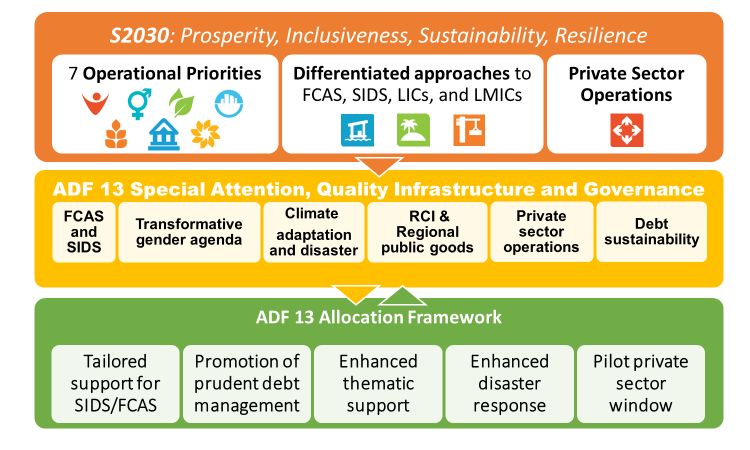
The figure below summarizes the linkages between Strategy 2030, the ADF 13 areas for special
attention, quality infrastructure and governance as cross-cutting-priorities, and how the strategic
directions are implemented through the proposed ADF 13 allocation framework.
Figure A2: Implementing Strategy 2030 with ADF 13
ADF = Asian Development Fund, FCAS = fragile and conflict-affected situations, LIC = low-income country,
LMIC = lower-middle-income country, RCI = regional cooperation and integration, S2030 = Strategy 2030, SIDS =
small island developing states.
Note: The enhanced thematic support will be provided by a single thematic pool addressing gender equality, climate
adaptation and disaster risk reduction, and RCI including regional public goods.
Source: Asian Development Bank.You can also read


