Alien scorpions in the Municipality of São Paulo, Brazil - evidence of successful establishment of Tityus stigmurus (Thorell, 1876) and first ...
←
→
Page content transcription
If your browser does not render page correctly, please read the page content below
BioInvasions Records (2018) Volume 7, Issue 1: 89–94
                             DOI: https://doi.org/10.3391/bir.2018.7.1.14
                                                                                                                 Open Access
                             © 2018 The Author(s). Journal compilation © 2018 REABIC

    Rapid Communication

Alien scorpions in the Municipality of São Paulo, Brazil – evidence of
successful establishment of Tityus stigmurus (Thorell, 1876) and first records
of Broteochactas parvulus Pocock, 1897, and Jaguajir rochae (Borelli, 1910)

Rogério Bertani 1, * , Rosiani Kakiuti Bonini 2 , Marisa Mayimi Toda 2 , Leandra Sayuri Isa 3 , Júlia Vono
Alvarez Figueiredo 3 , Miyuki Roberta dos Santos 4 and Sérgio Cominato Ferraz 3
1
  Laboratório Especial de Ecologia e Evolução, Instituto Butantan, Av. Vital Brazil, 1500, 05503-900, São Paulo, São Paulo, Brazil
2
  Subgerência de Prevenção, Monitoramento e Controle de Fauna Sinantrópica, Centro de Controle de Zoonoses de São Paulo,
  02031-020, Rua Santa Eulália, 86, São Paulo, São Paulo, Brazil
3
  Laboratório de Identificação e Pesquisa em Fauna Sinantrópica, Centro de Controle de Zoonoses de São Paulo, 02031-020, Rua
  Santa Eulália, 86, São Paulo, São Paulo, Brazil
4
  Supervisão de Vigilância em Saúde Penha, 03621-000, Rua Candapuí, 492, São Paulo, São Paulo, Brazil
Author e-mails: rogerio.bertani@butantan.gov.br (RB), rosiani@prefeitura.sp.gov.br (RKB), marisatoda@prefeitura.sp.gov.br (MMT),
leandrasayuri@prefeitura.sp.gov.br (LSI), juliavono@prefeitura.sp.gov.br (JVAF), mrobertasantos@prefeitura.sp.gov.br (MRS),
biolocus@gmail.com (SCF)
*Corresponding author
Received: 10 August 2017 / Accepted: 9 January 2018 / Published online: 27 January 2018
Handling editor: Luciano Neves dos Santos

Abstract
We report the successful introduction and invasion of the scorpion species, Tityus stigmurus (Thorell, 1876), in São Paulo
municipality, Brazil, more than 1,000 km from its southern-most record. The species has considerable impacts on human
health, because of its venomous sting. The first specimen appeared in 2012, and by the end of 2015, three populations were
identified, with 86 records so far. They were probably introduced via the fruit trade. Two other alien scorpion species were
recorded in São Paulo, including a single specimen of Broteochactas parvulus Pocock, 1897, and two specimens of Jaguajir
rochae (Borelli, 1910).
Key words: fruit trade, invasive species, synanthropic, venomous species

Introduction                                                              was introduced into England (Benton 1991) and
                                                                          Uruguay (Toscano-Gadea 1998), and Isometrus
Invasive alien species are a constant threat to the                       maculatus (De Geer, 1778) is now a pan-tropical
local biodiversity, economy, and human health (Elton                      species (Lourenço 2002). In Brazil, Tityus stigmurus
1958; Early et al. 2016). Some of these invasive                          (Thorell, 1876) was introduced in the island of
species are venomous animals, such as scorpions                           Fernando de Noronha (Freitas and Vasconcelos
(Benton 1991; Toscano-Gadea 1998; Freitas and                             2008). The parthenogenetic and medically important
Vasconcelos 2008). These arachnids are among the                          Tityus serrulatus (Lutz and Mello, 1922) has expan-
primary causes of human envenomation and are                              ded considerably from its original geographical
mostly distributed in tropical and subtropical regions                    distribution to the north and southern parts of Brazil.
of the world (Chippaux and Goyffon 2008). They are                        Single individuals as well as small to large popu-
easily transported to distant countries by human                          lations of T. serrulatus are found hundreds of
activities (Freitas and Vasconcelos 2008). However,                       kilometers away from its previously known geo-
successful introduction of scorpions is rarely                            graphic range (Eickstedt et al. 1996; Bortoluzzi et al.
recorded. Euscorpius flavicaudis (De Geer, 1778)                          2007; Rosa et al. 2015).

                                                                                                                                 89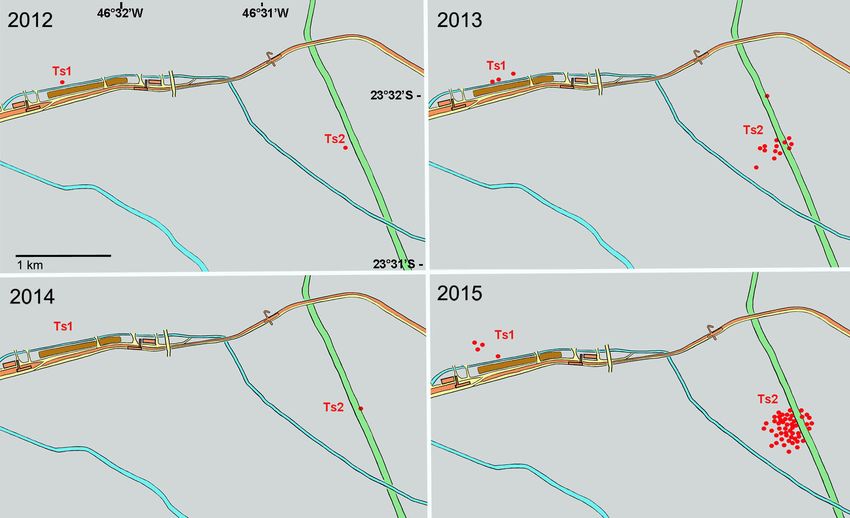
R. Bertani et al.

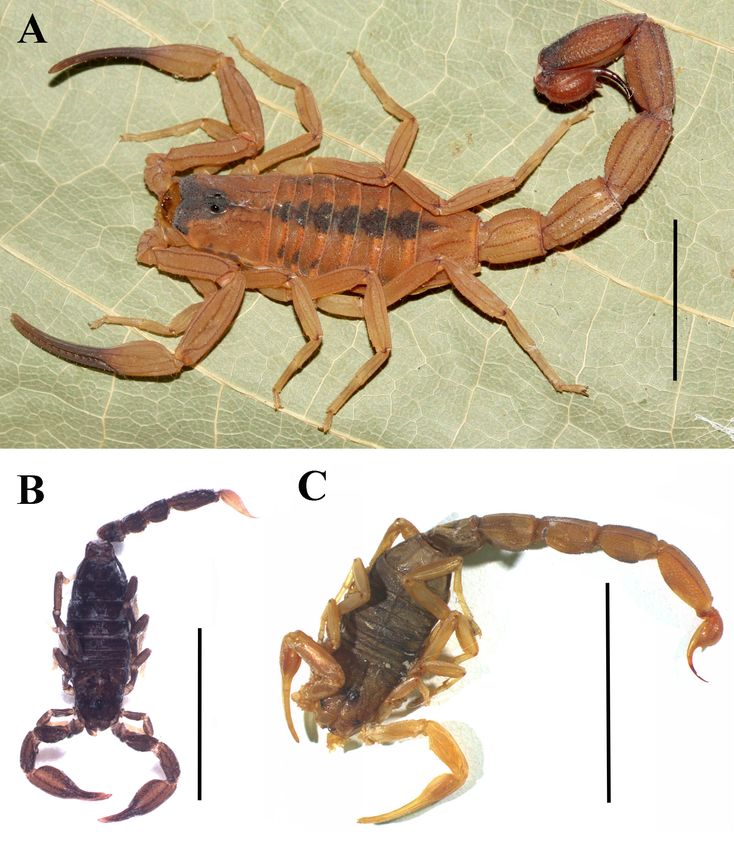
Figure 1. Alien scorpions collected in São
Paulo, state of São Paulo, Brazil. A: living
Tityus stigmurus (Thorell, 1876);
B: preserved Broteochactas parvulus
Pocock, 1897; C: preserved Jaguajir
rochae (Borelli, 1910). Scale bar = 10 mm.
Photos: R. Bertani.

   Herein, we report the successful introduction of        Garcia and Pirani 2005). The areas where T. stigmurus
Tityus stigmurus (Figure 1A), a medically important        (Figure 1A) specimens were found are highly urba-
species, originally distributed in the northeastern        nized (Figure 3).
parts of Brazil (Figure 2A), in three urban areas in
the Municipality of São Paulo, state of São Paulo,         Sampling and species identification
Brazil (Figure 2B). Records of the alien scorpions
                                                           Scorpion records were obtained from three sources
Broteochactas parvulus Pocock, 1897, and two
specimens of Jaguajir rochae (Borelli, 1910) in São        in the period between May/2012 to December/2015.
Paulo are also presented here (Figures 1B–C).              Either the scorpions were donated spontaneously by
                                                           the citizens to the CCZ – Centro de Controle de
                                                           Zoonoses (Center for Zoonosis Control), São Paulo
Material and methods                                       Municipality, state of São Paulo, Brazil, and SUVIS
                                                           – Supervisão de Vigilância em Saúde (Regionalized
Study site
                                                           Services of Health Surveillance), São Paulo Munici-
The municipality of São Paulo is one of the most           pality, State of São Paulo, Brazil, or the scorpions
densely populated regions in the world, with appro-        were collected by the municipality agents as a part of
ximately 12 million people living within a 1,521 km2       a larger anti-scorpion program carried out monthly
(IBGE 2016) area. It is a plateau, ca. 900 m asl, having   (CCZ), or as a result of requests by the population
originally a mosaic of open fields and Brazilian           for local inspection conducted by SUVIS. Specimens
Atlantic Forest. The region is also crossed by two         are deposited at the Coleção de Fauna Sinantrópica do
main rivers. Historically, there were important areas      Município de São Paulo, Labfauna, – Laboratório de
with riparian vegetation and swamps (Usteri 1911;          Identificação e Pesquisa em Fauna Sinantrópica

90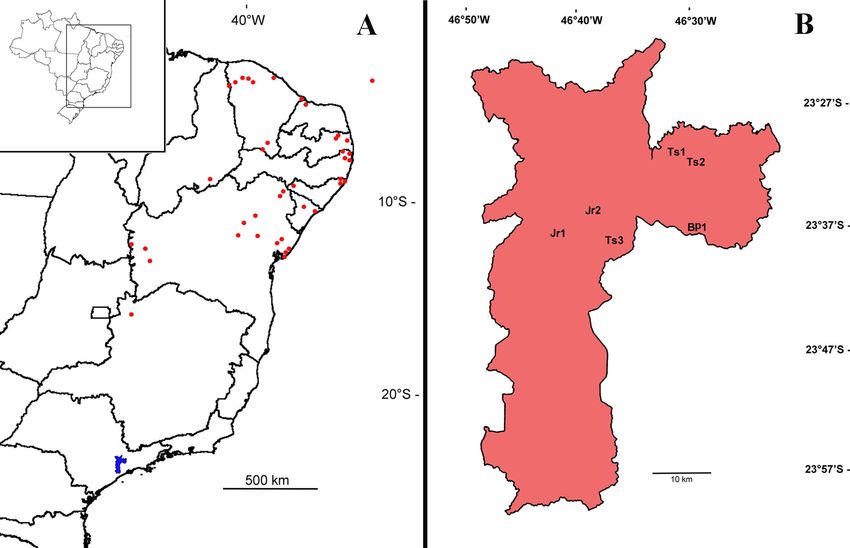
Alien scorpions in the Municipality of São Paulo, Brazil

    Figure 2. A: Map of Brazil showing published records for Tityus stigmurus (Thorell, 1876) (red dots) distribution and the location
    of the Municipality of São Paulo (blue). Records are based on Souza et al. (2009) and Santos et al. (2014). B: Map of the
    municipality of São Paulo indicating the records of alien Tityus stigmurus (Thorell, 1876) (Ts1-3), Jaguajir rochae (Borelli, 1910)
    (Jr1-2), and Broteochactas parvulus Pocock, 1897 (Bp1).

       Figure 3. Records of Tityus stigmurus (Thorell, 1876) (red dots) for two areas (Ts1 and Ts2) in the eastern region of São
       Paulo Municipality. The main streets and bridges are shown in yellow; the Metro and railway systems are in orange; the main
       rivers are in blue; the large empty area with low vegetation coverage and used for high voltage power towers is in green; and
       the anti-flood area is depicted in brown.

                                                                                                                                          91
R. Bertani et al.

(Laboratory for the Identification of and Research        to spring and beginning of summer) the records
into Synanthropic Fauna), CCZ, São Paulo Munici-          increased considerably (Table S2, Figure 3). In 2014,
pality, State of São Paulo, Brazil (CFS-SP, Marco         we had a single record of 3 specimens (Table S2,
Otávio de Matos Júnior). The specimens were               Figure 3). However, the following year, with a more
identified using the keys and diagnoses based on          intense search, we obtained 59 records of 138 speci-
Lourenço (2002).                                          mens, mostly from the pluvial system (Table S2,
                                                          Figure 3). Recently, in the first semester of 2015,
Results                                                   area Ts3 had two additional records.

Three species of non-indigenous scorpions were            Discussion
recorded for the first time in the São Paulo
Municipality: Broteochactas parvulus Pocock, 1897         Over the four-year study period, we compiled the
(Chactidae) (Figure 1B); Jaguajir rochae (Borelli,        records of scorpion species from two areas in the
1910) (Figure 1C), and Tityus stigmurus (Buthidae)        eastern Municipality of São Paulo. The increase in
(Figure 1A). A single specimen of Broteochactas           the number of collected specimens during this period
parvulus Pocock, 1897 was recorded in a house located     and the presence of females carrying young scorpions
in the extreme east of the municipality, close to a       in their dorsum suggest that T. stigmurus have
milk box which was recently brought from a market,        reproduced, providing evidence that this species is
in February 2012 (Figures 1B, 2B, Supplementary           already established in the regions Ts1–2.
material Table S1). Two specimens of J. rochae were          Tityus stigmurus is the second species of non-
found in central-southern São Paulo (Figures 1C,          indigenous Tityus to become established in the
2B) on November 29, 2010, and on June 3, 2013.            Municipality of São Paulo (after T. serrulatus Eickstedt
Both specimens were found in public schools, one          et al. 1996). Compared to the indigenous species,
individual was crawling inside the building and the       Tityus costatus (Karsch, 1879) and Tityus bahiensis
other was coming out of a recently opened box             (Perty, 1833), T. serrulatus is the most medically
containing melons (Table S1). There were 86 records       important species in Brazil, and has reached the
of T. stigmurus between May 8, 2012 and December          municipality after geographic distribution extension
16, 2015, totaling 180 specimens in the three areas       (Eickstedt et al. 1996). However, contrary to this
(Ts1–3) (Table S2).                                       species, the southernmost record of T. stigmurus was
   Specimens of areas Ts1 (N = 8) and Ts2 (N = 76)        ca. 1,000 km from São Paulo (Souza et al. 2009;
were recorded inside pluvial galleries (Ts1 = 37.5%,      Santos et al. 2014). Therefore, presumably it was
N = 3; Ts2 = 64.47%, N = 49), houses or backyards         introduced passively. Despite the local climate being
(Ts1 = 62.5%, N = 5; Ts2 = 19.74%, N = 15), public        significantly colder and more humid than that in its
schools (Ts2 = 10.53%, N = 8), or in other places         original habitat (northeastern parts of Brazil), the
(Ts2 = 5.26%, N = 4). In area Ts3, one specimen was       species thrived under these modified conditions. The
collected from a house and another from a pluvial         species is known to live in the urban areas in the
gallery. There was a bias towards pluvial galleries       northeastern parts of Brazil (Albuquerque et al. 2009)
since they are routinely inspected as part of the anti-   and its natural region of origin is not fully resolved.
scorpion program managed by CCZ and SUVIS.                The wide distribution showed by T. stigmurus in
   The T. stigmurus specimens (86 records) were           northeastern Brazil (Figure 2A) is definitely artificial,
either sent by citizens (Ts1 = 37.5%, N = 3; Ts2 =        reflecting the expansion, introduction, and adaptation
22.37%, N = 17) or collected by municipality agents       that allows the scorpions (for example T. serrulatus)
of the anti-scorpion program (CCZ, SUVIS) (Ts1 =          to live and reproduce in the neighboring urban areas
62.5%, N = 5; Ts2 = 77.63%, N = 59). The two              (Eickstedt et al. 1996). Their ability to survive
specimens in area Ts3 were collected by municipality      harnessing the perturbations of the environment is a
agents. Specimens in all developmental stages were        critical factor that facilitated the successful
found in areas Ts1 and Ts2.                               introduction of T. stigmurus in São Paulo. Similar to
   The first T. stigmurus specimen was recorded in        T. serrulatus, T. stigmurus is also parthenogenetic,
area Ts1, near a school in May 2012 (Figure 3). A         with a few recorded sexual populations (Ross 2010;
few months later (December 2012), another speci-          Santos et al. 2014). Hence, even a few individuals
men was recorded inside a school, but 2.5 km away         can successfully establish a new population.
from the first area (Ts2) (Figure 3). We revisited           The record of three distinct populations of Tityus
areas Ts1 and Ts2 in 2012 but no additional               stigmurus raises the question as to whether this
specimens were found. Other records appeared in the       species was introduced once or in three independent
beginning of 2013. In the second semester (late winter    events. The more recent record (Ts3) in central-

92
Alien scorpions in the Municipality of São Paulo, Brazil
southern São Paulo suggests that it was an inde- References
pendent event, since the distance to the other records
Albuquerque CMR, Barbosa MO, Iannuzzi L (2009) Tityus stigmurus
(Ts1 and Ts2) in the eastern region (ca. 14 km in (Thorell, 1876) (Scorpiones: Buthidae): response to chemical
straight line) was significant. On the other hand, the control and understanding of scorpionism among the population.
two areas in the eastern region were separated by Revista da Sociedade Brasileira de Medicina Tropical 42:
only 2.5 km (shortest distance), which suggests the 255−259, https://doi.org/10.1590/S0037-86822009000300004
Benton TG (1991) The life history of Euscorpius flavicaudis
possibility of a single introductory event. However, (Scorpiones, Chactidae). The Journal of Arachnology 19:
we did not find any specimen in the region between 105−110. http://www.americanarachnology.org/JoA_free/JoA_v19_n2%
the two areas, despite several attempts, reinforcing 20/JoA_v19_p105.pdf (accessed 11 December 2017)
the hypothesis of distinct introductions. The origin Bortoluzzi LR, Querol MVM, Querol E (2007) Notas sobre a
ocorrência de Tityus serrulatus Lutz & Mello, 1922 (Scorpiones,
of the specimens is presumably the northeastern part Buthidae) no oeste do Rio Grande do Sul, Brasil. Biota
of Brazil, an area known for the presence of this Neotropica 7, https://doi.org/10.1590/S1676-06032007000300036
species (Figure 2A). An underlying factor common Chippaux JP, Goyffon M (2008) Epidemiology of scorpionism: a
to all records (except area Ts3, but including J. global appraisal. Acta Tropica 107: 71−79, https://doi.org/10.1016/
j.actatropica.2008.05.021
rochae records) is trade, specifically the routes of Early R, Bradley BA, Dukes JS, Lawler JJ, Olden JD, Blumenthal
fruit trade. The two J. rochae specimens were both DM, Gonzalez P, Grosholz ED, Ibañez I, Miller LP, Sorte CJB,
found in schools, and one of them was coming out of Tatem AJ (2016) Global threats from invasive alien species in
the twenty-first century and national response capacities. Nature
a box of melons. One of the main areas of melon Communications 7: 12485, https://doi.org/10.1038/ncomms12485
production in Brazil is the northeastern region, Eickstedt VRD, Ribeiro LA, Candido DM, Albuquerque MJ, Jorge
which is inhabited by J. rochae. The same region is MT (1996) Evolution of scorpionism by Tityus bahiensis (Perty)
also within the native range of T. stigmurus. The two and Tityus serrulatus Lutz and Mello and geographical
distribution of the two species in the state of São Paulo- Brazil.
first records in areas Ts1 and Ts2, were inside or Journal of Venomous Animals and Toxins 2, https://doi.org/10.
close to schools, which normally receive fruits from 1590/S0104-79301996000200003
government programs for student nutrition. The trade Elton CS (1958) The Ecology of Invasions by Animals and Plants.
of fruits is an important route via which international Methuen, London, England, 181 pp, https://doi.org/10.1007/978-1-
4899-7214-9
alien spider transport occurs (Vetter et al. 2014); Freitas GCC, Vasconcelos SD (2008) Scorpion fauna of the island of
therefore, it is likely that the same route could be Fernando de Noronha, Brazil: first record of Tityus stigmurus
attributed to the introduction of T. stigmurus in São (Thorell 1877) (Arachnida, Buthidae). Biota Neotropica 8,
https://doi.org/10.1590/S1676-06032008000200019
Paulo. Garcia RJF, Pirani JR (2005) Análise florística, ecológica e fitogeo-
São Paulo Municipality now has three Tityus species gráfica do Núcleo Curucutu, Parque Estadual da Serra do Mar
(T. bahiensis, T. serrulatus, and T. stigmurus), which (São Paulo, SP), com ênfase nos campos junto à crista da Serra
pose considerable medical concern. This information do Mar. Hoehnea 32: 1−48, http://arquivos.ambiente.sp.gov.br/hoehnea/
2016/12/321_T01_24_07_2015-2.pdf (accessed 11 December 2017)
must be broadly shared with the local medical care IBGE – Instituto Brasileiro de Geografia e Estatística (2016)
institutions so that they can identify T. stigmurus http://cod.ibge.gov.br/493 (accessed 25 October 2016)
specimens and treat their envenomation cases. Our Lourenço WR (2002) Scorpions of Brazil. Les Éditions de I’If, Paris,
findings show that Tityus stigmurus colonizes urban France, 306 pp
Rosa CM, Abegg AD, Borges LM, Bitencourt GSS, Di Mare RA
areas with very distinct climate from its indigenous (2015) New record and occurrence map of Tityus serrulatus
geographical distribution, it can be considered an Lutz & Mello, 1922 (Scorpiones, Buthidae) in the state of Rio
invasive species, and immediate control actions must Grande do Sul southern Brazil. Check List 11: 1556, https://doi.
org/10.15560/11.1.1556
be implemented after its first appearance. Ross LK (2010) Confirmation of parthenogenesis in the medically
significant, synanthropic scorpion Tityus stigmurus (Thorell,
Acknowledgements 1876) (Scorpiones: Buthidae). Revista Ibérica de Aracnologia
18: 115−121. http://sea-entomologia.org/Publicaciones/RevistaIberica
We thank the teams of “Vigilância em Saúde Ambiental Penha”, Aracnologia/RIA18/115-122NBrevePartenogenesisTityus.pdf (accessed
“Supervisão Técnica de Saúde Penha”, and the municipality agents 11 December 2017)
and the municipality zoonosis agents of “Centro de Controle de Santos MDS, Porto TJ, Lira-da-Silva RM, Brazil TK (2014)
Zoonoses” and from “SUVIS Penha”, for participating in the search Description of the male of Tityus kuryi Lourenço, 1997 and
and collection of the scorpions. The labfauna – CCZ team are notes about males of Tityus stigmurus (Thorell, 1877) and Tityus
thanked for their crucial support in completion of this work. serrulatus Lutz & Mello, 1922 (Scorpiones, Buthidae). Zookeys
“SUVIS Jabaquara-Vila Mariana”, “SUVIS Ipiranga”, “SUVIS Lapa- 435: 49−61, https://doi.org/10.3897/zookeys.435.6694
Pinheiros”, “SUVIS Vila Prudente-Sapopemba” and the teams of Souza CAR, Candido DM, Lucas SM, Brescovit AD (2009) On the
“Vigilância em Saúde Ambiental” are thanked for participating in Tityus stigmurus complex (Scorpiones, Buthidae). Zootaxa
scorpion collection and support, especially Giuliano Chieco 1987: 1−38
Ribeiro, Neide Satie Takahashi, Sérgio Luis Batisttini and Silvia Toscano-Gadea CA (1998) Euscorpius flavicaudis (de Geer, 1778) in
dos Santos Gorrão. Marco Otávio de Matos Júnior is thanked for Uruguay: first record from the New World. Newsletter of the
providing a repository for the specimens. Two anonymous British Arachnological Society 81: 6
reviewers are thanked for improving the manuscript. Support: Usteri A (1911) Flora der Umgebung der Stadt São Paulo. G.
Fapesp 2015/19976-3 and CNPq reasearch fellow for RB. Fischer, Jena, Germany, 271 pp
93R. Bertani et al.
Vetter RS, Crawford RL, Buckle DJ (2014) Spiders (Araneae) found American arachnologists for identification. Journal of Medical
in bananas and other international cargo submitted to North Entomology 51: 1136−1143, https://doi.org/10.1603/ME14037
Supplementary material
The following supplementary material is available for this article:
Table S1. Jaguajir rochae (Borelli, 1910) (Jr) and Broteochactas parvulus Pocock, 1897 (Bp) records (specimens) in São Paulo
Municipality.
Table S2. Tityus stigmurus (Thorell, 1876) records (specimens) from 2012 to 2015 in three areas (Ts1, Ts2, and Ts3) in São
Paulo Municipality.
This material is available as part of online article from:
http://www.reabic.net/journals/bir/2018/Supplements/BIR_2018_Bertani_etal_SupplementaryTables.xlsx
94You can also read


