IT Operations analytics redefined: uncovering business impact and opportunities with Application Analytics - Harnessing application intelligence ...
←
→
Page content transcription
If your browser does not render page correctly, please read the page content below
An AppDynamics Business White Paper

                                      IT Operations analytics
                                      redefined: uncovering
                                      business impact and
                                      opportunities with
                                      Application Analytics
                                      Harnessing application intelligence to reconcile ever-
                                      increasing user expectations and ever-more-complex
                                      and dynamic application environments.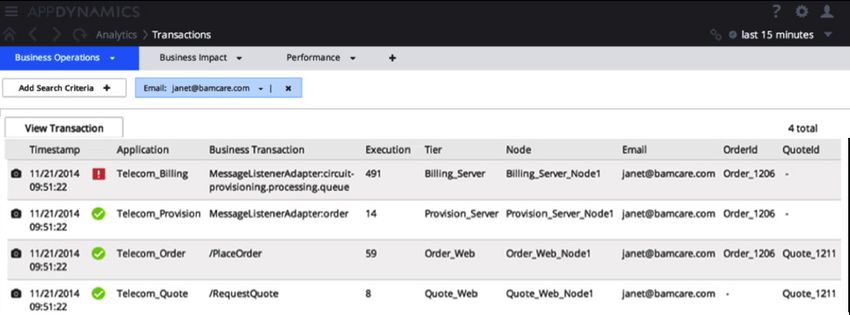
The business world is in the midst of a dramatic transformation, and IT is at the
                                                             center of it. Enterprises increasingly depend on software across all parts of their
                                                             operations. More and more, businesses don’t simply run on software, but are in fact
                                                             defined by software. Every time we deposit a check using our bank’s mobile app,
                                                             every time we watch a streaming movie on our TV, every time we buy gifts online
                                                             from our favorite retailer, it’s software in action. And that means IT has moved
                                                             front and center, responsible for the health of operations, and now also holding the
                                                             keys to a treasure trove of data that can guide not only the smooth functioning of
                                                             systems and applications, but also the success of the businesses they support.

                                                             Unlike previous technology-driven transformations, this is a paradigm shift driven
                                                             largely by customers, and powered by mobility and the cloud. Never before in the
                                                             history of IT have customers so leveraged their own technology choices to drive
                                                             how they engage with the businesses that serve them and the enterprises with
                                                             which they choose to interact. As consumers, our experience with the Facebooks,
                                                             Googles, Twitters, and Ubers of the world have raised the bar for performance at
                                                             scale for all other organizations. End-user expectations have never been higher.

                                                             To serve these ever-increasing expectations, today’s IT environments are dynamic,
                                                             complex , and no longer contained within the walls of the enterprise. The rise of cloud
                                                             computing has scattered IT resources, sometimes around the globe, increasing the
                                                             complexity and inherent risks of the now-distributed infrastructure. Gluing all this
                                                             technology together is the API economy, extending the principles of service-oriented
                                                             architecture to the cloud, mobile devices and applications, and ultimately, to the
                                                             growing host of connected devices insinuating themselves into every part of daily life.

                                                             Simultaneously maintaining control over this complexity and delivering amazing
                                                             user experiences at the speed of “now” is the crux of the challenge IT faces today.

                                                             Application Intelligence to the rescue
                                                             To get a grip on what’s happening for the end user and throughout their now-
                                                             highly complex, highly distributed application environments, enterprises and their IT
                                                             departments are exploring new ways to leverage the operational as well as business
                                                             data processed by their application ecosystem. By unlocking insights hidden in this
                                                             data, both IT and business can collaborate to respond to fickle user preferences and
                                                             deliver winning experiences.

                                                             First task at hand is to collect the data itself. Numerous dedicated technologies
                                                             are used to collect data from machines -- applications, servers, databases, devices,
                                                             and even wire data flowing through the network. In many cases previously
                                                             available log files are used, but in other cases, the data collection technology has
                                                             to understand where to look for the relevant data. But as the number of systems,
                                                             devices, and networks under management grows, so too do the quantity and
                                                             variety of log files and other data. Such information is difficult to manage in a
                                                             fragmented IT organization, and at best provides only static views of increasingly
                                                             dynamic environments.

Beyond IT operations analytics: uncovering business impact                                                                                          2
and opportunities with Application Analytics
In an attempt to consolidate and harvest value from this data, a new discipline has
                                                             emerged: IT Operations Analytics (ITOA), which Gartner defines as “processes and
                                                             technologies that support the automated generation of insights from data for IT
                                                             system behaviors, states, configuration, problems, and incidents.”

                                                             Now with the help of ITOA, IT has a greater understanding than ever before about
                                                             what is happening in its domain. But current generation ITOA still is hamstrung by
                                                             the fundamental way the data is framed: it still looks at unstructured or machine-
                                                             generated log data as the primary unit of analytics, when what is more relevant and
                                                             of value is the user-generated business transaction.

                                                             This legacy perspective is not surprising, because it’s typically been an arduous task
                                                             to parse huge volumes of data to reconstruct the business context. But unless that
                                                             data is able to answer questions that are relevant to the business — to understand
                                                             revenue impacts, user behaviors, anomalies that can become opportunities (user
                                                             tiers, gender, time of day, etc., etc.) — it’s just another set of application performance
                                                             metrics, the utility of which doesn’t go far past the walls of the IT department.

                                                             What ops and business personnel need is a holistic view of all the available
                                                             management information, so they can effectively correlate application metrics
                                                             and the operational and business impacts of any issues anywhere in their
                                                             fragmented production environments. This parsed and consolidated data can be
                                                             interpreted and used in the decision-making process to give the broader business
                                                             a substantial competitive advantage over firms that are unable to leverage this
                                                             critical application insight.

                                                             Introducing Application Analytics
                                                             AppDynamics has developed a powerful new solution to address this huge data
                                                             challenge and opportunity through its Application Analytics offering. AppDynamics
                                                             collects this data from the application and processes it in real-time so organizations
                                                             can get up to the minute views into the health of the software defined businesses.
                                                             With Application Analytics, customers can automatically extract the data associated
                                                             with each transaction flowing through their application and propagate business
                                                             context without having to worry about coding to logs.

                                                             Application Analytics provides insight into business outcomes by combining
                                                             pattern discovery, root cause analysis of problems, and anomaly detection against
                                                             ‘in-flight’ transactions. Not only is data collection automated via distributed,
                                                             code instrumentation agents, but the data processing is fast and scalable, and
                                                             finally, people can view and take action on the resulting analysis via sophisticated
                                                             visualization techniques that present information with a business context.
                                                             Because of this built-in business context, Application Analytics provides high-value
                                                             information to decision-makers across the organization, pulling together a full
                                                             spectrum of data ranging from user behaviors and their data, system behaviors,
                                                             states, and configurations to problems and incidents.

Beyond IT operations analytics: uncovering business impact                                                                                            3
and opportunities with Application Analytics
Analytics-ready data sets with built-in business context
                                                             Application Analytics runs on the AppDynamics Application Intelligence Platform.
                                                             This platform focuses on the business transaction as the primary unit of measure
                                                             — it provides real-time visibility into each user interaction, each click-through from
                                                             the web tier all the way to the database. This single platform seamlessly connects
                                                             business and IT priorities with a real-time big data analytics architecture, a key
                                                             requirement for today’s software-driven business. At the core of this platform is
                                                             AppDynamics’ application intelligence technology that automatically records every
                                                             transaction end-to-end across the entire distributed environment — with low
                                                             overhead and no custom coding required.

                                                             Purchase transactions are among the most obvious and important, but other
                                                             examples of business transactions include logging into the website or mobile app,
                                                             signing up for a newsletter, submitting information on a form, or posting via social
                                                             media. By leveraging the Application Intelligence Platform’s ability to automatically
                                                             discover and group these distributed business transactions, Application Analytics
                                                             automatically propagates business context without requiring code changes, and
                                                             maintains it over time even as applications change, saving a huge amount of
                                                             programming effort and time.

                                                             Application Analytics helps illuminate the drivers behind any number, including
                                                             answers to both business and operations questions — for example: real-time
                                                             information about behavior of different customer tiers, what purchases customers
                                                             are making, and how they are combining various technology touchpoints to interact
                                                             with the enterprise.

Beyond IT operations analytics: uncovering business impact                                                                                            4
and opportunities with Application Analytics
Customer use cases                                           Customer use cases
1.    Business impact analytics
                                                             AppDynamics customers are using Application Analytics to address a range of
2.    Business operations monitoring                         business and technical challenges. Here are some examples.
3.    Customer analytics
                                                             Business impact analytics
4.    Performance analytics
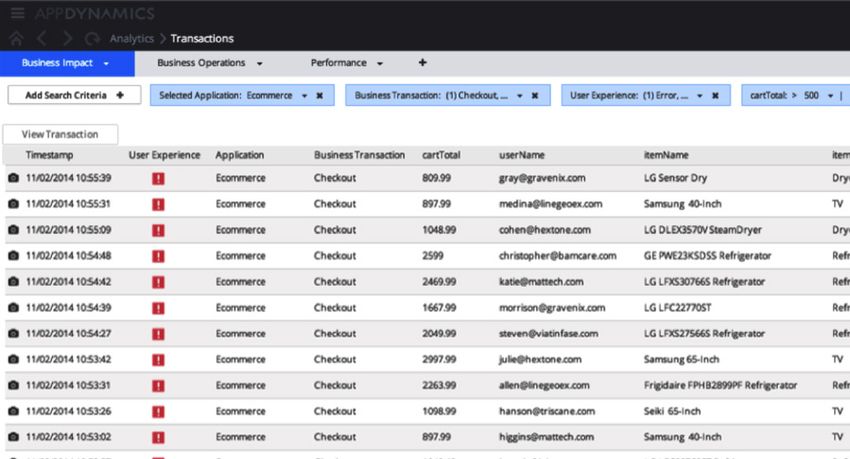
                                                                In action: The checkout function errored for a large group of customers
5.    SLA management
                                                                who had filled their shopping carts — an expensive application failure for
                                                                any online retailer. With Application Analytics, not only are all the affected
                                                                customers identified, but the contents of their shopping carts are captured
                                                                as well. Spreadsheet-friendly reports are generated for the marketing team,
                                                                who quickly puts together a win-back campaign that puts the items back in
                                                                the carts, automatically includes a 10% discount, and notifies all the affected
                                                                customers. A good portion of sales are recovered, and the negative impact of
                                                                the outage has been mitigated.

                                                             Perhaps the most important type of question business personnel can ask of IT
                                                             operations is how a technical problem impacts the business. For example, how
                                                             much revenue is being lost as the result of a system outage? Which customers were
                                                             affected by an outage or slowdown?

                                                             In those situations where there is a complete outage, Application Analytics is able
                                                             to identify the affected users with incomplete transactions, and then provide
                                                             information to the marketing team so that they can put a re-engagement plan into
                                                             effect to assuage and win back disgruntled customers. In such damage control
                                                             situations, it’s important to see details about every error and report back with the
                                                             information the business needs to recoup lost revenue and goodwill. This type of
                                                             resolution is not possible with traditional business intelligence that works only off
                                                             of data stored in the operational database where only completed transactions are
                                                             recorded. The operational database is unaware of such in-flight transactions; hence
                                                             the need for a modern, real-time solution.

Beyond IT operations analytics: uncovering business impact                                                                                           5
and opportunities with Application Analytics
Customer use cases Business operations monitoring
1. Business impact analytics
In action: A customer calls into a telecom provider to take advantage of
2. Business operations monitoring a promotion and order deluxe TV and Internet service. She works out her
package with the customer rep, sets up installation, and is told a confirmation
3. Customer analytics
email will be sent. Three days later, no email. With Application Analytics,
4. Performance analytics when the new customer calls back in, her order can be found wherever it is
in the system using any number of criteria — order number, email address,
5. SLA management phone number, etc. The rep can quickly identify where the order stalled and
get it back on its way.
In many organizations, critical business transactions are part of complex business
processes that span multiple applications on multiple systems as well as human-
powered steps. It is essential for businesses to monitor such processes in-flight
to understand where a particular transaction resides and if there is a problem
completing any step of the transaction as expected.
Application Analytics enables organizations to find lost or compromised customer
requests across the end-to-end transactional environment for even the most
complex processes. Sometimes a lost or missing transaction is due to a software
bug or infrastructure issue, while in other cases, it could be due to bad data (an
incorrect zip code, for example). Application Analytics can differentiate among
various causes, empowering customer service or technical support to address the
problem with the customer quickly.
Application Analytics also enables visibility across all business transactions in
progress, providing an ordered list of such transactions, as well as other critical
operational insight into the health of business operations.
Beyond IT operations analytics: uncovering business impact 6
and opportunities with Application AnalyticsCustomer use cases Customer analytics
1. Business impact analytics
In action: At a company offering an online project management system,
2. Business operations monitoring
marketing believes that smaller customers with 25 employees or less are not
3. Customer analytics using the forecasting module because they aren’t taking the time to learn it.
Through Application Analytics, they identify those small companies who have
4. Performance analytics accessed the forecasting module less than once a week in the past quarter,
and target them for a special online training promotion.
5. SLA management
Application Analytics provides vital insight into the day-to-day behavior of
customers – even when everything is working perfectly. For example, Application
Analytics answers questions such as “which customers have used product X the
most in the past week?” or “how do conversion rates compare between type X and
type Y customers?”
Application Analytics helps business managers understand both aggregate and
detailed customer usage patterns, empowering them to make data-driven business
decisions. As the business continues to augment and refine the digital experience,
such customer visibility becomes critically important for identifying what works well
and what doesn’t, and why.
Beyond IT operations analytics: uncovering business impact 7
and opportunities with Application AnalyticsCustomer use cases Performance analytics
1. Business impact analytics
In action: The marketers at a major e-commerce company have determined
2. Business operations monitoring
that high-value customers with cart averages of $500+ are absolutely critical
3. Customer analytics to their revenue projections. So it’s imperative that those customers have
an exceptional experience. With the help of Application Analytics, they are
4. Performance analytics able to separate out those customers, see their experience plotted visually,
and zero in on those transactions falling outside the 95th percentile — the
5. SLA management slowest 5%, in other words — and proactively troubleshoot and correct those
slowdowns to keep them from affecting more customers, thereby protecting
the revenue stream from this highly valuable customer segment..
Every digital professional realizes how closely tied technical performance and
business performance are in today’s customer-driven world. Technology consumers
– both at work and elsewhere – expect fast, responsive interactions from all of their
technology touchpoints. If your web site or mobile app is a fraction of a second too
slow, customers will switch to your competitor and leave you bad reviews to boot.
These stringent customer expectations are why performance analytics is such an
important part of the Application Analytics value proposition. Business users, for
example, can get answers to questions such as “which transactions were above
the 95th percentile response time?” or “which customers were impacted by certain
poorly performing transactions?”
For slowdowns, the platform identifies which transactions are affected and enables
rapid root cause analysis. In many cases, AppDynamics can also fix the issue
automatically, without human intervention.
Performance impacts customer behavior at every step of the purchase funnel,
from the initial encounter, to search, to shopping cart interactions, to checkout.
Substandard performance at any step in this funnel means lost customers and
abandoned carts. While retail e-commerce is the most common example, the same
principles apply to any business transaction across all industries.
Beyond IT operations analytics: uncovering business impact
and opportunities with Application AnalyticsCustomer use cases SLA management
1. Business impact analytics
In action: A major financial institution has an agreement with a tier one
2. Business operations monitoring customer to execute its transactions within certain time constraints. Using
Application Analytics, the financial institution’s operations team creates
3. Customer analytics
a dashboard for the account leader, so she can see that transactions are
4. Performance analytics being completed within the target timeframes and continuously safeguard
the customer’s experience. Often times, the delays are a result of third-
5. SLA management party services that this bank’s service relies on. If outlier transactions occur
because of external dependencies, the ops team can quickly drill down to
see who was impacted, discover root cause, and quickly remediate with the
partner, minimizing customer impact.
The final use case for Application Analytics is management of service-level
agreements. Whichever side of the the SLA one is on — the enterprise making the
performance promise, or the one receiving the guarantee — an SLA is only as good
as the collection and reporting of the data that governs it.
It’s not untypical for multiple third parties to contribute to a single customer
interaction. In these cases, an enterprise will have contracts with those outside
parties that include SLAs that specify response times or other requirements for
third-party services.
Beyond IT operations analytics: uncovering business impact
and opportunities with Application AnalyticsWhen a third-party service slows down a transaction, all the customer sees is poor
performance that is attributed to the primary brand, not the third party. Operations
staff must monitor in real-time whether each business partner (or group of business
partners) is meeting their SLAs.
Conversely, as in the action example above, an enterprise may have SLAs that they
need to honor to protect relationships with key customers and ensure that they are
delivering an outstanding experience.
In either case, Application Analytics delivers real-time insight into the performance
of business transactions governed by SLAs, so action can be quickly taken when
one is undermining overall performance, and reports incidents where performance
thresholds have not been met over time, so underlying issues can be addressed.
AppDynamics – The Leader in Application Intelligence
In today’s digital world, the business and technology contexts for business operations
increasingly overlap. For the software-driven business, the business context makes IT
Try it FREE at operations personnel more effective and better aligned with the business. Correspondingly,
appdynamics.com the IT operations context drives the efficacy, influence, and power of business operations.
Application Analytics is designed to deliver the vital real-time business visibility, in context,
that empowers both IT and business teams to reach and exceed their performance goals.
AppDynamics, Inc. Copyright © 2014 AppDynamics, Inc. All rights reserved. The term
APPDYNAMICS and any logos of AppDynamics are trademarked or
appdynamics.com registered trademarks of AppDynamics, Inc.You can also read


