Annual Update for Developing the 2021-22 Local Control and Accountability Plan - Portola Middle School
←
→
Page content transcription
If your browser does not render page correctly, please read the page content below
California Department of Education
January 2021

Annual Update for Developing the 2021-22 Local Control and Accountability
Plan
Annual Update for the 2019–20 Local Control and Accountability Plan Year
Local Educational Agency (LEA) Name                Contact Name and Title                              Email and Phone

Portola Charter Middle School (PCMS)               Jennifer Yoo, Principal                             jyoo2@lausd.net
                                                                                                       (818) 654-3300

The following is the local educational agency’s (LEA’s) analysis of its goals, measurable outcomes and actions and services from the
2019-20 Local Control and Accountability Plan (LCAP).

Goal 1

PROFICIENCY FOR ALL

State and/or Local Priorities addressed by this goal:

State Priorities: Priority 2 (Implementation of State Standards), Priority 4 (Pupil Achievement), Priority 5 (Pupil Engagement), Priority 7
(Course Access)
Local Priorities:

                                                                                                                                     Page 1
Annual Measurable Outcomes
Expected Actual
● Due to the impact of Covid 19 and remote learning, the
2019-2020 SBAC was cancelled and actual measurable
outcome is not available.
Smart Balanced Assessment Consortium (SBAC) Assessment ● During the 2019-2020 school year, due to the impact of
English Language Arts Proficiency Rate COVID-19 and remote instruction, the annual SBAC for
All Students 56% Language Arts was not administered. Departments used
informal assessments per teacher to assess student
Reclassified Fluent English Proficient Students (RFEP) 45% progress. Teachers used observation measures on Zoom
English Learners 4% to track student engagement and participation during
Foster Youth N/A class and online assignments. Our teachers and
Low-Income Students 41% administration attended the district provided Future Ready
Latino Students 36% Training, and many received Future Ready certification.
ELA and math teachers administered informal
African-American Students 26% assessment tools on digital platforms provided by the
Students with Disabilities 17% district.
● In lieu of SBAC in 20-21, ELA and math informal formative
Renaissance assessments were administered three times
this year to monitor student progress.
Smart Balanced Assessment Consortium (SBAC) Assessment Smart Balanced Assessment Consortium (SBAC) Assessment
Mathematics Proficiency Rate Mathematics Proficiency Rate - Based on 2018-2019 Data
All Students 52%
Reclassified Fluent English Proficient Students (RFEP) 42% ● Due to the impact of Covid 19 and remote learning, the
2019-2020 SBAC was cancelled and actual measurable
English Learners 6% outcome is not available.
Foster Youth N/A ● During the 2019-2020 school year, due to the impact of
Low-Income Students 36% COVID-19 and remote instruction, the annual SBAC for
Latino Students 29% Language Arts was not administered. Departments used
African-American Students 26% informal assessments per teacher to assess student
progress. Teachers used observation measures on Zoom
Page 2Students with Disabilities 52% to track student engagement and participation during
class and online assignments. Our teachers and
administration attended the district provided Future Ready
Training, and many received Future Ready certification.
Towards the end of the year, these teachers along with
their grade levels began to implement informal
assessment tools on digital platforms provided by the
district. Some of these platforms that focused on
Language Arts include Schoology, Google Slides, and
Google Classroom applications.
● In lieu of SBAC in 20-21, ELA and math informal formative
Renaissance assessments were administered three times
this year to monitor student progress.
ELPAC Scores Level 4 percentage ELPAC Scores Level 4 percentage
Level 4 - 24.7% Level 4
Level 3 - 39.7% Level 3
Level 2 - 16.1% Level 2
Level 1 - 23.6% Level 1
Actions / Services
Planned Budgeted
Actual Expenditures
Action/Service Expenditures
1. District has allocated the following general fund staffing and resources to 5,163,128 5,163,128
the school, based on the schools enrollment and/or other factors, LCFF LCFF
necessary for administering and implementing the schools core 1000-1999 Certificated 1000-1999 Certificated
educational programs and services as well as operating the school: Salaries, 40 Teachers, Salaries, 40 Teachers,
● 1 Principal
● 40 Teachers 3 Counselors, 1 3 Counselors, 1
● 3 Counselors Principal, Day to Day Principal, Day to Day
● Day to Day Subs subs, Tchr Activity Diff, subs, Tchr Activity Diff,
● Advisor Reg Prep Advisory Reg Prep Advisory Reg Prep
● Tchr Activity Diff
● General Supplies 49,413 49,413
● IMA
Page 3● SAA LCFF LCFF
● 2 Office Techs 4000-4999 4000-4999 Instructional
● 2 Senior Office Techs Instructional Materials, Materials, General
● Clerical subs General Supplies Supplies
88,767 88,767
LCFF LCFF
2000-2999 Classified 2000-2999 Classified
Salaries; Sch Salaries; Sch
Administrative Administrative Assistant
Assistant
2,528 2,528
LCFF LCFF
2000-2999 Classified 2000-2999 Classified
Salaries; Clerical Subs Salaries; Clerical Subs
141,526 141,526
LCFF LCFF
2000-2999 Classified 2000-2999 Classified
Salaries; Senior Office Salaries; Senior Office
Techs Techs
138,628 138,628
LCFF LCFF
2000-2999 Classified 2000-2999 Classified
Salaries; Office Techs Salaries; Office Techs
2. See LAUSD LCAP. 462,878 462,878
The District has allocated the following staffing and resources to the LCFF LCFF
school necessary for administering and implementing the schools core 1000-1999 Certificated 1000-1999 Certificated
educational programs and services for students with disabilities: Salaries; Salaries;
Page 4● SpEd-Resource Specialist Prog SpEd-Resource SpEd-Resource
● SpEd-Special Day Program Specialist Prog Specialist Prog
● SpEd-Assistants-Moderate To Se
● SpEd-Assistants 571,725 571,725
● Occupational & Physical
● Visual Services Program LCFF LCFF
● Adapted Physical Education Pro 1000-1999 Certificated 1000-1999 Certificated
● Deaf & Hard of Hearing Program Salaries, SpEd-Special Salaries, SpEd-Special
● Speech & Language Program Day Program Day Program
● Inclusion Facilitator Program
● SPED-SCHOOL ALLOC-COMPLIANCE
1,100,771 1,100,771
LCFF LCFF
2000-2999 Classified 2000-2999 Classified
Salaries, Salaries,
SpEd-Assistants SpEd-Assistants
and SpEd Assistants and SpEd Assistants
Moderate To Severe Moderate To Severe
71,907 71,907
LCFF LCFF
1000-1999 Certificated 1000-1999 Certificated
Salaries, Adapted Salaries, Adapted
Physical Education Pro Physical Education Pro
47,269 47,269
LCFF LCFF
1000-1999 Certificated 1000-1999 Certificated
Salaries, Occupational Salaries, Occupational
and Physical Therapy and Physical Therapy
Program Program
8,655 8,655
Page 5LCFF LCFF
1000-1999 Certificated 1000-1999 Certificated
Salaries, Visual Salaries, Visual
Services Program Services Program
123,969 123,969
LCFF LCFF
1000-1999 Certificated 1000-1999 Certificated
Salaries, Speech and Salaries, Speech and
Language Language
7,573 7,573
LCFF LCFF
1000-1999 Certificated 1000-1999 Certificated
Salaries; Salaries;
Deaf & Hard of Deaf & Hard of Hearing
Hearing Program Program
30,394 30,394
LCFF LCFF
1000-1999 Certificated 1000-1999 Certificated
Salaries; Salaries;
Inclusion Facilitator Inclusion Facilitator
Program Program
4,920 4,920
LCFF LCFF
1000-1999 Certificated 1000-1999 Certificated
Salaries; Salaries;
SPED School SPED School
Alloc-compliance Alloc-compliance
Page 63. Classified Salaries $0 $0
Additionally, for English Learners, Youth, and Low Income, the school will: LCFF LCFF
● Provide all English Learners, Foster Youth, and Low-Income 2000-2999 Classified 2000-2999 Classified
students with need- appropriate interventions to support access to Salaries Salaries
the core curriculum. Provide after-school tutoring to target student
growth.
4. Provide 2 Generic Assistant Principals and an Assistant Principal, 315,312 315,312
Secondary Counseling Services to assist targeted students to meet LCFF LCFF
grade-level standards in all academic areas and monitor progress through
1000-1999 Certificated 1000-1999 Certificated
data analysis. . Salaries; LAUSD Salaries; LAUSD
Program 10552 Program 10552
5. Teacher Tutor time: $0 $0
EL, low income, and foster youth student to ensure accurate monitoring Federal Revenues - Federal Revenues -
and intervention programs designed for our students. School Plan for Title I Title I
Student Achievement 1000-1999 Certificated 1000-1999 Certificated
Salaries; Teacher tutor Salaries; Teacher tutor
fund 7T197 fund 7T197
6. Purchase a fully credentialed Physical Education teacher to insure the $0 $0
psychomotor development of our students. We are proponents of the LCFF LCFF
notion that a healthy and physically fit body is necessary for learning. 1000-1999 Certificated 1000-1999 Certificated
Salaries; Program Salaries; Program
13723 13723
7. Provide 2 Teacher's Assistants to lead focused small group interventions $0 $0
for LEP students that have been identified through the School support LCFF LCFF
and Progress Team (SSPT) and teacher referrals. 2000-2999 Classified 2000-2999 Classified
Salaries; Teaching Salaries; Teaching
Assistants Assistants
8. Teacher Assignments and Credentialing: The school will assign 100% of $0 $0
teachers in accordance with their credentials, including subject matter and LCFF LCFF
EL authorizations.
Page 71000-1999 Certificated 1000-1999 Certificated
Salaries; Teacher Cost Salaries; Teacher Cost
S&C S&C
9. Provide a full-time librarian to render assistance to students with research 116,739 116,739
and inquiry projects. LCFF LCFF
1000-1999 Certificated 1000-1999 Certificated
Salaries; Program Salaries; Program Code
Code 10989 10989
10. Provide a class size reduction teacher for the charter-mandated norm $0 $0
numbers. LCFF LCFF
1000-1999 Certificated 1000-1999 Certificated
Salaries; Funded with Salaries; Funded with
13724 & 13723 13724 & 13723
11. GF contribution to the special education program $0 $0
LCFF LCFF
2000-2999 Classified 2000-2999 Classified
Salaries; GF Salaries; GF
contribution to the contribution to the
special education special education
program program
Goal Analysis
A description of how funds budgeted for Actions/Services that were not implemented were used to support students, families, teachers,
and staff.
The school did not spend any additional funds as a result of Covid-19. The Los Angeles Unified School District allocates the bulk of
these funds and dictates where these funds are allocated. Most of these funds are spent toward personnel and therefore toward
students learning the CCS Standards. These resources are implemented toward the goal of proficiency for all students.
Page 8A description of the successes and challenges in implementing the actions/services to achieve the goal.
Our school continues to show success academically. The school as a whole showed improvement in both ELA and Math. Students
were unable to take the SBAC in 2019-2020 due to the COVID -9 school closure and data was derived from the 2018-2019 SBAC.
Implementation of the actions and services above was a success as our teachers and staff pivoted quickly to shift the delivery from
in-person to online and to ensure that all students had access. Teachers and staff participated in multiple online, district-provided PD
opportunities to ensure that the online format and delivery met the diverse needs of our students. In the event that students
experienced technical difficulties, our support staff and teachers alike assisted and provided support and guidance with a daily virtual
help desk, as well as providing devices and hotspots for all those who requested. In order to meet the needs of our EL students, low
income students, and students who are not reaching benchmark on informal assessments, Portola focused on ongoing intervention
services by providing opportunities for virtual tutoring, a winter break session, teacher office-hours, providing small group interactions
by the classroom teacher with virtual breakout groups, and support from our counselors. Progress reports were generated every five
weeks to identify at-risk students who were in need of intervention and grade recovery.
The specific needs of our EL students during integrated and designated ELD time with ongoing support from teachers and in-person
small group tutoring available after school whenever possible and deemed safe by our County and District’s guidelines.
One challenge was to ensure that all students remained fully engaged during virtual learning. Although attendance increased based on
the District’s guidelines for attendance, student engagement and active participation in class during the synchronous times was a
challenge. Another challenge was obtaining accurate assessment results, both formative and summative, in order to effectively plan for
intervention support and allotment of resources.
Overall, the 2019-20 school year was a success, in spite of the challenges presented by the pandemic. While formal state
assessments were canceled, teachers continued to seek student accountability and were met with unexpected positive outcomes, such
as improved technology skills and improved student achievement on daily remote assignments and assessments.
Page 9Goal 2
100% ATTENDANCE
State and/or Local Priorities addressed by this goal:
State Priorities: Priority 5 (Pupil Engagement)
Local Priorities:
Annual Measurable Outcomes
Expected Actual
2020-2021: The percent of students attending 173-180 days
The percent of students attending 173-180 days each school year each school year (96% attendance rate)
(96% attendance rate) All Students: 89.2% (through April 2021)
All Students 71% Low-Income Students: 83.3% (through April 2021)
Low-Income Students 64% English Learners: 67.8% (through April 2021)
English Learners 53% Foster Youth: No data results for this subgroup
Foster Youth 57% African-American Students: 80% (through April 2021)
African-American Students 32% Students with Disabilities: 84.2% (through April 2021
Students with Disabilities 54%
Hispanic Students 67% *Note: Due to the pandemic, the attendance data reflects the
virtual model.
2019- 2020: CHRONIC
Percentage rate of Students Missing 16 days or more each
school year
All Students: 12.1% (through June 2020 adjusted)
Low-Income Students: 16.2% (through February 2020)
English Learners: 24.4% (through February 2020)
Page 10Foster Youth: No data results for this subgroup
African-American Students: 18.8% (through February 2020)
Students with Disabilities: 17.3% (through February 2020)
*Note: Due to the pandemic, the 2019-20 results represent
attendance through March 13, 2020, the last day of in-person
instruction in the 2019-20 school year.
2020-2021: Chronic Percentage rate of Students Missing 16
days or more each school year
All students: 12.1% (through April 2021)
Low-Income Students: 11.2% (through April 2021)
English Learners: 17.2% (through March 2021)
Foster Youth: No data results for this subgroup
African-American Students: 15.1% (through April 2021)
Students with Disabilities: 10.5% (through April 2021)
Actions / Services
Planned Budgeted
Actual Expenditures
Action/Service Expenditures
1. TSP $0 $0
LCFF LCFF
1000-1999 Certificated 1000-1999 Certificated
Salaries Salaries
2. See LAUSD LCAP $0 $0
Additionally, the school will: LCFF LCFF
Promote and strengthen the home-school partnership through programs 1000-1999 Certificated 1000-1999 Certificated
and activities implemented by certificated staff. Salaries Salaries
Page 11Promote and strengthen the home-school partnership through programs
and activities implemented by the staff with the help of web-sites, emails,
printed material. (see Parent and Family Involvement provisions above)
3. See LAUSD LCAP $0 $0
For low income and foster youth, the school will: LCFF LCFF
Provide consistent monitoring of attendance and support families with 1000-1999 Certificated 1000-1999 Certificated
resources and counseling Salaries; Workshops Salaries; Workshops
Provide additional intervention services and provide parent workshops parent education parent education
specifically to serve the unique and individual needs of low-income and
foster youth.
Provide informational material on trainings for parents who cannot
physically attend meetings but need the information to help their child
through repro-graphic printed material or emails.
Goal Analysis
A description of how funds budgeted for Actions/Services that were not implemented were used to support students, families, teachers,
and staff.
The school did not spend any additional funds as a result of Covid-19. The Los Angeles Unified School District allocates the bulk of
these funds and dictates where these funds are allocated. Most of these funds are spent toward personnel and therefore toward
students learning the CCS Standards. These resources are implemented toward the goal of 100% attendance for all students.
A description of the successes and challenges in implementing the actions/services to achieve the goal.
Based on the 2019 California School Dashboard student data, PCMS shows a significant increase in the Chronic Absenteeism rate with
an increase of 6.5% placing our school in the Red tier for this category only. This significant drop can be attributed to the work
stoppage in the month of January 2019. Beyond January 2019, the natural disasters and the global pandemic in the 2019-2020 and
2020-2021 school years caused school closures and a transition to virtual learning, which affected school attendance rates.
Our PSA Counselor, School Nurse, and support staff continued to provide services remotely and in-person throughout the school
closure and supported the needs of families and staff by assisting with a variety of tasks, including device distribution and maintenance,
Page 12workshop scheduling, communications, technology support, making contact with at-risk students and families, and other duties as
necessary.
Page 13Goal 3
PARENT, COMMUNITY, AND STUDENT ENGAGEMENT
State and/or Local Priorities addressed by this goal:
State Priorities: 3. Parent involvement; 6. School climate
Local Priorities:
Annual Measurable Outcomes
Expected Actual
Percentage of parents’ responses on the School
Experience Survey in the category of School Climate:
Percentage of parents who feel positive about the overall school Overall Customer Service: 83%
climate (question on School Experience Survey): 77% Overall Parent Engagement: 82%
Overall Parent Involvement: 85%
Overall Resource Availability: 79%
Percentage of students who feel connected with the school:
Percentage of students who feel connected to their school: 61%
63%
Actions / Services
Planned Budgeted
Actual Expenditures
Action/Service Expenditures
1. The school will increase the number of parents completing the School $0 $0
Experience Survey and percentage of parents trained on academic LCFF LCFF
initiatives by providing a minimum of four workshops annually. 1000-1999 Certificated 1000-1999 Certificated
Topics to focus on: Salaries; Salaries;
Parents feeling like a partner with their school in decisions about child’s Teacher x time for Teacher x time for
education, provided with comprehensible information, provide parent education parent education
opportunities for parents to support student learning.
Page 14Provide opportunities for parents on Local Charter Governance Council to
build education literacy by attending training on current and relevant
academic topics such as needs of English Learners, etc..
2. Provide programs for parents, including literacy, mathematics, technology, $0 $0
and science family workshops to help parents support their child's LCFF LCFF
academic progress at home and serve as a liaison to build strong 1000-1999 Certificated 1000-1999 Certificated
partnerships between home and school. Salaries; Salaries;
Provide opportunities for parents to be involved in their child's classroom Parent training Parent training
activities through training programs to help parents be classroom
volunteers.
Goal Analysis
A description of how funds budgeted for Actions/Services that were not implemented were used to support students, families, teachers,
and staff.
Based on our analysis of school experience data and growth data and other evidence variables, including the data presented above,
our school continues to build partnerships with our parents and community members. Our School Experience Surveys demonstrates a
steady increase of parent response rate over the years.
LAUSD provides us with a base of resources provided by the state based on our enrollment. Much of our employees and resources are directed in
part toward the goal of improved Parent and Community engagement. In addition, to these resources, In addition, our Community Representative,
Administrators, out-of-class support staff, teachers, and clerical staff will continue to provide the following actions both in the virtual and in-person
settings as outlined by the current guidelines. We will continue to improve parent and community communication, facilitating parent workshops,
increasing parent portal use, increasing volunteer opportunities, and increasing parent center use.
A description of the successes and challenges in implementing the actions/services to achieve the goal.
During the pandemic, many more families and students required technology support, counseling support, and information to help their
child and family adjust to the school closures and virtual learning. We immediately established a daily drop-in help desk via the phone
or through video conferencing to assist our parents. Our staff established Google Voice phone numbers and the various ways to
contact a staff member was published weekly via our website, emails, and phone calls. Social media, Facebook and Instagram, were
also utilized to connect with our families and offer support. In addition, an administrator was available to meet parents on any day, even
weekends, to distribute materials needed. Staff transitioned parent workshops and meetings to a virtual format, and many more
parents were able to attend, due to the ease of accessibility of video conferencing via the Zoom platform. Families continued to feel
Page 15that they were a part of their school due to the increased and targeted efforts of the staff to keep the community engaged and
connected. Our traditional school wide events were modified to be virtual - talent show, student clubs, musical theatre program, student
and family game nights, movie nights, student competitions, awards ceremonies, dances, etc.
We increased the percentage of parent, staff, and student communication channels (website, e-blasts from school and from teacher,
ConnectEd messages, text messages with direct links to the survey, parent handbook with direct links, social media, etc.) The
multi-faceted and tenacious effort helped to keep our community moving forward and engaged..
Parent Zoom and webinar meetings and parent workshops were held throughout the year to keep parents and stakeholders informed
on all important updates in regards to students and announcements. Meetings were scheduled at varied times and dates in order to
accommodate parent schedules including mornings, afternoons, evenings, and weekends.
Our challenge was modifying all traditional events to a virtual format while meeting families’ expectations. Many parents and staff
members put forth hours of planning and research to transition in-person events to a fun and creative virtual format that would attract
the interest of our families and continue to build community. For our new parents (mostly 6th grade families), they have found it more
difficult to connect with other families and make personal friendships via the virtual setting.
Page 16Goal 4
ENSURE SCHOOL SAFETY
State and/or Local Priorities addressed by this goal:
State Priorities: Priority 2(Implementation of State Standards), Priority 4 (Pupil Achievement), Priority 5 (Pupil Engagement)
Local Priorities:
Annual Measurable Outcomes
Expected Actual
Percent of Students Suspended Based on the CA Dashboard 2019, our overall suspension
All Students 1% declined by .5% and .9% of the students were suspended.
Our overall CA Dashboard data shows improvement and
has our school in the Green tier for Suspensions.
Number of Suspension Events Number of Suspension Events 2019-20 ed-data.org
All Students 38 All Students 18
English Learners 3 English Learners 0
African-American Students 6 African-American Students 5
Hispanic Students 11 Hispanic Students 6
Maintain suspension rates below an incident rate of 1 per 1000 Maintain suspension rates below an incident rate of 1 per 1000
All Students .01% All Students 1%
LEP .07% English Learners 0%
Low Income .02% Economically Disadvantaged 1%
Students with Disabilities.06% Students with Disabilities 1.7%
African American .06% African American 5.1%
Hispanic .01% Hispanic 1.1%
Percentage of students who feel safe on school grounds - 94% Percentage of students who feel safe on school grounds: 72%
Page 17Actions / Services
Planned Budgeted
Actual Expenditures
Action/Service Expenditures
1. In addition, the school will provide parent education evenings to $0 $0
disseminate information and create partnerships with our parents and LCFF LCFF
families. The school will: 1000-1999 Certificated 1000-1999 Certificated
Continue Foundation Discipline Policy “Caught Being Present" To support Salaries Salaries
attendance
Caught being respectful, responsible and safe awards
2. Campus Aides will provide a safe environment in the campus for all $0 $0
students both in the classroom and on the yard LCFF LCFF
2000-2999 Classified 2000-2999 Classified
Salaries; Campus Salaries; Campus Aides
Aides
3. Supervision aides will provide for a safe welcoming environment in the $0 $0
classroom and on the yard for students, staff, and parents. LCFF LCFF
2000-2999 Classified 2000-2999 Classified
Salaries; Supervision Salaries; Supervision
Aides Aides
4. ITN Psych School C $0 $0
LCFF LCFF
1000-1999 Certificated 1000-1999 Certificated
Salaries Salaries
Goal Analysis
A description of how funds budgeted for Actions/Services that were not implemented were used to support students, families, teachers,
and staff.
LAUSD provides us with a base of resources provided by the state based on our enrollment. Much of our employees and resources
directed in part toward the goal of improved School Safety and Climate. In addition, PCMS will continue to use Restorative Justice
practices and provide RJ training.Our teachers will continue to promote digital citizenship skills. PCMS did not use any additional
Page 18funds to mitigate the impact of COVID-19 that were not part of the 2019-20 LCAP, and all expenditures for salaries were spent as
budgeted. Note that additional supports to address the immediate school closures in March 2020 and distance learning impacts on
students were provided by the Los Angeles Unified School District to all students, including those attending Affiliated Charters like
PCMS. See the LAUSD LCAP Annual Update for more information.
A description of the successes and challenges in implementing the actions/services to achieve the goal.
Based on our analysis of student suspension data and other evidence variables, including the 2019 CA School Dashboard, PCMS
decreased the suspension rate and moved to the Green band. Restorative Justice is used at Portola in helping our teachers and staff
in having a positive approach that focuses on building, maintaining, and repairing relationships among our students. A designated staff
member trained in RJ practices worked with our teachers, students and parents to implement specific Restorative Justice strategies in
the school and in the home. These practices provided a safe environment for students to have their voice heard and to model behavior
that encouraged kindness and respect. All safety protocols on campus when assisting our families even during the school closures as
per the County and District guidelines.
During school closure, the process of identifying students who were in need of intervention, both academically and socio-emotionally,
posed a challenge due to the physical distance. Identifying students of real need, obtaining parent permission, gathering data from
teachers, proposing effective measures for intervention was a challenge during the pandemic. However, the time invested in offering
support, via one-to-one Zoom calls, small group intervention, regular parent check-ins, etc. - was a necessary effort to maintain a safe
school environment. Our annual school survey saw a drop this year for students feeling safe on campus. Since students were not
physically on campus, our hypothesis is that students interpreted the question to mean physical safety on campus due to the Covid-19
pandemic and school closure due to the virus.
Page 19Goal 5
PROVIDE FOR BASIC SERVICES
State and/or Local Priorities addressed by this goal:
State Priorities: Priority 1 (Basic Services), Priority 2 (Implementation of State Standards), Priority 5 (Pupil Engagement)
Local Priorities:
Annual Measurable Outcomes
Expected Actual
Percentage of teachers that are appropriately credentialed for the Percentage of teachers that are appropriately credentialed for
students they are assigned to teach: 89% Compliant the students they are assigned to teach: 97 % Compliant
Percentage of school based staff attending 96% or above. Percentage of school based staff attending 96% or above: 74.7%
Percentage of schools providing students with standards based Percentage of schools providing students with standards based
instructional materials by meeting Williams Act requirements: instructional materials by meeting Williams Act requirements:
100% Compliant 100% Compliant
Percentage of facilities that are in good repair: Exemplary Rating Percentage of facilities that are in good repair: Exemplary Rating
Actions / Services
Planned Budgeted
Actual Expenditures
Action/Service Expenditures
1. See LAUSD LCAP $0 $0
Note: The District LCAP provides most of the relevant information for LCFF LCFF
Section 2 of this LCAP. As an LAUSD Affiliated Charter school, the school 4000-4999 Books and 4000-4999 Books and
receives from the District many of the resources necessary to operate the Supplies; Supplies;
school, including "services" as the term is defined in the LCAP IMA 13027 IMA 13027
regulations. Section 2 of the District LCAP therefore is incorporated by
reference herein: this section of the school's LCAP directly addresses
Page 20only those actions and services corresponding to funds allocated to and
budgeted by the school as a District Affiliated Charter School.
2. See LAUSD LCAP. 338,731 338,731
The District has allocated the following general fund staffing and LCFF LCFF
resources to the school, based on the schools enrollment and/or other 2000-2999 Classified 2000-2999 Classified
factors, for purposes of maintaining and operating the school facilities: Salaries; Plant Salaries; Plant
● Plant Manager manager, Assistant manager, Assistant
● Assistant Plant Manager Plant Manager, Plant Manager, building
● Buildings and Grounds Worker building and grounds and grounds worker
worker
3. Centralized Support and Resources $0 $0
Accounting, Human Resources and additional administrative supportive LCFF LCFF
received by LAUSD Central office. 2000-2999 Classified 2000-2999 Classified
Operations Sch-Pos Salaries; Salaries;
Central Office Resources Central Office Support Central Office Support
$0 $0
LCFF LCFF
2000-2999 Classified 2000-2999 Classified
Salaries; Salaries;
Central Office Support Central Office Support
$0 $0
LCFF LCFF
2000-2999 Classified 2000-2999 Classified
Salaries; Salaries;
Central Office Central Office
Resources Resources
4. Maintenance and Operation - supplies allocated to the school to maintain $0 $0
a clean and safe campus LCFF LCFF
Page 215000-5999 Services 5000-5999 Services
and Other Operating and Other Operating
Expenses; Expenses; Maintenance
Maintenance & & Operation supplies
Operation supplies
Goal Analysis
A description of how funds budgeted for Actions/Services that were not implemented were used to support students, families, teachers,
and staff.
LAUSD provides us with a base of resources provided by the state based on our enrollment. Much of our employees and resources are directed in part toward the
goal of maintaining or Basic Services. In addition, to these resources, PCMS will provide the following actions.
A description of the successes and challenges in implementing the actions/services to achieve the goal.
Based on the data provided above, we met all measurable objective goals. During the 2019-2020 year, PCMS either met or exceeded
expected outcomes in the various areas of Basic Services.
Page 22Annual Update for the 2020–21 Learning Continuity and Attendance Plan
The following is the local educational agency’s (LEA’s) analysis of its 2020-21 Learning Continuity and Attendance Plan (Learning
Continuity Plan).
In-Person Instructional Offerings
Actions Related to In-Person Instructional Offerings
Estimated
Total Budgeted
Description Actual Contributing
Funds
Expenditures
1. School will invest in ongoing maintenance to prepare for a future return to
$5,490,352 $5,490,352 N
in-person instruction
Note that expenditures for health and safety protocols are covered under the
District’s Learning Continuity and Attendance Plan, as these actions are taken N/A N/A N/A
district-wide.
A description of any substantive differences between the planned actions and/or budgeted expenditures for in-person instruction and
what was implemented and/or expended on the actions.
This action was implemented as planned: as an LAUSD affiliated charter school, our school receives resources necessary to operate
the school from the District, based on the school’s enrollment and/or other factors, for purposes of maintaining and operating the school
facilities.
Analysis of In-Person Instructional Offerings
A description of the successes and challenges in implementing in-person instruction in the 2020-21 school year.
In compliance with federal, state, and county guidelines for safe opening of schools, all Los Angeles Unified schools including Portola
Charter Middle remained closed for in-person instruction for the majority of the 2020-21 school year, with all students engaging in
Page 23distance learning. As countywide COVID numbers began to fall, the District implemented the highest standards of COVID safety of
any school district in the nation to prepare for a return to school. Los Angeles Unified upgraded air filters with the equivalent of an
N-95 mask and reprogrammed the systems to circulate air 24 hours a day. Staff were trained and schools provided with adequate
supplies of PPE. Custodial staff were doubled to make sure schools are cleaned and disinfected top to bottom, and classrooms were
reconfigured to keep all at school safely apart.
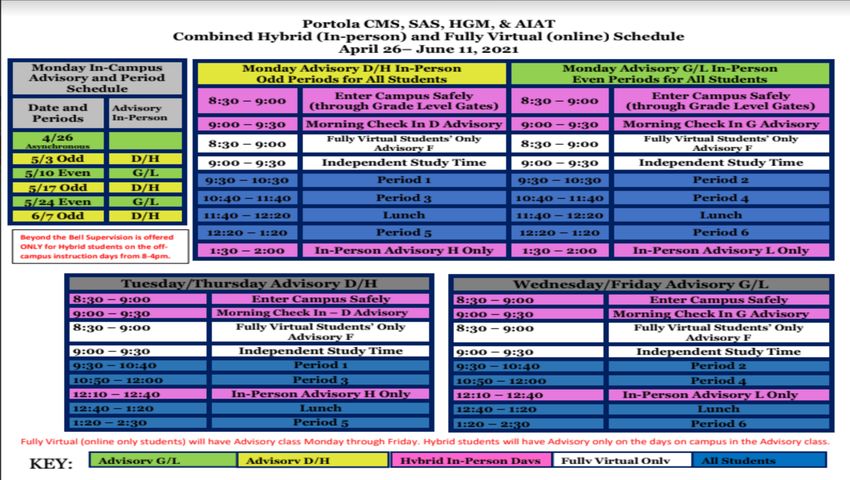
Over the course of the month of April, Los Angeles Unified reopened schools for hybrid instruction:
● During the week of April 12th, 61 elementary schools and 11 early education centers reopened.
● The week of April 19th, the remaining elementary schools and early education centers reopened.
● Finally, the week of April 26th, middle and high schools reopened.
In the hybrid model, middle school and high school students were on campus 2-3 days a week with the same group of students,
staying in the same classroom. While on campus, students participated in advisory classes with their teacher for in-person community
building and social-emotional learning, and received online instruction for their classes. Students completed coursework online and
participated in independent work when not receiving direct instruction. On-site childcare and enrichment activities were available for
middle school students during the days and times when they were not receiving direct instruction.
In addition, families could also elect to keep students in distance learning. In this model, middle school and high school students
continued to learn online similar to how students were previously learning online.
PCMS’ in-person hybrid learning began on:
● Monday, April 26, 2021: teachers and staff on campus and synchronous/asynchronous times for students in
their new Hybrid Advisory classes.
● Tuesday, April 27, 2021 for grade six cohort H Hybrid students on campus
● Wednesday, April 28, 2021 for grade six cohort L Hybrid students on campus and Beyond the Bell (BTB) supervision
● Thursday, April 29, 2021 grades six, seven and eight cohort H Hybrid students on campus and BTB supervision
● Friday, April 30, 2021 grades six, seven and eight cohort L Hybrid students on campus and BTB supervision.
Page 24Successes experienced in implementing in-person instruction:
● According to Whole Child, 88.9% of students are in the green band, 3.7% are in the yellow band, and 7.4% are in the
red band for attendance.
● Educators have worked in collaboration with their department and grade level colleagues in order to design a curriculum
plan that fits the needs of all learners.
Page 25● Students at every grade level have been grouped in cohorts to minimize any potential outbreak.
● Covid Task Force meets regularly to review and analyze a solid schoolwide safety plan for contract tracing, cleaning,
and safety protocols
● PCMS scored 100% on the District Covid Compliance Report Card.
.
Challenges experienced in implementing in-person instruction:
● It was difficult to replace teachers who were unable to return with qualified substitutes.
● Delay of external COVID test results being processed by the District on the Daily Pass Dashboard.
● Teachers experienced connectivity issues in the afternoons while teaching their PM online cohorts.
Distance Learning Program
Actions Related to the Distance Learning Program
Estimated
Total Budgeted
Description Actual Contributing
Funds
Expenditures
2. Our school will provide high-quality curriculum and instructional resources to $7,303,789 $8,278,272 N
support distance learning and ensure continuity of instruction for all students
as part of our general education program.
3. We will also continue to provide a rigorous special education program to $5,310,278 $5,303,962 N
support our students with disabilities in distance learning.
Note that device and connectivity resources, professional development, and N/A N/A N/A
expenditures for staff roles and responsibilities are covered under the District’s
Learning Continuity and Attendance Plan, as these actions are taken district-wide.
A description of any substantive differences between the planned actions and/or budgeted expenditures for the distance learning
program and what was implemented and/or expended on the actions.
Page 26In alignment with Los Angeles Unified School District policy, our school implemented distance learning for the majority of the 2020-21
school year. The actions above were implemented as planned - variations in expenditures are generally attributable to adjusted
funding levels as a result of normed allocations and staffing based on per-pupil enrollment.
Analysis of the Distance Learning Program
A description of the successes and challenges in implementing each of the following elements of the distance learning program in the
2020-21 school year, as applicable: Continuity of Instruction, Access to Devices and Connectivity, Pupil Participation and Progress,
Distance Learning Professional Development, Staff Roles and Responsibilities, and Support for Pupils with Unique Needs.
Continuity of Instruction
● Standards aligned digital tools implementation continued to provide engaging and rigorous lessons/activities to support both
synchronous and asynchronous learning.
● Ongoing professional development and planning support was provided to educators on effective remote learning and
engagement strategies as well as pacing to address essential standards and data in remote instructional settings.
● To prepare for Return to Campus, guidance and support for teaching in each content area in hybrid environments was
provided to educators.
● In order to support continuity of instruction across all District schools, Los Angeles Unified developed numerous resources for
school site leaders, including:
○ Principal’s Playbook and Addendum outlined not only the operational planning for a return to campus, but an academic
plan to ensure continuity of instruction as well, including progress monitoring, academic content planning, and modality
transition preparation for potential quick transitions between online, in-person, and hybrid learning.
○ Transition Plan: From Safer At Home to In-Person Services - this checklist provided prioritized tasks to be performed in
preparation for In-person services. The checklist is to be used alongside the Principal’s Playbook and Addendum.
○ Instructional Toolkit - this resource includes instructional strategies for elementary and secondary educators both to
continue to support virtual learning and to adapt to the hybrid learning model.
○ Instructional Handbook for Online Learning and Hybrid Model - this resource for educators provides information on
instructional time, assessment strategies, supervision of instruction, social and emotional well-being supports, and
additional policies and procedures.
○ Return to Campus: Family Guide - this resource provides information to families on instructional models, childcare
offerings, health and safety protocols, the daily health check and more to keep our families informed and prepared for
the transition to hybrid learning.
○ Safe Steps to Safe Schools Toolkit - this messaging resource aligned and standardized communications across the
District to ensure that consistent information was shared with all staff, families and the greater school community.
Page 27Access to Devices and Connectivity
● Thanks to collaborative efforts and unprecedented levels of commitment across the District, every student had access to a
learning device in the 2020 Spring Semester. During that time, the District’s daily student log-in rates increased by 58
percentage points district-wide.
● The District also distributed tens of thousands of connectivity devices to families over the past year, providing a relatively swift
and low-cost solution to the problem of ensuring equitable access to household connectivity, allowing increased time to
develop and implement more long-term and sustainable solutions.
All PCMS students who requested a device or hotspot, received them.
923 student devices were assigned to students and 12% of our students received a hotspot.
Pupil Participation and Progress
● Teachers, site administrators as well as local district and district staff continued to monitor student engagement and
participation using the following sources (note that this information continued to be captured and monitored in the spring hybrid
instructional models):
○ MiSIS
○ Whole Child Data Platform
○ Schoology
○ Digital Tools Participation/Task Completion such as:
○ SeeSaw
○ Nearpod
○ Discovery
○ IXL
○ Brainpop
○ ST Math
○ Zearn
● Attendance submittal by teachers is monitored at each school site and by communities of schools and Local Districts, as well
as the central office. Submittal rate in MiSiS continues to be high (99.71% district-wide year to date for 2020-21).
Distance Learning Professional Development
● The District provided a Virtual Teaching and Learning Academy for new hires, contract pool and substitute teachers, with initial
sessions held in August and additional sessions held throughout the year. This Academy pursued innovative strategies such
as developing podcast-style sessions focused on Tech Tips, using Zoom technologies to create breakout sessions allowing for
differentiation, and identification of a cadre of presenters who are engaging, effective communicators, and knowledgeable.
Page 28● Starting in the 20-21 school year, Los Angeles Unified’s Human Resources Division started to provide virtual orientation and
training for all student teachers in the District needing to earn their student teaching hours to earn their credential. The District
now has a more centralized system to track Student Teachers, Guiding Teachers, and host schools. Student teachers were
given access to District systems such as District email accounts, MyPLN for PD opportunities, and Schoology Learning
Management System for the first time in order to support online instruction with their students. Student Teachers were also
provided with support on how to use distance learning tools, resources, and platforms, and were offered opportunities to
receive COVID Vaccine to expand our pool of educators. These Student Teacher Virtual Orientations and Resources reached
over 700 student teachers from various teacher preparation programs.
● Substitute teachers were provided with an additional 5 sessions of professional development from November to January 2021,
exploring building positive rapport, practicing routines, and procedures for logging into and using District platforms and tools.
On average 650 substitute teachers attended the professional development sessions.
● 12 hours of professional development were provided to paraprofessionals. Topics included social emotional learning,
supporting instruction, safe COVID practices, universal design for learning, Schoology, and using Zoom to engage learners.
Over 14,000 paraprofessionals completed the trainings offered, and more than 4,000 feedback forms were received.
Overwhelmingly, paraprofessionals indicated that the learning opportunities were highly engaging, highly effective, and built
their capacity to support distance teaching and learning.
The majority of PCMS’s teachers were trained through the District’s Future Ready Training Program towards the end of the 2020
school year. These teachers in collaboration with department level colleagues, began to implement informal assessment tools on
digital platforms provided by the district. Some of these resources that focus on Language Arts include Schoology, Google Slides,
NearPod, and resources from StudySync. Some of the resources that focus on Mathematics include, Schoology, Zearn, Gizmos, and
FipGrid. Distance Learning Professional Development was provided to all teachers and staff before the school year began (August
2020). In addition, PD was provided to all teachers and staff at the start of the second semester (January 2021). Grade level common
planning time and department planning time were provided throughout the year.
Staff Roles and Responsibilities
● Throughout the District, Special Program Substitutes were assigned to schools to support the primary grades, and ELA and
Math in the secondary grades. These substitutes provided differentiation of instruction, and the lower ratio of teacher to student
in targeted grade levels allowed for personalization and improved student engagement. Additional staff allowed for small group
instruction and intervention for students, as well as increased teacher collaboration to meet the needs of students.
● On average, there were 1,680 Special Program Substitutes who remained in the same assignment. This average increased to
1,830. This increase in demand can be seen as a testament to the success of the program.
PCMS received Special Program Substitutes to support classroom teachers with the following:
● Small group instruction
● Day to day coverage for teacher absences
Page 29● ELD support
● IEP Coverage
Support for Pupils with Unique Needs
● For more information on these supports for students with unique needs, please see below under the Analysis of Pupil Learning
Loss.
Pupil Learning Loss
Actions Related to the Pupil Learning Loss
Estimated
Total Budgeted
Description Actual Contributing
Funds
Expenditures
4. Our school will implement strategies and interventions to measure and $516,411 $937,652 N
address learning loss for all students.
5. We will also provide additional supports which primarily benefit LCFF target $604,175 $602,144 Y
student groups (low-income students, students in foster care, and English
learners) to address their unique learning loss challenges.
6. Our school will also target funding allocated by the District through the Student $1,342,930 $1,068,910 Y
Equity Needs Index to further fund interventions to support English learners,
foster youth, and low-income students.
A description of any substantive differences between the planned actions and/or budgeted expenditures for addressing pupil learning
loss and what was implemented and/or expended on the actions.
Actions 4 and 5 above were implemented as planned - variations in expenditures are generally attributable to adjusted funding levels
as a result of normed allocations and staffing based on per-pupil enrollment.
Action 6: PCMS students were provided Extended Learning session during winter break. 8th graders were provided another
Page 30grade-recovery session during the Spring semester after school. Small group and 1:1 tutoring was offered to English Learners and
Students with Disabilities as staff availability permitted.
Analysis of Pupil Learning Loss
A description of the successes and challenges in addressing Pupil Learning Loss in the 2020-21 school year and an analysis of the
effectiveness of the efforts to address Pupil Learning Loss to date.
Assessment Strategies
Portola Charter Middle complied with Los Angeles Unified and state policy on assessments.
● ELA and Math Assessments were administered three times during the year. Assessment results for the following Beginning of
year (BOY) and middle of year (MOY) administrations were analyzed and used to inform re-teaching, pre teaching and
differentiated instruction:
○ Renaissance Star Reading 6 -8
○ Renaissance Star Math 6-8
○ DIBELS (K- 5/6)
○ Edulastic Math (TK - 5/6)
● Student use of core curriculum and supplemental digital tools included regular assessment. Educators used the dashboards
within the assessment systems described above to identify standards and skills for re-teaching, pre teaching and differentiated
instruction.
● Informal assessment data such as review of completed assignments, discussion threads in Schoology, Zoom chat, etc. and
observation during synchronous sessions also continued to inform instructional planning.
General Learning Recovery Strategies
● District, local district and school-based extended learning opportunities were provided to students in the Fall and Spring
sessions.
● Multiple Summer learning opportunities, intervention and enrichment, will be offered to all TK-12 students.
English Learners
● The District provided the following Master Plan services / supports for English Learners:
○ Synchronous/asynchronous professional development/training on Designated ELD (dELD), Integrated ELD (iELD),
Dual Language Education, Target Language Development, EL instructional approaches and ELPAC.
○ Technical support on all the operational aspects of the Master Plan programs options for English Learners, especially
around the expansion of Dual Language Education Programs.
○ Model lessons on dELD, iELD, target language development and resiliency.
○ Content lessons and resources in 6 languages (Arabic, Armenian, French, Korean, Mandarin, and Spanish).
Page 31○ Pathway to Biliteracy Awards/Seal of Biliteracy toward the goal of promoting bilingualism and biliteracy.
○ EL Instructional Coaches for schools with high concentration of ELs.
○ Supplemental instructional programs for ELs such as Reading Horizons and Rosetta Stone.
○ Before/after/Saturday intervention/enrichment to PLTELs and LTELs in need of targeted instructional support.
○ Family webinars/workshops/ trainings and home-school resources.
● Despite the school closures and the limited Summative ELPAC opportunity provided by CDE Fall 2020, 65% of ELPAC at level
3 ELs took the Fall 2020 Summative ELPAC remotely across the District.
● 8.56% of the District’s LTELs have reclassified and 9.2% of LTELs with disabilities have reclassified.
Standard English learners, including African American students
● SEL Coaches continue to utilize LAS Links diagnostic assessment across the District to identify areas of growth and/or need,
and attend to this data by establishing intervention groups focusing on academic language development and mainstream
English language development, in addition to providing small group instruction in break-out rooms synchronously.
● Based on a preliminary LAS Links (BOY - MOY) comparison report, there is evidence of an increase in literacy (reading,
writing) proficiency levels. Qualitatively, based on evaluation compilations and observations, teachers have reported an
increase in student engagement and remote learning participation.
Students with Exceptional Needs
● 60,000 IEPs were completed, with a Distance Learning Plan embedded
● Professional developments were made to assist special educators with using the digital tools to provide accommodations
virtually. These include “IXL in Special Education,” “Kami for Remote Learning,” and “Nearpod: Explore Tools for
Differentiation”
○ 483 educators watched our training on IXL,
○ 772 watched the Nearpod trainings, and
○ 220 watched the training on Kami.
● 300 teachers and administrators engaged in a series of three trainings by Katie Novak on Universal Design for Learning (UDL)
● Every school in the district was asked to send a team including a special educator to Orton Gillingham trainings.
● 95% Phonics Lesson Library kits and professional development were provided to elementary Special Education teachers.
Elementary administrators and support staff were able to participate in a synchronous or asynchronous webinar on supporting
the PLL. Office hours to support teachers and administrators were held.
● 7000 paraprofessionals participated in a webinar to prepare for the transition to hybrid learning
Students in Foster Care and Experiencing Homelessness
● Counselors have maintained relationships with students and families and continue to provide support and advocacy.
● Foster caregivers and families experiencing homelessness continue to have access to the enrollment portal to support
immediate school enrollment. Thousands of applications have been submitted for new students through the pre-enrollment
Page 32portal (enroll.lausd.net)
● Student Health and Human Services hotline continues to offer dedicated staffing and support on school days to support our
students in foster care and experiencing homelessness with addressing any barriers. The hotline has served over 19,000
callers, addressing basic needs and providing support and consultation, referrals, and services/support for students, caregivers
and staff.
Gifted and Talented (GATE) Students
● The District created and implemented a variety of online presentations and events for families to provide general GATE
program information and tools for supporting children in a virtual learning environment, e.g., E-Learning workshops, Annual
GATE/SAS Parent Trainings, Annual GATE/SAS Parent Conference (2020-2021 academic year). Almost 1,500 parents have
participated in online workshops this year.
● The Advanced Learning Options team also secured a districtwide site license that provides access for all Los Angeles Unified
educators to participate in an asynchronous course on “Questioning Deep Dive” as a strategy for distance learning with Lisa
Van Gemert, Educator and Consultant, Gifted Guru (2020-2021 academic year)
● The District also developed, in collaboration with the You Matter Foundation and Zoom, a 13-week enrichment program, Every
Monday Matters (EMM), to engage gifted/talented youth (grades 3-8) in topics and activities that support social-emotional
well-being and social-responsibility. 341 students are participating in our Every Monday Matters program online each week
PCMS provided opportunities for enrichment. Students were able to participate in the LA County Science Fair, History Day LA, a
school-based virtual talent show, a virtual musical theatre program, Math Counts and weekly CA Jr. Scholarship Federation activities.
The annual GATE parent meeting and various parent workshops were provided for our parents.
Analysis of Mental Health and Social and Emotional Well-Being
A description of the successes and challenges in monitoring and supporting mental health and social and emotional well-being in the
2020-21 school year.
Educators and school community stakeholders have embraced the thematic days and activities in support of Mindful Monday,
Grati-Tuesday, Wellness Wednesday, Thoughtful Thursday, and Fun Friday. Daily lessons and activities are available to all educators
to support community building, check-in/check-out activities, use of 4:1 (positive to corrective) feedback, and creating/teaching and
reinforcing classroom expectations.
In addition, over 10,000 educators are part of the Student Health and Human Services Positive Behavior Interventions and Supports.
Finally, as referenced above, the Student Health and Human Services hotline has served over 19,000 callers, addressing basic needs
Page 33You can also read


