Arkansas School Funding Guide 2022-2023 - Fiscal and Administrative Services Division
←
→
Page content transcription
If your browser does not render page correctly, please read the page content below
Arkansas School Funding Guide
          2022-2023

  Fiscal and Administrative Services Division
Purpose of the Manual
The purpose of this manual is to provide guidance and resources for school districts to
become better informed regarding fiscally responsible practices. The information
contained in this manual may not reflect current regulations as laws, rules, and
procedures change. This manual is not fully comprehensive of the rules, regulations, and
funding sources available for districts. As a result, this manual should only be used as a
reference.
Division Mission
Fiscal and Administrative Services (FAS) provides leadership, service, and professional
support to the Division of Elementary and Secondary Education (DESE), public school
districts, charter schools, education service cooperatives, and the public as well as local,
state, and federal agencies. FAS promotes uniform coding, fiscally sound, efficient, and
effective financial systems for public education.
Message from the Assistant Commissioner
Fiscal and Administrative Services in the Division of Elementary and Secondary
Education is dedicated to supporting schools. It is through this support that education
opportunities are provided for the students in the state. I hope that you find this manual
beneficial. We are available to assist with any concerns and look forward to helping you.
If we can be of any support, please do not hesitate to contact us.
Sincerely,
Greg Rogers
Assistant Commissioner
Fiscal and Administrative ServicesTable of Contents Contents Assessment and Local Taxes ...........................................................................................5 Funding Matrix ..................................................................................................................6 Special Needs (Categorical) Funding ................................................................................8 Alternative Learning Environment (ALE) ...........................................................................9 English Language Learners (ELL) ........................................................................................11 Professional Development (PD) .........................................................................................12 Enhanced Student Achievement State Categorical (ESA) ...................................................13 ESA Matching Grant........................................................................................................15 Student Growth Funding .................................................................................................16 Declining Enrollment Funding .........................................................................................17 Isolated Funding ..............................................................................................................18 Bonded Debt Assistance ...................................................................................................27 Educational Excellence Trust Fund.......................................................................................28 Miscellaneous Funds ..........................................................................................................29 State Aid Notices - Charter and District Payment Notifications ............................................30 Limitation on Fund Balances ...........................................................................................31 Required Expenditures ....................................................................................................32 Federal Title Funds ...........................................................................................................34 Maintenance of Effort – Federal Funds (ESSA) ..................................................................38 DESE Federal Funding Website...........................................................................................39 E-Rate .............................................................................................................................40 Special Education Services-Extended School Year ................................................................42 Special Education – High-Cost Occurrences ......................................................................42 Residential Centers/Juvenile Detention .................................................................................42 Title VI Part B Special Education Programs for Early Childhood ...............................................43 IDEA Part B School Age Special Education Programs ............................................................43 Maintenance of Effort (Special Education) ......................................................................44 Child Nutrition ..................................................................................................................46 Arkansas Better Chance Program (ABC) ........................................................................48 Medicaid ..........................................................................................................................49 Arkansas Medicaid Administrative Claiming (ARMAC) ...................................................50
Annual Statistical Report ...................................................................................................51
Best Financial Practices ....................................................................................................52
DESE Website ................................................................................................................56
Resources .......................................................................................................................57
Assessment and Local Taxes

Real, Personal and Utility taxes comprise three main categories. Real, Personal and Utility
Assessments are added together to create the Total Assessment for a school district.
Real + Personal + Utility = Total Assessment

Through Article 14 of the Arkansas Constitution, a school district is required to have a
minimum of 25 mills, known as the Uniform Rate of Tax (URT), dedicated to maintenance
and operation. The local district has the option to increase its millage rate by having voters
within the district vote on additional mills. To estimate the amount of taxes a district could
receive, the amount of Total Assessment is multiplied by the millage rate. For example:

School District X has the following assessment information: Total Millage = 40mills

       Real Assessment              $ 50,000,000
       Personal Assessment          $ 20,000,000
       Utility Assessment           $ 75,000,000
       Total Assessment              $145,000,000

To estimate the amount of taxes a district could receive, multiply the Total Assessment
by .001 and then by the total mills: $145,000,000 X .001 X 40 = $5,800,000

The actual assessment and collection rate is unique to each individual school district. For
good financial forecasting, it is recommended to look at historical data (past
assessments, past collection rates, etc.…), current trends (new building, abandoned
homes, new or moving industry and businesses, etc.…), and other pertinent
information to make more informed financial decisions.

Local taxes are collected through the following sources:
    • Property Taxes-Current (Received July-December) (2001-11110)
    • Property Relief Sales Tax (2001-11115)
    • Property Tax-by 6/30 (Received January-June) (2001-11120)
    • Property Relief Tax - 6/30 (2001-11125)
    • Property Tax-Delinquent (2001-11140)
    • Excess Commission (2001-11160)
    • Land Redemption- In State Sales (2001-11160)
    • Penalties/Interest on Tax (2001-11400)

The amount of local funds including miscellaneous funds collected is divided by the
number of students to derive at the amount of local money collected per student.

                                              5
Funding Matrix
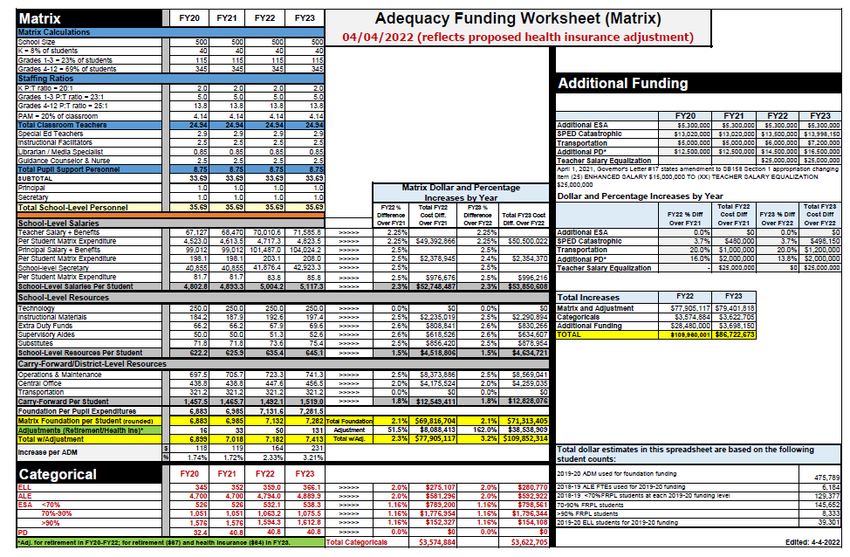
Arkansas uses a specific formula to arrive at the per-student funding amount. This formula
is known as the matrix. The matrix calculates the per-student funding rate based on the
cost of personnel and other resources for operating a prototypical school of 500 students.
Each year legislators involved in the adequacy study determine the dollar amount needed
to fund each line item of the matrix based on the money needed to adequately fund school
districts. Unlike the foundation funding amount ($7,413 for 2022-23), the matrix is not
established in statute. Instead, it is used as a tool to set the foundation funding rate.
The matrix is divided into three parts:
1. School-level salaries of teachers and other pupil support staff, a principal, and a
secretary. The matrix also determines how many of which type of teachers and other
personnel are needed.
2. School-level resources including instructional materials and technology-related
expenses.
3. District-level resources, which include funding for operations & maintenance,
districts’ central offices and transportation expenses.” ¹
67
Special Needs (Categorical) Funding

Special Needs or Categorical Funding is pursuant in A.C.A. § 6-20-2301 et seq. and the
Arkansas Division of Elementary and Secondary Education Rules Governing Student
Special Needs Funding, effective June 20223. Alternative Learning Environment (ALE),
English Language Learners (ELL), Enhanced Student Achievement (ESA), and
Professional Development (PD) are considered State Categorical Funds. The expenditure
of funds from each of these categories is restricted. Allowable expenditures for each
category are specified in law and/or rules. A school district may transfer funds received from
any categorical fund source to another categorical fund source. Per-student state categorical
funding is provided in addition to per-student foundation funding.

There is a limit to the amount of categorical funds a district can carry over in a fiscal year.
Districts that carry over balances larger than allowed may be required to surrender those
unspent excess funds. Districts must expend a minimum of 85% of the current year ESA
funding. The total aggregate balance of categorical funds at year-end shall not exceed 20%
of the current year allocation.

                                              8
Alternative Learning Environment (ALE)
An ALE program must comply with laws including A.C.A § 6-48-101 et seq. and with DESE
rules. It is important to note that for ALE funding eligibility, a student must be enrolled in
an eligible ALE program for a minimum of 20 consecutive days per school year. In fiscal
year 2022-2023, ALE funding is $4,890 multiplied by the district’s eligible ALE students’
full-time equivalents (FTE) in the previous year as defined in 4.06 of the DESE Rules
Governing Student Special Needs Funding, effective July 2022. For example:
Number of Days
Twenty ALE Course Number of
Student Enrolled in ALE in
Consecutive Days? Minutes Minutes Per Day
Prior Year
A 49 No 110 360
B 89 Yes 216 360
C 178 Yes 360 360
D 12 No 360 360
Students “A” and “D”, enrolled fewer than 20 consecutive days in the prior school year,
are ineligible for ALE funding. The full-time equivalent (FTE) per student is calculated by
dividing the number of days each student was enrolled in the ALE by the total number of
days in the school year (typically 178) and multiplying the result by the number of enrolled
course minutes divided by the number of minutes in a day.
Student “B” FTE = (89/178) x (216/360) = .30 Student FTE
Student “C” FTE = (178/178) x(360/360) = 1.0 Student FTE
To calculate ALE funding, multiply the total FTE (1.3) by the per-student ALE funding
amount ($4,890).
1.3 X $4,890 = $6,357
10English Language Learners (ELL)
From DESE Rules Governing Student Special Needs Funding, effective July 2022:
3.07 English Language Learners (ELL) are students identified as not proficient in the
English language based upon approved English proficiency assessment instruments,
which measure proficiency in and comprehension of English in reading, writing, speaking,
and listening.
5.02 The ELL funding amount shall be the amount authorized by law multiplied by the
district’s identified ELL students in the current school year.
5.02.1 The number of identified ELL students shall be a total of all students identified as
not proficient in the English language based upon the statewide Entrance and Exit
Procedures criteria, including an approved English proficiency assessment instrument.
5.02.3 An ELL student shall be counted as no more than one (1) student for ELL funding
purposes.
In fiscal year 2022-2023, ELL funding is $366 multiplied by the number of identified ELL
students. DESE utilizes certified data submitted in Cycle 2 to determine the total ELL
count for every district. If the DESE finds errors on the COGNOS Language Minority
Student Error Report, staff work with the district to get the data corrected and will utilize
corrected data.
District “A” reported 247 ELL identified students in cycle 2 enrolled as of October 1 of the
current fiscal year with the count verified as accurate.
247 X $366 = $90,402
11Professional Development (PD)
Per DESE Rules Governing Student Special Needs Funding, effective July 2022:
The Professional Development funding amount shall be an amount up to the amount
authorized by law multiplied by the district’s ADM of the previous school year.
In fiscal year 2022-2023, the professional development funding per-student is an amount
up to $40.80 multiplied by the school district’s prior-year three-quarter average daily
membership. A portion of the $40.80 is used to fund statewide professional development
programs each year. The funding amount per-student provided directly to a school district
is calculated each year after removing the portion corresponding to statewide programs.
For fiscal year 2022-2023, the amount of per-student professional development funding
excluding statewide programs is $37.50. This amount will be provided on the preliminary
state aid notice and funding notification each year.
To calculate PD funding, multiply prior-year three-quarter average daily membership by
the per-student PD funding amount. For example, for a school district with fiscal year
2021-2022 three-quarter average daily membership of 629.17 and a per-student PD
funding rate for fiscal year 2022-2023 of $37.50, the PD funding would be calculated as
follows:
629.17 X $37.50 = $23,594
12Enhanced Student Achievement State Categorical (ESA)
For fiscal year 2022-2023, ESA state categorical funding for each identified free and
reduced (F&R) student is as follows:
• For a school district in which 90% or more of the previous school year’s enrolled students
(from Cycle 2 as of October 1) are F&R students, the amount of per-student enhanced
student achievement state categorical funding is $1,613.
• For a school district in which at least 70% but less than 90% of the previous school year’s
enrolled students (from Cycle 2 as of October 1) are F&R students, the amount of per-
student enhanced student achievement state categorical funding is $1,076.
• For a school district in which less than 70% of the previous school year’s enrolled students
(from Cycle 2 as of October 1) are F&R students, the amount of per- student enhanced
student achievement state categorical funding is $538.
• If a school district would receive, in the current school year, ESA state categorical funding
that is based on a different per student rate of ESA state categorical funding than the
school district received in the immediately preceding school year, due to a percentage
change in F&R students, the DESE shall adjust the rate per-student to the school district
in a transitional 3-year period.
From 6.01 of the DESE Rules Governing Student Special Needs Funding, effective June
2022:
• For determination of the per-student amount of enhanced student achievement state
categorical funding, the percentage shall be calculated to one tenth of one percent
(0.10%), and rounded up to the nearest whole number from five-tenths of one percent
(0.5%).
• If the school district is a Provision 2 district, this funding is based on the school district’s
percentage of F&R students submitted in the base year, multiplied by the number of
enrolled students for the immediately preceding school year.
• If the school district is a Community Eligibility Provision (CEP) district, this funding is
based on the school district’s percentage of F&R submitted in the year prior to
implementing CEP, multiplied by the number of enrolled students for the immediately
preceding school year.
13For example, a school district with October 1, 2021, enrollment of 2,576 students and
1,753 free and reduced-price lunch students, the ESA free and reduced-price lunch
percentage and ESA funding amount would be calculated as follows:
1753/2576 = 68%
1,753 X $538 = $943,114
If a district has grown at least 1% in enrollment (using Cycle 2 enrollment date) for each
of the 3 previous years, it shall qualify for the Enhanced Student Achievement State
Categorical Growth Funding. The funding shall be calculated as the 3-year average growth
in enrollment multiplied by the district’s previous year’s percentage of F&R students
multiplied by the applicable per-student funding amount.
14ESA Matching Grant
Act 217 of 2022 allocated $5,300,000 for a matching grant program for Enhanced Student
Achievement (ESA) expenditures for evidence-based programs to improve the academic
achievement of identified National School Lunch students. ESA expenditures incurred
from July 1, 2022, to June 30, 2023, with the following codes will be eligible for matching
funds:
Expenditures in ESA
• Before and after-school academic programs, including transportation to and
from the programs
• Pre-kindergarten programs
• Tutors
Funding will be distributed to school districts on a dollar-for-dollar matching basis unless
the total of statewide expenditures exceeds the amount of funding allocated, at which
point, funding will be paid on a pro rata matching basis to the districts. For a pro rata
basis, a matching percentage will be calculated by dividing each LEAs allowable
expenditures by the statewide total of allowable expenditures and applying that
percentage to the amount of funding available to determine the funds reimbursed to the
district.
Matching ESA Grant funds may be used only for the expenses allowed under this
program and are meant to supplement, not replace, the districts enhanced student
achievement spending.
15Student Growth Funding
To help ease the potential financial burden resulting from rapid increase in students, a
school district with growth in quarterly average daily membership compared to prior-year
three-quarter average daily membership may be eligible for student growth funding. Act
741 of 2017 changed the student growth funding calculation, necessitating a revision to
the DESE Rules Governing Declining Enrollment and Student Growth Funding for Public
School Districts, effective June 20224.
For example, to calculate student growth funding for fiscal year 2022-2023:
FY21 528.16 FY22 541.11 Growth in 12.95
3-Quarter ADM quarter 4 ADM Quarter 4
FY22 540.19 FY23 552.33 Growth in 12.14
3-quarter ADM quarter 1 ADM Quarter 1
FY22 540.19 FY23 549.08 Growth in 8.89
3-quarter ADM quarter 2 ADM Quarter 2
FY22 540.19 FY23 539.02 Growth in No growth
3-quarter ADM quarter 3 ADM Quarter 3
(12.95 X $1,853.25) + (12.14 X $1,853.25) + (8.89 X $1,853.25) + (0 X $1,853.25) =
$62,973
Pursuant to A.C.A. § 10-3-2101, the State of Arkansas is required to know how school
districts expend state revenue, including student growth funding. To preserve the ability to
track how each district expends student growth funding for adequacy studies, the source
of fund code applicable to student growth funding is restricted and transfers from the fund
are not allowed. However, student growth funding is unrestricted funding. School districts
may expend student growth funding on any eligible school purpose while maintaining the
student growth revenue code. No district can receive both declining enrollment and
student growth funding. Therefore, a district will receive the larger amount of Declining
Enrollment Funding or Student Growth Funding.
Pursuant to A.C.A. § 6-20-2305(c)(2)(C), if net revenues minus any recoupment under
subdivision (a)(4)(B) of this section plus miscellaneous funds calculated under § 6-20-
2308(b)(1)(A) exceed the foundation funding amount, a school district shall be eligible to
receive the amount of calculated student growth funding that exceeds net revenues
minus any recoupment under subdivision (a)(4)(B) of this section plus miscellaneous
funds calculated under § 6-20-2308(b)(1)(A).
16Declining Enrollment Funding
Pursuant to A.C.A. § 6-20-2303(5), “declining enrollment funding” means the amount
of state financial aid provided to an eligible school district from funds made available
for the decline in the average daily membership of the school district in the
preceding school year compared to the school year before the preceding school
year.
Declining enrollment funding is equal to the three-quarter ADM of the prior year,
subtracted from the average of the three-quarter ADMs of the prior fiscal year and the
fiscal year prior to the prior fiscal year, multiplied by the current per-student foundation
funding amount.
For example, to calculate declining enrollment funding for fiscal year 2022-2023:
FY21 3-quarter ADM FY22 3-quarter ADM
870.28 851.34
(870.28+851.34)/2 – 851.34 = 9.47
9.47 X FY22 per-student foundation funding
9.47 X $7,413 = $70,201 declining enrollment funding
Pursuant to A.C.A. § 10-3-2101, the State of Arkansas is required to know how school
districts expend state revenue, including declining enrollment funding. To preserve the
ability to track how each district expends declining enrollment for adequacy studies,
the source of fund code applicable to declining enrollment funding is restricted and
transfers from the fund are not allowed. However, the declining enrollment funding is
unrestricted funding. School districts may expend declining enrollment funding on any
eligible school purpose while maintaining the declining enrollment revenue code.
17Isolated Funding
Pursuant to A.C.A. § 6-20-601, “isolated school district” means a school district that
meets any four (4) of the following five (5) criteria:
(1) There is a distance of twelve (12) miles or more by hard-surfaced highway from
the high school of the district to the nearest adjacent high school in an adjoining
district;
(2) The density ratio of transported students is less than three (3) students per
square mile of area;
(3) The total area of the district is ninety-five square miles (95 sq. mi.) or greater;
(4) Less than fifty percent (50%) of bus route miles is on hard-surfaced roads;
and
(5) There are geographic barriers such as lakes, rivers, and mountain ranges that
would impede travel to schools that otherwise would be appropriate for
consolidation, cooperative programs, and shared services.
An isolated school district shall be eligible to receive isolated funding under this section
if:
(1) The school district's budget is prepared by the school district with Division of
Elementary and Secondary Education approval;
(2) The school district has a prior-year three-quarter average daily membership
of fewer than three hundred fifty (350); and
(3) The school district and each school within the school district meets the
minimum standards for accreditation of public schools prescribed by law and
rule.
Any school district designated as an isolated school district for the 1996-1997 fiscal year
that used geographic barriers as one (1) of the four (4) criteria necessary to receive
isolated funding shall be allowed to continue to use geographic barriers as a criterion for
future allocations of isolated funding.
State financial aid in the form of isolated funding shall be provided to school districts
qualifying under this section.
There are two (2) categories of isolated funding:
Category I isolated funding shall be provided to all school districts that qualify under
this section and shall be calculated as:
(i) Three hundred fifty (350) minus the prior-year three-quarter average daily
membership; divided by
(ii) Eight hundred fifty (850); multiplied by
(iii) The prior-year three-quarter average daily membership; and multiplied by
(iv) The per-student foundation funding amount under § 6-20-2305(a)(2); and
Category II isolated funding shall be additionally provided to those school districts that
qualify under this section and have a prior-year three-quarter average daily membership
density ratio of less than one and two-tenths (1.2) students per square mile and shall be
calculated at fifty percent (50%) of Category I funding.
18An isolated school district whose per-student revenue exceeds the per-student
foundation funding amount shall receive isolated funding calculated as follows:
(i) The sum of Category I plus Category II; minus
(ii) The per-student foundation funding amount; minus
(iii) The school district's per-student revenue; and multiplied by
(iv) The prior-year three-quarter average daily membership.
As used in this subdivision (d)(3), “revenue” has the same meaning as defined in
§ 6-20-2303.
Except as provided under subdivision (e)(2) of this section, a school district that
qualifies under § 6-20-603 to receive additional state aid because its prior-year three-
quarter average daily membership is less than three hundred fifty (350) is not eligible to
receive funding under this section.
A school district may elect to receive funding under this section in lieu of funding under
§ 6-20-603 if the school district qualifies for funding under § 6-20-603 and for funding
under this section.
Pursuant to A.C.A. § 6-20-603, upon the effective date of consolidation, annexation, or
reorganization, the following school districts that received isolated funding in the 2003-
2004 school year shall become isolated school areas for the sole purpose of receiving
isolated funding and shall have a per student isolated funding amount as provided in the
following chart.
Each school year, state financial aid in the form of isolated funding shall be provided to
school districts containing an isolated school area in an amount equal to the prior-year
three-quarter average daily membership of the isolated school area multiplied by the per
student isolated funding amount.
Except as provided under subdivision (c)(2) of this section, a school district may not
receive isolated funding under this section for an isolated school area if the prior-year
three-quarter average daily membership of the isolated school area exceeds three
hundred fifty (350).
A school district is entitled to receive the funding under this section for an isolated
school area received by the school district in:
a. A consolidation under § 6-13-1401 et seq. or the Public Education
Reorganization Act, § 6-13-1601 et seq.; or
b. An annexation under § 6-13-1401 et seq. or the Public Education Reorganization
Act, § 6-13-1601 et seq.
A school district receiving isolated funding for an isolated school area shall expend the
funds solely for the operation, maintenance, and support of the isolated school area.
Except as provided under subdivision (e)(2) of this section, a school district that
qualifies under § 6-20-601 to receive additional state aid because its prior-year three-
19quarter average daily membership is less than three hundred fifty (350) is not eligible to
receive funding under this section.
For the purposes of this section, school districts with isolated school areas shall account
for the average daily membership of all schools located in the isolated school areas as
required by the Division of Elementary and Secondary Education and shall submit
reports as required by the division.
The division shall distribute isolated funding under this section in two (2) payments per
school year.
This section does not determine a school district's qualification as an isolated school
district under § 6-20-601 as required to prohibit the closing of an isolated school in § 6-
20-602.
If all of an isolated school area in a school district is closed, the school district shall
receive funding based on the prior-year three-quarter average daily membership of the
isolated school area.
If part of an isolated school area in a school district is closed, the school district funding
is based on the prior-year three-quarter average daily membership of the part of the
isolated school area that remains open.
Funding received by a school district under this subsection is restricted for use at the
closed isolated school area or for transporting students of the closed isolated school
area to another school in the district.
If a closed isolated school area is subsequently used by the school district for an
alternative learning environment program or other regular classroom teaching, the
school district using the now closed isolated school area may submit prior-year three-
quarter average daily membership to the state to request funding under this section.
20Isolated Funding Flowchart
Does the district meet 4 of the following 5 criteria to qualify
as an Isolated School District?
• Distance of 12 miles or more by hard-surfaced highway from the
high school of the district to the nearest adjacent high school in District does
an adjoining district
NO not qualify
• Density ratio of transported students is less than 3 students per
for funding.
square mile
• Total area of the district is 95 square miles or greater
• Less than 50% of bus routes are on hard-surfaced roads
• There are geographic barriers such as lakes, rivers and mountain
ranges that would impede travel to schools that otherwise would
be appropriate for consolidation, cooperative programs and
shared services?
YES
Does the school district meet the following criteria?
• The school district’s budget is prepared by the school district with
Division of Elementary and Secondary Education approval; District does
• The school district has a prior-year three-quarter average daily NO not qualify
membership of fewer than three hundred fifty (350); for funding.
• The school district and each school within the school district meets
the minimum standards for accreditation of public schools
prescribed by law and rule.
YES TO ALL
Is the district receiving funding under 6-20-603? District must choose
YES
funding under 6-20-601 or
6-20-603
NO
Is the isolated school area listed in 6-20-603? District does not qualify for
NO
funding.
YES
NO District is eligible for
Is the prior year three-quarter ADM greater than 350?
funding.
YES
21YES
Is the isolated school area in a consolidation or
NO District does not
annexation under 6-13-1401 et seq. or 6-13-1601
qualify for funding.
et seq?
YES
District is eligible
for funding
22Per-Student Isolated Funding per A.C.A. §6-20-603
23Special Needs Isolated Funding 6-20-604
Was the school district consolidated or annexed or received an
annexed school under the Public Education Reorganization Act NO No funding
§ 6-13-1601 et seq? available.
YES
Did the local school district board of directors by majority vote
determine that the isolated school is so isolated that to combine No funding
NO
its operation to one (1) school district campus would be available.
impractical or unwise?
YES
Does the isolated school or district:
A. Meet the requirements of § 6-20-601 and filed an affidavit of
isolated school status with the State Board of Education during
the consolidation or annexation process and the facts of the
affidavit are verified by the State Board or its designee;
B. Meet the requirements of § 6-20-601 and filed an affidavit of No funding
isolated school status with the State Board after the NO available.
consolidation or annexation processor with regard to the 2006-
2007 school year no later than June 1, 2006, and the facts of
the affidavit are verified by the State Board or its designee; OR
C. Meet the requirements of § 6-20-601 but for the prior-year
three-quarter average daily membership requirement of three
hundred fifty (350) students or fewer and filed an affidavit of
isolated school status with the State Board after the
consolidation or annexation process or with regard to the 2006-
2007 school year no later than June 1, 2006, and the facts of
the affidavit are verified by the State Board of its designee?
YES
Does the school district have:
A. School facilities serving students in any grade in Additional funding
kindergarten through grade twelve (K-12) in one (1) or is provided in the
more isolated schools meeting the requirements of amount equal to
subsection © of this section; YES 20% of the per-
B. A prior-year three-quarter average daily membership for
the school district of five-hundred (500) or less; AND student foundation
C. A density ratio of one and three-tenths (1.3) student or funding.
less per square mile?
24NO
Does the school district have:
A. School facilities open for kindergarten through grade
twelve (K-12) in two (2) or more isolated schools meeting
the requirements of subsection (b) of this section and
meeting the requirements of § 6-20-601 and if both Additional funding
isolated schools were annexed under the Public Education is provided in the
Reorganization Act § 6-13-1601 et seq; YES amount equal to
B. A prior-year three-quarter average daily membership for 15% of the per-
the school district of five-hundred one (501) to one student foundation
thousand (1,000); AND funding.
C. A density ratio of one and five-tenths (1.5) students or less
per square mile?
NO
Does the district have a three-quarter daily membership of
one-thousand one (1,001) or greater and an isolated school Additional funding
area received by the school district in: is provided in the
A. A consolidation under § 6-13-1401 et seq. or § 6-13-1601 amount equal to
et seq.; OR YES 15% of the per-
B. An annexation under § 6-13-1401 et seq. or the Public student foundation
Education Reorganization Act § 6-13-1601 et seq. funding.
NO
Additional funding
is provided in the
Does the district have school facilities open for kindergarten amount equal to
through grade twelve (K-12) in one (1) or more isolated YES 10% of the per-
school areas? student foundation
funding.
NO
Does the school district: Additional funding
A. Have school facilities serving students in any grade in is provided in the
kindergarten through grade twelve (K-12) in one (1) or amount equal to
more isolated school areas meeting the requirements of YES 10% of the per-
subsection (b) of this section; AND
student foundation
B. The school district closed an isolated facility serving
funding
students in grades seven through twelve (7-12)?
NO
25NO
Additional
Does the school district have a: funding is
A. Prior-year three-quarter average daily membership of less YES provided in
than five-hundred (500) students; AND
B. Density ratio of two (2) student or less per square mile? the amount
Note-Districts do not have to meet consolidation, board equal to 5% of
vote, and affidavit requirements of A.C.A. §6-20-604. the per-
26Bonded Debt Assistance
Bonded debt assistance is restricted funding to be used solely for the payment of bonded
debt. Pursuant to A.C.A. § 6-20-2503, the calculation of bonded debt assistance is based
on a school district’s principal and interest payment schedule, in effect, and on file with the
Division of Elementary and Secondary Education (DESE) on January 1, 2005. This list is
available on the DESE website at the following link:
Bonded Debt Assistance
A.C.A. § 6-20-2503 attributed 90% of each school district’s outstanding bonded debt to the
financing of academic facilities. However, the law provided for a school district to submit
documentation if more than 90% of its outstanding bonded debt was issued in support of
academic facilities. This established percentage of 90% or more is applied to each
district’s fiscal year principal and interest bonded debt payment from the January 1, 2005,
debt schedule. The resulting “adjusted 1/1/05 scheduled debt payment” is divided by the
total assessed value of the district multiplied by 1,000 to calculate the required debt
service mills. This product is multiplied by the state wealth index (defined in A.C.A. § 6-
20- 2503(a)(6) - note this is different than the facilities wealth index (defined in A.C.A. §
6-20- 2502) multiplied by the prior year three-quarter average daily membership and
multiplied by a funding factor of $18.03.
Under A.C.A. § 6-20-2503, these funds must be paid on or before August 1 and February
1 each year. Typically, a disbursement of 50% is made in July with the remaining balance
disbursed in January. For more information, see the Commission for Arkansas Public
School Academic Facilities and Transportation Rules Governing Bonded Debt Assistance,
effective December 31, 2018, at the following link:
Disbursement
27Educational Excellence Trust Fund
The Educational Excellence Trust Fund (EETF), established in 1991, is defined and
explained in A.C.A. § 6-5-301 et seq., and in the DESE Rules Governing the School
District Educational Excellence Trust Fund, effective January 1, 2020. The portion of
foundation funding that represents the Educational Excellence Trust Fund obligation is
provided on the state aid notice and allocations section of the DESE website. Open-
enrollment public charters do not have an EETF allocation.
Under A.C.A. § 6-5-307 any increase in EETF allocation for teacher salaries shall be
used by school districts to provide salary increases for current licensed personnel
positions and for no other purpose, except that required social security and teacher
retirement matching required to be paid by the school districts may be paid from the
funds.
The Trust Fund amount on the final State Aid Notice for the current school year must
be expended in the form of salaries, social security, and retirement matching for current
licensed personnel positions.
The DESE has developed a tool to assist school districts in determining whether they
are required to give salary increases to meet the EETF requirement.
A. Trust fund for current year as reported on allocations page of DESE website
B. Trust fund amount divided by 1.2265 = amount to be distributed to licensed $
personnel salaries (not as a bonus or nonrecurring payment)*
C. Amount (projected or actual) spent on non-federal licensed salaries**
D. Amount exceeding/(shortage) of salary expenditure vs. EETF allotment (Line C $
minus Line B)
If line D is positive, the EETF requirements have been met.
If line D is negative, non-federal licensed salaries must be increased.
E. Total number of licensed non-federal FTEs
F. Amount of salary increase needed per FTE (take the amount from line D and $
make it a positive number and divide by line E)
*22.65% is comprised of 7.65% FICA and 15% ATRS employer contribution for FY23
**Applies to non-federal licensed staff, including those paid with state categorical funds
28Miscellaneous Funds
Miscellaneous Funds are defined in A.C.A. § 6-20-2303(12) as funds received by a school
district from federal forest reserves, federal grazing rights, federal mineral rights, federal
impact aid, federal flood control, wildlife refuge funds, severance taxes, in lieu of taxes and
local sales and use taxes dedicated to education under § 26-74-201 et seq., § 26-74- 301
et seq., § 26-75-301 et seq., and the Local Government Bond Act of 1985, § 14-164- 301
et seq.
Miscellaneous funds are used in the calculations of bonded debt assistance (under
A.C.A. § 6-20-2503) and state foundation funding aid (under A.C.A. § 6-20-2305 and § 6-
20- 2308). The DESE Rules Governing the Calculation of Miscellaneous Funds, effective
November 2014 provides information regarding the use of miscellaneous funds in both
funding calculations.
In the calculation of bonded debt assistance and in the initial calculation of state
foundation funding aid, the DESE calculates the miscellaneous funds of a school district
as the aggregate amount of miscellaneous funds received in the calendar year
immediately preceding the beginning of the current school fiscal year multiplied by the
ratio of the uniform rate of tax to the district’s total millage rate as of January 1 of the
calendar year in which the school district received the miscellaneous funds.
In February, the initial calculation of state foundation funding aid is updated to replace
the initial miscellaneous funds with miscellaneous funds from the calendar year that
includes the beginning of the school fiscal year. If the current calendar year
miscellaneous funds received are less than the previous calendar year miscellaneous
funds, for those school districts that receive state foundation funding aid the DESE will
adjust the state foundation funding aid.
If the current calendar year miscellaneous funds are more than the previous calendar
year, the DESE will reduce the state foundation funding aid by the difference in
calculated miscellaneous funds.
If the current calendar year miscellaneous funds are less than the previous calendar
year, the DESE will increase the state foundation funding aid by the difference in
calculated miscellaneous funds.
29State Aid Notices - Charter and District Payment Notifications
State Aid Notices provide state funding information to school districts and open-
enrollment public charter schools are published periodically throughout the fiscal year
on the DESE website at the following link: Publications and Reports
Additionally, funding information is provided at the following links under the School
Funding menu.
Allocations
Funding Data
Monthly disbursements of certain categories of state funding (typically the funding
shown on the state aid notices) to open enrollment public charters and school districts
are posted to APSCN at the following link: APSCN payment listing
30Limitation on Fund Balances
Pursuant to Ark. Code Ann. § 6-20-2210, established by Act 1105 of 2017, if at the
close of the fiscal year a public school district has a net legal balance that exceeds
twenty percent (20%) of the public school district’s current year net legal balance
revenues, the public school district shall within five (5) years reduce its net legal balance
to no more than twenty percent (20%) of the public school district’s current year net
legal balance revenue.
A public school district may reduce its excess net legal balance by:
(1) Transferring funds into the public school district’s building fund to be used for
construction, renovation, repair or other planned building fund expenditure or project; or
(2) Spending funds on pre-kindergarten programs, remediation programs, career and
technical education or workforce readiness programs or any other program or for any
other purpose authorized by law.
The Division shall monitor on a yearly basis each public school district’s compliance
with the net legal balance requirements and withhold subsequent state funding from a
public school district for each year the district fails to make required reductions.
31Required Expenditures
Gifted and Talented Program
Pursuant to Ark. Code Ann. § 6-20-2208(c)(6), school districts are required to expend
state and local revenues on Gifted and Talented Programs in an amount equal to fifteen
percent (15%) of the Foundation Funding amount multiplied by five percent (5%) of the
school district's prior year three quarter average daily membership (3 QTR ADM).
Utilities and Facilities Maintenance
Ark. Code Ann.§ 6-21-808(d)(1), concerning the annual expenditure requirement for
utilities and facilities maintenance, requires school districts to dedicate nine percent
(9%) of Foundation Funding exclusively to payment of utilities and costs of custodial,
maintenance, repair, and renovation activities, which include related personnel costs,
for public school facilities.
The following definitions are included in Ark. Code Ann. § 6-21-803:
(4) Custodial Activities means routine and renovation cleaning activities related to the
daily operations and upkeep of a public school facility, including related supervisory and
management activities.
(10) Maintenance, Repair, and Renovation means any activity or improvement to a
public school facility that maintains, conserves, or protects the state, condition, or
efficiency of the public school facility.
(13) Public School Facility means any public school building or space, including related
areas such as the physical plant and grounds that is used for any purpose, including,
without limitation:
(A) An extracurricular activity;
(B) An organized physical activity course as defined in Ark. Code Ann. § 6-16-137;
(C) Pre-kindergarten education;
(D) District administration; or
(E) Delivery of instruction to public school students that is an integral part of an
adequate education as described in Ark. Code Ann.§ 6-20-2302.
School districts should code expenditures eligible to meet the nine percent (9%)
requirement as follows: Fund = 2000 or 2100-2199, 65300 through 69999. This will
include all Operating Fund expenditures charged to Operating and Maintenance of Plant
Services in the "General Operating Fund" except for " Insurance Other than Employee
Benefits".
If any amount of the dedicated nine percent (9%) is unspent at the end of the school
district's fiscal year, the funds shall carry over, and the school district must transfer the
32remaining amount into a public school facility escrow account. Fund Source of Fund code
2391 shall be used for this escrow account. The funds in escrow may be used in any fiscal
year for payment of utilities and costs of custodial, maintenance, repair, and renovation
activities, which include related personnel costs, for public school facilities.
If a school district wants to use funds from its public school facilities escrow account for
new construction, the school district shall apply to the Division of Public School Academic
Facilities and Transportation for approval.
33Federal Title Funds
Definitions were taken from Elementary & Secondary Education Act (ESEA) as
amended by Every Student Succeeds Act (ESSA)
TITLE I – IMPROVING THE ACADEMIC ACHIEVEMENT OF THE DISADVANTAGED
The purpose of this title is to provide all children significant opportunity to receive fair,
equitable, and high-quality education, and to close educational achievement gaps. (ESSA
Section 1001)
TITLE I, PART D—PREVENTION AND INTERVENTION PROGRAMS FOR CHILDREN
AND YOUTH WHO ARE NEGLECTED, DELINQUENT, OR AT-RISK
It is the purpose of this part to:
1. Improve educational services for children and youth in local, tribal, and State
institutions for neglected or delinquent children and youth so that such children and
youth have the opportunity to meet the same challenging State academic standards
that all children in the State are expected to meet.
2. Provide such children and youth with the services needed to make a successful
transition from institutionalization to further schooling or employment; and
3. Prevent at-risk youth from dropping out of school, and to provide dropouts, and
children and youth returning from correctional facilities or institutions for neglected or
delinquent children and youth, with a support system to ensure their continued
education and the involvement of their families and communities. (ESSA Section
1401)
34TITLE II, PART A—PREPARING, TRAINING, AND RECRUITING HIGH-QUALITY TEACHERS,
PRINCIPALS, OR OTHER SCHOOL LEADERS
The purpose of this title is to provide grants to State educational agencies and sub-
grants to local educational agencies to:
1. Increase student achievement consistent with the challenging state academic
standards.
2. Improve the quality and effectiveness of teachers, principals, and other school
leaders.
3. Increase the number of teachers, principals, and other school leaders who are
effective in improving student academic achievement in schools; and provide low-
income and minority students greater access to effective teachers, principals, and
other school leaders. (ESSA Section 2001)
TITLEIII, PARTA- LANGUAGE INSTRUCTION FOR ENGLISH LEARNERS AND IMMIGRANT
STUDENTS
The purposes of this part are to:
1. Help ensure that English learners, including immigrant children and youth, attain
English proficiency and develop high levels of academic achievement in English.
2. Assist all English learners, including immigrant children and youth, to achieve at
high levels in academic subjects so that all English learners can meet the same
challenging State academic standards that all children are expected to meet.
3. Assist teachers (including preschool teachers), principals and other school leaders,
State educational agencies, local educational agencies, and schools in
establishing, implementing, and sustaining effective language instruction
educational programs designed to assist in teaching English learners, including
immigrant children and youth.
4. Assist teachers (including preschool teachers), principals and other school leaders,
State educational agencies, and local educational agencies to develop and enhance
their capacity to provide effective instructional programs designed to prepare
English learners, including immigrant children and youth, to enter all-English
instructional settings; and
5. Promote the parental, family, and community participation in language instruction
educational programs for the parents, families, and communities of English learners.
(ESSA Section 3102)
35There are two types of Title III subgrants: Title III EL Formula subgrant (ESSA Section
3114(a)) and the Title III Recent Immigrant subgrant (ESSA Section 3114(d)). The Title
III EL Formula subgrant is determined using the number of English Language Learners,
while the Title III Recent Immigrant subgrant is determined using the number of Recent
Immigrants.
TITLE IV, PART A – Student Support and Academic Enrichment (SSAE)
The purpose of this sub-part is to improve students’ academic achievement by increasing
the capacity of States, local educational agencies, schools, and local communities to:
1. Provide all students with access to a well-rounded education.
2. Improve school conditions for student learning; and
3. Improve the use of technology in order to improve the academic achievement and
digital literacy of all students.
(ESSA Section 4101)
TITLE IV, PART B- Nita M. Lowey 21st Century Community Learning Centers (This is a
competitive grant)
The purpose of this part is to provide opportunities for communities to establish or
expand activities in community learning centers that:
1. Provide opportunities for academic enrichment, including providing tutorial services
to help students, particularly students who attend low-performing schools, to meet
the challenging State academic standards.
2. Offer students a broad array of additional services, programs, and activities, such as
youth development activities, service learning, nutrition and health education, drug
and violence prevention programs, counseling programs, arts, music, physical
fitness and wellness programs, technology education programs, financial literacy
programs, environmental literacy programs, mathematics, science, career and
technical programs, internship or apprenticeship programs, and other ties to an in-
demand industry sector or occupation for high school students that are designed to
reinforce and complement the regular academic program of participating students;
and
3. Offer families of students served by community learning centers opportunities for
active and meaningful engagement in their children’s education, including
opportunities for literacy and related educational development. (ESSA Sec. 4201)
36TITLE V—RURAL EDUCATION INITIATIVE
This part may be cited as the “Rural Education Achievement Program”. (ESSA Section
5201)
Subpart 1—Small, Rural School Achievement Program
A local educational agency shall be eligible to use the applicable funding in accordance
with subsection if:
1. The total number of students in average daily attendance at all of the schools
served by the local educational agency is fewer than 600; or each county in
which a school served by the local educational agency is located has a total
population density of fewer than 10 persons per square mile; and (ii) all of the
schools served by the local educational agency are designated with a locale
code of 41, 42, or 43, as determined by the Secretary;
2. The agency meets the criteria established in subparagraph (A)(i) and the
Secretary, in accordance with paragraph (2), grants the local educational
agency’s request to waive the criteria described in subparagraph (A)(ii); or (C)
the local educational agency is a member of an educational service agency that
does not receive funds under this subpart and the local educational agency
meets the requirements of this part. (ESSA Section 5211(b))
Subpart 2—Rural and Low-Income School Program
A local educational agency shall be eligible to receive a grant under this subpart if:
1. 20 percent or more of the children ages 5 through 17 years served by the local
educational agency are from families with incomes below the poverty line and
all of the schools served by the agency are designated with a locale code of 32,
33, 41, 42, or 43, as determined by the Secretary; or
2. The agency meets the criteria established in clause (i) of subparagraph (A) and
the Secretary, in accordance with paragraph (2), grants the local educational
agency’s request to waive the criteria described in clause (ii) of such subparagraph.
(ESSA Section 5221(b))
37Maintenance of Effort – Federal Funds (ESSA)
a) IN GENERAL.—A local educational agency may receive funds under a covered
program for any fiscal year only if the State educational agency finds that either the
combined fiscal effort per student or the aggregate expenditures of the agency and
the State with respect to the provision of free public education by the agency for the
preceding fiscal year was not less than 90 percent of the combined fiscal effort or
aggregate expenditures for the second preceding fiscal year, subject to the
requirements of subsection (b).
b) REDUCTION IN CASE OF FAILURE TO MEET
1) IN GENERAL - The State educational agency shall reduce the amount of the
allocation of funds under a covered program in any fiscal year in the exact
proportion by which a local educational agency fails to meet the requirement of
subsection (a) of this section by falling below 90 percent of both the combined fiscal
effort per student and aggregate expenditures (using the measure most favorable
to the local agency), if such local educational agency has also failed to meet such
requirement (as determined using the measure most favorable to the local agency)
for 1 or more of the 5 immediately preceding fiscal years.
2) SPECIAL RULE - No such lesser amount shall be used for computing the effort
required under subsection (a) of this section for subsequent years.
c) WAIVER - The Secretary may waive the requirements of this section if the Secretary
determines that a waiver would be equitable due to:
1) exceptional or uncontrollable circumstances, such as a natural disaster or a change
in the organizational structure of the local educational agency; or
2) a precipitous decline in the financial resources of the local educational agency.
(ESSA Section 8521)
NOTE: The federal fund Maintenance of Effort requirements are different than IDEA
Maintenance of Effort. IDEA maintenance of effort calculation is conducted by the
DESE Special Education Unit. See Special Education Fiscal Procedures Manual at:
Procedures Manual
38DESE Federal Funding Website
DESE Funding Page
There are several reports available on the DESE Website for funding.
• Allocations
• Carryover (Allotment balances)
• Federal Funds Statements
• Federal Grants Management Procedures
• Funding Notifications (aka Grant Award Letters)
• Indirect Cost
• Maintenance of Effort
• Maintenance of Equity
• SAM.gov registration information
• Funding Data
• Title I Comparability
The DESE Federal Grants Management Unit calculates funding for the following federal
programs: Title I Part A, Title I Part D Subpart 1 and Subpart 2, Title I School
Improvement 1003a, Title II-A, Title III, Title V REAP- RLIS, Title IV-B Special Education
(School Age), and Federal Preschool Special Education. The unit also verifies obligation
and expenditure of those funds according to federal laws and regulations.
39You can also read


