Arrangements for Implementing the Regulations for the European Baccalaureate (Applicable for the Year 2021 European Baccalaureate session)
←
→
Page content transcription
If your browser does not render page correctly, please read the page content below
Schola Europaea / Office of the Secretary-General

Ref.: 2015-05-D-12-en-21
Orig.: EN

Arrangements for Implementing the Regulations
for the European Baccalaureate (Applicable for
the Year 2021 European Baccalaureate session)

Approved by the Board of Governors on its meeting of 15 - 17 April 2020

Cancels and replaces document 2015-05-D-12-en-18

                                              1 / 79                              2015-05-D-12-en-21
RELEVANT PROVISIONS OF THE STATUTE

Article 5.2 of the Convention defining the Statute of the European Schools is at the origin of this document’s
provisions.

Entry into force of the Version 21 of the “Arrangements for Implementing the Regulations for the European
Baccalaureate” (applicable for the year 2021 European Baccalaureate session): 1st September 2020.

                                                    2 / 79                                2015-05-D-12-en-21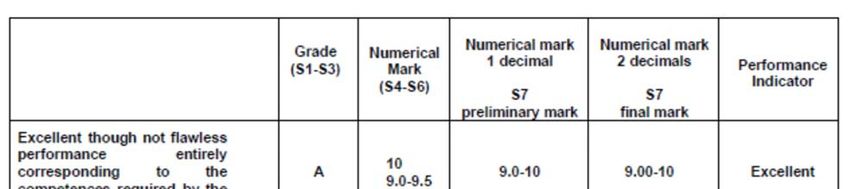
CONTENTS
 Article 1    The European Baccalaureate; Registration and Choices of Examinations           5

 Article 2    The European Baccalaureate Session; Admission                                  6

 Article 3    Uniformity of Examinations                                                     7

 Article 4    Content, Level, Language of Examinations and Other Restrictions                8

 Article 5    The Examining Board and its Responsibilities                                 10

 Article 6    Detailed Rules for Calculation of the European Baccalaureate Mark and
                                                                                           15
              the Organisation of Examinations

 Article 7    Communication of Results                                                     30

 Article 8    Absences                                                                     32

 Article 9    Procedure in the Event of Cheating or Attempted Cheating during
                                                                                           34
              Examinations

 Article 10   European Baccalaureate Diploma and Certificates                              35

 Article 11   Payment of Expenses                                                          37

 Article 12   Complaints and Appeals                                                       38

 Article 13   Additional Written Examination                                               39

 Article 14   Distance Learning                                                            40

 Article 15   Special Arrangements                                                         41

 Article 16   Confidentiality                                                              42

 Article 17   Transitional and Final Provisions                                            43

 ANNEXES
 Annex I      Choices of Examinations in the European Baccalaureate                        44

 Annex II     Definition of the Level of the Languages in which an Examination may be      46
              taken

 Annex III    a) Oral Assessment Record Sheet                                              47

              b) Oral Examinations Mark Sheet                                              48

 Annex IV     Marking in Secondary Year 7 and Calculation of the European                  49
              Baccalaureate Mark

                                           3 / 79                           2015-05-D-12-en-21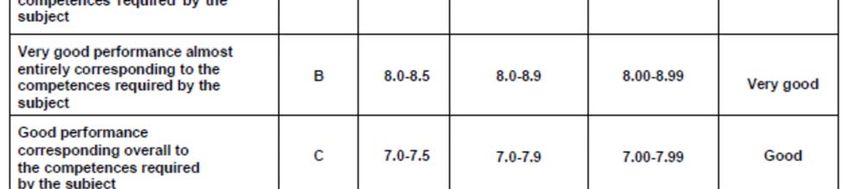
Annex V       a) European Baccalaureate Registration Fee                                   51

              b) Additional Examination Registration Fee                                   52

Annex VI      Additional Examination Application Form                                      53

Annex VII     Procedures for the Requesting of Special Arrangements in the European        54
              Baccalaureate

Annex VIIIa   Non Exhaustive list of Authorized Material for the European                  65
              Baccalaureate Written Examinations

Annex VIIIb   Non Exhaustive list of Authorized Material for the European                  70
              Baccalaureate Oral Examinations

Annex IX      Minutes of the European Baccalaureate Session: Procedure                     72

Annex X       Harmonisation in the European Baccalaureate Cycle                            74

                                          4 / 79                            2015-05-D-12-en-21
ARTICLE 1 — THE EUROPEAN BACCALAUREATE; REGISTRATION
AND CHOICES OF EXAMINATIONS

     1.1 Trade Mark Law Protection
           The name ‘European Baccalaureate’ belongs solely to the European Schools, which, since their
           establishment, have had a monopoly over its use in all the official languages of the European
           Union.

     1.2 The European Baccalaureate Diploma certifies the completion of secondary studies in a
         European School or in a School Accredited by the Board of Governors.1
           The European Baccalaureate Diploma is officially recognised as an entry qualification for higher
           education in all the countries of the European Union.
           The European Baccalaureate Diploma is awarded to successful candidates on behalf of the Board
           of Governors by the Secretary-General of the European Schools.

     1.3 Registration Procedure

    1.3.1 Candidates must register before the 15th of October of their final school year using the form
          attached in annex I.

    1.3.2 Candidates must supply either the original or a certified copy of an official document with their
          personal particulars (birth certificate, certified photocopy of a national ID or passport, etc.)
           At this point, candidates will also provide the School they attend an email address which will be
           expected to remain valid, and at which they may be contacted until the end of their schooling,
           inclusive of the time periods required to handle any complaint or appeal. Any change of email
           address will be communicated to the school without delay.
    1.3.3 The registration fee is payable by the 31st of March of the final school year at the latest (see
          annex V). This fee is not refundable.

    1.3.4 The registration fee will be converted into the currencies of those countries not using the Euro.

     1.4 Choices of Examinations

    1.4.1 Candidates must choose the examinations which they wish to sit at the time of registration.
          Choices are restricted by the dispositions in articles 6.4.1 and 6.5.1. Once made, these choices
          cannot be changed. Schools will input pupils’ choices in the School Management System by the
          20th of October.

    1.4.2 The choices form attached in Annex I will be given to the pupils by the Schools at the end of
          year s6.

1 Accredited European Schools are schools which, without forming part of the network of European Schools set up by the
intergovernmental organisation ‘The European Schools’, offer a European education that meets the pedagogical requirements laid
down for the European Schools but within the framework of the national school networks of the Member States and hence outside
the legal, administrative and financial framework to which the European Schools are compulsorily subject. In this document when
the term “School” is used it refers to both European Schools and Schools Accredited by the Board of Governors.
                                                            5 / 79                                      2015-05-D-12-en-21
ARTICLE 2 — THE EUROPEAN BACCALAUREATE SESSION;
ADMISSION

 2.1 The ordinary European Baccalaureate session shall take place each year during the dates decided
     by the Board of Governors. It is comprised of approximately the last 5 weeks of the school year.
     It begins with the written examinations and ends with the oral examinations followed by the
     communication of results and the European Baccalaureate proclamation.
      The written examinations can be organised during national or local holidays. In this case, the
      Schools affected will ensure that examinations take place normally.
      In certain cases, resitting of examinations may be organized in an extraordinary European
      Baccalaureate session in September (see articles 8 and 12).

 2.2 Prerequisite for Admission to the European Baccalaureate Session
      Except for duly justified reasons, regular and consecutive attendance at classes in years 6 and 7
      of the secondary cycle is a sine qua non condition to be admitted to the European Baccalaureate
      session.
      Pupils must have completed without interruption not less than the final two years of secondary
      education in a European School or in a School Accredited by the Board of Governors.
      The entry procedure and fees shall be determined by the Board of Governors.

 2.3 Retaking the European Baccalaureate when already Awarded
      A candidate who has already been awarded the European Baccalaureate diploma may not repeat
      year s7 nor re-sit the Baccalaureate examinations a second time.

 2.4 Repeating Year s7 when Failed
      A candidate who has failed can only repeat the year s7 once. When repeating, the candidate must
      follow the same subjects as in his first attempt. The only changes allowed are those in
      article 4.2.1.2. However, the candidate can change his written and oral examinations options from
      those he chose the previous year (see art. 6).
      If a candidate fails a second time, exceptionnally he may be allowed to repeat the year a third time
      with the approval of the Director of the School following the recommendation of an extraordinary
      Class Council.

                                                  6 / 79                                2015-05-D-12-en-21
ARTICLE 3 — UNIFORMITY OF EXAMINATIONS
3.1 Uniformity of Examinations
The following can be the subject of written and oral European Baccalaureate examinations:
Compulsory subjects (with the exception of Physical Education and Religion/Ethics)
Options
Advanced subjects
All written European Baccalaureate examinations carry the same weighting.
All oral European Baccalaureate examinations carry the same weighting.
3.1.1 The examinations in Languages 1, 2, 3 and 4 are different in so far as the examination papers are
set with reference to texts in the original languages. However, they must also follow the general
harmonisation framework2 (see annex X).
For all the other written European Baccalaureate examinations, the content of each subject
examination will be the same for all candidates, irrespective of the language section to which
they belong.
3.1.2 In Language 13, basic course, a uniform examination will be taken by all the pupils in the same
language section. The same applies to Language 1, advanced course.
3.1.3 In Foreign Languages4, a uniform examination will be taken in each language and at each level
by candidates from all language sections.
2 See 2015-01-D-18 Harmonisation in the European Baccalaureate cycle
3
See 2014-06-D-5 Proposal for harmonisation of the L1 written examination in the European Baccalaureate
4 See 2015-01-D-33 “Syllabus for all L2 Languages – Main course”, 2010-D-49 “Syllabus for all L3 Languages” and 2016-07-D-12
“Syllabus for all L4 Languages”
7 / 79 2015-05-D-12-en-21ARTICLE 4 — CONTENT, LEVEL, LANGUAGE OF EXAMINATIONS AND
OTHER RESTRICTIONS
4.1 Content of Examinations
The examinations will normally cover the year s7 syllabus, but will also assess the knowledge,
skills and attitudes acquired in previous years, especially in year s6.
4.2 Language and Level
The examination (written and oral) in each individual subject must be taken in the language
and at the level followed in years s6 and s7.
4.2.1 Exceptions:
4.2.1.1 If a course is taught in more than one language in a class, a candidate may choose to sit the
examination in any one of the languages used. This will be clearly indicated in the registration
form (annex I). The Schools will introduce it into the School Management System (by the 20th
of October). Once the choice of language is introduced, it will not be changed.
4.2.1.2 Between s6 and s7, only the following changes of level are possible:
Mathematics 5 ↔ Mathematics 3
4-period option ↔ Compulsory 2-period course (same subject)
A change to a more advanced course (Mathematics 5, 4-period option) is conditional upon the
passing of an attainment test demonstrating the pupil’s ability to keep up successfully with the
requirements of the course requested.
4.2.1.3 Requests for changes, in respect of both language (article 4.2.1.1) and level (article 4.2.1.2),
submitted at the end of year 6 must be also accompanied by the Class Council’s opinion. They
will be examined by the Director, who will decide.
4.2.1.4 Pupils following a subject in s7 in a different language from the one they followed it in s6, due
to a change of school between year s6 and s7 or staffing imperatives, will take their
examinations in the language they are taught in s7. However, upon request, the Director may
allow a pupil to take an examination in the language the subject was followed in s6. In this
case, internal assessment cannot be assured by either the s6 in the previous school or the current
s7 teacher and a second external examiner may be appointed by the Director of the School in
consultation with the Inspector responsible for the subject and the European Baccalaureate
Unit. In both cases, the provisions in 6.4.6.8 will apply.
4.2.1.5 All changes must comply with the administrative provisions in force.
8 / 79 2015-05-D-12-en-214.3 Other Restrictions
4.3.1 The substitution of one option for another is not permitted.
4.3.2 Dropping an option, advanced course or complementary subject between year s6 and s7 is
possible, provided that there is compliance with the administrative provisions, more particularly
the minimum number of periods required, i.e., 31 (minimum 29 periods of compulsory subjects,
options and advanced courses + minimum 2 periods complementary subject)
4.3.3 Adding a new option, advanced course or complementary subject in year s7 is not allowed.
4.4 Information for the Pupils
Pupils must be informed of the provisions in this article at the time when they make their
choices, on going into year 6.
9 / 79 2015-05-D-12-en-21ARTICLE 5 — THE EXAMINING BOARD AND ITS RESPONSIBILITIES
5.1 Members of the Examining Board
The members of the Examining Board are:
The internal examiners, i.e., the teachers who have taught the subjects which the pupil
has chosen to take in the European Baccalaureate examinations
The external examiners from the Member States appointed by the Board of Governors
on proposal by the Inspectors
The Director of the European School. In case of an Accredited School, either the
Director or the competent authority in the Member State concerned
A Chairman and Vice-Chairmen
The Examining Board shall be chaired by a teacher from higher education, who shall be
appointed by the Board of Governors on a proposal from the appropriate authorities of the
country whose turn it is to assure the Chairmanship.
The Inspectors representing each country on the Board of Inspectors (Secondary) shall, in the
capacity of Vice-Chairmen, assist the Chairman. At least one Vice-Chairman shall be assigned
to each examination centre in order to replace the Chairman when he is unable to attend.
The members of the Examining Board shall exercise the greatest discretion and treat anything
which takes place during the examination proceedings as confidential.
The Board of Governors shall determine the responsibilities of the members of the Examining
Board.
5.2 Chairman of the Examining Board
The written examination papers are set under the responsibility of the secondary cycle
Inspectors. They are submitted to the Chairman of the Examining Board for approval.
The Chairman of the Examining Board:
Opens the examination session
Ensures the quality control of the organisation of the European Baccalaureate. To that end,
a structure of the organisation of the European Baccalaureate is put in place annually on a
proposal from the Secretary-General, prepared by the European Baccalaureate Unit
(European Baccalaureate Memorandum), and approved by the Board of Inspectors
(Secondary)
Proposes the external auditor(s) for the subject examinations decided by the Board of
Inspectors to be submitted to a University Observation
May at any moment during the session have access to documents relating to the candidates
Convenes the Examining Board at his convenience
Adjudicates on matters where disputes arise, in the context of complaints and appeals
Ensures standardised assessment (moderation) of the European Baccalaureate written
examinations
Takes the decisions which he deems fair and equitable, including cases of cheating,
attempted cheating or clear mismatch between a question and the syllabus of a subject
Closes the European Baccalaureate examination session
Sends the Secretary-General of the European Schools a detailed report on the European
Baccalaureate session which he chaired
May award exceptions in duly justified reasons to the conditions set in article 2.2
10 / 79 2015-05-D-12-en-215.3 Vice-Chairmen
Secondary Inspectors are required to act as Vice-Chairmen. They:
Assist the Chairman in his duties
Replace the Chairman if he is absent, in which case, they assume his powers
5.4 Experts and External Examiners
The experts and external examiners are appointed by the Board of Governors on proposal of the
European Schools Inspectors (secondary). National Inspectors and Inspectors responsible for
the different subjects will seek agreement in the process of appointment.
Members of the staff of the European Schools or of Schools Accredited by the Board of
Governors cannot be appointed as experts or external examiners. However, former members of
the staff can be appointed provided they have no conflict of interest with the European Schools
(see article 5.8 bias).
They shall be appointed after careful consideration of their references, qualifications and
expertise in one or more subjects.
5.4.1 Experts
Experts are in charge of the elaboration of the written examination papers under the guidance
and coordination of the Inspectors responsible for each subject. Experts also assure the different
language versions of the papers. The written examination papers are elaborated from the
proposals sent by the Schools, which can be adapted and/or complemented by the experts.
Experts may also include in the examination papers questions written by them (see article 6.4.3).
Experts must produce a detailed report in order to give feedback to the teachers concerning the
quality and suitability of their proposals. This is part of the quality assurance process. The report
is transmitted by the Inspector to the European Baccalaureate Unit for distribution to the Schools
once the European Baccalaureate session is over.
Expert’s profile:
Qualified subject specialist
Preferably currently employed in his national system or left it a maximum of 5 years
ago
Relevant examination experience in the setting of upper secondary leaving examinations
Command of 2 languages of the European Schools among DE, EN or FR, for all
subjects, and command of 1 language of the European Schools among DE, EN or FR
for language experts
Computer literate
Access to the internet, via a broadband (or faster) connection
Ready to work through collaborative e-platforms
11 / 79 2015-05-D-12-en-215.4.2 External examiners
External examiners carry out the second correction of written examination scripts and/or
participate in the assessment of oral examinations. In the oral examinations external examiners
enjoy equal status with the subject teacher and must question the candidates.
External examiner’s profile:
Experienced teacher in the subject
Preferably currently employed in his national system or left it a maximum of 5 years ago
Experience in the correction of upper secondary leaving examinations
Meets the conditions in his country of origin regarding the appointment of members of
an equivalent examining board
Command of at least 1 of the languages of the European Schools among DE, EN or FR
Computer literate
Access to the internet, via a broadband (or faster) connection
Ready to work through collaborative e-platforms and online marking systems
5.4.2.1 The Office of the Secretary-General of the European Schools will send the external examiners
a copy of the “Regulations of the European Baccalaureate”, the “Arrangements for
Implementing the Regulations for the European Baccalaureate”, the syllabuses of their
examination subjects, the assessment criteria, marking instructions and other relevant
documents when informing them of their appointment.
5.4.2.2 At the end of the examination session, the external examiners must write a report containing
comments on the written and oral questions in the subjects they have examined.
These reports will be forwarded to the Office of the Secretary-General of the European Schools
by the 1st of August. The Office of the Secretary-General of the European Schools will upload
them to a secure e-platform for the attention of:
The Inspector responsible for the subject
The Inspector of the external examiner’s nationality
The Director of the School concerned, who makes the content of the report available to the
candidates’ teachers
5.4.2.3 The appointment of experts and external examiners can be prolonged for a maximum of
10 European Baccalaureate sessions. However, yearly extensions can be granted on a positive
performance review by the appointing inspector.
12 / 79 2015-05-D-12-en-215.5 Director of the School
5.5.1 He is responsible for:
The quality assurance of Pre-Baccalaureate examinations in his School
The practical arrangements for the European Baccalaureate examinations in his School’s
examination centre
Passing on the written proposals and the oral examination questions to the Office of the
Secretary-General of the European Schools
Making the oral examination questions available to the Chairman and/or Vice-Chairman
assigned to his School and to the external examiners
The conduct and organisation of the invigilation of the written and oral examinations
Keeping the written papers and the questions set for the oral examinations in the School
for 3 years. This also concerns Pre-Baccalaureate examinations (long and short)
contributing towards the European Baccalaureate mark (see also article 6.4.6)
Preparing and signing the minutes of the European Baccalaureate session in his School
Forwarding the minutes of the European Baccalaureate session to the Secretary-General of
the European Schools. The minutes of the European Baccalaureate session will be prepared
following the structure in annex IX5
The consultation of the examination scripts after their marking, in compliance with
article 6.4.10
5.5.2 The Director should render every possible assistance to the Chairman and Vice-Chairmen of
the Examining Board.
5.5.3 At the request of the Office of the Secretary-General of the European Schools and in agreement
with the Inspector responsible for the subject in question, the Director may need to propose
external examiners or replacement for internal examiners in case of absence or within the
circumstances and provisions described in article 5.8.
5.6 Internal Examiners
The internal examiners, who are the candidates’ subject teachers, carry out the first correction
of the written examination scripts.
They propose the questions for the oral examinations. These questions will be communicated
to the relevant Inspectors by the 15th of March of the year of the current session.
In the oral examinations, the internal examiners will question the candidates together with the
external examiners.
5.7 Other Responsibilities of the Examining Board
See articles 6, 7, 8 and 9 of these Arrangements.
5 See 2012-09-D-41 Minutes of the European Baccalaureate – Procedure
13 / 79 2015-05-D-12-en-215.8 Bias
5.8.1 The legal representatives and the relations of a pupil in s7 working for the European Schools
must not be involved in the European Baccalaureate preparation or proceedings, for this pupil.
They are not allowed to correct his European Baccalaureate examinations or to orally examine
this candidate. This applies to all his examinations (Pre-Baccalaureate examinations, short and
long, and Baccalaureate examinations both written and oral).
5.8.2 The examination centres will communicate to the Office of the Secretary-General of the
European Schools all such cases and the replacements to fulfil their tasks.
5.8.3 Should the examination centre not have another specialist subject teacher available, the Office
of the Secretary-General of the European Schools will undertake to provide the name of a
teacher in the European Schools or an external expert who would be able to guarantee the
preparation of the examinations and the correction and marking of the script(s) of the candidates
concerned only.
5.8.4 The Board of Inspectors (Secondary) will be informed of these special cases at its autumn
meeting and will be invited to approve the replacements proposed.
5.8.5 Such special cases will be brought to the attention of the Chairman or Vice-Chairman of the
Examining Board before the examination session begins.
14 / 79 2015-05-D-12-en-21ARTICLE 6 — DETAILED RULES FOR CALCULATION OF THE
EUROPEAN BACCALAUREATE MARK AND THE ORGANISATION OF
EXAMINATIONS
6.1 Final Marks
Within the framework of the new marking scale entering into force at the European
Baccalaureate session 2021, decimal marks will be used. The overall average preliminary mark
in year 7 will be expressed with whole numbers and one decimal and the overall final mark in
year 7 will be expressed with whole numbers and two decimals. (Annex IV)
6.1.1 The final overall European Baccalaureate mark is expressed out of one hundred (100) and is
accurate to two decimal places. The following 3 factors are taken into consideration for the
calculation of the European Baccalaureate final mark:
The average preliminary mark C expressed out of 100
The average written examinations mark W expressed out of 100
The average oral examinations mark O expressed out of 100
C, W and O are expressed as numbers with one decimal place.
6.1.2 The proportion of the final total mark for the examination allotted to the various parts will be
as follows:
50 percent for the average preliminary mark C
35 percent for the average W for the written examinations
15 percent for the average O for the oral examinations
Final result = 0.50 C + 0.35 W + 0.15 O
All marks are expressed as a mark accurate to one decimal place.
6.1.3 The mark for each subject in the school report will thus be calculated as follows:
C x 0.5 + W x 0.35 + O x 0.15
(C x 0.5 + W x 0.35) / 0.85 as the case may be
(C x 0.5 + O x 0.15) / 0.65
C
Mid-semester reports issued in s7 should indicate marks with only half-marks.
6.2 Preliminary Mark
The preliminary mark (C mark) is made up of the following:
Class marks (A marks)
Part examination marks (B marks).
6.2.1 Class Marks: A marks (Formative assessment)
They will account for 20 marks out of 50 for purposes of calculating the preliminary mark
(C mark). A class mark will be given for each subject taken in year s7 at the end of each
semester.
These marks must reflect the candidates’ performance in class work. The class mark for the
year will be the arithmetical average of the two A marks given by the subject teacher at the
end of each semester.
The A marks of Ethics/Religion will not be considered for the calculation of the preliminary
and final marks.
15 / 79 2015-05-D-12-en-216.2.2 Marks for the Part Examinations (Pre-Baccalaureate): B marks (Summative assessment)
They will account for 30 marks out of 50 for purposes of calculating the preliminary mark
(C mark). A mark will be given for each subject on the basis of the results obtained in the part
examinations.
For Ethics/Religion and complementary subjects the B mark may be based either in the results
obtained in examination(s) or in other assessment methods prescribed in the syllabus of the
subject. The B marks of Ethics/Religion will not be considered for the calculation of the
preliminary and final marks.
6.3 The part examinations (Pre-Baccalaureate) will be organised as follows:
6.3.1 A set of short written examinations
a) In Philosophy (2 periods) and in Mathematics Advanced course: a short written examination
will be organised as part of the normal school week at the end of each semester. The time
allowed will be 2 consecutive teaching periods. The final B mark will be the arithmetical
average of the 2 semester B marks.
b) In Biology, History and Geography (all with 2 periods a week) either the same as above in
point a) or 2 short written examinations lasting 1 teaching period will be organised as part of
the normal timetable in the course of each semester. The final B mark will be the arithmetical
average of the 4 semester B marks.
c) For complementary subjects, either the same as above in points a) or b) or through other
assessment methods prescribed in the syllabus of the subject.
6.3.2 A set of long written examinations which will be organised over a maximum of 10 working
days at the end of the first semester, i.e., at least 2 weeks after the Christmas holidays. All the
subjects in which a written examination may be taken in the European Baccalaureate will be
examined, i.e.:
Language 16
Language 1 Advanced if followed by the pupil
Language 27
Language 2 Advanced if followed by the pupil
Mathematics (3 and 5 periods)
All options being followed by the pupil (4 periods)
Every pupil will be examined in each of the courses listed above s/he is following.
The time allowed will correspond to that for the written examination in the European
Baccalaureate.
Candidates can be required to sit a maximum of two 3-hour examinations per day. There must
be a minimum break of 1 hour between the two examinations. Any extra time which candidates
with special needs may be allowed for each examination is not considered part of the official
examination time and does not, therefore, extend its official length.
6 A definition of the level of the languages is given in annex II to this document.
7 A definition of the level of the languages is given in annex II to this document.
16 / 79 2015-05-D-12-en-216.3.3 For Physical Education the following arrangements will apply:
The B mark shows the results of the assessment held at the end of each unit of instruction
Assessment will be purely practical, involving no written work of any kind
6.3.4 Pre-Baccalaureate examinations must be harmonised8 within each School. The assurance of
their quality is primarily the responsibility of each School. The management of each School
through the subject coordinators or subject referents will ensure that all Pre-Baccalaureate
examinations are original, harmonised and adjusted to the syllabuses.
6.3.5 Any information about the contents of the Pre-Baccalaureate examinations that could
jeopardize the fairness, validity and/or reliability of the examinations must not be disclosed.
Preparation of pupils for the pre-Baccalaureate examinations must not be done by using
identical or nearly identical tasks to those that will appear in the examinations.
Should a breach of examination confidentiality occur, confirmed by irrefutable evidence, the
School management will consult the Inspectorate and the Office of the Secretary-General of
the European Schools about the measures to be taken.
Possible measures could include assessment moderation (eliminating one or more questions,
adapting marking instructions, remarking, etc.) or establishing a re-examination for all or some
of the pupils.
Disciplinary measures can also follow whenever it is proven that there has been an intentional
breach of the regulations.
The School management will propose the measures and see to their implementation, once the
Secretary-General of the European School has given his approval.
6.3.6 The assessment of the Pre-Baccalaureate examinations will be harmonised within each School.
Clear assessment criteria and marking instructions will be agreed for each Pre-Baccalaureate
examination. Suggested answers may also be produced.
6.3.7 Correction of the Pre-Baccalaureate examinations
The Pre-Baccalaureate examination scripts are submitted to one single correction, by the
teacher who taught the subject to the candidate (with exception laid in Art. 5.8).
For correction purposes, teachers may use the original scripts, correction grids, scanned copies
of the scripts or photocopies of the scripts.
Shall they wish to correct on the original scripts, they should use a pen of a different colour
that the one(s) used by the pupil. Prior to being corrected, the original scripts shall be scanned
or copied so that the examination centre is able to provide the original version, as delivered by
the pupil, of the corrected scripts, at any time.
The final mark of the script will be entered into the System under the School management
responsibility.
6.3.8 Standardised assessment (moderation) of the Pre-Baccalaureate examinations may be ensured
by the School management in consultation with the Inspectorate and the Office of the
Secretary-General of the European Schools.
8 2015-01-D-18 “Harmonisation in the European Baccalaureate cycle” (annex X)
17 / 79 2015-05-D-12-en-216.3.9 The part examination scripts (short and long) will be filed so that the Examining Board may
refer to them. The Schools will keep them for 3 years. Should a complaint or appeal be lodged
with the Complaints Board, all documents relating to the complaint must be retained until such
time as a final ruling has been given.
6.3.10 Viewing of part examinations (Pre-Baccalaureate)
The candidates, or their legal representatives if the candidates are minors, have the right to
view and get a copy of:
Their original Pre-Baccalaureate scripts
The mark awarded, potential annotation and sub-marking
The examination paper
The marking scheme.
Any documentation made available to candidates will, in the case of those parts containing
information about other candidates, be made anonymous.
The request must be made in writing to the Director of the School not later than 4 calendar
days after the date that shows on the semester report.
The Director will make all documents available not later than 3 calendar days after receipt of
the request. The Director may decide to make all documents available only through a secure
electronic form.
A belated request for the viewing of the examination papers will be inadmissible.
6.4 Written European Baccalaureate Examinations
6.4.1 Number and nature of written examinations
6.4.1.1 Candidates will sit 5 written examinations:
1. Language 1 or Language 1 Advanced
2. Language 2 or Language 2 Advanced
3. Mathematics (5 periods) or Mathematics (3 periods)
4. Option (4 periods)
5. Option (4 periods)
6.4.1.2 Restrictions for compulsory subjects and for options
Written examinations 1 and 2:
Candidates who have chosen to follow an advanced course in Language 1 and/or in Language
2 will be required to sit a written examination on that course, and not, therefore, on the basic
course in the subject.
Written examinations 4 and 5:
The choices of options will have to be made at the time of registering for the examination. The
choices cannot be changed during the school year.
Candidates who choose ONL cannot choose L4.
18 / 79 2015-05-D-12-en-216.4.2 Time allowed for written examinations
Language 1 4 hours
Language 1 Advanced 4 hours
Language 2 Advanced 4 hours
5-period Mathematics 4 hours9
Art 5 hours10
Philosophy 4 hours
All other subjects 3 hours
6.4.3 Proposals for examination questions
6.4.3.1 For each subject in the written examinations, the Schools designated by the Office of the
Secretary-General of the European Schools, including Accredited European Schools as from
their third participation to the Baccalaureate session, will prepare examination proposals. By
way of a derogation, during their first two Baccalaureate sessions, Accredited European
Schools will be invited to hand in literary and scientific proposals with no binding commitment
to deliver them. For the purpose of this provision, the Schools will already ensure compliance
with article 5.8 (Bias).
The proposals will be uploaded to a secure e-platform in order to make them available to the
Inspectors and the experts by the 15th of November at the latest. Instructions as how to label
the proposals can be found on the platform.
Should an examination be organised in only one School, it is particularly important to find
ways of guaranteeing the credibility and objectivity of the examination. When possible, even
if a subject is taught in only one School, at least two Schools should submit proposals. When
the other Schools do not have subject specialists for that particular examination, the external
experts can also prepare the full examination or part of the examination themselves under the
guidance of the Inspector responsible for the subject.
6.4.3.2 Proposals will be submitted in all the languages in which the subject is taught in a School from
EN, FR and DE. The original language has to be clearly indicated for each question in the
proposal.
Proposals in a different original language will be submitted with a translation in either EN, FR
or DE. The necessary translations will be made by the teachers in the School concerned.
6.4.3.3 The proposed questions must be typed on a computer and presented in an editable file format
and in such a way that, if chosen, the texts, tables, diagrams, figures and formulas which they
contain can easily be easily opened in a word processing text software and used in setting the
examination paper.
Proposals will be typed in font Arial 12 (Formulas may also be typed in Times New
Roman 12).
Source texts will be properly referenced, indicating author, year of publication, work, publisher
and/or URL address if the source is web-based.
9 For details concerning the Mathematics examinations, reference should be made to document ‘2010-D-441-en’, approved by the
Board of Governors at its meeting of 14-16 April 2010.
10 For details concerning the Art examinations, reference should be made to document ‘2009-D-579-en’, approved by written
procedure 2009/34 on the 13th of November 2009.
19 / 79 2015-05-D-12-en-216.4.3.4 Each School is bound to secrecy with regard to its own examination proposals. Schools may
not inform each other of the questions they have submitted to the Inspectors.
The members of the staff of each School and of the Office of the Secretary-General of the
European Schools and the members of the Examining Board shall be bound to secrecy with
regard to matters concerning the examination proposals.
6.4.3.5 Questions which are not selected may only be used in class after the next European
Baccalaureate session is over.
6.4.4 Elaboration of the European Baccalaureate examination papers
6.4.4.1 The Inspectors will decide on the original language of the examination papers.
The experts will provide one main paper (in all necessary language versions) and the number
of reserve papers established by the European Baccalaureate Unit by the 15th of March.
Reserve papers will only be provided in the necessary language versions.
The whole reserve paper or part of it that has not been used may be re-used for the main or
reserve paper(s) of the next European Baccalaureate session.
6.4.4.2 The time allowed for the examination paper and the number of questions to be answered will
be indicated on the examination papers.
Marking instructions and marking grids will be provided for each paper. They shall be
accompanied by suggested answers for all scientific subjects and all others, where a specific
answer is required. For each question on the examination main and reserve papers the
allocation of marks must be indicated.
6.4.4.3 The special provisions for each subject will be determined by the Board of Inspectors
(Secondary). These provisions will be communicated to the Schools. The list of the equipment
which candidates will be permitted to use during the examinations can be found in annex VIII
of this document.
6.4.4.4 Translations
Examination papers will only be translated into those languages in which the examination will
be taken.
If translations of questions into all the languages required have not been sent, these will be
done, preferably by qualified members of the European Baccalaureate Examining Board, under
the responsibility of the Inspectors for the languages concerned. If necessary, the translations
can be done by other specialists from the countries concerned.
20 / 79 2015-05-D-12-en-216.4.4.5 External auditing
The external auditing of draft examination papers is an optional layer of quality assurance.
The Board of Inspectors will decide which subject(s) will be submitted to the auditing.
The external auditing of the examination papers will be performed by independent experts with
experience in the field of assessment or elaboration of secondary school-leaving examinations
or entrance examinations to higher education studies. This process is referred to as “University
Observation”.
The Chairman of the European Baccalaureate session will propose the external auditor(s) (see
article 5.2).
A fit for purpose report will be issued. After the external auditing, the inspectors (and the
main experts) will still have the possibility to adjust the draft papers.
6.4.5 Beginning of the written examinations
6.4.5.1 The written examinations will start at 9.00 or at 14.00 C.E.T.
6.4.5.2 The examination papers will be sent in sealed envelopes. The envelopes will only be opened
30 minutes before the examination starts. However, the separate envelope containing the
storage media with the Music exam files can be opened 2 hours prior the beginning of the
examination so that the files can be copied to the players or computers with ample time. The
Schools will ensure that they have in place the most adequate tools and resources to perform
this action and will guarantee that the contents of the storage media are not disclosed until the
examination begins.
All envelopes will be opened in the presence of the Vice-Chairman and/or the Director of the
School. Should the Vice-Chairman be absent, the Director will designate another person to
replace him. The Deputy Director will replace the Director in the case of bias (see article 5.8)
Two people must be always present at the opening of the envelopes and the preparation of the
files.
6.4.6 Proceedings of the written examinations
6.4.6.1 Candidates who arrive late to a written examination may not be admitted. If there is a valid
reason for a candidate’s late arrival, the Chairman or the Vice-Chairman of the Examining
Board or the Director of the School will decide whether he may nevertheless be admitted and
whether he may possibly be allowed extra time for this examination paper.
6.4.6.2 Candidates are only allowed to write on the paper provided by the School for their work, i.e.,
the paper for the script and the paper for rough work. Rough paper will not be corrected.
6.4.6.3 Candidates may only take into the examination room the permitted equipment listed on the
cover page of each examination paper.
6.4.6.4 The possession of mobile phones, watches, smart watches and technological devices in the
examination room is not allowed (unless specified in Annex VIII). The possession of such
previously mentioned material will be considered as cheating (See Article 9).
21 / 79 2015-05-D-12-en-216.4.6.5 Pencil can only be used on graph paper, partitions, art work, etc. as indicated in the cover page
of examinations. Scripts must be written with blue or black ballpoint pens or rollerball pens.
Text written in pencil will not be corrected.
6.4.6.6 Correction fluid or erasable pens are not allowed. To correct mistakes, candidates must simply
neatly cross out with the help of a ruler.
6.4.6.7 When the examination paper provides several questions, candidates must indicate clearly which
question they are answering.
6.4.6.8 A candidate who has followed in a foreign language a course normally taught in his Language 1
(or language of the section for SWALS pupils) but not organised in this language in the School
attended may use, upon request, a bilingual dictionary (Language 1 / Language of the section
↔ Language of the course) during the written examination. The dictionary will be provided by
the School.
A SWALS pupil who enters the European Schools in year 6 may also have 2 examination
papers, one in his Language 1, the other in the language in which the course has been followed.
This request will be made at the time of registration, by the 15th of October, indicating it in the
form provided in annex I.
In all cases, candidates are required to answer the examination questions in the language in
which they followed the course (With the exception laid in Article 4.2.1.4).
This applies also to short and long part Pre-Baccalaureate examinations.
Translations of Pre-Baccalaureate examinations will be made by the Schools when they have a
competent staff member in the language required. Should that not be the case, they will be
requested to the European Baccalaureate Unit at least 20 days before the date the examination
will take place.
6.4.7 Invigilation of the written examinations
The written examinations shall be conducted under continuous invigilation arranged by the
Director of the examination centre of the European School or, in the case of a School Accredited
by the Board of Governors, the competent authority in the Member State concerned.
The number of invigilators will be 1 every 25 candidates. In any case, the minimum number of
invigilators will always be 2.
Invigilators will remind the candidates of the importance of filling in properly all personal
details in all the headers of the examination paper, numbering the used pages correctly and
arranging them in the right order when handing in the scripts.
Invigilators will check the candidate’s scripts when they are handed in. To this end, the number
of invigilators should be increased in the last 10 minutes of every examination.
6.4.7.1 Invigilation in the examination room will be carried out by teachers and supervisory staff who
do not teach the candidates in the subject being examined, with the exception of Art.
6.4.7.2 Invigilators must focus their attention on the candidates at all times. The use of mobile phones
in the examination room is not allowed.
6.4.7.3 Invigilators may not answer any questions from candidates relating to the examination.
However, they may give any information which has been authorised by the Vice-Chairman of
the Examining Board or the Director of the School.
22 / 79 2015-05-D-12-en-216.4.8 End of the written examinations
6.4.8.1 A candidate who wishes to hand in his script early may not leave his seat until his script has been
accepted by an invigilator. Once having handed in his script and left the examination room, the
candidate cannot return to it while the examination is still being held.
6.4.8.2 Candidates shall adopt an appropriate behaviour so as to not disturb the other candidates sitting
in the same examination room. So as not to disturb the conclusion of the examination, candidates
may not leave their seats during the last 10 minutes.
6.4.8.3 The time appointed for the end of the examination must be strictly adhered to. Candidates must
take care to hand in all pages of their scripts at the time appointed for the end of the examination.
No page handed in later will be accepted: no extra part of his/her script will be taken into
consideration / accepted by the invigilators after the candidate has left the examination room.
Rough paper must not be turned in. Schools should be able to provide evidence of the time of
leaving of the candidates.
6.4.8.4 Before a candidate hands in his script, he must check that the questions he has answered have
been clearly indicated on the script. Candidates must also check that all the headers of the
examination paper have been properly filled in, that all the used pages have been correctly
numbered and that all A3 sheets have been arranged in the right order from the first used (outside)
to the last used (inside). Graph paper sheets always come last.
6.4.8.5 After the end of the examination, candidates may take the rough paper and the examination
papers with them.
6.4.9 Correction of written European Baccalaureate examination scripts
6.4.9.1 Scripts will be scanned in each examination centre, anonymised and corrected with an on-line
correction tool. No visible marks may be made on the paper scripts.
Art and Music written examinations will not be anonymised so that the written part of the
examination can be related to the artwork and music portfolios of the candidates. However, the
marks for all parts of the Art and Music examinations will be introduced in the on-line correction
tool. As to the Music portfolio, the schools will communicate to the European Baccalaureate Unit
a link for its deposit, easily accessible to all the correctors.
The link to the Music portfolio needs to be communicated to the European Baccalaureate Unit
before the start of the European Baccalaureate session according to the instructions from the
European Baccalaureate Unit. After the link has been provided, candidates may continue to
update the content of their portfolio until the day of the examination.
The absence of portfolio shall be considered, for the pupil, as an absence to the examination
within the meaning of Article 8.1.
6.4.9.2 The written examination scripts are subject to double correction. On one hand, by the teacher
who taught the subject to the candidate and, on the other hand, by an external corrector.
23 / 79 2015-05-D-12-en-216.4.9.3 Scripts will be marked on a scale of 0 to 10. The final mark for a script will be the average of
the mark awarded by the teacher and the mark awarded by the external corrector.
However, in the case of a mark disagreement between the teacher and the external corrector of
over 2 points, a third corrector (external) will be involved.
In this case, account should be taken of the following instructions:
a) When correcting a script, the third corrector should be in possession of the marks awarded
and commentaries made by the first two correctors
b) The mark given by the third corrector must be within the range of the marks awarded by the
other two, and must be accompanied by a justifying commentary (see art. 6.4.9.5)
c) The final mark will be the one awarded by the third corrector
d) All the correctors will be informed of each other’s commentaries.
6.4.9.4 All correctors (teachers / external) will correct and mark the scripts following the assessment
criteria and marking instructions established by the relevant Inspectors. The marks will be
introduced in the on-line correction tool.
The on-line correction tool allows the use of correction signs and annotations. They are inserted
as a superimposed layer, i.e., the script remains blank. Correction signs and annotations are
personal and only accessible by each individual corrector, the corresponding pedagogical
supervisors (inspectors responsible for the different subjects) and the administrator of the on-
line correction tool (European Baccalaureate Unit).
In compliance with their duty of discretion and confidentiality, the teachers and the external
correctors may not be in contact to exchange information about their correction and marking.
6.4.9.5 All correctors (teachers and external) will complete the correction of each individual script with
a commentary justifying the mark awarded (i.e. explaining how the mark awarded is in
compliance with the marking criteria, whether specifically referring to a question and/or to the
examination script as a whole). Commentaries will also be introduced in the on-line correction
tool.
6.4.9.6 External correctors will correct from distance. They may also finalise their corrections at an
established correction centre for a maximum of 2 days, if requested by the inspector responsible
for a subject.
6.4.9.7 Standardised assessment (moderation) of the European Baccalaureate written examinations is
ensured by the Chairman of the Examining Board and/or by the Vice-Chairmen.
6.4.9.8 Subject teachers will not be informed of the candidates’ final marks or of the commentaries until
the communication of results (see article 7).
6.4.9.9 The electronic archives from the on-line correction tool will be filed and stored in the Office of
the Secretary general for at least 3 years.
The paper examination scripts will be filed and kept in the School for at least 3 years.
Should a complaint or appeal have been lodged with the Complaints Board, all these elements
must be kept until a final ruling has been given by the latter.
24 / 79 2015-05-D-12-en-216.4.10 Viewing of the European Baccalaureate scripts after marking
The candidates or their legal representatives, if they are minors, have the right to view and get
a copy of:
Their original script
The final mark awarded to the examination script (average of first and second
corrector mark and, where applicable, third corrector mark)
The mark (potential sub-marking) awarded by each one of the correctors (first
corrector mark, second corrector mark and, where applicable, third corrector mark)
The correctors’ commentaries
The examination paper
The marking scheme
The request must be made in writing to the Director of the School not later than 4 calendar days
after the candidate has been informed of the examination results, communicated in accordance
with article 7.3.
The Director will make all documents available not later than 3 calendar days after receipt of
the request. The Director may decide to make all documents available only through a secure
electronic form.
A belated request for the viewing of the examination papers will be inadmissible.
6.5 Oral European Baccalaureate Examinations
6.5.1 Number and nature of oral examinations
6.5.1.1 Candidates will sit 3 oral examinations. The subjects in which an oral examination will or may
be taken are:
1. Language 1 or Language 1 Advanced
2. Language 2 or Language 2 Advanced, or
History (2 or 4 periods), or
Geography (2 or 4 periods)
3. Mathematics Advanced, or
Philosophy (2 or 4 periods), or
Language 3, or
Language 4, or
ONL, or
Biology (2 or 4 periods), or
Chemistry (4 periods), or
Physics (4 periods)
25 / 79 2015-05-D-12-en-216.5.1.2 Restrictions for compulsory subjects and for options
Examination 1: Language 1 or Language 1 Advanced
Candidates who have followed the advanced course will be required to sit an oral examination
on that course, and not, therefore, on the basic course.
Examination 2: Language 2 or Language 2 Advanced or Geography or History
Candidates who have followed the Advanced Language 2 course and who wish to choose L2
for their second oral examination will be required to sit an oral examination on that advanced
course, and not on the basic course.
The candidates who do not wish to sit an oral examination in Language 2 (basic or advanced
course) will sit an oral examination in History (2 or 4 periods) or Geography (2 or 4 periods). It
is possible for candidates to sit the History or Geography oral examination provided that they
have not chosen to sit the subject in question as a written examination.
Examination 3:
Candidates who have followed the advanced course in Mathematics will be compulsorily
examined on that course.
Candidates who have not followed the advanced course in Mathematics will be required to sit
an examination in one of the options listed above, which they may choose freely, provided that
they have not already chosen to take the subject in question as a written examination.
Candidates who choose the ONL cannot choose L4.
6.5.1.3 A candidate who has followed in a foreign language a course normally taught in his Language 1
(or language of the section for SWALS pupils) but not organised in this language in the School
attended may use, upon request, a bilingual dictionary (Language 1 / Language of the section
↔ Language of the course) during the preparation of the oral examination. The dictionary will
be provided by the School.
A SWALS pupil who enters the European Schools in year 6 may also have 2 oral questions, one
in his Language 1, the other in the language in which the course has been followed. This request
will be made at the time of registration, by the 15th of October, indicating it in the form provided
in annex I.
In all cases, candidates are required to answer in the language in which they followed the course
(With the exception laid in Article 4.2.1.4).
Translations of oral questions will be made by the Schools when they have a competent staff
member in the language required. Should that not be the case, they will be requested to the
European Baccalaureate Unit before the 15th of March.
6.5.2 Time allowed for oral examinations
Oral examinations will last 20 minutes, plus 5 minutes for the marking which will take place
immediately after each oral examination. Before each oral examination candidates will be
allowed preparation time immediately prior to their examination. This time including the time
needed to proceed to the examination room and to pick the question will not exceed 25 minutes.
26 / 79 2015-05-D-12-en-216.5.3 Oral Examination questions
6.5.3.1 Oral practice should be organised in class all through the European Baccalaureate cycle (s6-
s7).
Preparation of pupils for the oral examinations must not be done by using identical or nearly
identical questions to those that will appear in the examinations.
The school management will assure fair and equivalent treatment of all pupils.
6.5.3.2 The oral examination will be based on questions and working documents which candidates
will draw from the pool provided.
The examination questions will be proposed by the subject teacher: All questions proposed
must be syllabus-relevant. The range of questions proposed must cover all elements of the
syllabus or the relevant competences as prescribed in it.
There will be the same number of questions as candidates plus 5. However, for large groups
(equal or over 15 pupils), the number of questions will be limited to 20. Each question will be
numbered.
The members of the staff of each School and of the Office of the Secretary-General of the
European Schools and the members of the Examining Board shall be bound to secrecy with
regard to matters concerning the examination proposals.
6.5.3.3 The examination questions will be handed in by the subject teachers to the Director of the
School before the 15th of March.
They can be accompanied by a separate document with suggested answers or content outlines.
6.5.3.4 All questions and working documents must be clearly legible and/or visible, i.e. clearly typed,
be good photocopies or scanned images.
6.5.3.5 The Director of the School will be responsible for forwarding electronically the examination
questions to the Office of the Secretary-General of the European Schools, in order to make
them available to the Inspectors and the external experts through a secure e-platform by the
15th of March. Instructions as to how to label the proposals can be found on the platform.
6.5.3.6 The Inspector or the external examiners may ask the teachers to change or withdraw one or
more questions before the examination begins if they do not fit the requirements.
6.5.3.7 The Schools will keep a complete list of the questions from which candidates may choose at
the disposal of the Chairman or of the Vice-Chairman of the Examining Board. The questions
will be kept in the School for at least 3 years after the European Baccalaureate session.
6.5.4 Proceedings of the oral examinations
6.5.4.1 Number of oral examinations per day per external examiner
An oral examiner can be requested to orally examine up to 14 pupils per day.
6.5.4.2 The oral examinations will be conducted by 2 examiners: the candidate’s teacher and an
external examiner. The provisions of article 5.5.3. also apply to the present article, if the case.
During the examination the external examiner will have equal status with the subject teacher.
27 / 79 2015-05-D-12-en-21You can also read


