PARENT HANDBOOK Early Childhood & Lower School 2018-2019
←
→
Page content transcription
If your browser does not render page correctly, please read the page content below
Early Childhood & Lower School
      PARENT HANDBOOK
          2018-2019
Welcome to the Early Childhood and Lower School at Heathwood Hall
Episcopal School. Below you will find a listing of the information contained
in the handbook.
Index of Contents
ARRIVAL AND DISMISSAL 4
ATTENDANCE 5
BEHAVIOR MANAGEMENT 6
CELL PHONES 11
CHAPEL 11
CLASSROOM MANAGEMENT 7
COMMUNICATION 11
CONTACT INFORMATION 3
DISCIPLINE PROCEDURES 7
DRESS CODE 12
EC/LS EVENT CALENDAR 24
EMERGENCY PROCEDURES 14
FIELD TRIPS 14
HEALTH POLICY 14
HEATHWOOD PLUS (Afternoon Express) 22
HOMEWORK 16
LIBRARY 17
LOST AND FOUND 17
LUNCH 17
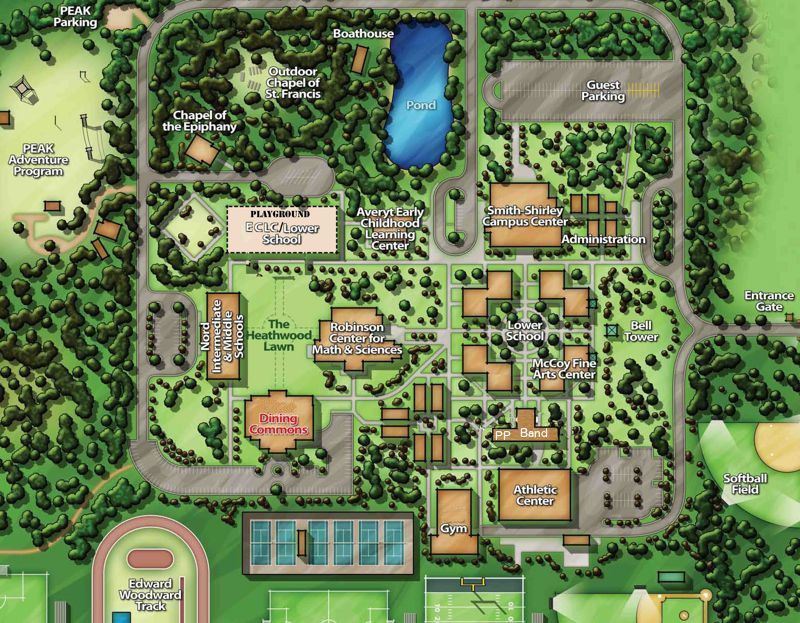
MAP INFORMATION 4
NON-CUSTODIAL PARENTS 18
PARENT VISITS AND INVOLVEMENT 19
PEAK OUTDOOR PROGRAM 19
POTTY TRAINING 19
SCHOOL SUPPLIES 20
STUDENT REPORTS AND CONFERENCES 20
STUDENT SUPPORT/INTERVENTIONS 20
SUMMER TUTORING 22
TESTING 22
TOYS 22
1IMPORTANT CONTACT INFORMATION
Stephanie Scanlon
Head of Early Childhood and Lower School
sscanlon@heathwood.org; 803-231-7748
Mary Kay Deese
Assistant Head of Early Childhood and Lower School
mdeese@heathwood.org; 803-231-7748
Nikki Merritt
Early Childhood and Lower School Administrative Assistant
nmerritt@heathwood.org; 803-231-7748
Ross Beale, RN
Student Health Office
rbeale@heathwood.org; 803-231-7728
Jessie Garlinghouse
Director of Extended Learning
jgarlinghouse@heathwood.org; 803-231-7710
Heidi Beckwith
Business Office Manager
hbeckwith@heathwood.org; 803-231-7713
Alison Edwards
Main Office Receptionist
aedwards@heathwood.org; 803-765-2309
23
ARRIVAL AND DISMISSAL
In an effort to ensure every child’s safety at the start and end of the school day, the Early
Childhood and Lower School staff asks families to abide by the following guidelines.
PARKING During Drop-Off and Pick-Up Times
If you would like to walk into the building for drop-off or pick-up, you can either park in the large
parking lot near the Smith Shirley Campus Center or in the gravel parking lot near the chapel.
The gravel lot is accessed via the Chapel driveway. Parking is not allowed in the short term
carpool circle parking spots or anywhere along the back circle during morning or
afternoon carpool.
PARKING During Morning Express Drop-Off (7:30 - 8:00 a.m.) and Afternoon Express
Pick-Up (3:15 - 6:00 p.m.)
Parents using Morning Express or Afternoon Express may not park in the fire lane at any
time. Please park in the short-term parking spaces in the center of the carpool circle or the
gravel parking lot near the chapel.
Arrival:
● For children arriving as early as 7:30 a.m., two teachers are on duty to receive students
downstairs in the Averyt Early Childhood building. Parents must walk their child(ren) into
early care and sign them in.
● All other classrooms open at 8:00 a.m. Any child arriving before 8:00 a.m. must go to the
Morning Express rooms in the Averyt Early Childhood building.
Morning Carpool (8:00 - 8:20 a.m.):
● EC and LS students are not allowed to use the front circle for drop-off.
● There can be no standing or parking within the Fire Lane.
● There is only ONE lane of traffic allowed through the back circle. There will be NO passing
during carpool. There will be no parking allowed in the short term carpool circle spots
(center of the back circle) during carpool times.
● Loading/unloading will only occur from the passenger side of the car. In the morning,
Safety Patrol members will help unload cars. Parents should put their car in park and remain
in the car while students are unloading.
● Please do not talk on the cell phone when you are in a moving carpool line. Your full
attention is needed for the safety of our children.
Dismissal
● Students are dismissed at 3:05 p.m.
● Please notify your child’s teacher in advance of your daily pick-up arrangements or changes.
● EC and LS students are not allowed to go to any other area of the campus (main lot, front
circle, gym lot) without being accompanied by an adult.
● EC and LS students are not allowed to go to the MS or US buildings for pick-up. The older
students must join the younger students at carpool.
● If child is not picked up by 3:20 p.m., he or she will be sent to the Afternoon Express
program. Children can be picked up in their regular classroom pod. There is a charge
for this service.
4Afternoon Carpool (3:05 - 3:20 p.m.):
● EC and LS students are not allowed to use the front circle for pick-up.
● There can be no standing or parking within the Fire Lane.
● There is only ONE lane of traffic allowed through the back circle. There will be NO
passing during carpool.There will be no parking allowed in the short term carpool circle
spots during carpool times.
● Carpool students will be dismissed to the concrete area under the Smith Shirley Campus
Center where they will be seated by grade level.
● As you pull around, we will call your child over to stand on a particular number. Your
child will be helped into the car when you have stopped at their number. Children will be
placed in the car on the passenger side. If you need to buckle a carseat, please gather
your child and pull forward to space number 0.
● For parents who park in the Smith-Shirley lot and walk in to get children from under the
Campus Center, please check in with the teacher monitoring your child’s class.
● Please do not bring pets to carpool.
Bus Riders: A teacher will walk all bus students to bus pick-up in the Smith-Shirley Campus
Center parking lot and ensure that each child boards the appropriate bus. Teachers will remain
at the bus stop until the bus departs or the bus drivers are present. Buses depart from campus
promptly at 3:10 p.m. (See BUS SAFETY for additional information.)
ATTENDANCE AND SCHOOL HOURS
The school day begins at 8:20 a.m. for all students, and students are dismissed at 3:05.
Extended Care, however, is available until 6:00 p.m. daily through Afternoon Express,
Heathwood Hall’s afternoon program for children enrolled in preschool through Grade 6. Please
contact Jessie Garlinghouse, Director of Extended Learning, for more information.
A teacher is on duty in the Averyt Early Childhood Center at 7:30 a.m. to receive children who
arrive before 8:00 a.m. At 8:00 a.m. students are dismissed from the Averyt Early Childhood
Center to report to their classrooms. Bus students may go to classrooms at 8:00 a.m.
LS students who arrive after drop-off concludes (no adults present to receive students)
should be signed-in at the office by a parent/caregiver. (EC students should be walked
directly to their classrooms.)
If leaving school prior to dismissal, please sign your student out in the Lower School
office. Parents are asked, when possible, to arrange medical and other necessary
appointments outside of class hours.
If you know your child will be absent, or more than a few minutes late, please email your child’s
teacher or call EC/LS Admin. Assistant, Nikki Merritt (803-231-7748).
While attendance is important, parents may not send children who have a fever over 100ºF or
contagious symptoms to school. If a child contracts a communicable disease, please notify
Ross Beale, the school nurse, so that parents of classmates may be advised of children’s
exposure. A child must be completely symptom-free for 24 hours (without the assistance
of medication) before returning to class.
5BEHAVIOR MANAGEMENT (EARLY CHILDHOOD)
During the preschool years, children are learning to cope well emotionally and behaviorally with
others in a classroom community. We want to create environments that are respectful, positive,
and supportive, in which procedures are taught and practiced and expectations for behavior are
clearly communicated and reinforced.
DEVELOPMENT OF SOCIAL SKILLS
For a young child to develop social skills and understandings that are important for their overall
growth as a student, they need to be developing in the areas outlined below. The format for
these ideas is taken from The Intentional Teacher by Ann Epstein.
Young Children’s Development in Social Skills and Understandings
● Emotional Self-Regulation
○ a self-awareness begins to develop during the preschool years
● Creating a Caring Community of Learners
○ becoming a member of the community, accepting the social norms
● Social Skills
○ develop a range of appropriate strategies for interaction
● Social Dispositions
○ enduring character traits like curiosity, humor, generosity as well as
close-mindedness, argumentativeness, selfishness are developing
f teaching these social skills are best done through modeling (being explicit with your
The how o
words to describe your actions), coaching (break a positive behavior into its components/parts
especially for those having trouble), and providing opportunities for practice (vital to learn and
unlearn patterns that stem from thoughts and behaviors).
Each class works together to establish classroom rules and expectations for how they will live
together at their home away from home. Modeling calm, patient behavior and encouraging
children to plan ahead in their thinking and work are ways that we are able to help children solve
social problems. Through monitoring student interactions, we have the opportunity to teach
children how to resolve conflicts.
Most of the expectations center around:
● Treat others with kindness and respect.
o Keep hands, feet, and other objects to yourself.
o Use appropriate language at all times.
o Follow directions the first time.
o Do not say or do anything to hurt anyone physically or emotionally.
o Listen carefully and wait for your turn to speak.
6CLASSROOM MANAGEMENT (LOWER SCHOOL)
We have established an environment that focuses on management versus discipline. A
classroom environment that carefully teaches procedures, clearly articulates expectations,
intentionally creates a supportive community of learners, and regularly engages the students in
meaningful learning is a well-managed class.
The teachers are very attentive to behavior in the classroom and are prepared with a variety of
ways to address behavior issues in the class. We believe in handling matters in a timely and
age-appropriate way while capitalizing on the learning opportunities present in each situation.
Positive discipline techniques will be used to handle behavior issues which may arise during the
course of the day. Each child will learn that he/she is responsible for his/her own actions and
that there are natural and logical consequences for inappropriate behavior. We will actively
model acceptable behavior, use language to facilitate resolutions, and help each student
develop a repertoire of problem-solving techniques. Through these methods, each child will
develop greater self-control and self-discipline.
The Early Childhood and Lower School divisions use four guiding principles as a framework for
our Code of Conduct. These principles are KINDNESS, RESPONSIBILITY, RESPECT, and
POSITIVE ATTITUDE. The Early Childhood and Lower School divisions will be using the
Responsive Classroom strategies for developing a sense of classroom and school-wide
community. Children will work together to interpret the Code of Conduct and develop a set of
expected behaviors so that developmentally appropriate rules and expectations are understood
and implemented throughout the school day. We are also teaching the children strategies for
interacting and communicating with their peers so they can advocate for themselves and
resolve issues in appropriate ways when uncomfortable social situations arise.
When teacher intervention is necessary, we want the following ideas to guide our decisions:
● Seeing the harm done rather than just the rule breaking
● Giving voice to the person harmed
● Holding people accountable through empathy and repair of harm
● Seeking to empower change and growth
● Enhancing responsibility
● Focusing on the notion of choice – who is in charge of your behavior?
● Employing logical consequences to “fix” damage done
DISCIPLINE PROCEDURES (EC and LS)
Our Discipline Plan clearly outlines consequences for intentional behaviors which demonstrate
an escalation in frequency, disruption, or aggression, and for serious instances which directly
threaten the safety of the student or others within our school community. Depending on the
severity of the incident, or a demonstrated pattern or increase in the number of occurrences, the
school reserves the right to skip the first one or two steps outlined below and proceed directly to
more permanent consequences.
Discipline responses for serious behaviors which cannot be handled within the classroom and
require the intervention of an administrator or other support personnel:
7First serious offense:
● Student will be removed from classroom setting and spend some supervised quiet time away with
Mrs. Scanlon, Mrs. Deese, Mrs. Garlinghouse, or Mrs. Holder. During that time, there will be a
deeper conversation trying to get a clearer picture of what happened and what the trigger may
have been.
○ student will be guided through an age-appropriate reflective process.
● Student will be returned to class when issue has been resolved and student fully agrees to abide
by the logical (age appropriate) consequences which will follow the offense.
○ You break it, you fix it. (Making reparations)
○ Loss of privileges.
● Parents will be contacted at the end of the day and given a full review of the day’s events,
including the incident, the conversation with student, the consequences, and how the rest of the
day progressed. A follow-up email will be sent.
● Parents will be given the opportunity to provide any additional information they may acquire from
subsequent conversations with student.
Second serious offense (not necessarily on the same day):
● Student will be removed from the classroom setting, parents will be contacted, and
student will remain in the care of Mrs. Scanlon, Mrs. Deese, Mrs. Garlinghouse, or Mrs.
Holder until such time as he/she can be picked-up by a designated family member or
caregiver.
○ During that time, there will be a deeper conversation trying to get a clearer picture of what
happened and what the trigger may have been.
○ Student will be guided through an age-appropriate reflective process.
○ Student will not be allowed to return to the classroom for the remainder of the day.
○ A follow-up email will be sent.
○ Parents will be given the opportunity to provide any additional information they may
acquire from subsequent conversations with student.
○ Parents must bring student into school the next day for a brief conversation with the
teacher before school starts so student realizes that everyone is one the same page with
behavior expectations.
○ Parents must participate in a meeting with Mrs. Scanlon, and anyone else whose
presence is deemed necessary, to discuss next steps.
Potential consequences for repeated serious offenses as determined through
consultation between the EC/LS Head and the Head of School:
● Removal from school for a prescribed period of time (suspension)
● Permanent removal from school for the remainder of the year (expulsion)
● Withholding the invitation to re-enroll for the following year
Parent refusal to cooperate with the plan outlined here could result in immediate dismissal from
the school.
8Examples of behavior which are serious enough to warrant the initiation of disciplinary
measures:
● Injury to self, another child, or an adult
● Serious destruction or stealing of school property
● Purposely leaving a teacher-supervised area
● Repeated uncontrollable behaviors and outbursts that disrupt the classroom community
● Inappropriate touching
● Inability to function within the normal program structure
● Threats made toward other children or adults
● Bullying (see definition below)
● Any behavior which is deemed a threat to the safety and physical or emotional
well-being of the students or staff
Bullying happens when someone mistreats or intimidates another person on purpose, and the
person being bullied is unable to defending himself or herself. Usually, bullying follows a pattern.
Teasing is not bullying. Bullying is the "intimidation of a weaker person; the process of
intimidating or mistreating somebody weaker or in a more vulnerable situation." The definition of
teasing is "to make fun of somebody, either playfully or maliciously.” (Definitions taken from
www.psychologytoday.com) While teasing can be mean-spirited and hurt another person’s
feelings, it is not the same as bullying. The goal of bullying is to use one’s p ower to intentionally
cause harm, either physical or emotional (intimidation).
Examples of bullying
● Physical Bullying
○ When one person uses physical actions to gain power or control over another
person.
● Verbal Bullying
○ When one person uses statements or name-calling to belittle, demean or hurt
another person to gain power or control over them
● Relational Aggression
○ When one person (or group) ostracizes another from a group, spreads rumors
about them, or manipulates situations in order to sabotage the target’s social
standing or increase their own. Can often go unnoticed by adults.
● Cyberbullying
○ The use of technology to threaten, harass, embarrass, or intimidate another
person
● Sexual Bullying
○ Consists of repeated harmful, humiliating actions that can include sexual
name-calling, crude comments, vulgar gestures and inappropriate touching in
order to gain power or control over another.
● Prejudicial Bullying (as an additional component to any of the above forms of bullying)
○ Demeaning comments based on race, religion, disability, ethnic origin, gender,
sexual orientation, etc.
ttps://www.verywellfamily.com/types-of-bullying-parents-should-know-about-4153882)
(from: h
9ADDITIONAL BEHAVIOR EXPECTATIONS
At lunch:
● Children will enter and dismiss in a quiet and orderly manner .
● Children should go through the lunch line in a quiet, orderly manner. Words like “please” and
“thank you” are encouraged.
● Children should display appropriate table manners while in the Dining Commons
● Children may talk to immediate neighbors at their own table. Children need to stay seated unless
given permission to get up from the table.
● Children will clean up the table and floor area directly surrounding them before being dismissed.
● Children will be respectful of Dining Commons food services and maintenance staff as well as
other adults and fellow students.
On the playground:
● Be patient and wait your turn
● Always ask the recess teacher for permission to leave the playground for ANY reason.
● Use equipment appropriately ( Ex.Sliding boards are made for sliding down. Use the ladders to climb
back to the top. One person per swing. Hang on, but do not sit on, the monkey bars, keep mulch in
designated area )
● Be respectful of your peers. If there is a problem you cannot handle with appropriate behavior,
contact a teacher.
● Line up immediately in the designated area when the bell rings.
● Everyone should take ownership of the playground; therefore, everyone should make certain
materials and equipment are put away before leaving the playground. Check for personal items.
● Include anyone who is interested, play fairly with respect for one another
● Display positive sportsmanship using the same game rules as expected in PE
On the bus:
All children are expected to:
● Walk from the building to the bus.
● Respect the authority of the bus driver.
● Keep noise level to a minimum.
● Not open the emergency door.
● Keep all objects and body parts inside the bus.
● Remain seated at all times, facing the front.
● Sit in the designated seat if assigned.
● Keep the bus a safe and clean place.
● Not eat or drink on the bus.
● Be seated and ready to leave by 3:05 p.m. for afternoon transportation. (Buses leave the campus
promptly at 3:10 p.m.)
● If your child misses the bus, he or she will be sent to Afternoon Express and parents will be
contacted to arrange for pick-up.
Children who repeatedly violate bus rules and are written up three times will be
prohibited from riding school buses. Children may lose bus-riding privileges on the first or
second notice if the violation is extreme. The Early Childhood & Lower School Head has
discretion on such matters. Refer to Conduct Code for further details. A teacher will meet Early
Childhood children at the buses and walk them to class, and they are walked to the bus at the
end of the day.
10CELL PHONES
Early Childhood and Lower School students may not use cell phones, smart watches or other
cellular-based mobile devices at school. If a student has one, it must be kept in his/her
backpack during the school day.
CHAPEL
In keeping with Heathwood’s belief that spiritual maturity is one of the goals of the learning
process, Chapel is held on Wednesdays for all students. During that time, students, teachers,
and other guests gather together to worship. Services are developmentally appropriate and are
in keeping with Episcopal traditions. The Episcopal Liturgical Calendar is observed throughout
the School. All children need to be in Chapel Dress on Wednesdays (refer to Dress Code).
The Lower School Chapel (K-4) is at 9:05 a.m.; Early Childhood Chapel is at 10:40 a.m.
Parents are always invited to join their children for Chapel. Special offerings are sometimes
collected during the year. In the past this has included food for Harvest Hope, cleaning supplies
for Habitat for Humanity, gifts for local children, or books. Holy Eucharist is celebrated quarterly
and students are invited to partake in Holy Communion or receive a blessing from the Priest.
Parents sign a permission form noting the family’s choice for the student.
COMMUNICATION
We encourage a close, two-way relationship between the school and our families. Open and
regular communication between home and school is essential to a successful experience for
your child(ren). Teachers will regularly communicate with parents (both individually and as a
whole class) about daily happenings, classroom curriculum, homework assignments, and
upcoming activities, as well as specific issues, concerns, and accomplishments. Please take the
time to read all correspondence that arrives from the school.
Since the family provides the most important influence on a child’s development, it is essential
that family and teachers work together, as a team, on all matters. We ask parents to please
notify the teachers if there are changes to your family’s routine or to your home situation, such
as parents’ trips, houseguests, hospital visits, etc.
Avenues of communication from the Lower School include:
● Classroom communication via the Seesaw App. Pertinent information such as your
child’s class list, daily schedules, newsletters, and links to academic websites can also
be found there.
● Individual and group emails
● Personal phone calls
If parents have questions or concerns, we strongly encourage direct communication with the
classroom teacher and/or the division head. Responses from teachers should be expected
within 24 hours. Due to the nature of a teacher’s work, emails and/or phone calls received
during the school day will only be returned before school, at lunch time, or after school.
Instant responses are not possible when teachers’ attention is on learning. If there is an
emergency and/or an immediate response is required, please contact the Early Childhood and
Lower School office (803-231-7748).
11DRESS CODE (EARLY CHILDHOOD)
Early Childhood students may participate in the Lower School Dress Code, but there are no
daily attire requirements for Early Childhood students except the following:
● Chapel Dress (see Dress Code Chart) is required for Chapel Day (Wednesday).
● It is highly recommended that all Early Childhood 3s and 4s students wear rubber-soled,
closed-toed, shoes that are secured with laces/lace-locks or a strap everyday.
● Students need to be prepared for all types of weather during the school year: hot, cold,
and rainy. Please have your child dress accordingly as he/she will be playing outside
and walking to related arts classes. Students should keep a raincoat or poncho at
school or in a bookbag at all times. Please do not send umbrellas.
● Students should bring a small book bag or backpack to school each day. The use of
rolling bookbags in EC is not allowed. They do not fit well in the space each child has
in the class and are unnecessary for the few belongings students have.
● Early Childhood students are continuing to develop their independence. Please dress
your child in clothing that he/she can manage by him/herself in the bathroom. Elastic
waist pants are best and belts should stay at home until they become independent with
them.
● Students should have a change of clothes – seasonally appropriate – at school.
DRESS CODE (LOWER SCHOOL)
The dress code pertains to the school day, from arrival in the morning until dismissal in the
afternoon. Students should dress according to the guidelines as outlined by the charts on the
following page of this document. Articles of clothing from the Plaid Peddler or specified
Heathwood clothes from Lands’ End or the uniform section of a department store are
acceptable Heathwood attire. For special events, there may be special dress. There will be no
distinction of dress code requirements for Chapel days. Guidelines apply Monday – Friday.
In addition, the following General Guidelines should be followed:
● Clothing should not be ripped, torn, patched, frayed, or otherwise visibly damaged or
altered.
● Clothing should fit properly. Clothing should not be excessively baggy, too short, too
tight, or too revealing.
● Clothing which refers to alcoholic beverages, tobacco, illegal substances, or anything
that includes derogatory, inflammatory, or obscene language is not permitted.
If a student does not come to school in dress-code approved clothing, he or she will be given a
verbal warning, and a Dress Code Reminder will be sent home from the teacher. Parents will
need to sign the warning and return it to school. If the problems continue, the parent will be
called and asked to bring acceptable attire to school.
12LOWER SCHOOL DRESS CODE
Daily Dress Code Girls Boys
Shirt Style: HHES logo on collared Shirt Style: HHES logo on collared polo/golf
Shirts polo/golf shirts, turtlenecks, and shirts, turtlenecks, and shirts with straight
shirts/blouses with straight collar, collar or button-down collar.
button-down collar, or Peter Pan collar
Color: Heathwood logo shirt from Plaid
Color: Heathwood logo shirt from Plaid Peddler or Lands’ End in navy blue, light
Peddler or Lands’ End in navy blue, light blue, gray, yellow, white, or dark green.
blue, gray, yellow, white, or dark green.
Shirts under jumpers do not require logo
but should be the colors listed above.
Pants, shorts, skirts or skorts in khaki or Pants or shorts in khaki or navy purchased
Bottoms navy purchased from Plaid Peddler, Land’s from Plaid Peddler, Lands’ End or Uniform
End or Uniform section of department store section of department store or Heathwood
or Heathwood plaid from the Plaid Peddler; plaid from the Plaid Peddler; no cargo pants
no cargo pants or cargo shorts, please. or cargo shorts, please.
Heathwood plaid (Plaid Peddler); khaki or
Jumpers/Dresses navy blue uniform jumpers; Polo Dress with
Heathwood logo from Lands’ End in
approved colors
Leggings White, black, gray, green, or navy leggings
under jumpers or skirts
Closed-toe and closed heel athletic shoes Closed-toe and closed heel athletic shoes
Shoes with a rubber sole, secured by laces or a with a rubber sole, secured by laces or a
strap; Rain boots are welcome on rainy strap; Rain boots are welcome on rainy
days, but athletic shoes must be worn for days, but athletic shoes must be worn for PE
PE
Sweaters/Jackets Sweaters/sweatshirts/jackets/fleece with Sweaters/sweatshirts/jackets/fleece with
Sweatshirts Heathwood logo in acceptable colors; or Heathwood logo in acceptable colors; or
worn inside buildings plain white, navy blue, dark gray, or dark plain white, navy blue, dark gray, or dark
green sweater or fleece. No other logos green sweater or fleece. No other logos
permitted. permitted.
Outerwear No specifications No specifications
13EMERGENCY PROCEDURES
The school has developed a crisis management plan for different emergency situations that may
arise. Parents can read over these procedures in their child’s classroom. They are located on a
pamphlet beside the door in each classroom and the hallway. There is also a detailed copy of
the plan located in each division office.
FIELD TRIPS
Field trips are an important part of the curriculum and give children opportunities to expand their
learning beyond the school campus. Most trips are confined to the greater Columbia area and
are appropriate to the students’ interests and studies. With each field trip, a Field Trip
Authorization Form must be completed and on file in order for the student to participate. There
is often a charge for field trips. All field trip transportation will be by bus. Younger siblings are
not permitted to attend field trips with a parent who is chaperoning. Attire for field trips is Dress
Code unless otherwise determined by the School. Students will not be allowed to attend a
field trip if a signed Field Trip Authorization Form has not been returned.
The Early Childhood students also have a Fine Arts program with theater productions as an
“in-house” field trip.
HEALTH POLICY
If your child is sick, cranky, uncomfortable, or needs the full attention of a staff person, your
child deserves the comfort of home and parent. Control of communicable illness among the
children is the utmost concern of Heathwood Hall. If your child’s presence compromises the
health or care of other children, you will be contacted and asked to pick your child up.
The South Carolina Department of Health and Environmental Control School Exclusion List is
followed by Heathwood Hall and may be found on the Parent Portal of the Heathwood website
under “Health Information.”
In order to protect the entire group of children as well as your own child, we ask that parents
assist us by keeping your child home if he/she has experienced any of the following conditions
within the past 24 hours:
● Fever above 100*F
● Diarrhea, vomiting or an upset stomach
● Runny nose with green or yellow nasal discharge
● Unusual or unexplained fatigue, irritability or headache
● Signs of a newly developing cold or severe cough
● A sore throat
● Any unexplained rash
● Any contagious disease or infection (including, but not limited to, ear infections, strep,
conjunctivitis, H1N1, and influenza)
A child may return to school:
● 24 hours fever-free and symptom-free, without the use of medications, or
● 24 hours after antibiotics have been started for infections, or
● With a doctor’s permission for severe coughs or unexplained rashes, or
● In the case of communicable disease, when deemed by health care professional to be no longer
infectious to other students.
14Please contact the school if your child has contracted a contagious disease so that other
parents can be alerted. Your family’s privacy will be maintained to the best of our ability.
ALLERGY: Please notify the school nurse and teachers if your child has any allergies,
especially allergies to foods, bee stings, fire ant bites, or contact allergies. If your child has a
prescribed epi-pen, please talk with the school nurse to establish emergency treatment
protocols before the opening day of school. Parents of a child with food allergies who are
desirous of their child eating meals in the school dining commons should consult with
the school nurse and dining commons director to determine what accommodations are
needed.
HEAD LICE: The Heathwood Hall Episcopal School Head Lice Policy is based on extensive,
evidence-based research from the American Academy of Pediatrics (AAP), the Centers for
Disease Control and Prevention (CDC), the South Carolina Department of Health and
Environmental Control (SC DHEC), and the National Association of School Nurses (NASN). The
policy is consistent with the School and Childcare Exclusion Lists published by SC DHEC
(www.scdhec.gov/health/disease/exclusion.htm). For consistency, the HHES head lice policy
will apply to all enrolled students from the Early Childhood Center through the Upper School.
Teachers or administrators will report to the school nurse any student suspected of having head
lice. The nurse will conduct a confidential examination, looking for the presence of live, active,
crawling lice, or nits (lice eggs) that appear to be ¼” or closer to the scalp. Parents will be
notified when a student is found to have head lice during the school day. Unless live, active,
crawling lice are detected, the child may remain in school until the end of the school day. If
active, crawling lice are found, parents will be contacted to get their child from school to be
treated.
The child may return to school following treatment with an appropriate pediculicidal medication
or therapy as recommended by a licensed physician and if an inspection by the school nurse
identifies no active, crawling lice on the student’s head. The child must report to the Health
Office for examination by the school nurse before returning to the classroom. The school
nurse will review recommendations for environmental cleaning with families (e.g., washing bed
linens with hot water, bagging un-washable toys and clothes for two (2) weeks, vacuuming
carpet, furniture, car seats, etc.) Pediculicide spray is not necessary and should not be used
Immunization: State law requires that Certificates of Immunization be presented on or
before the Opening Day of school. Please make certain we receive that information by
August 1. If your child has received immunizations, or their South Carolina Certificate of
Immunization has expired, please submit an updated certificate to the Health Office at
Heathwood no later than August 1. If you have moved to South Carolina from another state, the
school nurse will be able to assist you with transferring your child's immunization information to
the South Carolina immunization form. Contact the School nurse, Ross Beale, at 803-231-7728
or by email at rbeale@heathwood.org for assistance, or if you have questions.
MEDICAL AUTHORIZATION FORMS: If you have not already completed a Medical
Authorization form, which was enclosed in your matriculation package, please download a form
from the Parent Portal (on the Heathwood website), fill it out, and return it by the first day of
school.
15MEDICATION: While the use and administration of medication at school is discouraged, it is
recognized that there are times when medications may restore a student’s functional capacity in
accordance with both educational goals of improved academic achievement and decreased
absenteeism. South Carolina law does not allow dispensing over-the-counter or prescription
medication to students without written permission from a parent/legal guardian and a licensed
healthcare provider. Administration of medications will be permitted on school property only
when medically necessary and under the direct supervision of the school nurse or appropriate
faculty and staff members. For the safety of Heathwood Hall students, and in order to be in
compliance with State law, parents must complete and submit forms to the school nurse. These
forms can found on the Parent Portal, , HH Community, in the Health Office tab under the forms
section.
HOMEWORK (LOWER SCHOOL)
Homework is assigned in the lower grades to accomplish several important goals:
● First and foremost to enhance the development of reading skills and the love of reading
● To provide parents with a daily snapshot of current learning
● To practice skills and/or review content learned during the school day
● To provide assessment data for specific skills and content
● To develop positive work habits (time-management, self-discipline, study skills) and
responsibility as students develop into independent learners
As students mature and grow developmentally, expectations for homework increase. The
following guidelines provide a common framework among all grade levels:
Kindergarten
● 15 minutes of reading or being read to each night. As students are ready, teachers will
begin sending home “book bags” with sets of leveled books to be read each week in
addition to being read to by parents.
First Grade
● 20 minutes of reading – At the start of the year, this reading may be a parent reading to
a child. As the year progresses, the expectation is for the child to read to the parent for
20 minutes.
● Additional Skill practice not to exceed 15 – 20 minutes.
o Sight Word/Word Work practice
o Math practice
● Occasional projects
Second Grade
● 20 minutes of reading – 10 minutes reading aloud and 10 minutes reading silently
● Additional Skill practice not to exceed 20 minutes
o Math practice
o Word Work
● Occasional project
16Third Grade
● 20 minutes of reading –weeknights
● Additional Skill practice not to exceed 30 minutes
o Math, Language Arts, Science, or Social Studies
● Occasional project
Fourth Grade
● 30 minutes of reading – weeknights and weekends
● Additional Skill practice and/or studying content not to exceed 40 minutes
o Math practice
o Language Arts Skills – vocabulary and/or word work.
o Writing
Classroom teachers will communicate specific homework procedures to parents AND students
at the start of the year. Teachers will address these often asked questions from parents:
● How to respond when your child needs help or doesn’t understand.
● How to communicate with the teacher when your child needs support and/or when to
move on when they reach “the point of no return.”
● How to interact with your child during and after homework. How much assistance?
Review it? Correct it?
LIBRARY
All Early Childhood and Lower School students visit the library on a weekly basis. Additionally,
students may visit to work on research projects with the assistance of the library staff. The
library staff plans with classroom teachers to provide meaningful activities that supplement
classroom curriculum. Students check out books weekly; our youngest students keep their
books in the classroom while older students take the books home. Overdue notices are printed
monthly, and we ask parents to contact the library if they believe the notice is incorrect and that
materials have already been returned.
LOST AND FOUND
A Lost and Found center is located under the Smith-Shirley Campus Center where the children
gather for carpool pick-up at the end of the day. All clothing and equipment brought to
school should be labeled with the student’s name. Unclaimed items will be given to
charities at the end of each semester.
LUNCH (EARLY CHILDHOOD)
We are fortunate to have a delicious and healthy lunch program at Heathwood. Our students
eat in a small area of the Dining Commons that is specifically designed for their size and to give
them more time to eat. EC2 students may begin the year eating lunch in their classrooms and
will transition to the Dining Commons mid-year. If your child purchases lunch from school, it will
be delivered to the classroom from the Dining Commons. EC3 and EC4 students eat in the
dining commons. Appropriate selections are made for Early Childhood students who purchase
lunch from Heathwood. The teachers also get to know the children’s eating habits and try to find
the balance between encouraging them to try new things and providing healthy choices they like
so they are well-fed. Special Note: There are no microwaves or refrigerators on campus for
lunches brought from home.
17SNACK (EARLY CHILDHOOD) Each family pays a one-time snack fee before the school year
begins. We will provide two peanut-free snack offerings for the children. Families are asked to
send a water bottle with sip-lid each day.
LUNCH (LOWER SCHOOL)
All students eat lunch in the Dining Commons, and the program is included in the cost of
attending Heathwood Hall for grades K - 12. Heathwood Hall recognizes that it shares
responsibility with parents to teach good nutritional habits to our young people. The lunch
program offers students a variety of healthy choices designed to satisfy most food preferences.
Offerings include two hot entrée choices (plus vegetarian options) with sides, hot soup, a fully
stocked salad bar, a sandwich/deli bar, and dessert (only one dessert unless there is a fruit
offering). Drink choices are 2% milk, chocolate milk, and water. Parents are welcome to join
students for lunch. Adult lunch tickets may be purchased for $7.00 from Nikki Merritt or the Plaid
Peddler. Parents of a child with food allergies should consult with the school nurse and the
Dining Commons staff to determine how their child’s diet would be best accommodated.
SNACK (LOWER SCHOOL) Parents provide daily snacks for their child. Classroom teachers
will provide specific details and suggestions.
NON-CUSTODIAL PARENTS (in cases of separation or divorce)
In cases of separation or divorce, we communicate with both parents unless we are presented
with a court order barring one parent from associating with his or her child. This means that
both parents will receive report cards, interim reports, and general mailings, regardless of who is
financially responsible. Each parent is granted access to the child(ren), to teachers, and to
administrators. Such access is provided without notification to other parties. It is the
responsibility of each parent to make sure the school has his or her current address, phone
numbers, and email addresses. It is the parents’ responsibility to provide to the Early Childhood
and Lower School Head’s office all records of relevant court decisions and up-to-date contact
information. Given the unique legal situation of each family, the school may make exceptions to
this policy.
Heathwood Hall’s first obligation is to its students. Regardless of the relationship of parents to
each other, we believe that a healthy partnership among the school and both parents is in the
students’ best interest. If a person comes on campus and we have written documentation
restricting contact with the student, we will notify our school resource officer and have the
unauthorized person removed from campus. We will contact the custodial parent to make them
aware of the situation.
It is the job of the parents to communicate with each other. The school wishes to stay out of
marital conflicts and settlements; we ask parents not to pull teachers or administrators into the
middle of such disputes. All attorneys must direct any questions or requests to the Assistant
Head for Finance and Operations. Attorneys are not to have any direct contact with classroom
teachers.
When an important issue necessitates short notice, we will attempt to reach both parents.
Some situations warrant calling or writing the custodial parent only. They include – but are not
18limited to – calls that a child is sick, routine classroom matters (field trips, homework
assignments, special dress requirements, etc.), and special requests. We will use our judgment
about which kinds of issues both parents want and need to know.
PARENT VISITS and INVOLVEMENT
We have an open door policy and parents are welcome to visit and participate in the school
lives of their children, both informally and on special occasions. If you intend to visit the school
or volunteer in the classroom, we request that you make arrangements ahead of time with your
child’s teacher. We especially encourage parents to share their interests, cultures, careers or
unique talents, and to assist in special class events and celebrations. There will be room
parents in each class who will help coordinate parent involvement for special events in their
respective classrooms. Parents may also be involved by chaperoning field trips, and attending
school programs, theatre productions, and sporting events.
There are many volunteer opportunities on campus, and many outlets through which parents
may share their talents. All parents are automatically members of the Heathwood Parent
Association (HPA). Please contact Nikki Merritt (nmerritt@heathwood.org) if you are interested
in finding out more about volunteer opportunities. Parents are also encouraged to join the
Heathwood Hall Booster Club, known as the Highlanders Club.
PEAK OUTDOOR PROGRAM
PEAK after school programs take place in the fall and in the spring for first through fourth
graders. Students are introduced to environmental and adventure education through a 6-week
formal Outdoor Education class with PEAK instructors. Club size is limited. See the Heathwood
website for more detailed information and PEAK registration information.
POTTY-TRAINING
EC2s: If your child is not potty-trained, please bring pull-ups with easy open sides for your child;
wipes are provided. Restrooms are accessible from the EC2s classrooms and we will
encourage and reinforce potty-training throughout the year. If you would like for your child to
have diaper cream at school, please provide a bottle labeled with your child’s name. A
Non-prescription Medication Administration form must be completed and submitted with the
labeled diaper cream.
EC3s and 4s: Your 3 or 4 year-old child is expected to be toilet-trained by the first day of
school. Your child should be able to clean him/herself and manage his/her own clothing. Elastic
waistbands make it much easier for your child to be independent. We understand accidents will
happen and teachers will provide appropriate assistance as needed. Teachers are prepared to
help a child who has an occasional wetting accident but, if after the first two weeks of school a
child refuses to use the bathroom at school or has accidents on a daily basis, parents will be
asked to take the child out of the program for a period of time to work on toilet training at home.
The child’s spot will be saved.
19SCHOOL SUPPLIES
Parents pay an annual supply fee at the beginning of each year to cover classroom supplies.
Children should come to school with an appropriate-sized backpack, however, additional school
supplies are not necessary. Those materials are all covered by the supply fee and are therefore
provided by the school.
STUDENT REPORTS AND CONFERENCES
While ongoing communication between the teacher and the parents will take place throughout
the year, formal reporting to parents includes a scheduled parent/teacher conference during the
fall and spring, and written reports at the end of the first and second semesters. Those written
reports, referred to as developmental profiles (EC) or progress reports (LS) contain specific,
individualized information about your child’s growth and development throughout the year.
There will be no classes on conference days. Afternoon Express will provide care for those who
need it all day, and a drop-off service is available while parents are in the conference. Siblings
or playmates not enrolled at Heathwood cannot be served. Parents are encouraged to contact
the teacher at any time during the year if they would like additional conferences, or with any
questions or concerns.
STUDENT SUPPORT / INTERVENTIONS
Child Study Team:
In an effort to provide consistent and early intervention when learning and/or behavioral
concerns arise for our students, the Lower School convenes a Child Study Team. This team,
consisting of the Lower School Head, the Transitions Coordinator, the parents, the classroom
teachers and other appropriate professionals (counselor, school nurse, etc.) meet to develop a
plan of action that strives to address the issue and promote success. Our hope is to provide
support for the student, the teacher, and the family as we meet the learning/behavioral needs of
our children. Teachers primarily make referrals to the Team; however, if ever parents want to
initiate the process, they may do so by contacting the Lower School Head.
Academic Achievement Center:
The AAC provides a resource to students who are in need of individual tutoring by specially
trained instructors in the areas of OT, Speech, and Math. It exists to help the school achieve its
mission, that is, to ensure the success and joy of learning for every student at Heathwood. The
classroom teacher will work closely with the Academic Achievement Center teachers as the
student’s needs are addressed.
(Fees are charged for this special instruction.)
Our national board-certified speech and language pathologists play an important role in the
prevention of literacy problems and provide opportunities for success in spoken and written
language. Areas assessed and treated include articulation, fluency, voice, auditory processing,
written language, and receptive-expressive delays. Speech and language therapy is offered
daily for 30 minute sessions during the regular school day.
Occupational Therapy is available to children who demonstrate delays with gross motor skills,
fine motor skills, visual-motor skills, as well as decreased coordination skills, poor handwriting,
and sensory processing difficulties. Students are evaluated by our board-certified occupational
therapist. Families and teachers are then provided with recommendations and goals. Individual
20treatment sessions occur during the regular school day, focusing on improving the child’s
development.
Individualized tutoring in math and reading is available to EC and LS students who require
additional support in those areas. (Fees are charged for this special instruction.)
Transition Program:
In addition to the resources available through the Academic Achievement Center, the Child
Study Team may recommend a student for the Lower School Transition Program. This program
is designed for students in kindergarten through grade four who need more intensive instruction
in reading, writing, and/or mathematics. Students work closely with a learning specialist who
uses a variety of approaches. The duration of time a student spends with the learning specialist
depends on the child's unique learning needs and academic progress. The learning specialist
works closely with the student's teachers to provide individual and small group instruction both
in the transition classroom and in the student's general education classroom. (Fees are charged
for the use of the Transition Program)
School Counselor:
The Early Childhood and Lower School Counselor at Heathwood Hall implements a
comprehensive guidance and counseling program, which includes providing direct services to
students as well as consulting services to parents and faculty. The direct services entail
classroom guidance lessons and individual and small group counseling. The classroom lessons
comprise the preventative component of the counseling program. In the EC2 classes, the year
will begin with observations and interacting with the students while they play in order to assess
what skills would best foster their Social-Emotional development. As the year progresses,
puppets, books, songs, and activities will be incorporated into the lessons. In EC3 through
second grade, the curriculum addresses Skills for Learning, Self-Regulation, Empathy, Emotion
Management, and Problem Solving. The third and fourth grade curriculum is a
bullying-prevention program, which includes recognizing, refusing, and reporting bullying as well
as the role of a bystander. Many of the skills taught in the Early Childhood and Lower School
are lifelong skills to support children’s overall success and development. Intervention
strategies, such as individual and small group counseling, offer students the opportunity to
develop skills in problem solving and goal setting. This approach is more specific to the
individual or small group’s needs. Referrals for individual and small group counseling can come
from the teacher, parent, admin, or student.
In discipline matters, the school counselor is available as an additional adult resource, offering
intervention, support, and a location for quiet time away, but not necessarily performing
disciplinary actions or assigning discipline consequences.
After-School Help:
Classroom teachers may provide Extra Help sessions for students who do not fully understand
a concept or who need additional practice with a skill. Children who have more complicated
academic problems will need to be tutored through the Transition Program or attend the
Academic Achievement Center.
21SUMMER TUTORING
When children have academic difficulty during the school year, the School may recommend or
require summer tutoring. A conference will be held with the teacher, Transitions Coordinator,
and Lower School Head to make recommendations. A follow-up conference will be held before
school begins for reporting on summer tutoring results. Summer tutoring can determine your
child’s placement or their ability to return to Heathwood.
TESTING
In addition to formal and informal classroom assessments, Heathwood administers online
achievement testing through the Educational Records Bureau (ERB) each spring to students in
grades 2-8. Results of the tests are sent home when available.
TOYS
Students are not to bring toys, card collections, or electronic devices to school. Toy guns,
knives and other “weapons” are never allowed. Special objects or toys for “sharing” are only
allowed with teacher permission.
TOYS (EARLY CHILDHOOD): Children who nap are allowed to bring a small blanket and/or
travel-size pillow that will stay at school. These rest items will be sent home on Fridays to be
washed and then returned to school on Monday. Your child may also bring one small item to
rest with, if it is needed to sleep. Pacifiers and baby bottles are not allowed at Heathwood Hall.
Outside of those security items and the occasional sharing item, please help your child
understand the importance of leaving additional toys at home. Frequently, home toys are
inappropriate and unsafe for classroom play and keep children from the open-ended activities
that we offer and encourage. There is also the possibility of the toys getting broken or lost,
which can be quite upsetting for children. Please leave these personal treasures at home or in
the car.
HEATHWOOD PLUS: Afternoon Express, Enrichment Activities, and
Summer Programs
Heathwood Plus encompasses a variety of ways in which students are engaged in learning and
fun outside the regular school day. We strive to provide excellent care and enriching
opportunities which extend the Heathwood experience and continue to develop the intellectual,
creative, and moral capacities of our students.
Early Morning Express (7:30-8:00 a.m.): Students who arrive at school between 7:30 and
8:00 a.m. must be brought to Early Morning Express. This complimentary service is
located on the first floor of the Early Childhood Learning Center. Parents need to sign
their child into Early Morning Express each time they attend.
22Afternoon Express (until 6:00 p.m.): Afternoon Express (AE) serves students in the Early
Childhood, Lower School, and Middle School divisions. AE teachers provide after-school
snacks, support homework, and engage students in meaningful games and activities that
complement the curricular goals of the school day. There is a fee associated with
Afternoon Express.
Enrichment Activities: Enrichment Activities provide a variety of exciting options for your
child without ever leaving campus. These programs are offered in the fall and spring
semesters and typically meet once a week for 45 minutes to one hour for 12 weeks.
Some examples of Enrichment Activities include tennis, golf, piano, chess, and
cheerleading. Registration for these fee-based programs is run through Ultra Camp.
Summer Programs: Heathwood Hall hosts a world-class summer program on our
120-acre campus. Open to both Heathwood students and children across the Midlands,
we offer a variety of sports clinics, technology courses, academic classes, and thematic
week-long camps.
For questions, or to register for Heathwood Plus, please contact Jessie Garlinghouse
(Jgarlinghouse@heathwood.com), Director of Extended Learning.
23EC/LS Calendar of Events
2018
August 13 Early Childhood Drop In Assigned Times
August 13 Kindergarten Drop In Assigned Times
August 13 New LS Student Drop In 9:00 - 10:30am
August 15 Opening Day for All Students
August 22 EC/LS Back to School Night 6:00pm
August 25 Heathwood Night with the Fireflies 6:05pm
September 3 Labor Day Holiday
September 5 Convocation 8:30am
September 12 Picture Day (Chapel Dress)
September 13 EC4 Dads’ Day on the Pond 8:30am
September 14 EC3 Dads’ Day on the Pond 8:30am
September 25 Highlander Games 1:20pm
October 10 Picture Makeup and Retake Day
October 12 End of 1st Quarter
October 19 Grandparents’ & Special Friends’ Day
October 19 Fall Break begins (noon dismissal for students)
October 22 Fall Break
October 31 EC Trick or Treating 8:30am
October 31 LS Halloween Parade 2:30pm
November 1 Conference Day
November 8 LS STEM Night 6:00 - 7:00pm
November 21-23 Thanksgiving Holiday
December 5 LS Christmas Concert (3rd & 4th) 6:00pm
December 7 EC3 & EC4 Merry Moms 8:30 - 10:00am
December 13 Kindergarten Play (for students) 9:30am
December 14 Kindergarten Play (for parents) 9:00am
December 14 All School Sing-a-long
December 14 End of 2nd quarter
December 14 Christmas Break begins (noon dismissal for students)
24You can also read


