Australia's South China Sea challenges - POLICY BRIEF - MALCOLM COOK MAY 2021 - Lowy Institute
←
→
Page content transcription
If your browser does not render page correctly, please read the page content below
POLICY BRIEF

Australia’s South China
Sea challenges

MALCOLM COOK
MAY 2021
AUSTRALIA’S SOUTH CHINA SEA CHALLENGES

The Lowy Institute is an independent policy think tank. Its mandate ranges
across all the dimensions of international policy debate in Australia —
economic, political and strategic — and it is not limited to a particular
geographic region. Its two core tasks are to:

• produce distinctive research and fresh policy options for Australia’s
  international policy and to contribute to the wider international debate

• promote discussion of Australia’s role in the world by providing an
  accessible and high-quality forum for discussion of Australian
  international relations through debates, seminars, lectures, dialogues
  and conferences.

Lowy Institute Policy Briefs are designed to address a particular, current
policy issue and to suggest solutions. They are deliberately prescriptive,
specifically addressing two questions: What is the problem? What should
be done?

The views expressed in this paper are entirely the authors’ own and not
those of the Lowy Institute.

                  POLICY BRIEF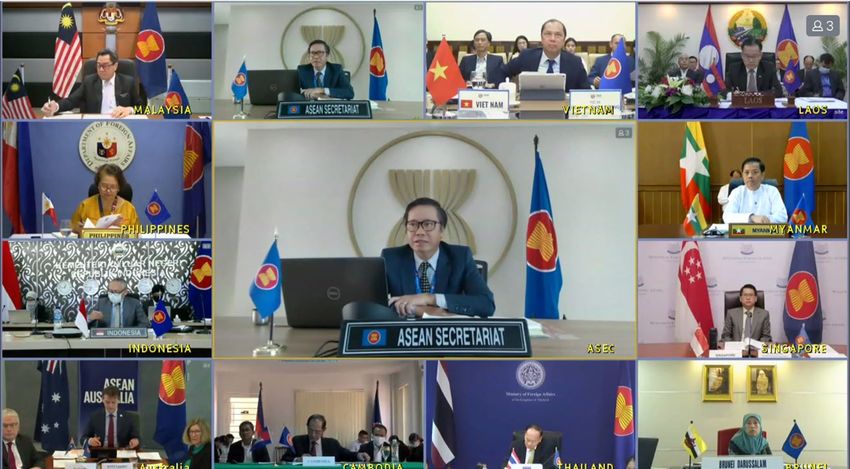
AUSTRALIA’S SOUTH CHINA SEA CHALLENGES

KEY FINDINGS
 •   China will not agree to a South China Sea Code of Conduct
     (COC) that is consistent with the 2016 South China Sea arbitral
     tribunal ruling, and therefore any COC which China agrees with
     the Association of Southeast Asian Nations (ASEAN) will harm
     Australia’s interests. But a lack of Australian support for such a
     Code would aggravate relations with Southeast Asian states
     and ASEAN, and with China.

 •   Australia should use the time afforded by the drawn-out Code
     of Conduct negotiations to coordinate with the five littoral
     Southeast Asian states affected by China’s unlawful maritime
     claims. Australia should emphasise the need for consistency
     with international law, especially the 2016 arbitral ruling.

 •   The Biden administration is likely to increase pressure on
     Australia to conduct freedom of navigation operations
     (FONOPS) in the South China Sea. Such action may risk a
     significant Chinese response against Australia.

                                                       POLICY BRIEF       1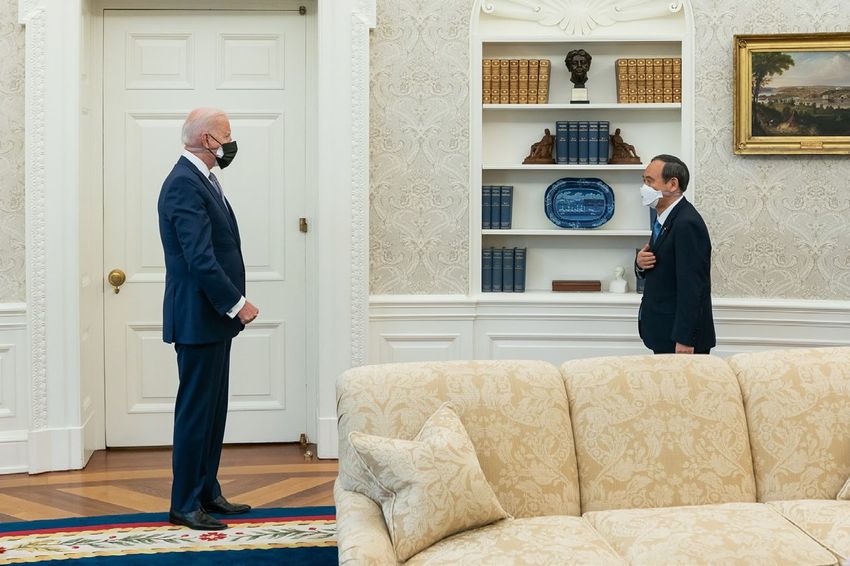
AUSTRALIA’S SOUTH CHINA SEA CHALLENGES

    EXECUTIVE SUMMARY
    What is the problem?

    Australia’s current South China Sea policies are under strain from two
    sides. On the China side, Beijing will not agree to any Code of Conduct
    that is consistent with the arbitral tribunal ruling it rejects. If the ASEAN
    member states agree to such a Code of Conduct, Australia cannot
    support it. On the US side, there is an increasing likelihood that the
    Biden administration will place more pressure on Australia to conduct
    freedom of navigation operations (FONOPs) in support of the 2016
    United Nations Convention on the Law of the Sea (UNCLOS) ruling,
    forcing Australia to choose between damaging our relations with China
    or rejecting a request from the United States.

    What should be done?

    Australia should coordinate with willing Southeast Asian littoral states
    to influence future Code of Conduct negotiations and encourage states
    not to sign up to it if the likely Code is not consistent with the 2016
    arbitral tribunal ruling.

    Australia should not conduct FONOPs in the South China Sea that pass
    within 12 nautical miles of features claimed by China. Rather, Australia
    should participate in bilateral and minilateral naval exercises with
    willing Southeast Asian littoral states in their respective exclusive
    economic zones in the South China Sea; it should do this more often
    and more publicly.

    Australia should advocate for regular Quadrilateral Security Dialogue
    (Quad) Leaders’ Summits and inclusion of China’s unlawful maritime
    claims and activities in the South China Sea on the agenda.

    These policy adjustments should advance Australia’s interests in
    strengthening Southeast Asian littoral states’ hands in Code of
    Conduct negotiations with China, moderate pressure to conduct
    FONOPs in the South China Sea, and reduce the likelihood and scale of
    Chinese punitive measures against Australia.

2                      POLICY BRIEF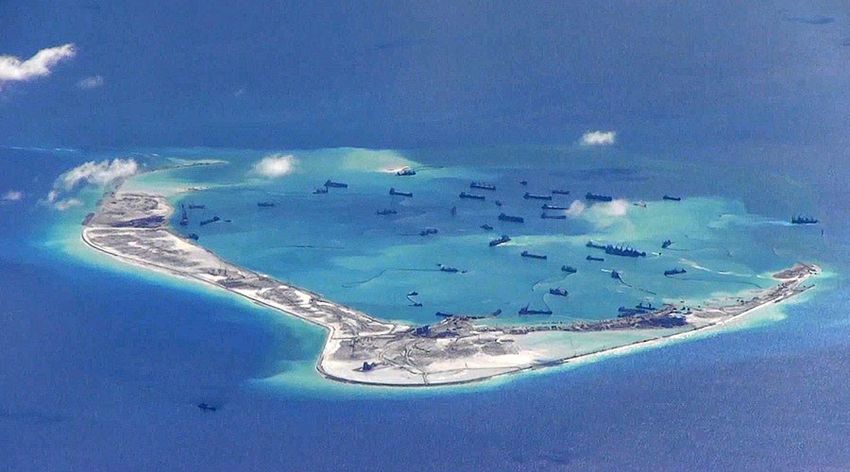
AUSTRALIA’S SOUTH CHINA SEA CHALLENGES

INTRODUCTION
A key test of China’s willingness to accept the current rules-based
order is the way it handles its disputes with five Southeast Asian littoral
states (Brunei, Indonesia, Malaysia, the Philippines, and Vietnam) in the
South China Sea. China is failing this test as it seeks effective control
of the Sea — a vital conduit of international trade.

Over the past decade, China has more aggressively pushed its unlawful
‘nine-dash line’ 1 maritime claims in the South China Sea — an approach
that violates the maritime and sovereign rights of these five Southeast
Asian littoral states. This poses a direct challenge to Australia’s support
for the rules-based order and its “deep stake in the security of
Southeast Asia”. 2

China’s aggressive approach has become a greater concern in
Australia’s relations with China, the United States, Southeast Asian
littoral states, and ASEAN, since China’s artificial island-building
campaign in the Spratlys from 2013. 3 This has made the South China
Sea an increasingly important arena for the mounting US–China rivalry.

                                                           POLICY BRIEF       3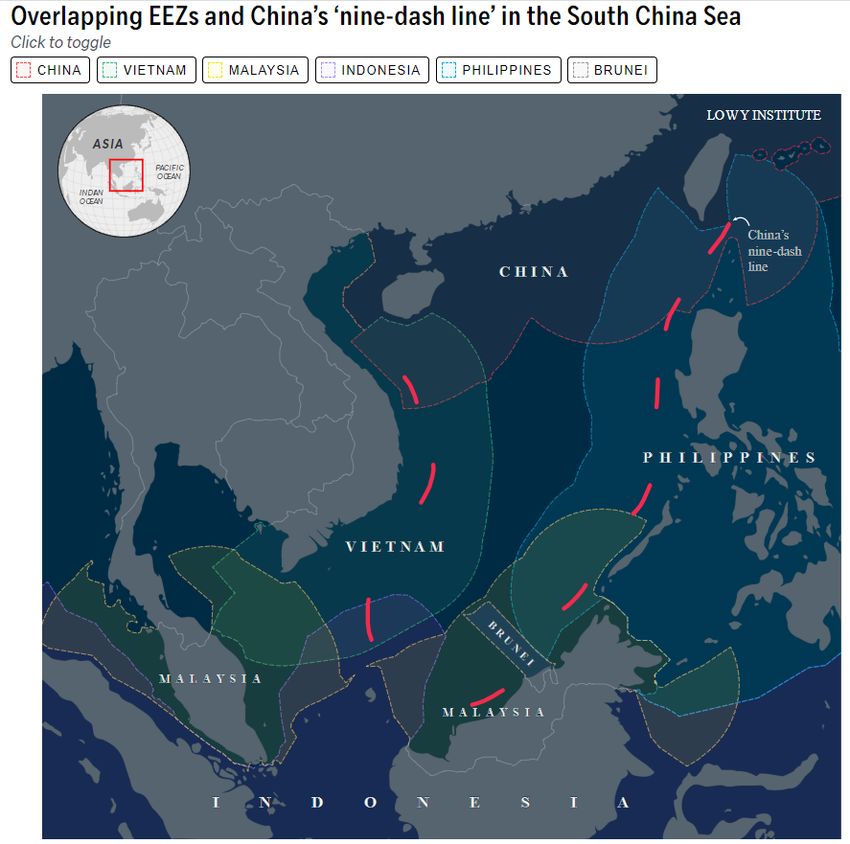
AUSTRALIA’S SOUTH CHINA SEA CHALLENGES

    The United States exercises its freedom of navigation and overflight
    rights in the South China Sea to contest China’s claims and offer
    support to Southeast Asian littoral states.

    Southeast Asian littoral states have reacted unevenly to China’s
    escalating aggression in advancing its unlawful claims in the South
    China Sea, but have mostly sought to defend their sovereign and
    maritime rights, individually and through ASEAN. At the same time, US
    FONOPs challenging these Chinese claims have become more
    frequent and public.

    Australia has supported the efforts of its Southeast Asian neighbours,
    and may be required to do more of this in the coming years. To date,
    the Australian government has resisted calls to conduct FONOPs that
    could provoke a punitive Chinese response; Chinese state media has
    warned that Royal Australian Navy presence operations in the South
    China Sea are at risk of Chinese attack. 4

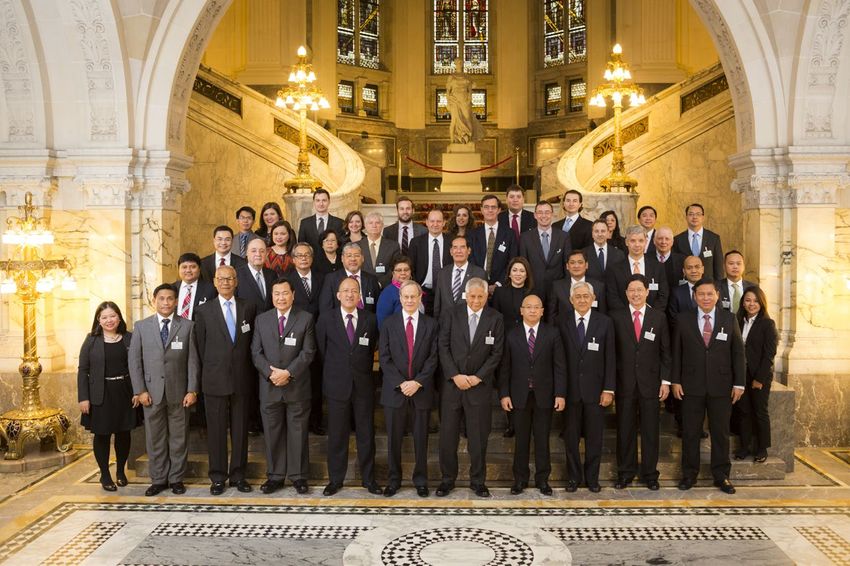
    The Philippines instituted arbitral proceedings against China under the United
    Nations Convention on the Law of the Sea (UNCLOS) in January 2013. The
    Philippines’ delegation (pictured) attended the Merits Hearing in November
    2015, and in 2016 the arbitral tribunal ruled overwhelmingly in favour of the
    Philippines. Image: Courtesy Permanent Court of Arbitration.

    China’s more aggressive approach has become clearer over the past
    decade. This began with Chinese patrol boats harassing a seismic
    survey vessel around Reed Bank on the Philippine continental shelf in
    the South China Sea in 2011.5 The following year, China forcefully

4                       POLICY BRIEF
AUSTRALIA’S SOUTH CHINA SEA CHALLENGES

                        asserted control of Scarborough Shoal in the Philippine exclusive
                        economic zone in the South China Sea. 6

                        These events led the Philippines to file an arbitration case under
The Philippines         UNCLOS against China in January 2013, arguing that China was
                        violating Philippine sovereign and maritime rights in the Philippine
accepted the
                        exclusive economic zone in the South China Sea. China attempted to
UNCLOS ruling as        avoid the arbitral tribunal by arguing that a system for resolving
                        disputes in the South China Sea already existed through various
final and binding on
                        instruments, including the 2002 China–ASEAN Declaration on the
the Philippines and     Conduct of Parties in the South China Sea (DOC). 7
China. China
                        The July 2016 arbitral tribunal ruling upheld the Philippine case against
rejected it outright.   China. 8 The tribunal:

                            •   rejected China’s jurisdictional argument, ruling the DOC a
                                political, non-binding agreement which did not exclude other
                                means of dispute resolution;

                            •   acknowledged that the third party interventions of Vietnam,
                                Malaysia, and Indonesia in the proceedings supported the
                                validity of the Philippine case;

                            •   concluded that China had violated the Philippines’ sovereign
                                rights in the Philippine exclusive economic zone in the South
                                China Sea;

                            •   found that there is no legal basis for China to claim historic
                                rights to resources within the ‘nine-dash line’; and

                            •   found that “none of the Spratly Islands is capable of generating
                                extended maritime zones”, and “the Spratly Islands cannot
                                generate maritime zones collectively as a unit”.

                        The Philippines accepted the UNCLOS ruling as final and binding on
                        the Philippines and China. China rejected it outright.

                                                                                 POLICY BRIEF       5
AUSTRALIA’S SOUTH CHINA SEA CHALLENGES
AUSTRALIA’S POSITION ON THE
UNCLOS RULING
On the day of the UNCLOS ruling, Australia called on “the Philippines
and China to abide by the ruling, which is final and binding on both
parties”. 9 Australia has repeatedly reaffirmed this position, as have the The opposing
Philippines, the United States, and Japan.
positions of
The opposing positions of Australia and China on the UNCLOS ruling Australia and China
have been a significant factor in deteriorating Australia–China
relations. But Canberra has not stepped back. Australia’s 23 July 2020
on the UNCLOS
Note Verbale to the Secretary-General of the United Nations rejected ruling have been a
China’s arguments against the UNCLOS ruling and affirmed its final and
binding nature. 10
significant factor in
deteriorating
In the now notorious list of 14 Australian behaviours that Beijing
claimed in November 2020 are “poisoning bilateral relations”, seventh
Australia–China
was that Australia was “the first non-littoral country to make a relations.
statement on the South China Sea to the United Nations”. 11
Most Southeast Asian states’ responses to the UNCLOS ruling have
been less direct and categorical than Australia’s. 12 ASEAN, a
consensus-constrained body, has not referred to the UNCLOS ruling.
That may be because of Prime Minister Hun Sen of Cambodia — leader
of the Southeast Asian state perceived as the most closely aligned with
China. In 2016, he reportedly labelled the ruling “the worst political
collusion in the framework of international politics”, and opposed “any
declaration by ASEAN to support the verdict in relation to the South
China Sea disputes”. 13
These varying responses have created the impression that Australia,
the United States, and Japan support the UNCLOS ruling more than the
Southeast Asian littoral states that directly benefit from it. But this
perception may be changing. Indonesia’s 26 May 2020 Note Verbale
to the Secretary-General of the United Nations cited the UNCLOS
ruling as confirming Indonesia’s position on “the maritime entitlements
of the maritime features”, and that China’s “Nine-Dash Line map
implying historic rights claim clearly lacks international legal basis and
is tantamount to upset[ting] UNCLOS 1982”. 14
6 POLICY BRIEFAUSTRALIA’S SOUTH CHINA SEA CHALLENGES
On 22 September 2020, Philippine President Rodrigo Duterte, during
his first address to the United Nations General Assembly, called on
China to accept the UNCLOS ruling in the strongest terms he has
Regional elite and used. 15 Previously, Duterte had said in December 2016 that he would
Philippine public “set aside” this ruling to improve relations with China. 16
opinion polling also Regional elite and Philippine public opinion polling also show strong
show strong support support for the UNCLOS ruling and a COC consistent with it:
for the UNCLOS • In the ISEAS State of Southeast Asia: 2021 Survey 17 of regional
ruling and a COC. elites, 85 per cent of respondents from the ten ASEAN member
states agreed that “ASEAN should take a principled stand that
upholds international law, including UNCLOS, and respect the
2016 arbitral tribunal ruling.” In the same report, 100 per cent
of Philippine, 91 per cent of Vietnamese, 91 per cent of
Indonesian, and 90 per cent of Bruneian respondents agreed.
Almost 81 per cent of all respondents agreed that “the COC
must be aligned with international law including UNCLOS”;
• In a July 2020 Social Weather Stations poll, 70 per cent of adult
Filipinos wanted their government to assert their rights in the
West Philippine Sea (the local name for the Philippine exclusive
economic zone in the South China Sea), against 13 per cent
who disagreed. Four out of five agreed that “The Philippines
should form alliances with other democratic countries that are
ready to help in defending our territorial rights in the West
Philippine Sea.” 18
More frequent polling on the UNCLOS ruling and the COC in and across
the Philippines, Vietnam, Indonesia, Malaysia, and Brunei is likely to
show very similar levels of support for the UNCLOS ruling and a COC
based on it. New, corroborated polling data would strengthen the
position of littoral states in COC negotiations and pressure their
governments not to concede.
POLICY BRIEF 7AUSTRALIA’S SOUTH CHINA SEA CHALLENGES
AUSTRALIA’S COMING
CHALLENGES
The UNCLOS ruling and China’s rejection of it frame two looming
challenges to Australia’s South China Sea policies: a possible Code of
Conduct in the South China Sea between ASEAN and China (the COC);
and the likelihood of increased US pressure on Australia to conduct Since the UNCLOS
FONOPs within 12 nautical miles of Chinese-claimed features in the
ruling against China,
areas covered by the UNCLOS ruling.
Beijing has pushed
COC Challenge
for the negotiations
The origin of the COC under negotiation is in China. In 1995, China took to move faster.
control of Mischief Reef, a low-tide feature in the Philippine exclusive
economic zone in the South China Sea. This provocative act spurred
Southeast Asian littoral states, through ASEAN, to call for a COC with
China to lower tensions and the risk of conflict. In 2002, ASEAN and
China agreed to the interim DOC that stated:
“The Parties concerned reaffirm that the adoption of a code of conduct
in the South China Sea would further promote peace and stability in the
region and agree to work, on the basis of consensus, towards the
eventual attainment of this objective.” 19
Negotiations stalled for over a decade until the Philippines filed its
arbitration case in January 2013. On 2 April 2013 China announced its
willingness to restart “consultations” on the COC. Since the UNCLOS
ruling against China, Beijing has pushed for the negotiations to move
faster. On 13 November 2018, Chinese Premier Li Keqiang called on the
parties “to strive to conclude consultations on a code of conduct in
three years’ time on the basis of consensus”. 20
China’s three-year timeline will not be met. No face-to-face
negotiations have taken place since early 2020 due to the COVID-19
pandemic. However, China’s interest in the COC helps deflect attention
away from Beijing’s rejection of this ruling and advances China’s
position that the South China Sea disputes do not and should not
interest or involve ‘non-regional’ powers like Australia. 21
The course of COC negotiations since 2013 has reinforced
assumptions that China will not agree to any COC that is consistent
with the UNCLOS ruling or that will only include issues not covered by
the ruling. Instead, they suggest that China will use the COC to counter
8 POLICY BRIEFAUSTRALIA’S SOUTH CHINA SEA CHALLENGES
future UNCLOS cases against it in the South China Sea, and undermine
the South China Sea interests of ‘non-regional’ powers.
China’s proposed COC text became public in the August 2018 COC
“Single Draft Negotiating Text” as agreed between China and the
ASEAN member states. Its provisions would prevent all parties from
cooperating in marine economic activity with companies from “outside
the region”, and would require parties to notify each other of any
military exercises with countries from “outside the region” that other
signatories could reject. 22
China’s recent South China Sea activities are consistent with those
provisions — they include ongoing harassment of energy projects
involving “companies from outside the region” in the Philippine,
Vietnamese, and Malaysian exclusive economic zones in the South
China Sea. One example of many is the November 2020 incident in
which a China Coast Guard ship “harassed a drilling rig and its supply
ships operating just 44 nautical miles from Malaysia’s Sarawak State”. 23
The 32nd ASEAN–Australia Forum Co-Chairs’ Summary was held via
videoconference on 18 May 2020 to discuss, among other matters, a shared
commitment “to promote an open, stable and prosperous region”. Image:
Courtesy ASEAN / asean.org.
Reflecting these developments, Australia’s support for the COC has
become more conditional. The Co-Chairs’ Summary of the 32nd
ASEAN–Australia Forum on 18 May 2020 states that:
“Australia expressed its expectation that the COC would be consistent
with international law including UNCLOS, not prejudice the interests of
POLICY BRIEF 9AUSTRALIA’S SOUTH CHINA SEA CHALLENGES
third parties, and reinforce and not undermine existing, inclusive
regional architecture.” 24
China’s proposed text for the COC is inconsistent with these Australian
expectations. Australia’s interests may therefore be better served by
having no COC at all, rather than a COC that China would be prepared
to sign.
As expected, China
FONOPs Challenge has castigated these
After the Philippines filed its arbitration case against China under US operations and
UNCLOS in January 2013, the United States began to make public its cited them as a
FONOPs that challenge China’s excessive maritime claims in the South
China Sea. These have included US warships sailing within 12 nautical pretext for further
miles of low-tide features that China has developed into fortified militarising its
artificial islands. Under UNCLOS, such features have no territorial seas
of their own. 25 As expected, China has castigated these US operations artificial islands.
and cited them as a pretext for further militarising its artificial islands.
After the UNCLOS ruling, under the Trump administration, these
operations became more frequent.
The United States is the only country that has acknowledged
conducting these types of operations. Australia resisted the Obama
and Trump administrations’ encouragement for other like-minded
states to conduct similar operations. Former Prime Minister Malcolm
Turnbull notes in his autobiography that he “considered undertaking
such freedom of navigation operations (FONOPs), but was unsure
whether the Americans, under Barack Obama, would actually back us
if we did.” 26
Voices on both sides of the Australian parliament have called for such
operations by Australia. The day after the UNCLOS ruling’s release,
Australia’s shadow defence minister, Labor Senator Stephen Conroy,
called on the Royal Australian Navy to sail within 12 nautical miles of
Chinese-controlled low-tide elevations. 27 However, soon after, the
Opposition appeared to soften this position. 28
Advocates for Australian FONOPs extend beyond the parliamentary
chamber. On 7 March 2018, former Defence Secretary Dennis
Richardson publicly remarked:
“I believe we should be conducting freedom of navigation exercises
through territorial seas claimed by China, generated by man-made
features. They [China] have the right to be in the South China Sea, but
10 POLICY BRIEFAUSTRALIA’S SOUTH CHINA SEA CHALLENGES
they don’t have a right to create man-made features and seek to assert
territorial waters from those.” 29
Foreign Minister Bishop responded:
“We will continue to exercise our rights to freedom of navigation,
pursuant to international law, as we have always done and we will
continue to do so. What we won’t do is unilaterally provoke an increase
in tensions in the South China Sea.” 30
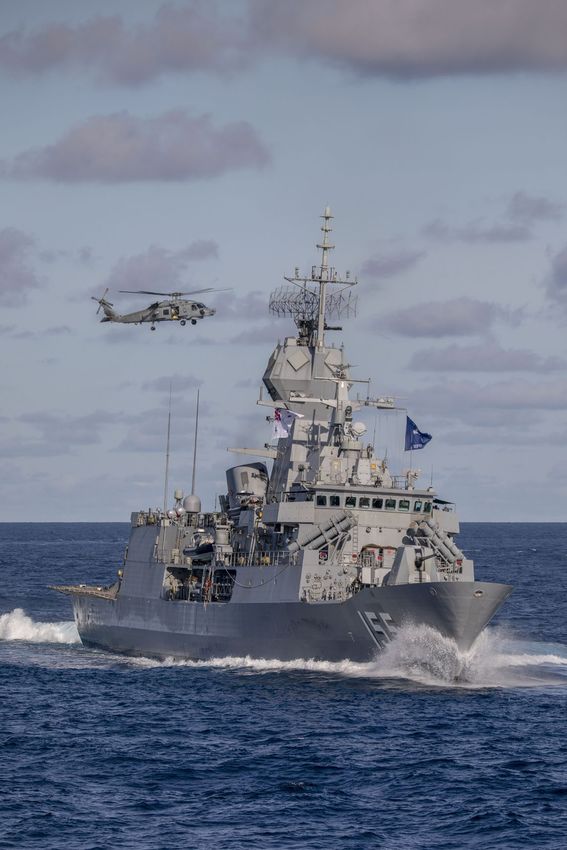
HMAS Ballarat and her embarked MH-60R helicopter operate in the South China
Sea Passage. The vessel is part of a regional presence deployment where
operations are being conducted with partners across Northeast and Southeast
Asia and the Northeast Indian Ocean. Image: LSIS Thomas Sawtell/
Defence.gov.au.
POLICY BRIEF 11AUSTRALIA’S SOUTH CHINA SEA CHALLENGES
The Trump administration, while seemingly unilateralist and dismissive
of US alliances, encouraged Australia to conduct FONOPs in the South
China Sea. The Biden administration may be more insistent. Because it
is more multilateralist and pro-alliances, it will want its allies to do more. Two senior Biden
administration
In the first months of the new Biden administration, three of these
operations have been made public, suggesting that there will be no let- appointees have
up in US FONOPs that accord with the UNCLOS ruling. In their 16 April particular expertise
2021 Joint Leaders’ Statement, US President Biden and Prime Minister
Suga of Japan reaffirmed their “objections to China’s unlawful maritime and interest in the
claims and activities in the South China Sea” and their “strong shared South China Sea
interest in a free and open South China Sea governed by international
law, in which freedom of navigation and overflight are guaranteed”. 31 disputes and may
advocate for a more
Two senior Biden administration appointees have particular expertise
and interest in the South China Sea disputes and may advocate for a robust US and allied
more robust US and allied position on these disputes. position on these
Ely Ratner, who worked with Biden when he was a senator and vice disputes.
president, is Biden’s nominee for Assistant Secretary of Defense for
Indo-Pacific affairs and leads the Department’s new China task force.
In a 2017 Foreign Affairs article, Ratner argued for a more forward-
leaning US policy on the South China Sea and closer cooperation with
Australia if China were to deploy advanced military capabilities to its
artificial islands in the Spratlys.32 China has done so.
Kurt Campbell is the first Indo-Pacific Coordinator at the National
Security Council. Campbell is a strong supporter of the US–Australia
alliance and of allied cooperation in Asia. In 2019, Campbell and Jake
Sullivan, now Biden’s National Security Advisor, outlined a future China
strategy for the United States “that must start with allies” and seek “a
steady state of clear-eyed coexistence [with China] on terms favourable
to US interests and values”. 33 Campbell, as Assistant Secretary of State
for East Asian and Pacific Affairs, was intimately involved in the failed
negotiations to stop China taking control of Scarborough Shoal in 2012.
US pressure on Australia to conduct FONOPs within 12 nautical miles
of China-claimed land features in the South China Sea, and the debate
in Australia about these, is likely to mount in the coming years.
12 POLICY BRIEFAUSTRALIA’S SOUTH CHINA SEA CHALLENGES
WHAT AUSTRALIA SHOULD DO:
POLICY RECOMMENDATIONS
1. Coordinate statements with Southeast Asian littoral states on
Chinese activities inconsistent with the UNCLOS ruling
Operation Gateway Australia should coordinate with Southeast Asian littoral states that are
is Australia’s main willing to criticise Chinese activities inconsistent with the UNCLOS
ruling, and issue supporting statements. Coordination on statements
program of can be done from Canberra or through Australian missions. Such
presence operations statements would reinforce Australia’s position on the UNCLOS ruling
and Australia’s relations with the infringed-upon Southeast Asian
in maritime littoral states.
Southeast Asia.
In March 2021, Australia joined the United States, Japan, the European
Union, and Canada in a Philippines-led criticism of the massing of
Chinese vessels around Whitsun Reef in the Philippine exclusive
economic zone of the South China Sea. China rebuffed these
statements of support, describing them as being coordinated and
“irresponsible”. 34 The more countries issue such statements,
individually or in groups, the more effective each will be in reducing the
likelihood and scale of Chinese punitive measures against any of them.
2. Do not conduct FONOPs within 12 nautical miles of Chinese-
claimed features in the South China Sea
Australia should continue to resist any US pressure to conduct
FONOPs and, instead, strengthen other forms of cooperation with the
United States on the South China Sea disputes.
An Australian FONOP would require a change to Australia’s maritime
operations doctrine. FONOPs are not one of the thirteen maritime
operations identified by the Royal Australian Navy. 35 The closest
Australian operations to the FONOPs conducted by the US Navy are
presence operations. Operation Gateway is Australia’s main program of
presence operations in maritime Southeast Asia. Under Australia’s
maritime doctrine, presence operations are included in the non-
coercive category of diplomatic operations. An Australian FONOP
would be hard to classify as such.
POLICY BRIEF 13AUSTRALIA’S SOUTH CHINA SEA CHALLENGES
Any Australian FONOP in the South China Sea would likely face greater
operational risks and lead to greater punitive reactions from China than
US operations have. In 2019, Chinese fishing vessels reportedly
directed laser beams at Royal Australian Navy helicopters during Indo- Any Australian
Pacific Endeavour presence operations far from any China-claimed
land features in the South China Sea. 36 An Australian FONOP should FONOP in the South
expect to face greater operational risks, and China could impose China Sea would
punitive diplomatic and economic measures on Australia of a greater
scale than those facing the country currently. likely face greater
operational risks and
3. Conduct and promote more bilateral and minilateral military
exercises with Southeast Asian littoral states in the South lead to greater
China Sea punitive reactions
Australia should instead participate in more and larger bilateral and from China than US
minilateral military exercises with Southeast Asian littoral states in their operations have.
respective exclusive economic zones in the South China Sea. These
exercises would deepen defence relations with Southeast Asian littoral
states and signal Australia and littoral states’ opposition to China’s
COC proposal for a notification and rejection mechanism for such
exercises.
Southeast Asian littoral states are more actively participating in
exercises with ‘non-regional’ powers, of which Australia is a key
example. These exercises include Australia’s now regular participation
in the annual US–Philippine multi-service Balikatan exercises; and the
Australia–Vietnam naval exercises during Australian Defence Force’s
2019 Indo-Pacific Endeavour activity.
Recently, the United States, Japan, and Australia conducted trilateral
military exercises in the South China Sea and the four Quad countries
—Australia, the United States, Japan, and India — participated in a joint
exercise in the Philippine Sea. Extending future exercises to include
willing Southeast Asian littoral states would send a powerful common
message. So would exercises with Southeast Asian littoral states in
parallel, but separate from, US–Japan–Australia or Quad exercises in
the South China Sea. These would be less sensitive for Southeast Asian
littoral states who are wary of ‘annoying’ China and concerned about
punitive reactions.
14 POLICY BRIEFAUSTRALIA’S SOUTH CHINA SEA CHALLENGES
It would be difficult for China to characterise Australian exercises with
Southeast Asian states in their respective exclusive economic zones in
the South China Sea as an Australian offence against China.
4. Support regular Quad Leaders’ Summits with the South China
Sea disputes on the agenda
During the Trump administration, the Quad, made up of Australia, the
United States, Japan, and India, was revived and then elevated to
foreign minister-level in September 2019. In October 2020, the four
ministers met virtually, and again in February 2021. The inaugural Quad
Leaders’ Summit was held on 12 March 2021 and an announcement
made of “an in-person summit by the end of 2021”. 37 In his opening
remarks, President Biden emphasised that this was “the first
multilateral summit that I’ve had the opportunity to host as President”
and that “the Quad is going to be a vital arena for cooperation in the
Indo-Pacific.” 38
US President Joe Biden meets with Japanese Prime Minister Yoshihide Suga in the
Oval Office, April 2021. The two leaders released their Joint Leaders’ Statement
on 16 April 2021, reaffirming their “objections to China’s unlawful maritime
claims and activities in the South China Sea”. Image: POTUS / Facebook.
Regional elite polling shows strong Southeast Asian support for the
Quad. Responding to the ISEAS State of Southeast Asia: 2020 Survey,
62 per cent of respondents supported their country participating in
security initiatives and military exercises organised under the Quad
framework, including a majority from each country except Cambodia
and Laos. 39 In an earlier, smaller survey, Australian researcher Huong
POLICY BRIEF 15AUSTRALIA’S SOUTH CHINA SEA CHALLENGES
Le Thu found strong agreement with the statement that “the Quad will
contribute to stability and peace in the Indo-Pacific” (55 per cent),
with just 14 per cent disagreeing. 40
From its conception, the Quad has played an important signalling role
to all states in the Indo-Pacific region. The elevation of the Quad to
ministerial level two years ago boosted that signal. Elevating the Quad
to regular Leaders’ Summits, as now seems likely, would send an even
louder signal of cooperation and common purpose; it would be the only
mechanism that brings these four leaders together without China also
being present.
Including the South China Sea disputes on the Summit agenda would
reinforce the members’ shared views on the UNCLOS ruling and the
legitimate interests of non-littoral states in the South China Sea. Quad
military exercises in international waters in the South China Sea would
too. The outcomes of the inaugural Quad Leaders’ Summit included a
Quad Vaccine Partnership and a Quad Vaccine Experts Group, a Quad
Climate Working Group, and a Quad Critical and Emerging Technology
Working Group. The next Summit should announce a Quad Maritime
Security Working Group.
CONCLUSION
Over the past decade, China’s more aggressive approach to its
unlawful claims in the South China Sea has directly challenged core
Australian interests and the global rules-based order. In the coming
years, Australia will face greater and new challenges in the South China
Sea.
To increase support for the pivotal UNCLOS ruling and counter
Chinese aggression without inviting a punitive response that singles
out Australia, Canberra should step up coordination with Southeast
Asian littoral states and put the South China Sea disputes on the Quad
leaders’ agenda.
16 POLICY BRIEFAUSTRALIA’S SOUTH CHINA SEA CHALLENGES
NOTES
Cover image: Chinese dredging vessels are purportedly seen in the waters
around Subi Reef in the disputed Spratly Islands in the South China Sea,
May 2015. Image: United States Navy / Wikimedia Commons.
This publication is part of the Lowy Institute’s ‘Australia’s Security and the
Rules-Based Order Project’ and is supported by the Department of
Defence’s Strategic Policy Grants Program.
1 For a short history of China’s ‘nine-dash line’ claims, see Hannah Beech,
“Just Where Exactly did China Get the South China Sea Nine-dash Line
from?”, Time, 19 July 2016, https://time.com/4412191/nine-dash-line-9-
south-china-sea/.
2 Australian Maritime Doctrine, Sea Power Centre, Royal Australian Navy, 2010,
41,
https://www.navy.gov.au/sites/default/files/documents/Amd2010.pdf.
3 China Island Tracker, Asian Maritime Transparency Initiative,
https://amti.csis.org/island-tracker/china/.
4 Andrew Tillett, “Chinese Media Threatens ‘Evil’ Australia’s Warship in South
China Sea”, Australian Financial Review, 1 December 2020,
https://www.afr.com/politics/federal/chinese-media-threatens-evil-
australia-s-warships-in-south-china-sea-20201201-p56jfb.
5 For more details, see Ian Storey, “China and the Philippines: Implications of
the Reed Bank incident”, China Brief, Vol 11, No 8, The Jamestown
Foundation, 6 May 2011, https://jamestown.org/program/china-and-the-
philippines-implications-of-the-reed-bank-incident/. Reed Bank is called
Recto Bank in the Philippines.
6 For more details, see Lowell B Bautista, “The Philippine Claim to Bajo de
Masinloc [Scarborough Shoal] in the Context of the South China Sea
Dispute”, Journal of East Asia and International Law, Vol 6, No 2, 2013,
https://ro.uow.edu.au/cgi/viewcontent.cgi?article=2053&context=lhapa
pers. Scarborough Shoal is called Bajo de Masinloc in the Philippines.
7 Position Paper of the Government of the People’s Republic of China on the
Matter of Jurisdiction in the South China Sea Arbitration Initiated by the
Republic of the Philippines, 7 December 2014,
https://www.fmprc.gov.cn/mfa_eng/zxxx_662805/t1217147.shtml.
8 The South China Sea Arbitration, Press Release, Permanent Court of
Arbitration, The Hague, 12 July 2016,
https://pcacases.com/web/sendAttach/1801.
9 “Australia Supports Peaceful Dispute Resolution in the South China Sea”,
Department of Foreign Affairs and Trade Media Release, 12 July 2016,
https://www.dfat.gov.au/news/news/Pages/australia-supports-peaceful-
dispute-resolution-in-the-south-china-sea.
10 United Nations Note Verbale No 20/026,
https://www.un.org/depts/los/clcs_new/submissions_files/mys_12_12_2
019/2020_07_23_AUS_NV_UN_001_OLA-2020-00373.pdf.
POLICY BRIEF 17AUSTRALIA’S SOUTH CHINA SEA CHALLENGES
11 Eryk Bagshaw, “Here are the 14 Disputes with Australia”, Twitter, 18
November 2020,
https://twitter.com/ErykBagshaw/status/1328983898911457280 .
12 See Ian Storey, “Assessing Responses to the Arbitral Tribunal’s Ruling on
the South China Sea”, ISEAS Perspective 2016/43, ISEAS-Yusof Ishak
Institute, 28 July 2016,
https://www.iseas.edu.sg/images/pdf/ISEAS_Perspective_2016_43.pdf .
13 Cited in “Cambodia Retains Stance of Not Backing Arbitration Court’s
Award over South China Sea: Spokesman”, Xinhua, 12 July 2016,
http://www.china.org.cn/world/Off_the_Wire/2016-
07/12/content_38865984.htm.
14 United Nations Note Verbale No 126/POL-703/v/20 (Unofficial translation),
https://www.un.org/Depts/los/clcs_new/submissions_files/mys_12_12_2
019/2020_05_26_IDN_NV_UN_001_English.pdf.
15 Presidential Communications Operations Office, “Statement of President
Rodrigo Roa Duterte during the General Debate of the 75th Session of
the United Nations General Assembly”, 22 September 2020,
https://pcoo.gov.ph/presidential-speech/statement-of-president-
rodrigo-roa-duterte-during-the-general-debate-of-the-75th-session-of-
the-united-nations-general-assembly/ .
16 Cited in Nestor Corrales, “Duterte Says He’ll ‘Set Aside’ Arbitral Ruling on
South China Sea”, Philippine Daily Inquirer, 17 December 2016,
https://globalnation.inquirer.net/150814/duterte-says-hell-set-aside-
arbitral-ruling-on-south-china-sea.
17 “The State of Southeast Asia: 2021 Survey Report”, ISEAS-Yusof Ishak
Institute, 10 February 2021, https://www.iseas.edu.sg/wp-
content/uploads/2021/01/The-State-of-SEA-2021-v2.pdf.
18 “SWS: 4 out of 5 Filipinos Say PH Should Form Alliances with Countries
Ready to Defend Territorial Rights in West PH Sea”, CNN Philippines, 14
July 2020, https://www.cnn.ph/news/2020/7/14/sws-survey-west-
philippine-sea-alliance.html.
19 Declaration on the Conduct of Parties in the South China Sea, Association
of Southeast Asia Nations (ASEAN), 4 November 2002,
https://asean.org/?static_post=declaration-on-the-conduct-of-parties-in-
the-south-china-sea-2.
20 “Premier Li Keqiang’s Speech at the 44th Singapore Lecture”, China Daily,
15 November 2018,
http://www.chinadaily.com.cn/a/201811/15/WS5bece520a310eff30328
8e55.html.
21 Ian Storey, “Assessing the ASEAN-China Framework for the Code of
Conduct for the South China Sea”, ISEAS Perspective, 2017/62, ISEAS-
Yusof Ishak Institute, 8 August 2017,
https://www.iseas.edu.sg/images/pdf/ISEAS_Perspective_2017_62.pdf.
22 Carl Thayer, “A Closer Look at the ASEAN-China Single Draft South China
Sea Code of Conduct”, The Diplomat, 3 August 2018,
https://thediplomat.com/2018/08/a-closer-look-at-the-asean-china-
single-draft-south-china-sea-code-of-conduct/.
23 “China and Malaysia in Another Staredown over Offshore Drilling”, Asia
Maritime Transparency Initiative, 25 November 2020,
18 POLICY BRIEFAUSTRALIA’S SOUTH CHINA SEA CHALLENGES
https://amti.csis.org/china-and-malaysia-in-another-staredown-over-
offshore-drilling/.
24 “32nd ASEAN-Australia Forum — Co-Chairs’ Summary”,
https://asean.org/storage/2020/05/Co-Chairs-Summary-32nd-ASEAN-
Australia-Forum-FINAL.pdf.
25 “Part II: Territorial Sea and Contiguous Zone”, United Nations Convention
Agreements,
https://www.un.org/Depts/los/convention_agreements/texts/unclos/par
t2.htm.
26 Greg Sheridan, “Cool Heads Key amid Gung-ho South China Sea Rhetoric”,
The Australian, 27 July 2020,
https://www.theaustralian.com.au/world/cool-heads-key-amid-gungho-
south-china-sea-rhetoric/news-
story/699b0b0a79078073d8272ff883a821ae.
27 Iain Henry, “Australia Struggles for Clarity on the South China Sea”, Lowy
Interpreter, 14 May 2019, https://www.lowyinstitute.org/the-
interpreter/australia-struggles-clarity-south-china-sea.
28 “Labor Shifts on South China Sea Operations”, 9News, 19 October 2016,
https://www.9news.com.au/national/fed-labor-shifts-on-sth-china-sea-
policy/47000708-f4ef-43e3-986f-dd8079f0f202.
29 Angus Grigg and Lisa Murray, “Former Spy Chief Dennis Richardson Says
China Overstepped in Australia”, Australian Financial Review, 7 March
2018, https://www.afr.com/business-summit/former-spy-chief-dennis-
richardson-says-china-overstepped-in-australia-20180307-h0x5va.
30 Richardson and Bishop are cited in Elena Collinson “Australia-China
Relations Summary”, Australia-China Relations Institute, March 2018,
https://www.australiachinarelations.org/sites/default/files/Australia-
China%20relations%20monthly%20summary%20-
%20March%202018_0.pdf.
31 “US–Japan Joint Leaders’ Statement”, 16 April 2021,
https://www.whitehouse.gov/briefing-room/statements-
releases/2021/04/16/u-s-japan-joint-leaders-statement-u-s-japan-global-
partnership-for-a-new-era/.
32 Ely Ratner, “Course Correction: How to Stop China’s Maritime Advance”,
Foreign Affairs, July/August 2017,
https://www.foreignaffairs.com/articles/2017-06-13/course-correction.
33 Kurt M Campbell and Jake Sullivan, “Competition without Catastrophe: How
America Can Both Challenge and Co-exist with China”, Foreign Affairs,
September/October 2019,
https://www.foreignaffairs.com/articles/china/competition-with-china-
without-catastrophe.
34 Christia Marie Ramos, “China Feuds with EU, UK, Canada Envoys over
Comments on WPS”, Philippine Daily Inquirer, 25 March 2021,
https://globalnation.inquirer.net/194585/china-hits-back-as-more-
nations-call-it-out-for-raising-tensions-in-wps.
35 Australian Maritime Operations, Sea Power Centre, Royal Australian Navy,
2017,
https://www.navy.gov.au/sites/default/files/documents/Australian_Marit
ime_Operations_2017.pdf.
POLICY BRIEF 19AUSTRALIA’S SOUTH CHINA SEA CHALLENGES
36 Lisa Martin, “Australian Navy Pilots Hit with Lasers during South China Sea
Military Exercise”, The Guardian, 29 May 2019,
https://www.theguardian.com/australia-news/2019/may/29/australian-
navy-pilots-hit-with-lasers-during-south-china-sea-military-exercise.
37 “Quad Leaders’ Joint Statement: ‘The Spirit of the Quad’”, White House, 12
March 2021, https://www.whitehouse.gov/briefing-room/statements-
releases/2021/03/12/quad-leaders-joint-statement-the-spirit-of-the-
quad/.
38 “Remarks by President Biden, Prime Minister Modi of India, Prime Minister
Morrison of Australia, and Prime Minister Suga of Japan in the Virtual
Quad Leaders’ Summit”, 12 March 2021,
https://www.whitehouse.gov/briefing-room/speeches-
remarks/2021/03/12/remarks-by-president-biden-prime-minister-modi-
of-india-prime-minister-morrison-of-australia-and-prime-minister-suga-of-
japan-in-virtual-meeting-of-the-quad/.
39 “The State of Southeast Asia: 2020 Survey Report”, ISEAS-Yusof Ishak
Institute, 16 January 2020, https://www.iseas.edu.sg/wp-
content/uploads/pdfs/TheStateofSEASurveyReport_2020.pdf.
40 Huong Le Thu, “Southeast Asian Perceptions of the Quadrilateral Security
Dialogue”, ASPI Special Report, October 2018, https://s3-ap-southeast-
2.amazonaws.com/ad-aspi/2018-
10/SR%20130%20Quadrilateral%20security%20dialogue.pdf?Fm448sn
_MfBnQebAdDv1bBqlKOu8iWud.
20 POLICY BRIEFAUSTRALIA’S SOUTH CHINA SEA CHALLENGES
ABOUT THE AUTHOR
Malcolm Cook is a Nonresident Fellow at the Lowy Institute. From 2003 to
2010, he was the Institute’s inaugural East Asia Program Director. He
completed a PhD in International Relations from the Research School of
Pacific and Asian Studies at the Australian National University. He also
holds a Masters degree in International Relations from the International
University of Japan and an honours degree from McGill University in
Canada, his country of birth. Before moving to Australia in 2000, Malcolm
lived and worked in the Philippines, South Korea and Japan. In 2011,
Malcolm became the inaugural Dean of the School of International Studies
at Flinders University of South Australia and in 2014, became a Senior
Fellow at the ISEAS – Yusof Ishak Institute in Singapore.
Malcolm Cook
POLICY BRIEF31 Bligh Street Tel. +61 2 8238 9000 lowyinstitute.org Sydney NSW 2000 Fax +61 2 8238 9005 @LowyInstitute
You can also read


