Big Lagoon Community Services District Municipal Services Review and Sphere of Influence Update - Adopted March 17, 2021 www.humboldtlafco.org
←
→
Page content transcription
If your browser does not render page correctly, please read the page content below
Big Lagoon Community Services District
Municipal Services Review and
Sphere of Influence Update

Adopted
March 17, 2021

www.humboldtlafco.org
HUMBOLDT LOCAL AGENCY FORMATION COMMISSION
Commissioners:

Virginia Bass, District 4 Supervisor

Mike Wilson, District 3 Supervisor

Stephen Avis, City of Ferndale

Mike Losey, City of Fortuna

Troy Nicolini, Peninsula Community Services District

Debra Lake, Fruitland Ridge Fire Protection District

Ali O. Lee, Public Member

Alternate Members:

Michelle Bushnell, District 2 Supervisor

Gordon Johnson, City of Rio Dell

Dave Couch, McKinleyville Community Services District

Skip Jorgensen, Public Member

Staff:

Colette Santsche, AICP, Executive Officer

Krystle Heaney, AICP, Analyst/Clerk

Raquel Menanno, Analyst

Jason Barnes, GIS Analyst

Ryan Plotz, Legal Council

Acknowledgements:

LAFCo would like to thank the Board Members at Big Lagoon CSD and volunteer operator
Valen Castellano for their assistance during the preparation of this MSR and SOI update.
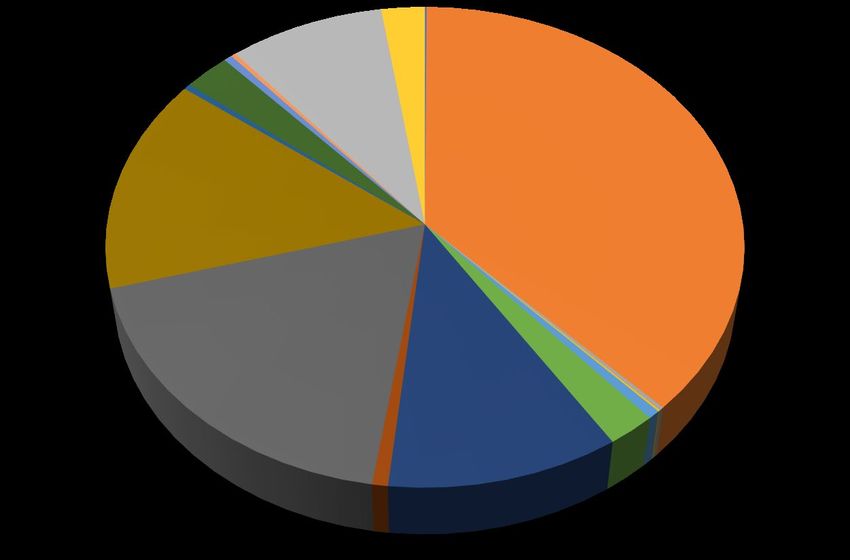
TABLE OF CONTENTS
1.0     MSR/SOI Background ............................................................................................................... 1
1.1     Role and Responsibility of LAFCo ...................................................................................................... 1
1.2     Purpose of Municipal Service Reviews ............................................................................................. 1
1.3     Purpose of Spheres of Influence ....................................................................................................... 2
1.4     Disadvantaged Unincorporated Communities.................................................................................. 3
2.0     Big Lagoon Community Services District.................................................................................... 4
2.1     Agency Overview .............................................................................................................................. 4
2.2     Formation and Development ............................................................................................................ 4
2.3     Boundary and Sphere of Influence ................................................................................................... 5
2.4     Land Use and Zoning ....................................................................................................................... 10
2.5     Growth and Population ................................................................................................................... 10
2.6     Disadvantaged Unincorporated Communities................................................................................ 10
2.7     Municipal Services .......................................................................................................................... 11
2.8     Organizational Structure ................................................................................................................. 13
2.9     Accountability and Transparency.................................................................................................... 13
2.10    Financial Overview .......................................................................................................................... 13
3.0     Big Lagoon MSR Determinations ............................................................................................. 16
4.0     Big lagoon SOI Determinations ............................................................................................... 18

List of Figures

Figure 1: Big Lagoon CSD 1997 Boundary ................................................................................ 5
Figure 2: Big Lagoon CSD Alternate 1997 Boundary............................................................... 6
Figure 3: Big Lagoon CSD Boundary and SOI Changes ......................................................... 8
Figure 4: Big Lagoon CSD Land Use .......................................................................................... 9
Figure 5: January 2016-August 2020 Expenses....................................................................... 14

List of Tables

Table 1: Water Demand Summary ......................................................................................... 12
Table 2: Big Lagoon CSD Board of Directors ......................................................................... 13
Table 3: BLCSD Annual Budget Summary .............................................................................. 15
Table 4: BLCSD Profit and Loss Summary ................................................................................ 15
1.0 MSR/SOI BACKGROUND
1.1 Role and Responsibility of LAFCo
Local Agency Formation Commissions (LAFCos) are independent regulatory commissions
that were established by the State legislature in 1963 to encourage the orderly growth
and development of local governmental agencies including cities and special districts.
Today, there is a LAFCo in each of California’s 58 counties. Humboldt LAFCo is a seven-
member commission comprised of two members of the Humboldt County Board of
Supervisors, two City Council members, two Special District representatives, and one
Public Member-At-Large. The Commission also includes one alternate member for each
represented category.

LAFCo is responsible for implementing the Cortese-Knox-Hertzberg Local Government
Reorganization Act of 2000 (“CKH Act”) (California Government Code Section 56000 et
seq.) for purposes of facilitating changes in local governmental structure and boundaries
that fosters orderly growth and development, promotes the efficient delivery of services,
and encourages the preservation of open space and agricultural lands. Some of LAFCo’s
duties include regulating jurisdictional boundary changes and the extension of municipal
services. This includes city and special district annexations, incorporations/formations,
consolidations, and other changes of organization. LAFCo seeks to be proactive in raising
awareness and building partnerships to accomplish this through its special studies,
programs, and actions.

The CKH Act outlines requirements for preparing Municipal Service Reviews (MSRs) for
periodic Sphere of Influence (SOI) updates. MSRs and SOIs are tools created to empower
LAFCo to satisfy its legislative charge of “discouraging urban sprawl, preserving open
space and prime agricultural lands, efficiently providing government services, and
encouraging the orderly formation and development of local agencies based upon
local conditions and circumstances” (§56301). CKH Act Section 56301 further establishes
that “one of the objects of the commission is to make studies and to obtain and furnish
information which will contribute to the logical and reasonable development of local
agencies in each county and to shape the development of local agencies so as to
advantageously provide for the present and future needs of each county and its
communities.” SOIs therefore guide both the near-term and long-term physical and
economic growth and development of local agencies, and MSRs provide the relevant
data to inform LAFCo’s SOI determinations.

1.2 Purpose of Municipal Service Reviews
As described above, MSRs are designed to equip LAFCo with relevant information and
data necessary for the Commission to make informed decisions on SOIs. The CKH Act,
however, gives LAFCo broad discretion in deciding how to conduct MSRs, including
geographic focus, scope of study, and the identification of alternatives for improving the
efficiency, cost-effectiveness, accountability, and reliability of public services. The
purpose of a MSR in general is to provide a comprehensive inventory and analysis of the
services provided by local municipalities, service areas, and special districts. A MSR

Big Lagoon CSD
2021 MSR & SOI Update                                                                  [1]
evaluates the structure and operation of the local municipalities, service areas, and
special districts and discusses possible areas for improvement and coordination. While
LAFCos have no direct regulatory authority over cities and special districts, MSR’s provide
information concerning the governance structures and efficiencies of service providers –
and may also serve as the basis for subsequent LAFCo decisions. The MSR is intended to
provide information and analysis to support a sphere of influence update. A written
statement of the study’s determinations must be made in the following areas:

   (1) Growth and population projections for the affected area
   (2) Location and characteristics of any disadvantaged unincorporated communities
       within or continuous to the sphere of influence
   (3) Present and planned capacity of public facilities, adequacy of public services,
       and infrastructure needs or deficiencies
   (4) Financial ability of the agency to provide services
   (5) Status of and opportunities for shared facilities
   (6) Accountability for community service needs, including governmental structure
       and operational efficiencies
   (7) Any other matter related to effective or efficient service delivery, as required by
       Commission policy
This MSR is organized according to these determinations listed above. Information
regarding each of the above issue areas is provided in this document.

1.3 Purpose of Spheres of Influence
In 1972, LAFCos were given the power to establish SOIs for all local agencies under their
jurisdiction. As defined by the CKH Act, “‘sphere of influence’ means a plan for the
probable physical boundaries and service area of a local agency, as determined by the
commission” (§56076). All boundary changes, such as annexations, must be consistent
with an agency’s sphere of influence with limited exceptions.

Pursuant to Humboldt LAFCo policy, a MSR is conducted prior to or in conjunction with its
mandate to review and update each local agency’s sphere of influence every five years
or as necessary. The municipal service review process is intended to inform the
Commission as to the availability, capacity, and efficiency of local governmental
services prior to making sphere of influence determinations.

LAFCo is required to make five written determinations when establishing, amending, or
updating an SOI for any local agency that address the following (§56425(c)):

   (1) The present and planned land uses in the area, including agricultural and open
       space lands.
   (2) The present and probable need for public facilities and services in the area.

Big Lagoon CSD
2021 MSR & SOI Update                                                                   [2]
(3) The present capacity of public facilities and adequacy of public services that the
agency provides or is authorized to provide.
(4) The existence of any social or economic communities of interest in the area if the
commission determines that they are relevant to the agency.
(5) For an update of an SOI of a city or special district that provides public facilities or
services related to sewers, municipal and industrial water, or structural fire
protection, the present and probable need for those public facilities and services
of any disadvantaged unincorporated communities within the existing sphere of
influence.
Service reviews may also contain recommendations for sphere of influence or
government structure changes needed to implement positive service changes. Where
more detailed analysis of service options is necessary, service reviews may contain
recommendations for special studies where there is the potential to reduce service gaps
and improve service levels.
1.4 Disadvantaged Unincorporated Communities
SB 244 (Chapter 513, Statutes of 2011) made changes to the CKH Act related to
“disadvantaged unincorporated communities,” including the addition of SOI
determination number five listed above. Disadvantaged unincorporated communities,
or “DUCs,” are inhabited territories (containing 12 or more registered voters) where the
annual median household income is less than 80 percent of the statewide annual
median household income.
Humboldt LAFCo has adopted DUC policy, which identifies 31 inhabited unincorporated
“legacy” communities for purposes of implementing SB 244. These legacy communities
were defined as part of the Humboldt County 2014 Housing Element for areas not located
within the sphere of influence of a city. Therefore, additional review is needed to
determine “disadvantaged unincorporated communities” within and adjacent to city
spheres of influence.
CKH Act Section 56375(a)(8)(A) prohibits LAFCo from approving a city annexation of
more than 10 acres if a DUC is contiguous to the annexation territory but not included in
the proposal, unless an application to annex the DUC has been filed with LAFCo. The
legislative intent is to prohibit selective annexations by cities of tax-generating land uses
while leaving out under-served, inhabited areas with infrastructure deficiencies and lack
of access to reliable potable water and wastewater services. DUCs are recognized as
social and economic communities of interest for purposes of recommending SOI
determinations pursuant to Section 56425(c).
Big Lagoon CSD
2021 MSR & SOI Update [3]2.0 BIG LAGOON COMMUNITY SERVICES DISTRICT
2.1 Agency Overview
The Big Lagoon Community Services District (BLCSD) provides water service to the small
community of Big Lagoon located on a bluff overlooking Big Lagoon Beach just west of
Highway 101 and approximately 8 miles north of Trinidad. The community consists of
single-family homes, Big Lagoon School, Big Lagoon Park Company, and big Lagoon
County Park. The area receives many visitors seeking out lagoon and beach access and
overnight camping.
Primary Contact William Wenger
E-mail bill@biglagooncsd.com
Address PO Box 847, Trinidad, CA 95570-0847
Phone (707) 677-2008
Website Under construction
2.2 Formation and Development
BLCSD was formed on April 28, 1998 as an independent special district for the purposes
of supplying water to homes in the Big Lagoon subdivision and Big Lagoon School
(Resolution No. LAFCo 97-04) 1. Residents of the big Lagoon Estates subdivision applied for
formation of the District in order to purchase and operate an existing private water system
which historically provided water to the Big Lagoon Estates subdivision. The proponents
requested activation of water service powers and the application was supported by the
Division of Drinking Water.
The District was conditionally formed upon a Local Coastal Plan amendment of the
proposed boundaries to coincide with the Urban Limit Line (ULL) as identified in the
Northcoast Area Plan 2. The ULL establishes the maximum extension of development for a
five-year period, at which time the ULL shall be reexamined by the County and the
California Coastal Commission and adjustments, if necessary or appropriate, made 3.
The proposed District boundaries and ULL as identified in the Northcoast Area Plan were
not in alignment. Therefore, staff recommended the project be conditioned upon
making application to amend the ULL to be coincidental with the proposed District
boundaries to be consistent with the Northcoast Area Plan 4.
1 Humboldt County Board of Supervisors Meeting, Agenda Item No. J-2, April 28, 1998 (Resolution No.98-49).
2 LAFCo Resolution No. 97-04.
3 North Coast Area Plan, Chapter 3-page 2. Revised December 2014.
4 Formation of the BLCSD Case No. 97-04, LAFCo Meeting January 28, 1998.
Big Lagoon CSD
2021 MSR & SOI Update [4]Figure 1: Big Lagoon CSD 1997 Boundary 2.3 Boundary and Sphere of Influence The district boundary consists of 61 parcels bounded on the west by the Pacific Ocean, on the east by Highway 101, and on the south by forested areas. The current SOI expands west, north, and east of the District as shown in Figure 2. The northern extent of the SOI includes single-family homes and the eastern extent includes Big Lagoon School. The District includes undeveloped parcels which may not be buildable due to topography and/or proximity to the edge of the bluff. Big Lagoon CSD 2021 MSR & SOI Update [5]
Figure 2: Big Lagoon CSD Alternate 1997 Boundary

Big Lagoon CSD
2021 MSR & SOI Update                              [6]
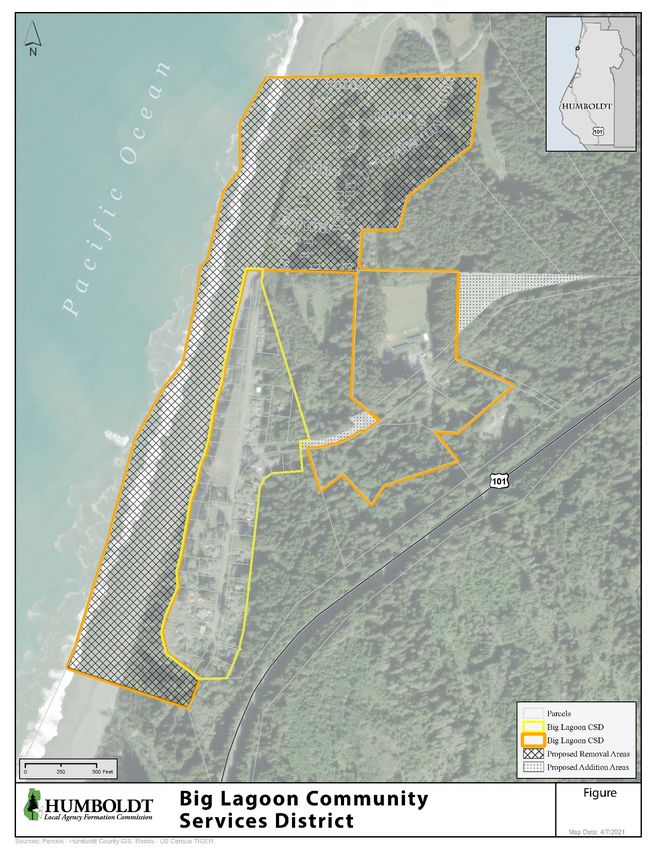
The original district boundary consisted of 66 parcels and 55 acres 5. As shown in Figures
1 and 2, conflicting boundaries were shown. In order to delineate the actual boundary
of the District, tax rate area maps were used to determine which parcels have been
recorded with the State Board of Equalization. Based on this analysis the District boundary
is as shown in Figure 3.

Fifteen parcels along the western boundary of BLCSD are no longer served because they
were condemned after the 1998 bluff erosion event and are now property of Humboldt
County. There are four parcels located outside of the District’s boundary and within the
SOI that are out-of-district service customers. These include the District wells, three
residences, and Big Lagoon Elementary School.

The proposed SOI changes, as shown on Figure 3, are intended to better align the SOI
with parcels receiving water service and satisfy the requests of District. This includes
removal of the condemned bluff parcels, Big Lagoon Park Company parcels (served by
a separate water system), and adjacent undeveloped land. This SOI change will also
help support detachment of the bluff parcels from the District should the District Board
decide to move forward with a boundary change process.

5   BLCSD Formation, Attachment D. November 26, 1997 meeting.

Big Lagoon CSD
2021 MSR & SOI Update                                                                   [7]
Figure 3: Big Lagoon CSD Boundary and SOI Changes

Big Lagoon CSD
2021 MSR & SOI Update                               [8]
Figure 4: Big Lagoon CSD Land Use

Big Lagoon CSD
2021 MSR & SOI Update               [9]
2.4 Land Use and Zoning
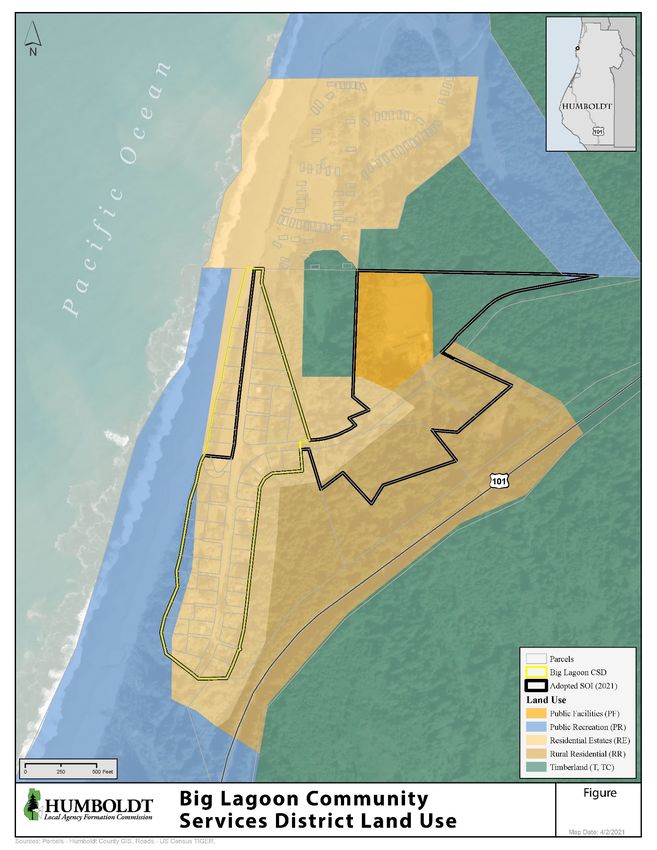
Land use within the District is subject to the North Coast Area Plan of the Humboldt
County Local Coastal Program, Humboldt County General Plan Volume II. The land use
designation for the entirety of the District is Residential Estates (RE). Areas surrounding the
District include Public Facility (PF), Public Recreation (PR), RE, Railroad (RR), and Coastal
Commercial Timberland (TC) 6.

Zoning within the District is Residential Single Family (RS) with combining zones X –
No further subdivision allowed and D – Design Review. Zoning surrounding the District
includes RS-X/D, PR, TC, and Rural Residential Agriculture minimum lot size 5 acres (RA-
5) 7. A small portion of parcels also have the Streams and Riparian Corridors Protection (R)
combining zone which greatly restricts development. Given these zoning districts, limited
growth is anticipated.

2.5 Growth and Population
The BLCSD boundary includes 46 parcels that are primarily developed with single family
residential uses. The population of Big Lagoon Census Designated Place (CDP) is 118
people 8. The CDP is larger than the District boundary and includes homes located north
of the District. According to staff, BLCSD serves 41 households with a total population 75 9.
Additionally, many of the homes in the District are second homes or vacation rentals that
are not regularly occupied. Due to restrictions on further subdivisions, limited potential for
development in the area, and limited full time occupation of homes, the population is
not expected to grow over the next five to ten years.

2.6 Disadvantaged Unincorporated Communities
Disadvantaged unincorporated communities, or “DUCs,” are inhabited territories
(containing 12 or more registered voters) where the annual median household income
(MHI) is less than 80 percent of the statewide annual median household income.

BLCSD is within Big Lagoon CDP which in 2018 had an estimated MHI of $66,806. This is 94
percent of the estimated California MHI of $71,228 10 which means the District does not
qualify as a DUC. However, the census data is based on a small sample size and may
not accurately depict the income levels of the District. The District is encouraged to
conduct an income survey to better evaluate the status of the community.

To the north of the District is the small community of Big Lagoon Rancheria. This
community is within census block group 1, census tract 102 and can be considered a

6 Humboldt County Web GIS, Jurisdiction Boundaries & Land Use, Planning Layers, Current General Plan Land Use.

Accessed November 2, 2020.
7 Humboldt County Web GIS, Jurisdiction Boundaries & Land Use, Planning Layers, Zoning. Accessed November 2, 2020.
8 US Census, American Community Survey 2018 5-year Estimates, Big Lagoon CDP, Table B01003 Total Population. Accessed

November 2, 2020.
9 BLCSD, Vice Chair, Personal Communication, August 24, 2020.
10 US Census, American Community Survey 2018 5-year Estimates, State of California and Big Lagoon CDP, Table S1903 and

B19013. Accessed November 2, 2020.

Big Lagoon CSD
2021 MSR & SOI Update                                                                                            [10]
DUC 11. It is important to note that the block group covers a large area and might not
accurately depict the MHI of the rancheria. The Rancheria is a federally recognized tribe
and has independent service systems including a community water treatment facility
and storage tank 12. Wastewater is handled by onsite wastewater treatment systems and
fire/ emergency response services are provided by CSA #4.

2.7 Municipal Services
BLCSD is authorized to provide water services to the community of Big Lagoon. All other
services listed under CSD law are considered latent powers of the District.

Water Services
BLCSD has three wells, one of which is operational. The District relies primarily on
groundwater from a single well located at 47 Roundhouse Creek Road and identified as
Well 2010 (site 003) 13. An 8” well (Well 2) is shut off with closed isolation valves and
relegated to emergency standby. The original 12” well (Well 1) is used as a monitoring
well 14.

Groundwater is treated through a chlorination process and stored in two 5,000-gallon
plastic tanks that provide water to the community. The District’s treatment plant can
process up to 24 gpm, or 33,900 gallons per day 15 which equals approximately 12,373,500
million gallons per year. During 2019, the total amount of water pumped from the
treatment plant to the storage tanks was 1,792,500 gallons. The District is currently and
has previously experienced water loss issues in the system. According to the 2019 and
2018 Consumer Confidence Reports, the District did not receive any water quality
violations 16.

BLCSD serves 43 households and Big Lagoon School. Average water use in the District in
2019 was approximately 121 gallons per day per household which is 0.4 percent of the
District’s daily treatment capacity. The monthly average for water produced in 2019 was
149,375 gallons with a monthly high of 253,100 gallons in January and a low of 96,100
gallons in February. This indicates the District has ample capacity to serve additional
demand should it arise.

11 US Census, American Community Survey 2018 5-year Estimates, Block Group 1 Census Tract 102 Humboldt County, Table
B19013 ($35,600). Accessed November 2, 2020.
12 California Coastal Commission, Staff Recommendation on Consistency Determination No. CD-077-06. December 15,

2006.
13 BLCSD 2019 Consumer Confidence Report
14 Personal Communication with BLCSD staff, December 4, 2020.
15 Personal Communication with BLCSD staff, December 4, 2020.
16 BLCSD 2019, 2018 Consumer Confidence Report

Big Lagoon CSD
2021 MSR & SOI Update                                                                                          [11]
Table 1: Water Demand Summary
                                      Gallons per Month
 Month                      2018                             2019
 January                   121,600                         253,100
 February                  117,800                          96,100
 March                     132,200                         116,000
 April                     116,300                         124,500
 May                       164,400                         133,900
 June                      200,900                         171,900
 July                      280,700                         200,800
 August                    283,100                         177,800
 September                 280,600                         148,500
 October                   180,600                         128,300
 November                  208,200                         111,900
 December                  224,100                         129,700
 Total Gallons            2,310,500                       1,792,500

In October 2019, the District adopted Resolution 19-03 designating 320 acres of the
surrounding watershed as critically important to the BLCSD water supply. In effort to
further monitor the watershed and potentially help improve water quality in the area, the
District is encouraged to coordinate and collaborate with conservation and restoration
organizations such as the North Coast Resource Partnership or North Coast Land Trust.

Infrastructure Upgrades
Several infrastructure upgrades and adjustments have been made since the 2008 MSR.
The original 12” well is now used as a monitoring well instead of primary pumping. The 8”
well, which provides good water quality but not in quantities to meet back up
requirements, is now used as a standby well for emergency situations. However, with the
low pumping capacity of the well it would not be able to provide enough water to
support District needs and additional sources of water would be needed in the event of
an emergency. The newest 5” well was drilled in 2010 and produced 23 gallons per
minute when first operational. The original 20,000-gallon redwood tank and 3,000-gallon
pressurized tank were replaced in 2011 with two 5,000-gallon plastic tanks. While this
reduced maintenance costs, it also reduced the overall storage for the District and is
inadequate to meet minimum fire flow. CalFire recommends the District increase storage
capacity to 40,000 gallons. Additionally, the propane tank for the generator, the back-
up power supply for treatment and distribution, was doubled in size to 500 gallons to
cover extended blackout periods.

Future planned improvements include a new well. Currently, the emergency well only
produces about 0.66 gpm and shuts off after running for two minutes. The water table
for their primary well has been dropping over the past several years. An earthquake once
caused a drop from 62 feet to 92 feet in the water table. Readings from this year indicate
the table ranges from 90 to 100 feet and fluctuates based on level of precipitation. The
primary well is approximately 200 feet deep with the pump located 6-8 feet from the

Big Lagoon CSD
2021 MSR & SOI Update                                                                 [12]
bottom. While there is still ample room left for pumping, the well should continue to be monitored for further drops in the water table. The overall goal of the current board is to plan for and implement infrastructure upgrades in order to provide more resiliency to the system. 2.8 Organizational Structure BLCSD is an independent special district served by a five-member Board of Directors that are elected to four-year staggered terms. The Board holds regular meetings monthly and has special meetings as needed. Until December 2020 Board meetings were held at a Board member’s house four times a year or as needed for maintenance related business, prior to COVID-19. Currently, the Board meets via Zoom on the next to last Saturday of each month at 2:00pm. The District does not currently employee any part-time or full-time staff. Resident volunteer Val Castellano, who holds a D1 certification, is the primary water operator responsible for monitoring, maintaining, and supervising any major repair work. A paid water operator is budgeted should the need arise. Resident volunteers read the water meters every other month. Table 2: Big Lagoon CSD Board of Directors Board Member Title Term Expiration Joseph Blaine Member-At-Large December 2022 William Wenger Chair December 2022 Richard Maier Treasurer December 2022 Charles King Member-At-Large December 2024 Craig Satein Vice Chair December 2024 2.9 Accountability and Transparency Board agendas and notices are posted at the Big Lagoon School and at the Trinidad Post Office at least 72 hours in advance of scheduled Board meetings and emailed to members of the District that provided email addresses. The agendas are also planned to be posted at the Trinidad library once it reopens. The District does not yet have a website but the design and implementation of a website has been initiated and will be available by the end of 2021. The previous Board approved and renewed a resolution of hardship in accordance with SB929 on June 14, 2020 (originally Resolution No. 19-02). The current Board is seeking to increase District transparency and provide more resources to District residents. 2.10 Financial Overview Revenue and Expenditures BLCSD is primarily funded through user fees for services and budgets are set for the calendar year from January-December. User fees include a monthly base rate charge and usage charges. The current usage rate is 0.0359 cents per cubic foot and 0.04799 cents per 10 gallons depending on what type of meter is installed. The base rate charge accounts for approximately $23,000-24,000 per year while the water usage charge Big Lagoon CSD 2021 MSR & SOI Update [13]
accounts for approximately $6,000-9,000 per year. Expenditures for the District include
depreciation and operational expenses. As shown in Figure 3, depreciation accounts for
the largest expense at 38% from January 2016-August 2020, followed by insurance at 18%
and maintenance at 15%.

Figure 5: January 2016-August 2020 Expenses
                                                                 Bank Charges
                    Water Testing
                        9%                                       Depreciation Expense
                                               Depreciation      Election
                                                 Expense         Water Meters
                                                   38%           Supplies
  Maintenance
                                                                 Dues
     15%
                                                                 Electric
                                                                 Gas
                                                                 Insurance
                                                                 Maintenance
                 Insurance
                                                                 Office Supplies
                    18%
                                                                 Parts
                                                                 Postage
                                    Electric
                                      11%                        Regulatory Expenses
                                                                 Water Testing
                                                                 Water Distribution Operator

As stated above, the District currently adopts operational budgets for the calendar year.
Government Code §61110 states that a preliminary and final budget must be adopted
for the District on or before July 1 of each year or, for districts using two one-year budgets
or a biennial budget, every other year, in accordance public notice and processing
procedures. Government Code §53901 states that within 60 days after the beginning of
the fiscal year each local agency must submit its budget to the county auditor. These
budgets are to be filed and made available on request by the public at the county
auditor’s office. The District is encouraged to begin adopting budgets for the fiscal year
(July 1 to June 30) and begin filing regularly with the County Auditor.

Currently, BLCSD has no audits on file and there is no record of reporting to the State
Controller. According to CSD law (California Government Code §61118), the Board of
Directors shall provide for regular audits of the District’s accounts and records and shall
provide for annual financial reports to the State Controller. Special districts must submit a
report to the State Controller of all financial transactions of the district during the
preceding fiscal year within 90 days after the close of each fiscal year, in the form
required by the State Controller, pursuant to Government Code §53891. If filed in
electronic 22 format, the report must be submitted within 110 days after the close of the
fiscal year. All special districts are required to submit annual audits to the County within
12 months of the completion of the fiscal year unless the Board of Supervisors has

Big Lagoon CSD
2021 MSR & SOI Update                                                                          [14]
approved a biennial or five-year schedule 17. The District is strongly encouraged to bring
their financial reporting up to date. This may help with qualifying for future grant
opportunities for water system upgrades. It would also be beneficial to become a
member of California Special Districts Association which would provide access to helpful
resources related to budgeting, auditing, and reporting.
Table 3 provides a summary of the last five years of budgeted revenues and
expenditures. The Profit/Loss Summary in Table 4 shows the District experiencing a gain in
the past five calendar years. This means the District is able to cover major maintenance
and repairs every few years without exhausting reserves. However, expenses for annual
audits and/or major repair work could alter this trend. Currently, the general fund
balance is approximately $133,000 and the District holds approximately $50,000-60,000 in
assets 18.
Table 3: BLCSD Annual Budget Summary
Calendar Year
Category Jan-Dec Jan-Dec Jan-Dec Jan-Dec Jan-Dec Jan-Dec
2016 2017 2018 2019 2020 2021
Base Rate 23,124 23,716.67 23,716.67 23,692.92 23,692.92 24,900
Water Usage 6,680 8,312.39 8,312.39 9,407.56 9,493.07 7,400
Revenues 29,804 31,471.72 32,029.06 33,100.48 33,185.99 32,900
Depreciation 7,568 7,568 7,568 7,568 7,568 7,568
Operation 18,736.94 19,379.91 14,976.84 17,938.59 18,367.15 17,072
Other - 60 60 120 12 -
Expenditures 26,304 27,007.91 22,604.84 25,626.59 25,947.15 24,640
Gain/ (Loss) $3,499.06 $4,463.81 $9,424.22 $7,473.89 $7,238.84 $8,338.64
Table 4: BLCSD Profit and Loss Summary
Calendar Year
Category Jan-Dec Jan-Dec Jan-Dec Jan-Dec Jan-Aug
2016 2017 2018 2019 2020
Base Rate 23,431.67 23,692.92 23,597.92 24,188.50 16,176.31
Water Usage 8,178.75 9,046.53 9,033.57 7,823.83 5,453.62
Installation - - - 10,000 -
Revenues 31,053.08 32,256.54 31,820.44 42,325.04 26,629.93
Depreciation 7,568 7,568 7,568 7,568 3,784
Operation 19,379.91 662.81 15,514.63 11,537.20
Other 60 12.83 12 - -
Expenditures 27,007.91 8,243.64 23,094.63 19,105.20 13,061.20
Gain/ (Loss) $4,045.17 $24,012.90 $8,725.81 $23,219.84 $13,568.73
17 California Government Code Section 26909 (5)(b)(1-3).
18 Personal Communication with BLCSD Staff, December 4, 2020.
Big Lagoon CSD
2021 MSR & SOI Update [15]3.0 BIG LAGOON MSR DETERMINATIONS
As set forth in Section 56430(a) of the CKH Act- In order to prepare and to update the
SOI in accordance with Section 56425, the commission shall conduct a service review of
the municipal services provided in the county or other appropriate area designated by
the commission. The commission shall include in the area designated for a service review
the county, the region, the sub-region, or any other geographic area as is appropriate
for an analysis of the service or services to be reviewed, and shall prepare a written
statement of its determinations with respect to each of the following:
(1) Growth and population projections for the affected area.
a) The estimated population of the District is 75. Due to the limited potential for future
development and the transient uses of the area, the population is not expected
to grow measurably over the next five to ten years.
(2) The location and characteristics of any disadvantaged unincorporated communities
within or contiguous to the sphere of influence.
a) The 2018 American Community Survey MHI for Big Lagoon CDP is $66,806 which
does not qualify it as a DUC. However, the District is encouraged to conduct a
District wide income survey to more accurately determine the MHI.
b) Just north of the District is the Big Lagoon Rancheria which has an estimated 2018
American Community Survey MHI of $35,600 which does qualify it as a DUC. The
MHI estimate is for a large census tract and the actual MHI of the Rancheria may
be higher or lower. The community is currently served by its own community water
system. Should consolidation of services be considered in the future for the area,
the District should coordinate with the Rancheria to ensure adequate services are
provided.
(3) Present and planned capacity of public facilities and adequacy of public services,
including infrastructure needs or deficiencies.
a) The District has a current treatment capacity of 33,900 gallons per day while the
average demand is approximately 5,000 gallons per day with a peak demand of
8,000 gallons per day. This indicates the District has ample supply to support the
potable water needs of the community.
b) The District currently does not have a sufficient backup source of water. Should
the primary well fail, the District would likely need to rely on trucked in water while
repairs are made. The District is encouraged to continue seeking a suitable
backup water source.
c) The water system continues to experience losses. The District is encouraged to
monitor and identify potential areas in need of repair to help reduce losses in the
system.
Big Lagoon CSD
2021 MSR & SOI Update [16]d) The District does not currently have the storage capacity to meet minimum fire
flow recommendations. CalFire recommends at least 40,000 gallons of water be
available for fire flow.
(4) Financing ability of agencies to provide services.
a) The District is currently funded by fees for services including a monthly base
charge, usage fees, and connection fees. The last five years of profit and loss
statements show a positive trend for the District indicating that revenue is sufficient
to cover current expenses and minor capital improvements.
b) The District currently adopts an annual budget for the calendar year. In order to
come into compliance with current state financial regulations, the District should
begin adopting budgets for the fiscal year.
c) The District does not currently conduct audits. In order to come into compliance
with CSD law and state financial regulations, the District should work with the
county auditor to determine a schedule and complete audits for the District. Due
to its small size, the District may be eligible to conduct audits every two years rather
than on an annual basis.
(5) Status of and, opportunities for, shared facilities.
a) There are currently two small water systems operating adjacent to Big Lagoon
CSD. These are the Big Lagoon Park Company system and Big Lagoon Rancheria
system. Consolidation of the systems would require substantial investment in
additional infrastructure and is not feasible at this time. However, should one of
the neighboring systems fail, they may request service from the District.
b) At this time there are currently no opportunities for shared facilities.
(6) Accountability for community service needs, including governmental structure and
operational efficiencies.
a) The District is currently served by a five-member board of directors that are elected
at large to staggered four-year terms.
b) The District currently does not have a website. A District website is being designed
and will be active by the end of 2021. In previous years, the District declared a
hardship in compliance with SB 929.
c) The District is encouraged to provide training to board members on Brown Act
regulations and other governance activities such as budgeting and capital
improvement planning.
(7) Any other matter related to effective or efficient service delivery.
a) There are no other matters affecting services at this time.
Big Lagoon CSD
2021 MSR & SOI Update [17]4.0 BIG LAGOON SOI DETERMINATIONS
In order to carry out its purposes and responsibilities for planning and shaping the logical
and orderly development of local governmental agencies to advantageously provide
for the present and future needs of the county and its communities, the commission shall
develop and determine the sphere of influence of each city, as defined by G.C. Section
56036, and enact policies designed to promote the logical and orderly development of
areas within the sphere. In determining the sphere of influence of each local agency, the
commission shall consider and prepare a written statement of its determinations with
respect to the following:
(1) Present and planned land uses in the area, including agricultural and open-space
lands.
a) Land uses surrounding the District are predominantly Public Facility and Coastal
Timberland with some low density residential uses. These land uses limit the
potential for substantial growth in the area.
(2) Present and probable need for public facilities and services in the area.
a) There are currently two additional waters systems near the District: Big Lagoon Park
Company and Big Lagoon Rancheria. The additional systems and residential uses
in the area indicate there is continued need for services.
(3) Present capacity of public facilities and adequacy of public services that the agency
provides or is authorized to provide.
a) There is currently adequate capacity to meet current potable water service needs
for the District. Should adjacent developments request water services, there is
currently ample primary supply to meet the additional demand.
b) The District currently does not have a sufficient backup source of water. In the
event additional service connections were requested or additional areas were
annexed to the District, there would not be enough emergency water supply to
support the additional demand.
c) There is currently limited storage to accommodate recommended fire flow. The
current system has a storage capacity of 10,000 gallons and the CalFire
recommended storage is 40,000.
(4) Existence of any social or economic communities of interest in the area if the
commission determines that they are relevant to the agency.
a) The closest available community services, such as food, fuel, library, and others,
are located in the City of Trinidad approximately 7 miles south of the District. These
services support the residents of BLCSD.
(5) For an update of a sphere of influence of a city or special district that provides public
facilities or services related to sewers, municipal and industrial water, or structural fire
Big Lagoon CSD
2021 MSR & SOI Update [18]protection, the present and probable need for those public facilities and services of
any disadvantaged unincorporated communities within the existing sphere.
a) Unincorporated territory surrounding the District may qualify as disadvantaged.
Should future annexations or service extensions be proposed, special
consideration will be given to any DUCs affected by the annexation consistent
with GC §56375(8)(A) and LAFCo policy. This includes the big Lagoon Rancheria
which currently operates its own small water system for residents.
Big Lagoon CSD
2021 MSR & SOI Update [19]You can also read


