Bovine tuberculosis and wildlife in France - Maria-Laura Boschiroli Aurélie Courcoul Céline Richomme Gina Zanella
←
→
Page content transcription
If your browser does not render page correctly, please read the page content below
Bovine tuberculosis and wildlife
               in France
Maria-Laura Boschiroli
     Aurélie Courcoul               Jean Hars
    Céline Richomme             Ariane Payne
         Gina Zanella

  Edouard Réveillaud     Alexandre Fediaevsky
        Julie Rivière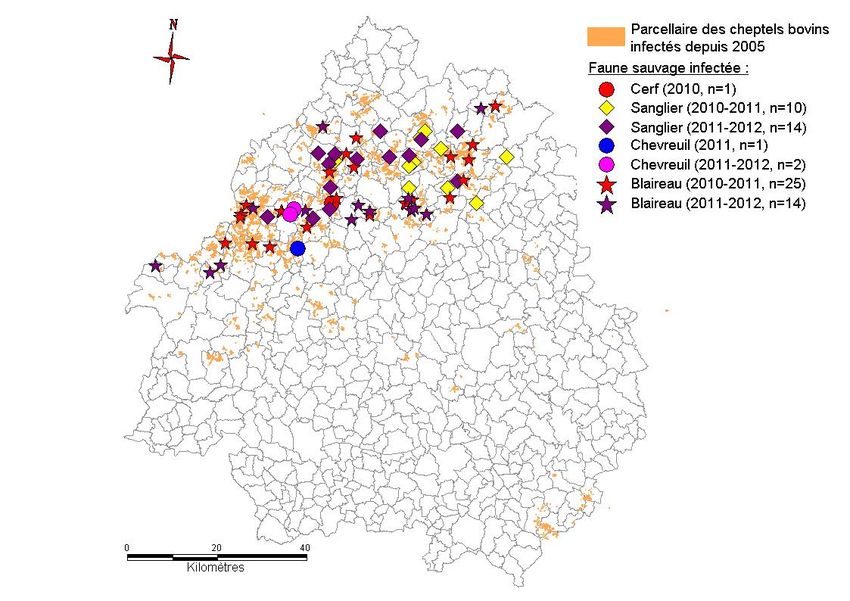
Historical background of bTB in French cattle

• 1954 : start of the eradication plan (voluntary)
• 1965 : the eradication plan becomes compulsory
         => tuberculin test and slaughter
• 2001 : France « officially free of bTB »

                                             Evolution of annual
                                              prevalence rate in
                                                French herds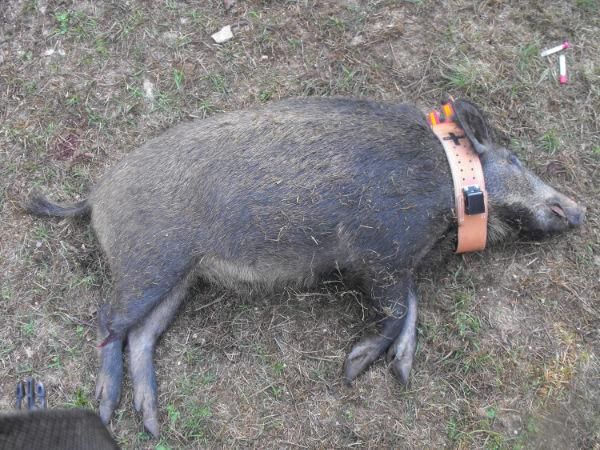
Historical background of bTB in French cattle
0,1800%
0,1600%
0,1400%                                               => Trend reversal since 2004
0,1200%
0,1000%
                           TB-free status             => High number of recividist
0,0800%
                                                                 herds
0,0600%
0,0400%
0,0200%                                                                     Côte d’Or
0,0000%
     -
          95 96 97 98 99 00 01 02 03 04 05 06 07 08 09 10

              Prevalence rate       Incidence rate

                                                     Dordogne

                                                                 Pyrénées Atlantiques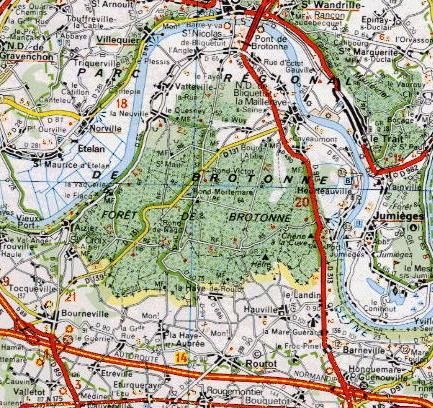
First detection of bTB in wildlife: Brotonne forest
January 2001: 3 hunted red deer with typical lung and
   hepatic tuberculous lesions : M. bovis isolation
First detection of bTB in wildlife: Brotonne forest
January 2001: 3 hunted red deer with typical lung and
hepatic tuberculous lesions : M. bovis isolation
Species
Year 2001/2 2005/6 2001/2 2005/6 PhD
Nb of hunted animals 72 138 85 155 thesis of
Gina
Prevalence lesions % 18 25 29 42
Zanella
Prevalence M. bovis % 13 24 7– 30 14 – 42
Comparative study of lesions in deer and wild boars
Difference in the type of lesions: deer more contagious
Difference in the lesion score between species
Brotonne forest: important role of deer in the within-
species and between-species infection spread
First detection of bTB in wildlife: Brotonne forest
Since 2006 in the Brotonne forest:
   • stamping out of the red deer population
   • reduction of wild boar density
   • removal of viscera of hunted animals
                                40
apparent infection prevalence

                                35
                                30
                                25
                                20
                                15
                                10
                                 5
                                 0

                                                           2012:
                                     hunting season   2 subadult wild
                                                       boar infected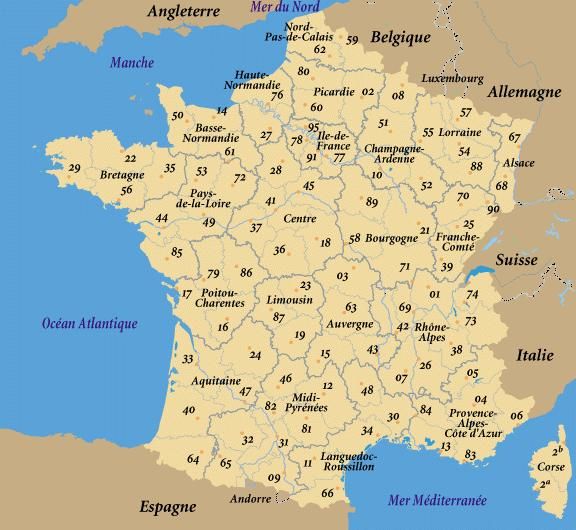
Wildlife cases 2001-2011

Hars et al. 2012. Dix Ten years of surveillance of bovine tuberculosis in wildlife in
France. Inventory and prospects. Bull. épidémio. DGAL/Anses, 52 : 7-8
Wildlife cases 2001-2011

Hars et al. 2012. Dix Ten years of surveillance of bovine tuberculosis in wildlife in
France. Inventory and prospects. Bull. épidémio. DGAL/Anses, 52 : 7-8
Wildlife cases 2001-2011

Hars et al. 2012. Dix Ten years of surveillance of bovine tuberculosis in wildlife in
France. Inventory and prospects. Bull. épidémio. DGAL/Anses, 52 : 7-8
Wildlife cases 2001-2011
Dordogne :
      more than 500 red deer and wild boars tested in 2006
      (all negative). First cases detected in 2010

                                     Localization of infected wildlife and
                                      pastures of infected cattle herds in
                                     Dordogne (E. Réveillaud, Vet. thesis)
Wildlife cases 2001-2011
Normandie Côte d’Or
BCG 5 5 4 5
GB35 7 4 5 4
GB35 6 4 5 4
Dordogne Cattle and wildlife share
the same M. bovis strains
BCG 5355
per region
Pyrénées Atlantiques Corse
F7 BCG 4 5 5 5
F1
ML Boschiroli. National reference laboratoryResearch questions
•What are the roles of wildlife in the bTB epidemiology in
France ?
Maintenance host? Spill over host ? Sentinel of
cattle infections ?
• If wildlife is a reservoir, how can we limit the spill back
of bTB from wildlife to cattle ?
How to quantify and qualify those contacts?
How to limit those contacts?
Interest of vaccinating wildlife ?
• How to optimize a surveillance program in wildlife?
Sampling strategy and diagnostic tools ?Research questions •What are the roles of wildlife in the bTB epidemiology in France ? • If wildlife is a reservoir, how can we limit the spill back of bTB from wildlife to cattle ? • How to optimize a surveillance program in wildlife? • Is the environment a bacterium reservoir in areas where the infection reemerges ? • What is the impact of hunting practices on infection prevalence in wildlife? • How to reconcile hunters and farmers interests ? • How to deal with game parks and supplier game farms?
Sylvatub: a new surveillance system
Objective:
  to detect bTB infection in wildlife species and follow
  prevalence along time
  + homogenization of sampling and diagnostic
  procedures and data centralization

                       Implemented since october 2011

                       3 levels of surveillance according to
                       incidence rates in cattle and wildlife

                       Both active and passive surveillance

                       Riviere et al. 2012. Bovine tuberculosis
                       surveillance in wildlife in France. WDA-EWDA
                       congress, Lyon – France
Sylvatub: a new surveillance system
Results 2011/2012 (prevalence of culture positive animals)
- Côte d’Or (infected area of the department)
• wild boars: 8.1% (95% CI : [4.4 – 11.8])
• deer: 0.7% (95% CI : [0.2 – 3.7])
• badgers: 2.9% (95% CI : [1 – 4.8]) –partial results
- Dordogne (infected area of the department)
• wild boars: 0.8% (95% CI : [0.3 - 2.7])
• badgers: 4.2% (95% CI : [2.3 – 6.1]) - partial results
• 1 roe deer found infected
- Pyrénées Atlantiques (infected area of the department)
• wild boars: 10.5% (95% CI : [2.6 – 18.5])
•1 badger found infected
No wildlife case outside cattle infected areas
Same spoligotypes/VNTR between wildlife and cattle
(except one case in Côte d’Or)An example of research program (1)
PhD of Ariane Payne (ONCFS-ENVA-université Lyon1)
To assess the risk of transmission of bTB between
wildlife (wild boars and badgers) and cattle in Côte
d’Or
surveillance
program
Density
Level of infection
Risk of
contacts level
transmission
Overlap of
habitats other research
program
M. bovis excretion M. bovis persistence
level in the environmentAn example of research program (1)
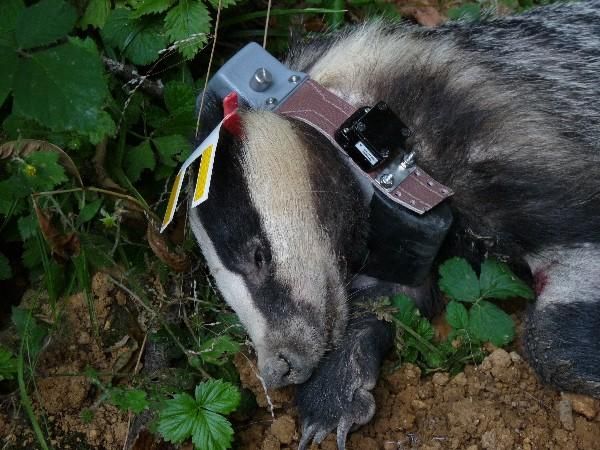
• GPS tracking:
– 10 wild boars and 10 badgers fitted with GPS collars
– Adults from different groups
– tracked during 1 to 8 months
Level of the use of cattle area by wild
boars and badgers
• Video surveillance:
– On selected places in cattle zone (troughs, silage,
drinking point, salt lick, farm buildings)
– Implemented for one year
Level of frequentation of cattle zone
Attractivity of the different places
Behaviour observation (opportunity for
bTB transmission?)An example of research program (1)
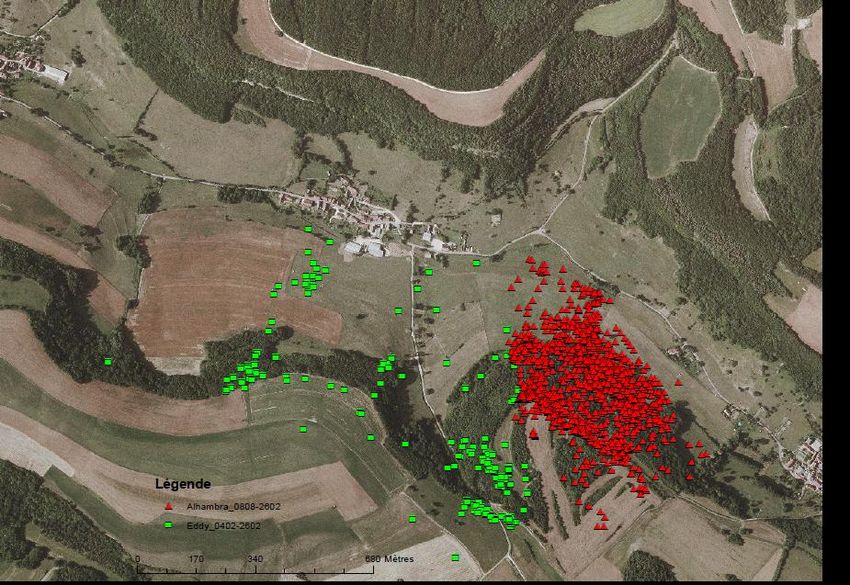
GPS tracking on badgers: example
GPS fixes (1 fix
per 1/2h during
the night) of 2
badgers:
•1 female
tracked for 6
months (red
triangles)
•1 male tracked
for 1 month
(green squares)An example of research program (2)
Is the environment a bacterium reservoir in areas
where the infection reemerges ?
PhD of Elodie Barbier (Anses-INRA)
=> to determine the prevalence of M. bovis and
other atypical Mycobacterium in different agro-
ecosystems
=> to determine the impact of the type of soil on M.
bovis presence and survival
In progress:
Development of a RT PCR to detect M. bovis in
water, soil, soil and aquatic fauna
Immunocapture strategy for bacteriology and
DNA extractionConclusion
French wildlife infected at various levels function of
geographical areas and species
=> What is the exact role of wildlife ?
In France, small geographical areas with increased
surveillance and monitoring activities: great number of
cattle and wildlife strains isolated in these areas since
2004
Can Next Generation Sequencing be used to reconstruct
the transmission chains of the infection within each
area and to better understand the role of wildlife?Thank you for your
attention !
Picture: A. PayneYou can also read


