MefCO 2 - Methanol Fuel From CO 2 - Reference (call): H2020-SPIRE-2014-2015 Start/end date: Dec. 2014 / Dec. 2018 Partners
←
→
Page content transcription
If your browser does not render page correctly, please read the page content below
Horizon 2020
                                                                                      European Union Funding
                                                                                     for Research & Innovation

 MefCO2 – Methanol Fuel From CO2
• Reference (call): H2020-SPIRE-2014-2015
• Start/end date: Dec. 2014 / Dec. 2018
• Partners:

                                          • EC funding: 8,622,292.60€
                                          • Private investment: 2,419,244.86 €
                                          • Leverage factor: 0,2805
                       This project has received funding from the European Union’s
                      Horizon 2020 research and innovation programme under grant
                                          agreement No 637016.
Horizon 2020
                                                                                          European Union Funding
Project Case Study                                                                       for Research & Innovation

    1. The EU/ SPIRE needs                                          4. How will this happen?
                                  2020       2030        2050
                                                                      Building up a pilot plant in Germany:
        GHG reduction*             20%       40%        80-95%
                                                                      • Production capacity: 1t /day
        Renewable energy share    20%**      27%           -
        Efficiency increase        20%      Min 27%        -
                                                                      • CO2 capture capacity per ton of MeOH: 1,5 t/d
                                                *From 1990 levels     • PEM electrolyser (600 kWel) with improved dynamic
                    ** 10% Renewable resources for transportation         response.
KC1 FEED: Valorisation of flue gases as alternative sources for       • MeOH unit: scalable production process with a novel
chemicals and fuels                                                       patent protected catalyst with improved conversion
KC2 PROCESS: New energy and resource management concepts                  and selectivity
KC3 APPLICATIONS: New materials contributing to develop
energy and resource efficient processes                               Scaling up the pilot plant for commercialization: Business
KC4 WASTE2RESOURCE: Pilot economically and                            cases for methanol plants of 10,000 and 50,000 t/yr
environmentally sustainable and technically feasible process
models
KC5 HORIZONTAL: dissemination of cross-sectorial transfer of
good energy and resource efficiency solutions and practices
                                                                    3. Value to Customers
KC6 OUTREACH: comprehensive dissemination strategy                   • Mitigation of CO2 emissions by making a
                                                                       feasible business case for CCS+CCU.
     2. The Project Solution                                         • Stabilisation of electric grid by the consumption
                                                                       of the electric energy at its peaks.
 Green chemicals (P2C) and advanced fuel production
                                                                     • Methanol blending with conventional gasoline
     (P2F) using captured CO2 as feedstock, an energy
                                                                       or methanol use in biodiesel production
  storage technology using methanol as energy vector
                                                                       contribute to the achieving the renewable
    in liquid fuels and a test bench for the provision of
                                                                       energy content and advanced fuels content in
                grid services using flexible electrolysers
                                                                       transportation.
What are the key expected sustainability impacts of MefCO2?
Indicator (Max 3-4 key indicators)                           Baseline   Expected Impact

Reduction of CO2 emissions of methanol as renewable          34 g/MJ    Emission associated with methanol fuels are expected to be below to
fuel                                                                    the reference value of 1st generation biofuels (34 g/MJ) with an
                                                                        expected emissions well below 20 g/MJ. A more accurate value shall
                                                                        be provided when the LCA analysis is completed.
Global Warming Potential (CO2 emission reduction) of         --         11 Mtons/year (without CCS) if methanol production were to cover
CCU w/o CCS                                                             methanol imports in the EU and 3% v/v blending with gasoline is
                                                                        achieved.
Fossil energy intensity                                      ---        Highly dependent of the energy mix in the area in which the plant is
                                                                        located and the mode of operation.

Fossil fuel displacement when substituting fossil gasoline   ---        Up to 1.3% on energy basis of gasoline consumption could be
                                                                        displaced if 3% v/v direct blending was achieved.

                                                                                                          Horizon 2020
                                                                                               European Union Funding
                                                                                              for Research & Innovation
Horizon 2020
                                                                                                    European Union Funding
                                                                                                   for Research & Innovation

What outputs or learning from MefCO2 could have value for other SPIRE
projects here?
•   Renewable hydrogen production: demonstration of flexible operation of water electrolysers can be used to decrease
    energy costs of renewable hydrogen production and reducing the reliance on natural gas steam reforming.
•   Surplus Oxygen can be sold or used directly in several industrial process such as combustion processes.
•   Optimised power plant operation when coupled with flexible hydrogen production for methanol production. Plants can be
    operated steadily at their maximum efficiency since flexible electrolysers can be adjusted to match supply and demand.
•   Job preservation: CCU+CCS can help carbon leakage sensitive industries, such as the steel or cement industry, to maintain
    its competiveness while reducing their emissions.
•   Growth of cost competitive non- manageable renewable energy generation will spur a new set of business opportunities
    for those who can build business models based integrating renewable energy surplus and stabilising the electrical grid.
•   MefCO2 results could contribute to the reduction of the dependency on methanol imports for the chemical industry in the
    EU-28. An average of 5.8 Mtons where imported Jan-Nov 2016.
•   Methanol produced in MefCO2 is considered an advanced fuel and its renewable energy content can be double counted
    towards the Renewable energy content in transport. Moreover, direct blending of methanol with gasoline can reduce the
    imports of gasoline. A 3% v/v blending with gasoline would add 2.2 Mton/year of additional methanol demand and
    displace up to 1 Mtoe of gasoline on an energy content basis.
Horizon 2020
European Union Funding
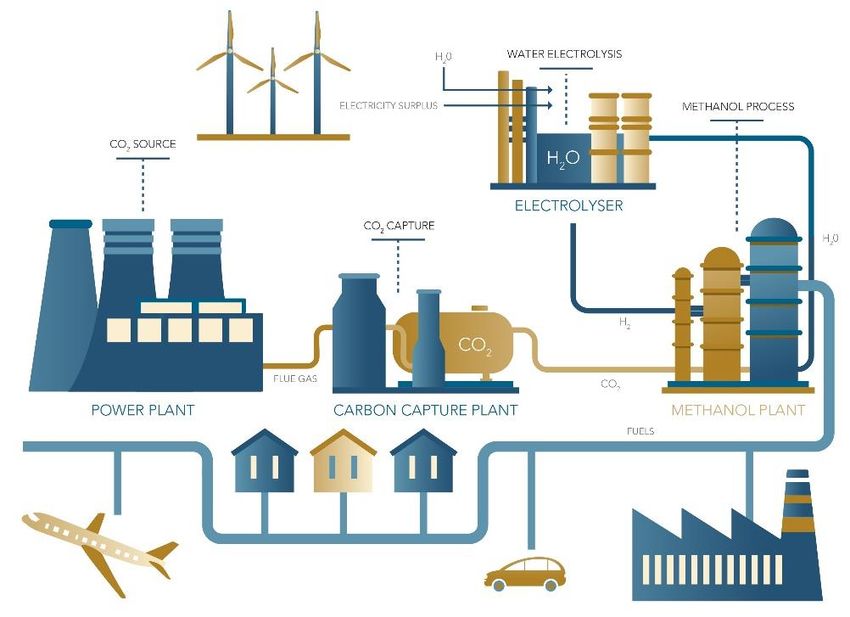
MefCO2 approach H2 production 600 kW PEM electrolyser for Research & Innovation
Niederaussen Coal fired power Post-combustion CO2
plant amine scrubber
(Germany)
MeOH plant
Max MeOH output
1000 kg/day
Max CO2 input 1500
kg/day
Watch our video!Horizon 2020
European Union Funding
for Research & Innovation
Contact
Project coordinator and exploitation manager:
• Mr. David Cuesta: david.cuesta.pardo@everis.com
• Ms. Rocío Pacios: rocio.pacios.blein@everis.com
Project website: www.mefco2.eu
info@mefco2.comYou can also read


