Master's thesis topics 2020/21 - RWTH AACHEN UNIVERSITY ...
←
→
Page content transcription
If your browser does not render page correctly, please read the page content below
Master’s thesis topics 2020/21

                        Prof. Dr. Philipp Mertsch

                     TTK, RWTH Aachen University
                          4 September 2020

Philipp Mertsch             Master’s thesis topics 2020/21   4 September 2020   1/9
Dark matter indirect detection
  • Annihilation or decay of dark matter can produce Standard Model particles
  • Astrophysical sources also accelerate cosmic rays
  • To discriminate, need excellent understanding of the astrophysics

Acceleration of charged dark matter in supernova remnants

 • Dark matter can have fractional electric charges
 • Would then be subject to (mostly) known acceleration & transport processes
 • Can search for their signatures in experiments on Earth

 • Different charges and masses ⇒ different dynamics
 • Charged dark matter can be important constituent of plasma!

      Philipp Mertsch         Master’s thesis topics 2020/21     4 September 2020   3/9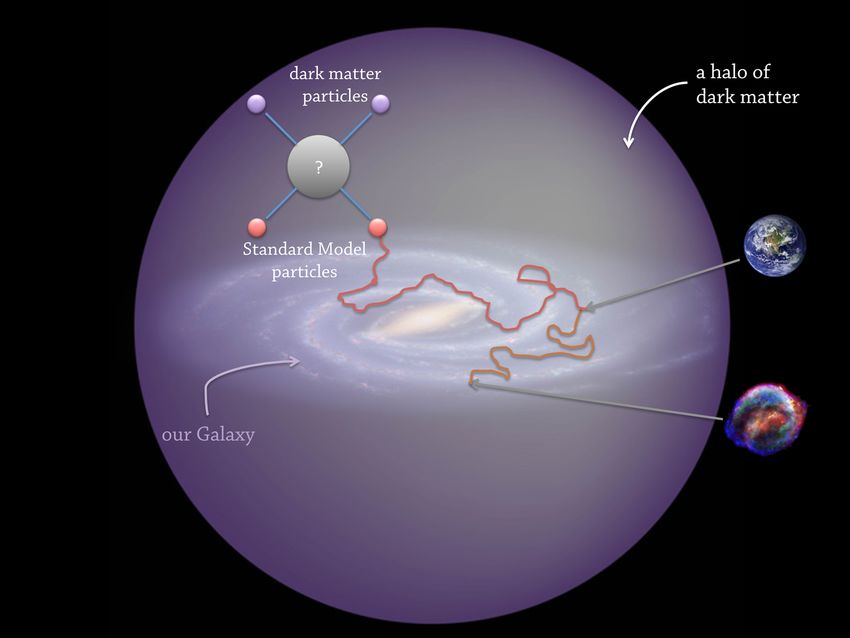
Acceleration of charged dark matter in supernova remnants

                                                        Your project
                                                          • Write numerical code
                                                            for shock acceleration
                                                            of charged dark matter
                                                          • Take into account
                                                            backreaction onto
                                                            plasma
                                                          • Set constraints or find
                                                            hints for dark matter?

     Philipp Mertsch   Master’s thesis topics 2020/21                  4 September 2020   4/9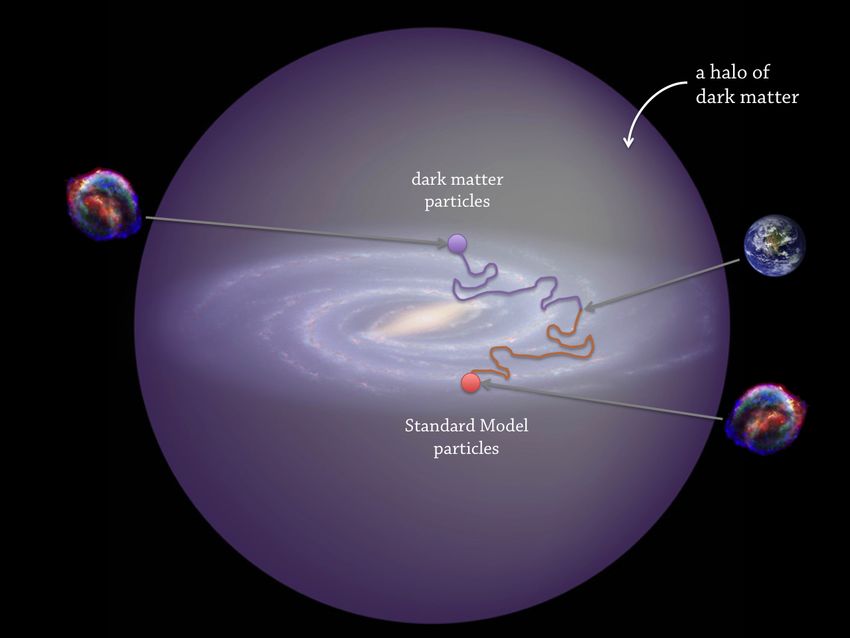
Small-scale anisotropies and the interstellar medium
     • Cosmic rays diffuse through the interstellar medium
     • Directional information quickly lost and only a dipole remains
     • Observationally, there is power on all angular scales

     • Particles travelling in the same magnetic fields become correlated
     • Standard diffusion theory ignores such high-order correlations
     • Angular correlations ↔ spatial structure of the magnetic fields

                                                                   !
     A      B∗
   hUt,t 0
           Ut,t 0
                  i =        +           +             +                  +       +

                         +       +       +             +             +        +       +

                                                   !
                         +           +                 + ...

       Philipp Mertsch                   Master’s thesis topics 2020/21                   4 September 2020   5/9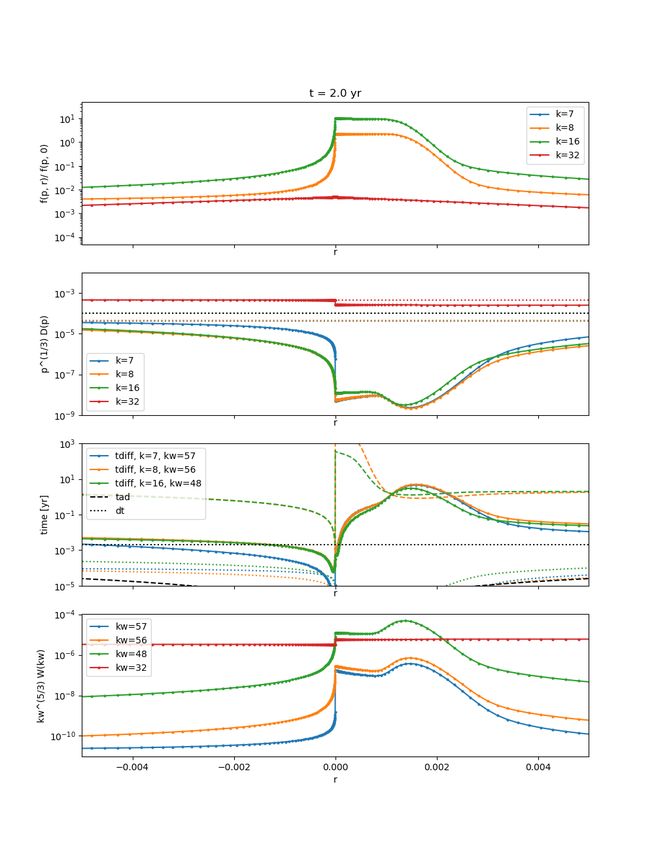
Small-scale anisotropies and the interstellar medium
8 M. G. Aartsen et al.
Figure 5. Angular power spectra for the relative intensity map for six years of IceCube data. Blue and red points show the power spe
before and after the subtraction of the best-fit dipole and quadrupole terms from the relative intensity map. Error bars are statistica
Your project
the text for a discussion of systematic errors). The gray bands indicate the 68% (dark) and 95% (light) spread in the C` for a large s
of isotropic data sets. The power spectrum is calculated using the unsmoothed map.
4.2. Energy Dependence of Anisotropy accurately determine the energy where the transiti
• Understand the perturbative
anisotropy occurs and how rapid the transition is. T
To study the energy dependence of the cosmic-ray
anisotropy, we split the data into the nine energy bins de- description
lustrate the energy dependence of the phase and stre
of the anisotropy, we show in Fig. 9 amplitude (left
scribed in Section 3.2. This results in a sequence of maps
of cosmic rays transport
phase (right) of the dipole moment as a function o
with increasing median energy, starting from 13 TeV for
ergy. Both values are calculated by fitting the s
the lowest-energy bin to 5.3 PeV for the highest-energy
harmonic functions with n 3 to the projection o
bin. The sky maps in relative intensity for all nine en-
• Extend analytical treatment,
ergy bins in equatorial coordinates are shown in Fig. 6.
ascension,
In addition to the nine maps based on IceCube data,
e.g.
two-dimensional relative intensity map (Fig. 6) in
we also show the IceTop map with its median energy of
compute energy cross-correlations
1.6 PeV. Because of the reduced statistics in these maps,
X
A cos[n(↵ )] ,
3
n n
we have applied a top-hat smoothing procedure with a n=0
• Check you predictions
smoothing radius of 20 to all, improving the sensitivity
with
to larger structure. Note that the relative intensity scaleexisting
where A is the amplitude and is the phase of th
n n
for these plots is identical for energies up to 580 TeV,
harmonic term, respectively. The fit is performed
numerical results projection
where it then switches to a di↵erent scale to account for
with a 5 bin width in right ascension. W
the strong increase in relative intensity. For the IceTop
the one-dimensional projection in right ascension r
bins with 580 TeV, 1.4 PeV, and 5.4 PeV median energy than the full sky map because the two-dimension
and for the IceTop data, Fig. 7 shows the sky maps in of spherical harmonics to the map is difficult to per
statistical significance. with a limited field of view. As a result of the me
Philipp Mertsch The maps clearly
Master’s thesisindicate
topics a2020/21
strong energy dependence 4 September
we apply to generate 2020
the reference 6 / 9map
map, the sky
High-energy neutrinos from blazars
   Your project
  52
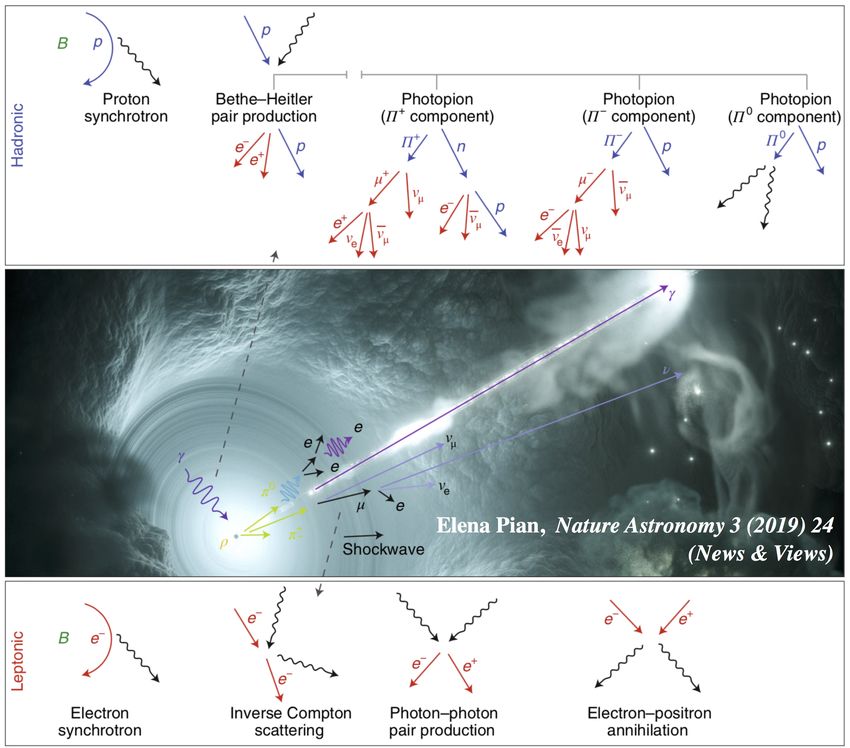
       • L.Blazars
           Sironi, D. Giannios and M. Petropoulou
                       are supermassive black holes that produce high-energy jets
       • Reconnection is the likely source of high-energy radiation
  52   • L.Can
           Sironi,be
                  D. Giannios
                      emulatedand M.by
                                    Petropoulou
                                        Monte Carlo simulations

                                                                                                                                                                    Downloaded from
                                                                                                                                                                                  Downloaded
                                                                                                                                                                                    https://academic.oup.com/mnras/article-abstract/462/1/48/2589596
                                                                                                                                                                                                from https://academic.oup.com/mnras/article-abstract/462/1/4
                                                                                                                                                                                                                                                       by RW
  Figure 1.Philipp  Mertsch
            2D structure of the particle number density in the lab frameMaster’s     thesis
                                                                         nlab , in units of thetopics  2020/21
                                                                                                lab-frame                                                       4 September
                                                                                                          number density n0 far from the reconnection layer, from a         2020                                                                               7/9
High-energy neutrinos from blazars
Your project
• Extend existing reconnection and radiation codes
• Study multiwavelength/multimessenger correlations
• Apply results to TXS 0506+056, first source detected by IceCube
Philipp Mertsch Master’s thesis topics 2020/21 4 September 2020 8/9Prerequisites
• Course work on
I “Astroparticle physics”,
I “The Non-Thermal Universe” or
I “Neutron Stars, Black Holes and Ultra-High Energy Cosmic Rays”
would be great!
• Enthusiasm to learn about the Universe at the highest energies
• Phenomenological interest
• Experience with coding most welcome, mostly C++ and python
Philipp Mertsch Master’s thesis topics 2020/21 4 September 2020 9/9You can also read


