Canada's Food Guide Eating
←
→
Page content transcription
If your browser does not render page correctly, please read the page content below
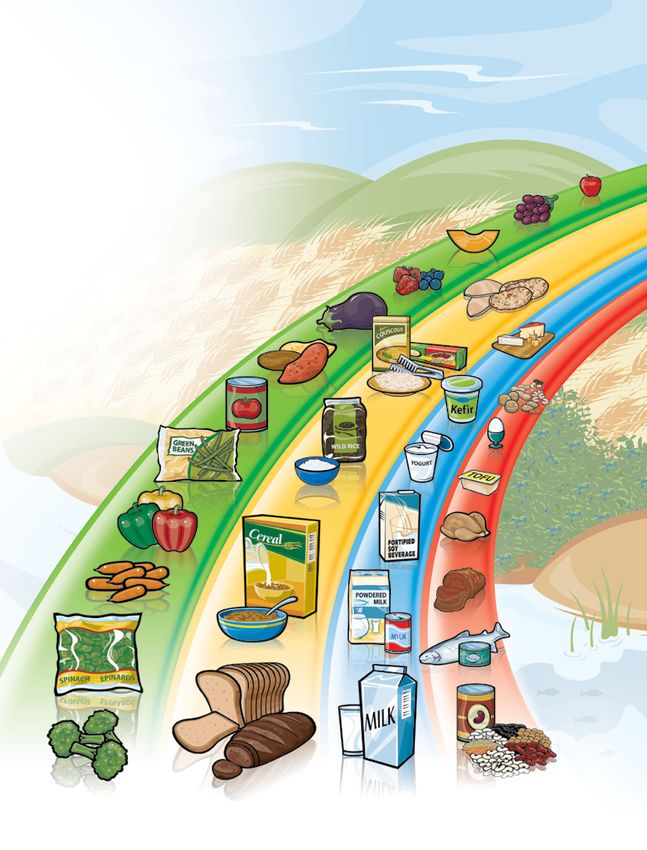
Eating
 Well with
Canada’s
Food Guide
Recommended Number of Food Guide Servings per Day
                           Children                    Teens                        Adults
    Age in Years   2-3        4-8         9-13         14-18            19-50                    51+
            Sex          Girls and Boys          Females   Males   Females   Males     Females         Males

 Vegetables
  and Fruit        4          5           6        7           8 7-8 8-10 7                             7

      Grain
   Products        3          4           6        6           7 6-7 8                       6          7

    Milk and
Alternatives       2          2 3-4 3-4 3-4 2                                   2            3          3

   Meat and
Alternatives        1           1 1-2               2          3      2         3            2           3

                    The chart above shows how many Food Guide Servings you
                    need from each of the four food groups every day.

                    Having the amount and type of food recommended and
                    following the tips in Canada’s Food Guide will help:
                    • Meet your needs for vitamins, minerals and other nutrients.
                    • Reduce your risk of obesity, type 2 diabetes, heart disease,
                       certain types of cancer and osteoporosis.
                    • Contribute to your overall health and vitality.
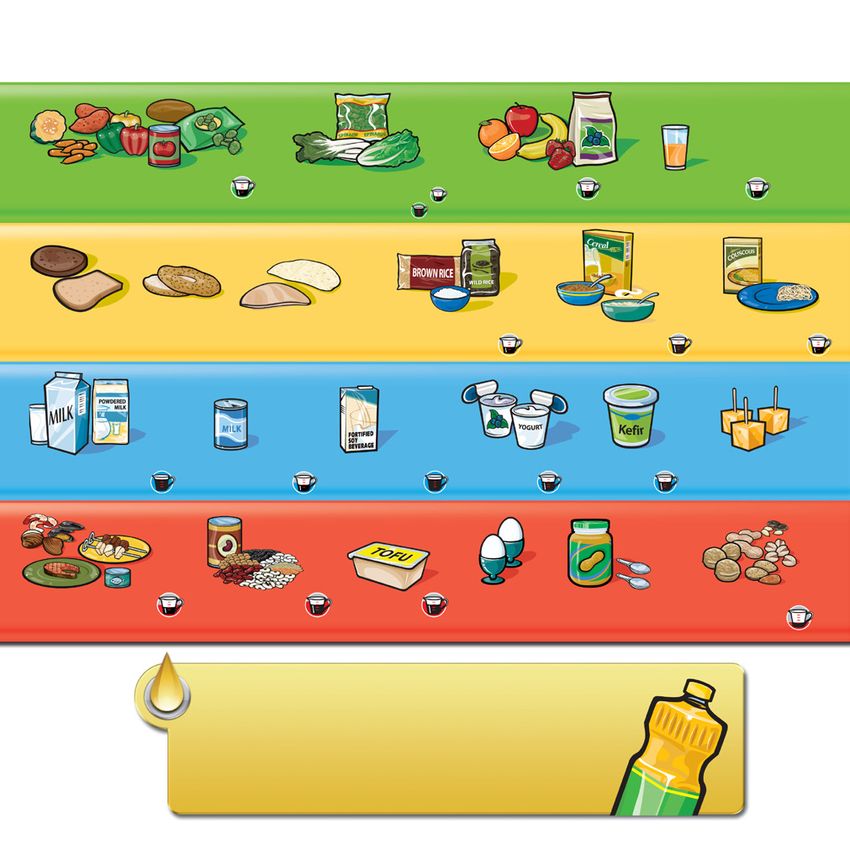
What is One Food Guide Serving?
Look at the examples below.

Fresh, frozen or canned vegetables                    Leafy vegetables                      Fresh, frozen or                      100% Juice
125 mL (1⁄2 cup)                                      Cooked: 125 mL (1⁄2 cup)              canned fruits                         125 mL (1⁄2 cup)
                                                      Raw: 250 mL (1 cup)                   1 fruit or 125 mL (1⁄2 cup)

Bread                Bagel                  Flat breads                    Cooked rice,                     Cereal                           Cooked pasta
1 slice (35g)        ⁄2 bagel (45 g)
                     1
                                            ⁄2 pita or 1⁄2 tortilla (35 g) bulgur or quinoa
                                            1
                                                                                                            Cold: 30 g                       or couscous
                                                                           125 mL (1⁄2 cup)                 Hot: 175 mL (3⁄4 cup)            125 mL (1⁄2 cup)

 Milk or powdered                Canned milk                   Fortified soy                   Yogurt                 Kefir                   Cheese
 milk (reconstituted)            (evaporated)                  beverage                        175 g                  175 g                   50 g (1 1⁄2 oz.)
 250 mL (1 cup)                  125 mL (1⁄2 cup)              250 mL (1 cup)                  (3⁄4 cup)              (3⁄4 cup)

 Cooked fish, shellfish,          Cooked legumes                      Tofu                   Eggs            Peanut or nut butters         Shelled nuts
 poultry, lean meat               175 mL (3⁄4 cup)                    150 g or               2 eggs          30 mL (2 Tbsp)                and seeds
 75 g (2 ⁄2 oz.)/125 mL ( ⁄2 cup)
         1               1
                                                                      175 mL (3⁄4 cup)                                                     60 mL (1⁄4 cup)

                                Oils and Fats
                                       • Include a small amount – 30 to 45 mL (2 to 3 Tbsp) – of unsaturated fat
                                          each day. This includes oil used for cooking, salad dressings, margarine
                                          and mayonnaise.
                                       • Use vegetable oils such as canola, olive and soybean.
                                       • Choose soft margarines that are low in saturated and trans fats.
                                       • Limit butter, hard margarine, lard and shortening.
Make each Food Guide Serving count…
wherever you are – at home, at school, at work or when eating out!
4Eat at least one dark green and one orange vegetable each day.
    • G o for dark green vegetables such as broccoli, romaine lettuce and spinach.
    • G o for orange vegetables such as carrots, sweet potatoes and winter squash.
4Choose vegetables and fruit prepared with little or no added fat, sugar or salt.
    • Enjoy vegetables steamed, baked or stir-fried instead of deep-fried.
4Have vegetables and fruit more often than juice.

4Make at least half of your grain products whole grain each day.
    • Eat a variety of whole grains such as barley, brown rice, oats, quinoa and wild rice.
    • Enjoy whole grain breads, oatmeal or whole wheat pasta.
4Choose grain products that are lower in fat, sugar or salt.
    • Compare the Nutrition Facts table on labels to make wise choices.
    • Enjoy the true taste of grain products. When adding sauces or spreads, use small amounts.

4Drink skim, 1%, or 2% milk each day.
    • Have 500 mL (2 cups) of milk every day for adequate vitamin D.
    • Drink fortified soy beverages if you do not drink milk.
4Select lower fat milk alternatives.
    • Compare the Nutrition Facts table on yogurts or cheeses to make wise choices.

4Have meat alternatives such as beans, lentils and tofu often.
4Eat at least two Food Guide Servings of fish each week.*
    • Choose fish such as char, herring, mackerel, salmon, sardines and trout.
4Select lean meat and alternatives prepared with little or no added fat or salt.
    • Trim the visible fat from meats. Remove the skin on poultry.
    • Use cooking methods such as roasting, baking or poaching that require little or no added fat.
    • If you eat luncheon meats, sausages or prepackaged meats, choose those lower in salt (sodium) and fat.

                                                                                                    Satisfy your
                             Enjoy a variety                                                        thirst with water!
                              of foods from                                                         Drink water regularly. It’s a
                                    the four                                                        calorie-free way to quench
                               food groups.                                                         your thirst. Drink more
                                                                                                    water in hot weather or
                                                                                                    when you are very active.

* Health Canada provides advice for limiting exposure to mercury from certain types of fish. Refer to www.healthcanada.gc.ca for the latest information.
Advice for different ages and stages…

Children                                      Women of childbearing age                            Men and women over 50
Following Canada’s Food Guide helps           All women who could become pregnant                  The need for vitamin D increases after
children grow and thrive.                     and those who are pregnant or                        the age of 50.
                                              breastfeeding need a multivitamin                    In addition to following Canada’s Food
Young children have small appetites and       containing folic acid every day.
need calories for growth and                                                                       Guide, everyone over the age of 50 should
                                              Pregnant women need to ensure that                   take a daily vitamin D supplement of
development.                                  their multivitamin also contains iron.               10 µg (400 IU).
• Serve small nutritious meals and snacks    A health care professional can help you
   each day.                                  find the multivitamin that’s right for you.
• Do not restrict nutritious foods because
                                              Pregnant and breastfeeding women need
   of their fat content. Offer a variety of
                                              more calories. Include an extra 2 to 3
   foods from the four food groups.
                                              Food Guide Servings
• Most of all... be a good role model.       each day.

                                              Here are two
                                              examples:
                                              • Have fruit and yogurt
                                                for a snack, or
                                              • Have an extra
                                                slice of toast at
                                                breakfast and an
                                                extra glass of milk
                                                at supper.

 How do I count Food Guide Servings in a meal?
                                              Here is an example:
                                                Vegetable and beef stir-fry with rice, a glass of milk and an apple for dessert
                                                     250 mL (1 cup) mixed broccoli,      =   2 Vegetables and Fruit Food Guide Servings
                                                       carrot and sweet red pepper
                                                            75 g (2 1⁄2 oz.) lean beef   =   1 Meat and Alternatives Food Guide Serving

                                                         250 mL (1 cup) brown rice       =   2 Grain Products Food Guide Servings

                                                             5 mL (1 tsp) canola oil     =   part of your Oils and Fats intake for the day

                                                            250 mL (1 cup) 1% milk       =   1 Milk and Alternatives Food Guide Serving

                                                                             1 apple     =   1 Vegetables and Fruit Food Guide Serving
Eat well and be active today and every day!

The benefits of eating well and being active include:                                                                                 Take a step today…
• Better overall health.                 • Feeling and looking better.                                                                3 Have breakfast every day. It may help
• Lower risk of disease.                 • More energy.                                                                                  control your hunger later in the day.
• A healthy body weight.                 • Stronger muscles and bones.
                                                                                                                                      3 Walk wherever you can – get off the
                                                                                                                                         bus early, use the stairs.
Be active                                                                                                                             3 Benefit from eating vegetables and fruit
                                                                                                                                         at all meals and as snacks.
To be active every day is a step towards better health and a healthy body weight.
                                                                                                                                      3 Spend less time being inactive such as
It is recommended that adults accumulate at least 2 1⁄2 hours of moderate to vigorous                                                    watching TV or playing computer games.
physical activity each week and that children and youth accumulate at least 60 minutes                                                3 Request nutrition
per day. You don’t have to do it all at once. Choose a variety of activities spread                                                       information about
throughout the week.                                                                                                                     menu items when
                                                         Start slowly and build up.                                                      eating out to help
                                                                                                                                         you make healthier
                                                                                                                                         choices.
Eat well                                                                                                                              3 Enjoy eating with
Another important step towards better health and a healthy body weight is to follow                                                      family and friends!
Canada’s Food Guide by:                                                                                                               3 Take time to eat and
• Eating the recommended amount and type of food each day.                                                                               savour every bite!
• Limiting foods and beverages high in calories, fat, sugar or salt (sodium) such as cakes and
   pastries, chocolate and candies, cookies and granola bars, doughnuts and muffins, ice cream
   and frozen desserts, french fries, potato chips, nachos and other salty snacks, alcohol, fruit
   flavoured drinks, soft drinks, sports and energy drinks, and sweetened hot or cold drinks.

                                                                                                                                    For more information, interactive
Read the label
                                                                                                                                    tools, or additional copies visit
• C ompare the Nutrition Facts table on food
   labels to choose products that contain less                       Nutrition Facts                                                Canada’s Food Guide on-line at:
                                                                                                                                    www.healthcanada.gc.ca/foodguide
  fat, saturated fat, trans fat, sugar                               Per 0 mL (0 g)
  and sodium.                                                        Amount                           % Daily Value
                                                                                                                                    or contact:
• Keep in mind that the calories and                                Calories 0
   nutrients listed are for the amount of                            Fat 0 g                                    0%                  Publications
  food found at the top of the Nutrition                               Saturated 0 g                            0%                  Health Canada
  Facts table.                                                         + Trans 0 g                                                  Ottawa, Ontario K1A 0K9
                                                                     Cholesterol 0 mg                                               E-Mail: publications@hc-sc.gc.ca
                                                                     Sodium 0 mg                                0%                  Tel.: 1-866-225-0709
                                                                     Carbohydrate 0 g                           0%                  Fax: (613) 941-5366
Limit trans fat                                                        Fibre 0 g                                0%                  TTY: 1-800-267-1245
When a Nutrition Facts table is not available, ask                     Sugars 0 g
for nutrition information to choose foods lower in                   Protein 0 g                                                    Également disponible en français sous le titre :
trans and saturated fats.                                            Vitamin A 0 %             Vitamin C        0%                  Bien manger avec le Guide alimentaire canadien
                                                                     Calcium   0%              Iron             0%
                                                                                                                                    This publication can be made available on
                                                                                                                                    request on diskette, large print, audio-cassette
                                                                                                                                    and braille.

© Her Majesty the Queen in Right of Canada, represented by the Minister of Health Canada, 2011. This publication may be reproduced without permission.
No changes permitted. HC Pub.: 4651 Cat.: H164-38/1-2011E-PDF ISBN: 978-1-100-19255-0
You can also read


