Climate Change Impact and Vulnerability Assessment for Uttarakhand using CORDEX Climate Data - Sandhya Rao, INRM Consultants
←
→
Page content transcription
If your browser does not render page correctly, please read the page content below
Climate Change Impact and Vulnerability
   Assessment for Uttarakhand using
         CORDEX Climate Data

      Sandhya Rao, INRM Consultants
         INDO-US Workshop, IITM, Pune
               March 08, 2017

                                        INRM Consultants , New Delhi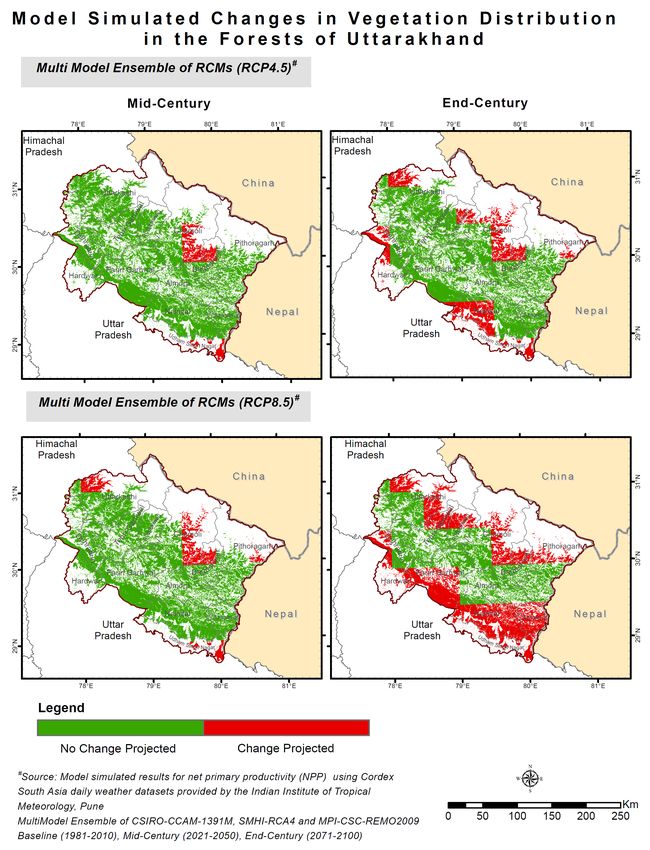
Outline
• Climate Variability and Climate Change –
  Uttarakhand
• Impact of Climate Change
  –   Water Resources
  –   Forest
  –   Agriculture
  –   Health
  –   Infrastructure
• Vulnerability Assessment
  – District level/Block level

                                             INRM Consultants , New Delhi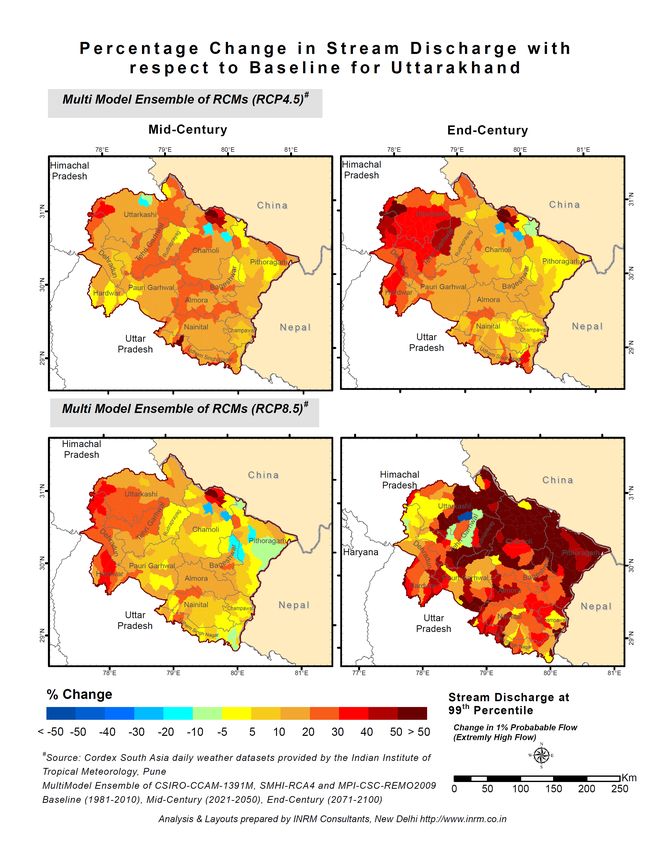
Methodology
• Analysis of historical (IMD data from 1951-2013)
• Projected climate data (using ensemble CORDEX
  Regional Climate Model data)
   – For baseline (1981-2010); mid-century, MC (2021-
     2050) and end-century, EC (2071-2100)
   – IPCC AR5 Climate scenarios RCP4.5 and RCP8.5
• Perform impact assessment for selected sectors
   – Water resource, forest, agriculture, health and
     infrastructure
• Assess the vulnerability using indicators derived
  from the climate change impact assessment

                                                       INRM Consultants , New Delhi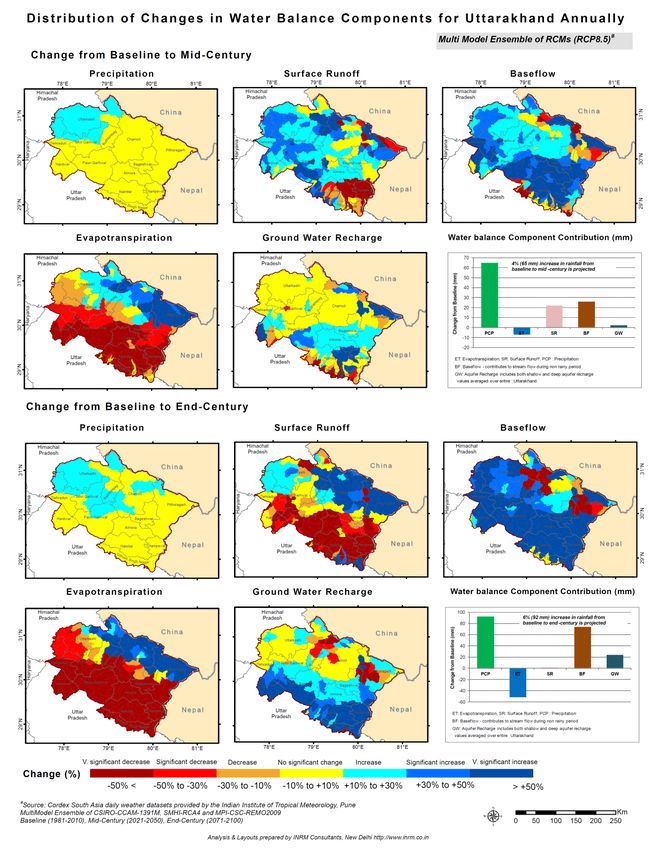
Climate Change Scenarios
• South Asia CORDEX Models for simulated climate data
      •   Bias corrected 3 RCMs (11 model runs)
          CSIRO-CCAM-1391M – (4)
                                           Sr. no Asia-CORDEX RCMs bias-corrected           RCM          GCM_BC
      •                                          1 ACCESS1-0_CSIRO-CCAM-1391M               CCAM         ACCESS1-0

      •   MPI-CSC-REMO2009 – (1)                 2 CCSM4_CSIRO-CCAM-1391M
                                                 3 CNRM-CM5_CSIRO-CCAM-1391M
                                                                                            CCAM
                                                                                            CCAM
                                                                                                         CCSM4
                                                                                                         CNRM

      •   SMHI-RCA4 – (6)                        4 MPI-ESM-LR_CSIRO-CCAM-1391M
                                                 5 MPI-M-MPI-ESM-LR_MPI-CSC-REMO2009
                                                                                            CCAM
                                                                                            REMO2009
                                                                                                         MPI-ESM-LR
                                                                                                         MPI-M
      •   Bias correction using WATCH data       6 CNRM-CERFACS-CNRM-CM5_SMHI-RCA4
                                                 7 NOAA-GFDL-GFDL-ESM2M_SMHI-RCA4
                                                                                            SMHI-RCA4
                                                                                            SMHI-RCA4
                                                                                                         CNRM
                                                                                                         GFDL

• Model Boundary Conditions                               8 ICHEC-EC-EARTH_SMHI-RCA4
                                                          9 IPSL-CM5A-MR_SMHI-RCA4
                                                                                            SMHI-RCA4
                                                                                            SMHI-RCA4
                                                                                                         IHEC-EC
                                                                                                         IPSL-CM5A

      • 9 boundary conditions                            10 MIROC-MIROC5_SMHI-RCA4
                                                         11 MPI-M-MPI-ESM-LR_SMHI-RCA4
                                                                                            SMHI-RCA4
                                                                                            SMHI-RCA4
                                                                                                         MIRCO
                                                                                                         MPI-M

• Scenario: IPCC SRES AR5 RCP4.5 and RCP8.5
• 3 time periods
      • baseline (1981-2010), mid-century, (2021-2050) and end-century,
        (2071-2100)
   – Grid resolution of 0.5° x 0.5°.

                                                                                         INRM Consultants , New Delhi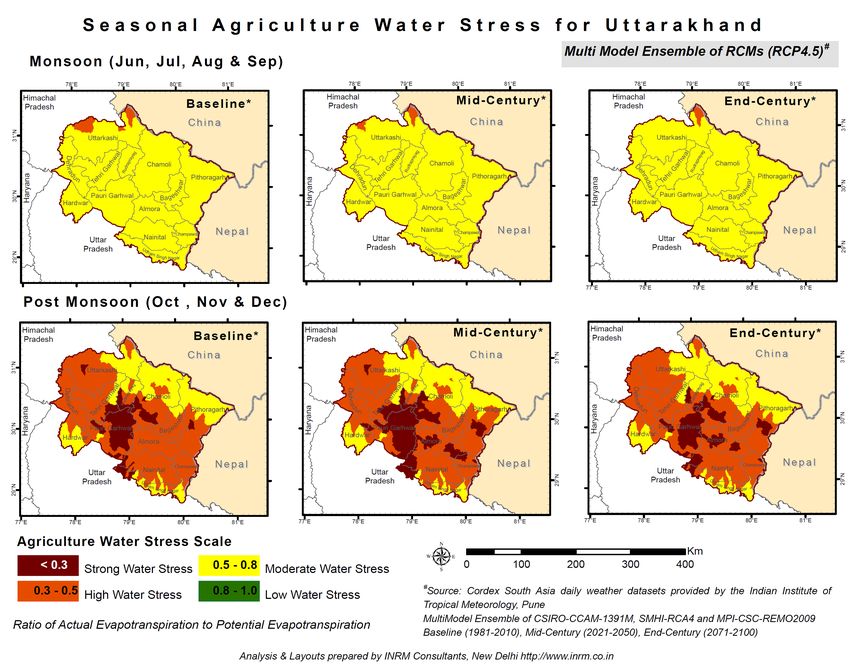
Climate Summary for Uttarakhand
• Historical
   – No appreciable change in annual max & min temperature
   – No definite trend in annual rainfall
   – annual number of rainy days ()
• Average annual maximum temperature (>)
   – RCP4.5: 1.5°C (Mid), 2.5°C (End)
   – RCP8.5: 1.8°C (Mid), 5.0°C (End)
• Average annual minimum temperature (>)
   – RCP4.5: 1.3°C (Mid), 2.6°C (End)
   – RCP8.5: 1.7°C (Mid), 4.7°C (End)
• Increase in maximum temperature higher than minimum
  temperature
• Average annual rainfall
   – RCP4.5: 0.8% (< Mid), 7.1% (> End)
   – RCP8.5: 3.6% (> Mid), 5.4% (> End)

                                                                   INRM Consultants , New Delhi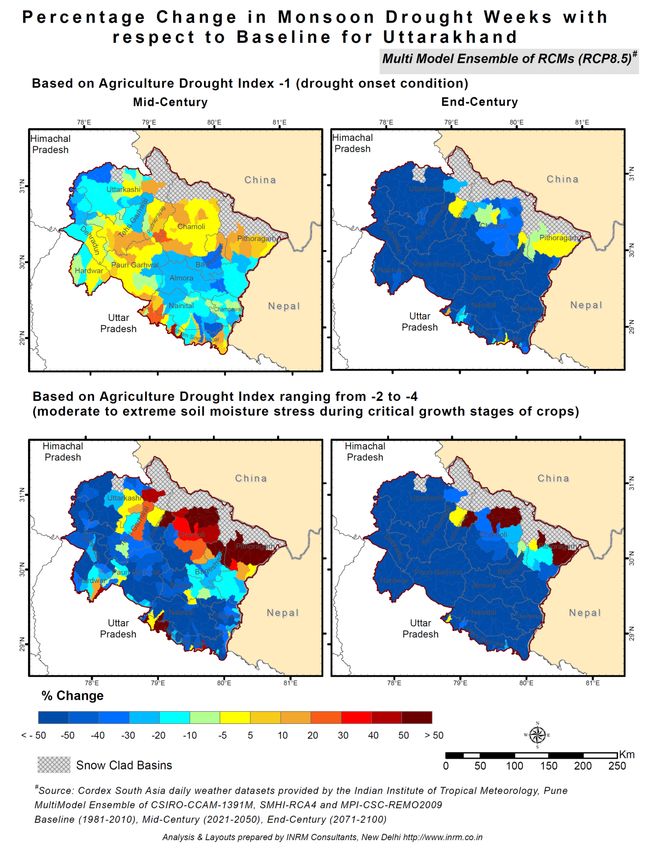
Summary

          INRM Consultants , New Delhi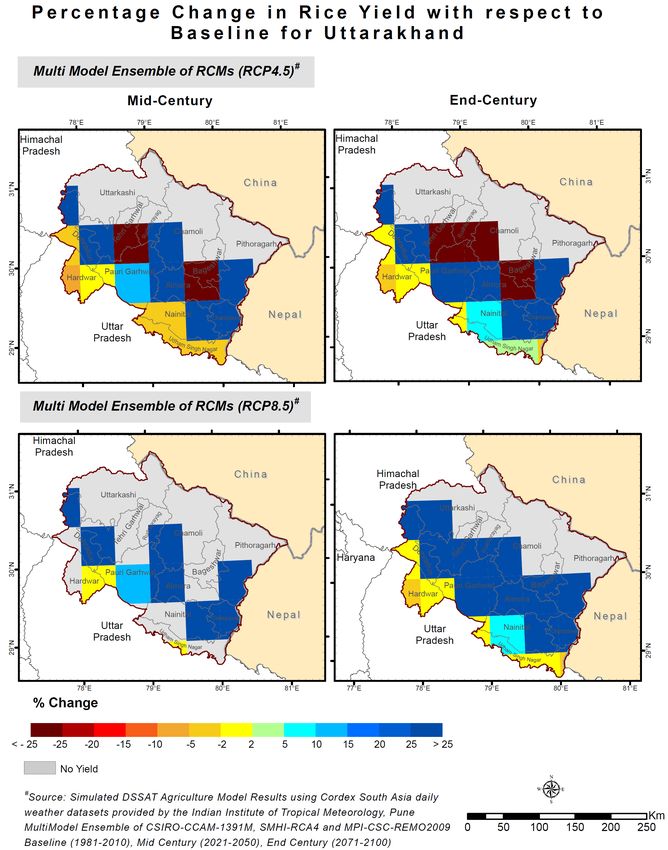
Key Inferences for Uttarakhand - Future Climate
               Change Projections
1.30C to 1.80C                       1.30C to 1.80C
-6% to 5%                               0% to 14%

1.50C to 2.20C                       4.50C to 6.00C
-5% to 12%                              1% to 14%

                                                INRM Consultants , New Delhi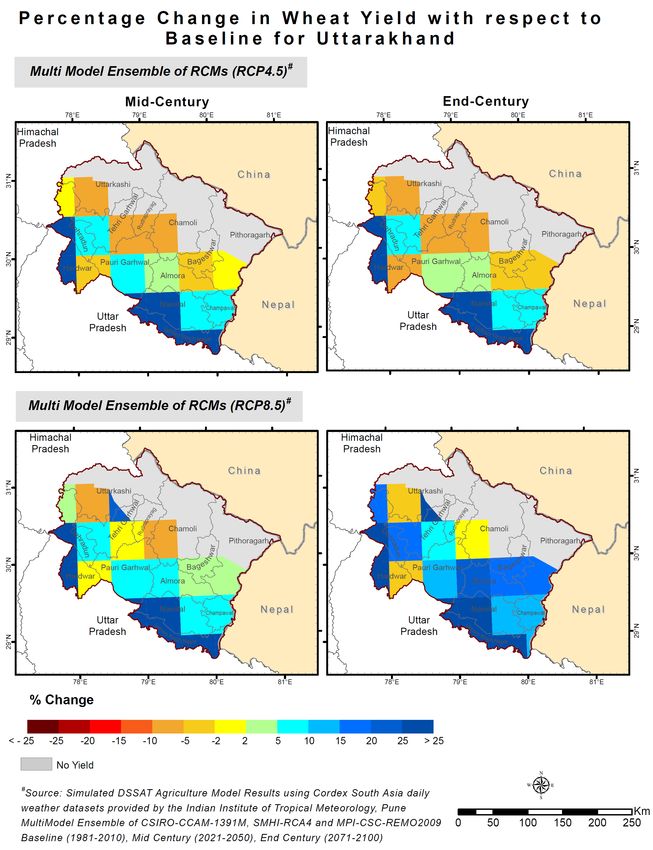
Extreme Climate Indices - Observed
                                    Temperature extremes indices*                                                           Precipitation extremes indices
                                                      TN    TX    TN     TX                                    RX1 RX5                                 R10 R20      PRCP
                      TXx   TNx   TXn    TNn   DTR                            WSDI CSDI                                     R95p R99p    CDD   CWD                         SDII
Districts                                            10P   10P   90P    90P               Districts            day    day                              mm mm         TOT
                            Absolute indices           Percentile indices      Duration                         Absolute    Percentile   Duration      Threshold       Other
                                                                                Indices                          Indices     Indices      Indices        Indices      Indices
Almora                                                                                    Almora
Bageshwar                                                                                 Bageshwar
Chamoli                                                                                   Chamoli
Champawat                                                                                 Champawat
Dehradun                                                                                  Dehradun
Pauri Garhwal                                                                             Pauri Garhwal
Hardwar                                                                                   Hardwar
Nainital                                                                                  Nainital
Pithoragarh                                                                               Pithoragarh
Rudraprayag                                                                               Rudraprayag
Tehri Garhwal                                                                             Tehri Garhwal
Udham Singh Nagar                                                                         Udham Singh Nagar
Uttarkashi                                                                                Uttarkashi
  * Spatial Resolution of IMD gridded data for temperature is not sufficient to arrive at long term trend

                             Positive Significant trend                           Negative Significant trend                    No Change
                             Positive Non Significant trend                       Negative Non Significant trend                NA

                                                                                                                                                     INRM Consultants , New Delhi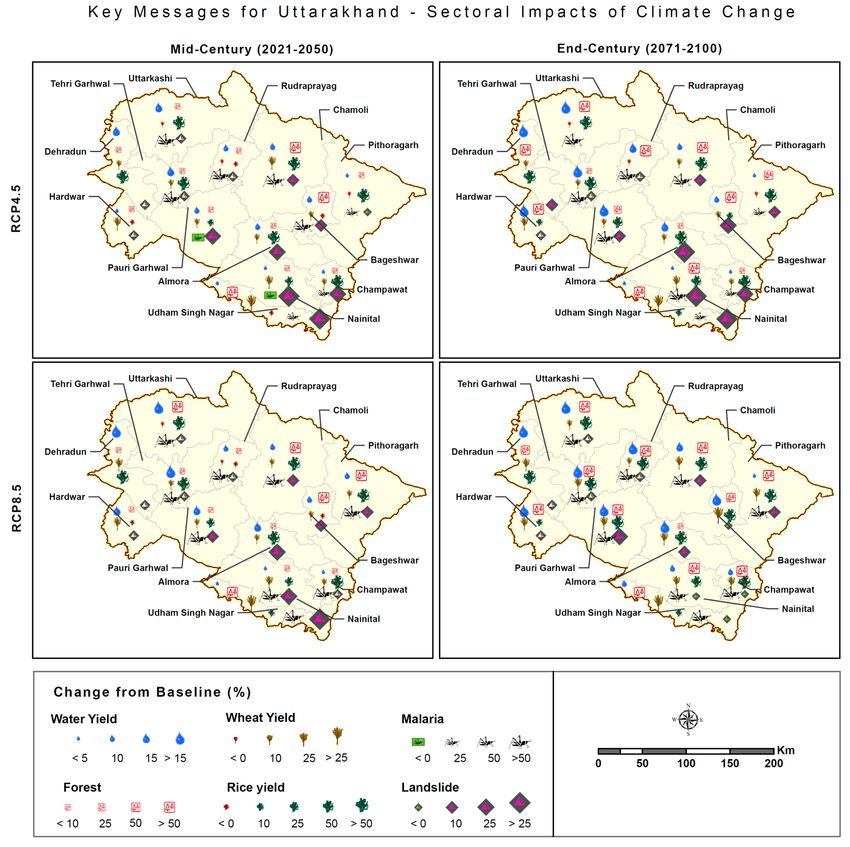
Projected Extreme Climate Indices
                                                         Baseline                                                                         Mid century                                                                         End century
                                                                                                                                                                                                                                                                                    RCP8.5
                                                          T N 10   T X 10    TN9 0 TX 9 0                                                      T N 10   T X 10    TN9 0 TX 9 0                                                     T N 10   T X 10     TN9 0 TX 9 0
                    TX x   TNx     TX n      TNn   DTR                                    W SD I C SD I   TX x   TNx    TX n      TNn   DTR                                    W SD I C SD I   TX x   TNx    TX n     TNn   DTR                                     W SD I C SD I
      District                                               P        P        P     P                                                            P        P        P     P                                                           P        P         P     P

                                                                                            Duration                                                                             Duration                                                                             Duration
                           Absolute indices                   Percentile indices                                 Absolute indices                  Percentile indices                                 Absolute indices                 Percentile indices
                                                                                             Indices                                                                              Indices                                                                              Indices

                                                                                                                                                                                                                                                                                     Positive Non Significant trend
                                                                                                                                                                                                                                                                                                                      Positive Significant trend
Almora
Bageshwar
Chamoli

Champawat
Dehradun
Hardwar
Nainital

Pauri Garhwal
Pithoragarh
Rudraprayag
Tehri Garhwal

Udham Singh Nagar
Uttarkashi

                                                                                                                                                                                                                                                                                     Negative Non Significant trend
                                                                                                                                                                                                                                                                                                                      Negative Significant trend
Data Source: CORDEX South Asia RCM: Multi Model Ensemble Mean
                                            Baseline                                                                                      Mid century                                                                         End century
                    RX 1    RX 5                                            R 10   R20   PR C P           RX 1   RX 5                                            R 10   R20   PR C P           RX 1   RX 5                                           R 10   R20    PR C P
                                    R 9 5p    R99p   CDD       CWD                                SD II                  R 9 5p    R99p   CDD      CWD                                 SD II                 R 9 5p    R99p   CDD      CWD                                  SD II
      District      d ay    d ay                                            mm     mm     T OT            d ay   d ay                                            mm     mm     T OT            d ay   d ay                                           mm     mm      T OT

                     Absolute        Percentile          Duration           Threshold        Other         Absolute       Percentile          Duration           Threshold        Other         Absolute      Percentile          Duration           Threshold         Other
                      Indices         Indices             Indices            Indices        Indices         Indices        Indices             Indices            Indices        Indices         Indices       Indices             Indices            Indices         Indices

Almora
Bageshwar
Chamoli
Champawat

Dehradun

Hardwar
Nainital

Pauri Garhwal

                                                                                                                                                                                                                                                                                     NA
                                                                                                                                                                                                                                                                                                                      No Change
Pithoragarh

Rudraprayag

Tehri Garhwal
Udham Singh Nagar
Uttarkashi                                                                                                                                                                                                                                                     INRM Consultants , New Delhi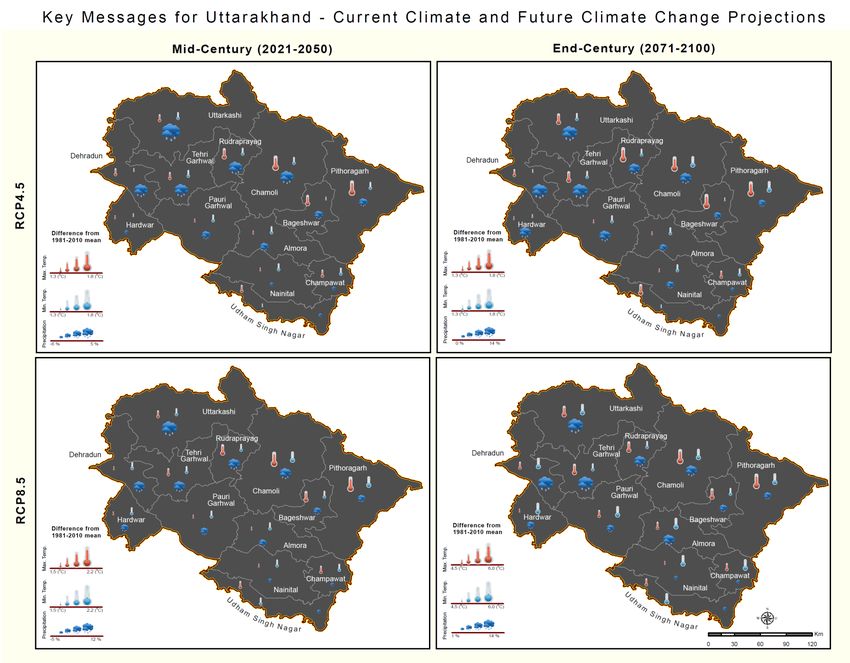
Sectoral Impact of Climate Change

                              INRM Consultants , New Delhi
Sectoral Impact Assessment
for Generating Indicator data for Vulnerability Assessment
System/ Time
Scale/Unit Indicators
Model Current , projected
Water
Day/Seasonal/ Surface WA, Ground WA, Crop water
SWAT Watershed,
annual/inter- requirement, Drought frequency,
hydrological River basin
annual flood magnitude/frequency
model
Agriculture
DSSAT
(Decision Support Crop Yield, Crop water requirement,
District Seasonal/annual
System for Length of growing period
Agrotechnology
Transfer)
Shift in forest boundary, Changes in
Forest Landscape/
Decade species mix, NPP, fire, pests and
LPJ Forest Grids
diseases
Health
Loosely coupled Heat Stress, vector borne diseases-
Administrative Day/Seasonal/
hydrology and Malaria, Temperature Humidity Index
entomology model (district/block) annual
(THI) for livestock
INRM Consultants , New DelhiWater Resources - Impacts
• RCP4.5: stream flow (~Mid), (~> End), peak discharge (> End)
• RCP8.5: stream flow (>), peak discharge (>> End)
• Dependable flow- 95% and 90%: (RCP8.5 > RCP4.5)
• Projected drought conditions likely to increase in hilly regions and improve in mid
and lower transects of Uttarakhand
• 100 year return period of baseline flow is likely to return 30 to 40 years earlier
INRM Consultants , New DelhiAgriculture - Impacts
Change in Rice yield Change in Wheat yield Agriculture Water Stress
• Marginal increase in Rice yield, 2% to 5%: (RCP8.5 > RCP4.5)
• Increase in Wheat yield, 15 to 20%: (RCP8.5)
• Seasonal (winter/Rabi) crop water stress (>)
INRM Consultants , New DelhiForest - Impacts
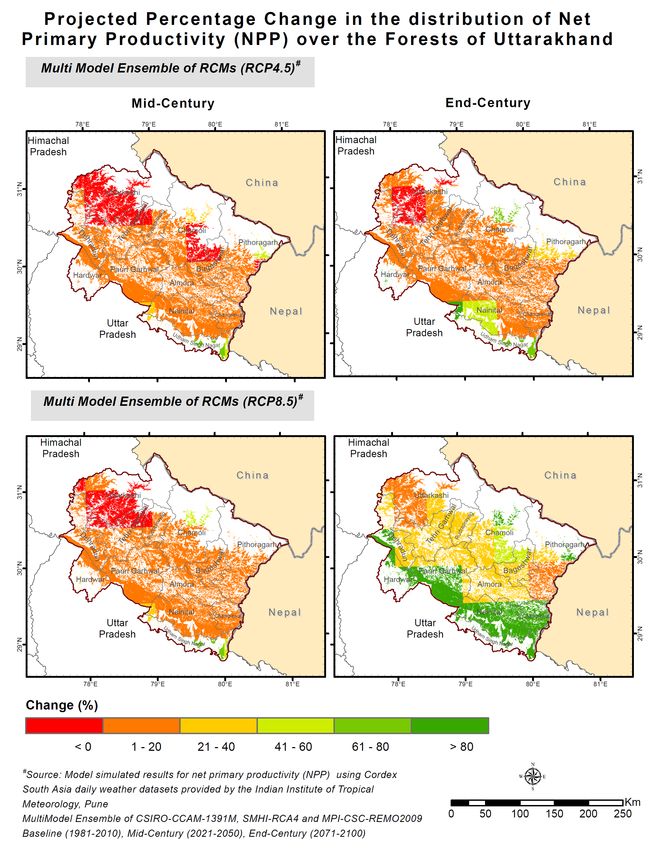
• Increased NPP, biomass production above and below ground, Increased heterotrophic
respiration
• Vegetation changes are likely in the two prominent physiological zones of the state
– Shivalik Himalayas, where plains link to the hills, where species from plains are likely to find refugee
from scorching heat
– Upper reaches of inner Himalaya, where vegetation may spread to the upper Himalayas
INRM Consultants , New DelhiHealth – Impacts
RCP8.5 July –August Adult Mosquito Occurrence RCP8.5 March –June Heat Stress
• Heat stress conditions are likely to exacerbate (March to October)
• March, April, May and October are projected to have favourable conditions for
mosquito growth (> End)
– Impact on the animals is projected to be the maximum in the months of June, July and August
INRM Consultants , New DelhiKey Inferences for
Uttarakhand -
Sectoral Impacts of
Climate Change
INRM Consultants , New DelhiUttarakhand District Vulnerability
INRM Consultants , New DelhiAssessment of Vulnerability to Climate
Change
• Assessment of vulnerability to climate
variability and change broadly helps in:
– Understanding current vulnerability
– Understand change in inherent vulnerability under
projected climate scenario (near and long term)
– Identify the factors that render some districts
more vulnerable than others (hotspots)
– Inform and facilitate the decision-making process
– Selection of adaptation strategies and practices
INRM Consultants , New DelhiMethodology
• Steps to assess the vulnerability of the districts
– Identification of Indicators
– Data collection, cleaning and quality checking
– Classification of indicators data into 3 categories :
• Adaptive Capacity , sensitivity and exposure
– Normalization of the indicators to make them unit free
– Assigning unbiased weights to indicators using Principal Component
Analysis
– Aggregation to arrive at Drill down Indices and Composite
Vulnerability Index
– Ranking districts based on the calculated indices
• Rank 1: least vulnerable (Highest index values), Rank 13: most vulnerable
(Lowest index values).
– Performing cluster analysis on the calculated indices to group
• in six categories of cluster-very low(1), low(2), moderate (3), high (4), very high
(5) and extremely high (6) vulnerability.
– Mapping the cluster using GIS for spatial visualization
INRM Consultants , New DelhiFlow Chart
INRM Consultants , New DelhiComposite Vulnerability Index (CVI)
• Developed by multivariate analysis using sectoral
indicators
– social, economic, climate, water resource, forest,
agriculture, health and natural disaster
• 78 indicators are used for Current Vulnerability
– 28 socio-economic
– 50 environmental indicators
• Projected Vulnerability due to climate change
– 30 environmental indicators out of the 50 which are
climate dependent (direct) have been used
INRM Consultants , New DelhiCurrent Composite Vulnerability
District of Uttarakhand
• Very high vulnerability
– Champawat and Tehri Garhwal
with ranks 13 and 12
• High vulnerability
– Hardwar, Almora and
Bageshwar with ranks 11, 10 and
9
• Moderate vulnerability
– Uttarkashi, Pauri Garhwal,
Rudraprayag and Udham Singh
Nagar (ranks 8, 7, 6, 5)
• Low vulnerability
– Chamoli and Pithoragarh with
ranks 4 and 3
• Very low vulnerability
– Dehradun and Nainital with
ranks 2 and 1
INRM Consultants , New DelhiDisaggregated Sectoral Vulnerability - Current
Districts Rank CV SV ECV CLV WRV FVI AGV HLV NDV
Almora 1 H M M H M M VH VL M
Bageshwar 2 H VH VH VL VL H M L L
Chamoli 3 L M VL VL L VL NA VL H
Champawat 4 VH VH H VH VL H VH M L
Dehradun 5 VL VL VL H VH L M M L
Hardwar 6 H H M H M M M VH H
Nainital 7 VL L L VH H M L L VL
Pauri Garhwal 8 M L L L VH M VH H H
Pithoragarh 9 L H H VL VL M NA VL M
Rudraprayag 10 M M H M L VL M VL H
Tehri Garhwal 11 VH M VL M L L VH VH H
Udham Singh Nagar 12 M H VL M M M VL H VL
Uttarkashi 13 M VH L L L INRM
VLConsultants
NA M VH
, New DelhiProjected
Vulnerability
– Change in
Current
Vulnerability
• All 13 districts of
Uttarakhand are
projected to
become more
vulnerable
• EC vulnerability >
MC vulnerability
INRM Consultants , New DelhiDis-
aggregated
Sectoral
Vulnerability
- Projected
• Climate, Forest,
Health and ND sector
vulnerability >
• Water resource,
Agriculture
vulnerability <
• RCP8.5 Vulnerability>
RCP4.5 Vulnerability
Projected Period INRM Consultants , New DelhiAcknowledgements
• This work was supported by CDKN
• Includes contribution from IISc. Bangalore and
GCRS, Hyderabad, CHEA
• Data support from IITM Pune
INRM Consultants , New DelhiThank You
INRM Consultants , New DelhiYou can also read


