Cancer services recovery plan - NHS Cancer Programme Classification: Official Publications approval reference: 001559 - NHS England
←
→
Page content transcription
If your browser does not render page correctly, please read the page content below
Classification: Official

Publications approval reference: 001559

NHS Cancer Programme

Cancer services recovery plan
14 December 2020
Background and purpose
    The coronavirus pandemic has presented major challenges for all healthcare systems.
    One of the most significant impacts was a sharp reduction in the number of people coming
    forward and being referred urgently with suspected cancer and referred from screening
    programmes.

    When coronavirus prevalence was at its highest at the start of the pandemic, this resulted
    in some people facing longer waits for diagnosis, some treatments being delivered in
    different ways or being interrupted or stopped on the grounds of clinical safety, and some
    follow-up care being disrupted.

    Yet, thanks to the efforts of NHS staff and their partners, including many staff and
    volunteers in the cancer charities, the number of people receiving first or subsequent
    treatment was maintained at 86% of that in the same period in 2019 (March to September).

    The response to the pandemic by NHS cancer services has focused on three phases (see
    Appendices B to D for further detail):

         •   Phase 1: ensure continuation of essential cancer treatment and screening for high
             risk individuals during the initial peak of the pandemic.
         •   Phase 2: restore disrupted services as far as possible to at least pre-pandemic
             levels.
         •   Phase 3 (to run until March 2021): full recovery of NHS cancer services in
             England, including ensuring that care for all patient groups continues to be safe,
             effective and holistic. This document sets out the national NHS plan to deliver
             this third phase. (See Appendices D and E for information on roles,
             responsibilities and governance for delivery of the plan.)

    Equality and Health Inequalities Statement
    Promoting equality and addressing health inequalities are at the heart of NHS England and
    NHS Improvement’s values. Throughout the development of the policies and processes cited in
    this document, we have:

         •   Given due regard to the need to eliminate discrimination, harassment and
             victimisation, to advance equality of opportunity, and to foster good relations
             between people who share a relevant protected characteristic (as cited under the
             Equality Act 2010) and those who do not share it; and,
         •   Given regard to the need to reduce inequalities between patients in access to, and
             outcomes from healthcare services and to ensure services are provided in an
             integrated way where this might reduce health inequalities.

2 | Cancer services recovery plan
The current picture
The principal reason for a reduction in the number of cancer patients commencing
treatment was the fall in referrals.
Urgent referrals
The number of people seen following an urgent referral for cancer fell in April 2020, but
by September had returned to 199,801 (102% of normal).
Screening
The NHS breast and bowel screening services were locally paused in March 2020, but
all services are now running across the country. The bowel screening programme is
issuing screening invitations at rates over 100% of pre-COVID rates. There is still work
to do to ensure the capacity is in place to manage patients that have experienced a
delay during Covid-19.
Waiting times
The number of people waiting more than 62 days for diagnostics and/or treatment
following urgent referral has fallen by more than half but remains above the pre-
pandemic level of about 11,800. This number peaked in May 2020 but by September
had fallen to below 20,000, with continuing improvement. By tracking this number we
can monitor the capacity of the system for diagnosis and treatment, and support regions
and local systems if there is any suggestion they have insufficient capacity to meet
demand.
Treatment
Most cancer treatment was maintained throughout the initial peak of the pandemic,
although the need to protect patients from coronavirus infection and to manage the
pressure on investigations, acute and critical care did disrupt pathways.
Over 291,000 people received their first or subsequent treatment for cancer during this
time (March to September 2020), 86% of the number treated in the same period in 2019.
Over 150,000 people started their first treatment. This is around 30,000 fewer than in the
same period last year, largely as a result of fewer referrals. Significant work has gone
into encouraging people to come forward.
3 | Cancer services recovery planThe Cancer Recovery Taskforce
This plan has been developed with the Cancer Recovery Taskforce, which is chaired by
Professor Peter Johnson, National Clinical Director for Cancer, and includes
representatives from cancer charities, royal colleges, national teams and the NHS Cancer
Programme’s Patient and Public Voices (PPV) Forum (see Appendix G for full
membership).
The taskforce’s focus is the recovery of cancer services, and it reports to the National
Cancer Board which oversees the delivery of the NHS Long Term Plan ambitions for
cancer – to diagnose 75% cancers at stage 1 or 2, and for 55,000 more people to survive
for five years or more, by 2028.
The taskforce’s roles are to:
• review progress against the aims of the recovery plan monthly, reporting to the
National Cancer Board
• identify any requirements for the successful recovery of cancer services that are
the responsibility of stakeholders outside the NHS Cancer Programme (eg public
awareness, cancer screening, infection control measures)
• understand and represent the needs of patients and their families, and NHS staff,
and engage with the wider cancer community on the national delivery of the
recovery plan and its progress
• share practical suggestions about what the wider cancer community can do to
support recovery.
The taskforce provides advice and guidance on national strategy for the recovery of
cancer services. It also has an important role in representing the views of the cancer
community in the wider national recovery strategy beyond cancer services, eg shielding.
The taskforce is monitoring progress against the aims of restoring demand, reducing
waiting times and ensuring sufficient capacity for cancer diagnosis and treatment.
Operational delivery resides with regional teams and STPs/ICSs, led and supported by
the cancer alliances.
4 | Cancer services recovery planPlan on a page
Aim 1. Restore demand to at least pre- Aim 2. Reduce number of people waiting longer Aim 3. Ensure sufficient capacity to manage
pandemic levels than they should future demand
• Run a major public awareness campaign • Audit and focus on longer waiters • Maximise use of available capacity (on both
• Ensure efficient routes into the NHS for people • Implement urgent plans to increase/manage screening and symptomatic pathways) through
at risk of cancer, including through supporting demand for endoscopy and imaging capacity system-wide working
restoration of screening programmes • Implement best practice and modified pathways to • Optimise use of available independent sector
• Improve referral management practice in account for impact of COVID-19, and ensure capacity
primary and secondary care patients are seen as quickly and as safely as • Enable restoration of other services
possible • Take action to protect service recovery in
preparation for winter
We will achieve these key aims by:
Supporting a ‘system-first’ • Alliances working through and with local systems in an integrated way
model through alliances • Single dataset at national, regional and local system level on referral, treatment and longer waiter numbers
• Monthly check-in rhythm with regions to ensure appropriate support and prioritisation is in place
Tackling inequalities • Monitor referral and treatment metrics by deprivation or ethnicity as data permits
• Target public awareness campaign in line with data
Ensuring public and staff • Promote implementation of national guidance on maintaining COVID-19 protected environments, including use of PPE and
confidence testing of staff and patients
• Communicate with patients and the public on steps being taken to ensure safety
Locking in innovations • Consolidate evidence-based innovations developed as a result of the pandemic
• Focus 2020/21 Innovation Fund on technologies to support recovery
Ensuring the right • Support ‘returners’ and volunteers to help cancer recovery
workforce is in place • Work towards reducing any gaps in the workforce and support existing staff to continue to deliver care
• Training bursaries for clinical nurse specialists and chemo-nurses
Restarting LTP activity that • Prioritise Long Term Plan commitments that will support recovery, including rapid diagnostic centres, bowel screening,
supports recovery targeted lung health checks and personalised stratified follow-up
Ensuring effective • Host regular webinars with the cancer charities and cancer clinicians
communications • Hold fortnightly calls with the cancer alliances, and regular meetings with the PPV Forum
5 | Cancer services recovery planSuccess measures
Our success measures show what we want to achieve against each of our three aims.
Aim Success measure Measurement
1. Restore demand coming The number of patients to be Monthly cancer waiting times
into the system to at least seen in a first outpatient data at national level (published)
pre-pandemic levels appointment following urgent Note: Progress on restoring
GP referral will have returned screening programmes will continue
to at least pre-pandemic to be measured and monitored
levels through the national cancer
screening programme boards
2. Reduce the number of The number of patients Monthly snapshot of the patient
people waiting longer than waiting more than 62 days tracking list (PTL) at national level
they should for diagnostics after urgent referral will have (published)
and/or treatment at least to returned to at least pre-
pre-pandemic levels on pandemic levels
both screening and
symptomatic pathways
3. Ensure sufficient The number of patients Monthly cancer waiting times
capacity to manage future receiving first definitive data at national level (published)
increased demand, treatment following a decision
including for follow-up care to treat will have returned to
at least pre-pandemic levels
Where our data identifies issues with the progress being made, we will continue to work
with regional teams to understand what they and their local partners are doing to
respond, and will agree additional actions and support where necessary to ensure we
see progress in all areas.
Ensuring we address ‘unmet need’
The drop in number of first treatments for cancer since the pandemic began indicates
that some people who have cancer have not yet gone to their GP with symptoms or had
a screening appointment. The NHS is acting to increase presentations to GPs and
restore all cancer screening programmes.
6 | Cancer services recovery planAs we monitor the number of people receiving first treatment – at national, regional and
alliance level – we need to see the system ‘catch up’ with this unmet need, and by
monitoring the waiting list over 62 days from urgent referral to see that capacity is
sufficient to diagnose and treat all these people.
7 | Cancer services recovery planPlanning for winter
COVID-19 infections in the community and hospitalisations are rising at different rates
across the country, but as we approach winter we must stay focused on delivering the
national plan for the recovery of cancer services by March 2021. We will continue to monitor
progress across the country, with additional support offered to areas as they experience
increased capacity challenges.
To help prepare for winter, we are asking cancer alliances to:
Maintain COVID-protected environments for cancer
• Ensure clear escalation plans are in place, with redeployment of staff involved in
cancer screening, treatment and care considered only as a very last resort.
• Maintain or step back up cancer hubs for cancer surgery in line with existing advice.
• Use hub arrangements to protect capacity for endoscopy where possible.
• Maximise the use of independent sector capacity for cancer.
• Test non-symptomatic staff directly involved in the treatment and care of patients in
cancer services on a weekly basis. Regularly test non-symptomatic patients
attending chemotherapy and radiotherapy appointments (as advised by their clinical
team), ensuring access to rapid testing at point of care for any patient who has not
been tested or who has been unable to follow advice to isolate.
Continue to prioritise patient support, safety netting and use of clinical
guidance
• Assign an individual patient navigator to each patient, as set out in the Adapt and
Adopt blueprint for cancer.
• Continue to ensure appropriate local safety netting process is in place for patients
where it has been necessary to postpone their treatment.
• Ensure paused clinical trials for cancer re-open as soon as possible and remain
open.
• Where appropriate, make use of clinical guidance for symptomatic and screening
services produced at the start of the year and during the pandemic, ensuring clinical
decisions to stop or start treatment continue to be made according to the risk and
benefit to the individual patient.
Maintain delivery of The Long Term Plan wherever possible
• Continue or resume the delivery of Targeted Lung Health Check projects.
8 | Cancer services recovery plan• Implement at least one Rapid Diagnostic Centre pathway for a challenged two-week
wait pathway, and one for patients with non-specific symptoms.
• Extend Personalised Stratified Follow Up programmes beyond breast, prostate and
colorectal to support patients following their treatment and to increase clinical
capacity by releasing outpatient slots.
Specific actions being taken at national level to support preparations for winter can be found
under aim 3.
9 | Cancer services recovery planKey actions
Aim 1: Restore demand at least to pre-pandemic levels
To deliver this aim we will:
Run a major public awareness campaign:
• Ensure next phase of national ‘Help us help you’ campaign includes core
cancer messaging, and that public-facing messaging on the importance of
accessing NHS services continues throughout winter.
• Alliances, working with regional NHS England and Improvement public health
commissioning teams where relevant, to lead and support delivery of local
initiatives to increase referrals and screening uptake, eg patient ‘walk through’
videos.
• Provide consistent messaging to patients and the public on the safety of
services, including screening services.
Ensure efficient routes into the NHS for people at risk of cancer:
• Through national communication and campaign efforts, as well as co-ordinated
work locally, support the restoration and use of screening services. Ongoing
restoration of the screening programmes will help to ensure the return to pre-
pandemic standards as soon as possible.
• Encourage use of patient pathway navigators and other relevant actions
through regional adapt and adopt plans.
• Support wider work on elective care to ensure that people with cancer not
referred through an urgent cancer route receive timely diagnosis and treatment.
Improve referral management practice in primary and secondary care:
• Ensure focus on high quality referral activity, including safety netting, and
identify and address unwarranted variation in referral access through key
primary care contractual levers in the quality outcomes framework and network
contract DES.
• Disseminate, monitor and embed the use of guidance and tools that promote
good practice in referral and safety netting activity, including to cancer
alliance, PCN and primary care contacts, through a range of communication
channels and as part of the commissioning framework for services.
10 | Cancer services recovery plan• Through aligned national messaging, encourage effective communication and
partnerships between primary and secondary care.
• Work in partnership with primary care at all levels to understand particular
barriers to access as recovery is implemented, and identify opportunities for
action.
Use this metric to track delivery:
• Number of patients seen in a first outpatient appointment following urgent
referral from their GP.
11 | Cancer services recovery planAim 2: Take immediate steps to reduce the number of people waiting
over 62 days from urgent referral
To deliver this aim we will:
Audit and focus on longer waiters:
• Cancer alliances to lead local audit and prioritisation of longer waiters in line
with clinical need (for patients on symptomatic and screening pathways) and
ensure clinical harm reviews are undertaken.
• Ensure consistent application of cancer waiting times monitoring dataset
guidance.
Implement urgent plans to increase/manage demand for endoscopy and imaging
capacity:
• Enable implementation of innovations, such as using faecal immunochemical
testing (FIT) as a triage tool, and telephone and video calls for specialist bowel
screening practitioners.
• Provide £6m funding to cancer alliances to develop pilot Colon Capsule
Endoscopy clinics. The clinics will use a small camera, which is swallowed by
the patient, to film inside the body and identify any signs of cancer.
• Support delivery of high impact actions within endoscopy and imaging adapt
and adopt blueprints.
• Cancer alliances to lead implementation of specific actions to help restore
endoscopy capacity, including substituting CT colonography for colonoscopy
where local circumstances permit, aligning infection prevention protocols locally
and fully implementing polyp surveillance guidance.
Implement best practice and modified pathways to account for impact of COVID-19
and ensure patients are seen as quickly and as safely as possible:
• Cancer alliances to lead implementation of diagnostic pathway modifications
and the RDC principles, including the use of ‘hot reporting’.
• Support full implementation of timed diagnostic pathways for lung, prostate,
colorectal and oesophago-gastric cancers, and establish new timed pathways
for head and neck and ovarian cancer.
• Prioritise treatment changes that deliver greater patient benefits, such as
changes to the delivery of chemotherapy, and ensure improvements are ‘locked
in’ for the future where appropriate.
12 | Cancer services recovery plan• Continue to monitor the management of patients requiring more than one
episode of treatment, to ensure those with recurrent/secondary cancer receive
timely and appropriate care and treatment.
Use this metric to track delivery:
• Number of patients waiting over 62 days after urgent referral.
Note: The data source currently covers only urgent referrals, but we are looking to
extend it to screening pathways.
13 | Cancer services recovery planAim 3: Ensuring sufficient capacity to meet demand
To deliver this aim we will:
Maximise use of available capacity (on both symptomatic and screening pathways)
through system-wide working:
• Cancer alliances to lead expansion of capacity of COVID-19 protected surgical
hub arrangements and, where appropriate, local extension of whole-system
models to other treatments (including palliative and end-of-life care) and
diagnostics (this may be through the early development of community
diagnostic hubs).
• Encourage delivery of relevant adapt and adopt cancer blueprint actions, eg use
of alliance-wide PTLs where appropriate locally.
• Support wider approaches aimed at maximising available capacity, eg
development of diagnostic networks.
Optimise use of available independent sector capacity:
• Monitor the use of diagnostic and treatment capacity within the independent
sector contract, and support regions, alliances and providers to take advantage
of independent sector capacity through national framework contracts from
November 2020 onwards.
Enable restoration of other services:
• Cancer alliances to lead the resumption of any support, follow-up or other
relevant services for those already diagnosed with cancer, that have been
impacted by the pandemic.
Take action to protect service recovery in preparation for winter:
• Keep national clinical guidance under review. Issue advice to regions for
specialised surgery, chemotherapy and radiotherapy.
• Work with cancer alliances to ensure readiness of cancer surgical hub
arrangements across the country and the protection of diagnostic and treatment
teams from redeployment.
• Work with NHS planning teams to optimise use of available independent sector
capacity, particularly to support cancer surgery.
• Work with the taskforce to ensure appropriate COVID-19 testing for patients
and staff. Monitor shielding advice and build this into public messaging.
14 | Cancer services recovery planUse this metric to track delivery:
• Number of patients receiving first definitive treatment following a decision to
treat for all cancers.
15 | Cancer services recovery planLooking to 2021/22 and beyond
We remain committed to delivering the Long Term Plan ambitions for cancer:
• by 2028, 55,000 more people will survive cancer for five years or more each year; and
• by 2028, 75% of people will be diagnosed at an early stage (stage one or two).
As indicated in this plan, we are working to ensure that activity that will help us to meet these
ambitions can continue during the pandemic, particularly through our major programmes of
work, such as Rapid Diagnostic Centres and Targeted Lung Health Checks. In addition, we
will want to capitalise on the innovations and new ways of working that have been developed
as a result of the pandemic. As the recovery phase is completed, there will also be a
renewed focus on securing sustainable delivery against the cancer waiting time standards.
We will continue to work with cancer alliances to support them to deliver change locally, for
example through dedicated funding, provision of data and analysis, and best practice and
tools. In addition, we will:
• work with relevant colleagues to ensure the additional £325m capital funding
announced in the Spending Review for diagnostics in 2021/22, as well as the
funding for elective care and workforce, supports delivery of the Long Term Plan
ambitions for cancer; and
• continue to identify and roll out innovative approaches that will improve outcomes,
including piloting a blood test, developed by GRAIL, that may detect early stage
cancers.
16 | Cancer services recovery planAppendix A: Supporting delivery of our Phase 3 aims
Supporting a ‘system-first’ model
• Cancer alliances, with their local ICS/STP, and NHS England and Improvement
reginal public health commission teams, will develop integrated local recovery
plans, including screening, diagnostics and workforce. Nationally, we will share
resources and best practice to support this.
• Cancer alliances will embed system-wide approaches to manage demand and
capacity, including clinical triage, use of the independent sector and centralised
booking and management systems.
• Nationally, we will provide weekly and monthly data packs with information on
managing referral, diagnostics, treatment and longer waiter numbers to inform
local planning and delivery.
• Nationally, we will run a monthly recovery check-in process to monitor and
identify priority actions for regions and alliances.
Tackling inequalities
• Nationally, we will develop specific analysis and monitor our key recovery
metrics by deprivation, age, sex and ethnicity, reviewing pre- and post-COVID-
19 access levels to identify areas for urgent action. Nationally, we will continue
to ask patients for their views through the NHS Cancer Programme PPV Forum,
the Cancer Improvement Collaborative, cancer charity partners and non-cancer
community organisations, and use this feedback to inform priority actions. We
will ensure that patient feedback mechanisms are in place for decision-making
at all levels.
• We will share the data and patient intelligence with alliances to inform local
actions, and use them nationally to target our public awareness activity.
Ensuring public and staff confidence
• National teams and cancer alliances will promote the implementation of national
guidance on reducing transmission of coronavirus in healthcare settings.
• Cancer alliances will monitor availability of testing, PPE and incidents of clinical
harm. They will escalate issues and take appropriate local action.
• National teams and cancer alliances will use all communications channels to set
out the steps the NHS is taking to maintain COVID-19 protected environments.
Through their networks and channels, the Cancer Recovery Taskforce will help
to amplify these messages as appropriate.
17 | Cancer services recovery planPrioritising innovations that support recovery
• National teams and cancer alliances will support the roll out of innovations
accelerated as a result of the pandemic, such as stereotactic ablative
radiotherapy (SABR), ‘COVID-friendly’ treatments and chemotherapy delivered
in different settings.
• Nationally, we will enable robust evaluation of innovations and prioritise support
from the 2020/21 Innovation Fund to roll out selected diagnostic interventions
(with an early focus on endoscopy), and support delivery of best practice (eg in
clinical decision-making, rule in/out tests).
• Cancer alliances will lead the local implementation of innovative solutions,
supported by £4m funding.
• Nationally, we will work with the National Institute for Health Research to
support the recovery of cancer clinical trials (including for children and young
people) by summer 2021.
Ensuring the right workforce is in place
• Cancer alliances will support the deployment of cancer staff returning to the
NHS through the bringing back staff scheme, and will pilot new NHS volunteer
roles to support cancer patients.
• National teams and cancer alliances will encourage take up of Health Education
England's 2020/21 training grants for clinical nurse specialists and chemo-
nurses and extra training places for other specialties highlighted in the People
Plan, including developing an advanced clinical practice qualification in
oncology.
• Cancer alliances will identify individuals nearing the symptomatic colonoscopy
accreditation thresholds and support them to gain JAG accreditation.
• Cancer alliances will support flexible working innovations, such as workforce
passports, remote reporting, seven-day working, additional lists for qualified
staff and parallel running of old and new machines, as well as approaches to
support NHS staff health and wellbeing.
• Cancer alliances will take action to retain and re-purpose the BowelScope
workforce while the service remains suspended, and expand training
opportunities for trainee lower GI endoscopists in the next 12 months.
• Cancer alliance will support clinical nurse specialists to work at the top of their
licence by deploying an effective skill mix model, including cancer support
worker and volunteer roles.
• Nationally, we will input to the spending review and prioritisation of funding.
18 | Cancer services recovery planRestarting Long Term Plan activity that supports recovery
• Cancer alliances will continue to develop and roll out RDCs in line with the RDC
specification;
• Nationally, we will work with sites to enable the early resumption of the TLHC
Programme, and ensure projects have access to sufficient CT capacity to be
able to deliver the programme.
• Cancer alliances will build on their work on personalised stratified follow-up
pathways across a range of cancers to support patients following treatment, and
increase clinical capacity for new patients requiring treatment by releasing
outpatient slots. Pathways are to include the use of remote surveillance and
access back to their cancer team when patients need it. Personalised care,
including access to patient education, is to be embedded alongside better
support for self-management, to ensure individual and holistic patient needs are
met.
Ensuring effective communication across the cancer community
• Nationally, we will run monthly webinars with cancer charities to brief them on
progress and get their feedback on patient experience, and publish a regular
stakeholder bulletin. We will also engage regularly with the NHS Cancer
Programme’s PPV Forum.
• We will host monthly calls with cancer clinicians and cancer alliance clinical
chairs, and continue to communicate regularly with cancer alliance managing
directors.
19 | Cancer services recovery planAppendix B: How our approach aligns with the plans and
priorities of the wider NHS
Phase 1 Phase 2 Phase 3
National • COVID-19 level • COVID-19 level 4 • COVID-19 incident response
response 4 incident incident response reduced to level 3, incident
response and critical response services
services switch on maintained
Wider NHS • Enable the • Enable the NHS to • Restoration of non COVID-19
priorities NHS to deal deal with continued services
with peak COVID-19 demand
• Prepare for winter pressures
COVID-19
• Start to restore alongside potential further
demand
critical services spikes in COVID-19
• Lock in beneficial changes
from our experience to date
National • To ensure • To restore • To restore urgent cancer
cancer continuity of disrupted services referrals to at least pre-
team key urgent and as far as possible pandemic levels
priorities essential to pre-pandemic
• To reduce the number of
cancer services levels
longer waiters to at least pre-
pandemic levels
• To ensure sufficient capacity
to manage increased
demand moving forward
Planning • Letter to NHS • Letter to NHS • Planning guidance letter
issued 17 issued 29 April issued 31 July
March 2020
20 | Cancer services recovery planAppendix C: Our key actions in Phase 1 – ensuring the
continuity of urgent and essential services
Providing clear clinical and operational guidance
✓ Guidance issued March 23 on prioritisation of patients and organisation of
services during the disruption.
✓ Letter sent to the NHS on the continuation of urgent and essential cancer
treatment.
✓ Other guidance on management of urgent referrals and safety netting, screening,
endoscopy, proton beam therapy and primary care.
Supporting the development of hubs for cancer surgery
✓ Worked with cancer alliances, regional teams and specialised commissioning to
support and enable continuation of essential cancer services.
✓ Following guidance, surgical ‘hubs’ were developed in all 21 cancer alliance
areas to provide surgical services in protected environments for cancer patients.
✓ Further work is underway to build on this model to deliver diagnostic services in
protected environments.
Ensuring clear communications and engagement
✓ Worked as part of the national ‘Help us help you’ campaign to deliver key
messages – in particular, that anyone with worrying symptoms should go to their
GP. Urgent referrals have been rising steadily since the campaign began.
✓ Maintained regular channels of communication with key stakeholders, including
updating FAQs for charities to use on their patient support lines.
21 | Cancer services recovery planAppendix D: Our key actions in Phase 2 – supporting
systems to start to return disrupted services
Continuing clear communications and engagement
✓ Continued to promote cancer-specific messages as part of the ‘Help us help you’
campaign.
✓ Developed patient-facing messages on approaches being taken to reduce the
risk of transmission in healthcare settings.
Providing clinical guidance and support
✓ Developed and shared a guide for the management of diagnostic services during
the pandemic – including applying RDC principles and adapted diagnostic
pathways.
✓ Developed and shared a guide for prioritisation and triage of patients with lower
GI symptoms.
✓ Supported development of guidance on testing for asymptomatic staff and
patients in non-surgical oncology in the UK.
Supporting new ways of delivering care and treatment
✓ Accelerated the implementation of the use of SABR, an innovative and life-saving
type of radiotherapy, for use by the end of the financial year.
✓ Supported cancer alliances to use innovative approaches locally, such as FIT
testing to triage lower GI referrals.
✓ Issued an amended service protocol for the delivery of TLHCs.
Developing analytical tools
✓ Developed and shared a national model to help alliances understand the
potential scale of the demand for services in different scenarios.
22 | Cancer services recovery planAppendix E: Roles and responsibilities
STPs/ICSs • Recovery of services is system-led. For cancer, this means that
and cancer STPs/ICSs are responsible for working through their cancer alliances to
alliances deliver the relevant actions and solutions to enable the restoration and
recovery of cancer services for their populations.
• System-level recovery plans for cancer (covering September 2020 to
March 2021) are developed by cancer alliances, working with their
STPs/ICSs, and NHS England and Improvement regional public health
commissioning teams who lead on the delivery of the public health
function agreement. Cancer alliances will lead the delivery of these plans.
Cancer alliances and STPs/ICSs may choose to publish their plans on
their websites.
Regional • Regional cancer SROs are responsible for:
teams – assuring that the system recovery plans for cancer are in place and
being delivered
– ensuring that any issues or challenges to delivery are tackled in a
timely and appropriate way
– working with regional NHS public health commissioning teams as they
oversee the restoration of cancer screening programmes, and other
relevant regional leads, such as the regional imaging leads
– working with the national team to provide assurances to government,
the wider cancer community and NHS England and NHS
Improvement leadership that recovery is deliverable and on track, and
that the risk to patients is being appropriately managed.
• Regional teams as a whole are responsible for ensuring that sufficient
diagnostic and treatment capacity is in place to meet demand from cancer
referrals.
National • The NHS Cancer Programme Team supports systems and regional teams
team through:
– working with regions and other partners (including other relevant
national teams, such as public health commissioning and specialised
commissioning) to set clear national priorities for cancer services, and
ensuring that local systems have access to service development
funding to support this activity
– providing scenario modelling, guidance and data to underpin the
development and implementation of local recovery plans, and support
effective conversations between regions and local systems
– developing a wider support offer, which prioritises systems that
regions identify as requiring particular assistance
– national advocacy and reporting on cancer recovery, including to
government, the wider cancer community and NHS England and NHS
Improvement leadership.
• The national NHS England and NHS Improvement Public Health
Commissioning and Operations Team is leading and is responsible for the
full restoration of cancer screening services across the country, working
through regional public health commissioning teams.
23 | Cancer services recovery planWider • The wider stakeholder community, including cancer charities where this
stakeholder aligns with their charitable objectives, and members of the Cancer
community Recovery Taskforce are responsible for:
– supporting and enabling the delivery of this plan through co-ordinated
and aligned activity
– providing expert input into the delivery of recovery efforts
– sharing practical suggestions on how the cancer community can
support recovery
– ensuring joined-up and aligned messages on recovery and service
delivery across the cancer community and beyond.
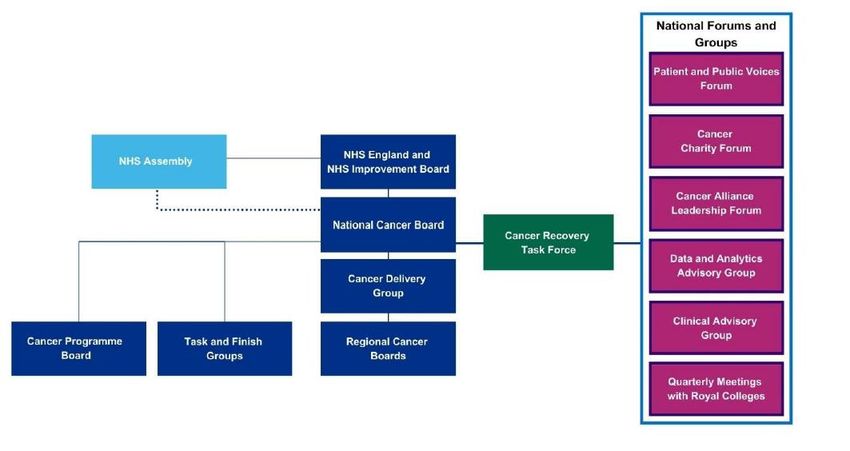
24 | Cancer services recovery planAppendix F: Governance
Appendix G: Cancer Recovery Taskforce members
• Blood Cancer Alliance • NHS England and NHS
• Bowel Cancer UK Improvement Public Health
• Breast Cancer Now Commissioning and Operations
• Cancer 52 • Public Health England
• Cancer Research UK • CMO
• Children and Young People’s • Royal College of General
Cancer Charities Coalition Practitioners
• Health Education England • Royal College of Nursing
• Less Survivable Cancers • Royal College of Pathologists
Taskforce • Royal College of Physicians
• Macmillan Cancer Support • Royal College of Radiologists
• NHS Cancer Programme Patient • Royal College of Surgeons of
and Public Voice Forum England
25 | Cancer services recovery planYou can also read


