Chapter 3: Taxonomy of Mobile Web Applications A Taxonomy and Business Analysis for Mobile Web
←
→
Page content transcription
If your browser does not render page correctly, please read the page content below
Chapter 3: Taxonomy of Mobile Web Applications
                       from
  A Taxonomy and Business Analysis for Mobile Web
                   Applications
                                                   By
                                          Kevin Hao Liu
                                       Ph.D. Computer Science
                                         Victoria University

                    Submitted to the System Design and Management Program
                    in Partial Fulfillment of the Requirements for the Degree of

                       Master of Science in Management and Engineering

                                              At the
                               Massachusetts Institute of Technology

                                         February 2009
                              © 2009 Kevin H Liu. All rights reserved

 The author hereby grants to MIT permission to reproduce and to distribute publicly paper and electronic
   copies of this thesis document in whole or in part in any medium now known or hereafter created.

                                            ABSTRACT
Mobile web applications refer to web applications on mobile devices, aimed at personalizing, integrating,
and discovering mobile contents in user contexts. This thesis presents a comprehensive study of mobile
web applications by proposing a new taxonomy for mobile web applications, and conducting a business
analysis in the field of mobile web applications.

The thesis reviews the current surrounding environment for mobile web applications, namely, web 2.0
and 3.0, wireless communication technology, and Smartphone platform. The recent entry and success of
Apple’s iPhone greatly enhanced the public awareness of the Smartphone technology. Google’s release
of open-source Android platform and T-Mobile’s deployment of Android-powered “Dream” Smartphone
not only intensify the competition among suppliers, but also provide an open-source foundation for
mobile web applications. This thesis introduces a new mobile web application taxonomy to
systematically study the values and the groupings of the mobile web applications. By introducing
features and categories, the taxonomy provides a framework so the related companies and businesses can
be comparatively analyzed and summarized. Selected case companies are studied in the light of the
taxonomy. The thesis discusses the key issues of mobile web aggregation, namely, mobile application
development platform, context modeling, mobile user interface, mobile application logic, and mobile web
aggregation strategy.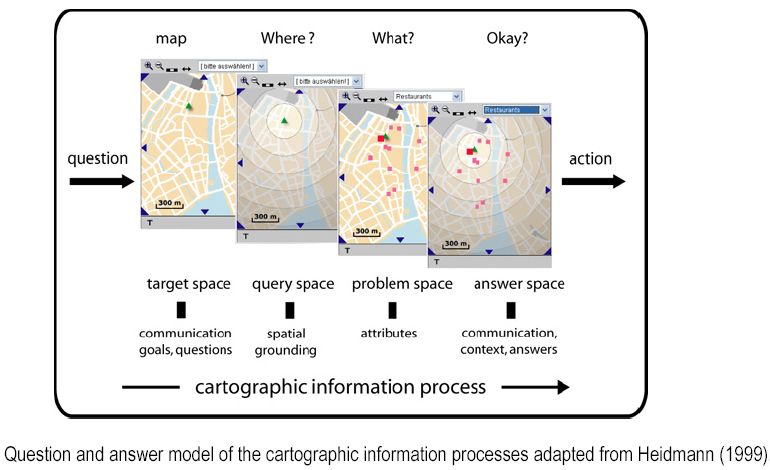
This is actually Chapter 3 from the thesis – lightly edited and reformatted for use in course 15.579.

1.         TAXONOMY OF MOBILE WEB APPLICATIONS
           This section presents a systematic study of mobile web applications, which are software applications
           running on a mobile web platform.

           Figure 1 shows the structure of the taxonomy in which mobile web applications are classified based
           on features and categories/subcategories.

           Features are the unique values that mobile web applications can deliver to customers, whereas
           categories/subcategories are groupings so that companies and businesses can be comparatively
           analyzed and summarized.

                  Taxonomy                      Mobile Web Applications

                                           Features

                          Context                                Ever
                                                                                                  Mobility
                          Specific                              Present

                                               Categories

               Location                     Mobile                           Mobile
                Based                        Infra-                       Entertainment
               Service                     Structure
                                           Software/
                                            Widget                                     Data
                                                                                     Collection
                                  Mobile
                       Mobile
                                  Social
                       Search                          Mobile       Mobile
                                 Network
                                                       Wallet      Marketing                  Safety     Emergency

                           Figure 1 A Taxonomy for Mobile Web Applications

     1.1       FEATURES
           A mobile device such as a mobile phone is often carried by the user, and since the user is in motion,
           the device is moving from place to place. Current mobile devices usually are loaded with calendars,
           address books, tasks, and emails. A feature represents the unique value that mobile web applications

                                                          -1-
together with the mobile platform can deliver to a user. Mobile web applications have the following
features:
• Context specific: Context refers to interrelated conditions in which something exists or
occurs. In computing, context is related to the information used to characterize the situation
of an entity, which is a person, place, or object considered relevant to the interaction
between a user and an application, including the user and application themselves. Dourish
in his 2004 paper on Personal and Ubiquitous Computing suggested that an individual’s
experience and history is part of his/her current context [7]. Beale and Lonsdale in their
2004 paper present a hierarchical description of context in that they define context as “a
dynamic process with historical dependencies”. The context is further described as “as set
of changing relationships that may be shaped by the history of those relationships.” A user’s
mobile phone contains the following information:
o Location: a GPS phone can precisely pinpoint the user’s current location
o Social network and status: names and contacts of one’s social network, e.g. via
Facebook or Myspace. For status information, these friends can be characterized by
their
• Proximity to others
• Social relationships
• Collaborative tasks.
o Address book
o Personal information: age, gender, and language
o Personal property: one may use mobile phone as a PDA (Personal Digital Assistant),
which can store information on his/her personal property information, e.g. car
online service account
o Emails
o Instant messages
o Tasks
o Calendars
o Time: current time and time zone
o Orientation: the orientation of a user to determine the direction the user is heading
in and thus what is in front, behind, and to either side of them.
o Favorite and historical bookmarks of the mobile web browser
o Navigation history: allows the users to see where they have been and what they have
seen and done.
o Physical surroundings: mobile devices can be equipped with sensors to detect
physical environment information such as temperature, lighting level (direct sunlight
level), and noise level.
o Mobile device system property: this describes the mobile device platform as well as
bandwidth and the quality of the positioning information such as the GSP coverage.
The above information describes context in 6 aspects:
o Spatial context: where you are?
o Social context: who you are with?
o Personal (interest) context: what are your past, current, and future interests?
o Physical (surroundings) context: what is your environment?
o System context: what is your platform?
-2-o Information context: what resources are nearby?
Mobile web applications of this feature aims at context awareness. The device provides the
context, whereas the service delivers feedback. In [9], user context is collected via “5 Ws”:
o Who – the ability of a device to identify not only its owner but also other people
and devices in its vicinity within the environment
o What - the ability to interpret user activity and behavior, and using that information
to infer what the user wants to do
o Where - the ability to interpret the location of the user and use that to tailor
functionality
o When - the ability to understand the passage of time, use it to understand the
activities around and to make inferences
o Why - the ability to understand the reasons behind certain user actions
• Ever present: worldwide mobile phone sales have surpassed PC sales for several years. A key
reason of the popularity is people carry mobile phone (small but with needed functionality)
not PC for their daily life. As mobile phones become more powerful and the
wireline/wireless communication infrastructure becomes more wide spread, ubiquitous
computing via mobile devices becomes reality. Mobile web applications on a ubiquitous
platform need to satisfy these fundamental requirements:
o Availability: a service should be available independent of context, and regardless of
changes in user status, needs, and preferences.
o Transparency: ideally, the applications in this space should allow users to perform
tasks in non-intrusive way by hiding the underlying technology.
Since users carry mobile phone wherever they go, it is convenient for users to make
purchase, watch news, and play games in addition to read emails and voice mails via the
mobile phone platform. There are also a number of mobile web infrastructure software
developed on the mobile web such as mobile Instant Massager and Widgets. PDA (Personal
Digital Assistance) software is also in this category.
• Mobility: Mobile web applications can provide value by leveraging original mobile network
characteristics. For instance, parents can use mobile web on their mobile phone to watch
real time video and retrieve information on their babies in infant day care center via sensors
and webcams. Diabetes patients can use cell phone together with a glucose meter to report
blood sugar levels to doctors for regular checkup. mobile networks originally are developed
for the following reasons
o Ease of deployment: mobile infrastructure is cheaper and easier to deploy especially
in a foreign environment or a remote region
o Use of sensors: cost-efficient to use sensors to collect information and/or provide
real time monitoring
o Safety and emergency: provides a unique solution for user emergency and safety
To sum up, given the 3 features of the taxonomy, mobile web applications should focus on the key
values of each feature
• Context: Emphasizing context results in intelligent application providing context-
awareness.
• Ever-present: applications with this feature are always available, transparent applications
providing user convenience.
-3-• Mobility: applications with this feature are easy to deploy, configure, and maintain
applications providing cost-efficiency.
1.2 CATEGORIES
In the light of the features introduced in the previous section, mobile web applications can be
grouped into categories and sub categories for comparative market analysis. Each feature has
multiple categories. A category is a collection of businesses and/or companies that are related in a
certain way.
Geographical
Information System/
Spatial Database
Web GIS Mobile GIS
LBS
Mobile
Internet & Internet Mobile Devices &
Web Wireless
Communication
Figure 2 LBS
1.2.1 FEATURE -- CONTEXT
Context related categories include
• Location based services (LBS): LBS are information and entertainment service that are
accessible with mobile devices through the mobile network and utilizing the ability to use the
geographical position of the mobile device. Figure 2 shows the LBS are the intersection of 3
technologies: mobile devices and wireless communication, Internet and Web, and
Geographical Information System (GIS) and spatial database. GIS and LBS have similarities
in relation to the handling of data with positional reference and spatial analysis functions.
For example, both are interested in answers to these questions: where am I, what is nearby,
and how can I go to a specific location. However, GIS and LBS are developed for different
-4-user groups and therefore have different requirements. GIS is designed for professional
geographic users and requires extensive computing resources, whereas LBS is targeted for
mobile web users and operates under the restriction of mobile platform environment like
low computational power, small displays, and limited run time battery of the mobile devices.
An important topic of LBS is a spatial information process model that usually contains a
model of possible user questions, defines queries of geographic base data and location
information, and specifies possible answers. Figure 3 shows an example of the cartographic
information process if a user asks for positions of restaurants close to his/her current
position. There are 4 steps in the process: target space to define communication goals, query
space to determine spatial grounding, problem space to apply known attributes, and answer
space to locate context and answers.
LBS can be a push or pull based service. A push based service acts on an event and is not
bound on user interactions. For instance, when a specific area is entered, a user receives a
notification or an alert. A push system can be configured through user needs and
preferences. A pull based service delivers information directly requested by the user. A pull
service can be functional or informational. For example, an information pull service is
needed when a user wants to know the closest Japanese restaurant to his current location; a
functional pull service is involved when a user needs a taxi in his current location.
Figure 3 GIS Information Processing
(Source: [8])
LBS is one of the most promising, valuable mobile web application categories. There are
potentially a wide range of LBS services developed or to be developed across many industry
sectors. Figure 4 shows a taxonomy to group LBS according to the categories of navigation,
tracking, management, advertising, information, and billing. Each subcategory may have
multiple domains. For example, a navigation LBS service can be used to provide directions,
indoor routing, traffic management, and car park guidance. Likewise, a tracking LBS service
-5-can be applied to people, product, or vehicle. A management LBS service can be centered at
infrastructure, facility, customer relationship, security, fleet scheduling, or environment. A
billing LBS service is either road tolling related or location sensitive billing. An information
LBS service can be based on traveling, shopping, or yellow page.
Taxonomy Location Based Service
(LBS)
Subcategories
Navigation Tracking Management Advertising Billing Information
Service Service Service Service Service Service
Domains
Security Environ-
Traffic
Direct- (police, mental
Manage- People Vehicle Facility
ion Ambul-
ment Location
Ance) Yellow
Sensitive Travel
Page
Billing
Indoor Car Park Fleet
Product Customer Scheduling
Routing Guidance Infra-
Relation- Road
structure Shopping
ship Tolling
Figure 4 LBS Taxonomy
• Mobile search: refers to information retrieval services on a mobile device platform such as
mobile phone. Mobile search is not just simply a spatial shift of PC web search to mobile
equipment, but it requires innovation from both mobile contents and mobile use interface.
According to eMarketer, a leading market research firm, by 2011, mobile search will account
for around $715 million, or 15% of that total mobile advertising market worth nearly $4.7
billion (see Figure 5, source: eMarketer). Mobile content refers to any type of media that is
viewed or used on mobile phones. Examples of mobile contents include ringtones, graphics,
discount offers, games, and movies. Senior Analyst at eMarketer used the following
prediction on mobile search, “whoever cracks the consumer and commercial code for
delivering and monetizing relevant answers for people on the go will secure a license to print
money, at least for a time.” As the number of mobile search users and mobile Internet users
continues to increase in the next few years (see Figure 5), the mobile search ad revenue will
increase dramatically.
-6-US Mobile Internet and Search Users, and Search
Advertising Revenues
800
700
600
500
Millions
400
300
200
100
0
2006 2007 2008 2009 2010 2011
Year
Mobile Internet Users
Mobile Search Users
Mobile Search Ad Revenues
Figure 5 U.S. Mobile Internet and Search Users, and Search Revenues
(Source: http://www.emarketer.com)
Figure 6 shows the taxonomy of mobile search with the categories of mobile discovery
service, mobile directory search, question and answer service, and mobile optimized search
engine. Discovery service offers user recommendation on what they should do next. For
example, based on the news the user is currently reading in his current location, discovery
service will suggest relevant news that the user should read next. Directory search allows
users to find local services in the vicinity of their current location, e.g. call a taxi. Mobile
question and answer service allow a user to text a question to a server and receive a reply
using text, e.g. via SMS messages. Mobile optimized search engines refer to search engines
optimized for mobile search and mobile platform, i.e. optimization in relation to network
bandwidth, user location, and mobile user interface of limited screen display.
-7-Taxonomy Mobile Search
Subcategories
Mobile
Question &
Answer
Service
Mobile
Discovery Mobile
Service Mobile Optimized
Directory Search Search
Engine
Figure 6 Mobile Search Taxonomy
• Mobile social network: Wikipedia defines a social network as a social structure made of
nodes (individuals or organizations) that are tied by one or more specific types of
interdependency such as values, visions, ideas, financial exchange, friendship, kinship, dislike,
conflict or trade. With Internet, web, and mobile device, social networking has reached a
new height. Facebook and MySpace are well known social networking web sites that allow a
user to establish and maintain his/her own social networks. Mobile social networks refer to
the social network activities on a mobile phone platform. Based on mobile application
configuration, there are 2 types of mobile social network:
o On-deck mobile social network: by working with the network carrier, the
community via the default start page on the mobile phone browser is distributed to
users. An example of this type of business is JuiceCaster.
o Off-deck mobile social network: the most common type of mobile social network.
A user can download the mobile web application and sign in to start to create
his/her mobile social network. Examples are MocoSpace and Bluepulse.
An example of mobile social network application is, on a Friday night, a user wants to know
if any of his friends are in a bar near here.
1.2.2 FEATURE -- EVER PRESENT
Ever present categories include
• Mobile infrastructure software and widgets: infrastructure software and/or application that
are built for mobile phone platform to enable valuable services. Mobile widgets are mobile
applications that can be installed on mobile phone/device to add functionality to the device.
Mobile widgets can easily be downloaded to the mobile phone via the Internet or often
times from the Web directly from the mobile device. Many cell phones even come with
widgets already installed, ready to customize and begin using them. For instance, eBay offers
a mobile widget ticker for all of one’s bids.
o Instant Messenger (IM): IM built for mobile device platform
-8-o Multimedia support: various image, video, audio formats’ coder and decoder on a
mobile device platform
o Microblog: a form of blogging that allows users to write brief text (less than 200
characters) and publish the text. Twitter is the most popular microblog and allows
text messaging for blog posting via mobile phones.
• Mobile Wallet: mobile wallet is to use a mobile phone as an e-wallet. NTT DoCoMo
developed “Osaifu-Keitai”, literally meaning “Wallet Mobile” in Japanese, the de facto
standard mobile payment system in Japan. Osaifu-Keitai services include electronic money,
identify card, royalty card, fare collection of public transits (including railways, buses, and
airplanes), or credit cards. A mobile wallet can be used for 2 purposes:
o Mobile banking: banking via mobile phone. For example, mFoundary, a startup
company in the mobile financial service space, offers regular banking needs such as
Bill Payments, Fund Transfers, ATM and Branch Locator, Customer Service
Support, Integrated Messaging Services (SMS & Alert), Account Information
(Account Balance, Status, Transaction Search) via mobile phone. In remote regions
of developing countries, people may not have a computer and certainly require lots
of training before they can use the computer. However, all these people have access
to mobile phones.
o Mobile payment: e-payment via mobile phone. Settling your payment directly using
your phone. For instance, one can directly use his mobile phone for subway and
train usage charges.
• Mobile Entertainment: entertainment services via mobile phone. Figure 7 shows the
taxonomy of mobile entertainment with the categories of gaming, gambling, music and
infotainment, mobile TV, and mobile UGC (User Generated Contents).
Taxonomy Mobile Entertainment
Subcategories
Mobile
TV
Mobile
Gaming Mobile User
Generated
Mobile Music & Contents
Gambling Infotainment (UGC)
Figure 7 Mobile Entertainment Taxonomy
-9-Mobile Entertainment
16000
14000
Millions of Dollars
12000
10000
8000 2006
6000 2011
4000
2000
0
es
o
g
ic
es
lt
TV
u
de
in
us
ag
am
Ad
bl
Vi
M
am
Im
G
G
Figure 8 Mobile Entertainment Market
(Source: http://www.emarketer.com)
Based on the eMarketer projection, the current major categories of mobile entertainment
include music, images, video, games, adult, gambling, and TV. By 2011, the three leading
categories of mobile entertainment are mobile music, mobile games, and mobile video. The
2006 market of mobile music is $7.4 billion and the 2011 market of mobile music will be
$13.6 billion (see Figure 8).
• Mobile Marketing: describes marketing on or with a mobile device. Marketing on a mobile
phone has become increasingly popular ever since the rise of SMS (Short Message Service) in
the early 2000s in Europe and some parts of Asia. There are several means that marketing
messages can reach a mobile device:
o SMS: in fact, SMS marketing has become a legitimate advertising channel in some
parts of the world. Network carriers in these countries provision specific channels
for marketers so the SMS messages are different from the usage of email messages
that are sent over the public Internet. The carriers charge marketers based on usage,
e.g. how many SMS messages are sent, how large is the SMS message, and how
many times the SMS messages need to be sent.
o MMS (Multimedia Message Service): MMS contains images, text, audio, and video
contents. MMS can be considered as multimedia enhancements to SMS.
o Bluetooth: these are offered as hotspot systems that consist of content-management
system with Bluetooth distribution function. Once a user registers in a hotspot area
via his mobile phone, he will receive emails, SMS, and/or MMS messages from the
hotspot content management system.
o Infrared: some European companies offer “shopping window marketing” via free
infrared waves.
- 10 -Taxonomy Mobile Marketing
Subcategories
In-Game
Mobile User Controlled
Marketing Mobile Media Mobile
Web Viral
Marketing Marketing
Figure 9 Mobile Marketing Taxonomy
Figure 9 shows the taxonomy of mobile marketing with the categories of in-game mobile
marketing, mobile web marketing, user-controlled media, and mobile viral marketing. As the
gaming industry grows in the Internet and mobile web sector, games become more
sophisticate and complex such as interactive real-time 3D and massive multi-player games.
Brands and businesses can deliver promotional message within mobile games or sponsoring
entire games to drive consumer engagement. Advertising on mobile web pages are similar to
the advertising on PC web pages except that mobile web advertising need to be aware of
mobile properties such as locations and mobile platforms. User controlled media refers to
advertising that is initiated by the consumer. Mobile viral marketing relies on consumers to
transmit content via mobile devices to other potential consumers in their social network and
to animate these contacts to also transmit the content.
According to eMarketer estimation, the world wide general mobile advertising spending is
slightly over $4 billion in 2008 and will reach $12 billion in 2011 (see Figure 10).
- 11 -World Wide Mobile Advertising Spending
14000
12000
Budget in Millions
10000
8000
6000
4000
2000
0
2006 2007 2008 2009 2010 2011
Year
General mobile ad spending Mobile Multimedia ad spending
Figure 10 Mobile Marketing Revenue Projection
(Source: http://www.emarketer.com)
1.2.3 FEATURE – MOBILITY
A mobile network via mobile devices and sensors can be deployed quickly to achieve a number of
objectives. Mobile web application leveraging mobility can greatly enhance operation efficiency as
well as improve operation safety.
• Data collection: mobile devices can be used in various industrial engineering projects to
improve operation efficiency and reduce operation costs. For example, periodical medical
measurements or readings can be collected through mobile phones instead of frequent
doctor visits by the patients.
• Real time monitoring: sensors can provide real time monitoring and sampling, and provide
feedback for intelligent, automatic management systems. For instance, a traffic mobile web
application can provide real time traffic monitoring and congestion report for subscribers.
• Safety and emergency: mobile devices with mobile web applications can provide unique
solutions to cope with various safety and emergency situations. For example, after
earthquake, wireless communication provides the quickest recovery for the communication
infrastructure. Mobile web applications can also be used for logistics coordination during
disaster recovery.
1.3 EXAMPLES OF EXISTING MOBILE WEB APPLICATIONS
In the taxonomy, the features emphasize the unique values that the mobile web applications deliver
to the customers, and the categories refer to the groupings under each feature. This section goes
through example companies in selected categories to highlight their market, product, and their
competitive strengths. Figure 11 shows the list of companies in each category; some companies are
well-known companies such as Yahoo and Google but others are still in startup stage such
MobiLuck.
- 12 -Taxonomy -
Mobile Web
Applications
Features
Context Ever
Mobility
Specific Present
Categories
Location Mobile Mobile Mobile Data
Mobile Mobile Mobile
Based Social IM / Entertain- Collection - Emergency
Search Wallet Marketing
Service Networking Widget ment Health Care
Companies
MIT
Vodaphone
MobiLuck mobile. trutap IXI Mobile Nokia Handango MedApps Media Lab
Mobile-As-
.com google.com .com Ogo.com Mosoko .com .com Disaster
Credit-Card
Recovery
Alivetec
Networks BuzzCity ebuddy InMotion
mInfo DoCoMo Makayama .com
InMotion .com .com Promotion
.com iMobile .com Alive Heart
.com myGamma .com
Monitor
Punchkick
Buzzd mobile. BluePulse Comverse mshopper Phonature Avalis.ch
Interactive
.com yahoo.com .com .com .net .com Telemedicine
.com
Diabetes
Loopt JumpTap ComVu Colibria digby mobilestorm Mobilegamesdb InControl
.com .com .com .com .com .com .com .com
T + Diabetes
Figure 11 Example Companies for Mobile Web Application Taxonomy
Due to the space limitation of the thesis, the following companies are selected for report in the
thesis.
• Context Specific
o Location Based Service (LBS): Loopt
o Mobile Search: Google’s mobile search
o Mobile Social Network: Trutap
• Ever Present
o Mobile Infrastructure Software: eBuddy
• Mobility
o Mobile Health Care & Data Collection: MedApps
1.3.1 LOOPT (WWW.LOOPT.COM)
Loopt is a mobile social mapping application company that offers social networking tools via GPS
maps. The company is based in Mountain View, California. The Loopt application shows friends on
a map in relation to their current location and status such as available or away. The users can request
- 13 -alerts when friends are within a certain distance. The users can also broadcast emails, messages,
images, or videos to friends in a specific region, and tag and blog the physical location so that friends
can access through the Loopt application.
(a) (b)
iPhone BlackBerry
(c) Loopt blog
Figure 12 Loopt
(Source: http://www.loopt.com)
Loopt was founded in 2005, and received seed funding from Y Combinator. The company received
$5 million in Series A funding from Sequoia Capital and New Enterprise Associates and launched its
service on Boost Mobile networks in September 2007. In August 2007, Loopt started services on
selected phones for Sprint, and in June 2008, the company started its service on Verizon networks.
As of October 21, 2008, the Loopt application is available at the networks of Verizon, AT&T, Sprint,
Nextel, T-Mobile, Boost Mobile, and MetroPCS over 100 types of phones, most notable RIM’s
Blackberry (Pearl, Curve, and World 8830) and Apple’s iPhone (original iPhone and 3G iPhone).
Figure 12 shows the Loopt application on 3G iPhone, Blackberry Pearl, and the blog. The Loopt
blog provides Journal widgets to allow users share their blogs and multimedia contents with their
friends easily.
The main products from Loopt’s geosocial networking services include:
• Mobile web application: provides real-time location updating. Users can use Loopt
application to update location, status and share social and location information with friends.
For iPhones, in addition to real-time location and status tracking, Loopt also integrated Yelp
contents to the iPhone platform. The Loopt application also integrated Twitter status and
Facebook status.
• Web portal: Loopt provides a web portal that is synchronized with the mobile version of the
Loopt service.
• Facebook application: use Loopt as an application of the Facebook to leverage one’s
Facebook social network.
- 14 -Loopt user requires registration that includes full name, phone number, date of birth, and email
address. Through profile settings, a user can choose the receiving of geo-social information and/or
alert.
The two main competitors of Loopt are Jaiku and Dodgeball. According to the web site statistics,
Loopt has performed well in the past year by increasing the unique number of visitors by 370.5%
(see Figure 13). By comparison, its main competitor, Jaiku, only improved 7.4%. Although Jaiku
started business early than Loopt, Loopt has been doing well in the past year and attracted more
attentions than any of its competitors. However, the data also shows that success can be very
transient.
Figure 13 Comparison of Loopt.com, Dodgeball.com, and Jaiku.com
(Source: http://www.compete.com)
Loopt is still an early stage startup company. The company is actively working closely with wireless
network carriers to roll out value-added location-based revenue services requiring user subscription.
The company’s revenue comes from Loopt service subscription.
1.3.2 GOOGLE (WWW.GOOGLE.COM) MOBILE SEARCH
Google is the leading web search engine in the USA, earning revenues from advertising related to
web search, email, on-line mapping, office productivity, social networking, and video sharing. The
company is co-founded by Larry Page and Sergey Brin in late 1990s, and the company’s headquarter
is located at Mountain View, California. Google became a public company in August 2004 making it
a $23 billion dollar company; in Jan 2008, Google had a market cap of over $200 billion US dollars.
Google’s main mobile products include
• Mobile search: web search from mobile devices
• SMS: use text messages to get quick information from Google, including local listings, sport
scores, weather conditions, and real time flight information
- 15 -• Mobile Device Calendar: Google calendar on mobile device
• News: keep informed of global and local events at all time with news headlines and articles
from your mobile phone
• Other Google web products: run other popular Google products from your mobile device.
These products include Google Maps, Gmail, YouTube, Google Blogger, and Picasa Web
Albums.
Google’s main competitors include Yahoo, MSN, and ASK. In May 2008, Google’s search accounts
for 68% of the search in the US while yahoo is in the distant second, with 20% of the search market
(see Table 1 for competitor analysis). Comparing with a year ago, Google improves its lead by 3%
while yahoo loses 1% of the US market share. In the UK, Google’s dominance is even bigger. In
May 2008, Google has 87% of the UK search market, which represents 12% increase over the year
before. The rest of the UK search market is divided as follows: yahoo 4.09%, MSN 3.72%, and ASK
3.07%. In the mobile search area, Google continues its dominance according to Nielsen Mobile. It
is estimated that Google has the 61% of the US mobile search market in the first quarter of 2008
(Table 2). Yahoo came in second at 18%, and MSN has around 5% of the mobile search market.
According to Compete.com, the number of unique users for Google web search continued to
increase by 3.5% while the number of Yahoo’s users decreased by 2.6% (see Figure 14). Ongoing
research indicates finding satisfactory results is still a bit of a challenge when it comes to mobile
search. Only 44% of Google searchers and 40% of Yahoo searchers rated their experience in the 8-
10 range on a scale of 10.
Percentage of U.S. searches among leading search engine providers
Domain May 08 Apr 08 May 07
Google.com 68.29% 67.9% 65.13%
Search.yahoo.com 19.95% 20.28% 20.89%
Search.msn.com 5.89% 6.26% 7.61%
Ask.com 4.23% 4.17% 3.92%
Table 1 U.S. Web Search Market
(Source: http://www.nielsenmobile.com )
Google Mobile Search Yahoo Mobile Search
Information 33% 33%
Local Listings 29% 24%
Websites/navigation 27% 26%
Others 11% 17%
Male vs Female User 65% vs. 35% 63% vs. 37%
Table 2 Google and Yahoo Mobile Search Revenue Decomposition
(Source: http://www.nielsenmobile.com )
- 16 -Figure 14 Comparison of Yahoo.com, Google.com, Msn.com, and Ask.com
(Source: http://www.compete.com)
Mobile search revenues come from advertisement that posted by companies and businesses selling
products and services. In Google’s 3rd quarter 2008 SEC filing ended September 2008, Google’s
advertising revenues from online search (including mobile search) made up 97% of total revenues,
over 5.5 Billion US dollars. Google AdWords is an automated online program that enables
advertisers to place targeted text-based and display ads on Google web sites and Google Network
members’ web sites. Most of AdWords customers pay on a cost-per-click basis, which means that an
advertiser pays only when a user clicks on one of its ads. Google AdWords is also offered on a cost-
per-impression basis that enables advertisers to pay based on the number of times their ads appear
on the web sites and Google Network members’ web sites as specified by the advertiser. Google
AdSense refers to the online programs through which Google distributes advertisers’ AdWords ads
for display on the web sites of Google Network members as well as programs to deliver audio ads on
radio broadcasts, print ads for display in newspapers and magazines, and ads on television
broadcasts. The AdSense programs include AdSense for search and AdSense for content. For online
AdSense program, Google advertisers pay a fee each time a user clicks on one of advertisers’ ads
displayed on the Google Network members’ web sites or, for those advertisers who choose cost-per-
impression pricing, as their ads are displayed.
In Google’s SEC yearly report, the company share a portion of the advertise revenues from online
search (including mobile search) with Google Network members as traffic acquisition costs under
cost of revenues. Google Network members do not pay any fees associated with the use of AdSense
program on their web sites.
1.3.3 TRUTAP (WWW.TRUTAP.COM)
Trutap Limited (Trutap) develops mobile social networking applications to allow users to stay
connected to their social lives wherever they go. These applications provide an integrated, social
networking mobile platform, which let users to chat friends on their mobile phones, get live updates
- 17 -from friends and meet new people, share and download games, sports, news, horoscopes, and
ringtones, and allow users to post blogs and photos all from their mobile phones.
The company was funded in 2007 by Doug Richard and David Whitewood. In September 2007,
Trutap received $13 million US dollars in series A funding led by Tudor Group. When asked for
Trutap’s market position, Trutap’s CEO, Doug Richard has the following statement:
“We are passionate about building our free service and offering, an easy way for people to
stay connected to their social lives. Aimed at 18-24 year olds, Trutap is the first service to
combine all the elements of a young person's social life into one. We see huge market
demand in our service and this new infusion of capital will enable us to continue broadening
our services and accelerate our leadership position in the industry.”
TruTap’s product combines several elements of a young person’s social life into one mobile web
application, and offers the ability to IM (MSN, Yahoo!, AIM (AOL), GoogleTalk, Jabber.org, ICQ,
Rediff Bol, and Facebook), group message, upload text and pictures to blogs and send pictures via a
mobile, specifically
• IM – access all accounts and converse with everyone at the same time
• Blog and Photo Sharing sites – supports Blogger, Blog.com, Livejournal, Flickr, NyOpera,
Photobucket, Typepad, Friendster, Xanga, and WordPress so text and pictures can be
uploaded
• Messaging – picture messaging, online status and group message with ‘all’ reply
functionality
TruTap’s applications are free to download http://trutap.com/?trigger=download, and they are
ranked as top recommended applications by Nokia. The major mobile phone platforms supported
are Nokia, Sony Ericsson, Motorola, LG, Samsung, and Panasonic smartphones and selected main
mobile phone platforms on GSM networks. The application itself does not require special
configuration, and offers a privacy setting that can restrict access and block users. Trutap can also be
used via a web browser from a Windows desktop and/or laptop computer.
- 18 -Figure 15 Comparison of Trucap.com, Bluepulse.com, and Buzzcity.com
(Source: http://www.compete.com)
The main competitors of Trutap include Bluepulse.com and BuzzCity.com. According to
Compete.com, the visitors to TruTap in the year of 2008 increased by 454.4% (see Figure 15).
Trutap is still an early stage startup company. Its revenues come from online advertising, a similar
business model as Facebook and MySpace.
1.3.4 EBUDDY (WWW.EBUDDY.COM)
EBuddy is a web based instant messaging aggregation service that enables users to chat with their
Yahoo, Google Talk, MSN, MySpace, Facebook, ICQ, and AIM buddies. By leveraging the web, the
service is not only available via mobile phones but is independent of network carrier or device via
WAP or mobile Internet browser. Ebuddy software allows multiple instant messaging networks in
one interface.
The company was founded by Paulo Taylor in 2003. The original name of the company was e-
messenger. In 2006, e-messenger was renamed to eBuddy.
EBuddy software can be downloaded at http://get.ebuddy.com. It supports these platforms:
Blackberry, HTC, LG, Motorola, Palm, iPhone, Nokia, PocketPC, SonyEricsson, Samsung, T-
Mobile, Orange, Qtek, Sharp, and Siemens. The service requires the creation of a login ID at eBuddy.
The company offers a secure login option. Users can also indicate if they wish to sign on invisibly.
The chat client includes a tab mode setting to differentiate chat windows, similar to tabbed web
browsing (see Figure 16).
- 19 -Figure 16 eBuddy.com Application
(Source: http:www.ebuddy.com)
EBuddy’s competitors are listed in Table 3. According to EBuddy web site, the company has active
users of 60 millions.
Product/Service
User count Date
Name
40.3 million peak online (majority in China) May 2008
317.9 million "active" (majority in China) May 2008
Tencent QQ
783 million total accounts “active” (majority in May 2008
China)
Windows Live
300 million active worldwide November 2007
Messenger
248 million active registered Yahoo global
Yahoo! Messenger January 2008
users
12 million peak online February 2008
Skype
309 million total April 2008
53 million active September 2006
AIM
>100 million total January 2006
eBuddy 60 million total December 2008
IBM Lotus Sametime 17 million total (private, in enterprises) November 2007
ICQ 15 million active July 2006
Xfire 11.5 million total October 2008
Gadu-Gadu 6 million active (majority in Poland) June 2008
Paltalk 3.3 million unique visitors per month August 2006
IMVU 1 million total June 2007
Mail.ru Agent 1 million active (daily) September 2006
Meebo 1 million total October 2006
Table 3 List of eBuddy Competitors
(Source: http://en.wikipedia.org/wiki/Instant_messaging)
EBuddy’s revenues come from online advertising. Its software and service are free for end users.
- 20 -1.3.5 MEDAPPS (WWW.MEDAPPS.NET)
MedApps is a health monitoring product innovation company that offers products and solutions to
replace expensive, hard-wired monitoring systems with mobile wireless technology in portable
mobile devices. The MedApps solution allows users to use off-the-shelf medical devices to collect
their health readings. The company believes that there are many diseases that can be managed at
home by patients in coordination with their health care providers. MedApps’ mobile applications
extend these benefits. When patients are compliant and regularly monitored, the benefits are two-
fold:
• the patient’s quality of life can be improved through a slower progression of their diseases
• the healthcare costs can decrease as patients are delayed or kept from progressing to costlier
disease states, resulting in fewer doctor office visits and hospital stays.
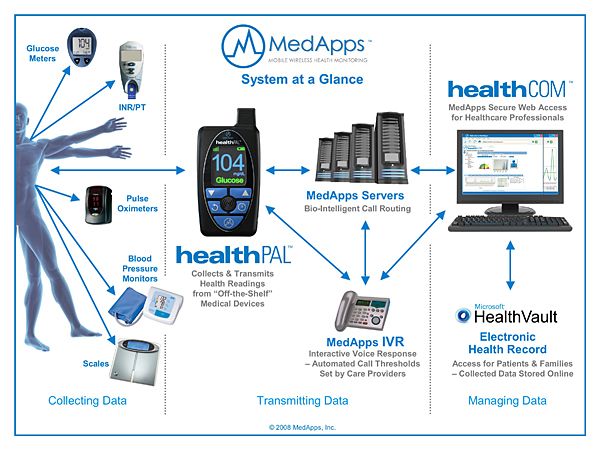
MedApps’s headquarter is located in Scottsdale, Arizona. MedApps’s products are designed to
address the challenges of chronic care management, connecting large health care enterprises with
their members for efficient, near real-time medical monitoring. The MedApps’s system includes
individual technology products for collecting and transmitting patient-monitored information, and
software applications used by health care providers to receive, analyze and store the patient
information (see Figure 17).
Figure 17 MedApps Applications
(Source: http://www.medaps.net)
Specifically, MedApps’s product lines include
- 21 -• HealthPAL: Portable hub embedded with Bluetooth and M2M cellular chip, which allows
wireless collection and transmission of data from inexpensive, off-the-shelf medical devices.
• HealthPOD: A docking station for HealthPAL that acts as charger. It allows multiple device
inputs and transmission of data via phone line.
• HealthLINK: Wireless adapter allows additional, low-cost, off-the-shelf, medical devices to
communicate to HealthPAL.
• HealthCOM: Complete server software for online remote patient management and data
storage.
• VoicePAL: Provides off-the-shelf medical devices the ability to “speak” readings to patients
(audio only / no transmitting functionality).
• MedPAL: Medication storage, reminder, and alert system that communicates through
HealthPAL.
MedApps’s products and solution currently has the following market focus:
• Disease Management: offering 3 steps product in disease management
o Recording and transmitting patient monitor readings
o Receiving, storing and analyzing patient-sent data
o Viewing, monitoring and acting upon patient-sent data.
• Corporate Wellness: Preventative health programs, otherwise known as “wellness
programs,” are activities that help to prevent chronic conditions. These programs are viewed
as a way of proactively reducing healthcare consumption, which results from chronic
illnesses, by implementing preventative or self-managed healthcare programs. These
programs motivate their participants to engage in fitness programs, maintain balanced diets
and encourage other health promoting activities in order to avoid costly chronic conditions
in the future.
• Consumer DTC: automatically sending the consumers personal health data to a central
repository (e.g., Microsoft HealthVault, Google Health) so that it can be reviewed and/or
analyzed at a later stage.
• Implanted Devices: designed to be able to incorporate different configurations to meet the
requirements of Implanted Devices, including Loop Recorders, Continuous Glucose
Monitors (CGM) and Insulin Pumps.
• PERS (Personal Emergency Response System): the ability to provide both an active and a
passive PERS feature.
1.4 MOBILE WEB APPLICATIONS VS. NATIVE MOBILE APPLICATIONS
Native mobile applications are traditional mobile applications for mobile devices whereas mobile web
applications are web applications on mobile devices. The key difference is to leverage the web
standard in the mobile web applications. As such, mobile web or native mobile applications are
implementation issues from the taxonomy perspective, and does not have direct impact on the
features and categories in this taxonomy.
Since the birth of PDA (Personal Digital Assistant) and smartphones, there are a number of native
mobile applications developed on various mobile phone platforms. For instance, Palm native
software application development was very popular a few years ago and the Palm development
- 22 -conference of the year of 2005 attracted over 100,000 people. At one time, it was estimated that there
are over 130,000 Palm native mobile application developers worldwide. However, with the strong
competition from RIM and HTC and the recent iPhone effort from Apple, the mobile application
space has changed dramatically. Leveraging the web and the browser, mobile web application
development has several advantages:
• Web browser: supporting mobile applications directly over native mobile phone platforms
has been a challenge since their inception. Sometimes, even one product may have several
versions, and unfortunately these versions are not backward compatible. From product
management perspective, a mobile application software company has to select and manage
the set of target market platforms. The web browser plays the roles of a universal client
program over all mobile phone platforms. A mobile web application is able to reach a
larger market as long as it can run inside a web browser. Table 4 lists the popular mobile
browsers by vendor in the current market.
Mobile Phone and/or PDA Vendor Mobile Web Browser(s)
Palm Blazer (based on NetFront), iPanel, Handspring
Bluelark
RIM Blackberry Proprietary Blackberry Browser
Apple iPhone Safari (based on WebKit)
Google Chrome – Android platform
Microsoft IE Mobile, Deepfish
Jataayu Software - Symbian Series 60, jB5 Mobile Browser
Windows Mobile and Linux platforms
Danger, T-Mobile Sidekick Proprietary Danger Browser
Infraware Embider
Motorola MOTOMAGX (based on WebKit)
ACCESS CO NetFront
Nokia Nokia Series 40, Web Browser for S60
Obigo AB owned by Teleca AB Obigo Browser
Purple Labs Openwave Mobile Browser
Opera Software ASA Opera Mobile, Opera Mini
Picsel Technologies Picsel Browser
Sony PlayStation Portable Web Browser
Torch Mobile Iris Browser
Digital Airways Wapaka Browser
Sun Microsystem Pixo
Mozilla Foundation Minimo
Table 4 List of Mobile Web Browsers
• Lower cost: even for mobile application companies that have customers and existing
products and platforms, leveraging the web and the browser potentially lowers operation
costs. For instance, leveraging the standard web technology and existing web browsers can
reduce the complexity in quality assurance testing and product development.
• Business model: most importantly, with the advance of Internet, mobile technology, and the
web, the mobile web applications are moving towards the cloud computing business model,
i.e. software as a service (SaaS). Instead of mobile application software development, a
company may transform to become a web service company to directly reach consumers not
only enterprise customers.
- 23 -1.5 MOBILE WEB APPLICATIONS VS. MOBILE WEB AGGREGATION
Mobile web aggregation is a special type of mobile web application, which requires integrating data
from multiple sources, at least one of the data sources from the web. For the features in the
taxonomy,
• Context specific: applications providing context specific features are naturally mobile web
aggregation applications. Since the applications need to be context aware, the context
information must be integrated into the applications.
• Ever present: applications providing ever present features may or may be mobile web
aggregation applications. The value of these applications is to provide user convenience. For
the categories under this feature in the taxonomy,
o Mobile wallet: mobile web applications in this category are not mobile web
aggregation applications.
o Mobile entertainment: mobile web applications in this category are not mobile web
aggregation applications.
o Mobile infrastructure software and widgets: usually infrastructure software and
widgets enable certain features on mobile platform. Software itself is not a mobile
web aggregation application. However, customizing the widget and software to
provide user convenience may become a mobile web aggregation application.
o Mobile marketing: the concept and the means to reach the consumer, e.g. SMS, are
not mobile web aggregation. However, an effective mobile marketing application
may integrate data from multiple sources including web source. Only then, a mobile
marketing application becomes a mobile web aggregation application.
• Mobility: applications providing mobility features may or may be mobile web aggregation
applications. For the categories under this feature in the taxonomy,
o Data collection: if the application is simply to collect data and forward to a backend
server for processing, this application is not mobile web aggregation. However, if
the application also processes and integrates data from multiple sources including
web source, the application is mobile web aggregation.
o Safety: if the safety application integrates data from multiple sources including web
source, this application is mobile web aggregation application.
o Emergency: if the emergency application integrates data from multiple sources
including web source, this application is mobile web aggregation application.
A mobility application can be as simply as a sensor data collection application or as
comprehensive as a vertical domain application, e.g. a mobile medicare system. As the
application logic becomes complex, it should takes advantage of the information available on
the Internet. Therefore, complex mobility applications are usually mobile web aggregation
applications.
- 24 -You can also read


