Characteristics of 263K Scrapie Agent in Multiple Hamster Species
←
→
Page content transcription
If your browser does not render page correctly, please read the page content below
Characteristics of 263K Scrapie
    Agent in Multiple Hamster Species
 Kimberly D. Meade-White, Kent D. Barbian, Brent Race, Cynthia Favara, Don Gardner, Lara Taubner,
                               Stephen Porcella, and Richard Race

     Transmissible spongiform encephalopathy (TSE) dis-                 adapts over several passages before recognizable clinical
eases are known to cross species barriers, but the patho-               disease occurs (1).
logic and biochemical changes that occur during transmis-                    The amino acid sequence of the prion protein (PrP) is
sion are not well understood. To better understand these                known to be an influential factor for cross-species trans-
changes, we infected 6 hamster species with 263K hamster                mission of TSE disease to a new host. Multiple single
scrapie strain and, after each of 3 successive passages in
                                                                        nucleotide polymorphisms resulting in amino acid changes
the new species, analyzed abnormal proteinase K (PK)–
resistant prion protein (PrPres) glycoform ratios, PrPres PK
                                                                        that control susceptibility to TSE disease have been identi-
sensitivity, incubation periods, and lesion profiles. Unique            fied in sheep, cervids, humans, and transgenic mice (2–6).
263K molecular and biochemical profiles evolved in each                 Similarly, incubation periods have also been correlated
of the infected hamster species. Characteristics of 263K                with nonsynonomous single nucleotide polymorphisms
in the new hamster species seemed to correlate best with                in the PrP gene. For example, 2 polymorphic residues at
host factors rather than agent strain. Furthermore, 2 poly-             amino acids 108 and 189 are associated with either short
morphic regions of the prion protein amino acid sequence                (Leu108/Thr189) or long (Phe108/Val189) incubation pe-
correlated with profile differences in these TSE-infected               riods in mice (7). Even a single point mutation in mice at
hamster species.                                                        amino acid position 101 has been shown to alter proteinase
                                                                        K–resistant prion protein (PrPres) deposition in brain, incu-

T    ransmissible spongiform encephalopathy (TSE) dis-                  bation periods, and host range (8).
     eases are infectious, fatal, neurodegenerative diseases                 In this study, we examined molecular and biochemi-
of the central nervous system that affect a wide variety of             cal changes associated with cross-species transmission in
mammals, including humans. In the past several decades, 3               6 hamster species of the rodent subfamily Cricetinae. All
new TSE diseases have been identified in different species:             animals were handled according to the National Institutes
chronic wasting disease of deer and elk, bovine spongiform              of Health guidelines and protocols approved by the Rocky
encephalopathy of domestic cattle, and variant Creutzfeldt-             Mountain Laboratories’ (Hamilton, MT, USA) Institutional
Jakob disease of humans. Thus, a better understanding of                Animal Care and Use Committee.
the process of cross-species transmission is needed.                         Phylogenetic classification of these hamster subspe-
     Recognition of natural cross-species transmission is               cies is based on DNA sequences of mitochondrial cyto-
not straightforward. If a disease that crosses species has              chrome b gene and a portion of the NADH dehydroge-
clinical or pathologic features similar to those of an already          nase 4 gene (9). These 6 species diverge into 3 genera,
well-characterized TSE disease, it may not be recognized                mainly Cricetulus (including Armenian and Chinese),
as a cross-species infection. Furthermore, some cross-spe-              Phodopus (including Djungarian and Siberian), and Me-
cies events involve slow processes in which the TSE agent               socricetus (including Turkish and Syrian) hamster species
                                                                        (Figure 1). By inoculating each of these hamster species
Author affiliation: National Institute of Allergy and Infectious Dis-
                                                                        with a well-characterized, stable strain of Syrian hamster
eases, Hamilton, Montana, USA
                                                                        scrapie (263K), we were able to compare and analyze mo-
DOI: 10.3201/eid1502.081173                                             lecular and biochemical parameters of cross-species trans-

                            Emerging Infectious Diseases • www.cdc.gov/eid • Vol. 15, No. 2, February 2009                       207
RESEARCH
Immunoblot Analysis of Proteinase K–Sensitive Prion
Protein and PrPres by Western blot
Proteinase K (PK)–sensitive prion protein (PrPsen)
and PrPres were prepared as previously described (12,13).
Samples were frozen at –20º C until they were subjected
to electrophoresis on a 16% sodium dodecyl sulfate–poly-
acrylamide gel (Invitrogen, Carlsbad, CA, USA). Immu-
noblots were probed by using polyclonal antibody R30 to
PrP (89–103 in Syrian hamsters) (14,15), which recognizes
PrP from each of the 6 species. Blots were developed by
Figure 1. Taxonomic classification for 6 hamster species. using either enhanced chemiluminescence or enhanced
Phylogenetically, these species are grouped into closely related
taxonomic genera (9).
chemifluorescence according to manufacturer’s instruc-
tions (Amersham-Pharmacia, Uppsala, Sweden). Enhanced
chemifluorescence blots were scanned by using a STORM
fluorescent detection system (Amersham-Pharmacia) as
mission events. To identify the cross-species transmission described previously (16).
event, we looked for recognizable features that may have
emerged in the new host. We found that each new host spe- Sensitivity of Proteinase K
cies presented a profile unlike that of the original Syrian To demonstrate PrPres sensitivity to PK, we adjusted
hamster host infected with 263K. These profile changes 20 μL of a 20% (wt/vol) third-passage brain homogenate
correlated with unique PrP amino acid sequences within in 0.01 M Tris, pH 7.3, from each species to 100 mmol/L
the 6 hamster species. This finding suggests that host PrP Tris HCl, pH 8.3, 1% Triton X-100, and 1% sodium deoxy-
sequences can change the phenotype presentation of the cholate. Samples were treated with 25 μg/mL, 100 μg/mL,
agent in the host and could thereby confound identification 400 μg/mL, or 1,600 μg/mL PK in a total volume of 35 μL
of cross-species transmission events. and incubated at 37º for 1 h. The reaction was stopped by
adding 2 μL of 0.1 M phenylmethylsulfonyl fluoride and
Materials and Methods placed on ice for 10 min. Samples were then mixed in equal
volumes with 2× sample buffer, boiled 5 min, and subjected
Incubation Periods and Titers for Passaged 263K to electrophoresis on sodium dodecyl sulfate–polyacrylam-
The original source of 263K hamster agent came from ide gels. PrP bands were quantitated as described above.
Kimberlin et al. (10) and was passaged 3 times in Syrian
hamsters at Rocky Mountain Laboratories. For cross-spe- PrP Gene Sequencing
cies transmissions, also referred to as first passage, wean- To sequence the PrP gene open reading frame (ORF), we
ling hamsters from each of the 6 hamster species were based primers on published regions of sequence homology be-
intracranially inoculated with 263K stock at a titer of 2 × tween the Syrian, Armenian, Chinese hamster; rat; and mouse
109 lethal dose for 50% per 50 μL of a 1% brain homoge-
nate. Clinically ill hamsters from each species were killed,
and 1% brain homogenate was passaged intracranially into
weanling hamster recipients of the same species (second
passage). The process was repeated for a third passage.
Brain homogenate from clinically ill third-passage ham-
sters was inoculated intracranially back into Syrian (back-
passaged) hamsters.
Each hamster was killed when it had lost ≈30% of its
body weight and was no longer able to remain upright and
feed itself. We determined endpoint titrations for 263K,
first, second, and third hamster passage inocula used in
these experiments for all species (except Chinese hamsters)
by preparing sequential 1:10 dilutions of a 1% brain homo-
genate to 10–8 or 10–10. Dilutions were then injected intrac-
Figure 2. Example of titration curves for all homogenates titered.
ranially into 6–8 hamsters for each dilution, and titers were The curve shown is Djungarian second-passage brain homogenate
determined as described (Figure 2) (11). with 3–7 hamsters per dilution. Error bars indicate SEM. Dpi, days
postinoculation.
208 Emerging Infectious Diseases • www.cdc.gov/eid • Vol. 15, No. 2, February 2009Characteristics of 263K Scrapie Agent in Hamsters
PrP genes. Primers 7F, S/O(–1), C(–1), S/T(+2), C/O(+2), third passage and were considerably different from those of
and 1R are located outside the ORF. The following primers the original Syrian hamsters (Table). Incubation periods for
were used: 7F-5′-GCCTTGTTCTTCATTTTGCAGA-3′, Chinese hamsters were still decreasing between second and
S/O(–1) 5′-TCATTTTGCAGATCAGCCATC-3′, C(–1) 5′- third passages. Because a fourth passage was not performed
TCATTTTGCAGATTAGCCAT-3′, S/T(+2) 5′-GTACAA for Chinese hamsters, whether third passage reflects the
GCAGGGAGGCTTCCTTC-3′, C/O(+2) 5′-GTACAAGC stable incubation period is unknown. Thus, for Djungarian,
AGGGAGGCTTCCCTC-3′, and 1R 5′-ACCCCTCCCCC Siberian, and Armenian hamsters, evidence was strong for
AGCCTAG-3′. unique incubation periods in the new species by second pas-
sage after inoculation with Syrian 263K agent.
Immunohistochemistry To determine whether incubation period differences
Immunohistochemistry procedures were conducted as for each species resulted from differing infectivity concen-
previously described (12). PrPres was detected by using tration in the inocula, we used endpoint titration to deter-
R30 anti-PrP antibody (residues 89–103). mine the brain titers after first, second, and third passages
(Table). These determinations were not conducted for Chi-
Results nese hamsters because the long incubation periods would
require several additional years. When comparing first-
Incubation Periods and Titers passage titers with titers in Syrian hamsters infected with
Incubation periods and infectivity titers are among 263K, the only decrease in infectivity titer was seen in Ar-
the criteria used to define TSE strains (17,18). Therefore, menian hamsters (Table). When comparing second-passage
we compared incubation periods and infectivity titers for titers with titers in Syrian hamsters infected with 263K, we
263K in Syrian hamsters with those observed for the 5 observed a minimal decrease in Turkish, Siberian, and Ar-
other hamster species. Cross-species transmission of Syr- menian hamsters. We observed no notable changes in titers
ian-derived 263K to Turkish hamsters, both members of among third passage animals of all 6 species, which sug-
the genus Mesocricetus (Figure 1), had similar incubation gests stable titers in each species by third passage.
periods (Table). Transmission of 263K to hamsters of the Additional evidence for adaptation of 263K agent to
genus Phodopus (Djungarian and Siberian) had incubation the new host species was obtained by infecting Syrian ham-
periods similar to each other but different from those of the sters with brain homogenates from third-passage hamsters.
Mesocricetus hamsters. Although Chinese and Armenian If the agent had adapted to the new species, we would ex-
hamsters each belong to the genus Cricetulus, after inocu- pect to see differences in incubation periods. In contrast, in
lation with 263K, their incubation periods differed from the absence of adaptation, we would expect reversion back
each other and from those of all the other species. In most to the characteristic 263K Syrian incubation period. The
instances, we observed prolonged incubation periods when only hamster for which third-passage brain homogenate re-
Syrian 263K was inoculated into the new hosts. Because all sulted in a decrease in incubation period was the Chinese
the hamsters received the same inoculum at passage 1, this hamster. Even so, at 168 days this incubation period still
finding likely reflects the species barrier between the hosts differed from the characteristic 80-day incubation period
(19) rather than inoculum titer. for Syrian hamsters. These results indicate that the 263K
Two additional passages from a donor to a recipient of agent adapted to the new host and that each 263K-infected
the same species showed that incubation periods in most hamster species has a unique incubation period (Table).
species differed considerably from those of the original Syr-
ian hamsters (Table). Incubation periods for the new spe- Glycoform Profiles
cies decreased and then became stable between second and PrPres glycoform profiles are another criteria used to
Table. Average incubation period for 263K scrapie*
Cross-species 263K Second passage Third passage Back passage‡
Hamster Titer/50 PL Titer/50 PL Titer/50 PL
species† Dpi ± SD (1% BH) Dpi (1% BH) Dpi (1% BH) Dpi
9
Syrian 85 2 x 10 ND ND ND ND 79 ± 5
8.9 6.7 8.25
Turkish 91 ± 4.9 1 x 10 103 ± 7.2 1 x 10 85 ± 7.6 1 x 10 76 ± 0
8.4 9.6 9.7
Djungarian 155 ± 23.4 1 x 10 100 ± 9.0 1 x 10 99 ± 7.2 1 x 10 97 ± 7
8.3 7.75 8.1
Siberian 148 ± 26.5 1 x 10 117 ± 9.9 1 x10 114 ± 8.3 1 x 10 128 ± 17
Chinese 372 ± 29.1 ND 233 ± 17.9 ND 207 ± 15.2 ND 168 ± 7
7.35 7.75 8.5
Armenian 188 ± 10.4 1 x 10 156 ±4.8 1 x 10 145 ±7.5 >1 x 10 145 ± 18
*Dpi, days postinoculation; ND, not done; BH, brain homogenate.
†16 hamsters/species.
‡In Syrian hamster.
Emerging Infectious Diseases • www.cdc.gov/eid • Vol. 15, No. 2, February 2009 209RESEARCH
differentiate TSE strains (20–22). Therefore, we compared characteristics in the various hamster species, we analyzed
PrPres glycoform profiles from each of the 6 hamster spe- PrPsen profiles by using Western blot. No differences were
cies at each passage. found in expression levels or banding patterns among the 6
When Western blotting was used to compare percent- hamster species (Figure 4, panel A). Bands detected at 37
ages between the 3 PrPres bands (Figure 3, panel A), the kDa were proven to be PrPsen because they were competed
data clearly showed 2 different PrPres glycoform profiles. out (protein signal disappeared) when we preincubated the
The Turkish hamster PrPres glycoform profile shared simi- antibody to PrP with a synthetic peptide specific for the
larities with that of both Syrian and Chinese hamsters. Sibe- PrP epitope. Bands >37 kDa did not compete out (Figure 4,
rian, Djungarian, and Armenian hamsters shared a second panel B). All PrPsen samples were PK sensitive (data not
PrPres glycoform profile. PrPres glycoform patterns from shown).
Turkish, Chinese, Siberian, and Djungarian hamsters fluc-
tuated noticeably over the 3 passages, which suggests a lack PK Resistance
of stability while adapting to the new species. In contrast, PrPres resistance to PK digestion has also been used
PrPres glycoform patterns from Armenian hamsters did not to differentiate TSE strains (23–25). When we compared
fluctuate over the 3 passages, which suggests a stable strain PrPres resistance to PK from 263K Syrian and third-pas-
in Armenian hamsters (Figure 3, panel A). sage Turkish, Armenian, Chinese, Siberian, and Djungar-
We also injected brain homogenates derived from the ian hamsters, we found no differences in sensitivity to PK.
third-passage hamsters back into Syrian hosts. We found that All samples retained equivalent PrPres signals on Western
glycoform patterns in the Syrian recipients were the same as blots after treatment with 25 and up to 1,600 μg/mL PK
those ordinarily associated with Syrian hamsters (Figure 3, (data not shown).
panel B), which suggests, as with incubation periods, that the
host had a predominant influence over glycoform patterns. Immunohistochemical Findings
Differentiation of TSE strains has also been based on
PrPsen regional distribution of PrPres and microscopic lesions in
To investigate the possibility that differences in PrPres brains of infected individuals (18). Therefore, we studied
glycoform profiles were reflections of different PrPsen lesion profiles in brain from 5–8 hamsters of each species
Figure 3. A) Proteinase K–resistant prion protein (PrPres) glycoform profiles for 6 hamster species for each of 3 successive passages:
1, initial cross-species passage; 2, second intraspecies passage; 3, third intraspecies passage. Each passage represents 6 different
animals, each quantified 6–8 times. Each lane had 0.5 mg tissue equivalents per lane. z, percentage of unglycosylated band; , partially
glycosylated band; S, fully glycoslyated band. Western blot representation of glycoform for each species visualized using R30 and
enhanced chemifluorescence. Error bars indicate SEM. B) Serially passaged 263K scrapie from 5 hamster species passaged back to
Syrian hamster. Western blot analysis of clinically ill Syrian hamster infected with Syrian 263K or 263K passaged 3 times through the new
hamster host. Syrian hamster inoculated with brain homogenate from the following hamsters: lane 1, Syrian 263K; 2, Turkish; 3, Chinese;
4, Armenian; 5, Djungarian; 6, Siberian. Tissue equivalents: lane 1, 0.5 mg; lanes 2, 5, and 6, 0.4 mg; lane 3, 0.7 mg; and lane 4, 0.9 mg.
210 Emerging Infectious Diseases • www.cdc.gov/eid • Vol. 15, No. 2, February 2009Characteristics of 263K Scrapie Agent in Hamsters
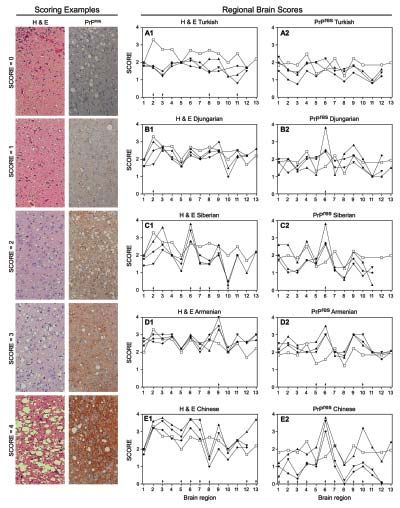
finding was not surprising. In the other 4 species (Djungar-
ian, Siberian, Armenian, and Chinese), PrPres distribution
in the thalamus was increased (region 6) over that in the
same region for Syrian hamsters. Further changes were seen
in Armenian hamsters; PrPres distribution was increased in
the spinal cord (region 5) and olfactory bulb (region 10).
PrPres distribution patterns in Chinese hamsters diverged
from those in the Syrian hamsters in almost every region
except the spinal cord (region 5). In all 6 species, including
our original Syrian hamster species, unique pathologic phe-
notypes developed. Immunohistochemical and glycoform
Figure 4. Proteinase K–sensitive prion protein (PrPsen) Western
blot analysis from 6 hamster species performed with A) polyclonal
antibody R30 (89–103) or B) R30 preincubated with peptide to
prion protein 89–103. Hamster species: lane 1, Syrian; lane 2,
Turkish; lane 3, Djungarian; lane 4, Syrian; lane 5, Chinese; lane
6, Armenian. Lane 7, proteinase K–resistant prion protein (PrPres)
from 263K Syrian hamsters. 0.8 mg tissue equivalents per lane; 37
kDa indicated.
at each passage. We scored 13 areas from 0 to 4 (none
to the highest degree of PrPres distribution or lesions)
(Figure 5, Scoring Examples). Averages for each brain re-
gion were scored and compared (Figure 5, Regional Brain
Scores). A score change >1 between species or passages
was considered a notable change for that region (26).
Microscopic lesion profiles (Figure 5, panels A1–E1)
from the 3 passages for each species were compared with Figure 5. Scoring examples: Hematoxylin and eosin (H&E)–stained
those of the 263K Syrian hamsters (stained with hemotoxy- and proteinase K–resistant prion protein (PrPres) scores from 0
lin and eosin [H&E]). We found that Djungarian hamster to 4. A score of 0 means no vacuolation or PrPres distribution; a
score of 4 means the highest degree of vacuolation and PrPres
profiles were most similar to 263K Syrian hamster profiles. distribution in that region. Panel H&E score: 0, Chinese hamster
Second-passage Armenian hamsters had increased vacu- olfactory bulb; 1, Syrian hamster spinal cord; 2, Armenian hamster
olation in the cortex; Turkish, Siberian, and Chinese ham- caudate putamen; 3, Armenian hamster cortex; 4, Syrian hamster
sters differed in multiple regions. Lesion profiles for the thalamus. Panel PrPres score: 0, Chinese hamster superior
3 passages in each of the new hamster host species, such colliculus; 1, Syrian hamster posterior colliculus; 2, Chinese
hamster brain stem; 3, Djungarian hamster posterior colliculus; 4,
as Chinese hamsters (Figure 5, H&E Chinese) regions 2 Chinese hamster thalamus. Regional Brain scores: all hamsters
and 3, did not necessarily correlate with PrPres distribution were compared with 263K Syrian hamster (□) shown in each panel
(Figure 5, panel PrPres Chinese) within that host. A1–E1 and A2–E2. Lesion and PrPres profiles of 263K scrapie-
When comparing the PrPres deposition profile (Figure infected hamster from each of the 5 new hamster species. Each
5, PrPres panels [right side]) at each of the 3 passages to the point represents the average from 6 different animals scored
in the following areas: 1, cerebellum; 2, posterior colliculus; 3,
Syrian PrPres deposition profile, we found that the profiles superior colliculus; 4, brain stem; 5, spinal cord; 6, thalamus; 7,
of the Turkish hamsters were the most similar. Because hypothalamus; 8, hippocampus; 9, cortex; 10, olfactory bulbs; 11,
Syrian and Turkish hamsters are closely related phyloge- caudate putamen; 12, septal nucleus; 13, tegmentum. S, first
netically and share similar PrPres glycoform patterns, this passage; T, second passage; , third passage.
Emerging Infectious Diseases • www.cdc.gov/eid • Vol. 15, No. 2, February 2009 211RESEARCH
profiles for 2 of the 3 genera were independently unique,
which suggests that similar host factors within those genera
influenced these TSE characteristics.
To determine the respective contributions of the agent
and host in immunohistochemical patterns, we injected
brain homogenate from third-passage hamsters back into
Syrian hamsters. When patterns were compared with those
of 263K Syrian hamster, only a few differences from 263K
Syrian were observed. Specifically, less PrPres was depos-
ited in the posterior colliculus (region 2) in Syrian hamsters
inoculated with brain homogenate from Chinese hamsters,
and more PrPres was deposited in the thalamus (region 6)
of Syrian hamsters inoculated with brain homogenate from
Djungarian hamsters (Figure 6, panel A). We also observed
a decrease in vacuolation in the hippocampus (region 8)
and cortex (region 9) of Syrian hamsters inoculated with
brain homogenate from Chinese hamsters (Figure 6, panel
B). For all other hamster species inocula, no remarkable
differences from 263K Syrian hamster were noted. There-
fore, the host appeared to play an important role in deter-
mining immunohistochemical patterns. It is not known
whether the differences seen in the Chinese and Djungarian
hamsters are due to donor species effect (27,28), whereby
a temporary change occurs as an agent is passed through
a new host species, or whether selection of a new strain
has occurred. To answer this question, a second passage
through Syrian hamsters is needed. These results suggest
that although 263K agent was substantially altered by pas-
sage through the new hamster species, in general it was not
able to impart molecular characteristics like glycoform or Figure 6. A) Proteinase K–resistant prion protein (PrPres)
the pathologic patterns established in the new species back pathogenicity profiles in Syrian hamsters inoculated with third-
to the Syrian hamsters. passage PrPres. B) Hematoxylin and eosin (H&E)–stained lesion
profiles of Syrian hamsters inoculated with brain homogenate
derived from third-passage hamsters. Each point represents the
Sequencing
average from 6 different animals scored in the following areas: 1,
Different PrP amino acid sequences have been associ- cerebellum; 2, posterior colliculus; 3, superior colliculus; 4, brain
ated with variation in lesion profiles, incubation periods, stem; 5, spinal cord; 6, thalamus; 7, hypothalamus; 8, hippocampus;
and susceptibility to TSE disease in humans and in sheep, 9, cortex; 10, olfactory bulbs; 11, caudate putamen; 12, septal
cervid, and mouse models. We report the PrP gene se- nucleus; 13, tegmentum. Syrian hamster inoculated with third-
passage brain homogenate from the following hamster species: z,
quences for Siberian, Djungarian, and Turkish hamsters. To
Turkish; , Djungarian; , Chinese; T, Armenian; S, Siberian; □,
determine how amino acid sequence might associate with Syrian. Arrows represent differences in multiple regions indicating
the TSE characteristics we observed here, we compared our increases or decreases in vacuolation or PrPres deposition.
new sequences with the published PrP gene ORF of Syrian
(29), Chinese, and Armenian hamsters (30,31). was found at codon 103 (encoding both S and N). In ad-
When comparing the new prnp sequences to the Syrian dition, Turkish hamsters have a deletion of 1 octapeptide
prnp sequence, we found considerable variation in nucle- repeat (Δ81–87) on both alleles, a characteristic shared
otides. Siberian hamsters had 40 nt changes, and Djungar- with African Green monkeys (32). In humans, deletion of 1
ian hamsters had 41. These nucleotide changes resulted in octapeptide repeat occurs at a frequency of 0.5% and is not
10 aa substitutions for both species; only 1 aa acid substi- associated with disease (33,34). We found 34 nt changes
tution, I215V, distinguished sequences between Siberian for Armenian and 37 for Chinese hamsters, resulting in 7 aa
from Djungarian hamsters (Figure 7). Only Turkish and substitutions for each hamster species, a finding that agrees
Syrian hamsters had 3 nt differences, resulting in 2 aa sub- with published data (30). The 3 aa differences that distin-
stitutions. An amino acid Y-to-F substitution was found at guish Armenian from Chinese hamsters are located at aa
codon 6 in the signal sequence, and a heterozygous base positions 103, 108, and 112 (30).
212 Emerging Infectious Diseases • www.cdc.gov/eid • Vol. 15, No. 2, February 2009Characteristics of 263K Scrapie Agent in Hamsters
Discussion lus, show significant differences from each other, having
Of the 6 hamster species inoculated with a well-de- only 3 aa substitutions at residues 103, 108, and 112 in this
fined hamster scrapie source, each species not only was N-terminal polymorphic region. In contrast, amino acid
susceptible to the agent but also developed unique PrPres sequences from Djungarian and Siberian hamsters were
biochemical and pathologic characteristics. These charac- the same in this region, and those from Turkish hamsters
teristics, which included incubation periods, PrPres glyco- matched those from the Syrian hamsters. These findings
form patterns, and PrPres distribution in brain, appeared to suggest a direct role for these residues and the N-terminus
segregate into related genera with the exception of the ge- in determining TSE characteristics. In addition, all 3 gen-
nus Cricetulus (Armenian and Chinese hamsters). Because era differ from each other at residue 139, the same position
TSE characteristics were unique for 2 of 3 genera, a role for thought to participate in the hydrophobic core potentially
host factor involvement is implicated. Our data suggest that stabilizing PrPsen in mice (37). The unstructured nature
PrP amino acid sequence is the host factor responsible for of this region has led some investigators to consider this
the unique characteristics. stretch of residues as a potential nucleation site for conver-
Data from our study and another experimental study
(30) suggest that not only is the host responsible for deter-
mining TSE characteristics such as incubation periods but
so is the agent. Our data show that closely related hamsters
infected with the same strain of TSE have different incuba-
tion periods. These differences cannot be explained by dif-
ferential expression levels of PrPsen because by Western
blot, PrPsen expression was equivalent (Figure 4, panel A).
Also, we believe that changes in incubation periods cannot
be attributed to differential infectivity titers because only
minor variations in titers were found. A second set of ex-
periments showed that the same hamster host inoculated
with different strains of TSE had different incubation peri-
ods, such as hyper (65 ± 1) and drowsy (168 ± 2) (23).
Because incubation periods and altered PrPres deposi-
tion in the brain have been linked to polymorphisms in the
PrP amino acid sequence (8,35), we investigated the possi-
bility that PrPres biochemical and pathologic changes cor-
relate with different host PrP amino acid sequences. When
comparing the PrP gene ORF for each of the 6 hamster spe-
cies, we found 13 possible amino acid substitutions local-
ized to 2 regions, either the N or the C terminus. Hamsters
from 2 genera in this study (Phodopus and Mesocricetus)
maintained sequence homogeneity at these 13 residues
and had very similar TSE characteristics. Hamsters of the
third genus, Cricetulus, differed in PrP gene sequence at Figure 7. Sequences of prion protein for 3 hamster species.
Hamster genomic DNA was purified from whole uninfected
3 amino acids within the N-terminal polymorphic region. hamster brain tissue by using the QIAamp DNA blood maxi 10
These polymorphic changes could explain why Armenian kit columns and the solutions and tissue protocol from QIAGEN
and Chinese hamsters have such different incubation peri- Dneasy Blood and Tissue kit (QIAGEN, Valencia, CA, USA). PCR
ods, PrPres glycoform patterns, and immunohistochemical products were amplified by using both PuReTaq Ready-To-Go PCR
profiles from each other as well as from the 2 genera Crice- beads (GE Healthcare, Piscataway, NJ, USA) and Expand High-
Fidelity Taq polymerase (Roche Diagnostic Corp, Indianapolis,
tulus and Phodopus. It is also possible that closely related IN, USA). Successful amplicons were purified by using QIAquick
hamsters have unidentified genes that also influence TSE PCR Purification kit (QIAGEN) according to manufacturer’s
characteristics. recommendations and sequenced by using their respective forward
Our results are consistent with the published data in- and reverse PCR primers with an ABI 3730xl DNA Analyzer (Applied
dicating that amino acids 102–139 may control scrapie Biosystems, Foster City, CA, USA). Sequence data were stored
in the FINCH data management system (Geospiza, Seattle, WA,
incubation periods in experimental models (7,30,36). In USA). Assembly and comparisons were made against the Syrian
addition, our data suggest that PrPres glycoform profiles prion protein gene sequence by using Sequencher (Gene Codes,
and lesion profiles are also associated with this region. Ar- Ann Arbor, MI, USA). Amino acid substitutions are indicated;
menian and Chinese hamsters, both in the genus Cricetu- otherwise, sequence matches that of Syrian hamster.
Emerging Infectious Diseases • www.cdc.gov/eid • Vol. 15, No. 2, February 2009 213RESEARCH
sion of PrPsen to PrPres (37). Sequence differences in this Infectious Diseases. Her primary interest is infectious diseases of
position may dramatically affect initial conversion events. the central nervous system, including transmissible spongiform
Certain amino acid substitutions may play only a mi- encephalopathies. Her background includes research in HIV and
nor role in TSE strain profiles. For instance, residue V215T cyclic neutropenia.
is thought to be responsible for the structural differences
between mouse and hamster PrPsen by introducing a bend References
in helix 3 (38). From our data, T215V/I substitutions may 1. Race R, Meade-White K, Raines A, Raymond GJ, Caughey B, Chese-
have had a minor in vivo effect with respect to TSE char- bro BJ. Subclinical scrapie infection in a resistant species: persis-
acteristics. Djungarian and Siberian hamsters differed only tence, replication, and adaptation of infectivity during four passages.
at this amino acid and had similar glycoform and IHC pat- J Infect Dis. 2002;186(Suppl 2):S166–70. DOI: 10.1086/344267
2. Goldmann W, Hunter N, Benson G, Foster JD, Hope JJ. Differ-
terns as well as incubation periods. ent scrapie-associated fibril proteins (PrP) are encoded by lines of
Amino acid substitutions identified in this study seg- sheep selected for different alleles of the Sip gene. J Gen Virol.
regated into genera with similar incubation periods, glyco- 1991;72:2411–7. DOI: 10.1099/0022-1317-72-10-2411
form profiles, and brain pathologic changes. Because we 3. Westaway D, Zuliani V, Cooper CM, Da CM, Neuman S, Jenny
AL, et al. Homozygosity for prion protein alleles encoding glu-
used only 1 TSE agent, these changes can be attributed to tamine-171 renders sheep susceptible to natural scrapie. Genes Dev.
the host factors and not to the agent. A previous study of 3 1994;8:959–69. DOI: 10.1101/gad.8.8.959
hamster species also concluded that host rather than agent 4. Bossers A, Schreuder BE, Muileman IH, Belt PB, Smits MA. PrP
had a predominant role in determining biochemical and mo- genotype contributes to determining survival times of sheep with
natural scrapie. J Gen Virol. 1996;77:2669–73. DOI: 10.1099/0022-
lecular PrPres attributes (30). Because host factors seem to 1317-77-10-2669
play a larger role in determining the TSE profile, identifying 5. Jewell JE, Conner MM, Wolfe LL, Miller MW, Williams ES. Low
the source of infection in cross-species infections may be frequency of PrP genotype 225SF among free-ranging mule deer
difficult, which would be especially worrisome when spe- (Odocoileus hemionus) with chronic wasting disease. J Gen Virol.
2005;86:2127–34. DOI: 10.1099/vir.0.81077-0
cies important to humans (e.g., sheep, cattle, cervids) are 6. Meade-White K, Race B, Trifilo M, Bossers A, Favara C, Lacasse
involved. These ruminant species are heterogeneous and not R, et al. Resistance to chronic wasting disease in transgenic mice
nearly as closely related as the hamsters studied here. expressing a naturally occurring allelic variant of deer prion protein.
Our study links PrP amino acid sequences to biochem- J Virol. 2007;81:4533–9. DOI: 10.1128/JVI.02762-06
7. Westaway D, Goodman PA, Mirenda CA, McKinley MP, Carlson
ical and pathologic profiles of PrPres in multiple hamster GA, Prusiner SB. Distinct prion proteins in short and long scrapie
species infected with 263K hamster scrapie. To further in- incubation period mice. Cell. 1987;51:651–62. DOI: 10.1016/0092-
vestigate how specific amino acid substitutions in PrP are 8674(87)90134-6
associated with specific TSE characteristics, these hamster 8. Barron RM, Thomson V, King D, Shaw J, Melton DW, Manson JCJ.
Transmission of murine scrapie to P101L transgenic mice. J Gen
and similar PrP gene sequences could be expressed in tis- Virol. 2003;84:3165–72. DOI: 10.1099/vir.0.19147-0
sue culture assays and protein modeling experiments. The 9. Conroy CJ, Cook J. MtDNA evidence for repeated pulses of specia-
results of these experiments could broaden our understand- tion within arvicoline and murid rodents. J Mamm Evol. 1999;6:221–
ing of TSE profiles and the role that PrP amino acid resi- 45. DOI: 10.1023/A:1020561623890
10. Kimberlin RH, Walker CA. Evidence that the transmission of
dues play, possibly leading to assays that could identify one source of scrapie agent to hamsters involves separation of
instances of cross-species transmission. agent strains from a mixture. J Gen Virol. 1978;39:487–96. DOI:
10.1099/0022-1317-39-3-487
Acknowledgments 11. Dougherty RM. Animal virus titration techniques. In: Techniques in
We thank Anita Mora and Gary Hettrick for graphics as- experimental virology. New York: Academic Press, Inc.; 1964.
12. Chesebro B, Trifilo M, Race R, Meade-White K, Teng C, LaCasse R,
sistance; Bruce Chesebro, John Portis, and Byron Caughey for
et al. Anchorless prion protein results in infectious amyloid disease
reviewing the paper; and Ed Schreckendgust for animal care as- without clinical scrapie. Science. 2005;308:1435–9. DOI: 10.1126/
sistance. science.1110837
13. Oldstone MB, Race R, Thomas D, Lewicki H, Homann D, Smelt
Syrian hamsters (Mesocricetus auratus) were purchased from S, et al. Lymphotoxin-alpha- and lymphotoxin-beta-deficient mice
Charles Rivers, Germantown, MD, USA; Turkish (Mesocricetus differ in susceptibility to scrapie: evidence against dendritic cell
brandt), Armenian (Cricetulus migratorius), Chinese (Cricetulus involvement in neuroinvasion. J Virol. 2002;76:4357–63. DOI:
10.1128/JVI.76.9.4357-4363.2002
griseus), Djungarian (Phodopus campbelli), and Siberian (Phodo- 14. Race R, Jenny A, Sutton DJ. Scrapie infectivity and proteinase K-
pus sungorus) hamsters were a generous gift from John Coe and resistant prion protein in sheep placenta, brain, spleen, and lymph
bred at Rocky Mountain Laboratories animal facility. node: implications for transmission and antemortem diagnosis. J
Infect Dis. 1998;178:949–53. DOI: 10.1086/515669
This work was supported by the National Institute of Allergy 15. Caughey B, Raymond GJ, Ernst D, Race RE. N-terminal trunca-
and Infectious Diseases, Division of Intramural Research. tion of the scrapie-associated form of PrP by lysosomal protease(s):
implications regarding the site of conversion of PrP to the protease-
Ms Meade-White is a senior research assistant in the Labora- resistant state. J Virol. 1991;65:6597–603.
tory of Persistent Viral Diseases, National Institute of Allergy and
214 Emerging Infectious Diseases • www.cdc.gov/eid • Vol. 15, No. 2, February 2009Characteristics of 263K Scrapie Agent in Hamsters
16. Race BL, Meade-White KD, Ward A, Jewell J, Miller MW, Wil- 30. Lowenstein DH, Butler DA, Westaway D, McKinley MP, DeAr-
liams ES, et al. Levels of abnormal prion protein in deer and elk with mond SJ, Prusiner SB. Three hamster species with different scrapie
chronic wasting disease. Emerg Infect Dis. 2007;13:824–30. incubation times and neuropathological features encode distinct
17. Bruce ME. TSE strain variation. Br Med Bull. 2003;66:99–108. prion proteins. Mol Cell Biol. 1990;10:1153–63.
DOI: 10.1093/bmb/66.1.99 31. Oesch B, Westaway D, Walchli M, McKinley MP, Kent SB, Aeber-
18. Bruce ME. Scrapie strain variation and mutation. Br Med Bull. sold R, et al. A cellular gene encodes scrapie PrP 27-30 protein. Cell.
1993;49:822–38. 1985;40:735–46. DOI: 10.1016/0092-8674(85)90333-2
19. Scott M, Groth D, Foster D, Torchia M, Yang SL, DeArmond SJ, 32. Schatzl HM, Da CM, Taylor L, Cohen FE, Prusiner SBJ. Prion pro-
et al. Propagation of prions with artificial properties in transgenic tein gene variation among primates. J Mol Biol. 1995;245:362–74.
mice expressing chimeric PrP genes. Cell. 1993;73:979–88. DOI: DOI: 10.1006/jmbi.1994.0030
10.1016/0092-8674(93)90275-U 33. Collinge J, Harding AE, Owen F, Poulter M, Lofthouse R, Boughey
20. Collinge J, Sidle KC, Meads J, Ironside J, Hill AF. Molecular analy- AM, et al. Diagnosis of Gerstmann-Sträussler syndrome in famil-
sis of prion strain variation and the aetiology of “new variant” CJD. ial dementia with prion protein gene analysis. Lancet. 1989;2:15–7.
Nature. 1996;383:685–90. DOI: 10.1038/383685a0 DOI: 10.1016/S0140-6736(89)90256-0
21. Hill AF, Desbruslais M, Joiner S, Sidle KC, Gowland I, Collinge 34. Goldfarb LG, Brown P, McCombie WR, Goldgaber D, Swergold GD,
J, et al. The same prion strain causes vCJD and BSE. Nature. Wills PR, et al. Transmissible familial Creutzfeldt-Jakob disease as-
1997;389:448–50, 526. DOI: 10.1038/38925 sociated with five, seven, and eight extra octapeptide coding repeats
22. Parchi P, Capellari S, Chen SG, Petersen RB, Gambetti P, Kopp in the PRNP gene. Proc Natl Acad Sci U S A. 1991;88:10926–30.
N, et al. Typing prion isoforms. Nature. 1997;386:232–4. DOI: DOI: 10.1073/pnas.88.23.10926
10.1038/386232a0 35. Barron RM, Manson JC. A gene-targeted mouse model of P102L
23. Bessen RA, Marsh RF. Biochemical and physical properties of the Gerstmann-Sträussler-Scheinker syndrome. Clin Lab Med.
prion protein from two strains of the transmissible mink encephal- 2003;23:161–73. DOI: 10.1016/S0272-2712(02)00067-7
opathy agent. J Virol. 1992;66:2096–101. 36. Supattapone S, Muramoto T, Legname G, Mehlhorn I, Cohen FE,
24. Bessen RA, Marsh RF. Distinct PrP properties suggest the molecular DeArmond SJ, et al. Identification of two prion protein regions that
basis of strain variation in transmissible mink encephalopathy. J Vi- modify scrapie incubation time. J Virol. 2001;75:1408–13. DOI:
rol. 1994;68:7859–68. 10.1128/JVI.75.3.1408-1413.2001
25. Bessen RA, Kocisko DA, Raymond GJ, Nandan S, Lansbury PT, 37. James TL, Liu H, Ulyanov NB, Farr-Jones S, Zhang H, Donne
Caughey B. Non-genetic propagation of strain-specific proper- DG, et al. Solution structure of a 142-residue recombinant prion
ties of scrapie prion protein. Nature. 1995;375:698–700. DOI: protein corresponding to the infectious fragment of the scrapie iso-
10.1038/375698a0 form. Proc Natl Acad Sci U S A. 1997;94:10086–91. DOI: 10.1073/
26. Fraser H, Dickinson AG. The sequential development of the pnas.94.19.10086
brain lesions of scrapie in three strains of mice. J Comp Pathol. 38. Liu H, Farr-Jones S, Ulyanov NB, Llinas M, Marqusee S, Groth D,
1968;78:301–11. DOI: 10.1016/0021-9975(68)90006-6 et al. Solution structure of Syrian hamster prion protein rPrP(90-
27. Kimberlin RH, Cole S, Walker CAJ. Temporary and permanent mod- 231). Biochemistry. 1999;38:5362–77. DOI: 10.1021/bi982878x
ifications to a single strain of mouse scrapie on transmission to rats
and hamsters. J Gen Virol. 1987;68:1875–81. DOI: 10.1099/0022- Address for correspondence: Kimberly D. Meade-White, Laboratory of
1317-68-7-1875
Persistent Viral Diseases, Rocky Mountain Laboratories, National Institute
28. Kimberlin RH, Walker CA, Fraser HJ. The genomic identity of dif-
ferent strains of mouse scrapie is expressed in hamsters and pre- of Allergy and Infectious Diseases, 903 South Fourth St, Hamilton, MT
served on reisolation in mice. J Gen Virol. 1989;70:2017–25. DOI: 59840-2932, USA; email: kmeade-white@niaid.nih.gov
10.1099/0022-1317-70-8-2017
29. Basler K, Oesch B, Scott M, Westaway D, Walchli M, Groth DF, et
al. Scrapie and cellular PrP isoforms are encoded by the same chro- Use of trade names is for identification only and does not imply
mosomal gene. Cell. 1986;46:417–28. DOI: 10.1016/0092-8674 endorsement by the Public Health Service or by the U.S.
(86)90662-8 Department of Health and Human Services.
Emerging Infectious Diseases • www.cdc.gov/eid • Vol. 15, No. 2, February 2009 215You can also read


