Sunda pangolin, Manis javanica - EDGE of Existence
←
→
Page content transcription
If your browser does not render page correctly, please read the page content below
Sunda pangolin, Manis javanica

Compiler: Sodsai, W.

Contributors: Gray, C.; Amin, R.; Pollini, B.; Thomas, W.; Larney, E.;
Thampitak, S.; Sapantupong, A.; Namsupak, S.; Yindee, M.;
Sookmasuang, R.

Suggested citation: Sodsai, W. et al. A Survival Blueprint for the
conservation and management of the Sunda Pangolin in Thailand. An
output from the EDGE of Existence fellowship, Zoological Society of
London, 2018.

1. STATUS REVIEW

1.1 Taxonomy: Mammalia > Pholidota > Manidae > Manis > javanica
(Although Palawan in the Philippines was previously thought to be a stronghold for this
species, here the species has since been re-categorized as the Philippine pangolin under the
name Manis culionensis by Feiler (1998) and subsequently by Gaubert and Antunes (2005)).

English: Sunda Pangolin, Malayan Pangolin
French: Pangolin Javanais, Pangolin Malais
Spanish: Pangolín Malayo

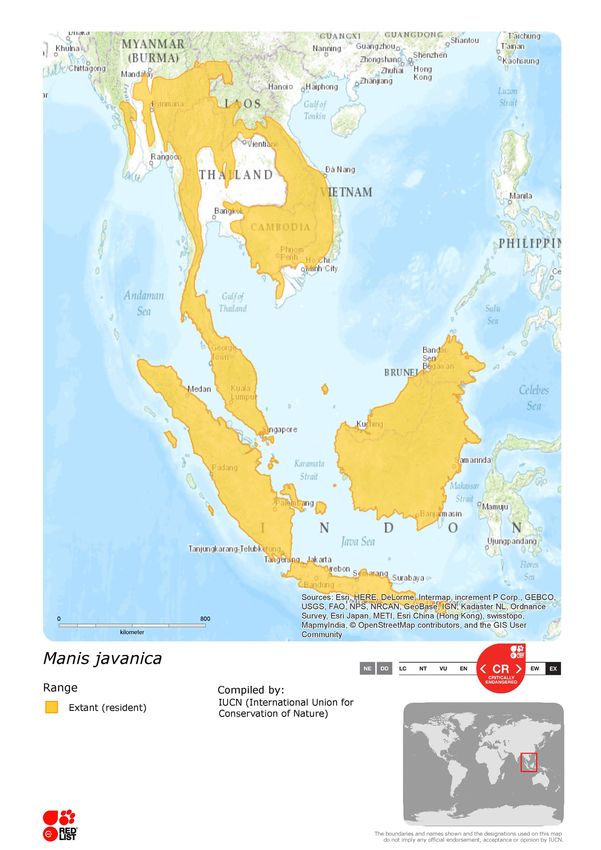
1.2 Distribution and population status:

       1.2.1 Global distribution: “The highlighted text has been reproduced with
       permission from the IUCN Red List of Threatened Species account for the Sunda
       Pangolin, as available June 2018” (Challender et al. 2014). The species is widely
       distributed geographically, occurring across Southeast East Asia, from southern China
       and Myanmar through to lowland Lao PDR and including much of Thailand, central
       and southern Viet Nam, Cambodia, Peninsular Malaysia, Sumatra, Java and adjacent
       islands (Indonesia) and Borneo (Malaysia, Indonesia, Brunei). However, the northern
       and western limits of its range are poorly known (Schlitter 2005, Wu et al. 2005). It has
       been recorded from sea level up to 1,700 m above sea level.
Population
Country estimate Distribution Population trend Notes
(plus (plus references)
references)
Myanmar There is This species is distributed in central and There is no recent data on the status of This species is rarely
virtually no southern Myanmar (Corbet and Hill 1992, this species in Myanmar. However observed, principally
information Salter 1983), but has apparently been seizures involving the Sunda pangolin because of its increasing
available on eradicated widely from lowland areas due in China in recent years infer that the rarity, but also because it is
population to human agricultural expansion and trade originated in Myanmar, secretive, elusive and
levels of any hunting (J.W. Duckworth pers. comm. suggesting populations of this species primarily nocturnal. There is
species of 2006). here are under threat (Challender et al. a paucity of research on
Asian pangolin in prep). population densities at local,
and no national and global scales
comprehensive (WCMC et al. 1999, CITES
population 2000).
estimates.
Lao PDR Not available Historically this species waswidespread in Nooren and Claridge (2001) reported This species is now
Lao PDR. There are records of varying that populations in Lao PDR have been extremely rare in the northern
reliability from a wide range of areas below severely reduced as a result of hunting part of its range (J.W.
c. 600 m asl altitude, though it is possible for consumption and trade. In three Duckworth pers. comm.
that in Lao PDR the species is restricted to separate areas within the range of 2006) where there have been
the Mekong plain and adjacent foothills up Manis javanica in Lao PDR (Xe Pian, massive declines, especially
to c. 900 m asl, with a possible occurrence Dong Phou Veng and Khammouan in Lao PDR (Nooren and
on the Bolaven Plateau, north from Xe Limestone NBCA), villagers reported in Claridge 2001).
Pian National Biodiversity Conservation the late 1990's that pangolin
Area in the south at least as far north as populations had declined due to
Nam Kading (Duckworth et al. 1999, J.W. hunting, in some areas to as little as
Duckworth pers. comm. 2006). one percent of the level 30 years ago
(Duckworth et al. 1999; Nooren &
Claridge 2001).
Thailand Not available The species historically occurred M. javanica is considered threatened
throughout Thailand (Lekagul and and becoming increasingly rare in
McNeely 1977, Bain and Humphrey 1982,WCMC et al. 1999), but has since been Thailand (Bain and Humphrey 1982,
lost from much of the lowland areas due to Steinmitz pers. comm. 2006)
human agricultural expansion and hunting
(J.W. Duckworth and R. Steinmitz pers.
comms. 2006). Camera trap data confirms
the presence of the species in Khao Yai
National Park (Lynam et al. 2006 in
Newton et al. 2008), south-eastern
Western Forest Complex (sWEFCOM),
and Khlong Nakha Wildlife Sanctuary (W.
Sodsai pers. Comms, 2018).
Viet Nam Not available In Viet Nam, there are records which vary In three areas of Viet Nam where
in reliability throughout the central and interviews were conducted (Khe Net The species is listed as
southern parts of the country. There are Protected Area, Ke Go Nature Reserve Endangered in Viet Nam
older records from Kon Tum Province, Tay and Song Thanh National Park), 95% (Viet Nam Red Data Book
Ninh Province and Quang Nam Province of hunters here believed pangolins 2007),
(Bourret 1942). There are more recent populations have declined severely,
records (summarised by Newton 2007) which is a consequence of hunting
from: Ha Tinh Province (Timmins and pressure (Newton et al. 2008). Hunters
Cuong 1999); Kien Giang and Ca Mau reported that populations had
Provinces (in U Minh Thuong National massively declined in the last few
Park) (CARE 2004); Dong Nai, Bin Phuoc decades, but particularly since about
and Lam Dong Provinces (Cat Tien 1990, when the commercial trade in
National Park) (Murphy and Phan 2001); pangolins began to escalate (Newton
Quang Binh (Le et al. 1997b) and Dak Lak 2007). In all three areas, the species
(Le et al. 1997a). Recent research was described as now being extremely
suggests the species is present but rare in rare. The intense biodiversity survey
central and southern Viet Nam (MacMillan effort and extremely limited number of
and Nguyen 2013, Nuwer and Bell 2013). confirmed records of pangolins
However, it is understood to be present in throughout Viet Nam's protected areas
Cat Tien National Park and recent adds weight to this observation (P.
enforcement activity suggests the species Newton pers. comm. 2008). The rarity
is still present in Dak Nong, Kon Tum, of the species was highlighted in moreQuang Binh and Gia Lai provinces as well recent research in U Minh Thuong
as U Minh Thuong National Park (L. National Park (Nuwer and Bell 2013)
Fletcher & A. Nguyen, pers. comms. and Quang Nam Province (MacMillan
2013). Based on camera trap data it is also and Nguyen 2013).
present in U Minh Ha National Park
(Willcox et al. in prep.).
Cambodia Not available In Cambodia, M. javanica has been This species is present in a number of
recorded as present from 150 m to 800 m reserves in the Cardomom Mountains, Rare in Cambodia (2003).
asl (A. Olsson pers. comm. 2012). Cambodia (the Elephant mountains,
According to hunters in Cambodia, its Central Cambodian Lowland Forests
distribution is concentrated around water (Prey Long), Eastern Plains
bodies in the dry season, though in the wet Landscape, Northern Plains and
season it is present throughout deciduous Northeast Cambodia) but populations
forest, lowland and mountainous are declining. Interviews with hunters
evergreen forest and secondary forest. suggest the species is absent in some
Although it is widely distributed in of these areas, which is attributed to
Cambodia, hunters infer that it now only hunting (A. Olsson pers. comm. 2013).
occurs in low numbers.
Peninsular Not available The species is widely distributed This species is present in Peninsular
Malaysia geographically in Peninsular Malaysia, Malaysia, where it has previously been Vulnerable in Peninsular
primarily in forest, but also in gardens and described as common in some areas, Malaysia (2012).
plantations, including oil palm and rubber at least up until 1999 (Ickes and
plantations (Medway 1977; Numata et al. Thomas 2003). Azhar et al. (2013)
2005). It is also found on the island in report its presence in oil palm
Penang. Numata et al. (2005) and Ickes plantations in Selangor and Negri
and Thomas (2003) note its presence in oil Sembilan though it is subject to very
palm and regenerating lowland dipterocarp heavy hunting pressure there.
forest in and around Pasoh Forest According to Numata et al. (2005) the
Reserve where it was previously species is present in Pasoh Forest
considered common. Manis javanica Reserve. Based on recent camera trap
remains present within oil palm plantations data, the species is also present in the
in Selangor and Negri Sembilan, Kenyir Wildlife Corridor (D.W.S.
Peninsular Malaysia, based on interviews Challender, pers. comms. 2013).with plantation workers (Azhar et al. 2013). However, interviews with hunters and
However, Azhar et al. (2013) report that in villagers in 2007 and 2011 indicate
areas where interviews have been populations in Peninsular Malaysia are
conducted it is in decline from hunting for decreasing as a result of hunting
trade. pressure for trade (D.W.S. Challender
pers. comm. 2013).
Borneo Not available This species is widely distributed in In Sabah, Manis javanica has
Borneo, from sea level to 1,700 m asl on previously been considered relatively
Mount Kinabalu in Sabah (Payne et al. common (Han and Giman pers.
1985). It has been recorded in mixed comms. 2008 assessment), and
dipterocarp forest, riverine forest (Azlan though there is little recent data on the
and Engkamat 2013) as well as remnant species' status here, populations are
forests (Giman et al. 2007). It is rarely under pressure from collection for both
seen in Sabah, especially compared to ten local use and international trade, which
years ago (Panjang, E. pers. comms. seems to have intensified in recent
2013), although it is evidently widely years based on available evidence,
distributed, being known by local people and which could well be having a
throughout the state (Davies and Payne detrimental impact on population levels
1982). The species is reportedly still found (Pantel and Anak 2010). For example,
in Kebun Cina Forest Reserve (Sabah; Pantel and Anak (2010) report that
Damit 2009) while data from Sabah >22,000 pangolins were collected for
Wildlife Department suggest the species is trade in an 18-month period here
mainly distributed in central Sabah (E. between 2007 and 2009.
Panjang pers. comm. 2013). Surveys
conducted in 2005 report the presence of
the species at Bintulu, Sarawak (Wilson et
al. 2006) though it appears to be absent
from the extensive peat swamp forests in
this state (CITES 2000). The species is
presumably present in Brunei, which was
reported by Medway (1977), and which is
supported by the rescue of a small number
of individuals here in 2013. Theabundance of this species is understood to
be low in the peat-swamp forests of east
and central Kalimantan (Indonesian
Borneo; S. Cheyne pers. comm. 2012) but
otherwise has a widespread distribution in
Indonesia on Sumatra, Java, Borneo, Kiau
and Lingga archipelago, Bangka and
Belitung, Nias and Pagi islands, Bali and
adjacent islands (Corbet and Hill 1992). The populations appear
Singapore Not available The species is still found in the wild in stable in Singapore (B. Lee
and adjacent Singapore and adjacent islands, including pers. comm. 2013). Here,
islands Pulau Tekong, and potentially Pulau Ubin Lim and Ng (2007) estimated
(CITES 2000, Lim and Ng 2007). the range size of one
individual, but made no
estimate of total population
size or density. Recent
revision of the national Red
List assessment in Singapore
lists the species as Critically
Endangered (Singapore Red
Data Book 2008).
1.2.2 Local distribution: This information is based on studies on the Sunda pangolin in Thailand.
Country Region / province Site Level of Population Reference(s) Notes
Protection size
Thailand The southern end of the Mae Ping National National Park Unknown Local news: Many research studies with
Thanon Thong Chai Park https://www.sanook.co camera traps and local news
Mountain Range in m/news/1173443/ in Thailand still confirm the
Lamphun, Tak, and presence of the species in
Chiang Mai Provinces in many protected areas
northern Thailand.Thailand Uthai Thani and Tak Huai Kha Khaeng Wildlife Unknown Local news: throughout Thailand (W.
Provinces. The park, Wildlife Sanctuary Sanctuary / “เสือโคร่ งไทยถูกยิงตายใน Sodsai pers. Comms, 2018).
along with the Thungyai World
ประเทศพม่ า” by WCS
Naresuan Wildlife Heritage Site
Sanctuary, is declared a Thailand, 2017.
World Heritage Site by
UNESCO, and is part of
the Thailand’s Western
Forest Complex
(WEFCOM)
Thailand Southeastern Western Southeastern Western National Park Unknown Research: Pangolin
Forest Complex Forest Complex / Wildlife Conservation Project
(sWEFCOM) in the west (sWEFCOM) including Sanctuary by ZSL Thailand,
of Thailand, in Salakpra Wildlife 2016-2017.
Kanchanaburi Province. Sanctuary, Srinakharin
National Park,
Chareomrattanakhosin
National Park, Erawan
National Park, and
Srisawat No Hunting
Zone.
Thailand The park is in Ranong Khlong Nakha Wildlife Wildlife Unknown Research: Pangolin
Province, part of the Sanctuary sanctuary Conservation Project
Khlong Saeng-Khao Sok by ZSL Thailand,
Forest Complex in the 2016-2017.
south of Thailand.
Thailand The park lies on the Khao Yai National National Park Unknown (Lynam et al. 2006 in
Sankamphaeng Park / World Newton et al. 2008)
Mountain Range in Heritage Site
eastern Thailand and
covers Nakhon
Ratchasima, Saraburi,Prachinburi, and Nakhon
Nayok Provinces.
Thailand Phetchaburi and Kaeng Krachan National Park Unknown Local news: Sunda
Prachuap Khiri Khan National Park Pangolin by Wildlife &
Provinces in the south of National Parks of
Thailand. Thailand, 2015;
https://wildlifethailand.
com/blog-
posts/mammals/268-
sunda-pangolin-manis-
javanica
Thailand The park is situated at Hala-bala Wildlife Wildlife Unknown Local news: “รวบ 2
the Thailand-Malaysia Sanctuary Sanctuary หนุ่มคาป่ าฮาลา-บาลา
border in southern
Thailand, in Yala and ลอบจับตัวนิ่มขนาดใหญ่
Narathiwat Provinces. ไปขายโลละพัน” by
Thairath, a daily
newspaper, in April
2017.
1.3 Protection status: The Sunda pangolin is currently considered as critically endangered species on the IUCN Red List (Challender et al.
2014). In 2017, the species was listed by CITES in its Appendix I. Also the Sunda pangolin has full legal protection in Thailand under the Wild
Animal Reservation and Protection Act, B.E. 2535.
1.4 Habitat and resource assessment: This species is found in primary and secondary forest, including lowland dipterocarp forest, and
cultivated areas including gardens and oil palm and rubber plantations and near other human settlements (Azhar et al. 2013, Nowak 1999).
Hunters interviewed in Viet Nam reported that the species is found in a variety of habitats, though areas with primary forest support more
pangolins, probably because they contain older, larger trees with hollows suitable for sleeping and for use as den sites (P. Newton pers. comm.
2008) and have lower levels of human activity. However, the population in Singapore is in very low quality forest in which they have been able tosurvive for decades without an obvious decline (J.W. Duckworth pers. comm. 2006). Therefore further research is required to determine habitat utilization and the ability of this species to persist outside primary forest. 1.5 Biology and ecology: As with other pangolins, this species is primarily nocturnal, solitary and a specialized feeder on ants and termites. Inference from other species indicates that one young is born at a time, after a gestation period of a minimum of 130 days. Hunters in Viet Nam have consistently reported that Manis javanica is a more arboreal species than Manis pentadactyla, and that they are adept climbers with prehensile tails. They often climb to access ants nests in trees. They sleep in hollows either in or at the base of trees, but have also been known to dig burrows in soil. Lim and Ng (2007) recorded the activity budget of a radio-tracked individual with the following results: maternal care followed the birth of a single offspring for approximately three to four months - Challenger et al. (2011) witnessed behaviour in captivity concurring with this. Three natal dens were used, all associated with hollows in large trees (50 cm DBH) and home-range size was estimated as being 6.97 ha. Daily activity was 127 ± 13.1 minutes, with peak activity between 03hr00 and 06hr00. 1.6 Threat analysis: This information is based on studies on the Sunda pangolin in Thailand. Historically, the Sunda Pangolins are consumed for subsistence, and used in traditional medicine by locals residing around the species’ habitat. According to questionnaire distribution carried out in 2017 by ZSL-Thailand’s pangolin conservation project, Sunda pangolins were eaten in rural areas as bushmeat and were widely available in local markets. Also, their scales were used as jewellery to protect against diseases in children in some parts of Thailand in the past (W. Sodsai pers. comm. 2017). Now, due to its high value in the illegal wildlife trade (Challender et al. 2015) resulting from a significant rise in international demand for pangolin meat and scales, many of the locals have opted to sell the Sunda Pangolins instead (MacMillan & Quoc Anh Nguyen 2013; Nuwer & Bell 2013). The demand is particularly strong in China and Vietnam, where the meat is consumed as a luxury dish and the scales are used in traditional medicine (Challender et al. 2015; Shairp et al. 2016; Xu et al. 2016). As demand increases and the species becomes rarer, its price is expected to grow even higher (Drury 2011). Therefore, direct hunting is not the only activity that pose a serious threat to the species, but other activities like non-timber forest product (NTFP) collection and free cattle ranging around PAs’ boundaries also pose a major threat to pangolins because whenever people encounter pangolins (quite easy to do so when they are with domestic dogs), they will likely attempt to capture and sell them. Although habitat destruction is not likely to be a direct threat to Sunda Pangolins since they are quite resilient to high levels of human-induced habitat change in a wide variety of habitats, including grasslands, peatswamp forest, primary and secondary forests, palm oil plantations, and urban areas (Payne et al. 1985; Lim 2007; Lim and Ng 2008; Azhar et al. 2013; Wearn 2015; Fletcher 2016; Willcox et al. 2017), forest degradation for the expansion of roads and commercial concessions (e.g. mining, hydro-power dams, logging, plantations) eventually make the pangolins more susceptible to hunting activities. With my personal experiences working on this species in the south of Thailand, pangolins are
frequently caught in rubber plantations, especially in the ones that are adjoined PAs’ boundaries. Rubber collection activities are conducted
during the night which is the active time of the predominantly nocturnal Sunda pangolins (e.g. Lim 2007).

Sunda pangolin has full legal protection in Thailand, but unfortunately with relatively low enforcement attention for small- and medium-sized
wildlife hunting in rural villages, pangolin poaching and smuggling are likely to continue. This potentially makes Thailand still the source and
transit country for pangolin trade.

1.7 Stakeholder analysis: This information is based on studies on the Sunda pangolin in Thailand.

 Country          Stakeholder             Interest            Current activities            Impact        Intensity of        Proposed activities
                                                                                            (positive,    impact
                                                                                            negative or   (low, medium,
                                                                                            both)         high or critical)
 International    SOS (SAVE OUR           Conservation        Funders                       +             Critical            Financial support to
                  SPECIES)                                                                                                    protect the species
                                                                                                                              from extinction
 International    Fondation Segre’        Conservation        Funders                       +             Critical            Financial support to
                                                                                                                              protect the species
                                                                                                                              from extinction
 International    The United States       Conservation        Funders                       +             Critical            Financial support to
                  Fish and Wildlife                                                                                           protect the species
                  Service (USFWS or                                                                                           from extinction
                  FWS)
 International    Zoology Society of      Conservation        Partners                      +             Critical            Funding and advising
 NGO              London (ZSL)                                                                                                the project
 Thailand         Zoology Society of      Conservation        Practitioners (monitoring     +             Critical            To project the
                  London, Thailand                            population, strengthening                                       species in research
                  Programme (ZSL-                             law enforcement, and                                            sites
                  Thailand)                                   community engagement
                                                              in two study sites
(sWEFCOM and Khlong
Nakha Wildlife Sanctuary)
in Thailand)
Thailand Department of Government PA Managers + Critical Permission to work in
National Parks, protected areas
Wildlife and Plant
Conservation (DNP)
Thailand National Research Government Administrators + Low Permission to
Council of Thailand support international
researchers working
in Thailand
Thailand Kasetsart University Research & Partners + High Serve as project
conservation adviser and to
provide student
volunteers for field
surveys
Thailand Mahidol University Research & A captive centre for + High Captive husbandry
(Livestock and conservation confiscated population for confiscated
Wildlife Hospital) population of Sunda
pangolin including
recovery and release
in some cases
Thailand Communities Commercial Agriculture, rubber & palm - Critical Making income for a
surrounding the PAs oil plantation, illegal living
logging, wildlife poaching,
non-timber forest product
collecting and tourism.1.8 Context and background information that will affect the success of any conservation action for this species: This information is
based on studies on the Sunda pangolin in Thailand.
Description Threats Opportunities
Socio-cultural effects Throughout history this species, Most of the PAs in Thailand are The Sunda pangolin is a
like other wild animals, is surrounded by communities nocturnal and elusive mammal.
domestically consumed as which makes forests easily From local interviews, pangolins
bushmeat, and its scales are accessible for hunters. are very hard to find without
used in traditional medicines. The hunting dogs. Therefore,
trend changed when the species targeting the use of hunting dogs
became very high value because offers an opportunity for effective
of a high demand from China and conservation action.
Vietnam. According to local
interviews by ZSL-Thailand,
pangolins have been excessively
hunted since the last decade to
supply the illegal international
wildlife trade.
Economic implications Most of the communities are Although non-timber forest Many research studies using
agriculturists with low income. product gathering inside any PAs camera traps show that pangolins
Locals still rely on forests as food is illegal by law, many are still present in some PAs that
sources. Non-timber forest communities are originally settled are well-protected, like in World
products like mushrooms, inside the parks before they were Heritage Sites or in habitats with
bamboo shoots, fire wood, etc. established, which makes tough terrains.
are widely collected. The relative restricting their activity very
value of one pangolin is very challenging. Whenever people
high. encounter pangolins, they will
likely attempt to capture and sell
them because of their high value
in the illegal wildlife trade.Existing conservation Currently, ZSL-Thailand is the Populations are very difficult to The species’ assessment for the
measures only international NGO to study estimate due to the species’ IUCN Red List of Threatened
the wild population of Sunda ecology. Species for 2018 is being
pangolins to determine the developed by IUCN SSC
population status in the study The project needs continuous Pangolin Specialist Group.
areas. This is being done through support from donors since it is a
the development of an effective long term study. Sunda Pangolin (Manis javanica)
surveying methodology, collection monitoring protocol is being
of baseline data to inform patrol- Although the species is protected developed by ZSL.
based monitoring, improvement under the law, the very high price
of law enforcement efficiency, of pangolins can be considered
and engagement of local as a main factor for poaching
communities in the protection of activities, especially since locals
the species. are low income.
Administrative/political set-up The management of natural The value of pangolins is often ZSL-Thailand has a plan to
resources by government is not higher than its fine since arrange a stakeholder workshop
effective. penalties are very small. Law with Department of National
enforcement is weak. Corruption Parks, Wildlife and Plant
is widespread and ongoing. Conservation (DNP) to discuss
Sunda pangolin conservation in
Thailand.
Local expertise and interest Pangolins provide a significant Despite pangolins becoming rare There is optimism that school
extra income. In many and more difficult to find, some students are likely to enjoy
communities that hunt pangolins, poachers still hunt pangolins for a awareness raising activities on
conservation activities potentially living. pangolin conservation.
bring a conflict between locals
and conservationists.
Cultural attitudes Some local people believe that The species is consumed both
pangolin meat and scales contain domestically and internationally.
many medicinal properties.Appeal of species Pangolins are the only mammal Hunters can catch pangolins with The popularity and international
in the world with bodies covered their bare hands. interest in pangolins has
in strong scales. They feed on dramatically increased in recent
ants and termites. Rolling their years.
bodies up into a ball is the only
protection mechanism from
predators.
Resources Insufficient manpower and weak The species is easily hunted Increasing global support for
law enforcement play an along the PAs’ boundaries by pangolin conservation will
important role in the lack of opportunistic poaching, especially hopefully provide new sources of
protection of the species in many during a non-timber forest funding, coordination and
PAs. product gathering season support.
(normally in rainy season).
An insufficient number of park
rangers is always a main factor
that restricts the PAs’ protection
in Thailand.2. ACTION PROGRAMME
Vision (30-50 years)
A population of Sunda pangolins in Thailand thriving again throughout its range, with full protection in the healthy ecosystem.
Goal(s) (5-10 years)
To assess the population status of the Sunda pangolin in the country, and ensure the effective protection of the populations with strict
patrolling and efficient law enforcement. Engage local communities located near to the species’ habitats in the protection of the species.
Objectives Prioritisation
(low, medium, high or critical)
1. Population status is assessed across the country. Critical
2. The whole pangolin population in the country is secure and fully protected. Critical
3. Local communities are engaged in the protection of the species. Critical
4. Efficient management of confiscated and rehabilitated populations. High
5. All checkpoints on the illegal wildlife trade routes in Thailand are more strictly enforced. Medium
6. The Sunda pangolin conservation programme is supported by all stakeholders in Thailand. HighActivities Country Priority Associated Time scale Responsible Indicators Opportunities Activity type
/ region (low, Cost stakeholders and threats
medium,
high or
critical)
1. Population status is assessed across the country
1.1 Identify Thailand Critical Over 30 By 2020 Government Reports, Habitats of the Improving
distribution of the million baht agencies distribution data species are knowledge &
species across the (DNP), NGOs, identified and supporting
country researchers protected protection
activities
1.2 Develop a Thailand High 500000 baht 2018 DNP, NGOs, A monitoring …An effective Improving
standard protocol researchers protocol survey knowledge
for surveying and methodology
monitoring since pangolins
are elusive
mammal and
difficult to
monitor
1.3 Establish long- Thailand High 10 million From 2015 DNP, NGOs, Long-term Data from the Improving
term monitoring baht researchers, pangolin studies can be knowledge &
programmes universities conservation used to inform supporting
programmes protection protection
activities activities
2. A whole population in the country is secure and fully protected
2.1 Strengthen law Thailand Critical Over 50 From 2018 Government New Act for wild Increase Law & Policy
enforcement million baht animal pressure on
(penalty and fine) conservation and pangolin
protection poachingActivities Country Priority Associated Time scale Responsible Indicators Opportunities Activity type
/ region (low, Cost stakeholders and threats
medium,
high or
critical)
2.2 Employ more Thailand High Over 50 By 2020 DNP More rangers in More efforts to PAs’
rangers to maintain million baht PAs protect the management
sufficient species & protection
manpower
2.3 Improve park Thailand High 20 million From 2015 DNP, NGOs Number of Effective PAs’
rangers’ skills baht training and patrolling and management
through regular participants, efficient & protection
training reports protection
3. Local communities are engaged in protection of the species
3.1 Support locals Thailand Medium 1 million From 2018 Thailand Amount of the Higher income Livelihoods,
on how to manage baht each Ministry of agricultural may lead to economic, and
their agricultural community Agriculture and products reduced local other
land to produce the Cooperatives, hunting incentives
optimal amount of DNP, NGOs
crops without using
chemicals or
expanding their
land into the forestsActivities Country Priority Associated Time scale Responsible Indicators Opportunities Activity type
/ region (low, Cost stakeholders and threats
medium,
high or
critical)
3.2 Introduce Thailand Medium Over 10 From 2018 DNP, NGOs Amount of the Extra income Livelihoods,
alternative ways for million baht communities’ potentially halts economic, and
communities to income local hunting other
gain extra income incentives
(eco-tourism,
selling local
products, organic
farming)
3.3 Share Thailand Critical 10 million From 2016 DNP, NGOs, Changes in Reduction in Improving
knowledge about baht universities communities’ pangolin knowledge,
pangolins with local attitudes of consumption raising
communities and pangolin awareness
alter perceptions of consumption as
pangolin assessed by
consumption questionnaires
and interviewsActivities Country Priority Associated Time scale Responsible Indicators Opportunities Activity type
/ region (low, Cost stakeholders and threats
medium,
high or
critical)
3.4 Raise Thailand High 20000 baht From 2016 NDP, NGOs Number of Increased Improving
awareness of per school activities, pressure on knowledge,
pangolin materials, and pangolin raising
conservation participants, pre poaching awareness
through and post surveys
recreational to demonstrate
activities conducted increased
with the public and knowledge about
local schools pangolins among
participants.
4. Efficient management of confiscated and rehabilitated populations.
4.1 Develop a Thailand High Over 5 By 2020 DNP, A protocol or an Increase wild Population
protocol for million baht international & action plan for population management
rehabilitated national rehabilitated
populations NGOs, populations is
universities needed because
most of the
confiscated
pangolins in
Thailand hardly
survive after
being released
back to the wild.Activities Country Priority Associated Time scale Responsible Indicators Opportunities Activity type
/ region (low, Cost stakeholders and threats
medium,
high or
critical)
4.2 Establish Thailand High Over 10 By 2025 DNP Husbandry and Captive/stored Population
husbandry and million baht breeding populations management
breeding programmes available for
programmes for conservation
captive populations programmes
to store genetic
diversity
5. All checkpoints on the illegal wildlife trade routes in Thailand are more strictly enforced.
5.1 Identify illegal Thailand Medium 20 million By 2020 DNP, NGOs, Database/reports Improving
wildlife trade routes baht customs, on the wildlife knowledge &
over the country universities trade routes in supporting
Thailand protection
activities
5.2 Collaborate Thailand Medium Over 10 From 2020 DNP, police, Action plans (i.e. Increased Law
with the police, million baht customs having some pressure on enforcement
customs authority officials from DNP illegal wildlife
and military at all working at the trade
checkpoints on the checkpoints with
illegal wildlife trade police and military
routes for illegal wildlife
trade inspection)Activities Country Priority Associated Time scale Responsible Indicators Opportunities Activity type
/ region (low, Cost stakeholders and threats
medium,
high or
critical)
6. The Sunda pangolin conservation programme is supported by all stakeholders in Thailand
6.1 Organise the Thailand High 2 million From 2018 DNP, ZSL Workshops, Species & its
stakeholder baht each Thailand, conferences, habitat
workshop to review year Kasetsart meetings management,
and assess the University community
progress of the (KU), NGOs livelihoods,
conservation economic, and
programmes other
annually incentives for
conservationLiterature Cited Anon. 1999. Review of Significant Trade in Animal Species included in CITES Appendix II: Detailed Reviews of 37 Species, Manis javanica. Draft Report to the CITES Animals Committee. WCMC (World Conservation Monitoring Centre), IUCN Species Survivial Commission and TRAFFIC Network. Azhar, B., Lindenmayer, D., Wood, J., Fischer, J., Manning, A., McElhinny, C. and Zakaria, M. 2013. Contribution of illegal hunting, culling of pest species, road accidents and feral dogs to biodiversity loss in established oil-palm landscapes. Wildlife Research 40: 1-9. Azlan, M. and Engkamat, L. 2013. Camera trapping and conservation in Lanjak Entimau Wildlife Sanctuary, Sarawak, Borneo. Raffles Bulletin of Zoology 61(1): 397-405. Bain, J.R. and Humphrey, S.R. 1982. A Profile of the Endangered Species in Thailand. Report No.4.. Office of Ecological Services, Florida State Museum, University of Florida, Gainesville, Florida, USA. Bourret, R. 1942. Les mammifères de la collection du Laboratoire de Zoologie de l'Ecole Supérieure des Sciences. Notes et Travaux de l'Ecole Supérieure, Université Indochinoise No. 1. Broad, S., Luxmoore, R. and Jenkins, M. 1988. Significant Trade in Wildlife: a review of selected species in CITES Appendix II. Volume 1: Mammals. IUCN/CITES. CARE. 2004. Biodiversity survey: U Minh Thuong National Park, Vietnam. U Minh Thuong National Park conservation and community development program (1998-2003). CARE, Agricultural Publishing House. Challender, D., Nguyen Van, T., Shepherd, C., Krishnasamy, K., Wang, A., Lee, B., Panjang, E., Fletcher, L., Heng, S., Seah Han Ming, J., Olsson, A., Nguyen The Truong, A., Nguyen Van, Q. & Chung, Y. 2014. Manis javanica. The IUCN Red List of Threatened Species 2014: e.T12763A45222303. http://dx.doi.org/10.2305/IUCN.UK.2014-2.RLTS.T12763A45222303.en. Downloaded on 05 June 2018 Challender, D.W.S. 2011. Asian pangolins: Increasing affluence driving hunting pressure. TRAFFIC Bulletin 23: 92-93. Challender, D.W.S. and MacMillan, D.C. 2014. Poaching is more than an enforcement problem. Conservation Letters Early View: 1-11. Challender, D.W.S. In prep. The trade and conservation of pangolins in Asia, PhD Thesis. Durrell Institute of Conservation & Ecology (DICE), University of Kent.
CITES. 2000. Prop. 11.13. Manis crassicaudata, Manis pentadactyla, Manis javanica. Transfer
from Appendix II to Appendix I (India, Nepal, Sri Lanka, United States). Available at:
http://www.cites.org/eng/cop/11/prop/13.pdf.

Corbet, G.B. and Hill, J.E. 1992. Mammals of the Indo-Malayan Region: a Systematic Review.
Oxford University Press, Oxford, UK.

Damit, A. 2009. Sandakan Rainforest Park: A Scientifically & Historically Important Forest.
Sabah Forestry Department.

Davies, G. and Payne, J.B. 1982. A Faunal Survey of Sabah. WWF Malaysia, Kuala Lumpur.

Duckworth, J.W., Salter, R.E. and Khounbline, K. 1999. Wildlife in Lao PDR: 1999 Status
Report. IUCN, Vientiane, Laos.

Ellis, R. 2005. Tiger Bone and Rhino Horn: The Destruction of Wildlife for Traditional Chinese
Medicine. Island Press, Washington D.C>.

Giman, B., Stuebig, R., Megum, N., McShea, W.J. and Stewart, C.M. 2007. A camera trapping
inventory for mammals in a mixed use planted forest in Sarawak. Raffles Bulletin of Zoology
55(1): 209-215.

Ickes, K. and Thomas, S.C. 2003. Native, wild pigs (Sus scrofa) at Pasoh and their impacts on
the plant community in T. Okuda. In: N. Manokaran, Y. Matsumoto, K. Niiyama, S. C. Thomas
and P. S. Ashton (eds), Pasoh: Ecology and Natural History of a Southeast Asian Lowland
Tropical Rain Forest.

Lekagul, B. and McNeely, J.A. 1977. Mammals of Thailand. Association for the Conservation of
Wildlife, Bangkok, Thailand.

Lim, N.T.L. and Ng, P.K.L. 2007. Home range, activity cycle and natal den usage of a female
Sunda pangolin Manis javanica (Mammalia: Pholidota) in Singapore. Endangered Species
Research 3: 1-8.

Li, Y. and Li, D. 1998. The dynamics of trade in live wildlife across the Guangxi border between
China and Vietnam during 1993-1996 and its control strategies. Biodiversity and Conservation
1998(7): 895-914.

MacMillan, D.C. and Nguyen Anh, Q. 2013. Factors influencing the illegal taking of wildlife by
trapping and snaring among the Katu ethnic group in Vietnam. Oryx FirstView: 1-9.

Medway, L. 1977. Mammals of Borneo: Field keys and an annotated checklist. Monographs of
the Malaysian Branch of the Royal Asiatic Society, Kuala Lumpur, Malaysia.

Murphy, D. and Phan, T. D. 2001. Mammal observations in Cat Tien National Park. WWF,
Hanoi, Vietnam.
Newton, P. 2007. Potential applications of hunters' knowledge for the conservation of pangolins
in Vietnam. M.Sc. Thesis, University of East Anglia.

Newton, P., Nguyen Van, T., Roberton, S. and Bell, D. 2008. Pangolins in Peril: using local
hunters' knowledge to conserve elusive species in Vietnam. Endangered Species Research
6(41-53).

Nooren, H. and Claridge, G. 2001. Wildlife trade in Laos: the end of the game. Netherlands
Committee for IUCN, Amsterdam.

Nowak, R.M. (ed.) 1999. Walkers Mammals of the World. Sixth edition. The Johns Hopkins
University Press, Baltimore and London.

Numata, S., Okuda, T., Sugimoto, T., Nishimura, S., Yoshida, K., Quah EngSeng, Yasuda, M.,
Muangkhum, K. and Nur Supardi, M.N. 2005. Camera-trapping: a non-invasive approach as an
additional tool in the study of mammals in Pasoh Forest Reserve and adjacent fragmented
areas in Peninsular Malaysia. Malayan Nature Journal 57(1): 39-45.

Nuwer, R. and Bell, D. 2013. Identifying and quantifying the threats to biodiversity in the U Minh
peat swamp forests of the Mekong Delta, Vietnam. Oryx FirstView: 1-7.

Pantel, S. and Anak, N.A. 2010. A preliminary assessment of the pangolin trade in Sabah.
TRAFFIC Southeast Asia, Petaling Jaya, Selangor, Malaysia.

Pantel, S. and Chin, S.Y. 2009. Proceedings of the Workshop on Trade and Conservation of
Pangolins native to South and Southeast Asia. TRAFFIC Southeast Asia. Petaling Jaya,
Selangor, Malaysia.

Payne, J., Francis, C.M. and Phillipps, K. 1985. A field guide to the mammals of Borneo. The
Sabah Society and WWF Malaysia, Kota Kinabalu and Kuala Lumpur, Malaysia.

Schlitter, D.A. 2005. Order Pholidota. In: D.E. Wilson and D.M. Reeder (eds), Mammal Species
of the World: A Taxonomic and Geographic Reference, pp. 530-531. Johns Hopkins University
Press, Baltimore, MD, USA.

Sopyan, E. 2008. Malayan Pangolin Manis javanica Trade in Sumatra, Indonesia. In: Pantel, S.
and Yun, C.S. (eds), Proceedings of the Workshop on Trade and Conservation of Pangolins
native to South and Southeast Asia. TRAFFIC Southeast Asia, Petaling Jaya, Selangor,
Malaysia. Singapore Zoo.

Timmins, R.J. and Cuong, T.V. 1999. An assessment of the conservation importance of the
Huong Son (Annamite) Forest, Ha Tinh province, Vietnam, based on the results of a field survey
for large mammals and birds. Center for Biodiversity and Conservation and American Museum
of Natural History., New York, USA.

Willcox, D., Tran, Q.P. and Roberton, S. In prep. Conservation status of small carnivores in the
U Minh wetlands. Carnivore and Pangolin Conservation Programme., Cuc Phuong, Viet Nam.
Wilson, D.E., Helgen, K.M., Chin, S.Y. and Giman B. 2006. Small mammal survey at two sites in
planted forest zone, Bintulu, Sarawak. Malayan Nature Journal 52(2): 165-187.

World Conservation Monitoring Centre. 1999. Review of significant trade in animal species
included in CITES Appendix II: Detailed reviews of 37 species. CITES Animals Committee.

Wu, S. and Ma, G. 2007. The status and conservation of pangolins in China. TRAFFIC East
Asia Newsletter: 1-5.

Yue, Z. 2008. Conservation and Trade Control of Pangolins in China. In: Pantel, S., Chin, S.Y.
(ed.), Workshop on Trade and Conservation of Pangolins Native to South and Southeast Asia,
pp. 66-74. Singapore Zoo, Singapore.
You can also read


